-market.png&w=256&q=75)
Focal Segmental Glomerulosclerosis (FSGS) Insights and Trends
- FSGS is a rare kidney disorder characterized by scarring (sclerosis) of parts of the glomeruli, leading to significant protein loss in urine.
- Treatment outcomes are highly heterogeneous, driven by disease subtype (primary, secondary, genetic), steroid responsiveness, and underlying podocyte injury mechanisms, complicating therapy selection and long-term disease control.
- Steroid-resistant and steroid-dependent FSGS represent the most commercially and clinically challenging segments, accounting for a disproportionate share of progression to end-stage kidney disease (ESKD) and healthcare costs.
- Lack of validated non-invasive biomarkers limits early detection and patient stratification. Hence, the diagnosis relies heavily on a kidney biopsy.
- In nephrotic syndromes like FSGS, immunosuppressive therapies are commonly used. However, managing relapses or dependency on glucocorticoids poses ongoing challenges. Rituximab, a B-cell-depleting approach, is considered a potential solution, but evidence for its efficacy in adults remains limited, especially in restoring remission after initial treatment success. The benefits of personalized, relapse-based approaches for patients are yet to be fully understood.
- Sparsentan (FILSPARI) is driving a paradigm shift away from steroids and immunosuppressant’s in the FSGS market, with proteinuria reduction emerging as the primary efficacy endpoint across key pipeline assets such as DMX-200.
- Key Companies involved in the emerging treatment landscape of FSGS are Dimerix, Boehringer Ingelheim, Akebia Therapeutics, and others.
- Major unmet need in FSGS stems from limited disease-modifying options and high treatment resistance, with many patients progressing to chronic kidney disease despite therapy, highlighting the need for targeted agents that can sustainably reduce proteinuria and preserve renal function.
Focal Segmental Glomerulosclerosis (FSGS) Market Size and Forecast in the 7MM
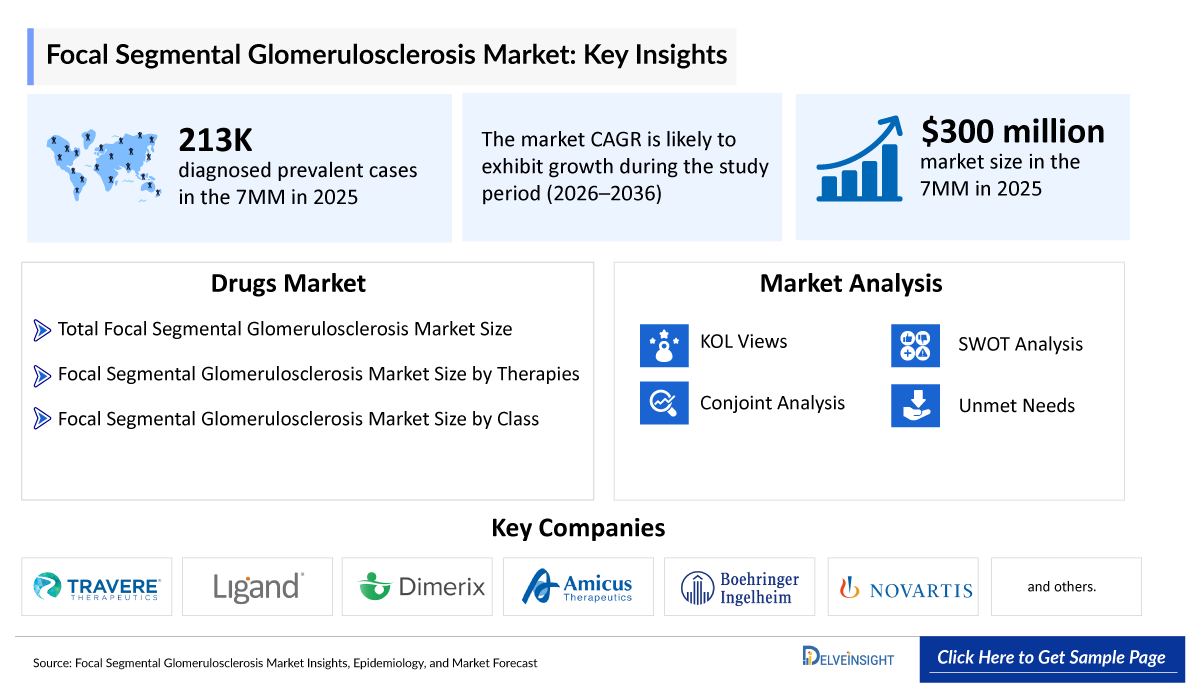
- 2025 FSGS Market Size: ~300 million
- 2036 Projected FSGS Market Size: XX million
- FSGS Growth Rate (2026–2036): XX% CAGR
DelveInsight's ‘Focal Segmental Glomerulosclerosis (FSGS) Market Insights, Epidemiology and Market Forecast – 2036’ report delivers an in-depth understanding of the FSGS, historical and forecasted epidemiology, as well as the FSGS market trends in the United States, EU4 (Germany, Spain, Italy, and France) and the United Kingdom, and Japan.
The FSGS market report delivers a comprehensive analysis of the current treatment landscape, including standards of care, clinical practices, and evolving therapeutic algorithms. It evaluates FSGS patient burden trends, revenue & market share dynamics, peak patient share & therapy uptake analysis, and provides an in-depth market size assessment, and growth rate projections (Historical & Forecast 2022–2036) across global regions. The report highlights key unmet medical needs in FSGS and maps the competitive and clinical landscape to uncover high‑value opportunities, providing a clear outlook on future market growth potential.
|
Study Period |
2022–2036 |
|
Historical Year |
2022–2025 |
|
Forecast Period |
2026–2036 |
|
Base Year |
2026 |
|
Geographies Covered |
|
|
Focal Segmental Glomerulosclerosis (FSGS) Market CAGR (Forecast period) |
XX% (2026–2036) |
|
Focal Segmental Glomerulosclerosis (FSGS) Epidemiology Segmentation Analysis |
Patient Burden Assessment
|
|
Focal Segmental Glomerulosclerosis (FSGS) Companies |
|
|
Focal Segmental Glomerulosclerosis (FSGS) Therapies |
|
|
Focal Segmental Glomerulosclerosis (FSGS) Market |
Segmented by
|
|
Analysis |
|
|
|
Key Factors Driving the Focal Segmental Glomerulosclerosis (FSGS) Market
Rising Disease Prevalence and Kidney Disorder Burden
One of the strongest growth drivers is the increasing global incidence of chronic kidney diseases (CKD), with FSGS being a significant subtype. Growth in diabetes, hypertension, obesity, and aging populations is directly contributing to higher FSGS cases.
High Unmet Need Driving Innovation
FSGS remains a rare condition with limited approved therapies, creating strong market opportunity while accelerating the development of novel and targeted treatments—including APOL1 inhibitors, endothelin receptor antagonists, biologics, TRPC inhibitors, and dual receptor antagonists—which are collectively reshaping the treatment landscape.
Focal Segmental Glomerulosclerosis (FSGS) Understanding and Treatment Algorithm
Focal Segmental Glomerulosclerosis (FSGS) Overview
FSGS is a rare but serious kidney disorder characterized by scarring (sclerosis) in parts (segments) of some (focal) glomeruli—the filtering units of the kidney. It can be classified as primary (idiopathic) or secondary, with secondary forms linked to conditions such as obesity, viral infections, or genetic mutations. FSGS often presents with proteinuria (excess protein in urine), which can progress to nephrotic syndrome and eventually chronic kidney disease or end-stage renal disease if untreated. The disease burden is increasing globally due to rising rates of risk factors like diabetes and hypertension, making it a growing concern in nephrology.
Focal Segmental Glomerulosclerosis (FSGS) Diagnosis
Diagnosis of FSGS typically involves a combination of clinical evaluation, laboratory testing, and confirmatory procedures. Initial signs include persistent proteinuria, edema, and reduced kidney function, detected through urine analysis and blood tests measuring creatinine and albumin levels. However, a definitive diagnosis requires a kidney biopsy, where histological examination reveals segmental scarring of glomeruli. Advances in diagnostic approaches, including genetic testing and biomarker identification, are improving the ability to differentiate between primary and secondary forms of the disease, which is critical for selecting the most appropriate treatment strategy.
Further details are provided in the report.
Current Focal Segmental Glomerulosclerosis (FSGS) Treatment Landscape
Treatment of FSGS aims to reduce proteinuria, slow disease progression, and preserve kidney function. Traditional management includes corticosteroids, immunosuppressive agents, and supportive therapies such as ACE inhibitors or angiotensin receptor blockers to control blood pressure and protein leakage. Recently, the therapeutic landscape has evolved with the approval of sparsentan, the first FDA-approved drug specifically indicated for FSGS. This dual endothelin and angiotensin II receptor antagonist (DEARA) helps reduce proteinuria and represents a breakthrough in a field previously dominated by off-label treatments. Sparsentan is currently the only approved targeted therapy for this condition, marking a shift toward disease-specific and precision-based treatment approaches.
Further details related to country-based variations are provided in the report.
Focal Segmental Glomerulosclerosis (FSGS) Unmet Needs
The section “unmet needs of FSGS” outlines the critical gaps between the current state of patient care, diagnosis, and the ideal & effective management of the disease. It highlights the obstacles experienced by patients, clinicians, and researchers and identifies potential solutions for future progress.
- Limited Disease-Specific Therapies
- Incomplete Understanding of Disease Pathophysiology
- High Relapse and Progression Rates and Others..
Note: Comprehensive unmet needs insights in FSGS and their strategic implications are provided in the full report.
Focal Segmental Glomerulosclerosis (FSGS) Epidemiology
Key Findings from FSGS Epidemiological Analysis and Forecast
- According to analysis, in 2025, the total diagnosed prevalent cases of FSGS in the 7MM were approximately 213,000 and are expected to increase through 2036.
- The United States accounted for the highest diagnosed prevalent cases of FSGS, representing approximately 36% of total cases in the 7MM in 2025.
- Among the EU4 and the UK, the UK accounted for the highest diagnosed prevalent cases of FSGS in 2025, followed by Germany.
- The prevalence of FSGS was the highest in individuals aged 18–64.
- In 2025, primary FSGS was found to be the more prevalent type among the two forms of FSGS, accounting for approximately 80% of the diagnosed population in the United States.
- DelveInsight estimates that Japan has more diagnosed prevalent cases of FSGS in males (61%) than females (39%).
Focal Segmental Glomerulosclerosis (FSGS) Drug Analysis & Competitive Landscape
The FSGS drug chapter provides a detailed, market-focused review of the emerging pipeline across Phase I-III clinical trials and preclinical trials. It covers the mechanism of action, clinical trial data, regulatory approvals, patents, collaborations, and strategic partnerships for each therapy, along with their advantages, limitations, and recent developments. This section offers critical insights into the FSGS treatment landscape, supporting market assessment, competitive analysis, and growth forecasting for the FSGS therapeutics market.
Approved Therapies for Focal Segmental Glomerulosclerosis (FSGS)
Sparsentan (FILSPARI): Travere Therapeutics and Ligand Pharmaceuticals
FILSPARI is the first and only medicine approved by the FDA for the treatment of FSGS. FILSPARI is a (Dual Endothelin Angiotensin Receptor Antagonist) DEARA. It has been granted Orphan Drug Designation (ODD) for the treatment of FSGS in the US and Europe. The US FDA approval was based on the Phase III (DUPLEX) study, which had a significant 46% reduction in proteinuria. In February 2012, Ligand Pharmaceuticals granted Travere Therapeutics a worldwide sublicense to develop, manufacture, and commercialize FILSPARI. Under the agreement, Ligand retained the right to receive approximately 9% royalty on worldwide net sales of the product. In September 2021, Travere Therapeutics and Vifor Pharma announced that they had entered into a collaboration and licensing agreement for the commercialization of FILSPARI in Europe, Australia, and New Zealand.
|
Focal Segmental Glomerulosclerosis (FSGS) Marketed/Approved Therapies | ||||||
|
Drug/Therapy |
Company |
Indication |
Molecule Type |
MoA |
RoA |
Marketed Region |
|
Sparsentan (FILSPARI) |
Travere Therapeutics/Ligand Pharmaceuticals |
FSGS |
Small molecule |
DEARA antagonist |
Oral |
US: 2026 |
Note: Detailed marketed therapies assessment will be provided in the final report.
Focal Segmental Glomerulosclerosis (FSGS) Pipeline Analysis
DMX-200: Dimerix and Amicus Therapeutics
DMX-200 (QYTOVRA in some territories) is a chemokine receptor (CCR2) blocker and is administered to patients taking an angiotensin II type I (AT1) receptor blocker (ARB), which is the standard of care treatment for kidney disease. DMX-200 has been granted patents in various territories until 2032, with patent applications in that may extend this to 2042 if granted. DMX-200 for FSGS is currently in a Phase III clinical trial and has been granted ODD by the FDA and EMA. It has also received ODD in Japan.
BI-764198 (apecotrep): Boehringer Ingelheim
BI-764198 is a potential first-in-class, oral drug being investigated as a novel, targeted, non-immunosuppressive therapy in people with primary FSGS. The drug works by selectively inhibiting TRPC6, a calcium channel found in kidney podocytes that plays a key role in maintaining the filtration barrier. In clinical studies, the drug has shown promising results, including a notable reduction in proteinuria in Phase II trials, while generally demonstrating good tolerability with mild side effects such as headache or diarrhea. It is currently being evaluated in larger Phase III trials to confirm its long-term safety and effectiveness. BI-764198 was granted ODD by the EMA and the Japanese Ministry for Health, Labour and Welfare (MHLW). The Phase II results were published in The Lancet and presented at the 2025 American Society of Nephrology (ASN)’s Kidney Week.
|
Competitive Landscape of Pipeline Drugs | ||||||
|
Drug Name |
Company |
Highest Phase |
Indication |
RoA |
MoA |
Anticipated Launch in the US |
|
DMX-200 |
Dimerix |
III |
FSGS |
Oral |
CCR2 Anatgonist |
Information is available in the full report |
|
BI 764198 (apecotrep) |
Boehringer Ingelheim |
III |
FSGS |
Oral |
TRPC6 Inhibitor |
Information is available in the full report |
|
Praliciguat |
Akebia Therapeutics |
II |
FSGS |
Oral |
Sgc Stimulator |
Information is available in the full report |
|
Note: Launch insights are provisional and may change with future report updates or the occurrence of major key catalysts. | ||||||
Note: Detailed emerging therapies assessment will be provided in the final report.
Focal Segmental Glomerulosclerosis (FSGS) Key Players, Market Leaders, and Emerging Companies
- Travere Therapeutics
- Ligand Pharmaceuticals
- Dimerix
- Amicus Therapeutics
- Boehringer Ingelheim
- Akebia Therapeutics
- Apellis Pharmaceuticals
- Novartis Pharmaceuticals, and others
Focal Segmental Glomerulosclerosis (FSGS) Drug Updates
- In April 2026, Travere Therapeutics announced that the US FDA had approved FILSPARI to reduce proteinuria in adult and pediatric patients aged 8 years and older with FSGS without nephrotic syndrome.
- In April 2026, Dimerix and Amicus Therapeutics announced that the two companies had entered into an exclusive license agreement for the commercialization of drug candidate DMX-200 for all indications, including FSGS, in the United States.
- In January 2026, Akebia Therapeutics announced that the first patient had been dosed in a Phase II clinical trial of praliciguat for the treatment of biopsy-confirmed FSGS.
- In January 2026, Boehringer Ingelheim announced results from a 12-week Phase II clinical trial evaluating apecotrep (BI-764198). Apecotrep reduced proteinuria by 40% in the 20 mg dose group compared to placebo.
- In December 2025, Dimerix announced that it had received feedback from the US FDA on the clinical appropriateness of proteinuria reduction as an endpoint for full approval of DMX-200 in the Phase III (ACTION 3) trial in patients with FSGS.
Focal Segmental Glomerulosclerosis (FSGS) Market Outlook
The treatment landscape for FSGS has historically depended on supportive care measures, including renin–angiotensin–aldosterone system (RAAS) blockade and corticosteroid. A significant advancement came with the approval of FILSPARI. It is a DEARA antagonist, designed to reduce proteinuria and slow disease progression. It represents the first targeted, non-immunosuppressive therapy approved specifically for FSGS, marking a shift toward mechanism-based treatment approaches.
The pipeline for FSGS is expanding, with several promising investigational agents targeting novel pathways. DMX-200 is a CCR2 antagonist that aims to reduce renal inflammation and fibrosis by inhibiting monocyte recruitment, a key driver in kidney injury. BI-764198 (apecotrep) targets the TRPC5 ion channel, which is implicated in podocyte dysfunction and proteinuria, offering a novel mechanism focused on preserving kidney filtration barrier integrity. Another candidate, Praliciguat, works as a sGC stimulator, potentially improving renal hemodynamics and reducing fibrosis through nitric oxide pathway modulation.
Overall, the launch of novel therapies, improved diagnostic techniques, and rising awareness of FSGS are projected to propel steady market growth across the 7MM from 2022 to 2036, yielding significant commercial opportunities for existing products and pipeline candidates.
- According to estimates, the total FSGS market size in 7MM was approximately USD 300 million in 2025, with the United States accounting for the largest share, and the market is projected to grow at a significant CAGR through 2036.
- In 2025, among the EU4 and the UK, the UK held the largest market share, followed by Germany, while Italy accounted for the smallest share.
Further details will be provided in the report….
Drug Class/Insights into Leading Emerging and Marketed Therapies in Focal Segmental Glomerulosclerosis (FSGS) (2022–2036 Forecast)
The FSGS market (2022–2036 forecast) is evolving toward targeted, mechanism-based therapies that focus on reducing proteinuria, preserving podocyte function, and slowing disease progression rather than relying solely on broad immunosuppression after symptom onset.
-
Small molecule: The current FSGS pipeline features several small molecule candidates designed to act on distinct but complementary disease pathways. Sparsentan (FILSPARI) is a DEARA that reduces proteinuria and protects glomerular structure through hemodynamic modulation. DMX-200 is a CCR2 inhibitor targeting inflammatory and fibrotic pathways by limiting macrophage recruitment. BI 764198 is a TRPC5 channel inhibitor that stabilizes podocyte structure and function, addressing a key driver of protein leakage.
FSGS innovation is not driven by a single dominant mechanism, but rather by a convergence of small molecule therapies targeting podocyte injury, inflammation, fibrosis, and glomerular hemodynamics, collectively driving pipeline growth and advancing disease-modifying treatment strategies.
Focal Segmental Glomerulosclerosis (FSGS) Drug Uptake
This section focuses on the uptake rate of potential drugs expected to be launched in the market during the forecast period (2026–2036). The analysis covers the FSGS drug’s uptake, performance at peak, factors affecting performance during prime years of growth, patient uptake by therapy, and anticipated sales generated by each drug.
During the forecast period, drug uptake in FSGS is expected to remain gradual but more dynamic, driven by increasing recognition of the disease, improved diagnostic stratification (including genetic testing), and the emergence of targeted therapies. FILSPARI is expected to play a central role in the evolving FSGS treatment landscape. As a DEARA, FILSPARI targets both proteinuria and disease progression pathways. Its uptake is anticipated to expand steadily, particularly in patients with primary FSGS and significant proteinuria, supported by its differentiated mechanism and clinical efficacy in reducing proteinuria compared to standard therapies.
Emerging pipeline therapies for FSGS are expected to see gradual and selective uptake due to disease rarity and heterogeneity. DMX-200 (Dimerix) is likely to be used as an add-on therapy targeting inflammation and persistent proteinuria. BI 764198 (apecotrep) focuses on podocyte protection and may follow a biomarker-driven adoption pathway. Praliciguat is expected to provide anti-fibrotic and renal hemodynamic benefits. Overall uptake will depend on clinical efficacy, safety outcomes, and positioning alongside standard of care therapies.
Detailed insights into emerging therapies' drug uptake are included in the report
Market Access and Reimbursement of Approved Therapies in Focal Segmental Glomerulosclerosis (FSGS)
The United States
|
US Reimbursement of Therapies Approved for Focal Segmental Glomerulosclerosis (FSGS) | |
|
Drug/Therapy |
Access Program |
|
FILSPARI |
Travere TotalCare Program |
Reimbursement is a crucial factor that affects the drug’s access to the market. Often, the decision to reimburse comes down to the price of the drug relative to the benefit it produces in treated patients. To reduce the healthcare burden of these high-cost therapies, many payment models are being considered by payers and other industry insiders.
NOTE: Further Details are provided in the final report….
Focal Segmental Glomerulosclerosis (FSGS) Therapies Price Scenario & Trends
Pricing and analogue assessment of FSGS therapies highlights evolving price dynamics structures. This section summarizes the cost of approved treatments, the closest and most appropriate analogue selection for emerging therapies, and the understanding of how pricing influences market access, adherence, and long-term uptake.
Industry Experts and Physician Views for Focal Segmental Glomerulosclerosis (FSGS)
To keep up with FSGS market trends, we take Key Opinion Leaders (KOLs) and Subject Matter Experts (SMEs) opinions working in the domain through primary research to fill the data gaps and validate our secondary research. Industry experts were contacted for insights on the FSGS emerging therapies, evolving treatment landscape, patient adherence to conventional therapies, therapy switching trends, drug adoption and uptake, accessibility challenges, and epidemiology and real-world prescription patterns in FSGS, including MD, PhD, Instructor, Postdoctoral Researcher, Professor, Researcher, and others.
DelveInsight’s analysts connected with 15+ KOLs to gather insights at the country level. Centers such as the Duke Molecular Physiology Institute, Department of Nephrology, Hospital Universitario Fundación Alcorcón, and Nippon Medical School, etc. were contacted. Their opinion helps understand and validate current and emerging FSGS therapies, highlight unmet medical needs, provide epidemiological context, and support strategic decisions for market access, therapy adoption, and pipeline prioritization in FSGS.
|
Region |
Key Opinion Leaders (KOLs) and Subject Matter Experts (SMEs) |
|
United States |
“The meticulous linkage analysis on affected families has illuminated a potential genetic site on chromosome 11 linked to this disease. This breakthrough sets the stage for extensive research to pinpoint the specific gene involved. Collaborating with affected and unaffected individuals is crucial, emphasizing the collective commitment needed to untangle the intricate genetics of FSGS.” |
|
Germany |
“The lack of easily accessible genetic FSGS testing may have contributed to genetic causes being overlooked, as patients with the genetic FSGS generally do not have an obvious, identifiable cause that explains the presence of protein in their urine. As a result, many patients have faced misdiagnosis, being labeled as having primary FSGS and receiving treatments like steroids or other immunosuppressive therapies typically used for primary FSGS.” |
Qualitative Analysis: SWOT and Conjoint Analysis
We perform qualitative and market Intelligence analysis using various approaches, such as SWOT analysis and conjoint analysis.
In the SWOT analysis of FSGS, strengths, weaknesses, opportunities, and threats in terms of disease diagnosis, patient awareness, patient burden, competitive landscape, cost-effectiveness, and geographical FSGS accessibility of therapies are provided.
Conjoint analysis analyzes emerging therapies based on relevant attributes such as safety, efficacy, frequency of administration, route of administration, and order of entry. Scoring is given based on these parameters to analyze the effectiveness of therapy.
The team of analysts analyzes promising emerging therapies based on relevant attributes such as safety, efficacy, frequency of administration, route of administration, and order of entry. In efficacy, the trial’s primary and secondary outcome measures are evaluated, whereas the therapies’ safety is evaluated, wherein the acceptability, tolerability, and adverse events are mainly observed. In addition, the scoring is also based on the route of administration, order of entry, probability of success, and the addressable patient pool for each therapy. According to these parameters, the final weightage score and the ranking of the emerging therapies are decided.
Scope of the Report
- The report covers a segment of key events, an executive summary, a descriptive overview of FSGS, explaining its causes, signs and symptoms, pathogenesis, and currently available treatments.
- Comprehensive insight has been provided into the epidemiology segments and forecasts, the future growth potential of the diagnosis rate, and disease progression along treatment guidelines.
- Additionally, an all-inclusive account of both the current and emerging treatments, along with the elaborate profiles of late-stage and prominent therapies, will have an impact on the current treatment landscape.
- A detailed review of the FSGS market, historical and forecasted market size, market share by therapies, detailed assumptions, and rationale behind our approach is included in the report, covering the 7MM drug outreach.
- The report provides an edge while developing business strategies by understanding trends through SWOT analysis and expert insights/KOL views, patient journey, and treatment preferences that help in shaping and driving the 7MM FSGS market.
Report Insights
- Focal Segmental Glomerulosclerosis (FSGS) Patient Population Forecast
- Focal Segmental Glomerulosclerosis (FSGS) Therapeutics Market Size
- Focal Segmental Glomerulosclerosis (FSGS) Pipeline Analysis
- Focal Segmental Glomerulosclerosis (FSGS) Market Size and Trends
- Focal Segmental Glomerulosclerosis (FSGS) Market Opportunity (Current and Forecasted)
Report Key Strengths
- Epidemiology‑based (Epi‑based) Bottom‑up Forecasting
- Artificial Intelligence (AI)-Enabled Market Research Report
- 11-Year Forecast
- Focal Segmental Glomerulosclerosis (FSGS) Market Outlook (North America, Europe, Asia-Pacific)
- Patient Burden Trends (By Geography)
- Focal Segmental Glomerulosclerosis (FSGS) Treatment Addressable Market (TAM)
- Focal Segmental Glomerulosclerosis (FSGS) Competitive Landscape
- Focal Segmental Glomerulosclerosis (FSGS)) Major Companies Insights
- Focal Segmental Glomerulosclerosis (FSGS) Price Trends and Analogue Assessment
- Focal Segmental Glomerulosclerosis (FSGS) Therapies Drug Adoption/Uptake
- Focal Segmental Glomerulosclerosis (FSGS) Therapies Peak Patient Share Analysis
Report Assessment
- Focal Segmental Glomerulosclerosis (FSGS) Current Treatment Practices
- Focal Segmental Glomerulosclerosis (FSGS) Unmet Needs
- Focal Segmental Glomerulosclerosis (FSGS) Clinical Development Analysis
- Focal Segmental Glomerulosclerosis (FSGS) Emerging Drugs Product Profiles
- Focal Segmental Glomerulosclerosis (FSGS) Market Attractiveness
- Focal Segmental Glomerulosclerosis (FSGS) Qualitative Analysis (SWOT and conjoint analysis)
FAQs
Market Insights
- What was the FSGS market size, the market size by therapies, market share (%) distribution in 2025, and what would it look like by 2036? What are the contributing factors for this growth?
- What are the anticipated pricing variations among different geographies for the emerging therapies in the future?
- What can be the future treatment paradigm of FSGS?
- What are the disease risks, burdens, and unmet needs of FSGS? What will be the growth opportunities across the 7MM concerning the patient population with FSGS?
- Who is the major future competitor in the market, and how will the competitors affect their market share?
- What are the current options for the treatment of FSGS? What are the current guidelines for treating FSGS in the US, Europe, and Japan?
Reasons to Buy
- The report will help in developing business strategies by understanding the latest trends and changing treatment dynamics driving the FSGS market.
- Bottom-up forecasting builds from the affected population to product forecasts, delivering a robust, data-driven approach ideal for new therapies and novel classes.
- Insights on patient burden/disease incidence, evolution in diagnosis, and factors contributing to the change in the epidemiology of the disease during the forecast years.
- Understand the existing market opportunities in varying geographies and the growth potential over the coming years.
- Identifying strong upcoming players in the market will help devise strategies to help get ahead of competitors.
- Detailed analysis and ranking of class-wise potential emerging therapies under the conjoint analysis section to provide visibility around leading classes.
- To understand KOLs’ perspectives on the accessibility, acceptability, and compliance-related challenges of existing treatment to overcome barriers in the future.
- Detailed insights into the unmet needs of the existing market so that the upcoming players can strengthen their development and launch strategy.
- This Artificial Intelligence (AI)-enabled report summarize and simplify complex datasets within the report into clear, actionable insights for stakeholders, investors, and healthcare providers, enabling faster, data-driven decisions.