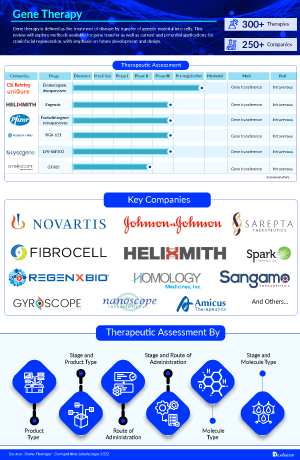
Gene Therapy Pipeline Landscape
DelveInsight’s, “Gene Therapy - Competitive landscape, 2025,” report provides comprehensive insights about 180+ companies and 200+ drugs in Gene Therapy Competitive landscape. It covers the therapeutics assessment by product type, stage, route of administration, and molecule type. It further highlights the inactive pipeline products in this space.
Geography Covered
- Global coverage
Gene Therapy: Understanding
Gene Therapy: Overview
Gene therapy is defined as the treatment of disease by transfer of genetic material into cells. Gene therapy is understood as the capacity for gene improvement by means of the correction of altered (mutated) genes or site-specific modifications that have therapeutic treatment as target. One of the most often used techniques consists of recombinant DNA technology, in which the gene of interest or healthy gene is inserted into a vector, which can be a plasmidial, nanoestrutured, or viral; the latter is the most often used due to its efficiency in invading cells and introducing its genetic material.There are three main strategies for gene delivery: in vivo, in vitro, and ex vivo. Systemic delivery is desirable if the target tissue is not directly accessible. Alternatively, matrix-based delivery allows for tissue-specific gene delivery, higher localized loading of DNA or virus, and increased control over the structural microenvironment. Gene therapy is also highly desired for the treatment of neurologic and other chronic disease.
Vectors used for gene therapy include modified versions of natural viruses and plasmids. Viruses have been modified to remove disease-causing genes and replace them with the gene(s) being transferred and the sequences that control its expression, while keeping the viral envelope or coat, which aids transfer. In vivo gene therapy involves direct injection of the gene therapy agent into the body; In an ex vivo delivery system, cells are harvested from the patients’ own body or other healthy individuals. In gene editing machinery is directly transferred into host cells to modify the genome within the recipient rather than using vectors to transfer the modified genes. Gene therapies can work by several mechanisms like Replacing a disease-causing gene with a healthy copy of the gene, inactivating a disease-causing gene that is not functioning properly, introducing a new or modified gene into the body to help treat a disease.
Gene therapy is specially suited for long-term delivery of a transgene to persons with a single genetic deficiency that is not amenable to protein or pharmacokinetic therapy. This was the premise of the first successful gene therapy clinical trials that inserted genes ex vivo into CD34+ cells to treat persons with SCID. Gene therapy is also highly desired for the treatment of neurologic and other chronic disease. Clinical trials have been implemented and/or completed for the treatment of HIV/AIDS, arthritis, angina pectoris, solid tumors, Parkinson’s disease, Huntington’s disease, Alzheimer’s disease, Batten disease, Canavan disease, and familial hypercholesterolemia and many others. In gene therapy, a normal gene is inserted into the genome to replace an abnormal gene responsible for causing a certain disease. A molecular carrier called a “vector” is used to release the gene, which needs to be very specific, display efficiency in the release of one or more genes of the sizes necessary for clinical applications, not be recognized by the immune system, and be purified in large quantities and high concentrations so that it can be produced and made available on a large scale.
Report Highlights
- In July 2024, Miltenyi Biotec, announced the signing of a Letter of Intent with the Translational Health Science and Technology Institute (THSTI). With this partnership, both organizations aim to address the growing need for innovative treatments in the fight against cancer by developing innovative cell and gene therapies.
- In May 2024, Taysha Gene Therapies has received a regenerative medicine advanced therapy (RMAT) designation for its gene therapy candidate TSHA-102 from the US Food and Drug Administration (FDA) to treat Rett syndrome.
- In April 2024, Charles River Laboratories International, Inc. announced a plasmid DNA contract development and manufacturing organization (CDMO) collaboration with Axovia Therapeutics Ltd. Charles River will manufacture High Quality (HQ) gene of interest plasmid to support the development of Axovia’s gene therapies for ciliopathies, including Bardet-Biedl Syndrome (BBS), a condition with limited treatment options and no cure.
- In April 2024, Ginkgo Bioworks had successfully completed the gene therapy collaboration with Biogen announced in May 2021. The companies aimed to advance the industry standard for manufacturing recombinant adeno-associated virus (AAV)-based vectors. The collaboration achieved its goals of enhancing the AAV production titers of Biogen's gene therapy manufacturing processes.
- In March 2024, Seattle Children’s Research Institute and Genezen, have unveiled a strategic manufacturing partnership for Seattle Children’s Research Institute’s X-linked agammaglobulinemia (XLA) program. This collaboration is focused on leveraging Genezen’s viral vector process development and cGMP manufacturing expertise to advance Seattle Children’s XLA gene therapy program.
- In March 2024, the company announced that Taysha Gene Therapies had received the needed approval to move forward with dose escalation in its Phase I/II trial testing TSHA-102, its gene therapy candidate for Rett syndrome, in adolescents and adults.
- In February 2024, The US Food and Drug Administration has approved the first cell therapy for a solid tumor, MIP Discovery secured £7 million in Series A financing to drive commercialization of novel synthetic affinity reagents within the cell and gene therapy space and Charles River Laboratories International has expanded its portfolio of human pluripotent stem cells through a collaboration with Pluristyx.
Gene Therapy: Company and Product Profiles (Marketed Therapies)
1. Company Overview: Novartis
Novartis is reimagining medicine to improve and extend people’s lives. As a leading global medicines company, company use innovative science and digital technologies to create transformative treatments in areas of great medical need. In quest to find new medicines, consistently rank among the world’s top companies investing in research and development. Novartis products reach more than 750 million people globally and are finding innovative ways to expand access to company latest treatments. Novartis Gene Therapies is reimagining medicine to transform the lives of people living with rare genetic diseases. Utilizing cutting-edge technology, company is working to turn promising gene therapies into proven treatments.
Product Description: Zolgensma
Zolgensma (onasemnogene abeparvovec) is the only gene therapy for spinal muscular atrophy (SMA) and the only SMA treatment designed to directly address the genetic root cause of the disease by replacing the function of the missing or non-working SMN gene to halt disease progression through sustained SMN protein expression with a single, one-time IV infusion. Zolgensma was approved by the US Food and Drug Administration for the treatment of pediatric patients less than 2years of age with spinal muscular atrophy (SMA) with bi-allelic mutations in the survival motor neuron 1 (SMN1) gene. . Zolgensma is now approved in more than 40 countries and more than 2,000 patients have been treated with Zolgensma globally across clinical trials, managed access programs, and in the commercial setting.
2. Company Overview: Spark Therapeutics
Spark Therapeutics, is a fully integrated company committed to discovering, developing and delivering gene therapies, challenge the inevitability of genetic diseases, including blindness, hemophilia and neurodegenerative diseases. The company have successfully applied our technology in the first FDA-approved gene therapy in the U.S. for a genetic disease, and currently have three programs in clinical trials, including product candidates that have shown promising early results in patients with hemophilia. At Spark, there is the path to a world where no life is limited by genetic disease.
Product Description: LUXTURNA
LUXTURNA is the first FDA-approved gene therapy for a genetic disease, the first and only pharmacologic treatment for an inherited retinal disease (IRD) and the first adeno-associated virus (AAV) vector gene therapy approved in the U.S. LUXTURNA was approved by FDA under Priority Review and previously received orphan drug and breakthrough therapy designations from FDA. With the approval of LUXTURNA, FDA will issue to Spark Therapeutics a Rare Pediatric Disease Priority Review Voucher for a Priority Review of a subsequent marketing application for a different product. Spark Therapeutics’ Marketing Authorization Application (MAA) for LUXTURNA is currently under review with the European Medicines Agency (EMA). LUXTURNA also has received orphan product designations from EMA.
Gene Therapy: Company and Product Profiles (Pipeline Therapies)
1. Company Overview: Pfizer
Pfizer Inc. is a global biopharmaceutical company with a rich history dating back to 1849 when it was founded by Charles Pfizer and Charles Erhart in Brooklyn, New York. The company is engaged in the discovery, development, manufacture, and sale of medicines and vaccines across various therapeutic areas such as vaccines, oncology, internal medicine, hospital, inflammation and immunology, and rare diseases. Pfizer's dedication to global health is evident through its extensive portfolio of medicines and vaccines that aim to enhance wellness, prevention, treatments, and cures for various diseases. The company collaborates with healthcare providers, governments, and communities worldwide to expand access to reliable and affordable healthcare services.
Product Description: Fordadistrogene movaparvovec
Fordadistrogene movaparvovec is an investigational recombinant adeno-associated virus serotype 9 (AAV9) capsid carrying a shortened version of the human dystrophin gene (mini-dystrophin) under the control of a human muscle-specific promotor. The AAV9 capsid was chosen as the delivery mechanism because of its potential to target muscle tissue. The FDA has lifted a clinical hold on Pfizer’s phase III clinical trial of its investigational gene therapy, fordadistrogene movaparvovec, in patients with Duchenne muscular dystrophy (DMD). Regulatory and ethics approvals to resume the CIFFREO Phase III ambulatory study, including the FDA’s lift of its clinical hold, follow reviews of data and protocol amendments. Currently the drug is in Phase III stage of development for the treatment of Duchenne muscular dystrophy
2. Company Overview: Ultragenyx Pharmaceutical Inc
Kyowa Kirin strives to create and deliver novel medicines with life-changing value. As a Japan-based Global Specialty Pharmaceutical Company with a more than 70-year heritage, the company apply cutting-edge science including expertise in antibody research and engineering, to address the needs of patients and society across multiple therapeutic areas including Nephrology, Oncology, Immunology/Allergy and Neurology. Across our four regions – Japan, Asia Pacific, North America and EMEA/International – The company focus on purpose, to make people smile, and are united by our shared values of commitment to life, teamwork/Wa, innovation, and integrity.
Product Description: DTX401
DTX401 is an investigational AAV8 gene therapy designed to deliver stable expression and activity of G6Pase-α using a single intravenous infusion. Long term Phase I/II data demonstrate an acceptable safety profile and durability of response. All treated patients have experienced stable or improved glucose control while tapering or discontinuing oral glucose replacement therapy with cornstarch after receiving DTX401. The Phase III GlucoGene study is underway to evaluate the ability of DTX401 to reduce the use of cornstarch while maintaining or improving glucose control as well as the therapy’s impact on patients’ quality of life. DTX401 was granted Orphan Drug Designation in the United States, EU and United Kingdom, and Regenerative Medicine Advanced Therapy (RMAT) designation and Fast Track designation in the United States. DTX401 was accepted into the EMA’s Priority Medicines program (PRIME), enabling more frequent interactions with the EMA and the potential for an accelerated approval.The drug has recently completed Phase III clinical trial for the treatment of patients with Glycogen storage disease type I.
3. Company Overview: Rocket Pharmaceuticals
Rocket Pharmaceuticals, Inc. is an emerging, clinical-stage biotechnology company focused on developing first-in-class gene therapy treatment options for rare, devastating diseases. Rocket’s multi-platform development approach applies the well-established lentiviral vector (LVV) and adeno-associated viral vector (AAV) gene therapy platforms. Rocket's lead clinical program is a LVV-based gene therapy for the treatment of Fanconi Anemia (FA), a difficult to treat genetic disease that leads to bone marrow failure and potentially cancer. Preclinical studies of additional bone marrow-derived disorders are ongoing and target Pyruvate Kinase Deficiency (PKD), Leukocyte Adhesion Deficiency-I (LAD-I) and Infantile Malignant Osteopetrosis (IMO). Rocket’s first AAV-based gene therapy program targets Danon disease, a rare neuromuscular and cardiovascular disease.
Product Description: RP-L102
RP-L102 is a gene therapy product containing autologous (patient-derived) hematopoietic stem cells (HSCs) that have been genetically modified with a lentiviral vector to contain a functional copy of the FANCA gene. If given early in life, RP-L102 gene therapy has the potential to serve as a preventative measure, correcting bone marrow cells before there is progression to severe bone marrow failure. RP-L102 has been granted Orphan Drug, Fast Track, and Regenerative Medicine Advanced Therapy (RMAT) designations for the treatment of Fanconi Anemia type A in the United States and Orphan Drug designation in Europe. The drug is currently in Phase II stage of development for the treatment of patients with Fanconi Anemia (FA).
4. Company Overview: Adverum Biotechnologies
Adverum Biotechnologies is a clinical-stage gene therapy company targeting unmet medical needs in serious ocular and rare diseases. Adverum is evaluating its novel gene therapy candidate, ADVM-022, as a one-time, intravitreal injection for the treatment of patients with neovascular or wet age-related macular degeneration.
Product Description: ADVM-022
ADVM022 is being developed for the treatment of wet AMD. ADVM-022 utilizes a propriety vector capsid, AAV.7m8, carrying an aflibercept coding sequence under the control of a proprietary expression cassette. Unlike other ophthalmic gene therapies that require a surgery to administer the gene therapy under the retina (sub-retinal approach) ADVM-022 has the advantage of being administered as a one-time IVT injection in the office and is designed to deliver long-term efficacy and reduce the burden of frequent anti-VEGF injections, optimize patient compliance, and improve vision outcomes for patients with wet AMD. The OPTIC trial is designed as a multi-center, open-label, dose-ranging, safety and efficacy trial of ADVM-022 in patients with wet AMD who have demonstrated responsiveness to anti-VEGF treatment. Patients in OPTIC are treatment experienced, and previously required frequent anti-VEGF injections to manage their wet AMD and to maintain functional vision. The drug is currently in Phase II stage of development for the treatment of patients with Wet AMD.
5. Company Overview: Kyverna Therapeutics
Kyverna is a patient-centered, clinical-stage biopharmaceutical company focused on developing cell therapies for patients suffering from autoimmune diseases. KYV-101 is advancing through clinical development across two broad areas of autoimmune disease: rheumatology and neurology, including two ongoing multi-center, open-label Phase I trials of KYV-101 in the United States and Germany for patients with lupus nephritis. Kyverna’s pipeline includes next-generation chimeric antigen receptor (CAR) T-cell therapies in both autologous and allogeneic formats with properties intended to be well suited for use in B cell-driven autoimmune diseases. By advancing more than one mechanism for taming autoimmunity, Kyverna is positioned to act on its mission of transforming how autoimmune diseases are treated.
Product Description: KYV-101
KYV-101 is an autologous, fully human CD19 CAR T-cell product candidate for use in B cell-driven autoimmune diseases. The CAR in KYV-101 was designed by the National Institutes of Health (NIH) to improve tolerability and tested in a 20-patient Phase I trial in oncology. Results were published by the NIH in Nature Medicine. Kyverna is currently conducting trials of KYV-101 in patients with lupus nephritis, an autoimmune disease in which more than half of patients do not achieve a complete response to current therapies and are at risk of developing kidney failure. Additional clinical trials of KYV-101 in systemic sclerosis, and myasthenia gravis are in preparation. The drug is currently in Phase I/II stage of development for the treatment of patients with Lupus nephritis.
6. Company Overview: Vivet Therapeutics
Vivet Therapeutics is a private, clinical-stage biotech company developing novel and long-lasting gene therapies for rare inherited metabolic conditions, including Wilson’s disease. Vivet’s gene therapy platform uses recombinant adeno-associated viruses (rAAVs) as vectors and has initiated two clinical programs and four pre-clinical assets to date. Its most advanced therapy is VTX-801, a novel gene therapy for Wilson’s disease, with key clinical read-outs expected by the end of 2024. Vivet Therapeutics was founded in 2016 by CEO Dr Jean-Philippe Combal and CSO Dr Gloria Gonzalez-Aseguinolaza and is led by a highly experienced management team with deep expertise developing gene therapies and orphan drugs.
Product Description: VTX-802
VTX-802 is an AAV-based gene therapy for patients with Progressive Familial Intrahepatic Cholestasis Type 2. It delivers a codon-optimized version of the BSEP gene to the liver and is currently under preclinical testing. The drug is currently in Preclinical stage of development for the treatment of patients with Intrahepatic cholestasis.
Further product details are provided in the report……..
Gene Therapy Analytical Perspective by DelveInsight
- In-depth Commercial Assessment: Gene Therapy Collaboration Analysis by Companies
The Report provides in-depth commercial assessment of drugs that have been included, which comprises collaboration, agreement, licensing and acquisition – deals values trends. The sub-segmentation is described in the report which provide company-company collaboration (licensing/partnering), company academic collaboration and acquisition analysis in tabulated form.
- Gene Therapy Competitive Landscape
The report comprises of comparative assessment of Companies (by therapy, development stage, and technology).
Gene Therapy Report Assessment
- Company Analysis
- Therapeutic Assessment
- Pipeline Assessment
- Inactive drugs assessment
- Unmet Needs
Key Questions
Current Treatment Scenario and Emerging Therapies:
- How many companies are developing Gene Therapy drugs?
- How many Gene Therapy drugs are developed by each company?
- How many emerging drugs are in mid-stage, and late-stage of development for the treatment of Gene Therapy?
- What are the key collaborations (Industry–Industry, Industry–Academia), Mergers and acquisitions, licensing activities related to the Gene Therapy therapeutics?
- What are the recent trends, drug types and novel technologies developed to overcome the limitation of existing therapies?
- What are the clinical studies going on for Gene Therapy and their status?
- What are the key designations that have been granted to the emerging and approved drugs?