PD-1 and PD-L1 Inhibitors Competitive Landscape
- The PD-1 and PD-L1 Inhibitors Competitive Landscape highlights the current competitive dynamics, emerging technologies, product portfolios, licensing activities, and research developments influencing the future of immune checkpoint inhibitor therapies.
- The leading PD-1 and PD-L1 Inhibitors Companies include Merck, Roche, GSK, Innovent Biologics, AstraZeneca, EQRx/CStone Pharmaceuticals, Pfizer, Agenus, Incyte Corporation, Suzhou Zelgen Biopharmaceuticals, Shanghai Junshi Biosciences, Eli Lilly and Company, Sichuan Huiyu Pharmaceutical, Vicero, Rophibio, Shanghai Henlius Biotech, Westlake Therapeutics, and others.
Request for Unlocking the Sample Page of the Report "PD-1 and PD-L1 Inhibitors Market"
Key Factors Driving the Growth of the PD-1 and PD-L1 Inhibitors Market
-
Increasing Global Cancer Burden
The rising incidence of cancer worldwide is one of the primary factors driving the growth of the PD-1 and PD-L1 inhibitors market. The growing prevalence of malignancies such as lung cancer, melanoma, renal cell carcinoma, and head and neck cancers has increased the demand for advanced immunotherapies that can improve survival outcomes.
-
Expanding Clinical Applications
PD-1 and PD-L1 inhibitors are being evaluated and approved for an increasing number of cancer indications. Their expanding use across multiple solid tumors and hematologic malignancies is broadening the patient population eligible for these therapies, supporting market growth.
-
Advancements in Immuno-Oncology Research
Continuous advancements in immuno-oncology have accelerated the development of novel checkpoint inhibitors and combination treatment strategies. Ongoing research into immune mechanisms and biomarkers is improving treatment effectiveness and driving innovation in the market.
-
Growing Pipeline of Novel Therapies
A robust pipeline of PD-1 and PD-L1 inhibitors, including next-generation molecules and combination regimens, is contributing significantly to market expansion. Pharmaceutical and biotechnology companies continue to invest heavily in clinical development to address unmet medical needs and improve therapeutic outcomes.
-
Rising Adoption of Combination Therapies
The increasing use of PD-1 and PD-L1 inhibitors in combination with chemotherapy, targeted therapies, radiation therapy, and other immunotherapies is improving treatment efficacy in several cancer types. This trend is creating additional growth opportunities within the market.
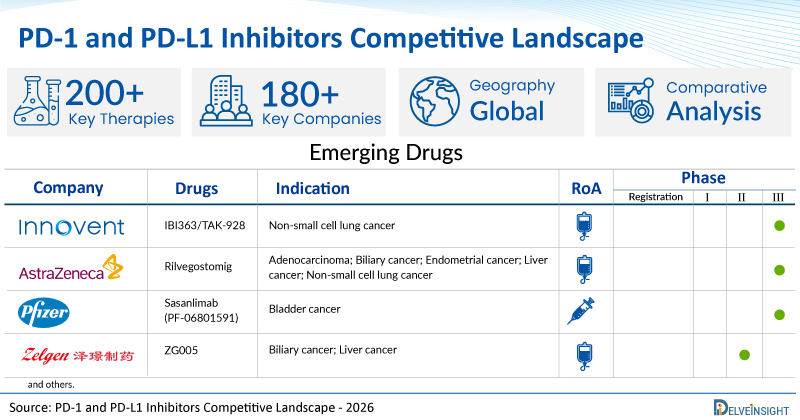
DelveInsight’s “PD-1 and PD-L1 Inhibitors Competitive Landscape, 2026” report provides comprehensive insights about 180+ companies and 200+ drugs in the PD-1 and PD-L1 Inhibitors Competitive Landscape. It covers the therapeutics assessment by product type, stage, route of administration, and molecule type. It further highlights the inactive PD-1 and PD-L1 Inhibitors Pipeline products in this space.
Geography Covered
- Global coverage
PD-1 and PD-L1 Inhibitors Understanding
PD-1 and PD-L1 Inhibitors Overview
PD-1 and PD-L1 inhibitors are classes of immunotherapy drugs designed to enhance the immune system's ability to fight cancer. The PD-1 receptor, found on the surface of T cells, and its ligand, PD-L1, present on tumor cells and some normal cells, play a crucial role in downregulating immune responses and promoting self-tolerance by suppressing T cell inflammatory activity.
Cancer cells often exploit this pathway to evade immune detection. PD-1 inhibitors block the PD-1 receptor, while PD-L1 inhibitors block the PD-L1 ligand, both effectively preventing the interaction that leads to immune suppression. This blockade allows T cells to recognize and destroy cancer cells more effectively, leading to improved outcomes in several types of cancer, including Melanoma, Non-Small Cell Lung Cancer, and Renal Cell Carcinoma.
The mechanism of action of PD-1 and PD-L1 inhibitors revolves around blocking the inhibitory pathway that tumors use to evade the immune system. PD-1, a receptor on T cells, interacts with PD-L1, a ligand on tumor cells and other cells in the tumor microenvironment, to downregulate immune responses and promote immune tolerance. PD-1 inhibitors, such as nivolumab and pembrolizumab, bind to the PD-1 receptor on T cells, while PD-L1 inhibitors, like atezolizumab and durvalumab, bind to the PD-L1 ligand on tumor cells.
By blocking this interaction, these inhibitors prevent the "off" signal from being sent to T cells, thus enhancing T cell activation and proliferation. This reactivation of T cells enables them to recognize and destroy cancer cells more effectively, leading to improved anti-tumor immune responses. This blockade effectively disrupts the tumor's ability to hide from the immune system, restoring the immune system's capability to target and kill cancer cells.
As a result, PD-1 and PD-L1 inhibitors have become critical components in the treatment of various cancers, demonstrating significant clinical benefits and improved patient outcomes.
The structure of PD-1 and PD-L1 inhibitors typically involves monoclonal antibodies designed to bind specifically to their targets. PD-1 inhibitors, such as nivolumab and pembrolizumab, are antibodies that bind to the PD-1 receptor on T cells, preventing its interaction with PD-L1. Similarly, PD-L1 inhibitors like atezolizumab and durvalumab are antibodies that bind to the PD-L1 ligand on tumor cells.
These antibodies are large, Y-shaped proteins composed of two heavy chains and two light chains, featuring variable regions that recognize and attach to specific epitopes on PD-1 or PD-L1. This precise binding blocks the inhibitory signaling pathway, thereby reactivating T cell activity against cancer cells.
Similar to other inhibitory co-receptors, PD-1 is expressed on activated T cells, B cells, monocytes, dendritic cells (DCs), Regulatory T cells (Tregs), and Natural Killer T Cells (NKT). PD-1 expression is defined as a hallmark of T cell exhaustion, which is well-defined in chronic virus infection and cancer. In many types of cancers, PD-1 is expressed on a large proportion of tumor infiltrating lymphocytes (TILs).
Among CD4 TILs, enhanced PD-1 expression is always observed on Treg cells, which may reflect their activation status, whereby the presence of active Treg cells indicates that the tumor microenvironment (TME) is in an immunosuppressive state.
PD-1 and PD-L1 Inhibitors Competitive Landscape Report Highlights
- In May 2026, Merck announced that calderasib (MK-1084), an investigational oral specific KRAS G12C inhibitor, in combination with KEYTRUDA® (pembrolizumab), Merck’s anti-PD-1 therapy, has been granted Breakthrough Therapy designation by the U.S. Food and Drug Administration (FDA) for the first-line treatment of patients with advanced or metastatic non-small cell lung cancer (NSCLC) with KRAS G12C-mutation and expressing PD-L1 (tumor proportion score [TPS] ≥1%). This is the first Breakthrough Therapy designation for calderasib and was supported by positive data from the Phase I KANDLELIT-001 trial.
- In May 2026, Innovent Biologics, Inc. announced the preliminary results from a PoC clinical study of its global first-in-class PD-1/IL-2α-bias bispecific fusion protein IBI363/TAK928 plus chemotherapy in the first-line treatment of advanced non-small cell lung cancer (NSCLC). The detailed data was presented at the 2026 American Society of Clinical Oncology (ASCO) Annual Meeting.
- In May 2026, AstraZeneca and Daiichi Sankyo’s Datroway (datopotamab deruxtecan) has been approved in the US for the treatment of adult patients with unresectable or metastatic triple-negative breast cancer (TNBC) who are not candidates for PD-1/PD-L1 inhibitor therapy. The approval follows Priority Review by the Food and Drug Administration (FDA) based on results from the TROPION-Breast02 Phase III trial which were presented at the 2025 European Society for Medical Oncology Congress and published in Annals of Oncology.
- In March 2026, AIM ImmunoTech Inc. announced that the Japan Patent Office has fully approved a Japanese patent covering the Company’s proprietary use of Ampligen (rintatolimod) in combination with checkpoint inhibitors (anti-PD-1 or anti-PD-L1 antibodies) for the treatment of cancer. The patent was granted in September 2025, but had to then pass a 6-month opposition period. The Japan patent expires December 20, 2039.
- In October 2025, According to findings from the Phase III ASCENT-03 trial (NCT05382299) presented at the 2025 ESMO Congress treatment with sacituzumab govitecan-hziy (Trodelvy) led to a 38% reduction in the risk of disease progression or death vs chemotherapy in patients with previously untreated, locally advanced unresectable, or metastatic triple-negative breast cancer (TNBC) who were ineligible for PD-1/PD-L1 inhibitors.
- In September 2025, Findings from a Phase Ib study of tarlatamab combined with a programmed cell death ligand 1 (PD-L1) inhibitor has delivered encouraging survival results for patients with extensive-stage small cell lung cancer (ES-SCLC), one of the most aggressive forms of lung cancer. The results, published in Lancet Oncology, suggest that pairing the bispecific T-cell engager (BiTE) tarlatamab (Imdelltra; Amgen) with Atezolizumab (Tecentriq; Genentech) or durvalumab (Infinzi; AstraZeneca) could reshape the treatment landscape for this hard-to-treat disease.
In August 2025, As shared in an announcement from the drug’s developer, Genmab the FDA had issued breakthrough therapy designation to the antibody-drug conjugate (ADC) rinatabart sesutecan (Rina-S; GEN1184) for use in patients with recurrent or progressive endometrial cancer whose disease progressed on or after treatment with a platinum regimen in addition to a PD-1 or PD-L1 therapy. - This regulatory decision is supported by data from the Phase I/II RAINFOL-01 trial (NCT05579366) presented at the 2025 American Society of Clinical Oncology Annual Meeting.
- In February 2025, Innovent Biologics announced that IBI363 had received its second Fast Track Designation (FTD) from the US Food and Drug Administration (FDA). This designation applies to the treatment of unresectable, locally advanced, or metastatic squamous non-small cell lung cancer (sqNSCLC) that has progressed following anti-PD-(L)1 immune checkpoint inhibitor therapy and platinum-based chemotherapy.
- In February 2025, Shanghai Henlius Biotech announced that its PD-L1 antibody-drug conjugate (ADC), HLX43 had successfully completed the first patient dosing in a Phase II clinical trial.
- In January 2025, Pfizer announced positive topline results from its pivotal Phase III CREST trial evaluating sasanlimab in combination with Bacillus Calmette-Guérin (BCG). The study met its primary endpoint of event-free survival (EFS) by investigator assessment, demonstrating a clinically meaningful and statistically significant improvement.
- In December 2024, AstraZeneca got approval from the Subject Expert Committee (SEC) functional under the Central Standard Control Organization (CDSCO) to conduct a Phase III clinical study of the anticancer drug Rilvegostomig (AZD2936) concentrate for solution for infusion, 50 mg/mL (750 mg/vial).
- In August 2024, the US Food and Drug Administration approved Jemperli (dostarlimab) in combination with carboplatin and paclitaxel (chemotherapy) followed by Jemperli as a single agent for the treatment of adult patients with primary advanced or recurrent endometrial cancer. This approval broadens the previous indication for Jemperli plus chemotherapy to include patients with mismatch repair proficient (MMRp)/microsatellite stable (MSS) tumors who represent 70-75% of patients diagnosed with endometrial cancer and who have limited treatment options.
PD-1 and PD-L1 Inhibitors: Company and Product Profiles (Marketed Therapies)
1. Company Overview: Merck & Co.
Merck & Co., Inc. is a global, research-oriented biopharmaceutical company headquartered in Rahway, New Jersey. It is committed to the development of novel medicines and vaccines across critical therapeutic areas, including oncology, infectious diseases, and immunology. The company strengthens its pipeline through strong internal research capabilities and strategic collaborations. Its strategic priorities emphasize scientific excellence, enhancement of patient outcomes, and the generation of sustainable long-term value for healthcare systems and stakeholders.
Product Description: KEYTRUDA
Pembrolizumab is the active ingredient of Keytruda, which is a humanized monoclonal antibody that binds to the programmed cell death – 1 (PD-1) receptor and blocks its interaction with PD-L1 and PD-L2, releasing PD-1 pathway-mediated inhibition of the immune response, including anti-tumor immune response. Pembrolizumab is an IgG4 kappa immunoglobulin and has an approximate 149 kDa molecular weight. Keytruda has received approval for advanced melanoma, non-small cell lung cancer (NSCLC), head and neck squamous cell cancer, classical Hodgkin lymphoma, microsatellite-instability-high cancer, Primary Mediastinal Large B-Cell Lymphoma (PMBCL), Small Cell Lung Cancer (SCLC), Microsatellite Instability-High Cancer, Gastric Cancer, Esophageal Cancer, Cervical Cancer, Hepatocellular Carcinoma, Merkel Cell Carcinoma, Renal Cell Carcinoma, Endometrial Carcinoma and advanced urothelial bladder cancer. In January 2020, Merck announced that the US Food and Drug Administration (FDA) has approved Keytruda, Merck’s anti-PD-1 therapy, as monotherapy for the treatment of patients with Bacillus Calmette-Guerin (BCG)-unresponsive, high-risk, non-muscle invasive bladder cancer (NMIBC) with carcinoma in situ (CIS) with or without papillary tumors who are ineligible for or have elected not to undergo cystectomy.
2. Company Overview: GSK
GSK is a global biopharmaceutical company headquartered in London, focused on the discovery, development, and commercialization of innovative medicines, vaccines, and specialty therapies. The company has a strong presence in oncology, infectious diseases, respiratory diseases, immunology, and HIV.
In oncology, GSK is advancing a diversified portfolio spanning immuno-oncology, antibody-drug conjugates, and targeted therapies, with JEMPERLI serving as a cornerstone asset in its immuno-oncology strategy. GSK operates in more than 100 countries and invests heavily in R&D to address high unmet medical needs worldwide.
Product Description: JEMPERLI
JEMPERLI (dostarlimab) is a humanized anti-programmed death receptor-1 (PD-1) monoclonal antibody developed by GSK for the treatment of various solid tumors. It works by blocking the PD-1 pathway, thereby enhancing T-cell-mediated antitumor immune responses. The therapy is approved for advanced or recurrent endometrial cancer, both as monotherapy and in combination with chemotherapy, and has also received approvals for certain mismatch repair-deficient (dMMR) solid tumors. GSK is further evaluating JEMPERLI across multiple tumor types, including colorectal, lung, and gynecologic cancers.
PD-1 and PD-L1 Inhibitors: Company and Product Profiles (Pipeline Therapies)
1. Company Overview: Innovent
Innovent is a leading biopharmaceutical company founded in 2011 with the mission to empower patients worldwide with affordable, high-quality biopharmaceuticals. The company discovers, develops, manufactures and commercializes innovative medicines that target some of the most intractable diseases. Its pioneering therapies treat cancer, cardiovascular and metabolic, autoimmune and eye diseases. Innovent has launched 18 products in the market.
It has 5 assets in Phase III or pivotal clinical trials and 14 more molecules in early clinical stage. Innovent partners with over 30 global healthcare companies, including Eli Lilly, Roche, Takeda, Sanofi, Incyte, LG Chem and MD Anderson Cancer Center Guided by the motto, "Start with Integrity, Succeed through Action," Innovent maintains the highest standard of industry practices and works collaboratively to advance the biopharmaceutical industry so that first-rate pharmaceutical drugs can become widely accessible.
Product Description: IBI363/TAK-928
IBI363 is a first-in-class PD-1/IL-2α-bias bispecific fusion protein developed by Innovent Biologics. It functions by both blocking the PD-1/PD-L1 pathway and selectively activating the IL-2 pathway. The IL-2 arm of IBI363 is designed to maintain its affinity for IL-2Rα while reducing binding to IL-2Rβ and IL-2Rγ, thereby minimizing toxicity. The PD-1 binding arm not only blocks PD-1 but also selectively delivers IL-2 to the tumor through binding to IL-2 receptor alpha. IBI363 is being evaluated in a series of clinical trials globally, led by a pivotal Phase II study in China in previously untreated acral and mucosal melanoma and a global multi-regional Phase III trial in immunotherapy-resistant squamous NSCLC.
In parallel, multiple Phase Ib/II trials are evaluating IBI363 in NSCLC and CRC including the first-line and later line settings, and in additional tumor types. IBI363 has received two Fast Track Designations (FTD) from the U.S. FDA and three Breakthrough Therapy Designations (BTD) from China NMPA so far. In October 2025, Innovent entered into a license and collaboration agreement with Takeda, under which Innovent and Takeda will co-develop IBI363 (Takeda R&D code: TAK-928) globally and co-commercialize IBI363 in the U.S., and Takeda will exclusively commercialize IBI363 worldwide other than the U.S. and greater China. The drug is currently in Phase III stage of development for the treatment of patients with NSCLC.
2. Company Overview: Pfizer
Pfizer is a leading global biopharmaceutical company headquartered in New York City, focused on discovering, developing, manufacturing, and commercializing innovative medicines and vaccines. The company operates across multiple therapeutic areas, including oncology, immunology, inflammation, rare diseases, internal medicine, and vaccines. Pfizer has a broad global footprint, serving patients in more than 180 countries through a diverse portfolio of marketed products and pipeline candidates.
The company is recognized for its strong R&D capabilities, strategic partnerships, and advancements in precision medicine, biologics, and mRNA-based technologies. Following the success of its COVID-19 vaccine program, Pfizer has continued to strengthen its position in oncology and specialty medicines through acquisitions and internal innovation.
Product Description: Sasanlimab (PF-06801591)
Sasanlimab is a humanized immunoglobulin G4 (IgG4) mAb that binds to human PD-1 to block its interaction with PD-1 and PD-L1/PD-L2. PD-1 is a protein expressed on T cells, dendritic cells, natural killer cells, macrophages, and B cells that functions as an immune checkpoint that negatively regulates T-cell activation and effector function when activated by its ligands and may play an important role in tumor evasion from host immunity. It can be administered through a once every four weeks SC injection by prefilled syringe (2mL).
In early-stage clinical studies, sasanlimab administered at 300 mg SC every four weeks showed clinical efficacy in advanced solid tumors and advanced urothelial cancer. In addition to NMIBC, sasanlimab is being evaluated in several ongoing clinical trials in combination with Pfizer’s antibody drug conjugate (ADC) portfolio. The drug is currently in Phase III stage of development for the treatment of patients with High-Risk Non-Muscle-Invasive Bladder Cancer.
3. Company Overview: Suzhou Zelgen Biopharmaceuticals
Suzhou Zelgen Biopharmaceuticals is a China-based biopharmaceutical company focused on the research, development, and commercialization of innovative therapies across oncology, immunology, and hematology. The company integrates small molecules and biologics into its pipeline, targeting unmet medical needs with a focus on differentiated mechanisms of action.
Zelgen follows a vertically integrated model, encompassing drug discovery, clinical development, manufacturing, and commercialization within China’s rapidly evolving healthcare landscape. With a commitment to scientific innovation and patient-centric development, the company aims to advance therapies that improve outcomes and expand treatment options in China and potentially global markets.
Product Description: ZG005
ZG005 is a bispecific monoclonal antibody developed by Suzhou Zelgen Biopharmaceuticals that targets both PD-1 and TIGIT immune checkpoints. This dual targeting aims to synergistically activate T cells and enhance the anti-tumor activity of natural killer (NK) cells, making it a promising immunotherapy for various solid tumors. ZG005 is currently being evaluated in Phase II for the treatment of Hepatocellular Carcinoma.
4. Company Overview: Incyte Corporation
Incyte Corporation is a biopharmaceutical company headquartered in Wilmington, Delaware, focused on the discovery, development, and commercialization of innovative therapeutics in oncology and inflammation. The company has established a diverse pipeline of small molecules and biologics, addressing both solid tumors and hematologic malignancies, as well as immune-mediated conditions. Incyte emphasizes precision medicine approaches, aiming to target disease mechanisms with greater specificity and efficacy. In addition to its in-house R&D capabilities, the company actively engages in strategic collaborations and licensing agreements to strengthen its portfolio and expand its global presence. Through continuous investment in science and innovation, Incyte strives to deliver meaningful therapeutic advances to patients worldwide.
Product Description: INCB 099280
INCB 099280 is an orally administered small-molecule inhibitor of programmed cell death ligand 1 (PD-L1), developed by Incyte Corporation, designed to disrupt the PD-1/PD-L1 interaction, which is a key immune checkpoint pathway exploited by tumors to evade immune surveillance. Currently, the drug is in Phase II stage of its clinical trial for the treatment of Cutaneous Squamous Cell Carcinoma and Advanced solid tumor.
5. Company Overview: ImmVira Pharma
ImmVira Pharma is a biotechnology company based in China that focuses on the development of next-generation oncolytic virus therapies for cancer treatment. The company leverages its proprietary OvPENS platform to design genetically engineered herpes simplex virus (HSV)-based therapies that selectively target and destroy tumor cells while stimulating anti-tumor immune responses.
ImmVira’s pipeline includes candidates for a variety of solid tumors, including those with limited treatment options. By combining viral oncology with immunotherapy, the company aims to create potent, targeted therapies that enhance efficacy and safety in cancer care.
Product Description: C5252
Leveraging ImmVira's OvPENS development platform, MVR-C5252 is designed specifically for the treatment of malignant glioma. This product has been further genetically engineered on the basis of MVR-T3011 (also known as T3011) by specific attenuation to achieve on-target malignant gliocyte killing while maintaining safety profile. MVR-C5252 also carries exogenous genes that express IL-12 and PD-1 mAb to promote the immune response of tumor microenvironment for further anti-tumor activity. C5252 is currently being evaluated in Phase I/II for the treatment of intracranial tumors and malignant glioma.
6. Company Overview: Xilio Therapeutics
Xilio Therapeutics is a clinical-stage biotechnology company focused on developing tumor-activated immuno-oncology therapies designed to improve the therapeutic index of existing cancer treatments. The company's proprietary platform engineers molecules that remain inactive in healthy tissues and become activated within the tumor microenvironment, aiming to enhance efficacy while reducing systemic toxicity.
Xilio's pipeline includes tumor-selective cytokines and immune checkpoint inhibitors targeting a range of solid tumors. Headquartered in Waltham, the company is advancing novel approaches to address limitations associated with conventional immunotherapies.
Product Description: XTX501
XTX501 is a novel bispecific PD-1 / masked IL-2 designed to selectively stimulate PD-1 positive, antigen-experienced T cells and enhance their function. XTX501 incorporates masking and is designed to overcome IL-2 receptor-mediated clearance, peripheral activity and tolerability issues associated with non-masked IL-2 agents. In preclinical studies, XTX501 demonstrated robust monotherapy activity (including in settings insensitive to PD-1 therapy) and tumor-selective pharmacodynamics consistent with its intended mechanism of action.
The company is planning to submit an IND application for XTX501 in the middle of 2026 and initiate a Phase I trial for XTX501 in the second half of 2026 and plan to initially evaluate XTX501 in patients with metastatic non-small cell lung cancer (NSCLC) before expanding development to other solid tumor types, including tumors that are insensitive to PD-1 therapy. XTX501 also has the potential to be a foundational “backbone” therapy for combination treatment with other agents. The drug is currently in Preclinical stage for the treatment of Cancer.
Further product details are provided in the report……..
PD-1 and PD-L1 Inhibitors Analytical Perspective by DelveInsight
In-depth Commercial Assessment: PD-1 and PD-L1 Inhibitors Collaboration Analysis by Companies
The PD-1 and PD-L1 Inhibitors Report provides in-depth commercial assessment of drugs that have been included, which comprises collaboration, agreement, licensing and acquisition – deals values trends. The sub-segmentation is described in the report which provide company-company collaboration (licensing/partnering), company academic collaboration and acquisition analysis in tabulated form.
PD-1 and PD-L1 Inhibitors Competitive Landscape
The PD-1 and PD-L1 Inhibitors competitive landscape report comprises of comparative assessment of Companies (by therapy, development stage, and technology).
PD-1 and PD-L1 Inhibitors Competitive Landscape Report Assessment
- PD-1 and PD-L1 Inhibitors Company Analysis
- PD-1 and PD-L1 Inhibitors Therapeutic Assessment
- PD-1 and PD-L1 Inhibitors Pipeline Assessment
- PD-1 and PD-L1 Inhibitors Inactive drugs assessment
- PD-1 and PD-L1 Inhibitors Unmet Needs
Key Questions Answered in the PD-1 and PD-L1 Inhibitors Competitive Landscape Report
- Current Treatment Scenario and Emerging Therapies:
- How many companies are developing PD-1 and PD-L1 Inhibitors drugs?
- How many PD-1 and PD-L1 Inhibitors drugs are developed by each company?
- How many emerging drugs are in mid-stage, and late-stage of development for the treatment of PD-1 and PD-L1 Inhibitors?
- What are the key collaborations (Industry–Industry, Industry–Academia), Mergers and acquisitions, licensing activities related to the PD-1 and PD-L1 Inhibitors therapeutics?
- What are the recent trends, drug types and novel technologies developed to overcome the limitation of existing therapies?
- What are the clinical studies going on for PD-1 and PD-L1 Inhibitors and their status?
- What are the key designations that have been granted to the emerging and approved drugs?
PD-1 and PD-L1 Inhibitors Companies
- Merck
- Roche
- GSK
- Innovent Biologics
- Astrazeneca
- EQRx/CStone Pharmaceuticals
- Pfizer
- Agenus
- Incyte Corporation
- Suzhou Zelgen Biopharmaceuticals
- Shanghai Junshi Biosciences
- Eli Lilly and Company
- Sichuan Huiyu Pharmaceutical
- Vicero
- Rophibio
- Shanghai Henlius Biotech
- Westlake Therapeutics
PD-1 and PD-L1 Inhibitors Key Products
- KEYTRUDA
- TECENTRIQ
- JEMPERLI
- IBI 363
- Rilvegostomig
- Sugemalimab
- Sasanlimab
- Balstilimab
- INCB 099280
- ZG005
- Toripalimab
- Sintilimab
- HY 0007
- VCR 045
- RBS-003 biosimilar
- Serplulimab
- WTX 212C
Stay updated with us for Recent Articles