
Tendonitis Market
- Tendonitis is an inflammation of a tendon – a thick, flexible cord of tissue that attaches muscles to bone and assists in moving the bone or structure. Tendonitis most commonly occurs in the shoulder, bicep, elbow, hand, wrist, thumb, calf, knee, or ankle.
- The condition is more common in athletes and adults over the age of 40.
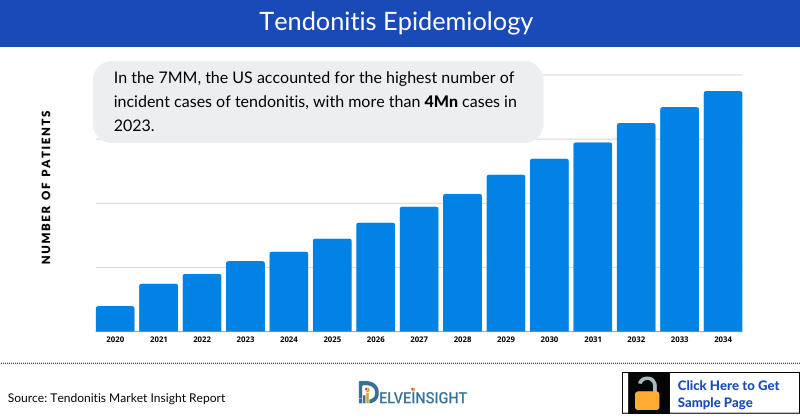
- In the 7MM, the US accounted for the highest number of incident cases of tendonitis, with more than 4 million cases in 2023.
- Tendonitis occurs more in males as compared to females.
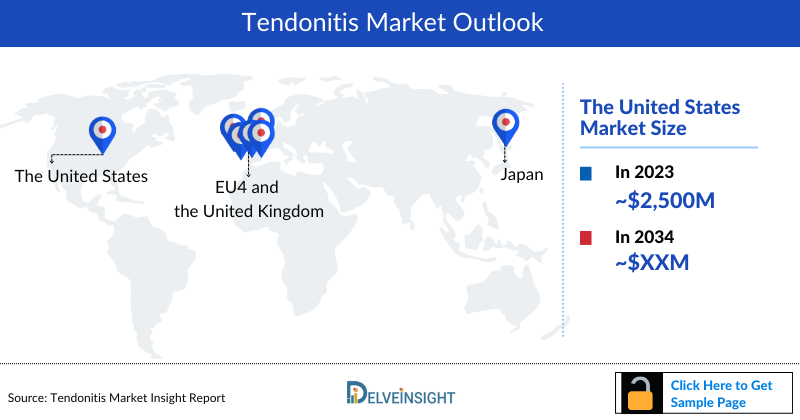
- In the 7MM, the US accounted for the largest market size of tendonitis with nearly USD 2,500 million in 2023.
- A few potential therapies are being investigated for the management of tendonitis. It is safe to assume that the future of this market is bright, and eventually, the upcoming therapies shall make a significant difference in the therapeutic landscape of tendonitis in the coming years.
- Delayed diagnosis of the disease and limitations associated with the current treatment are barriers to the market growth of tendonitis.
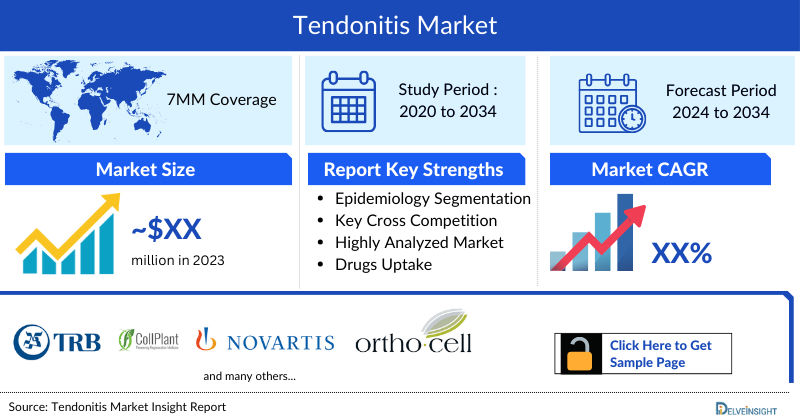
DelveInsight's “Tendonitis Market Insight, Epidemiology and Market Forecast – 2034” report delivers an in-depth understanding of tendonitis, historical and forecasted epidemiology as well as the tendonitis therapeutics market trends in the United States, EU4 (Germany, France, Italy, and Spain) and the United Kingdom, and Japan.
The tendonitis market report provides real-world prescription pattern analysis, emerging drugs, market share of individual therapies, and historical and forecasted 7MM tendonitis market size from 2020 to 2034. The report also covers current tendonitis treatment practices/algorithms and unmet medical needs to curate the best opportunities and assess the market’s underlying potential.
|
Study Period |
2020 to 2034 |
|
Forecast Period |
2024-2034 |
|
Geographies Covered |
|
|
Tendonitis Market |
|
|
Tendonitiss Market Size | |
|
Tendonitis Companies |
VERGENIXSTR, OSTENIL TENDON, Cosentyx, Tendon Cell Therapy, MiMedex Group Inc, MEDRx USA Inc, Cerimon Pharmaceuticals, InGeneron Inc, ZetrOZ Inc, ZARS Pharma Inc, Smith & Nephew Inc, and others. |
|
Tendonitis Epidemiology Segmentation |
|
Tendonitis Treatment Market
Tendonitis Overview, Country-Specific Treatment Guidelines and Diagnosis
Tendonitis is an inflammation of a tendon – a thick, flexible cord of tissue that attaches muscles to bone and assists in moving the bone or structure. Tendonitis most commonly occurs in the shoulder, bicep, elbow, hand, wrist, thumb, calf, knee, or ankle. Since the pain of tendonitis occurs near a joint, it is sometimes mistaken for arthritis. Some forms of tendonitis are named after certain sports e.g., tennis elbow, golfer’s elbow, pitcher’s shoulder, swimmer’s shoulder, and jumper’s knee.
The diagnosis of tendonitis made using X-ray and other imaging tests such as ultrasound or MRI may reveal swelling of the tendon sheath. An X-ray can show calcium deposits around the tendon, which may help confirm a diagnosis. These tests are often recommended when the patients do not respond to the RICE (Rest, Ice, Compression, and Elevation) treatment.
Further details related to country-based variations in diagnosis are provided in the report...
Tendonitis Treatment
Severe symptoms may require specialized treatment from a rheumatologist, an orthopedic surgeon, or a physical therapist. When properly treated, most types of tendonitis do not result in permanent joint damage or disability. Treatment options include RICE; physical or occupational therapy; and splints, braces, or slings – these assistive devices allow the affected area to rest until the pain eases. NSAIDs and corticosteroid injections are a mainstay for managing tendonitis pain after the failure of physical therapy and RICE.
Tendonitis Epidemiology
The tendonitis epidemiology chapter in the report provides historical as well as forecasted in the 7MM covering the United States, EU4 (Germany, France, Italy, and Spain) and the United Kingdom, and Japan from 2020 to 2034. The tendonitis epidemiology is segmented with detailed insights into total incident cases, total gender-specific cases, total region-specific cases, and total treated cases of tendonitis.
- In the 7MM, the US accounted for the highest number of incident cases of tendonitis, with more than 4 million cases in 2023.
- Tendonitis occurs more in males as compared to females.
- Among EU4 and the UK, the highest number of incident cases of tendonitis was observed in France, followed by the UK in 2023.
- Among the region-specific cases, most cases of tendonitis are of Achilles tendonitis.
Stay Informed on Tendonitis Epidemiology! Access comprehensive data on demographics and disease burden for effective healthcare planning.
Tendonitis Drug Chapter
The drug chapter segment of the tendonitis report encloses a detailed analysis of tendonitis-marketed drugs and late-stage (Phase III and Phase II) pipeline drugs. It also deep dives into the tendonitis pivotal clinical trial details, recent and expected market approvals, patent details, the latest news, and recent deals and collaborations.
Tendonitis Marketed Drugs
OSTENIL TENDON: TRB Chemedica
OSTENIL TENDON, a highly concentrated hyaluronic acid (2%), is designed to alleviate pain and restricted mobility in tendon disorders stemming from overuse or biomechanical stress. Its hyaluronic acid, mimicking the body's own, is produced through a non-animal-based biotechnological process, ensuring excellent tolerance. Each 2mL injection contains 40mg of sodium hyaluronate along with mannitol, a stabilizing agent that aids in preserving the hyaluronic acid chains. Developed with the collaboration of German orthopedic and trauma surgeons, Ostenil Tendon received CE certification as a medical device in 2011 for effectively addressing tendon-related pain and mobility issues.
VergenixSTR: CollPlant
VergenixSTR is a soft tissue repair matrix blending cross-linked rhCollagen with PRP, rich in platelets crucial for healing. Platelets carry growth factors vital for tissue regeneration, bone regrowth, and wound healing. Injected into the affected area, VergenixSTR forms a gel matrix, acting as a scaffold for cell growth and holding PRP in place near the injury site. This matrix activates platelets, releasing growth factors gradually for optimal healing. In the EU, it's approved for treating tendinopathy in various tendons like those in the elbow, rotator cuffs, patellar, Achilles, and hand.
|
Therapy Name |
Company Name |
ROA |
MOA |
Approval Year |
|
OSTENIL TENDON |
TRB Chemedica |
Injection |
Lubricating tendons and improving tendon function |
2011 |
|
VergenixSTR |
CollPlant |
Injection |
delayed degradation and enhanced retention |
2016 |
Explore the latest insights into the Tendonitis pipeline, emerging therapies, and future treatment potential. Stay informed today!
Tendonitis Emerging Drugs
Cosentyx (Secukinumab/AIN457): Novartis
Secukinumab, a human IgG1 monoclonal antibody, targets interleukin-17A (IL-17A), a cytokine involved in inflammatory and immune responses. By binding to IL-17A, it inhibits its interaction with the IL-17 receptor, reducing the release of pro-inflammatory cytokines and chemokines. IL-17A blockade has shown significant improvements in tendon structure and function in vivo, as observed through MRI and gait analysis after tendinopathy induction and treatment with anti-IL-17A antibody. Secukinumab is approved for various indications including ankylosing spondylitis and non-radiographic axial spondyloarthritis.
Currently, the company is investigating the drug for the treatment of rotator cuff tendinopathy in the Phase III clinical trial.
Tendon Cell Therapy: Orthocell
Autologous tendon therapy is a two-stage procedure. A biopsy of the healthy tendon, typically from the patella tendon, is performed in a doctor’s room using local anesthetic. The biopsied tissue is sent to Orthocell’s quality-controlled laboratory where the cellular building blocks of the tendon, the tenocytes, are isolated and grown to a clinically significant number under controlled conditions. Finally, the tendon cells are then implanted by injection into the affected tendon approximately 4 – 5 weeks after the initial biopsy via ultrasound-guided injection under local anesthetic.
The Phase IIb study is currently pending in the US.
Note: Detailed emerging therapies assessment will be provided in the final report...
|
Therapy Name |
Company Name |
ROA |
MOA |
Phases |
|
Cosentyx (secukinumab/AIN457) |
Novartis |
Subcutaneous |
Interleukin (IL)-17A inhibitor |
III |
|
Tendon Cell Therapy |
Orthocell |
Intravenous |
Cell Therapy |
IIb |
Tendonitis Market Outlook
The goals of tendonitis treatment are to relieve the pain and reduce inflammation. The self-care of tendonitis includes rest, ice, and over-the-counter (OTC) pain relievers. Pain relievers including aspirin, naproxen sodium (Aleve), or ibuprofen (Advil, Motrin IB, others) may relieve discomfort associated with tendonitis. Topical creams with anti-inflammatory medication – are popular in Europe and becoming increasingly available in the United States. Corticosteroids may be injected around a tendon to relieve tendonitis; injections of cortisone – naturally occurring corticosteroids – reduce inflammation and can help ease the pain. Platelet-rich plasma (PRP) is a well-known therapy for the treatment of tendinopathy.
A few potential therapies are being investigated for the management of tendonitis. It is safe to assume that the future of this market is bright, and eventually, the upcoming therapies shall make a significant difference in the therapeutic landscape of tendonitis in the coming years.
Key players, such as Novartis, Orthocell, Causeway Therapeutics, and others are evaluating their lead candidates in different stages of clinical development, respectively.
- The growth of the tendonitis disease market is expected to be mainly driven by the increase in the targeted patient pool and novel treatment approaches.
- In the 7MM, the US accounted for the largest market size of tendonitis with nearly USD 2,500 million in 2023.
- In 2023, Surgery + NSAIDs generated the highest revenue in the US.
- Delayed diagnosis of the disease and limitations associated with the current treatment are barriers to the market growth of tendonitis.
Tendonitis Drugs Uptake
This section focuses on the uptake rate of potential drugs expected to be launched in the market during 2024–2034, which depends on the competitive landscape, safety, and efficacy data along with order of entry. It is important to understand that the key players evaluating their novel therapies in the pivotal and confirmatory trials should remain vigilant when selecting appropriate comparators to stand the greatest chance of a positive opinion from regulatory bodies, leading to approval, smooth launch, and rapid uptake.
Further detailed analysis of emerging therapies drug uptake in the report…
Tendonitis Activities
The report provides insights into Tendonitis clinical trials within Phase III and Phase II stages. It also analyzes key players involved in developing targeted therapeutics.
Pipeline Development Activities
The report covers information on collaborations, acquisitions and mergers, licensing, and patent details for Tendonitis emerging therapies.
KOL Views
To keep up with the real-world scenario in current and emerging market trends, we take opinions from Key Industry leaders working in the domain through primary research to fill the data gaps and validate our secondary research. Industry Experts were contacted for insights on the evolving treatment landscape, patient reliance on conventional therapies, patient therapy switching acceptability, and drug uptake along with challenges related to accessibility.
DelveInsight’s analysts connected with 20+ KOLs to gather insights; however, interviews were conducted with 10+ KOLs in the 7MM. Their opinion helps understand and validate current and emerging treatment patterns of Tendonitis. This will support the clients in potential upcoming novel treatments by identifying the overall scenario of the market and the unmet needs.
|
Region |
KOL Views |
|
United States |
“When conditions do not get better with more conservative treatments, then sometimes consider using PRP”. This regenerative treatment involves taking a sample of the own blood, separating the platelets, and then re-injecting those healing elements into the affected area. While still relatively new to the field, it is quickly gaining popularity as an effective, non-surgical treatment for certain patients.” |
|
Spain |
“When we think of orthopedic injury, we often think surgery is the only option. However, “a large majority of orthopedic injuries are nonsurgical’’. “Many times these injuries improve without surgical intervention.” The same holds for tendonitis. For minor injuries, try the RICE method.” |
|
Japan |
“The most common symptom of knee Tendonitis is pain with movement. Certain medications including over-the-counter non-steroidal anti-inflammatory medications, such as ibuprofen and naproxen are recommended. They not only reduce the swelling but also relieve pain. Some of the medications are Advil, Motrin, and Aleve.” |
Qualitative Analysis
We perform Qualitative and market Intelligence analysis using various approaches, such as SWOT analysis and Conjoint Analysis. In the SWOT analysis, strengths, weaknesses, opportunities, and threats in terms of gaps in disease diagnosis, patient awareness, physician acceptability, competitive landscape, cost-effectiveness, and geographical accessibility of therapies are provided.
Conjoint Analysis analyzes multiple approved and emerging therapies based on relevant attributes such as safety, efficacy, frequency of administration, route of administration, and order of entry. Scoring is given based on these parameters to analyze the effectiveness of therapy.
Further, the therapies’ safety is evaluated wherein the acceptability, tolerability, and adverse events are majorly observed, and it sets a clear understanding of the side effects posed by the drug in the trials. In addition, the scoring is also based on the probability of success, and the addressable patient pool for each therapy. According to these parameters, the final weightage score and the ranking of the emerging therapies are decided.
Market Access and Reimbursement
The report further provides detailed insights on the country-wise accessibility and reimbursement scenarios, cost-effectiveness scenario of currently used therapies, programs making accessibility easier and out-of-pocket costs more affordable, insights on patients insured under federal or state government prescription drug programs, etc.
Scope of the Tendonitis Market Report
- The report covers a segment of key events, an executive summary, descriptive overview of Tendonitis, explaining its causes, signs and symptoms, pathogenesis, and currently available therapies.
- Comprehensive insight has been provided into the epidemiology segments and forecasts, the future growth potential of diagnosis rate, and disease progression along with country-specific treatment guidelines.
- Additionally, an all-inclusive account of both the current and emerging therapies, along with the elaborative profiles of late-stage and prominent therapies, will have an impact on the current treatment landscape.
- A detailed review of the Tendonitis market, historical and forecasted market size, market share by therapies, detailed assumptions, and rationale behind our approach is included in the report, covering the 7MM drug outreach.
- The report provides an edge while developing business strategies, by understanding trends, through SWOT analysis and expert insights/KOL views, patient journey, and treatment preferences that help in shaping and driving the 7MM Tendonitis market.
Tendonitis Report Insights
- Tendonitis Patient Population
- Tendonitis Therapeutic Approaches
- Tendonitis Pipeline Analysis
- Tendonitis Market Size and Trends
- Existing and future Market Opportunity
Tendonitis Report Key Strengths
- Eleven Years Forecast
- 7MM Coverage
- Tendonitis Epidemiology Segmentation
- Inclusion of Country specific treatment guidelines
- KOL’s feedback on approved and emerging therapies
- Key Cross Competition
- Conjoint analysis
- Tendonitis Drugs Uptake
- Key Tendonitis Market Forecast Assumptions
Tendonitis Report Assessment
- Current Tendonitis Treatment Practices
- Tendonitis Unmet Needs
- Tendonitis Pipeline Product Profiles
- Tendonitis Market Attractiveness
- Qualitative Analysis (SWOT and Conjoint Analysis)
- Tendonitis Market Drivers
- Tendonitis Market Barriers
FAQs
- What is the growth rate of the 7MM Tendonitis treatment market?
- What was the Tendonitis total market size, the market size by therapies, market share (%) distribution in 2020, and what would it look like in 2034? What are the contributing factors/key catalysts for this growth?
- Is there any unexplored patient setting that can open the window for growth in the future?
- What are the pricing variations among different geographies for approved and off-label therapies?
- How would the market drivers, barriers, and future opportunities affect the market dynamics and subsequent analysis of the associated trends? Although multiple expert guidelines recommend testing for targetable mutations before therapy initiation, why do barriers to testing remain high?
- What are the current and emerging options for the treatment of Tendonitis?
- How many companies are developing therapies for the treatment of Tendonitis?
- What are the recent novel therapies, targets, mechanisms of action, and technologies developed to overcome the limitations of existing therapies?
- Patient/physician acceptability in terms of preferred treatment options as per real-world scenarios?
- What are the country-specific accessibility issues of expensive, recently approved therapies?
Reasons to buy Tendonitis Market Forecast Report:
- The report will help in developing business strategies by understanding the latest trends and changing treatment dynamics driving the Tendonitis Market.
- Insights on patient burden/disease incidence, evolution in diagnosis, and factors contributing to the change in the epidemiology of the disease during the forecast years
- Understand the existing market opportunities in varying geographies and the growth potential over the coming years.
- Distribution of historical and current patient share based on real-world prescription data along with reported sales of approved products in the US, EU4 (Germany, France, Italy, and Spain), the United Kingdom, and Japan.
- Identifying strong upcoming players in the market will help devise strategies to help get ahead of competitors.
- Detailed analysis and ranking of class-wise potential current and emerging therapies under the conjoint analysis section to provide visibility around leading classes.
- Highlights of access and reimbursement policies of approved therapies, barriers to accessibility of expensive off-label therapies, and patient assistance programs.
- To understand Key Opinion Leaders’ perspectives around the accessibility, acceptability, and compliance-related challenges of existing treatment to overcome barriers in the future.
- Detailed insights on the unmet needs of the existing market so that the upcoming players can strengthen their development and launch strategy.