Growth Hormone Deficiency Market is Expected to Reach USD 3,304 million by 2034
Get a Sneak Peek at the Latest growth hormone deficiency market size Report
The Growth Hormone Deficiency market across the seven major markets (7MM) is poised for substantial expansion over the next decade. Valued at approximately USD 1.4 billion in 2023, the Growth Hormone Deficiency market is expected to grow from USD 1,626 million in 2025 to USD 3,304 million by 2034, reflecting a compound annual growth rate (CAGR) of 5.7%.
This steady growth will be driven by several factors, including the introduction of novel therapies such as LUM-201 and SCO-240, advancements in diagnosis, and an increasing prevalence of Growth Hormone Deficiency due to improved survival rates of premature infants, rising pituitary disorders, and exposure to endocrine-disrupting chemicals.
In 2023, DelveInsight estimated around 206,000 prevalent cases of GHD across the 7MM, of which about 165,000 were diagnosed. The United States accounted for the largest share (42.5%), followed by the EU4 and UK (41.7%), and Japan (15.8%).
Current treatment options mainly include somatotropin, SOGROYA, SKYTROFA/TRANSCON hGH, NGENLA, and GROWJECT, which are primarily administered via subcutaneous injections—either daily or weekly. However, daily dosing challenges, especially among pediatric patients, have spurred the development of long-acting and oral formulations aimed at improving adherence.
Key players such as Lumos Pharma and SCOHIA PHARMA are advancing innovative treatment candidates through clinical trials. Notably, in November 2024, Lumos Pharma presented updated Phase II data for its oral therapy LUM-201 (ibutamoren) in pediatric GHD at the European Society for Paediatric Endocrinology (ESPE) meeting.
Overall, the Growth Hormone Deficiency market is set for consistent growth through 2034, with the United States remaining the largest contributor, supported by a strong pipeline and ongoing innovations in drug delivery and formulation.
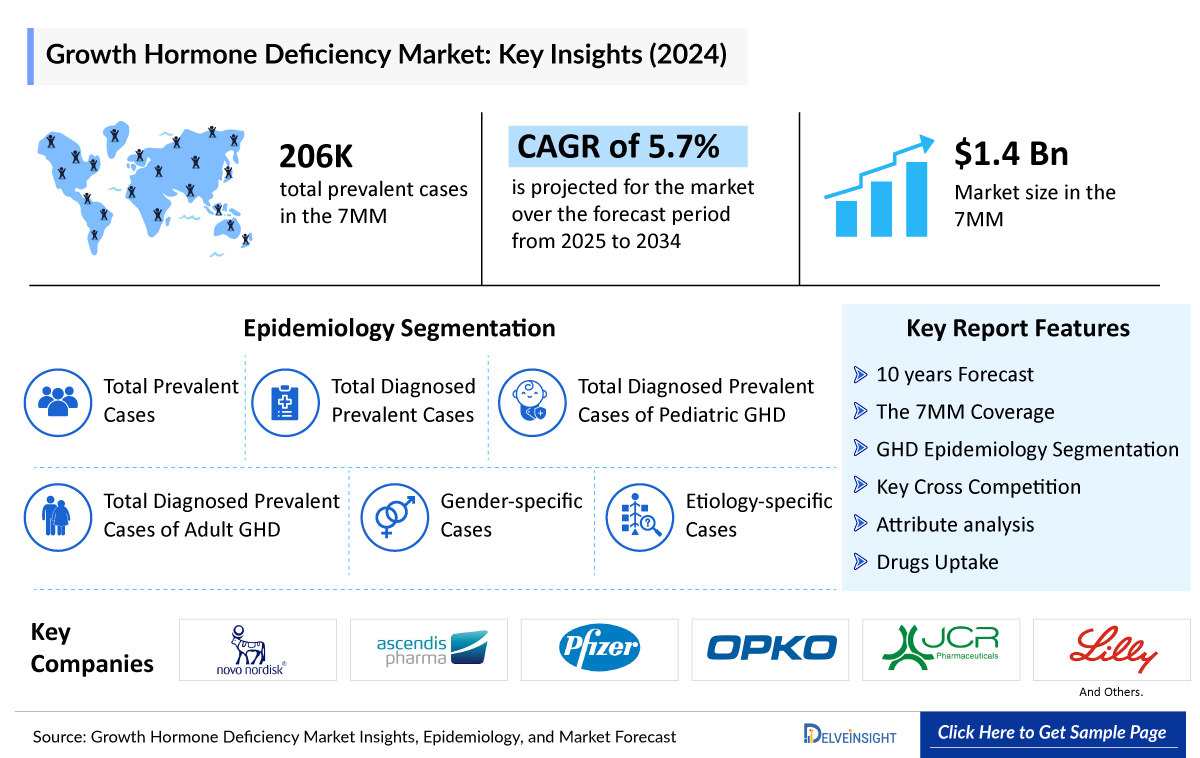
DelveInsight’s “Growth Hormone Deficiency Market Insights, Epidemiology, and Market Forecast-2034″ report offers an in-depth understanding of the Growth Hormone Deficiency, historical and forecasted epidemiology as well as the Growth Hormone Deficiency market trends in the United States, EU5 (Germany, Spain, Italy, France, and United Kingdom) and Japan.
Some of the key facts of the Growth Hormone Deficiency Market Report:
- In 2023, the Growth Hormone Deficiency (GHD) market across the seven major markets (7MM) was valued at approximately USD 1.4 billion.
- The market is projected to expand at a CAGR of 5.7% between 2025 and 2034, driven by therapeutic advancements and increased disease awareness.
- The United States represented the largest market, valued at USD 873.4 million in 2023, with further expansion expected as new therapies gain approval.
- The EU4 and UK collectively accounted for nearly USD 370.2 million, contributing around 27% of the overall 7MM market.
- Within Europe, Germany led with USD 96.5 million, followed by the UK (USD 86.2 million) and France (USD 82.0 million).
- The Japanese GHD market was estimated at USD 137 million in 2023 and is expected to exhibit steady growth through 2034.
- LUM-201, an oral candidate under development, is projected to generate approximately USD 131.1 million in revenue across the 7MM by 2034.
- The existing treatment landscape comprises somatotropin, SOGROYA, SKYTROFA/TRANSCON hGH, NGENLA, and GROWJECT, among others.
- Upcoming therapies, including SCO-240 and LUM-201, are expected to enhance patient adherence and diversify administration options beyond daily subcutaneous injections.
- In 2023, the total prevalent GHD population across the 7MM was estimated at ~206,000 cases, with ~165,000 diagnosed.
- The United States accounted for 42.5% of the diagnosed population, followed by EU4 and the UK (41.7%) and Japan (15.8%).
- The overall prevalence is expected to rise at a modest CAGR of 0.4% through 2034, reflecting improvements in diagnostic capabilities and awareness.
- Pediatric GHD: The U.S. represented ~51% of diagnosed pediatric cases, EU4 and the UK accounted for ~36%, and Japan contributed ~13%.
- Adult GHD: The U.S. comprised ~40% of adult diagnosed cases, EU4 and the UK collectively contributed ~43%, and Japan made up ~17%.
- Leading Companies: Novo Nordisk, Ascendis Pharma, Lumos Pharma (Double Point Ventures), SCOHIA PHARMA, among others.
- Key Therapies: SOGROYA (somapacitan-beco), SKYTROFA/TRANSCON hGH (lonapegsomatropin-tcgd), LUM-201 (ibutamoren), SCO-240, etc.
- Market expansion is underpinned by rising prevalence rates, enhanced diagnostic awareness, and the commercialization of next-generation therapies.
- The launch of multiple late- and mid-stage pipeline assets is expected to reshape the competitive landscape, improve treatment adherence, and broaden patient access.
Growth Hormone Deficiency Overview
Growth Hormone Deficiency (GHD) is a medical condition in which the body doesn't produce enough growth hormone, a key hormone responsible for growth, cell repair, and metabolism. It can occur in both children and adults. In children, GHD leads to slowed growth and short stature, while in adults, it may cause fatigue, reduced muscle mass, increased fat, and poor bone density. Causes can include genetic disorders, brain injuries, or tumors. Treatment typically involves daily injections of synthetic growth hormone to restore normal growth and metabolic function.
Growth Hormone Deficiency Epidemiology
In 2023, DelveInsight estimated approximately 206,000 prevalent cases of Growth Hormone Deficiency (GHD) across the seven major markets (7MM), with 165,000 diagnosed cases. Both figures are projected to increase modestly at a CAGR of 0.4% through 2034.
Across the 7MM, the United States accounted for the highest share of diagnosed cases, representing 51% of pediatric and 40% of adult GHD cases. The EU4 and the UK contributed around 36% of pediatric and 43% of adult cases, while Japan comprised 13% of pediatric and 17% of adult cases.
By gender, in 2023, the U.S. reported approximately 49,000 male and 21,000 female GHD cases, while the EU4 and UK recorded about 42,000 male and 26,000 female cases—both expected to increase by 2034.
Within Europe, around 62,000 idiopathic and 7,000 organic GHD cases were identified in 2023. In Japan, there were approximately 21,000 diagnosed adult cases, also projected to rise over the forecast period.
Growth Hormone Deficiency Epidemiology Segmentation:
The Growth Hormone Deficiency market report proffers epidemiological analysis for the study period 2020–2034 in the 7MM segmented into:
- Total Prevalence of Growth Hormone Deficiency
- Prevalent Cases of Growth Hormone Deficiency by severity
- Gender-specific Prevalence of Growth Hormone Deficiency
- Diagnosed Cases of Episodic and Chronic Growth Hormone Deficiency
Download the report to understand which factors are driving Growth Hormone Deficiency epidemiology trends @ Growth Hormone Deficiency Epidemiological Insights
Growth Hormone Deficiency Therapies and Companies
- Novo Nordisk: SOGROYA (somapacitan-beco)
- Ascendis Pharma: SKYTROFA/TRANSCON hGH (lonapegsomatropin-tcgd)
- Double Point Ventures (Lumos Pharma): LUM-201 (ibutamoren)
- SCOHIA PHARMA: SCO-240
To know more about Growth Hormone Deficiency treatment, visit @ Growth Hormone Deficiency Medications
Growth Hormone Deficiency (GHD) Market Drivers
- Rising Disease Prevalence and Improved Diagnosis
Growing awareness and advancements in diagnostic tools have increased the identification of both pediatric and adult GHD cases. Moreover, Enhanced survival rates of preterm infants and increasing incidences of pituitary or hypothalamic disorders are contributing to higher prevalence levels.
- Therapeutic Advancements and Pipeline Expansion
The introduction of next-generation therapies such as LUM-201 (oral formulation) and SCO-240 (long-acting agent) is expected to transform the treatment landscape. Also, a strong pipeline with multiple late- and mid-stage candidates is poised to drive market growth through improved efficacy and patient convenience.
- Shift Toward Long-Acting and Oral Growth Hormone Formulations
Development of weekly, monthly, and oral GH therapies aims to reduce the burden of daily injections, enhancing adherence, especially in pediatric populations. Also, the increased investment in drug delivery innovation is expected to expand market adoption.
- Strong Commercial Presence of Leading Players
Companies such as Novo Nordisk, Ascendis Pharma, Pfizer, and Lumos Pharma continue to dominate the segment through robust product portfolios, global distribution networks, and active R&D pipelines.
- Growing Awareness and Screening Programs
Awareness campaigns, pediatric screening initiatives, and improved healthcare infrastructure in developed markets are supporting early detection and intervention.
Growth Hormone Deficiency (GHD) Market Barriers
- High Treatment Costs and Reimbursement Challenges
The elevated cost of long-term growth hormone therapy poses significant financial burden, particularly in regions with limited insurance coverage or restrictive reimbursement policies.
- Adherence and Compliance Issues
Daily subcutaneous injections often result in poor adherence, especially among children and adolescents, reducing overall treatment effectiveness.
- Limited Diagnosis in Adults
Adult GHD remains underdiagnosed due to nonspecific symptoms such as fatigue and metabolic imbalance, leading to missed or delayed treatment opportunities.
- Safety Concerns and Adverse Effects
Long-term GH therapy can be associated with side effects such as edema, joint pain, and insulin resistance, potentially impacting treatment continuation rates.
- Regulatory and Developmental Hurdles
Complex clinical trial requirements and stringent regulatory approvals can delay product launches and increase development costs, limiting entry for smaller biotech firms.
- Market Saturation in Developed Economies
The presence of multiple established brands in mature markets, coupled with limited patient pools, creates competitive pressure and pricing constraints for new entrants.
Need more?
- ✅ Connect with our analyst to learn how this research was developed
- ✅ Expand the scope with additional segments or countries through free customization
- ✅ Discover how this report can directly influence your business growth
Related Reports

Adult-Onset Growth Hormone Deficiency - Pipeline Insight, 2025
"Adult-Onset Growth Hormone Deficiency Pipeline Insights, 2025" report by DelveInsight outlays comprehensive insights of present clinical development scenario and growth prospects across..
-pipeline.png&w=256&q=75)
Adult Growth Hormone Deficiency (AGHD) - Pipeline Insight, 2025
Adult Growth Hormone Deficiency (AGHD) Pipeline Insights, 2025 report by DelveInsight outlays comprehensive insights of present clinical development scenario and growth prospects across the..
