Metastatic Triple-Negative Breast Cancer Market Positioned for Accelerated Development Through 2034, DelveInsight Finds
Get a Sneak Peek at the Latest metastatic triple negative breast cancer market insights Report
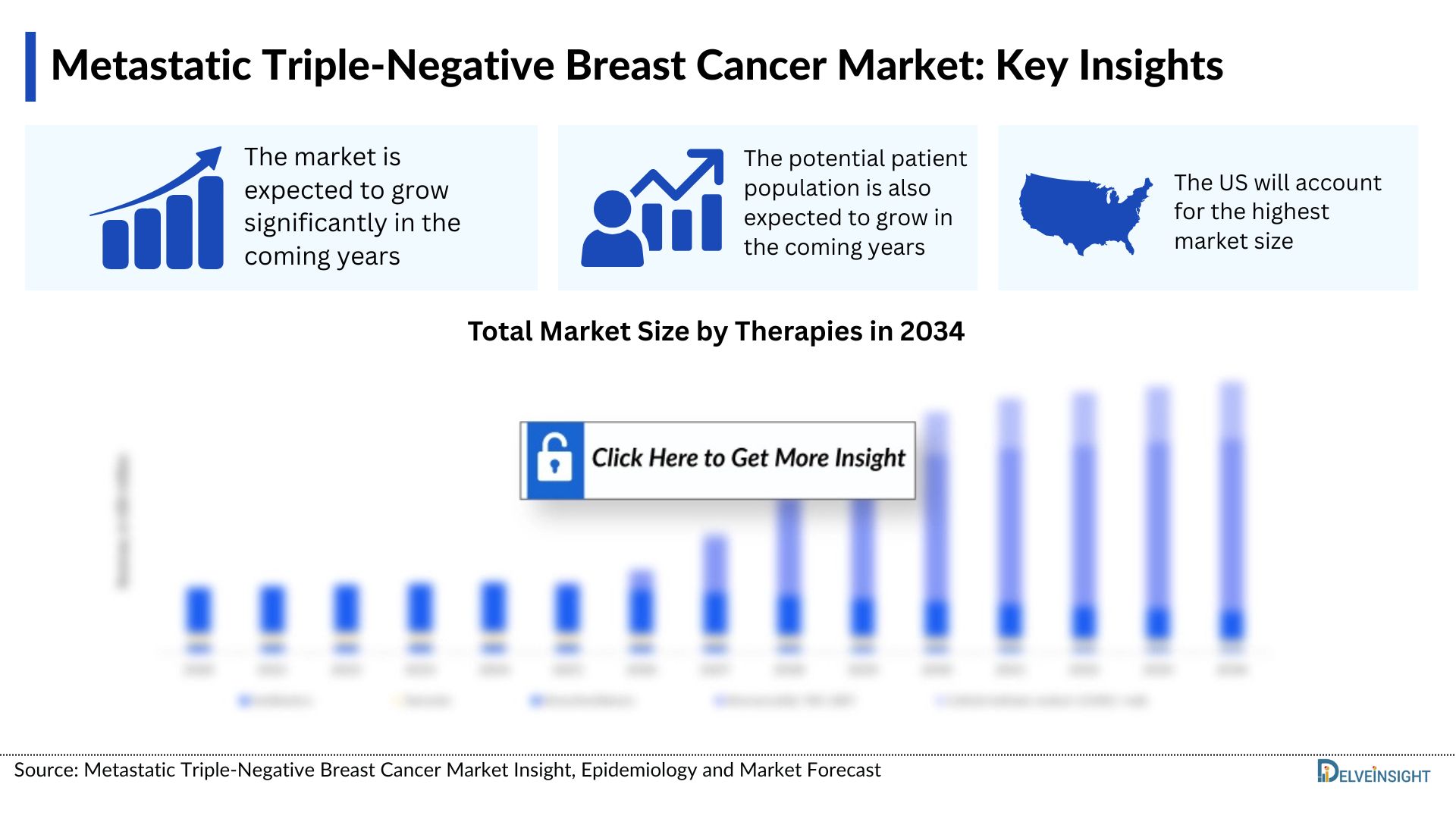
The metastatic triple-negative breast cancer (mTNBC) market is projected to grow at a robust CAGR during the forecast period (2025–2034). DelveInsight's comprehensive market research provides critical insights into such market trends, enabling stakeholders to understand growth drivers, emerging opportunities, and potential challenges within the metastatic triple-negative breast cancer landscape.
By analyzing historical data, current market dynamics, and future projections, DelveInsight equips pharmaceutical companies, investors, and healthcare professionals with actionable intelligence to make informed strategic decisions, identify investment opportunities, optimize product positioning, and plan research and development initiatives effectively.
The metastatic triple-negative breast cancer market is increasingly guided by innovative immunotherapy and antibody-drug conjugate therapies. Sacituzumab govitecan (TRODELVY) represents the dominant revenue-generating therapeutic agent, established as a first-in-class Trop-2-directed antibody-drug conjugate with exceptional clinical efficacy in relapsed/refractory mTNBC. Recent phase III ASCENT-04/KEYNOTE-D19 trial results in 2025 demonstrated that sacituzumab govitecan combined with pembrolizumab significantly improved progression-free survival compared to chemotherapy plus pembrolizumab, further solidifying its market position. The compound is projected to generate peak annual sales exceeding USD 400 million across the 7MM.
DelveInsight's report, "Metastatic Triple-Negative Breast Cancer Market Insights, Epidemiology, and Market Forecast-2034," provides a comprehensive analysis of the metastatic triple-negative breast cancer landscape. The report delivers detailed insights into the disease, including historical and projected epidemiology, helping stakeholders understand the prevalence, incidence, and patient demographics across key regions.
Additionally, it examines metastatic triple-negative breast cancer market dynamics, offering a thorough assessment of current and emerging market trends, treatment patterns, and therapeutic developments. The analysis spans major markets, including the United States, EU4 (Germany, France, Italy, and Spain), the United Kingdom, and Japan, equipping decision-makers with actionable intelligence for strategic planning, investment, and research initiatives.
To know in detail about the metastatic triple-negative breast cancer market outlook, drug uptake, treatment scenario and epidemiology trends, visit Metastatic Triple-Negative Breast Cancer Market Forecast
Some of the key facts of the Metastatic Triple-Negative Breast Cancer Market Report:
- Key Metastatic Triple-Negative Breast Cancer Companies: Gilead Sciences, Merck & Co., Roche/Genentech, Bristol Myers Squibb, AstraZeneca, G1 Therapeutics, Daiichi Sankyo, Nuvation Bio Inc., Tubulis, Sesen Bio, and others
- Key Metastatic Triple-Negative Breast Cancer Therapies: Sacituzumab govitecan (TRODELVY), Pembrolizumab (KEYTRUDA), Atezolizumab (TECENTRIQ), Olaparib (Lynparza), Talazoparib (Talzenna), Patritumab Deruxtecan, NUV-868, Capivasertib, Niraparib (Zejula), and others
- The metastatic triple-negative breast cancer market is expected to surge due to the disease's high prevalence and mortality rate, particularly among African American women, combined with expanding treatment options during the forecast period. Furthermore, launching various multiple-stage metastatic triple-negative breast cancer pipeline products with novel mechanisms will significantly revolutionize the metastatic triple-negative breast cancer market dynamics.
Metastatic Triple-Negative Breast Cancer Overview
Metastatic triple-negative breast cancer (mTNBC) is an aggressive form of breast cancer that lacks the three common receptors—estrogen receptors, progesterone receptors, and human epidermal growth factor receptor 2 (HER2)—that drive other breast cancer subtypes, making it particularly challenging to treat. Triple-negative breast cancer accounts for approximately 10–15% of all breast cancer cases, with incidence of 14.5 cases per 100,000 women in the United States, yet demonstrates significantly lower survival rates compared to other breast cancer subtypes. When TNBC progresses to the metastatic stage, prognosis becomes especially poor, with limited treatment responses, high recurrence rates, and 5-year survival rates 8–16% lower than hormone receptor-positive disease. The condition disproportionately affects African American women, with an incidence of 25.8 per 100,000, compared to non-Hispanic populations. Risk factors include younger age at diagnosis, genetic predisposition including BRCA1/2 mutations, family history of breast cancer, and various modifiable risk factors. Early detection through advanced screening strategies and access to innovative immunotherapies and antibody-drug conjugates significantly improve patient outcomes and survival rates.
Key Trends in Metastatic Triple-Negative Breast Cancer Therapeutics Market:
- Rising Adoption of Antibody-Drug Conjugates: Increasing use of Trop-2-directed ADCs such as sacituzumab govitecan as first-line and subsequent-line therapies for mTNBC with proven clinical superiority.
- Immunotherapy Expansion: Growing uptake of immune checkpoint inhibitors (pembrolizumab, atezolizumab, toripalimab) in combination with chemotherapy or novel ADCs for improved efficacy.
- PARP Inhibitor Integration: Expanding adoption of PARP inhibitors (olaparib, talazoparib, niraparib) in BRCA-mutated TNBC and broader populations through precision medicine approaches.
- Combination Therapy Paradigm: Shift toward ADC plus immunotherapy combinations demonstrating superior progression-free and overall survival compared to monotherapy approaches.
- Precision Medicine & Biomarker Testing: Enhanced molecular diagnostics enabling patient stratification based on PD-L1 expression, BRCA mutations, and Trop-2 expression levels.
- Pipeline Innovation: Development of novel mechanisms including next-generation ADCs with improved linker technology, bispecific antibodies, and PI3K-Akt inhibitors to overcome resistance.
Metastatic Triple-Negative Breast Cancer Epidemiology
The report on metastatic triple-negative breast cancer epidemiology provides a comprehensive analysis of the disease's prevalence, incidence, and patient demographics. It includes age- and gender-specific distribution, racial and ethnic trends, regional and global patterns, and data on disease severity and progression rates. The report also highlights risk factors, disease burden, and projections for future trends, helping stakeholders understand the scope of metastatic triple-negative breast cancer and plan targeted interventions, research, and treatment strategies.
Metastatic Triple-Negative Breast Cancer Epidemiology Segmentation:
The metastatic triple-negative breast cancer market report proffers epidemiological analysis for the study period 2020–2034 in the 7MM segmented into:
- Total Incidence of Breast Cancer in the 7MM
- Stage-specific Incidence of Metastatic Triple-negative Breast Cancer in the 7MM
- Incidence of Metastatic Triple-negative Breast Cancer in the 7MM
- Age-specific Incidence of Metastatic Triple-negative Breast Cancer in the 7MM
- Incidence of Metastatic Triple-negative Breast Cancer Cases by
- Hormonal Status in the 7MM
- Line-wise Treatment-eligible Pool for Metastatic Triple-negative Breast Cancer in the 7MM
Download the report to understand which factors are driving metastatic triple-negative breast cancer epidemiology trends @ Metastatic Triple-Negative Breast Cancer Epidemiology Forecast
Recent Developments In The Metastatic Triple-Negative Breast Cancer Treatment Landscape:
- In January 2026, Gilead Sciences announced that Sacituzumab Govitecan (TRODELVY) was added as a preferred regimen within first-line metastatic triple-negative breast cancer (mTNBC) treatment according to clinical guidelines, representing significant market validation and accelerated adoption potential.
- In May 2025, at the 2025 ASCO meeting, Gilead announced positive results from the Phase III ASCENT-04/KEYNOTE-D19 study, demonstrating that sacituzumab govitecan combined with pembrolizumab significantly improved progression-free survival (PFS) compared to chemotherapy plus pembrolizumab in first-line mTNBC, establishing a new standard-of-care combination.
- In November 2025, Gilead provided an update on the Phase 3 ASCENT-07 study of sacituzumab govitecan, showing robust efficacy and manageable safety profile with serious adverse reactions (SAR) reported in 28% of patients and 6% discontinuing due to adverse reactions, with the most common Grade 3–4 lab abnormalities being reduced neutrophils and leukocytes.
Metastatic Triple-Negative Breast Cancer Drugs Uptake and Pipeline Development Activities
The drugs uptake section focuses on the rate of uptake of potential metastatic triple-negative breast cancer drugs expected to be launched in the market during 2025–2034. The analysis covers metastatic triple-negative breast cancer market uptake by drugs, patient uptake by therapies, and sales of each drug. Sacituzumab govitecan demonstrates rapid and sustained uptake across treatment lines, with recent combination data accelerating first-line adoption. Pembrolizumab maintains steady market penetration in PD-L1-positive populations, while emerging ADCs and next-generation immunotherapy combinations are expected to capture increasing market share.
Moreover, the therapeutics assessment section helps understand the drugs with the most rapid uptake and the reasons behind maximal use, with ADCs demonstrating superior efficacy over conventional chemotherapy. Additionally, it compares the drugs based on market share and identifies therapeutic classes with greatest commercial potential through 2034.
The report also covers metastatic triple-negative breast cancer pipeline development activities, providing valuable insights about different therapeutic candidates in various stages and the key companies involved in developing targeted therapeutics. It analyzes recent developments including collaborations, acquisitions, mergers, licensing, patent details, and other information for emerging therapies.
Metastatic Triple-Negative Breast Cancer Therapies and Key Companies
- Sacituzumab govitecan (TRODELVY): Gilead Sciences
- Pembrolizumab (KEYTRUDA): Merck & Co.
- Atezolizumab (TECENTRIQ): Roche / Genentech
- Olaparib (Lynparza): AstraZeneca
- Talazoparib (Talzenna): Pfizer / Astellas Pharma
- Toripalimab (Loqtorz): Coherus BioSciences
- Patritumab Deruxtecan (Patritumab DXd): Daiichi Sankyo / Merck
- Capivasertib (Truqap): AstraZeneca
- Niraparib (Zejula): GlaxoSmithKline
- NUV-868: Nuvation Bio Inc.
- TUB-030: Tubulis
- Checkpoint Inhibitors (various PD-1/PD-L1 agents): Bristol Myers Squibb, Roche, AstraZeneca
- G1 Therapeutics pipeline compounds: G1 Therapeutics
- PharmAbcine/Merck pipeline agents: PharmAbcine
To know more about metastatic triple-negative breast cancer companies working in the treatment market, visit @ Metastatic Triple-Negative Breast Cancer Clinical Trials and Therapeutic Assessment
Metastatic Triple-Negative Breast Cancer Market Drivers
- Increasing prevalence of metastatic triple-negative breast cancer globally with approximately 14.5 cases per 100,000 women in the United States and disproportionate impact on African American populations at 25.8 per 100,000 women, creating large patient populations driving market demand.
- Growth of pharmaceutical innovations addressing previously unmet medical needs with diverse therapeutic mechanisms including antibody-drug conjugates, checkpoint inhibitors, PARP inhibitors, and PI3K-Akt inhibitors with proven clinical superiority.
- Expansion of combination therapy paradigms, particularly ADC plus immunotherapy combinations demonstrating superior progression-free and overall survival outcomes compared to monotherapy approaches.
- Rising disease awareness and improved diagnostic capabilities enabling earlier identification of metastatic disease and initiation of novel treatment regimens.
- Development of companion diagnostics facilitating patient stratification based on biomarker status (PD-L1 expression, BRCA mutations, Trop-2 expression, PI3K-Akt pathway mutations).
- Strong clinical trial pipeline with over 1,000 active clinical trials exploring immunotherapy and novel mechanism combinations, promising rapid introduction of new therapies and label expansions.
Metastatic Triple-Negative Breast Cancer Market Barriers
- High cost of advanced therapies limiting patient access, particularly in emerging markets and among underinsured populations in developed countries.
- Complex regulatory approval processes and lengthy clinical trial designs requiring multi-year development timelines.
- Treatment-related toxicities and safety concerns, particularly neutropenia with sacituzumab govitecan requiring proactive G-CSF management and dose modifications.
- Limited awareness and accessibility of newer therapies in certain geographic regions with lower oncology infrastructure.
- Variable patient response and emerging resistance mechanisms due to heterogeneous disease biology and tumor microenvironment complexity.
- Preference for conventional chemotherapy in some regions despite inferior outcomes, driven by cost considerations and physician familiarity.
- Reimbursement challenges and payer skepticism regarding cost-effectiveness of expensive ADCs and emerging mechanisms despite superior clinical benefits.
Scope of the Metastatic Triple-Negative Breast Cancer Market Report
- Study Period: 2020–2034
- Coverage: 7MM [The United States, EU4 (Germany, France, Italy, and Spain), the United Kingdom, and Japan]
- Key Metastatic Triple-Negative Breast Cancer Companies: Gilead Sciences, Merck & Co., Roche/Genentech, Bristol Myers Squibb, AstraZeneca, G1 Therapeutics, Daiichi Sankyo, Nuvation Bio Inc., Tubulis, Sesen Bio, and others
- Key Metastatic Triple-Negative Breast Cancer Therapies: Sacituzumab govitecan (TRODELVY), Pembrolizumab (KEYTRUDA), Atezolizumab (TECENTRIQ), Olaparib (Lynparza), Talazoparib (Talzenna), Patritumab Deruxtecan, NUV-868, Capivasertib, Niraparib (Zejula), and others
- Metastatic Triple-Negative Breast Cancer Therapeutic Assessment: Metastatic triple-negative breast cancer current marketed and metastatic triple-negative breast cancer emerging therapies
- Metastatic Triple-Negative Breast Cancer Market Dynamics: Metastatic triple-negative breast cancer market drivers and metastatic triple-negative breast cancer market barriers
- Competitive Intelligence Analysis: SWOT analysis, PESTLE analysis, Porter's five forces, BCG Matrix, Market entry strategies
- Metastatic Triple-Negative Breast Cancer Unmet Needs, KOL's views, Analyst's views, Metastatic Triple-Negative Breast Cancer Market Access and Reimbursement
Discover more about therapies set to grab major metastatic triple-negative breast cancer market share @ Metastatic Triple-Negative Breast Cancer Treatment Market
Need more?
- ✅ Connect with our analyst to learn how this research was developed
- ✅ Expand the scope with additional segments or countries through free customization
- ✅ Discover how this report can directly influence your business growth
Related Reports
-market.png&w=256&q=75)
Metastatic triple-negative breast cancer (mTNBC) - Market Insight, Epidemiology And Market Forecast - 2034
Metastatic triple-negative breast cancer (mTNBC) Market Report, 2034 delivers an in-depth understanding of the historical and forecasted epidemiology as well as the market trends in the 7MM
