Ambulance Services Market Summary
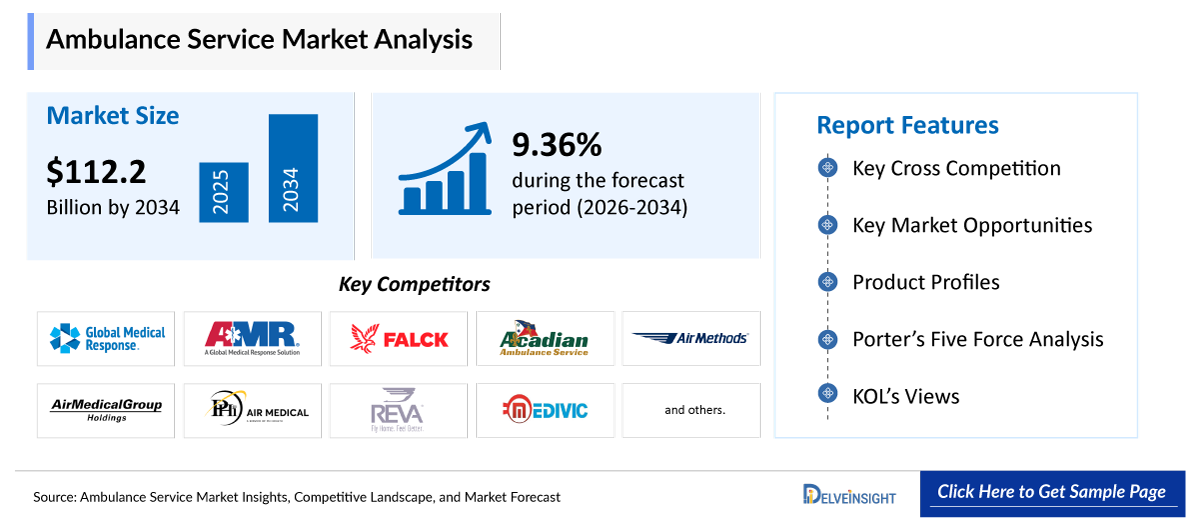
- The global ambulance service market is expected to increase from USD 50,457.53 million in 2025 to USD 112,288.35 million by 2034, reflecting strong and sustained growth.
- The global ambulance service market is growing at a CAGR of 9.36% during the forecast period from 2026 to 2034.
- The ambulance services market is primarily driven by the rising incidence of road accidents and trauma cases, along with the increasing prevalence of chronic diseases such as cardiovascular disorders and respiratory conditions that require urgent medical attention. The growing geriatric population further contributes to demand, as elderly individuals are more prone to medical emergencies and require frequent hospital transport. Additionally, expanding healthcare infrastructure and higher healthcare spending are improving access to emergency medical services. Rapid urbanization and traffic congestion are also increasing reliance on ambulances for timely care. Moreover, advancements in technologies such as GPS-enabled tracking and telemedicine, along with supportive government initiatives and rising public awareness about emergency care, are significantly boosting the growth of the ambulance services market.
- The leading companies operating in the ambulance service market include Global Medical Response (GMR), American Medical Response (AMR), Falck A/S, Acadian Ambulance Service, Air Methods Corporation, Air Medical Group Holdings, PHI Air Medical, REVA Air Ambulance, Scandinavian AirAmbulance, Medivic Aviation, Ziqitza Health Care Ltd., GVK Emergency Management and Research Institute (GVK EMRI), BVG India Ltd., Express Ambulance Services, Lifeline Ambulance Services, London Ambulance Service NHS Trust, St John Ambulance (Australia), SA Ambulance Service, National Ambulance LLC, Dutch Health B.V., and others.
- North America is expected to dominate the ambulance services market due to its well-established healthcare infrastructure, high healthcare expenditure, strong presence of advanced emergency medical service (EMS) systems, and increasing prevalence of chronic diseases and trauma cases, along with the widespread adoption of technologically advanced ambulances and supportive government policies.
- In the transport vehicle type segment of the ambulance service market, the ground ambulances category is estimated to account for the largest market share in 2025.
Ambulance Service Market Size and Forecasts
|
Report Metrics |
Details |
|
2025 Market Size |
USD 50,457.53 million |
|
2034 Projected Market Size |
USD 112,288.35 million |
|
Growth Rate (2026-2034) |
9.36% CAGR |
|
Largest Market |
North America |
|
Fastest Growing Market |
Asia-Pacific |
|
Market Structure |
Moderately Concentrated |
Factors Contributing to the Growth of the Ambulance Service Market
- Rising Incidence of Road Accidents and Trauma Cases: The rising incidence of road accidents and trauma cases is significantly boosting the ambulance services market, as such emergencies require immediate medical attention and rapid transportation to healthcare facilities. The increasing number of injuries from traffic collisions, industrial accidents, and other trauma-related events has heightened the demand for well-equipped ambulances and trained emergency personnel. This has led to greater utilization of both basic and advanced life support ambulance services, thereby driving the overall growth of the ambulance services market.
- Growing Prevalence of Chronic Diseases: The growing prevalence of chronic diseases such as cardiovascular disorders, diabetes, respiratory conditions, and stroke is driving the demand for ambulance services, as patients often require frequent medical attention, emergency care, and hospital transfers. These conditions can lead to sudden health complications, increasing the need for timely medical transportation and continuous monitoring during transit. As a result, both emergency and non-emergency ambulance services are witnessing higher utilization, thereby contributing to the overall growth of the ambulance services market.
- Technological Advancements in Ambulance Systems and Increase in Product Development Activities: Technological advancements in ambulance systems and increasing product development activities are significantly boosting the ambulance services market by enhancing the efficiency, speed, and quality of pre-hospital care. The integration of technologies such as GPS tracking, telemedicine, real-time patient monitoring systems, and advanced life-support equipment enables faster response times and better coordination with hospitals. Additionally, continuous innovation and development of smart ambulances and specialized medical transport solutions improve patient outcomes and expand service capabilities, thereby driving greater adoption and growth in the ambulance services market.
Ambulance Service Market Report Segmentation
This ambulance service market report offers a comprehensive overview of the global ambulance service market, highlighting key trends, growth drivers, challenges, and opportunities. It covers detailed market segmentation by Service Type (Emergency Ambulance Services and Non-Emergency Ambulance Services), Transport Vehicle Type (Ground Ambulances, Air Ambulances, and Water Ambulances), Equipment Level (Basic Life Support (BLS) Ambulances and Advanced Life Support (ALS) Ambulances), Ownership (Public/Government Ambulance Services, Private Ambulance Services, and Non-Profit Organizations), Application (Emergency Medical Services (EMS), Patient Transport Services, and Event Medical Services), End-Users (Hospitals and Clinics, Ambulatory Surgical Centers (ASCs), and Others), and geography. The report provides valuable insights into the competitive landscape, regulatory environment, and market dynamics across major markets, including North America, Europe, and Asia-Pacific. Featuring in-depth profiles of leading industry players and recent product innovations, this report equips businesses with essential data to identify market potential, develop strategic plans, and capitalize on emerging opportunities in the rapidly growing ambulance service market.
An ambulance service is a healthcare system that provides rapid medical assistance and transportation to individuals experiencing emergencies or requiring medical support during transit. It includes specially equipped vehicles staffed with trained personnel such as paramedics or emergency medical technicians, who deliver immediate care and safely transport patients to hospitals or other healthcare facilities.
The ambulance services market is primarily driven by the rising incidence of road accidents and trauma cases, which create a continuous need for rapid emergency response and immediate medical transportation. At the same time, the increasing prevalence of chronic diseases such as cardiovascular disorders, diabetes, and respiratory conditions is leading to a higher number of medical emergencies and routine hospital visits, thereby boosting both emergency and non-emergency ambulance utilization. The growing geriatric population further strengthens this demand, as elderly individuals are more susceptible to health complications, mobility limitations, and frequent hospital admissions.
In addition, expanding healthcare infrastructure and rising healthcare expenditure across both developed and emerging economies are improving the availability and accessibility of organized emergency medical services. Rapid urbanization and increasing traffic congestion, particularly in metropolitan areas, are making timely transportation to hospitals more challenging, thereby increasing dependence on well-equipped ambulance services. Moreover, technological advancements such as GPS-enabled fleet management, telemedicine integration, real-time patient monitoring, and the development of advanced life support (ALS) ambulances are enhancing service efficiency and patient outcomes. Supportive government initiatives, including public EMS programs and funding, along with rising public awareness regarding the importance of timely emergency care, are further accelerating the growth of the ambulance services market.
What are the latest ambulance service market dynamics and trends?
The rising incidence of road accidents and trauma cases, and the increasing cases of chronic disorders, are significantly boosting the overall growth of the ambulance service market. Additionally, the increase in technological advancement has further boosted the overall market of ambulance services.
According to the data provided by the World Health Organization (2023), between 20 and 50 million more people suffered non-fatal injuries, with many incurring a disability. The rising incidence of non-fatal injuries is significantly boosting the ambulance services market, as a large proportion of emergency calls are related to conditions that require immediate medical attention but are not life-threatening. Injuries such as fractures, road accidents, workplace trauma, and minor head injuries often necessitate safe and rapid transportation to healthcare facilities for evaluation and treatment. For example, cases involving soft tissue injuries or mild traumatic brain injuries (a form of traumatic brain injury) still require monitoring and timely intervention to prevent complications. This growing demand increases the utilization of both basic life support (BLS) and advanced life support (ALS) ambulances.
Additionally, as per the same source (2024), the highest drowning rates per population are among children aged 0-4 years. At the regional level, drowning rates among children 0-4 years are highest in the WHO Eastern Mediterranean Region at 16.8 deaths per 100:000 population. In the WHO Western Pacific Region, children aged 5-14 years die more frequently from drowning than from any other cause. The rising incidence of drowning cases is significantly boosting the market for water ambulances, particularly in coastal regions, riverine areas, and flood-prone zones. Drowning requires immediate rescue and rapid medical intervention within minutes to prevent severe complications or death, which increases the demand for specialized emergency response systems on water. Water ambulances equipped with life-saving devices, oxygen support, and trained paramedics enable faster access to victims in areas where traditional road ambulances cannot operate effectively.
Furthermore, one of the most impactful innovations is the integration of real-time GPS tracking and route optimization systems, which allow ambulances to navigate traffic more efficiently and reduce response times, particularly in congested urban areas. The adoption of telemedicine and remote patient monitoring enables paramedics to transmit vital signs and patient data directly to hospital specialists, allowing early diagnosis and preparation before arrival. This is especially crucial in time-sensitive conditions such as cardiac arrest and stroke. Advanced life-support systems, including portable ventilators, automated external defibrillators (AEDs), and infusion pumps, have transformed ambulances into mobile intensive care units. Furthermore, the incorporation of electronic health records (EHR) systems ensures seamless data sharing between emergency responders and healthcare facilities, improving continuity of care. For instance, in July 2025, KIMS Hospitals introduced Thane’s first AI-integrated 5G smart ambulance capable of real-time patient monitoring and AI-based interpretation of vitals, improving pre-hospital emergency care during the “golden hour.”
Thus, the factors mentioned above are expected to boost the overall market of ambulance services during the forecast period from 2026 to 2034.
However, the limited access in rural and remote areas, combined with stringent regulatory and compliance requirements, collectively act as a significant restraint on the ambulance services market by restricting both service availability and operational expansion. In many remote regions, poor road infrastructure, lack of connectivity, and sparse healthcare facilities make it difficult for ambulances to reach patients on time or operate efficiently. At the same time, strict licensing norms, vehicle standards, and medical compliance regulations increase the complexity and cost of deploying ambulance services in these areas. Smaller providers often struggle to meet these requirements, leading to fewer service operators and limited coverage. Together, these factors create gaps in emergency response systems, reduce market penetration, and hinder the overall growth of ambulance services, particularly in underserved regions.
Ambulance Service Market Segment Analysis
Ambulance Service Market by Service Type (Emergency Ambulance Services and Non-Emergency Ambulance Services), Transport Vehicle Type (Ground Ambulances, Air Ambulances, and Water Ambulances), Equipment Level (Basic Life Support (BLS) Ambulances and Advanced Life Support (ALS) Ambulances), Ownership (Public/Government Ambulance Services, Private Ambulance Services, and Non-Profit Organizations), Application (Emergency Medical Services (EMS), Patient Transport Services, and Event Medical Services), End-Users (Hospitals and Clinics, Ambulatory Surgical Centers (ASCs), and Others), and Geography (North America, Europe, Asia-Pacific, and Rest of the World)
By Service Type: The Emergency ambulance services category is expected to dominate the market.
In the service type segment of the ambulance service market, the emergency ambulance service category is contributing to 64.26% of the total market revenue in 2025, due to its essential role in time-sensitive medical situations and its high utilization rates. Emergency ambulance services are primarily deployed in critical conditions such as cardiac arrest, stroke, road accidents, trauma cases, and other life-threatening emergencies where immediate medical intervention and rapid transportation are vital for patient survival. For instance, in June 2025, Artemis Hospitals & Medulance introduced a 5G-enabled ambulance with AI-powered diagnostics and telemedicine capabilities, transforming ambulances into mobile emergency rooms for critical cases like cardiac emergencies and trauma.
Additionally, the increasing global burden of chronic diseases, rising incidence of road traffic injuries, and growing aging population have significantly increased the demand for emergency medical services (EMS), thereby boosting the frequency of ambulance dispatches.
Furthermore, governments and healthcare organizations are heavily investing in strengthening emergency response infrastructure, including the expansion of advanced life support (ALS) ambulances equipped with defibrillators, ventilators, and real-time monitoring systems. The integration of technologies such as GPS tracking, AI-based dispatch systems, and telemedicine further enhances the efficiency and responsiveness of emergency services, making them more reliable and widely adopted. Public awareness regarding the importance of timely emergency care is also increasing, encouraging more people to rely on ambulance services instead of private transportation during emergencies. Moreover, the implementation of universal emergency numbers and public-private partnerships is improving accessibility and coverage of emergency ambulance services, particularly in developing regions. As a result, the emergency ambulance service segment generates a substantial share of total revenue, increases service utilization rates, and acts as a primary growth driver for the overall ambulance services market globally.
By Transport Vehicle Type: Ground Ambulances Category Dominates the Market
In the transport vehicle type segment of the ambulance service market, the ground ambulances category is significantly boosting overall market growth due to its widespread accessibility, cost-effectiveness, and ability to handle the majority of emergency cases. Ground ambulances account for the largest share, nearly 72.56% of the total ambulance market, as they are the most practical and extensively deployed mode of patient transport across both urban and rural areas, supported by well-established road infrastructure. These ambulances are highly versatile, ranging from basic life support (BLS) units for routine emergencies to advanced life support (ALS) vehicles equipped with ventilators, defibrillators, and real-time monitoring systems, enabling immediate pre-hospital care. Their ability to quickly respond to high-volume emergencies such as road accidents, trauma, and chronic disease-related incidents significantly increases service utilization rates.
Additionally, governments and private players are continuously expanding ground ambulance fleets and upgrading vehicle designs, which further boosts market demand. For instance, in January 2025, Pinnacle Industries launched a new range of advanced ground ambulances (including AD-Gen Ultra and neonatal models) with improved medical interiors and modular equipment systems. Similarly, in 2024–2025, a major public-private partnership in Maharashtra planned the deployment of 1,756 ground ambulances across all districts to strengthen emergency response infrastructure. In February 2026, Indian state authorities also announced the addition of 129 new ambulances to expand coverage, particularly in underserved areas, while another initiative launched 250 new ambulances in phases between December 2025 and February 2026 to enhance emergency healthcare networks. Furthermore, innovative service models such as 10-minute response ambulance services introduced in January 2025 are improving accessibility and response times in urban regions. These continuous fleet expansions, technological upgrades, and rapid-response innovations highlight how ground ambulances remain the backbone of emergency medical services, driving higher utilization, improving patient outcomes, and significantly boosting the overall ambulance services market globally.
By Equipment Level: Basic Life Support (BLS) ambulances category is estimated to register the fastest growth.
In the equipment-level segmentation of the ambulance service market, the Basic Life Support (BLS) ambulances segment is expected to register the fastest growth, with a CAGR of 10.31% during the 2026–2034 forecast period. This segment is poised to play a pivotal role in driving overall market expansion, supported by strong demand, cost-effectiveness, and its broad applicability in managing the majority of emergency and non-critical cases. BLS ambulances are primarily equipped with essential life-saving tools such as oxygen support, automated external defibrillators (AEDs), stretchers, and basic monitoring systems, making them suitable for stabilizing patients during transport, especially in conditions like cardiac arrest, trauma, and respiratory distress. Because BLS ambulances are significantly more affordable than advanced life support units, governments and private providers deploy them in larger numbers to ensure broader coverage, particularly in rural and semi-urban areas.
In fact, BLS ambulances constitute the largest share of ambulance fleets globally, driven by national healthcare programs and emergency response systems. Recent developments further highlight their growing importance. For instance, in September 2025, the Delhi government launched 53 new BLS ambulances to strengthen emergency response infrastructure, while in February 2025, Blinkit introduced a rapid-response BLS ambulance service promising arrival within minutes to improve urban emergency accessibility. More recently, in March 2026, the Bihar government announced the induction of 124 additional BLS ambulances to expand healthcare access and improve “golden hour” response, especially in underserved regions. Additionally, large-scale fleet expansions such as the rollout of 300 BLS ambulances in Chhattisgarh in April 2026 further demonstrate increasing investments in this segment. These continuous deployments, along with their ability to handle high patient volumes and provide immediate pre-hospital care, make BLS ambulances the backbone of emergency medical services, thereby significantly driving the growth of the overall ambulance services market.
By Ownership: Public/Government Ambulance Services Category Dominates the Market
In the ownership segment of the ambulance service market, public/government ambulance services are significantly boosting overall growth by ensuring widespread accessibility, affordability, and large-scale deployment of emergency care infrastructure. Governments across countries invest heavily in national emergency response systems, such as free or subsidized ambulance networks, which increase service utilization among the population, especially in rural and low-income areas. Large fleet expansions, integration of centralized dispatch systems, and implementation of universal emergency helplines further strengthen response efficiency and coverage. Additionally, public-private partnerships and continuous funding for upgrading equipment and adding new ambulances contribute to market expansion. As a result, government-led initiatives drive higher demand, improve accessibility, and create a strong foundation for the growth of the ambulance services market globally.
By Application: Emergency Medical Services (EMS) Category Dominates the Market
In the application segment of the ambulance services market, Emergency Medical Services (EMS) are significantly boosting overall growth due to their critical role in providing rapid response and immediate medical care during life-threatening situations. EMS systems are widely utilized in emergencies such as cardiac arrest, stroke, trauma, and accidents, where timely intervention is essential for survival. The increasing incidence of such emergencies, along with growing public awareness and the expansion of centralized emergency helplines, has led to a rise in ambulance dispatch rates. Additionally, continuous government investments, integration of advanced technologies like GPS tracking and telemedicine, and the expansion of trained paramedic networks are further enhancing EMS efficiency and accessibility. As a result, EMS remains the backbone of ambulance services, driving higher utilization rates and significantly contributing to the growth of the overall ambulance services market.
By End-Users: Hospitals and Clinics Category Dominates the Market
In the end-user segment of the ambulance services market, hospitals and clinics are significantly boosting overall growth as they serve as the primary point of care, requiring continuous patient transportation. These healthcare facilities rely heavily on ambulance services for emergency response, inter-hospital transfers, and patient referrals, especially in critical cases such as cardiac arrest and stroke. The increasing number of hospitals, rising patient admissions, and growing need for timely medical intervention are driving the demand for both basic and advanced ambulance services. Additionally, many hospitals are investing in in-house ambulance fleets and partnering with private providers to ensure faster response times and improved patient outcomes. This continuous demand from hospitals and clinics significantly increases ambulance utilization rates, thereby contributing to the overall growth of the ambulance services market.
Ambulance Service Market Regional Analysis
North America Ambulance Service Market Trends
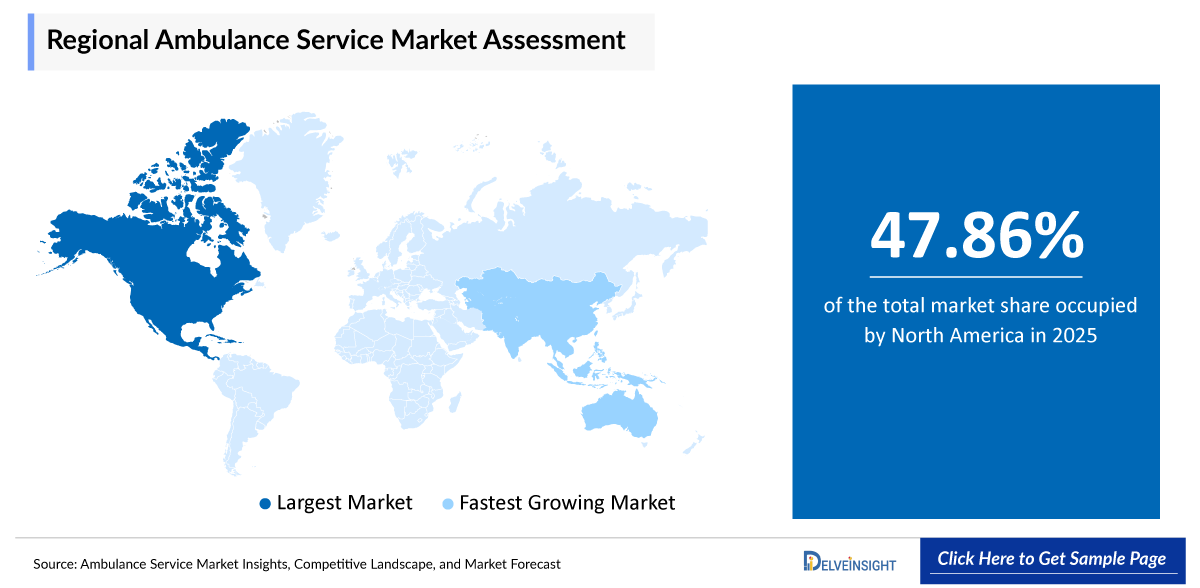
North America is expected to account for the highest proportion of 47.86% of the ambulance service market in 2025, out of all regions, due to its well-established healthcare infrastructure, high healthcare expenditure, strong presence of advanced emergency medical service (EMS) systems, and increasing prevalence of chronic diseases and trauma cases, along with the widespread adoption of technologically advanced ambulances and supportive government policies.
According to the data provided by the Centre for Disease Control and Prevention (2026), the number of emergency department visits for unintentional injuries was 26.2 million in the United States. A large proportion of these injury cases, such as falls, road accidents, and burns, require immediate medical attention and timely transfer to hospitals, increasing reliance on ambulance services rather than private transport. This surge in emergency cases leads to higher ambulance dispatch rates, greater utilization of both basic and advanced life support units, and continuous expansion of ambulance fleets and infrastructure, thereby directly contributing to the growth of the overall ambulance services market.
Additionally, the increasing product development activities are further boosting the adoption of ambulance services across the region. For instance, in February 2026, Montgomery County Hospital District (Texas) expanded its ambulance fleet with new stations and additional vehicles, along with telehealth integration to manage rising emergency call volumes. The system also increased Basic Life Support (BLS) units and optimized emergency response efficiency.
Thus, the factors mentioned above are expected to boost the overall market of ambulance services across the region during the forecast period.
Europe Ambulance Service Market Trends
In Europe, the growth of the ambulance services market is being strongly driven by a combination of rising emergency cases, robust government healthcare systems, and continuous technological and infrastructure advancements. The increasing prevalence of trauma injuries, road accidents, and chronic conditions such as cardiovascular diseases is significantly elevating the demand for rapid emergency response services across countries like the United Kingdom, Germany, and France, thereby boosting ambulance utilization rates. At the same time, strong public healthcare frameworks and government funding are enabling large-scale deployment of ambulance fleets, advanced life support systems, and integrated emergency response networks, which further enhance service accessibility and efficiency.
Technological advancements such as real-time patient data transmission, smart ambulance equipment, and telemedicine integration are also improving pre-hospital care quality and operational effectiveness. For instance, in March, 2026, the World Health Organization established modular ambulance stations in Ukraine to strengthen emergency medical response capacity, particularly in high-need regions, highlighting ongoing infrastructure expansion in Europe.
Additionally, in 2025, WHO-supported initiatives led to the deployment of multiple modular emergency units across affected regions, improving rapid response capabilities. Furthermore, continuous knowledge-sharing and innovation platforms such as the EMS Europe Congress (March 2026 announcement for 2027 event) and the European Emergency Medicine Congress 2026 are fostering collaboration, training, and adoption of best practices in emergency medical services across the region. These combined factors are strengthening emergency care systems, increasing ambulance demand, and ultimately driving the overall growth of the ambulance services market in Europe.
Asia-Pacific Ambulance Service Market Trends
The Asia Pacific region is emerging as a significant growth driver for the ambulance services market due to rapid urbanization, rising population density, and increasing incidence of road accidents and medical emergencies, which collectively drive strong demand for efficient emergency medical services (EMS). Governments across countries like India, China, and Southeast Asia are heavily investing in expanding ambulance fleets, strengthening emergency response infrastructure, and improving accessibility through national programs and public-private partnerships. For instance, in August 2024, the Maharashtra government in India launched the MEMS-108 Ambulance Project with an investment of around USD 190 million to modernize emergency services using advanced communication systems and data-driven operations, marking a major infrastructure upgrade. Additionally, increasing healthcare expenditure, expanding insurance coverage, and a growing geriatric population requiring frequent medical transport are further accelerating demand across the region. The adoption of advanced technologies such as GPS tracking, telemedicine, and AI-based dispatch systems is also improving response times and service efficiency. Moreover, the urgent need to strengthen emergency care systems in densely populated and developing nations, along with continuous fleet modernization initiatives observed during 2025-2026, is further fueling market expansion. Collectively, these factors are enhancing emergency care accessibility, increasing ambulance utilization rates, and positioning the Asia Pacific as one of the fastest-growing regions in the global ambulance services market.
Who are the major players in the ambulance service market?
The following are the leading companies in the ambulance service market. These companies collectively hold the largest market share and dictate industry trends.
- Global Medical Response (GMR)
- American Medical Response (AMR)
- Falck A/S
- Acadian Ambulance Service
- Air Methods Corporation
- Air Medical Group Holdings
- PHI Air Medical
- REVA Air Ambulance
- Scandinavian AirAmbulance
- Medivic Aviation
- Ziqitza Health Care Ltd.
- GVK Emergency Management and Research Institute (GVK EMRI)
- BVG India Ltd.
- Express Ambulance Services
- Lifeline Ambulance Services
- London Ambulance Service NHS Trust
- St John Ambulance (Australia)
- SA Ambulance Service
- National Ambulance LLC
- Dutch Health B.V.
- Others
How is the competitive landscape shaping the Ambulance Service market?
The competitive landscape of the ambulance services market is highly fragmented and dynamic, characterized by the presence of both large global players and numerous regional and local service providers competing on service quality, response time, pricing, and technological capabilities. Leading companies such as Falck A/S, Air Methods Corporation, Acadian Ambulance Service, and Global Medical Response dominate key regions through extensive fleet networks and advanced life support offerings, while public entities like the London Ambulance Service NHS Trust play a major role in government-led systems. Competition is intensifying due to the rapid expansion of private ambulance providers, especially in developing markets, which are leveraging cost-effective services and app-based booking platforms to gain market share.
Additionally, companies are increasingly focusing on strategic initiatives such as mergers and acquisitions, partnerships, and geographic expansion to strengthen their presence. For example, acquisitions and service integrations are being used to expand fleet capacity and regional coverage. Technological innovation has also become a key differentiator, with players investing in AI-based dispatch systems, GPS tracking, telemedicine, and connected ambulance platforms to improve efficiency and patient outcomes. Furthermore, the market is evolving into a tiered competitive structure, where large multinational companies lead in innovation and scale, mid-sized players compete through specialization and regional dominance, and smaller local operators focus on niche or community-based services. Overall, the increasing emphasis on technology integration, service quality, and strategic collaborations is shaping a highly competitive environment, driving continuous innovation and expansion in the ambulance services market.
Recent Developmental Activities in the Ambulance Service Market
- In February 2026, Indian state authorities announced the addition of 129 new ambulances to expand coverage, particularly in underserved areas.
- In September 2025, the Delhi government launched 53 new BLS ambulances to strengthen the emergency response infrastructure.
- In July 2025, KIMS Hospitals introduced Thane’s first AI-integrated 5G smart ambulance capable of real-time patient monitoring and AI-based interpretation of vitals, improving pre-hospital emergency care during the “golden hour.”
- In June 2025, Artemis Hospitals & Medulance introduced a 5G-enabled ambulance with AI-powered diagnostics and telemedicine capabilities, transforming ambulances into mobile emergency rooms for critical cases like cardiac emergencies and trauma.
- In May 2025, a major public-private partnership in Maharashtra planned the deployment of 1,756 ground ambulances across all districts to strengthen emergency response infrastructure.
- In February 2025, Blinkit introduced a rapid-response BLS ambulance service promising arrival within minutes to improve urban emergency accessibility.
|
Report Metrics |
Details |
|
Study Period |
2023 to 2034 |
|
Base Year |
2025 |
|
Forecast Period |
2026 to 2034 |
|
Ambulance Service Market CAGR |
9.36% |
|
Key Companies in the Ambulance Service Market |
Global Medical Response (GMR), American Medical Response (AMR), Falck A/S, Acadian Ambulance Service, Air Methods Corporation, Air Medical Group Holdings, PHI Air Medical, REVA Air Ambulance, Scandinavian AirAmbulance, Medivic Aviation, Ziqitza Health Care Ltd., GVK Emergency Management and Research Institute (GVK EMRI), BVG India Ltd., Express Ambulance Services, Lifeline Ambulance Services, London Ambulance Service NHS Trust, St John Ambulance (Australia), SA Ambulance Service, National Ambulance LLC, Dutch Health B.V., and others. |
|
Ambulance Service Market Segments |
By Service Type, by Transport Vehicle Type, by Equipment Level, by Ownership, by Application, by End-Users, and by Geography |
|
Ambulance Service Regional Scope |
North America, Europe, Asia Pacific, Middle East, Africa, and South America |
|
Ambulance Service Country Scope |
U.S., Canada, Mexico, Germany, United Kingdom, France, Italy, Spain, China, Japan, India, Australia, South Korea, and key Countries |
Ambulance Service Market Segmentation
- Ambulance Service by Service Type Exposure
- Emergency Ambulance Services
- Non-Emergency Ambulance Services
- Ambulance Service Transport Vehicle Type Exposure
- Ground Ambulances
- Air Ambulances
- Water Ambulances
- Ambulance Service Equipment Level Exposure
- Basic Life Support (BLS) Ambulances
- Advanced Life Support (ALS) Ambulances
- Ambulance Ownership Exposure
- Public/Government Ambulance Services
- Private Ambulance Services
- Non-Profit Organizations
- Ambulance Application Exposure
- Emergency Medical Services (EMS)
- Patient Transport Services
- Event Medical Services
- Ambulance Service End-Users Exposure
- Hospitals and Clinics
- Ambulatory Surgical Centers (ASCs)
- Others
- Ambulance Service Geography Exposure
- North America Ambulance Service Market
- United States Ambulance Service Market
- Canada Ambulance Service Market
- Mexico Ambulance Service Market
- Europe Ambulance Service Market
- United Kingdom Ambulance Service Market
- Germany Ambulance Service Market
- France Ambulance Service Market
- Italy Ambulance Service Market
- Spain Ambulance Service Market
- Rest of Europe Ambulance Service Market
- Asia-Pacific Ambulance Service Market
- China Ambulance Service Market
- Japan Ambulance Service Market
- India Ambulance Service Market
- Australia Ambulance Service Market
- South Korea Ambulance Service Market
- Rest of Asia-Pacific Ambulance Service Market
- Rest of the World Ambulance Service Market
- South America Ambulance Service Market
- Middle East Ambulance Service Market
- Africa Ambulance Service Market
- North America Ambulance Service Market
Ambulance Service Market Recent Industry Trends and Milestones (2022-2026)
|
Category |
Key Developments |
|
Ambulance Service Product Launch |
KIMS Hospitals introduced Thane’s first AI-integrated 5G smart ambulance, Artemis Hospitals & Medulance introduced a 5G-enabled ambulance with AI-powered diagnostics and telemedicine capabilities, Delhi government launched 53 new BLS ambulances. |
|
Ambulance Service Partnership |
The City of Boulder entered into a formal partnership with Falck Rocky Mountain Ambulance to provide 24/7 advanced life support (ALS) ambulance services. Webb County approved a multi-year EMS partnership contract (through 2027) with Angel Care Ambulance to provide emergency medical services at public venues, ensuring structured and reliable ambulance deployment. |
|
Ambulance Service Mergers and Acquisition |
AMR acquired LifeLine Ambulance, a regional provider in Connecticut, to expand its footprint in the Northeastern United States and strengthen its emergency and non-emergency transport capabilities. Response Plus Medical acquired Prometheus Medical, a UK-based medical training company, to enhance its emergency response capabilities and global ambulance service operations through improved training infrastructure. |
|
Company Strategy |
Falck A/S: Falck is focusing on digital transformation and sustainable ambulance solutions as a core growth strategy. The company is investing in tele-EMS triage systems, advanced dispatch platforms, and community paramedicine programs to reduce hospital burden and improve patient outcomes. Additionally, Falck is developing electric ambulance prototypes, aligning with environmental goals and government sustainability mandates. This strategy strengthens its position in public-sector contracts and long-term partnerships. Acadian Ambulance Service: Acadian is emphasizing telehealth platform development and advanced paramedic training programs to enhance service quality and operational efficiency. The company also leverages its employee-ownership model to maintain high staff retention and service reliability, which is a key differentiator in winning municipal contracts. Its focus on disaster response capabilities and community-based care models further strengthens its competitive advantage. |
|
Emerging Technology |
Artificial Intelligence (AI) & predictive analytics, telemedicine & remote diagnostics, 5G connectivity & IoT-enabled smart ambulances, advanced GPS & intelligent dispatch systems, smart ambulances with advanced monitoring systems, and others |
Impact Analysis
AI-Powered Innovations and Applications:
AI-powered innovations are transforming ambulance services by making emergency response faster, smarter, and more efficient. One of the key applications is AI-driven dispatch systems, which analyze incoming emergency calls, assess severity, and automatically assign the nearest available ambulance, significantly reducing response times. AI is also used for predictive analytics, helping service providers anticipate high-demand locations and strategically position ambulances in advance. During patient transport, AI-enabled monitoring systems can analyze real-time vital signs such as ECG, oxygen levels, and heart rate to detect early signs of deterioration, especially in critical conditions like cardiac arrest and stroke, allowing paramedics to take timely action. Additionally, AI supports clinical decision-making tools that guide paramedics with treatment protocols based on patient data, improving pre-hospital care quality. Integration with telemedicine platforms further enables AI-assisted diagnosis by transmitting analyzed data to hospital specialists before patient arrival. Moreover, AI-powered route optimization systems help ambulances navigate traffic efficiently, while natural language processing (NLP) is used in emergency call centers to quickly interpret caller information and prioritize cases. These innovations collectively enhance operational efficiency, improve patient outcomes, and play a crucial role in advancing the ambulance services market.
U.S. - Iran Conflict Impact Analysis on Ambulance Service Market:
The ongoing U.S.-Iran conflict is having a significant and largely negative impact on the ambulance services market, primarily by disrupting healthcare infrastructure, increasing operational challenges, and straining emergency response systems. Continuous airstrikes and military activities have damaged hospitals, emergency centers, and even ambulances, with reports indicating that hundreds of healthcare and emergency facilities have been affected and multiple ambulances destroyed or rendered non-functional. At the same time, the conflict has led to a sharp rise in casualties and injuries, significantly increasing demand for emergency medical transport; however, this demand is not fully met due to infrastructure damage and safety risks, limiting service efficiency. Supply chain disruptions caused by sanctions, blocked trade routes such as the Strait of Hormuz, and rising fuel costs are further increasing the cost of ambulance operations and delaying the availability of critical medical equipment. Additionally, cyberattacks and power outages linked to the conflict are affecting hospital and EMS coordination systems, reducing responsiveness. Overall, while the conflict increases the need for ambulance services, the simultaneous destruction of infrastructure, resource shortages, and operational constraints act as major barriers, thereby negatively impacting the growth and efficiency of the ambulance services market.
How This Analysis Helps Clients
- Cost Management: By understanding the tariff landscape, clients can anticipate cost increases and adjust pricing strategies accordingly, ensuring profitability.
- Supply Chain Optimization: Clients can identify alternative sourcing options and diversify their supply chains to reduce dependency on high-tariff regions, enhancing resilience.
- Regulatory Navigation: Expert guidance on navigating the evolving regulatory environment helps clients maintain compliance and avoid potential legal challenges.
- Strategic Planning: Insights into tariff impacts enable clients to make informed decisions about manufacturing locations, partnerships, and market entry strategies.
Startup Funding & Investment Trends
|
Company Name |
Total Funding |
Main Products |
Stage of Development |
Core Technology |
|
Dial4242 |
₹9 crore (~USD 1.04 million) |
Pre-Series A |
On-demand ambulance booking platform |
Real-time ambulance tracking, AI-enabled dispatch system, 24×7 emergency coordination platform. |
|
Medulance |
USD 3 million |
Series A |
Emergency ambulance and healthcare logistics platform |
AI-based emergency response optimization GPS-enabled ambulance tracking Cloud-based EMS management system |
Key takeaways from the ambulance service market report study
- Market size analysis for the current ambulance service market size (2025), and market forecast for 8 years (2026 to 2034)
- Top key product/technology developments, mergers, acquisitions, partnerships, and joint ventures happened over the last 3 years.
- Key companies dominating the ambulance service market.
- Various opportunities available for the other competitors in the ambulance service market space.
- What are the top-performing segments in 2025? How these segments will perform in 2034?
- Which are the top-performing regions and countries in the current ambulance service market scenario?
- Which are the regions and countries where companies should have concentrated on opportunities for the ambulance service market growth in the future?

