Healthcare Regulatory Affairs Outsourcing Market Summary
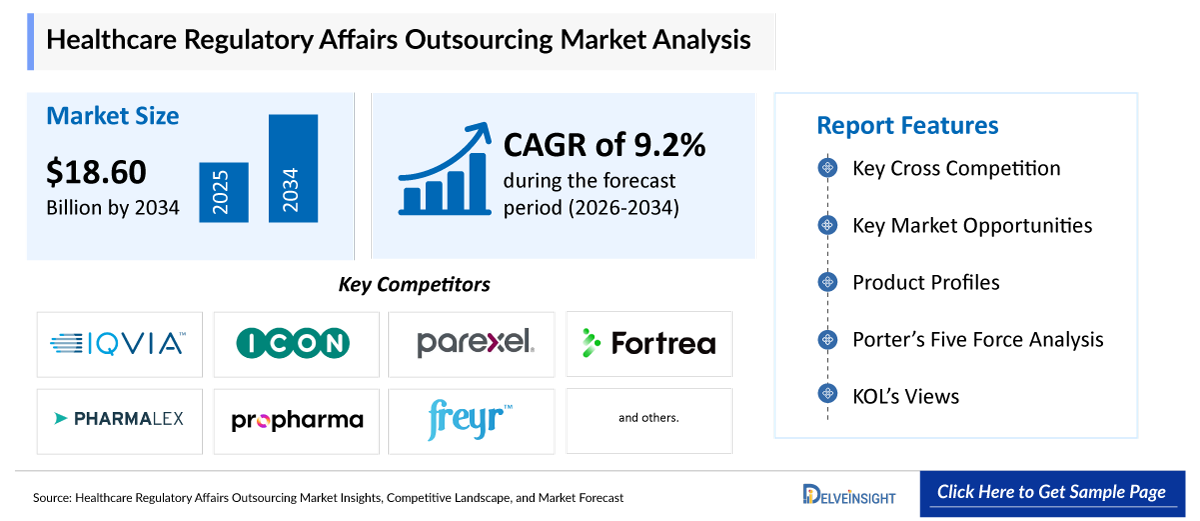
- The global healthcare regulatory affairs outsourcing market size was valued at USD 8.40 billion in 2025 and is projected to reach USD 18.60 billion by 2034.
- The market is expected to expand at a CAGR of 9.2% during the forecast period 2026-2034, supported by the increasing complexity and globalization of regulatory requirements, the drive to reduce cost and focus on core competencies, the growth of the biopharmaceutical pipeline, and the expanding post-approval and lifecycle maintenance burden.
- By service type, the regulatory writing and publishing segment dominated the healthcare regulatory affairs outsourcing market with a 34% share in 2025.
- By product category, the drugs segment dominated the healthcare regulatory affairs outsourcing market with a 48% share in 2025.
- By stage of development, the post-marketing segment dominated the healthcare regulatory affairs outsourcing market with a 42% share in 2025.
- By end-user, the pharmaceutical companies segment dominated the healthcare regulatory affairs outsourcing market with a 52% share in 2025.
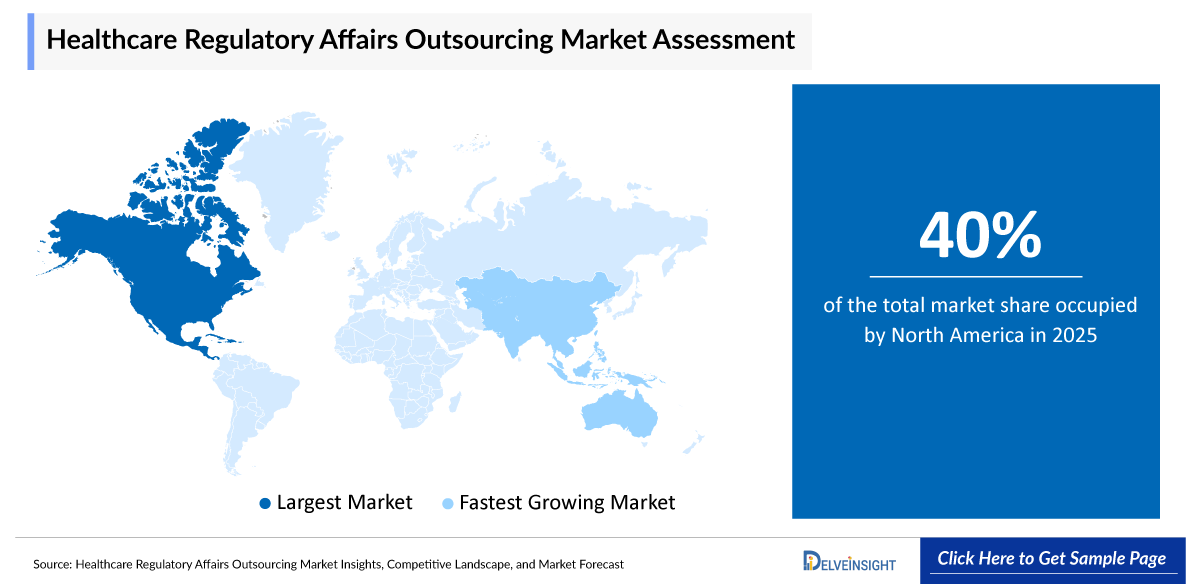
- North America accounted for the largest share of the healthcare regulatory affairs outsourcing market at 40% in 2025, while Asia-Pacific is anticipated to register the fastest growth through 2034.
Healthcare regulatory affairs outsourcing is the practice of engaging external specialist providers to perform the regulatory activities required to develop, register, and maintain drugs, biologics, and medical devices across global markets. The scope spans the full regulatory value chain, including regulatory strategy and intelligence, the preparation of chemistry, manufacturing, and controls documentation, the authoring of clinical and nonclinical documents, dossier compilation in the Common Technical Document format, electronic publishing and submission to health authorities, product registration and clinical trial applications, labeling and artwork management, legal and local representation, and post-approval lifecycle maintenance.
Providers range from large clinical research organizations that offer regulatory affairs alongside development services, such as IQVIA, ICON, Parexel, and Fortrea, to specialist regulatory firms such as Freyr, PharmaLex, and ProPharma Group, and to business process and consulting providers such as Accenture and Genpact. The work is performed under the harmonized framework of the International Council for Harmonisation and the electronic Common Technical Document standard mandated by the U.S. Food and Drug Administration, the European Medicines Agency, and regulatory agencies across many markets worldwide. The contemporary market is defined by the globalization of submissions, the burden of post-approval maintenance, and the integration of artificial intelligence and regulatory intelligence into outsourced services.
Healthcare Regulatory Affairs Outsourcing Market Key Growth Drivers
- Increasing complexity and globalization of regulatory requirements, with the electronic Common Technical Document mandated by the U.S. Food and Drug Administration for commercial submissions since May 2018 and required by the European Medicines Agency for centralized marketing applications since January 2010, and adopted by regulatory agencies across many markets worldwide.
- The advancement of submission standards, with the U.S. Food and Drug Administration supporting electronic Common Technical Document version 4.0 for new drug, biologic, generic, and investigational applications beginning September 16, 2024.
- The drive to reduce cost and focus on core competencies, with specialist providers such as Freyr reporting cost savings of 30 percent across outsourced regulatory engagements.
- Growth of the biopharmaceutical pipeline and expanding product launches that increase the volume of submissions and the number of markets requiring registration.
- The expanding post-approval and lifecycle maintenance burden of variations, renewals, and labeling updates across global markets.
- The rise of small and mid-sized biotechnology and medical device firms that lack in-house regulatory capacity and rely on outsourced coverage.
- The implementation of the European Union Medical Device Regulation and In Vitro Diagnostic Regulation that has intensified demand for device regulatory support.
Key Companies in Healthcare Regulatory Affairs Outsourcing Market
The leading participants in the healthcare regulatory affairs outsourcing market include the following:
- IQVIA Holdings Inc.
- ICON plc
- Parexel International Corporation
- Fortrea Holdings Inc.
- PharmaLex GmbH
- ProPharma Group, Inc.
- Freyr Solutions
- Accenture plc
- Genpact Limited
- Navitas Life Sciences, and others
For illustrative purposes, only the top 10 companies are listed in the Table of Contents. The report may include analysis and references to additional companies relevant to the market assessment.
Healthcare Regulatory Affairs Outsourcing Market Size
The following table summarizes the headline market metrics for the global healthcare regulatory affairs outsourcing market across the base year and the forecast horizon.
|
Report Metrics |
Details |
|
2025 Market Size |
USD 8.40 billion |
|
2034 Projected Market Size |
USD 18.60 billion |
|
Growth Rate (2026-2034) |
9.2% CAGR |
|
Largest Market |
North America (40% share in 2025) |
|
Fastest Growing Market |
Asia-Pacific |
|
Market Structure |
Fragmented |
All market values are expressed in USD and represent DelveInsight estimates synthesized from primary and secondary research.
Factors Contributing to the Growth of the Healthcare Regulatory Affairs Outsourcing Market
Healthcare Regulatory Affairs Outsourcing Market Drivers
- Increasing Complexity and Globalization of Regulatory Requirements: The foundational driver of the healthcare regulatory affairs outsourcing market is the increasing complexity and globalization of regulatory requirements, which compels companies to engage specialist providers with multi-regional expertise. The International Council for Harmonisation established the Common Technical Document in 2000 as a harmonized format for regulatory submissions across the U.S. Food and Drug Administration, the European Medicines Agency, and the Ministry of Health, Labour and Welfare in Japan, and its electronic form, the electronic Common Technical Document, has become the global standard. The U.S. Food and Drug Administration has required the electronic Common Technical Document for commercial investigational, new drug, biologic, and abbreviated new drug submissions since May 2018, the European Medicines Agency has required it for centralized marketing authorization applications since January 2010, and regulatory agencies across many markets worldwide now mandate the format, each with region-specific administrative requirements in Module 1. Companies bringing products to many markets must prepare and submit dossiers in the correct format to each authority, track divergent national requirements, and maintain compliance across the lifecycle, a task that requires regional expertise, technology, and scale that internal teams often cannot sustain. Specialist providers such as Freyr manage submissions across one hundred and twenty countries and maintain regulatory intelligence covering tens of thousands of regulations across many markets. The complexity, divergence, and constant change of global requirements make outsourcing to multi-geo specialists a durable necessity, and it sustains demand for regulatory writing, publishing, submission, and registration services across the market.
- The Advancement of Submission Standards and Technology: The continued advancement of submission standards and the technology required to meet them reinforces the value of outsourcing to providers that maintain current capabilities. The electronic Common Technical Document is a structured format built on an extensible markup language backbone and portable document format content, and it requires validated publishing tools, gateway connections, and specialist knowledge to produce error-free submissions that pass validation at the agency gateway. The U.S. Food and Drug Administration began supporting the electronic Common Technical Document version 4.0 for new drug, biologic, generic, investigational, and master file applications on September 16, 2024, and the transition to new versions and to structured data standards, including the identification of medicinal products standard, requires providers to update their tools and expertise continuously. A single formatting error can trigger rejection at the gateway and delay approval, which raises the value of experienced publishing teams and validated software. Specialist providers offer proprietary electronic Common Technical Document publishing and electronic submission tools alongside expert teams, and they invest in automation that validates dossiers against regional standards and reduces manual effort. Because maintaining current submission technology and expertise is costly and demands continuous investment, companies increasingly rely on providers that specialize in publishing and submissions. The advancement of standards, the risk of gateway rejection, and the cost of maintaining validated technology sustain demand for outsourced regulatory publishing and submission services and favor providers with proven tools and expertise.
- Cost Reduction and Focus on Core Competencies: The drive to reduce cost and to focus internal resources on core competencies is a central driver of regulatory affairs outsourcing. Building and maintaining a global regulatory organization with expertise across every market, product type, and submission standard is expensive, and for many companies the workload is variable and does not justify a large permanent team. Outsourcing converts fixed cost into variable cost, provides instant access to regional expertise and scalable resources, and allows internal teams to focus on regulatory strategy, agency interaction, and product innovation while providers handle operational tasks such as dossier preparation, publishing, submission, and lifecycle maintenance. Specialist providers report substantial savings, and Freyr states cost savings of 30 percent across its outsourced engagements while accelerating submission timelines. The flexible staff augmentation and functional service models offered by providers allow companies to scale regulatory capacity up and down with their pipeline and submission volume without the burden of permanent hiring. This economic logic applies across large pharmaceutical companies seeking efficiency, mid-sized firms managing growing portfolios, and small biotechnology and device companies without internal regulatory capacity. The combination of cost reduction, access to expertise, scalability, and the ability to focus internal resources on strategy sustains the shift of operational regulatory work to external providers and drives steady growth in the outsourcing market.
- Growth of the Biopharmaceutical Pipeline and Product Launches: The expansion of the biopharmaceutical pipeline and the rising number of product launches increase the volume of regulatory submissions and the number of markets requiring registration, driving demand for outsourced regulatory affairs. Each new drug, biologic, biosimilar, and medical device entering development and the market requires regulatory strategy, dossier preparation, submission, and registration in every target market, and the growth of biologics, cell and gene therapies, and specialty medicines adds products with complex regulatory profiles and demanding post-authorization commitments. Companies launching products across many markets face a large and rising volume of submissions, each of which must comply with region-specific requirements, and they increasingly outsource the preparation and submission of these dossiers to specialists with the capacity and regional expertise to manage the workload. The expansion of clinical trial activity generates clinical trial and investigational applications that require regulatory support, and the growth of generic and biosimilar competition adds abbreviated applications. Providers support the full range of submissions across pharmaceuticals, generics, biologics, and biosimilars and across the lifecycle from new registration through post-approval change. As the pipeline broadens and launches accelerate across an expanding set of markets, the volume of regulatory work rises in step, sustaining demand for outsourced regulatory writing, publishing, submission, and registration services and linking the growth of the outsourcing market to the underlying expansion of the biopharmaceutical industry.
- Expanding Post-Approval and Lifecycle Maintenance Burden: The expanding burden of post-approval and lifecycle maintenance is a durable driver of regulatory affairs outsourcing, generating a recurring workload that companies increasingly delegate. Once a product is approved, its marketing authorization must be maintained across every market through variations, renewals, labeling and artwork updates, safety-related changes, and responses to health authority queries, and this recurring work grows with the size and geographic reach of a company's portfolio. Post-approval changes are among the most complex and resource-intensive regulatory activities because each change may require submission to many authorities in divergent formats and timelines, and the volume of maintenance work accumulates as portfolios expand. Providers offer dedicated lifecycle maintenance services that manage variations, renewals, and labeling changes across markets, and Freyr and other specialists manage new registrations, lifecycle maintenance, and post-approval changes to ensure compliance at every stage of the product lifecycle. Because maintenance is continuous, high in volume, and spread across many markets, it is well suited to outsourcing to providers with the scale and regional coverage to manage it efficiently, and it generates the recurring revenue that anchors the outsourcing market. The accumulation of maintenance obligations as portfolios grow and as products remain on the market for many years sustains steady, recurring demand for outsourced lifecycle regulatory services across the forecast period.
- Rise of Small and Mid-sized Biotechnology and Device Firms: The rise of small and mid-sized biotechnology and medical device firms that lack in-house regulatory capacity drives demand for outsourced regulatory affairs. A large and growing share of innovation originates in emerging biotechnology and device companies that are focused on research and development and that do not maintain the global regulatory organizations required to register and maintain their products across markets. These companies rely on external providers for regulatory strategy, submission preparation, and registration, and they engage specialists to provide the global coverage, expertise, and scalable resources that they cannot build internally. Providers serve this segment with strategic guidance from experienced regulatory professionals, including former agency reviewers, and with operational teams that prepare and submit dossiers, and they offer flexible models that scale with the needs of a small company bringing its first products to market. The growth of venture-funded biotechnology, the expansion of the medical device and diagnostics sector, and the increasing number of first-in-human and rare disease programs enlarge this segment of the market. As emerging companies proliferate and continue to originate a large share of new products, their dependence on outsourced regulatory affairs sustains demand for the strategy, submission, and registration services offered by specialist providers and clinical research organizations, and it broadens the customer base of the outsourcing market.
- Implementation of the European Medical Device and Diagnostic Regulations: The implementation of the European Union Medical Device Regulation and In Vitro Diagnostic Regulation has intensified demand for device regulatory support and expanded the outsourcing market. The Medical Device Regulation and the In Vitro Diagnostic Regulation replaced the previous directives and substantially raised the requirements for clinical evidence, technical documentation, and post-market surveillance for medical devices and diagnostics placed on the European market, creating a large and complex workload for manufacturers. The transition has strained the capacity of notified bodies and manufacturers alike, and the European Union has adjusted transition timelines to manage the burden, extending deadlines to avoid the loss of devices from the market. Manufacturers, particularly small and mid-sized device companies, require specialist support to prepare technical documentation, clinical evaluations, and post-market surveillance systems and to navigate conformity assessment, and they increasingly outsource this work to regulatory providers with device expertise. Specialist firms and clinical research organizations offer dedicated medical device regulatory services covering the Medical Device Regulation and In Vitro Diagnostic Regulation, and the surge in demand has expanded the device segment of the outsourcing market. The scale, complexity, and ongoing nature of the European device regulatory transition, together with the tightening of device regulation in other markets, sustains demand for outsourced device regulatory affairs and broadens the market beyond pharmaceuticals.
Healthcare Regulatory Affairs Outsourcing Market Restraints
The healthcare regulatory affairs outsourcing market faces several interrelated restraints that temper its growth. The foremost is the concern over confidentiality and the protection of intellectual property, since regulatory dossiers contain the most sensitive scientific, manufacturing, and clinical information about a product, and companies are cautious about sharing this information with external providers and about the data security and cross-border data handling that outsourcing entails. A second restraint is the reluctance to cede control over regulatory strategy and agency interaction, since regulatory leaders at many companies retain the establishment of regulatory strategy and the management of health authority relationships in-house, which limits the scope of what is outsourced to operational tasks and constrains the addressable market for higher-value services. The regulatory accountability for a product remains with the marketing authorization holder regardless of outsourcing, so companies must maintain oversight, governance, and quality control over their providers, and vague roles, standard operating procedures, data ownership, and inspection accountability create risk that discourages outsourcing or complicates its governance. Variability in the quality and capability of providers, and the difficulty of governing service vendors whose work must nonetheless withstand inspection, require careful vendor selection and management that add cost and effort. Dependence on a provider can create switching costs and continuity risk, and the coordination of multiple providers across markets and functions adds management complexity. The shortage of experienced regulatory professionals affects providers as well as sponsors and can constrain capacity and raise cost. Regional data privacy and localization requirements complicate the cross-border delivery of services, and for small companies the cost of high-quality outsourced regulatory support can be substantial. Together these factors moderate the pace and scope of outsourcing and require providers to demonstrate confidentiality, quality, governance, and clear accountability to sustain growth.
Healthcare Regulatory Affairs Outsourcing Market Segment Analysis
The global healthcare regulatory affairs market is segmented by service type (regulatory consulting and strategy, regulatory writing and publishing, product registration and clinical trial applications, legal representation and other services), by product category (drugs and medical devices), by state of development (preclinical, clinical, and post marketing), by end-user (pharmaceutical companies, biotechnology companies, medical device companies, and others), and by geography (North America, Europe, Asia-Pacific, and the Rest of the World).
By Service Type
Dominant Subsegment: Regulatory Writing and Publishing.
The regulatory writing and publishing category is expected to dominate the market. The regulatory writing and publishing segment accounted for a 34% share of the healthcare regulatory affairs outsourcing market in 2025. Regulatory writing and publishing encompasses the authoring of clinical, nonclinical, and chemistry, manufacturing, and controls documents, the compilation of dossiers in the Common Technical Document format, and the electronic publishing and submission of those dossiers to health authorities, and it is the highest-volume and most frequently outsourced activity in the regulatory value chain. Its dominance reflects the recurring, operational, and technology-intensive nature of the work and the willingness of companies to delegate it while retaining strategy in-house. Every submission across every market requires writing and publishing, and the requirement to produce error-free electronic Common Technical Document submissions that pass validation at the agency gateway, using validated publishing tools and gateway connections, makes specialist providers particularly valuable. Freyr, for example, maintains dedicated teams and proprietary electronic Common Technical Document publishing software and supports submissions in electronic Common Technical Document, non-electronic Common Technical Document, and paper formats across many regions, and observers have long noted that regulatory writing and publishing constitutes the largest share of the outsourcing market. The advancement of submission standards, including the transition to electronic Common Technical Document version 4.0, and the risk and cost of maintaining current publishing technology reinforce the outsourcing of this work. The recurring volume, technology intensity, and delegability of writing and publishing sustain its leadership across the forecast period and anchor demand for the services offered by the leading providers.
By Product Category
Dominant Subsegment: Drugs.
The drugs category is expected to dominate the market. The drugs segment accounted for a 48% share of the healthcare regulatory affairs outsourcing market in 2025. Drugs, spanning small-molecule pharmaceuticals and generics, represent the largest category of regulated healthcare products and the largest source of regulatory submissions and maintenance work, which concentrates outsourcing demand in this segment. Its dominance reflects the size of the pharmaceutical and generic industry, the volume of new registrations, abbreviated applications, and post-approval changes that drugs generate, and the maturity of the outsourcing model for pharmaceutical regulatory work. Drug submissions follow the Common Technical Document structure across the U.S. Food and Drug Administration, the European Medicines Agency, and other authorities, and the large and continuous flow of new drug applications, abbreviated new drug applications, variations, and renewals creates a substantial and recurring workload that companies outsource to specialists and clinical research organizations. Providers support the full range of drug categories, including pharmaceuticals, generics, and their lifecycle maintenance, and the global generic industry in particular relies heavily on outsourced registration and maintenance across many markets. The scale of the drug industry, the volume and recurrence of drug submissions, and the maturity of the outsourcing model sustain the leadership of the drugs segment. Its size and the continuous flow of registration and maintenance work reinforce its position across the forecast period and anchor demand for outsourced pharmaceutical regulatory services.
By Stage of Development
Dominant Subsegment: Post-Marketing.
The post-marketing category is expected to dominate the market. The post-marketing segment accounted for a 42% share of the healthcare regulatory affairs outsourcing market in 2025. The post-marketing stage encompasses the maintenance of a marketing authorization across its lifecycle through variations, renewals, labeling and artwork updates, safety-related changes, and responses to health authority queries, and it generates the largest, most recurring, and most geographically dispersed workload in regulatory affairs. Its dominance reflects the accumulation of maintenance obligations as portfolios expand and as products remain on the market for many years, and the suitability of this recurring, operational work for outsourcing. Once a product is approved in many markets, each subsequent change may require submission to numerous authorities in divergent formats and timelines, and the volume of this maintenance work grows continuously with the size and reach of a company's portfolio. Providers offer dedicated lifecycle maintenance services that manage variations, renewals, and labeling changes across markets, and companies delegate this high-volume, continuous work to specialists with the scale and regional coverage to manage it efficiently while retaining strategic decisions in-house. The recurring nature of maintenance generates the steady revenue that anchors the outsourcing market, and the accumulation of obligations across large, long-lived portfolios sustains demand. The volume, recurrence, and geographic dispersion of post-marketing maintenance sustain the leadership of this segment across the forecast period and reinforce the recurring revenue base of the leading providers.
By End-User
Dominant Subsegment: Pharmaceutical Companies.
The pharmaceutical companies category is expected to dominate the market. The pharmaceutical companies segment accounted for a 52% share of the healthcare regulatory affairs outsourcing market in 2025. Pharmaceutical companies are the largest holders of marketing authorizations and the largest generators of regulatory submissions and maintenance work, and they are the principal purchasers of outsourced regulatory affairs services, which concentrates demand in this group. Their dominance reflects the size of their portfolios, the volume of submissions and maintenance that their products generate across many markets, and the maturity of their outsourcing relationships. Large pharmaceutical companies outsource operational regulatory work to gain efficiency and scalability while retaining strategy in-house, and mid-sized pharmaceutical companies rely on providers to manage growing portfolios across an expanding set of markets. These companies require the full range of services, from regulatory strategy and dossier preparation through publishing, submission, registration, and lifecycle maintenance, and they engage both specialist regulatory firms and clinical research organizations to deliver this work globally. The scale of the pharmaceutical industry, the volume and recurrence of its regulatory work, and the breadth of its outsourcing sustain the leadership of the pharmaceutical companies segment. Its size and the continuous flow of submission and maintenance work reinforce its position across the forecast period, even as biotechnology and medical device companies increase their use of outsourced services, and it shapes the direction of the market.
Healthcare Regulatory Affairs Outsourcing Market Region Analysis
Dominant Region: North America
North America accounted for a 40% share of the global healthcare regulatory affairs outsourcing market in 2025, representing the highest regional market share globally. The leadership of the region reflects the concentration of the pharmaceutical, biotechnology, and medical device industries, the presence of the leading providers, the rigor and influence of the U.S. Food and Drug Administration, and the maturity of the outsourcing model. The United States is the largest national market, supported by the size of its life sciences sector, the volume of submissions to the U.S. Food and Drug Administration, and the demand for regulatory strategy and submission support to navigate the agency. The U.S. Food and Drug Administration requires the electronic Common Technical Document for commercial submissions, operates the Electronic Submissions Gateway, and began supporting the electronic Common Technical Document version 4.0 for new applications on September 16, 2024, and its expedited pathways, meeting processes, and post-marketing requirements generate substantial demand for outsourced regulatory support. The leading providers, including IQVIA, ICON, Parexel, Fortrea, and ProPharma Group, are headquartered or heavily operate in the region, and a large population of emerging biotechnology and device companies without internal regulatory capacity relies on outsourced services. The concentration of the industry, the influence of the U.S. Food and Drug Administration, the presence of providers, and the maturity of outsourcing reinforce the leadership of the region. The combination of industry concentration, regulatory influence, provider presence, and outsourcing maturity sustains the position of North America as the largest regional market across the forecast period.
Fastest Growing Region: Asia-Pacific
Asia-Pacific is projected to register the fastest compound annual growth rate through 2034. The region is expanding its pharmaceutical, biotechnology, generic, and clinical trial activity, strengthening its regulatory frameworks, and serving as a major global center for regulatory outsourcing delivery, which drives demand for regulatory affairs services. China, Japan, and India are the principal national markets, supported by large and growing domestic pharmaceutical and generic industries, rising clinical trial volumes, and the strengthening of regulatory requirements by the National Medical Products Administration in China, the Pharmaceuticals and Medical Devices Agency in Japan, and the regulatory authorities in India. India in particular is a major global hub for regulatory affairs outsourcing delivery, hosting the operations of specialist providers and clinical research organizations that serve international clients, and its large generic industry generates substantial registration and maintenance work across many markets. As national authorities adopt the Common Technical Document and electronic submission standards and as domestic companies expand their international presence, demand for regulatory strategy, submission, and registration services rises. The combination of industry expansion, regulatory strengthening, outsourcing delivery concentration, and growing international registration positions Asia-Pacific as the fastest-growing regional market, and it attracts investment and commercial focus from the leading global providers.
Healthcare Regulatory Affairs Outsourcing Market Regional Commentary
North America
North America leads the market, supported by the concentration of the pharmaceutical, biotechnology, and medical device industries, the presence of the leading providers, and the rigor and influence of the U.S. Food and Drug Administration. The United States dominates the region through the size of its life sciences sector, the volume of submissions, and the demand for regulatory strategy and submission support. The concentration of large marketing authorization holders and a large population of emerging companies without internal regulatory capacity sustain demand for outsourced regulatory affairs.
Europe
Europe is a mature and substantial market, shaped by the European Medicines Agency and its centralized procedure, the Good Pharmacovigilance Practices, and the Medical Device Regulation and In Vitro Diagnostic Regulation. Germany, the United Kingdom, France, Italy, and Spain are the principal national markets, supported by strong regulatory rigor, a large pharmaceutical and device industry base, and the presence of European specialists including PharmaLex. Demand is sustained by multi-country registration and maintenance obligations and by the substantial workload created by the device regulations.
Asia-Pacific
Asia-Pacific is the fastest-growing region, driven by the expansion of the pharmaceutical, generic, and clinical trial industries and the strengthening of regulatory requirements across China, Japan, and India. India is a major global hub for regulatory affairs outsourcing delivery, and its large generic industry generates substantial registration and maintenance work. The adoption of the Common Technical Document and electronic submission standards and the international expansion of domestic companies sustain demand, and the region attracts commercial focus from the leading global providers.
Rest of World
The Rest of World, spanning Latin America, the Middle East, and Africa, represents an emerging opportunity as pharmaceutical and device markets expand and as regulatory authorities adopt the Common Technical Document and electronic submission standards. Growth is supported by the registration of products in new markets, the harmonization of requirements, and the reliance of companies on providers with local representation and regional expertise. Providers pursue these markets through in-country experts and local representation suited to developing regulatory frameworks.
Healthcare Regulatory Affairs Outsourcing Market Competitive Landscape
The global healthcare regulatory affairs outsourcing market is classified as Fragmented. A large number of providers compete across the regulatory value chain, including large clinical research organizations that offer regulatory affairs alongside development services, specialist regulatory firms, and business process and consulting providers, and no single provider holds a dominant share of the global market. Competition centers on global coverage, regulatory expertise, technology and automation, quality and inspection readiness, and the breadth of services across strategy, writing, publishing, submission, registration, and lifecycle maintenance, and acquisitions, partnerships, and technology investment intensify the contest.
The competitive landscape is evaluated across the following dimensions:
- Market concentration: Fragmented, with a large number of providers spanning scale clinical research organizations, specialist regulatory firms, and business process and consulting providers, and no single provider holding a dominant global share.
- Leading players: IQVIA, ICON, Parexel, and Fortrea lead among the scale clinical research organizations that offer regulatory affairs alongside development, PharmaLex, ProPharma Group, and Freyr lead among the specialist regulatory firms, and Accenture and Genpact lead among the business process and consulting providers, with Navitas Life Sciences and other providers contesting defined segments.
- Geographic reach: The leading providers maintain global delivery organizations with regional expertise and local representation, and specialist providers such as Freyr manage submissions across one hundred and twenty countries, while regional providers leverage local knowledge and cost advantages.
- Service portfolio strength: Competitive advantage rests on breadth across regulatory strategy, intelligence, writing, publishing, submission, registration, labeling, and lifecycle maintenance, since companies increasingly seek providers that can support the full value chain across markets and product types.
- Pipeline strength: Development is concentrated in artificial intelligence and automation for publishing and intelligence, regulatory information management as a service, medical device regulatory support under the European regulations, and expansion into emerging markets.
- Strategic partnerships: Collaboration spans functional service and staff augmentation models, integration with sponsor systems, and alliances that extend geographic and therapeutic coverage.
- M&A activity: Consolidation has shaped the field, exemplified by the acquisition of PharmaLex by Cencora, the merger of PharmaLex with BlueReg, and the establishment of Fortrea as an independent company following its separation from Labcorp, alongside continued consolidation among specialist providers.
- Innovation focus: Innovation is shifting toward artificial intelligence and automation in publishing and regulatory intelligence, technology-enabled service delivery, and structured data standards, together with dedicated support for the European device regulations and emerging market registration.
- Regulatory standing: Command of the electronic Common Technical Document, the Common Technical Document, the Good Pharmacovigilance Practices, and the region-specific requirements of the U.S. Food and Drug Administration, the European Medicines Agency, and other authorities, together with inspection readiness, is a decisive competitive credential and a principal axis of competition among the leaders.
Healthcare Regulatory Affairs Outsourcing Market Recent Developmental Activities
- In July 2025, PharmaLex GmbH merged with the strategic consultancy BlueReg, enhancing its capabilities across regulatory, quality, and compliance services through expanded skill sets and value delivery centers. Strategic significance: the merger strengthened the position of a leading specialist provider in the regulatory affairs outsourcing market by integrating complementary expertise and improving service delivery for pharmaceutical and medical device clients.
- In 2025, Freyr Solutions advanced its artificial intelligence-powered regulatory intelligence, providing access to tens of thousands of regulations, policies, guidelines, and health authority communications across one hundred and fifty markets, and expanded its submission support across one hundred and twenty countries. Strategic significance: the advancement reinforced the role of technology and regulatory intelligence in outsourced services and the value of multi-geo submission expertise.
- In September 2024, the U.S. Food and Drug Administration began supporting the electronic Common Technical Document version 4.0 for new drug, biologic, generic, investigational, and master file applications. Strategic significance: the advancement of the submission standard raised the value of providers that maintain current publishing technology and expertise and that can manage the transition to new versions.
- In 2024 and 2025, IQVIA Holdings Inc. advanced its regulatory affairs and medical affairs operations, providing strategy, submissions, and post-market compliance supported by data, technology, and analytics. Strategic significance: the developments reinforced the position of a leading scale provider that combines regulatory services with technology and data.
- In 2024 and 2025, ProPharma Group, Inc. advanced its full-lifecycle regulatory, compliance, and consulting services across the pharmaceutical, biotechnology, and medical device industries. Strategic significance: the developments strengthened the position of a leading specialist provider offering global regulatory strategy and complex submission management.
- In 2023, Cencora acquired PharmaLex, a leading provider of regulatory affairs, pharmacovigilance, and quality and compliance services, expanding its outsourced life sciences services. Strategic significance: the acquisition integrated a leading specialist provider within a global healthcare company and intensified competition and consolidation in the outsourcing market.
- In 2023, Fortrea Holdings Inc. was established as an independent company following its separation from Labcorp, offering clinical development and regulatory services across the product lifecycle. Strategic significance: the establishment of a large independent provider reshaped the competitive landscape among the scale clinical research organizations that offer regulatory affairs.
- In 2023, the European Union adopted Regulation (EU) 2023/607 extending the transition timelines of the Medical Device Regulation to avoid the loss of devices from the market. Strategic significance: the extension managed the burden of the device regulations while sustaining the large and complex device regulatory workload that drives demand for outsourced device services.
- In 2024 and 2025, Accenture plc and Genpact Limited advanced technology-enabled regulatory operations and business process services for life sciences clients. Strategic significance: the developments reinforced the role of business process and consulting providers in delivering scalable, technology-enabled regulatory operations.
- In 2024 and 2025, Navitas Life Sciences advanced its regulatory affairs and lifecycle services for pharmaceutical and biotechnology clients. Strategic significance: the developments strengthened the position of a specialist provider in regulatory operations and lifecycle maintenance.
- In 2024 and 2025, the European Union continued the phased implementation of the Medical Device Regulation and the In Vitro Diagnostic Regulation, sustaining demand for device and diagnostic regulatory support. Strategic significance: the ongoing implementation expanded the device segment of the outsourcing market and the demand for specialist device regulatory services.
- In 2024 and 2025, the leading providers embedded artificial intelligence, automation, and regulatory intelligence across publishing, submission, and lifecycle services and expanded their coverage across markets and product types. Strategic significance: the convergence of the leaders on technology-enabled, multi-geo, full-lifecycle services confirmed these as the defining axes of competition and signaled a market shifting toward intelligent, global, and integrated regulatory outsourcing.
Healthcare Regulatory Affairs Outsourcing Market Segmentation
- Healthcare Regulatory Affairs Outsourcing Market Assessment by Service Type
- Regulatory Consulting and Strategy
- Regulatory Writing and Publishing
- Product Registration and Clinical Trial Applications
- Legal Representation
- Other Services
- Healthcare Regulatory Affairs Outsourcing Market Assessment by Product Category
- Drugs
- Medical Devices
- Healthcare Regulatory Affairs Outsourcing Market Assessment by Stage of Development
- Preclinical
- Clinical
- Post-Marketing
- Healthcare Regulatory Affairs Outsourcing Market Assessment by End-User
- Pharmaceutical Companies
- Biotechnology Companies
- Medical Device Companies
- Others
Healthcare Regulatory Affairs Outsourcing Market Assessment by Geography
- North America Healthcare Regulatory Affairs Outsourcing Market Assessment
- United States Healthcare Regulatory Affairs Outsourcing Market Size in USD million (2023-2034)
- Canada Healthcare Regulatory Affairs Outsourcing Market Size in USD million (2023-2034)
- Mexico Healthcare Regulatory Affairs Outsourcing Market Size in USD million (2023-2034)
- Europe Healthcare Regulatory Affairs Outsourcing Market Assessment
- Germany Healthcare Regulatory Affairs Outsourcing Market Size in USD million (2023-2034)
- United Kingdom Healthcare Regulatory Affairs Outsourcing Market Size in USD million (2023-2034)
- France Healthcare Regulatory Affairs Outsourcing Market Size in USD million (2023-2034)
- Italy Healthcare Regulatory Affairs Outsourcing Market Size in USD million (2023-2034)
- Spain Healthcare Regulatory Affairs Outsourcing Market Size in USD million (2023-2034)
- Rest of Europe Healthcare Regulatory Affairs Outsourcing Market Size in USD million (2023-2034)
- Asia-Pacific Healthcare Regulatory Affairs Outsourcing Market Assessment
- China Healthcare Regulatory Affairs Outsourcing Market Size in USD million (2023-2034)
- Japan Healthcare Regulatory Affairs Outsourcing Market Size in USD million (2023-2034)
- India Healthcare Regulatory Affairs Outsourcing Market Size in USD million (2023-2034)
- Australia Healthcare Regulatory Affairs Outsourcing Market Size in USD million (2023-2034)
- South Korea Healthcare Regulatory Affairs Outsourcing Market Size in USD million (2023-2034)
- Rest of Asia-Pacific Healthcare Regulatory Affairs Outsourcing Market Size in USD million (2023-2034)
- Rest of the World Healthcare Regulatory Affairs Outsourcing Market Assessment
- Middle East Healthcare Regulatory Affairs Outsourcing Market Size in USD million (2023-2034)
- Africa Healthcare Regulatory Affairs Outsourcing Market Size in USD million (2023-2034)
- South America Healthcare Regulatory Affairs Outsourcing Market Size in USD million (2023-2034)
Healthcare Regulatory Affairs Outsourcing Market Recent Industry Trends and Milestones (2023-2026):
|
Category |
Key Developments |
|
Healthcare Regulatory Affairs Outsourcing Market Service Advancement |
The period was defined by the advancement of technology-enabled, multi-geo regulatory services rather than by device clearances. Freyr advanced artificial intelligence-powered regulatory intelligence and submissions across many markets, IQVIA advanced data and technology-enabled regulatory operations, and ProPharma Group advanced full-lifecycle regulatory services. Providers aligned their capabilities to the electronic Common Technical Document, including the transition to version 4.0 supported by the U.S. Food and Drug Administration, and to the Common Technical Document structure required by the European Medicines Agency and other authorities. Together these advances concentrated competition in technology-enabled, inspection-ready, and globally coordinated regulatory services. |
|
Healthcare Regulatory Affairs Outsourcing Market Service Expansion |
Service expansion advanced along three axes. The first is technology and automation, as providers embedded artificial intelligence and automation across publishing, intelligence, and lifecycle services to accelerate submissions and reduce error. The second is geographic and product coverage, as providers extended submission and registration support across more markets and across pharmaceuticals, generics, biologics, biosimilars, and medical devices. The third is medical device regulatory support, as providers expanded services for the European Medical Device Regulation and In Vitro Diagnostic Regulation and for device regulation in other markets. Providers also extended regulatory information management and labeling and artwork services and deepened lifecycle maintenance offerings. |
|
Healthcare Regulatory Affairs Outsourcing Market Investment |
Investment was shaped by consolidation and by the drive to embed technology. Strategic acquirers consolidated specialist providers, exemplified by Cencora's acquisition of PharmaLex and the subsequent merger of PharmaLex with BlueReg, and the establishment of Fortrea as an independent provider reshaped the scale tier. Providers invested in artificial intelligence, automation, and regulatory intelligence, and in the delivery centers and regional expertise required for multi-geo services. Investment also flowed into medical device regulatory capacity in response to the European regulations and into emerging market coverage, and providers expanded functional service and staff augmentation models to serve companies of every size. |
|
Company Strategy |
The unifying strategic theme is the combination of full-lifecycle regulatory services with technology-enabled, multi-geo delivery. IQVIA, ICON, Parexel, and Fortrea are competing as scale providers that offer regulatory affairs alongside development and technology, PharmaLex, ProPharma Group, and Freyr are competing as specialist regulatory firms with global coverage and technology, and Accenture and Genpact are competing as business process and consulting providers with scalable operations. Providers are differentiating on artificial intelligence and regulatory intelligence, global submission expertise, medical device support, and inspection readiness, and they retain flexible models that allow companies to outsource operational work while retaining strategy. Across the field, strategy centers on technology, global coverage, and full-lifecycle service. |
|
Emerging Technologies |
The defining emerging capabilities are artificial intelligence and automation that accelerate publishing, validate dossiers against regional standards, and power regulatory intelligence across many markets; regulatory information management delivered as a service; structured data standards, including the identification of medicinal products; and the electronic Common Technical Document version 4.0 and electronic submission gateways. Supporting these are technology-enabled labeling and artwork management, lifecycle maintenance automation, and dedicated tools for medical device documentation under the European regulations. Across these, the trajectory is toward regulatory affairs outsourcing that is technology-enabled, globally coordinated, and full-lifecycle, improving speed, accuracy, and compliance for companies managing submissions and maintenance across an expanding set of markets and product types. |
Healthcare Regulatory Affairs Outsourcing Market Startup Funding and Investment Trends
Investment in the healthcare regulatory affairs outsourcing field has concentrated on technologies and models that make regulatory operations more automated, more global, and more scalable, namely artificial intelligence and automation for publishing and regulatory intelligence, technology-enabled service delivery, and specialist coverage of medical device and emerging market regulation. Because the market is fragmented and served by scale clinical research organizations, specialist regulatory firms, and business process providers, most innovators pursue a differentiated technology or a focused service capability that a larger provider can absorb or that serves emerging biotechnology and device companies. The table below summarizes representative companies advancing the next generation of regulatory affairs services and technology.
|
Company |
Total Funding |
Funding Stage |
Main Product/Offering |
Core Technology |
|
Freyr Solutions |
Private equity backed |
Commercial stage |
Regulatory services and Freyr publishing tools |
Artificial intelligence regulatory intelligence and publishing |
|
ProPharma Group, Inc. |
Private equity backed |
Commercial stage |
Full-lifecycle regulatory and compliance services |
Technology-enabled regulatory operations |
|
Request for unlocking the report of the @ Healthcare Regulatory Affairs Outsourcing Market Insights | ||||
Capital formation in this field is shaped by the fragmentation of the market and by the difficulty of competing against scale clinical research organizations and established specialist providers, so investors have favored companies that introduce differentiated technology, such as artificial intelligence for publishing and intelligence, or focused service capabilities, such as medical device regulatory support or emerging market coverage, rather than those contesting the full value chain. Technology-enabled regulatory operations is the clearest thesis, seeking to accelerate publishing and submission and to deliver regulatory intelligence across many markets. Specialist coverage of the European device regulations and of emerging market registration constitutes a second thesis, addressing the large and complex workload created by the Medical Device Regulation and In Vitro Diagnostic Regulation and by expansion into new markets, and full-lifecycle service models that serve emerging biotechnology and device companies a third. The archetypal outcome is acquisition by a scale provider or a healthcare services company seeking to add capability or coverage, exemplified by the consolidation of specialist providers, which provides a defined exit that sustains earlier-stage investment. The principal risks are the confidentiality and quality expectations of sponsors, the retention of strategy and agency interaction in-house, the regulatory accountability that remains with the marketing authorization holder, and the fragmentation and competition of the market. Source: company disclosures.
Key Takeaways from the Healthcare Regulatory Affairs Outsourcing Market Report Study
- Market size analysis for the current healthcare regulatory affairs outsourcing market size (2025), and market forecast for 9 years (2026 to 2034).
- Top key service and technology developments, mergers, acquisitions, partnerships, and joint ventures that happened over the last 3 years.
- Key companies dominating the global healthcare regulatory affairs outsourcing market.
- Various opportunities available for competitors in the healthcare regulatory affairs outsourcing market space.
- What are the top-performing segments in 2025? How will these segments perform in 2034?
- Which are the top-performing regions and countries in the current healthcare regulatory affairs outsourcing market scenario?
- Which are the regions and countries where companies should concentrate their opportunities for healthcare regulatory affairs outsourcing market growth in the future?
Target audience who can benefit from this healthcare regulatory affairs outsourcing market report study
- Healthcare regulatory affairs outsourcing service providers
- Research organizations and consulting companies
- Healthcare regulatory affairs outsourcing-related organizations, associations, forums, and other alliances
- Government and corporate offices
- Start-up companies, venture capitalists, and private equity firms
- Distributors and traders dealing in healthcare regulatory affairs outsourcing
- Various end-users who want to know more about the healthcare regulatory affairs outsourcing market and the latest developments in the healthcare regulatory affairs outsourcing market.

