Laboratory Informatics Market Summary
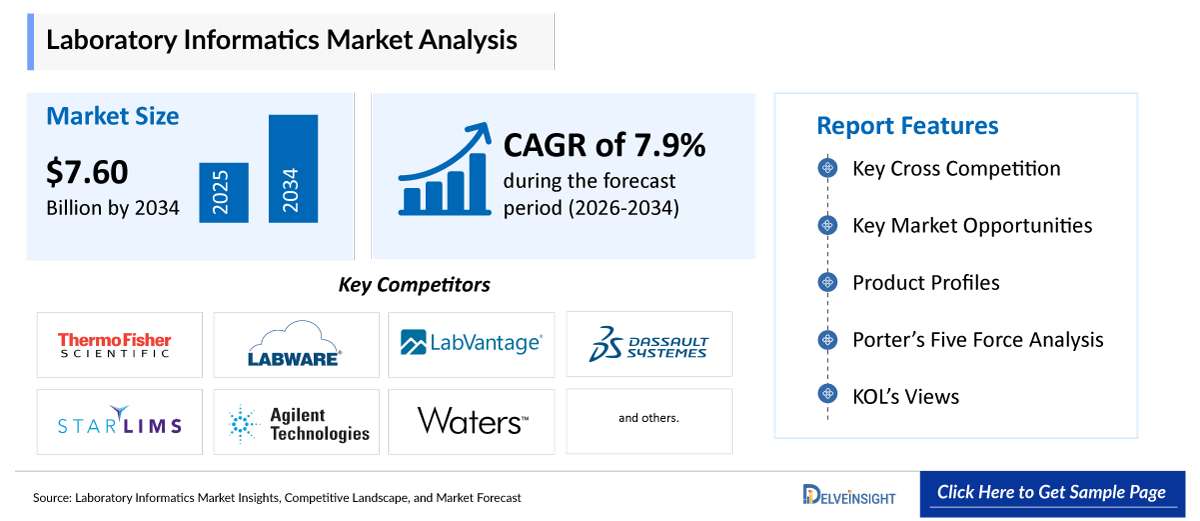
- The global laboratory informatics market size was valued at USD 3.85 billion in 2025 and is projected to reach USD 7.60 billion by 2034.
- The market is expected to expand at a CAGR of 7.9% during the forecast period 2026-2034, supported by stringent data integrity and regulatory compliance requirements, the rising volume and complexity of laboratory data, the adoption of artificial intelligence and advanced analytics, and the shift toward cloud and software-as-a-service deployment.
- By product type, the laboratory information management systems segment dominated the laboratory informatics market with a 40% share in 2025.
- By delivery mode, the cloud-based segment dominated the laboratory informatics market with a 52% share in 2025.
- By component, the software segment dominated the laboratory informatics market with a 58% share in 2025.
- By end-user, the pharmaceutical and biotechnology companies segment dominated the laboratory informatics market with a 34% share in 2025.
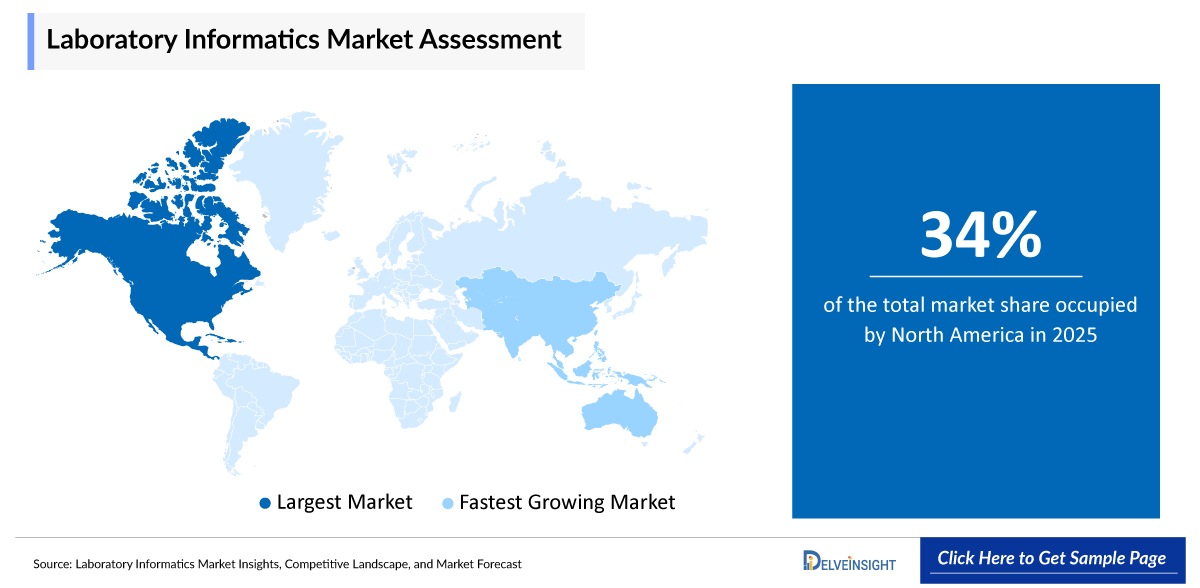
- North America accounted for the largest share of the laboratory informatics market at 40% in 2025, while Asia-Pacific is anticipated to register the fastest growth through 2034.
Laboratory informatics is the set of software systems and services used to capture, manage, analyze, and report scientific data and to orchestrate laboratory workflows across research, development, quality control, and diagnostic settings. The core product families are the laboratory information management system, which manages samples, tests, results, specifications, and reporting; the electronic laboratory notebook, which captures experimental records and documentation; the scientific data management system, which stores and organizes instrument data; the laboratory execution system, which enforces procedures and standard operating procedures at the point of work; and the chromatography data system, which controls analytical instruments and processes their output. Leading vendors deliver these capabilities on unified platforms, and Thermo Fisher SampleManager combines the laboratory information management system with the scientific data management system, electronic laboratory notebook, and laboratory execution system on one platform integrated with the Chromeleon chromatography data system, while LabVantage, LabWare, STARLIMS, and Dassault Systemes BIOVIA offer comparable integrated suites. The workflow proceeds from sample registration and test assignment through instrument data capture, review, approval, and reporting, all under audit trail and electronic signature controls. The contemporary market is defined by the shift from on-premise systems to cloud and software-as-a-service delivery and by the integration of artificial intelligence and advanced analytics across the informatics stack.
Laboratory Informatics Market Key Growth Drivers
- Stringent data integrity and regulatory compliance requirements, with the U.S. Food and Drug Administration enforcing 21 CFR Part 11 for electronic records and signatures and the ALCOA and ALCOA plus principles for data integrity across regulated laboratories.
- Harmonized international standards, including EU Annex 11 for computerized systems, the ISPE GAMP 5 framework for computerized system validation, and ISO/IEC 17025 for testing and calibration laboratories and ISO 15189 for medical laboratories.
- Rising volume and complexity of laboratory data from genomics, imaging, and connected instruments that require scientific data management and integrated informatics platforms.
- Rapid adoption of artificial intelligence and advanced analytics, with vendors including LabVantage, Revvity, STARLIMS, and Sapio Sciences embedding artificial intelligence across laboratory information management systems and electronic laboratory notebooks.
- A pronounced shift toward cloud and software-as-a-service deployment that lowers infrastructure cost and accelerates implementation across laboratories of every size.
- Growth of pharmaceutical and biotechnology research and development and the expansion of contract research and testing that increases the number of laboratories requiring informatics.
- Laboratory automation and the drive toward the connected and paperless laboratory that integrates informatics with instruments, enterprise resource planning, and manufacturing execution systems.
Key Companies in Laboratory Informatics Market
The competitive field is led by integrated platform vendors that offer the full informatics stack, challenged by specialist electronic laboratory notebook and cloud-native vendors and by regional providers. The leading participants in the laboratory informatics market include the following:
- Thermo Fisher Scientific Inc.
- LabWare, Inc.
- LabVantage Solutions, Inc.
- Dassault Systemes SE
- STARLIMS Corporation
- Agilent Technologies, Inc.
- Waters Corporation
- Revvity, Inc.
- Clarivate Plc
- Benchling, Inc., and others
For illustrative purposes, only the top 10 companies are listed in the Table of Contents. The report may include analysis and references to additional companies relevant to the market assessment.
Laboratory Informatics Market Size
The following table summarizes the headline market metrics for the global laboratory informatics market across the base year and the forecast horizon.
|
Report Metrics |
Details |
|
2025 Market Size |
USD 3.85 billion |
|
2034 Projected Market Size |
USD 7.60 billion |
|
Growth Rate (2026-2034) |
7.9% CAGR |
|
Largest Market |
North America (40% share in 2025) |
|
Fastest Growing Market |
Asia-Pacific |
|
Market Structure |
Consolidated |
All market values are expressed in USD and represent DelveInsight estimates synthesized from primary and secondary research.
Factors Contributing to the Growth of the Laboratory Informatics Market
Laboratory Informatics Market Drivers
- Stringent Data Integrity and Regulatory Compliance Requirements: The foundational driver of the laboratory informatics market is the requirement for data integrity and regulatory compliance in laboratories that operate under Good Practice regulations. The U.S. Food and Drug Administration 21 CFR Part 11, finalized in 1997, defines the criteria under which electronic records and electronic signatures are considered trustworthy and equivalent to paper, and it applies to laboratories working under predicate rules including current Good Manufacturing Practice, Good Laboratory Practice, and Good Clinical Practice. The agency data integrity guidance formalizes the ALCOA and ALCOA plus principles, which require that data be attributable, legible, contemporaneous, original, and accurate, together with complete, consistent, enduring, and available, and these expectations can only be met at scale with validated informatics that enforce audit trails, secure user access, and electronic signatures. Laboratory information management systems and electronic laboratory notebooks provide these controls, capturing original, time-stamped, traceable data across the record lifecycle, and vendors including LabWare state that their systems meet 21 CFR Part 11 and EU Annex 11 requirements with a track record of acceptance in FDA, EMA, and MHRA inspections. Because compliance is mandatory and inspected, regulated laboratories in pharmaceutical, biotechnology, and diagnostic settings adopt informatics as the primary means of demonstrating data integrity. The persistence and tightening of these requirements sustains durable demand for compliant laboratory information management systems, electronic laboratory notebooks, and the validation services that support them.
- Harmonized International Standards and Computerized System Validation: Beyond the United States, a harmonized framework of international standards and validation expectations sustains demand for laboratory informatics across regions. EU Annex 11 governs computerized systems in the European regulated environment and mirrors the electronic records and signatures expectations of 21 CFR Part 11, while the ISPE GAMP 5 framework provides the risk-based methodology for computerized system validation that laboratories use to validate their informatics without over-validation. ISO/IEC 17025 sets the requirements for the competence of testing and calibration laboratories, and ISO 15189 sets the requirements for medical laboratories, both of which drive the adoption of informatics that manage traceability, method control, and reporting. STARLIMS, for example, conforms to 21 CFR Part 11 for audit trails and electronic signatures and to ISO/IEC 17025 for testing laboratories and ISO 15189 for medical laboratories. The publication of the GAMP 5 Second Edition extended validation guidance to cloud computing, artificial intelligence, and agile development, aligning validation practice with the modern informatics stack. These standards apply across pharmaceutical, clinical, environmental, food, and forensic laboratories and across regions, and they favor informatics that are validated, auditable, and continuously updated for regulatory change. The breadth and consistency of the standards framework converts informatics from an operational convenience into a compliance necessity, sustaining demand across regulated laboratories worldwide and favoring vendors with proven validation support.
- Rising Volume and Complexity of Laboratory Data: The rising volume and complexity of laboratory data drive the adoption of scientific data management and integrated informatics platforms that can capture, organize, and analyze diverse data at scale. Modern laboratories generate not only sample and result records but vast multi-modal data, including genomic sequences, imaging, mass spectrometry and chromatography output, and sensor and instrument data from connected devices. This data must be captured in its original form, linked to samples and experiments, retained for regulatory periods, and made available for analysis, which requires scientific data management systems and the integration of instrument data systems with the laboratory information management system. Thermo Fisher SampleManager, for example, integrates the laboratory information management system with the scientific data management system and the Chromeleon chromatography data system so that chromatography and mass spectrometry data are managed within a single platform. As the scientific breakthroughs of genomics, cell therapy, and connected instrumentation generate ever larger datasets, laboratories require informatics that unify data across instruments and systems and that support downstream analytics and machine learning. The growth of data volume and variety increases the value of scientific data management and of platforms that consolidate the informatics stack, and it drives replacement of fragmented point solutions with integrated systems. This structural expansion of laboratory data sustains demand for scientific data management, integration, and analytics across the market.
- Adoption of Artificial Intelligence and Advanced Analytics: The adoption of artificial intelligence and advanced analytics is transforming laboratory informatics from a system of record into a decision-support platform and driving a wave of product investment. Vendors have embedded artificial intelligence and analytics across the informatics stack to automate workflows, surface operational insight, and accelerate research. LabVantage offers artificial intelligence-powered data analytics and semantic search across its platform and introduced voice command support in its LabVantage 8.9 release, Revvity Signals Software delivers artificial intelligence-enhanced research and development workflows across ChemDraw, Signals Notebook, and Spotfire, STARLIMS applies artificial intelligence for advanced analytics and integrates with connected instruments, and Sapio Sciences launched an artificial intelligence laboratory notebook with molecular docking and analytics built into the interface. These capabilities turn the data captured in laboratory information management systems and electronic laboratory notebooks into insight on turnaround times, backlogs, deviations, and process performance, and they accelerate discovery in research settings. As artificial intelligence features move from marketing claims into functionality that changes daily workflows, laboratories increasingly select platforms on the strength of their analytics and automation. This modernization shifts competition toward the intelligence of the platform, drives replacement of legacy systems, and expands the value delivered per deployment, sustaining growth in advanced laboratory informatics.
- Shift toward Cloud and Software-as-a-Service Deployment: A pronounced shift from on-premise systems toward cloud and software-as-a-service deployment is expanding the market and broadening its customer base. Cloud deployment lowers the infrastructure and maintenance burden, accelerates implementation and validation, scales capacity, and provides a foundation for advanced analytics by aggregating data across sites. LabVantage offers its full platform as software-as-a-service alongside cloud-hosted and on-premise options, LabWare offers software-as-a-service laboratory information management systems that are SOC 2 certified with deployment in a short period, STARLIMS offers on-premise, hybrid, and cloud deployments, and Thermo Fisher offers SampleManager on a managed cloud environment, an on-premise implementation, or a customer cloud. Cloud delivery is particularly important for smaller laboratories and for distributed, multi-site organizations that require common access, and it enables continuous regulatory updates and the integration of artificial intelligence services. Although cloud adoption in regulated laboratories has historically been slower because of the sensitivity of the data, subscription and hybrid models are now the foundation for aggregating data and applying analytics across multi-regional sites. As laboratories migrate from legacy on-premise databases to cloud and subscription models to reduce cost, improve scalability, and access analytics, the cloud-based segment leads the market and drives replacement demand across laboratories of every size.
- Growth of Pharmaceutical and Biotechnology Research and Contract Testing: The expansion of pharmaceutical and biotechnology research and development and the growth of contract research and testing increase the number of laboratories that require informatics and the intensity of their use. The biopharmaceutical pipeline continues to broaden with biologics, cell and gene therapies, and specialty medicines, each of which requires extensive research, development, and quality control testing supported by laboratory information management systems, electronic laboratory notebooks, and scientific data management systems. The growth of contract research organizations and contract testing laboratories, which perform work on behalf of sponsors across many products and clients, further multiplies the demand for informatics that manage high volumes of samples, tests, and data under regulatory control. These organizations require configurable, scalable, and validated platforms that can support diverse workflows and multiple clients, and they increasingly adopt cloud and subscription models to deploy quickly and at lower cost. The expansion of research, the migration of testing to specialized providers, and the intensification of quality control across the product lifecycle sustain demand for laboratory informatics in pharmaceutical, biotechnology, and contract laboratories. This driver links the growth of the informatics market to the underlying expansion of biopharmaceutical research and the outsourcing of laboratory work.
- Laboratory Automation and the Connected, Paperless Laboratory: The drive toward laboratory automation and the connected, paperless laboratory sustains demand for informatics that integrate instruments, systems, and workflows. Laboratories seek to eliminate paper, reduce manual transcription, and connect people, instruments, consumables, and software into a single ecosystem, and laboratory informatics is the backbone of this transformation. Laboratory information management systems connect to enterprise resource planning and manufacturing execution systems and to laboratory instruments, electronic laboratory notebooks, and chromatography data systems, and vendors offer integration tools and services to build the connected laboratory. Automating data capture from instruments reduces the human error that data integrity guidance seeks to eliminate, since the FDA identifies manually transcribed records as the riskiest, and it improves throughput and compliance. Laboratory execution systems enforce standard operating procedures at the point of work, and mobile and tablet access extends informatics to the bench. As laboratories pursue digital transformation to improve efficiency, quality, and compliance, they adopt integrated informatics that connect the laboratory end to end and generate documented, auditable records. This drive toward automation and the paperless laboratory expands demand for laboratory information management systems, laboratory execution systems, scientific data management systems, and the integration and services that connect them, and it favors vendors with comprehensive, interoperable platforms.
- Laboratory Informatics Market Restraints
- The laboratory informatics market faces several interrelated restraints that temper its growth. The foremost is the high cost, complexity, and duration of implementation and validation, since informatics must be configured to each laboratory's workflows, integrated with instruments and enterprise systems, and validated under 21 CFR Part 11 and GAMP 5 to demonstrate compliance, which requires time, specialized expertise, and capital that can be prohibitive for smaller laboratories. Integration with the diverse ecosystem of laboratory instruments, chromatography data systems, enterprise resource planning, manufacturing execution, and quality systems is technically demanding, and the absence of universal interoperability standards adds cost and risk to connectivity projects. Migration from entrenched legacy on premise systems is disruptive and carries risk to data integrity and business continuity, and because laboratories typically retain a laboratory information management system for a decade or more, replacement cycles are long and new sales are slow to materialize. Data security and residency concerns constrain the movement of sensitive laboratory data to cloud environments in regulated settings, and cloud adoption in these environments has historically lagged other industries because of the sensitivity and volume of the data. The shortage of experienced informatics and computerized system validation professionals limits the capacity of laboratories to implement, validate, and maintain advanced systems, and the deep configuration required by the leading platforms can demand administrator expertise. The adoption of artificial intelligence, while a driver, raises questions of validation, explainability, and regulatory acceptance that must be resolved before automated outputs can be relied upon in regulated work. Customization can create maintenance burden and complicate upgrades, and the concentration of the market among a few large vendors can raise switching costs and constrain flexibility for laboratories and smaller providers. Together these factors moderate the pace of adoption and modernization and require vendors to demonstrate clear compliance, efficiency, integration, and cost advantages to sustain growth.
Laboratory Informatics Market Segment Analysis
The global laboratory informatics market is segmented by product type (laboratory information management systems (LIMS), electronic laboratory notebooks (ELN), scientific data management systems (SDMS), laboratory execution systems (LES), chromatography data systems (CDS), and laboratory analytics and other informatics), by delivery mode (on-premise, cloud-based), by component (software and services), by end-user (pharmaceutical and biotechnology companies, contract research organizations, academic and research institutes, clinical and diagnostic laboratories, chemical and petrochemical, food and beverages, land others), and by geography (North America, Europe, Asia-Pacific, and the Rest of the World).
By Product Type
Dominant Subsegment: Laboratory Information Management Systems.
The laboratory information management systems category is expected to dominate the market. The laboratory information management systems segment accounted for a 40% share of the laboratory informatics market in 2025. The laboratory information management system is the central system of record in the laboratory, managing samples, tests, specifications, results, approvals, reporting, instrument connectivity, inventory, and compliance, and it is the foundation on which the wider informatics stack is built. Its dominance reflects its universal role across regulated and non-regulated laboratories and its position as the primary system through which laboratories demonstrate data integrity and regulatory compliance. The leading platforms are built upon the laboratory information management system and extend it with the electronic laboratory notebook, scientific data management system, and laboratory execution system, and Thermo Fisher SampleManager, LabWare, LabVantage, and STARLIMS all deliver the laboratory information management system as the core of an integrated suite. The system enforces the audit trails, electronic signatures, and secure access required by 21 CFR Part 11 and EU Annex 11, and it connects to instruments, enterprise resource planning, and manufacturing execution systems to enable the connected laboratory. The addition of artificial intelligence and analytics modules to laboratory information management systems, and the migration of these systems to cloud and subscription models, further reinforce their centrality. Because the laboratory information management system is the indispensable core of laboratory informatics and the primary vehicle for compliance and workflow management, it remains the largest and most defensible product segment, and its centrality sustains its leadership across the forecast period.
By Delivery Mode
Dominant Subsegment: Cloud-Based.
The cloud-based category is expected to dominate the market. The cloud-based segment accounted for a 52% share of the laboratory informatics market in 2025. Cloud and software-as-a-service delivery has become the leading deployment model because it lowers infrastructure and maintenance cost, accelerates implementation and validation, scales capacity, and provides the foundation for aggregating data and applying analytics across sites. Its dominance reflects the migration of laboratories from legacy on-premise databases toward cloud and subscription models and the preference of new adopters for rapid, low-capital deployment. The leading vendors have made cloud delivery central to their offerings, and LabVantage provides its full platform as software-as-a-service, LabWare offers SOC 2 certified software-as-a-service laboratory information management systems with rapid deployment, STARLIMS offers on-premise, hybrid, and cloud options, and Thermo Fisher offers SampleManager on a managed cloud environment, on-premise, or a customer cloud. Cloud delivery is particularly important for smaller laboratories and for distributed, multi-site organizations that require common access, and it enables continuous regulatory updates and the integration of artificial intelligence services. Although cloud adoption in regulated laboratories has historically been slower because of data sensitivity, hybrid and subscription models have become the foundation for modern informatics architecture. As laboratories migrate to reduce cost, improve scalability, and access analytics, the cloud-based segment leads the market and drives replacement demand, and its alignment with the analytics and artificial intelligence modernization cycle sustains its leadership across the forecast period.
By Component
Dominant Subsegment: Software.
The software category is expected to dominate the market. The software segment accounted for a 58% share of the laboratory informatics market in 2025. Software comprises the laboratory information management system, electronic laboratory notebook, scientific data management system, laboratory execution system, chromatography data system, and analytics applications that constitute the informatics platform, and it is the core deliverable that laboratories license and deploy. Its dominance reflects the central role of the software platform in managing laboratory data and workflows and the recurring nature of software licensing and subscription revenue, which has grown as vendors shift to cloud and software-as-a-service models. The leading vendors deliver comprehensive software suites that integrate the laboratory information management system with the electronic laboratory notebook, scientific data management system, and laboratory execution system on a single platform, and the migration to subscription models has strengthened the recurring software revenue base. While implementation, configuration, validation, and support services are essential complements that laboratories require to deploy and maintain their systems, the software platform is the foundation on which those services are delivered and the primary object of the laboratory's investment. The expansion of cloud and subscription licensing, the addition of artificial intelligence and analytics modules, and the consolidation of the informatics stack into unified platforms reinforce the leadership of the software component. Its centrality to the informatics deployment and the growth of subscription revenue sustain its leadership across the forecast period.
By End-User
Dominant Subsegment: Pharmaceutical and Biotechnology Companies.
The pharmaceutical and biotechnology companies’ category is expected to dominate the market. The pharmaceutical and biotechnology companies segment accounted for a 34% share of the laboratory informatics market in 2025. Pharmaceutical and biotechnology companies operate the largest and most regulated laboratory environments, spanning discovery research, development, and quality control, and they carry the most demanding data integrity and compliance obligations, which concentrates informatics demand in this group. Their dominance reflects the breadth of their laboratory operations, the intensity of their regulatory requirements under Good Manufacturing Practice, Good Laboratory Practice, and Good Clinical Practice, and their capacity to invest in comprehensive, validated informatics platforms. These organizations require the full informatics stack, from the laboratory information management system and electronic laboratory notebook through the scientific data management system and laboratory execution system, and they integrate informatics with enterprise resource planning, manufacturing execution, and quality systems to enable the connected laboratory. They are the principal adopters of artificial intelligence, analytics, and cloud deployment as they seek to accelerate research and improve quality and compliance, and their multi-site, global operations favor scalable, configurable platforms. The growth of the biopharmaceutical pipeline, the expansion of biologics and advanced therapies, and the intensification of quality control across the product lifecycle sustain demand from this segment. The scale, regulatory intensity, and modernization of pharmaceutical and biotechnology laboratories sustain their leadership across the forecast period and shape the direction of the market.
Laboratory Informatics Market Region Analysis
Dominant Region: North America
North America accounted for a 40% share of the global laboratory informatics market in 2025, representing the highest regional market share globally. The leadership of the region reflects the concentration of the pharmaceutical, biotechnology, and diagnostic industries, the presence of the leading informatics vendors, a stringent and well-defined regulatory framework, and the early adoption of cloud and artificial intelligence in the laboratory. The United States is the largest national market, supported by the size of its life sciences sector, the density of research, development, quality control, and clinical laboratories, and the rigor of the U.S. Food and Drug Administration framework. The agency enforces 21 CFR Part 11 for electronic records and signatures, applies the ALCOA and ALCOA plus data integrity principles, and maintains current Good Manufacturing Practice records requirements under 21 CFR Part 211 and Good Laboratory Practice under 21 CFR Part 58, and it has advanced a Computer Software Assurance approach that streamlines the validation of laboratory and quality-system software. The leading vendors, including Thermo Fisher Scientific, LabWare, LabVantage, and STARLIMS, are headquartered or heavily operate in the region, which accelerates the adoption of new platforms and artificial intelligence capabilities. The concentration of large, regulated laboratory operations, the availability of capital for modernization, and the maturity of cloud adoption reinforce the leadership of the region. The combination of industry concentration, regulatory rigor, vendor presence, and early adoption of automation and analytics sustains the position of North America as the largest regional market across the forecast period.
Fastest Growing Region: Asia-Pacific
Asia-Pacific is projected to register the fastest compound annual growth rate through 2034. The region is expanding its pharmaceutical, biotechnology, and contract research and testing industries, building research and quality control laboratory capacity, and strengthening regulatory requirements, which drives demand for laboratory informatics. China, Japan, and India are the principal national markets, supported by growing domestic life sciences sectors, rising research and development and manufacturing activity, and the expansion of contract research and testing. India is a major global center for contract research and laboratory outsourcing, and its laboratories adopt informatics at scale to serve international clients under regulatory control. As national authorities strengthen data integrity and quality requirements and as domestic companies expand their portfolios and international presence, laboratories adopt validated, cloud-based, and increasingly artificial intelligence-enabled informatics. The combination of industry expansion, regulatory strengthening, outsourcing concentration, and rising adoption of cloud and analytics positions Asia-Pacific as the fastest-growing regional market, and it attracts investment and commercial focus from the leading global vendors seeking presence in high-growth national markets.
Laboratory Informatics Market Regional Commentary
North America
North America leads the market, supported by the concentration of the pharmaceutical, biotechnology, and diagnostic industries, the presence of the leading informatics vendors, and a stringent regulatory framework. The United States dominates the region through the size of its life sciences sector, the rigor of the U.S. Food and Drug Administration data integrity and validation requirements, and the early adoption of cloud and artificial intelligence. The concentration of large, regulated laboratory operations and the availability of capital for modernization sustain demand for comprehensive, validated informatics platforms.
Europe
Europe is a mature and substantial market, shaped by EU Annex 11 for computerized systems, EU Good Manufacturing Practice, and the international standards ISO/IEC 17025 and ISO 15189, together with the GAMP 5 validation framework. Germany, the United Kingdom, France, Italy, and Spain are the principal national markets, supported by strong regulatory rigor, a large pharmaceutical and chemical industry base, and the presence of European vendors including Dassault Systemes BIOVIA. Demand is sustained by data integrity requirements and by the modernization of laboratory operations.
Asia-Pacific
Asia-Pacific is the fastest-growing region, driven by the expansion of the pharmaceutical, biotechnology, and contract research industries and the strengthening of regulatory requirements across China, Japan, and India. India is a major global center for contract research and laboratory outsourcing, and the adoption of cloud-based and artificial intelligence-enabled informatics is rising as regulatory requirements and laboratory capacity grow. The region attracts commercial focus from the leading global vendors seeking presence in high-growth national markets.
Rest of World
The Rest of World, spanning Latin America, the Middle East, and Africa, represents an emerging opportunity as life sciences, food, environmental, and clinical laboratory capacity expands and as regulatory authorities strengthen data integrity and quality requirements. Growth is supported by investment in laboratory infrastructure, the adoption of cloud and subscription models, and rising awareness of compliance obligations, though the adoption of advanced informatics varies by market. Vendors pursue these markets through cloud delivery and partnerships suited to developing regulatory infrastructure.
Laboratory Informatics Market Competitive Landscape
The global laboratory informatics market is classified as Consolidated. A small group of integrated platform vendors dominates the market through comprehensive informatics suites that combine the laboratory information management system with the electronic laboratory notebook, scientific data management system, and laboratory execution system, supported by strong installed bases, global delivery, and continuous investment in cloud and artificial intelligence, while specialist electronic laboratory notebook and cloud-native vendors and regional providers compete on differentiated technology, usability, and rapid deployment. Competition centers on the breadth of the informatics stack, cloud delivery, artificial intelligence and analytics, regulatory conformity, and integration with instruments and enterprise systems, and product launches, artificial intelligence introductions, and acquisitions intensify the contest.
The competitive landscape is evaluated across the following dimensions:
- Market concentration: Consolidated, with a small group of integrated platform vendors holding the majority of global revenue through comprehensive informatics suites, alongside a tier of specialist electronic laboratory notebook, cloud-native, and regional providers.
- Leading players: Thermo Fisher Scientific, with SampleManager, LabWare, LabVantage, and STARLIMS lead with integrated laboratory information management system, electronic laboratory notebook, scientific data management system, and laboratory execution system suites, while Dassault Systemes BIOVIA, Agilent Technologies, Waters, Revvity, Clarivate through IDBS, and Benchling contest defined segments and R&D informatics.
- Geographic reach: The leading vendors maintain global commercial and service organizations, while regional providers and specialists leverage local relationships and rapid, cost-effective deployment to serve their domestic and neighboring markets.
- Product portfolio strength: Competitive advantage rests on breadth across the laboratory information management system, electronic laboratory notebook, scientific data management system, laboratory execution system, chromatography data system, and analytics within a unified platform, since laboratories increasingly consolidate the informatics stack onto a single suite rather than assembling point solutions.
- Pipeline strength: Development is concentrated in artificial intelligence and advanced analytics, cloud and software-as-a-service delivery, semantic data integration and scientific data lakes, and integration with instruments, enterprise resource planning, and manufacturing execution systems.
- Strategic partnerships: Collaboration spans implementation and validation partners, integration with instrument and enterprise systems, and alliances that extend delivery and support reach across regions and industries.
- M&A activity: Consolidation has shaped the field, exemplified by Thermo Fisher's expansion of its informatics portfolio and by Clarivate's acquisition of IDBS, alongside continued consolidation of laboratory informatics and electronic laboratory notebook assets among the leaders.
- Innovation focus: Innovation is shifting toward embedded artificial intelligence and analytics, cloud-native and subscription delivery, unified data management across the informatics stack, and integration that enables the connected and paperless laboratory.
- Regulatory standing: Conformity with 21 CFR Part 11, EU Annex 11, GAMP 5, and the ISO/IEC 17025 and ISO 15189 standards, together with a track record of acceptance in FDA, EMA, and MHRA inspections, is a decisive competitive credential and a principal axis of competition among the leaders.
Laboratory Informatics Market Recent Developmental Activities
- In 2025, LabVantage Solutions, Inc. introduced its LabVantage 8.9 release with voice command support through its Lottie and Open Talk system, unveiled at Pittcon 2025, alongside artificial intelligence-powered analytics and semantic search across its laboratory information management system, electronic laboratory notebook, laboratory execution system, and scientific data management system platform. Strategic significance: the release advanced artificial intelligence and usability within a unified, no-code informatics platform, reinforcing competition on embedded intelligence.
- In 2025, Sapio Sciences launched an artificial intelligence laboratory notebook with molecular docking and ad hoc analytics built into the interface, demonstrated at SLAS 2025. Strategic significance: the launch illustrated the integration of artificial intelligence and scientific computation directly into the electronic laboratory notebook, intensifying competition in research and development informatics.
- In 2025, Thermo Fisher Scientific Inc. released SampleManager LIMS version 21.3 with an enhanced link to Chromeleon chromatography data system software, SAP integration, and security improvements, delivering laboratory information management system, scientific data management system, electronic laboratory notebook, and laboratory execution system functionality on one platform. Strategic significance: the release reinforced the integrated, single-platform model and the tight coupling of the laboratory information management system with the chromatography data system.
- In 2025, Revvity, Inc. advanced its Signals Software portfolio, including ChemDraw, Signals Notebook, Signals One, Signals Clinical, and Spotfire, with artificial intelligence-enhanced research and development workflows and predictive analytics. Strategic significance: the portfolio strengthened the position of a leading electronic laboratory notebook and analytics vendor and advanced artificial intelligence in research informatics.
- In 2025, LabWare expanded its software-as-a-service offerings, including LabWare SaaS QAQC for analytical quality control laboratories and LabWare ASSURE for food and beverage laboratories, both SOC 2 certified with rapid deployment. Strategic significance: the offerings extended the leading laboratory information management system vendor into subscription delivery and lowered the barrier to adoption for quality control and food laboratories.
- In 2025, STARLIMS Corporation advanced its Quality Suite with artificial intelligence-driven analytics, connected instrument integration, and on-premise, hybrid, and cloud deployment options across regulated, forensic, food, and clinical laboratories. Strategic significance: the developments reinforced the flexible deployment and compliance strengths of a leading vendor in regulated and public-sector laboratories.
- In 2024 and 2025, Dassault Systemes SE advanced its BIOVIA ONELab environment with open application programming interfaces for integration across the 3DEXPERIENCE platform and other laboratory informatics systems. Strategic significance: the developments extended a unified research and quality informatics environment and reinforced integration and deployment flexibility.
- In 2024 and 2025, Agilent Technologies, Inc. advanced its OpenLab chromatography data system and SLIMS laboratory informatics with cloud and connectivity enhancements. Strategic significance: the developments strengthened the position of a leading instrument and informatics vendor in chromatography data management and sample management.
- In 2023, Clarivate Plc acquired IDBS, the provider of the E-WorkBook electronic laboratory notebook and the Polar bioprocess platform, from Danaher, expanding its life sciences data and informatics portfolio. Strategic significance: the acquisition consolidated a leading research and development informatics provider within a life sciences data company and intensified competition in the electronic laboratory notebook segment.
- In 2022, the International Society for Pharmaceutical Engineering published the GAMP 5 Second Edition, updating computerized system validation guidance to address cloud computing, artificial intelligence and machine learning, and agile development. Strategic significance: the update aligned validation practice with the modern informatics stack and supported the adoption of cloud and artificial intelligence in regulated laboratories.
- In 2025, the U.S. Food and Drug Administration advanced its Computer Software Assurance approach for production and quality-system software, providing a risk-based method that streamlines the validation of laboratory and quality-system software. Strategic significance: the approach reduced the validation burden for laboratory informatics and supported the adoption of modern, cloud, and artificial intelligence-enabled systems in regulated laboratories.
- In 2024 and 2025, the leading vendors embedded artificial intelligence, analytics, and cloud delivery across their laboratory information management system, electronic laboratory notebook, scientific data management system, and chromatography data system platforms. Strategic significance: the convergence of the leaders on artificial intelligence, cloud, and unified informatics confirmed these as the defining axes of competition and signaled a market shifting from legacy on-premise systems toward intelligent, cloud-native, and integrated laboratory informatics.
Laboratory Informatics Market Segmentation
- Laboratory Informatics Market Assessment by Product Type
- Laboratory Information Management Systems (LIMS)
- Electronic Laboratory Notebooks (ELN)
- Scientific Data Management Systems (SDMS)
- Laboratory Execution Systems (LES)
- Chromatography Data Systems (CDS)
- Laboratory Analytics and Other Informatics
- Laboratory Informatics Market Assessment by Delivery Mode
- On-Premise
- Cloud-Based
- Laboratory Informatics Market Assessment by Component
- Software
- Services
- Laboratory Informatics Market Assessment by End-User
- Pharmaceutical and Biotechnology Companies
- Contract Research Organizations
- Academic and Research Institutes
- Clinical and Diagnostic Laboratories
- Chemical and Petrochemical
- Food and Beverage
- Others
Laboratory Informatics Market Assessment by Geography
- North America Laboratory Informatics Market Assessment
- United States Laboratory Informatics Market Size in USD million (2023-2034)
- Canada Laboratory Informatics Market Size in USD million (2023-2034)
- Mexico Laboratory Informatics Market Size in USD million (2023-2034)
- Europe Laboratory Informatics Market Assessment
- Germany Laboratory Informatics Market Size in USD million (2023-2034)
- United Kingdom Laboratory Informatics Market Size in USD million (2023-2034)
- France Laboratory Informatics Market Size in USD million (2023-2034)
- Italy Laboratory Informatics Market Size in USD million (2023-2034)
- Spain Laboratory Informatics Market Size in USD million (2023-2034)
- Rest of Europe Laboratory Informatics Market Size in USD million (2023-2034)
- Asia-Pacific Laboratory Informatics Market Assessment
- China Laboratory Informatics Market Size in USD million (2023-2034)
- Japan Laboratory Informatics Market Size in USD million (2023-2034)
- India Laboratory Informatics Market Size in USD million (2023-2034)
- Australia Laboratory Informatics Market Size in USD million (2023-2034)
- South Korea Laboratory Informatics Market Size in USD million (2023-2034)
- Rest of Asia-Pacific Laboratory Informatics Market Size in USD million (2023-2034)
- Rest of the World Laboratory Informatics Market Assessment
- Middle East Laboratory Informatics Market Size in USD million (2023-2034)
- Africa Laboratory Informatics Market Size in USD million (2023-2034)
- South America Laboratory Informatics Market Size in USD million (2023-2034)
Laboratory Informatics Market Recent Industry Trends and Milestones (2023-2026):
|
Category |
Key Developments |
|
Laboratory Informatics Market Product Approval |
The period was defined by platform releases and validated informatics rather than device clearances. Thermo Fisher released SampleManager LIMS version 21.3 with enhanced Chromeleon chromatography data system integration, LabVantage introduced its 8.9 release with voice command and artificial intelligence analytics, and STARLIMS advanced its Quality Suite for regulated laboratories. Revvity advanced its Signals Software portfolio, Dassault Systemes advanced BIOVIA ONELab, and Sapio Sciences launched an artificial intelligence laboratory notebook. The leading vendors delivered systems validated against 21 CFR Part 11 and EU Annex 11 with a track record of acceptance in FDA, EMA, and MHRA inspections, concentrating competition in validated, unified, and artificial intelligence-enabled informatics. |
|
Laboratory Informatics Market Product Expansion |
Product expansion advanced along three axes. The first is artificial intelligence and analytics, as vendors embedded artificial intelligence, semantic search, predictive analytics, and voice interfaces across the laboratory information management system and electronic laboratory notebook. The second is cloud and software-as-a-service delivery, as platforms including LabVantage, LabWare, STARLIMS, and Thermo Fisher SampleManager extended cloud, hybrid, and subscription options. The third is unified data management, as vendors consolidated the laboratory information management system, electronic laboratory notebook, scientific data management system, and laboratory execution system onto single platforms and connected them to instruments, chromatography data systems, enterprise resource planning, and manufacturing execution systems for the connected laboratory. |
|
Laboratory Informatics Market Investment |
Investment was shaped by consolidation and by the race to embed artificial intelligence and cloud. The leading vendors invested in artificial intelligence, analytics, and cloud-native platforms, and laboratories invested in migrating from legacy on-premise systems to unified cloud and subscription informatics. Strategic acquirers consolidated informatics and electronic laboratory notebook assets, exemplified by Clarivate's acquisition of IDBS and by Thermo Fisher's expansion of its informatics portfolio. Investment also flowed into the validation and regulatory conformity required to deploy cloud and artificial intelligence in a compliant manner, supported by the GAMP 5 Second Edition and the Computer Software Assurance approach, and vendors pursued expansion into high-growth Asia-Pacific and contract testing markets. |
|
Company Strategy |
The unifying strategic theme is the combination of a unified informatics platform with embedded artificial intelligence and flexible cloud delivery. Thermo Fisher is advancing SampleManager as a single platform integrated with Chromeleon, LabVantage and LabWare are competing with configurable, no-code, and software-as-a-service platforms, and STARLIMS is offering on-premise, hybrid, and cloud deployments for regulated laboratories. Dassault Systemes is advancing BIOVIA ONELab within the 3DEXPERIENCE platform, Revvity and Clarivate through IDBS are competing in research and development informatics and the electronic laboratory notebook, and Benchling is competing as a cloud-native research and development platform. Across the field, strategy centers on artificial intelligence, cloud delivery, unified data, and continuous regulatory conformity. |
|
Emerging Technologies |
The defining emerging technologies are embedded artificial intelligence and advanced analytics that turn laboratory data into operational and scientific insight; cloud-native and software-as-a-service platforms that scale across multi-site operations and enable continuous updates; semantic data integration and scientific data lakes that unify multi-modal laboratory data; voice and natural language interfaces and artificial intelligence laboratory notebooks that streamline data capture; and integration with instruments, chromatography data systems, enterprise resource planning, and manufacturing execution systems that enables the connected and paperless laboratory. Supporting these are validation approaches, including the GAMP 5 Second Edition and Computer Software Assurance that align compliance with cloud and artificial intelligence. Across these, the trajectory is toward laboratory informatics that is intelligent, cloud-native, unified, and connected, improving efficiency, quality, and compliance across research, quality control, and diagnostic laboratories. |
Laboratory Informatics Market Startup Funding and Investment Trends
Investment in the laboratory informatics field has concentrated on technologies that make laboratories more automated, more connected, and more intelligent, namely cloud-native research and development platforms, artificial intelligence and analytics embedded in the laboratory information management system and electronic laboratory notebook, and unified data platforms that integrate multi-modal laboratory data. Because the core market is consolidated among large integrated platform vendors with entrenched installed bases and comprehensive suites, most innovators pursue a differentiated, cloud-native technology or a modern research and development platform that a strategic acquirer can absorb or that serves emerging biotechnology and academic laboratories. The table below summarizes representative companies advancing the next generation of laboratory informatics.
|
Company |
Total Funding |
Funding Stage |
Main Product/Offering |
Core Technology |
|
Benchling, Inc. |
Venture-backed |
Commercial stage |
Benchling R&D Cloud |
Cloud-native electronic laboratory notebook and registry |
|
Sapio Sciences, LLC |
Privately held |
Commercial stage |
Sapio LIMS and ELN |
Unified informatics with artificial intelligence notebook |
|
Request for unlocking the report of the @ Laboratory Informatics Market Insights | ||||
Capital formation in this field is shaped by the difficulty of competing directly against the consolidated group of large platform vendors, whose comprehensive suites, installed bases, global delivery, and validation track records create high barriers, so investors have favored companies that introduce cloud-native, artificial intelligence-enabled, or research-focused platforms rather than those contesting the core laboratory information management system installed base. Cloud-native research and development informatics is the clearest technology thesis, seeking to serve emerging biotechnology and academic laboratories with modern, rapidly deployed platforms. Artificial intelligence and analytics embedded in the informatics stack constitute a second major thesis, turning laboratory data into operational and scientific insight, and unified data platforms that integrate multi-modal laboratory data a third. The archetypal outcome is acquisition by one of the leading platform vendors or a life sciences data company seeking to add a differentiated capability, exemplified by prior consolidation in the electronic laboratory notebook and informatics segments, which provides a defined exit that sustains earlier-stage investment. The principal risks are the demanding validation and regulatory conformity required for laboratory informatics, the long replacement cycles and switching costs that entrench incumbents, the concentration of the market among a few large vendors, and the slower adoption of cloud and artificial intelligence in regulated environments. Source: company disclosures.
Key Takeaways from the Laboratory Informatics Market Report Study
- Market size analysis for the current laboratory informatics market size (2025), and market forecast for 9 years (2026 to 2034).
- Top key product/technology developments, mergers, acquisitions, partnerships, and joint ventures that happened over the last 3 years.
- Key companies dominating the global laboratory informatics market.
- Various opportunities available for competitors in the laboratory informatics market space.
- What are the top-performing segments in 2025? How will these segments perform in 2034?
- Which are the top-performing regions and countries in the current laboratory informatics market scenario?
- Which are the regions and countries where companies should concentrate their opportunities for laboratory informatics market growth in the future?
Target audience who can benefit from this laboratory informatics market report study
- Laboratory informatics product providers
- Research organizations and consulting companies
- Laboratory informatics-related organizations, associations, forums, and other alliances
- Government and corporate offices
- Start-up companies, venture capitalists, and private equity firms
- Distributors and traders dealing in laboratory informatics
- Various end-users who want to know more about the laboratory informatics market and the latest technological developments in the laboratory informatics market.

