Pharmacovigilance and Drug Safety Software Market Summary
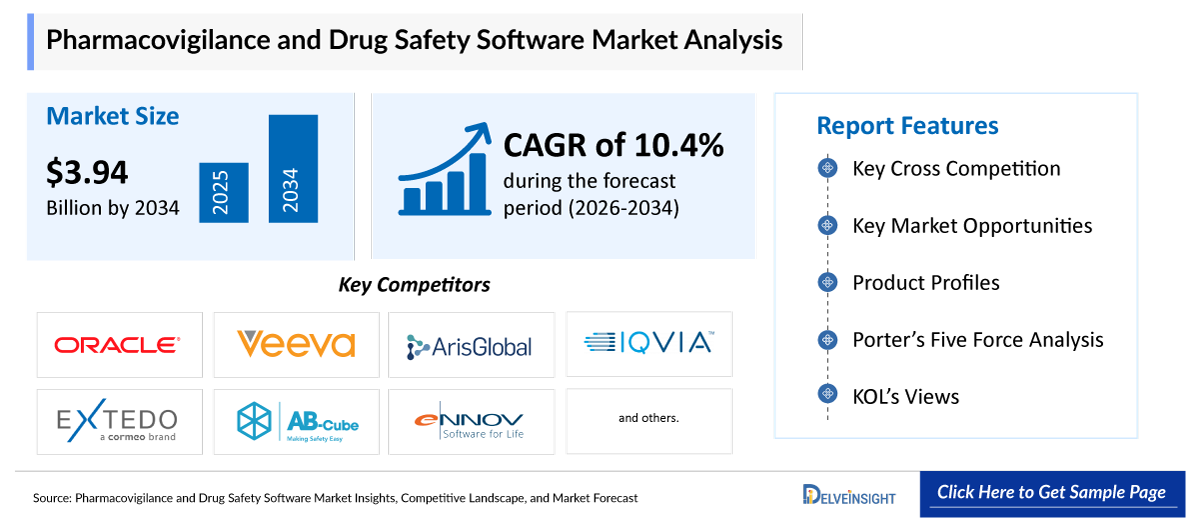
- The global pharmacovigilance and drug safety software market size was valued at USD 1.62 billion in 2025 and is projected to reach USD 3.94 billion by 2034.
- The market is expected to expand at a CAGR of 10.4% during the forecast period 2026-2034, supported by the rising volume of adverse event reports, the tightening of global pharmacovigilance regulations, the adoption of artificial intelligence and automation in case processing, and the shift toward cloud and software-as-a-service deployment.
- By software type, the adverse event reporting and case management segment dominated the pharmacovigilance and drug safety software market with a 38% share in 2025.
- By delivery mode, the cloud-based segment dominated the pharmacovigilance and drug safety software market with a 58% share in 2025.
- By end-user, the pharmaceutical and biotechnology companies segment dominated the pharmacovigilance and drug safety software market with a 62% share in 2025.
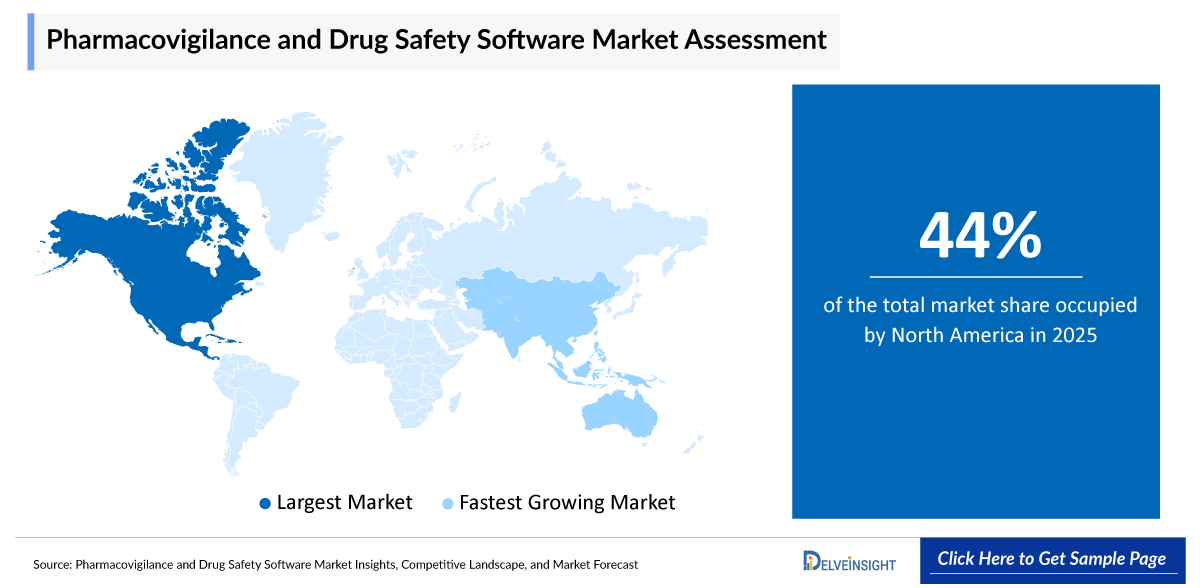
- North America accounted for the largest share of the pharmacovigilance and drug safety software market at 44% in 2025, while Asia-Pacific is anticipated to register the fastest growth through 2034.
Pharmacovigilance and drug safety software is the set of applications used to collect, process, assess, report, and monitor adverse events and safety data across the lifecycle of a medicinal product, from clinical development through post-marketing surveillance. The software supports the intake and processing of individual case safety reports, the electronic submission of reports to regulators in the ICH E2B format, medical coding with the Medical Dictionary for Regulatory Activities and the World Health Organization Drug Dictionary, the detection and management of safety signals, the preparation of aggregate reports such as periodic safety update reports and development safety update reports, and the management of risk management plans.
Leading platforms combine these capabilities into unified suites, including Oracle Argus and Empirica within Safety One, ArisGlobal LifeSphere MultiVigilance, Veeva Vault Safety with Vault Signal and SafetyDocs, the IQVIA Vigilance Platform, and the SafetyEasy suite powered by AB Cube. The workflow proceeds from case intake and triage through processing, coding, and medical review to regulatory submission, signal detection, and risk management, and the contemporary market is defined by the shift from on-premise systems to cloud deployment and by the integration of natural language processing and generative artificial intelligence to automate intake, coding, and narrative generation.
Pharmacovigilance and Drug Safety Software Market Key Growth Drivers
- Rising volume of adverse event reports, with the European Medicines Agency reporting that EudraVigilance contained 29.3 million individual case safety reports, representing 16.9 million unique cases, by early 2024.
- Mandatory electronic reporting standards, with the European Medicines Agency requiring the ICH E2B (R3) format for electronic individual case safety report submission to EudraVigilance and the U.S. Food and Drug Administration structuring its FAERS database to the ICH E2B guidance.
- Tightening global pharmacovigilance regulation, including the European Union Good Pharmacovigilance Practices modules, United States requirements under 21 CFR Part 11 and the post-marketing reporting rules, and the harmonized ICH guidelines.
- Rapid adoption of artificial intelligence and automation, with vendors including ArisGlobal, Oracle, Veeva Systems, and IQVIA embedding natural language processing and generative artificial intelligence to automate case intake, medical coding, and narrative generation.
- A pronounced shift toward cloud and software-as-a-service deployment that lowers infrastructure cost and accelerates implementation across pharmaceutical companies of every size.
- Growth of the biopharmaceutical pipeline and expanding product launches that increase the number of products under active safety surveillance.
- Expansion of multivigilance and real-world data sources, including medical device vigilance, cosmetovigilance, literature, and digital channels, that widen the scope and volume of safety data.
Key Companies in Pharmacovigilance and Drug Safety Software Market
The competitive field is led by large platform vendors that offer end-to-end safety suites, challenged by specialist multivigilance and modernization vendors and by regional providers. The leading participants in the pharmacovigilance and drug safety software market include the following:
- Oracle Corporation
- Veeva Systems Inc.
- ArisGlobal LLC
- IQVIA Holdings Inc.
- EXTEDO GmbH
- AB Cube SAS
- Ennov SAS
- Sarjen Systems Pvt. Ltd.
- Max Application SAS
- United BioSource LLC, and others
For illustrative purposes, only the top 10 companies are listed in the Table of Contents. The report may include analysis and references to additional companies relevant to the market assessment
Pharmacovigilance and Drug Safety Software Market Size
The following table summarizes the headline market metrics for the global pharmacovigilance and drug safety software market across the base year and the forecast horizon.
|
Report Metrics |
Details |
|
2025 Market Size |
USD 1.62 billion |
|
2034 Projected Market Size |
USD 3.94 billion |
|
Growth Rate (2026-2034) |
10.4% CAGR |
|
Largest Market |
North America (44% share in 2025) |
|
Fastest Growing Market |
Asia-Pacific |
|
Market Structure |
Moderately Consolidated |
All market values are expressed in USD and represent DelveInsight estimates synthesized from primary and secondary research.
Factors Contributing to the Growth of the Pharmacovigilance and Drug Safety Software Market
Pharmacovigilance and Drug Safety Software Market Drivers
- Rising Volume of Adverse Event Reports and Individual Case Safety Reports: The foundational driver of the pharmacovigilance and drug safety software market is the sustained growth in the volume of adverse event reports and individual case safety reports that safety teams must process, code, and submit within regulatory timelines. The European Medicines Agency has reported that EudraVigilance, its central database for adverse event reports across the European Union and European Economic Area, contained 29.3 million individual case safety reports, representing 16.9 million unique cases, by early 2024, a dataset comparable in scale to the FAERS database maintained by the U.S. Food and Drug Administration. The volume continues to rise as patient reporting expands, as digital and social channels generate new sources of safety data, and as the biopharmaceutical pipeline widens the number of products under surveillance. Manual processing cannot scale to this volume within the timelines that regulators require, which compels pharmaceutical companies, contract research organizations, and outsourcing providers to adopt software that automates intake, triage, coding, and submission. The recurring and mandatory nature of case processing makes adverse event reporting and case management the core of every safety deployment and the largest driver of software demand. As report volumes grow with product launches, patient engagement, and the broadening of vigilance to devices and other product types, the requirement for scalable, compliant, and increasingly automated case management sustains steady expansion of the market.
- Tightening Global Pharmacovigilance Regulations and Standards: A tightening and harmonization of global pharmacovigilance regulation has raised the compliance bar and expanded demand for validated safety software. The European Medicines Agency requires the ICH E2B(R3) format for the electronic submission of individual case safety reports to EudraVigilance, and it enforces the Good Pharmacovigilance Practices modules that govern signal management, risk management, and periodic reporting across the European Union. The U.S. Food and Drug Administration structures its adverse event database to the ICH E2B guidance, codes events with the Medical Dictionary for Regulatory Activities, and requires expedited and periodic reporting under its post-marketing rules, while 21 CFR Part 11 governs electronic records and signatures. The International Council for Harmonisation guidelines standardize the format and content of safety reporting across regions, and national authorities including the Pharmaceuticals and Medical Devices Agency in Japan and the National Medical Products Administration in China maintain their own electronic reporting requirements. These obligations compel companies to operate validated systems that produce compliant electronic submissions, maintain audit trails, and support signal and risk management workflows aligned to the Good Pharmacovigilance Practices. Because the requirements are mandatory, evolving, and multi-regional, they favor software that is continuously updated for regulatory change and that supports submission to multiple authorities from a single platform, sustaining durable demand for compliant pharmacovigilance and drug safety software.
- Adoption of Artificial Intelligence, Machine Learning, and Automation: The adoption of artificial intelligence, machine learning, and automation is transforming pharmacovigilance operations and driving a wave of software investment and modernization. Vendors have embedded natural language processing and generative artificial intelligence across the safety workflow to automate the extraction of case data from unstructured sources, the coding of events, and the generation of case narratives. ArisGlobal introduced LifeSphere NavaX, a cognitive computing engine using large language models and generative artificial intelligence, and reported that global pharmaceutical companies adopting it target efficiency gains of 65% across case processing with intake accuracy of 90%. Oracle added artificial intelligence features to Argus that automate the translation of free-text safety case information into 30 languages using Oracle Cloud Infrastructure, and Veeva Systems and IQVIA have embedded automation and natural language processing across case intake, narrative enhancement, and signal detection. Automation addresses the central operational challenge of the field, which is processing rising case volumes within fixed budgets and regulatory timelines, and it shifts competition toward the intelligence and accuracy of the platform rather than manual configuration. As organizations move from piloting artificial intelligence to scaling it across global operations, demand concentrates in platforms that deliver validated, auditable automation. This modernization cycle drives replacement of legacy systems, expands the value delivered per deployment, and sustains growth in advanced pharmacovigilance and drug safety software.
- Shift toward Cloud and Software-as-a-Service Deployment: A pronounced shift from on-premise systems toward cloud and software-as-a-service deployment is expanding the market and broadening its customer base. Cloud deployment lowers the infrastructure and maintenance burden, accelerates implementation and validation, and allows organizations to scale capacity with case volume, and it has become the default for modern safety platforms. Veeva Vault Safety is delivered as a cloud application on a single platform, the IQVIA Vigilance Platform is a secure software-as-a-service environment, the SafetyEasy suite powered by AB Cube is a cloud service that can be configured and validated within a short period, and Oracle has moved its safety solutions onto Oracle Cloud Infrastructure. Cloud delivery is particularly important for emerging biotechnology companies and for contract research and outsourcing providers that require rapid deployment without large capital investment, and it enables continuous regulatory updates and unified access across global teams. The model also supports the integration of artificial intelligence services and external data sources that on-premise systems cannot easily accommodate. As organizations migrate from legacy on-premise databases to cloud platforms to reduce cost, improve scalability, and access automation, the cloud-based segment leads the market and drives replacement demand. This transition broadens the addressable market to organizations of every size and sustains the growth of cloud pharmacovigilance and drug safety software.
- Growth of the Biopharmaceutical Pipeline and Product Launches: The expansion of the biopharmaceutical pipeline and the rising number of product launches increase the number of products under active safety surveillance and, with them, the demand for pharmacovigilance software. Each new drug, biologic, vaccine, and combination product entering clinical development and the market adds to the population of products that require continuous safety monitoring, adverse event collection, signal detection, and periodic reporting throughout its lifecycle. The growth of advanced therapies, biologics, and specialty medicines, many of which carry complex safety profiles and post-authorization commitments, intensifies the monitoring burden and the volume of safety data generated. Companies bringing products to multiple markets must submit compliant reports to several regulators and maintain risk management plans across regions, which requires scalable and multi-regional software. The proliferation of products also increases aggregate reporting obligations, including periodic safety update reports and development safety update reports, and expands the need for medical coding and literature monitoring. As the pipeline broadens and launches accelerate, the number of products, cases, and reports rises in step, sustaining demand for case management, signal detection, and aggregate reporting software. This structural driver links the growth of the safety software market to the underlying expansion of the biopharmaceutical industry and its regulatory obligations.
- Expansion of Multivigilance and Real-World Data Sources: The expansion of multivigilance and of real-world data sources broadens the scope and volume of safety monitoring and drives demand for software that can manage diverse product types and data channels. Modern platforms extend beyond drug pharmacovigilance to medical device vigilance, cosmetovigilance, and nutrivigilance, and the SafetyEasy suite powered by AB Cube manages pharmacovigilance, device vigilance, cosmetovigilance, and nutrivigilance within a single database, including combination product reporting. At the same time, safety data increasingly originates from scientific literature, patient support programs, social media, and digital channels, and vendors have added natural language processing to capture adverse events from these unstructured sources, with the IQVIA Vigilance Detect module applying natural language processing across many languages to uncover adverse events and product quality complaints. The integration of real-world data and observational sources into signal detection, exemplified by the analysis of healthcare data and external health authority datasets, further expands the data that safety software must ingest and analyze. As the definition of vigilance broadens across product types and as safety data proliferates across channels, organizations require platforms that unify multivigilance and real-world data within a compliant workflow. This expansion increases the volume, variety, and complexity of safety data and sustains demand for advanced, multi-source pharmacovigilance and drug safety software.
Pharmacovigilance and Drug Safety Software Market Restraints
The pharmacovigilance and drug safety software market faces several interrelated restraints that temper its growth. The foremost is the high cost and complexity of implementation and validation, since safety systems must be configured to each organization's processes, integrated with clinical, regulatory, and quality systems, and validated to demonstrate compliance with 21 CFR Part 11, the Good Pharmacovigilance Practices, and the ICH guidelines, which requires time, specialized expertise, and capital that can be prohibitive for smaller organizations. Migration from entrenched legacy on-premise databases to modern cloud platforms is disruptive and carries risk to data integrity and business continuity, and the effort of transferring large historical case volumes and revalidating workflows slows replacement decisions. Data privacy and security obligations, including the General Data Protection Regulation in Europe and the handling of sensitive personal and health data across borders, add compliance burden and constrain the movement of data to cloud environments, requiring anonymization and localization that increase complexity. The shortage of experienced pharmacovigilance and safety informatics professionals limits the capacity of organizations to implement and operate advanced systems and to validate artificial intelligence tools. The adoption of artificial intelligence, while a powerful driver, raises questions of regulatory acceptance, explainability, and data quality, since automated coding and narrative generation must be validated and auditable to satisfy regulators, and the evolving regulatory posture toward artificial intelligence in safety introduces uncertainty. Integration with the wider ecosystem of clinical trial, regulatory information management, and quality systems is technically demanding, and the multiplicity of regional reporting requirements adds ongoing maintenance cost. Reliance on outsourcing and the concentration of the installed base among a few large platform vendors can raise switching costs and constrain the flexibility of smaller providers. Together these factors moderate the pace of adoption and modernization and require vendors to demonstrate clear compliance, efficiency, and cost advantages to sustain growth.
Pharmacovigilance and Drug Safety Software Market Segment Analysis
The global spinal stenosis devices market is segmented by software type (adverse event reporting and case management, signal detection and management, risk management, regulatory and aggregate reporting, medical coding and dictionary management, and fully integrated safety suites), by delivery mode (on-premise, cloud-based), by end-user (pharmaceutical and biotechnology companies, contract research organizations, business process outsourcing firms, regulatory authorities and government agencies, and others), and by geography (North America, Europe, Asia-Pacific, and the Rest of the World).
By Software Type
Dominant Subsegment: Adverse Event Reporting and Case Management.
The adverse event reporting and case management category is expected to dominate the market. The adverse event reporting and case management segment accounted for a 38% share of the pharmacovigilance and drug safety software market in 2025. Case management is the core of every safety deployment, encompassing the intake, triage, processing, medical review, and electronic submission of individual case safety reports, and it is required continuously and at scale for every product under surveillance. Its dominance reflects the mandatory and recurring nature of case processing and the volume of reports that safety teams must handle within regulatory timelines. Every leading platform is built upon this capability, including Oracle Argus, ArisGlobal LifeSphere MultiVigilance, Veeva Vault Safety, the IQVIA Vigilance Platform, and the SafetyEasy suite powered by AB Cube, and the segment benefits directly from the automation wave, as vendors embed natural language processing and generative artificial intelligence to accelerate intake, coding, and narrative generation. The requirement to produce compliant electronic submissions in the ICH E2B (R3) format, to code events with the Medical Dictionary for Regulatory Activities, and to maintain audit trails concentrates value in validated case management systems. As report volumes rise with product launches, patient reporting, and the broadening of vigilance to additional product types, and as organizations modernize legacy systems to gain automation, case management remains the largest and most defensible segment. Its centrality to compliance and its exposure to the artificial intelligence modernization cycle sustain its leadership across the forecast period and anchor demand for the safety platforms supplied by the leading vendors.
By Delivery Mode
Dominant Subsegment: Cloud-Based.
The cloud-based category is expected to dominate the market. The cloud-based segment accounted for a 58% share of the pharmacovigilance and drug safety software market in 2025. Cloud and software-as-a-service delivery has become the default for modern safety platforms because it lowers infrastructure and maintenance cost, accelerates implementation and validation, scales capacity with case volume, and enables continuous regulatory updates and unified global access. Its dominance reflects the industry-wide migration from legacy on-premise databases toward cloud platforms and the preference of new adopters for rapid, low-capital deployment. Veeva Vault Safety is delivered as a cloud application on a single platform, the IQVIA Vigilance Platform is a secure software-as-a-service environment, the SafetyEasy suite powered by AB Cube is a cloud service that can be configured and validated within a short period, and Oracle has moved its safety solutions onto Oracle Cloud Infrastructure. Cloud delivery is especially important for emerging biotechnology companies and for contract research and outsourcing providers that require rapid deployment without large capital investment, and it enables the integration of artificial intelligence services and external data sources that on-premise systems cannot easily accommodate. As organizations migrate to reduce cost, improve scalability, and access automation, the cloud-based segment leads the market and drives replacement demand. The alignment of cloud delivery with the artificial intelligence modernization cycle and with the needs of organizations of every size sustains its leadership across the forecast period.
By End-User
Dominant Subsegment: Pharmaceutical and Biotechnology Companies.
The pharmaceutical and biotechnology companies’ category is expected to dominate the market. The pharmaceutical and biotechnology companies segment accounted for a 62% share of the pharmacovigilance and drug safety software market in 2025. Pharmaceutical and biotechnology companies are the marketing authorization holders that carry the primary legal responsibility for pharmacovigilance across the lifecycle of their products, and they operate the largest safety organizations, monitor the most products, and process the highest volumes of adverse event reports, which concentrates software demand in this group. Their dominance reflects the breadth of their portfolios, their obligations to multiple regulators, and their capacity to invest in comprehensive, validated safety platforms. These companies require the full range of capabilities, from case intake and processing through signal detection, risk management, aggregate reporting, and medical coding, and many consolidate these functions onto a single platform to standardize global safety operations. The largest organizations process hundreds of thousands of adverse event cases each year and are the principal adopters of the artificial intelligence and automation that vendors have introduced, as they seek to manage rising volumes within fixed budgets. Their multi-regional obligations favor platforms that support submission to several authorities and maintain risk management plans across regions. As portfolios expand with new launches and advanced therapies, and as these companies modernize legacy systems, pharmaceutical and biotechnology companies remain the largest and most influential end-user segment. Their scale, obligations, and modernization sustain their leadership across the forecast period and shape the direction of the market.
Pharmacovigilance and Drug Safety Software Market Region Analysis
Dominant Region: North America
North America accounted for a 44% share of the global pharmacovigilance and drug safety software market in 2025, representing the highest regional market share globally. The leadership of the region reflects the concentration of the global pharmaceutical and biotechnology industry, the presence of the leading safety software vendors, a stringent and well-defined regulatory framework, and the early adoption of cloud and artificial intelligence in pharmacovigilance. The United States is the largest national market, supported by the size of its biopharmaceutical sector, the volume of adverse event reports processed, and the rigor of the U.S. Food and Drug Administration post-marketing safety surveillance program. The agency maintains the FAERS database within its adverse event monitoring system, structures reporting to the ICH E2B guidance, codes events with the Medical Dictionary for Regulatory Activities, and enforces electronic records requirements under 21 CFR Part 11, and it operates the Sentinel initiative for active surveillance using real-world data. The leading vendors, including Oracle, Veeva Systems, ArisGlobal, and IQVIA, are headquartered or heavily operate in the region, which accelerates the adoption of new platforms and artificial intelligence capabilities. The concentration of large pharmaceutical organizations with global safety obligations, the availability of capital for modernization, and the maturity of cloud adoption reinforce the leadership of the region. The combination of industry concentration, regulatory rigor, vendor presence, and early adoption of automation sustains the position of North America as the largest regional market across the forecast period.
Fastest Growing Region: Asia-Pacific
Asia-Pacific is projected to register the fastest compound annual growth rate through 2034. The region is expanding its biopharmaceutical industry, clinical trial activity, and regulatory infrastructure, and it is building the pharmacovigilance capacity required to support that growth, which drives demand for safety software. China, Japan, and India are the principal national markets, supported by growing domestic pharmaceutical sectors, rising clinical trial volumes, and the strengthening of pharmacovigilance requirements by the National Medical Products Administration in China, the Pharmaceuticals and Medical Devices Agency in Japan, and the regulatory authorities in India. India is also a major global center for pharmacovigilance outsourcing, hosting the safety operations of many contract research and business process outsourcing providers that adopt safety software at scale. As national authorities strengthen electronic reporting and signal management requirements, and as domestic companies expand their portfolios and international presence, organizations adopt compliant, cloud-based, and increasingly automated safety platforms. The combination of industry expansion, regulatory strengthening, outsourcing concentration, and rising adoption of cloud and artificial intelligence positions Asia-Pacific as the fastest-growing regional market, and it attracts investment and commercial focus from the leading global vendors seeking presence in high-growth national markets.
Pharmacovigilance and Drug Safety Software Market Regional Commentary
North America
North America leads the market, supported by the concentration of the global pharmaceutical and biotechnology industry, the presence of the leading safety software vendors, and a stringent regulatory framework. The United States dominates the region through the size of its biopharmaceutical sector, the rigor of the U.S. Food and Drug Administration post-marketing surveillance program, and the early adoption of cloud and artificial intelligence. The concentration of large safety organizations with multi-regional obligations and the availability of capital for modernization sustain demand for comprehensive, validated safety platforms.
Europe
Europe is a mature and substantial market, shaped by the European Medicines Agency and its EudraVigilance system, the Good Pharmacovigilance Practices modules, and the requirement for the ICH E2B (R3) format for electronic reporting. Germany, France, Italy, Spain, and the United Kingdom are the principal national markets, supported by strong regulatory rigor, the presence of European specialists including EXTEDO, AB Cube, and Ennov, and the activity of the Pharmacovigilance Risk Assessment Committee. Demand is sustained by multi-regional compliance obligations and by the strengthening of signal and risk management requirements.
Asia-Pacific
Asia-Pacific is the fastest-growing region, driven by the expansion of the biopharmaceutical industry, rising clinical trial activity, and the strengthening of pharmacovigilance requirements across China, Japan, and India. India is a major global center for pharmacovigilance outsourcing, and the adoption of cloud-based and automated safety platforms is rising as regulatory requirements and portfolios grow. The region attracts commercial focus from the leading global vendors seeking presence in high-growth national markets.
Rest of World
The Rest of World, spanning Latin America, the Middle East, and Africa, represents an emerging opportunity as regulatory authorities strengthen pharmacovigilance requirements and as domestic pharmaceutical industries expand. Growth is supported by the adoption of electronic reporting, the participation of national authorities in the World Health Organization program for international drug monitoring, and rising awareness of safety obligations, though the adoption of advanced and cloud-based software varies by market. Vendors pursue these markets through cloud delivery and partnerships suited to developing regulatory infrastructure.
Pharmacovigilance and Drug Safety Software Market Competitive Landscape
The global pharmacovigilance and drug safety software market is classified as Moderately Consolidated. A small group of large platform vendors dominates the market through comprehensive, end-to-end safety suites, strong installed bases among large pharmaceutical organizations, global delivery, and continuous investment in artificial intelligence, while specialist multivigilance and modernization vendors and regional providers compete on differentiated technology, cost, and rapid deployment. Competition centers on automation, cloud delivery, signal detection, regulatory conformity, and the breadth of the safety suite, and product launches, artificial intelligence introductions, and platform migrations intensify the contest.
The competitive landscape is evaluated across the following dimensions:
- Market concentration: Moderately consolidated, with a small group of large platform vendors holding the majority of global revenue through comprehensive safety suites, alongside a tier of specialist multivigilance and modernization vendors and regional providers.
- Leading players: Oracle, with Argus and Empirica within Safety One, and Veeva Systems, with Vault Safety, Vault Signal, and SafetyDocs, lead alongside ArisGlobal, with LifeSphere MultiVigilance and NavaX, and IQVIA, with its Vigilance Platform, while EXTEDO, AB Cube, and Ennov contest defined segments with the SafetyEasy suite and specialist multivigilance offerings.
- Geographic reach: The leading vendors maintain global delivery and support organizations, while European specialists and regional providers leverage local relationships and rapid, cost-effective deployment to serve their domestic and neighboring markets.
- Product portfolio strength: Competitive advantage rests on breadth across case intake and processing, signal detection and management, risk management, aggregate reporting, and medical coding within a unified platform, since organizations increasingly consolidate safety operations onto a single suite rather than assembling point solutions.
- Pipeline strength: Development is concentrated in generative artificial intelligence and natural language processing for intake, coding, and narrative generation, in cloud and software-as-a-service delivery, in signal detection using real-world and external data, and in multivigilance across drugs, devices, and other product types.
- Strategic partnerships: Collaboration spans implementation and validation partners, integration with clinical, regulatory, and quality systems, and alliances that extend delivery and support reach across regions.
- M&A activity: Consolidation has shaped the field as large platform vendors and private capital have acquired and integrated safety and regulatory technology, and as vendors extend their suites across the safety and regulatory lifecycle.
- Innovation focus: Innovation is shifting toward generative artificial intelligence and automation across the safety workflow, cloud-native delivery, unified multivigilance, and signal detection that incorporates real-world data and digital sources.
- Regulatory standing: Conformity with the ICH E2B(R3) format, the Good Pharmacovigilance Practices, 21 CFR Part 11, and the multi-regional electronic reporting requirements is a decisive competitive credential, and the ability to update continuously for regulatory change has become a principal axis of competition among the leaders.
Pharmacovigilance and Drug Safety Software Market Recent Developmental Activities
- In June 2025, ArisGlobal LLC announced that a sixth global pharmaceutical company selected LifeSphere NavaX, its generative artificial intelligence cognitive computing engine, to enhance case processing, with the organization processing 150,000 adverse event cases each year on the LifeSphere MultiVigilance platform and targeting efficiency gains of 65% and intake accuracy of 90%. Strategic significance: the adoption confirmed the industry shift from piloting artificial intelligence to scaling it across global case processing operations in the dominant case management segment.
- In March 2025, ArisGlobal LLC announced that a fifth global biopharmaceutical company, processing 400,000 adverse event cases each year on the LifeSphere MultiVigilance platform, selected LifeSphere NavaX to enhance case processing with generative artificial intelligence. Strategic significance: the win reinforced the momentum of artificial intelligence adoption among the largest safety organizations and the modernization of legacy case processing.
- In October 2024, Oracle Corporation announced new artificial intelligence features in Argus Safety that automate the translation of free-text safety case information into 30 languages using Oracle Cloud Infrastructure language services. Strategic significance: the enhancement advanced automation within the leading installed-base case management platform and addressed the multilingual demands of global safety operations.
- In June 2024, ArisGlobal LLC announced that one of the world's largest biotechnology companies, processing 600,000 adverse event cases each year, went live on LifeSphere MultiVigilance and its reporting and analytics solution, consolidating core safety activities from legacy on-premise systems. Strategic significance: the consolidation illustrated the migration from on-premise databases to unified cloud safety platforms among high-volume organizations.
- In 2025, ArisGlobal LLC introduced an artificial intelligence MedDRA Coding Agent for intelligent medical coding within its LifeSphere platform. Strategic significance: the agent extended automation into medical coding, a labor-intensive step of case processing, reinforcing the competition on intelligent automation.
- In 2025, EPS Corporation and Nippon Shinyaku selected ArisGlobal LifeSphere, with EPS Corporation adopting LifeSphere MultiVigilance for case processing and Nippon Shinyaku adopting LifeSphere Safety. Strategic significance: the selections demonstrated the expansion of modern cloud safety platforms into the Japanese market and the outsourcing sector.
- In 2024, Veeva Systems Inc. advanced its Safety Suite, combining Vault Safety, Vault Signal, and SafetyDocs on a single cloud platform with artificial intelligence capabilities that automate case intake and enhance case narratives. Strategic significance: the unified suite strengthened the competitive position of a cloud-native vendor across case management, signal detection, and safety content.
- In 2025, the European Union adopted Regulation (EU) 2025/1466 relating to the pharmacovigilance framework and the process for medicinal product label updates. Strategic significance: the regulation reinforced the linkage between signal management and regulatory action and increased the value of software that accelerates the path from signal to label update.
- In early 2024, the European Medicines Agency reported that EudraVigilance contained 29.3 million individual case safety reports, representing 16.9 million unique cases. Strategic significance: the scale of the dataset underscored the volume of safety data that software must process and analyze and the importance of automation and signal detection.
- In 2025, the U.S. Food and Drug Administration organized its post-marketing surveillance under the FDA Adverse Event Monitoring System, which encompasses the FAERS database structured to the ICH E2B guidance and coded with the Medical Dictionary for Regulatory Activities. Strategic significance: the framework reaffirmed the electronic reporting and coding standards that safety software must support for the United States market.
- In December 2023, ArisGlobal LLC launched LifeSphere NavaX, a cognitive computing engine using large language models and generative artificial intelligence to accelerate case processing and pharmacovigilance operations. Strategic significance: the launch inaugurated the current wave of generative artificial intelligence adoption in pharmacovigilance and set a competitive benchmark for intelligent automation.
- In 2024 and 2025, the leading vendors advanced generative artificial intelligence and natural language processing across case intake, medical coding, narrative generation, and signal detection, and extended cloud and multivigilance capabilities across their platforms. Strategic significance: the convergence of the leaders on artificial intelligence, cloud delivery, and unified multivigilance confirmed these as the defining axes of competition and signaled a market shifting from legacy on-premise systems toward intelligent, cloud-native safety platforms.
Pharmacovigilance and Drug Safety Software Market Segmentation
- Pharmacovigilance and Drug Safety Software Market Assessment by Software Type
- Adverse Event Reporting and Case Management
- Signal Detection and Management
- Risk Management
- Regulatory and Aggregate Reporting
- Medical Coding and Dictionary Management
- Fully Integrated Safety Suites
- Pharmacovigilance and Drug Safety Software Market Assessment by Delivery Mode
- On-Premise
- Cloud-Based
- Pharmacovigilance and Drug Safety Software Market Assessment by End-User
- Pharmaceutical and Biotechnology Companies
- Contract Research Organizations
- Business Process Outsourcing Firms
- Regulatory Authorities and Government Agencies
- Others
Pharmacovigilance and Drug Safety Software Market Assessment by Geography
- North America Pharmacovigilance and Drug Safety Software Market Assessment
- United States Pharmacovigilance and Drug Safety Software Market Size in USD million (2023-2034)
- Canada Pharmacovigilance and Drug Safety Software Market Size in USD million (2023-2034)
- Mexico Pharmacovigilance and Drug Safety Software Market Size in USD million (2023-2034)
- Europe Pharmacovigilance and Drug Safety Software Market Assessment
- France Pharmacovigilance and Drug Safety Software Market Size in USD million (2023-2034)
- Germany Pharmacovigilance and Drug Safety Software Market Size in USD million (2023-2034)
- United Kingdom Pharmacovigilance and Drug Safety Software Market Size in USD million (2023-2034)
- Italy Pharmacovigilance and Drug Safety Software Market Size in USD million (2023-2034)
- Spain Pharmacovigilance and Drug Safety Software Market Size in USD million (2023-2034)
- Rest of Europe Pharmacovigilance and Drug Safety Software Market Size in USD million (2023-2034)
- Asia-Pacific Pharmacovigilance and Drug Safety Software Market Assessment
- China Pharmacovigilance and Drug Safety Software Market Size in USD million (2023-2034)
- Japan Pharmacovigilance and Drug Safety Software Market Size in USD million (2023-2034)
- India Pharmacovigilance and Drug Safety Software Market Size in USD million (2023-2034)
- Australia Pharmacovigilance and Drug Safety Software Market Size in USD million (2023-2034)
- South Korea Pharmacovigilance and Drug Safety Software Market Size in USD million (2023-2034)
- Rest of Asia-Pacific Pharmacovigilance and Drug Safety Software Market Size in USD million (2023-2034)
- Rest of the World Pharmacovigilance and Drug Safety Software Market Assessment
- Middle East Pharmacovigilance and Drug Safety Software Market Size in USD million (2023-2034)
- Africa Pharmacovigilance and Drug Safety Software Market Size in USD million (2023-2034)
- South America Pharmacovigilance and Drug Safety Software Market Size in USD million (2023-2034)
Pharmacovigilance and Drug Safety Software Market Recent Industry Trends and Milestones (2023-2026):
|
Category |
Key Developments |
|
Pharmacovigilance and Drug Safety Software Market Product Approval |
The period was defined by the introduction and adoption of generative artificial intelligence engines and modern cloud platforms rather than by device clearances. ArisGlobal launched LifeSphere NavaX, a generative artificial intelligence cognitive computing engine, and secured successive adoptions by global pharmaceutical companies for case processing, and it introduced an artificial intelligence MedDRA Coding Agent for intelligent medical coding. Oracle added artificial intelligence features to Argus that automate the translation of free-text safety case information into 30 languages, and Veeva Systems advanced its Safety Suite of Vault Safety, Vault Signal, and SafetyDocs with automation across intake and narrative generation. Together these releases concentrated competition in intelligent automation and unified cloud safety platforms. |
|
Pharmacovigilance and Drug Safety Software Market Product Expansion |
Product expansion advanced along three axes. The first is artificial intelligence and automation, as vendors embedded natural language processing and generative artificial intelligence across case intake, medical coding, narrative generation, and signal detection. The second is cloud and software-as-a-service delivery, as platforms including Veeva Vault Safety, the IQVIA Vigilance Platform, the SafetyEasy suite powered by AB Cube, and Oracle solutions on Oracle Cloud Infrastructure moved safety operations to the cloud. The third is multivigilance and real-world data, as platforms extended to medical device vigilance, cosmetovigilance, and nutrivigilance and added natural language processing to capture adverse events from literature and digital channels. Signal detection expanded to incorporate external health authority datasets and real-world data. |
|
Pharmacovigilance and Drug Safety Software Market Investment |
Investment was shaped by the modernization cycle and by the race to embed artificial intelligence. The leading vendors invested heavily in generative artificial intelligence engines, cloud-native platforms, and automation, and pharmaceutical organizations invested in migrating from legacy on-premise databases to unified cloud safety suites. Private capital and strategic acquirers continued to consolidate safety and regulatory technology, extending suites across the safety and regulatory lifecycle. Investment also flowed into the validation and regulatory conformity required to deploy artificial intelligence in a compliant and auditable manner, and vendors pursued geographic expansion into high-growth Asia-Pacific markets and the outsourcing sector. |
|
Company Strategy |
The unifying strategic theme is the combination of a unified cloud safety suite with embedded artificial intelligence. Oracle is advancing Argus and Empirica within Safety One on Oracle Cloud Infrastructure with artificial intelligence features, Veeva Systems is competing with a cloud-native suite of Vault Safety, Vault Signal, and SafetyDocs, and ArisGlobal is differentiating through LifeSphere MultiVigilance and the NavaX generative artificial intelligence engine. IQVIA is leveraging its Vigilance Platform and natural language processing detection, while EXTEDO, AB Cube, and Ennov pursue focused positions in cost-effective, rapidly deployed multivigilance. Across the field, strategy centers on automation, cloud delivery, multivigilance, and continuous regulatory conformity. |
|
Emerging Technologies |
The defining emerging technologies are generative artificial intelligence and large language models that automate case intake, medical coding, and narrative generation; natural language processing that captures adverse events from literature, social media, and digital channels across many languages; cloud-native and software-as-a-service platforms that scale with case volume and enable continuous regulatory updates; unified multivigilance that manages drugs, medical devices, cosmetics, and nutrition within a single database; and signal detection that incorporates real-world data and external health authority datasets. Supporting these are automation of aggregate reporting and the acceleration of the path from safety signal to regulatory label update. Across these, the trajectory is toward pharmacovigilance that is automated, cloud-native, intelligent, and unified across product types, improving compliance and efficiency for organizations managing rising volumes of safety data. |
Pharmacovigilance and Drug Safety Software Market Startup Funding and Investment Trends
Investment in the pharmacovigilance and drug safety software field has concentrated on technologies that make safety operations more automated, more intelligent, and more scalable, namely generative artificial intelligence and natural language processing for case intake, coding, and narrative generation, cloud-native and software-as-a-service platforms that lower cost and accelerate deployment, and unified multivigilance that extends safety monitoring across product types. Because the core market is dominated by large platform vendors with entrenched installed bases and comprehensive suites, most innovators pursue a differentiated technology or a modern, rapidly deployed platform that a strategic acquirer can absorb or that addresses the needs of emerging biotechnology and outsourcing organizations. The table below summarizes representative companies advancing the next generation of pharmacovigilance and drug safety software.
|
Company |
Total Funding |
Funding Stage |
Main Product/Offering |
Core Technology |
|
ArisGlobal LLC |
Private equity backed |
Commercial stage |
LifeSphere MultiVigilance and NavaX |
Generative artificial intelligence case processing |
|
AB Cube SAS |
Privately held |
Commercial stage |
SafetyEasy suite |
Cloud multivigilance with natural language processing |
|
Request for unlocking the report of the @ Pharmacovigilance and Drug Safety Software Market Insights | ||||
Capital formation in this field is shaped by the difficulty of competing directly against the large platform vendors, whose comprehensive suites, installed bases among large pharmaceutical organizations, global delivery, and artificial intelligence investment create high barriers, so investors have favored companies that introduce differentiated automation or modern, rapidly deployed cloud platforms rather than those contesting the core installed base. Generative artificial intelligence and natural language processing for case intake, coding, and narrative generation is the clearest technology thesis, seeking to process rising case volumes within fixed budgets and regulatory timelines. Cloud-native and software-as-a-service delivery constitutes a second major thesis, lowering the cost and accelerating the deployment of safety systems for emerging biotechnology and outsourcing organizations, and unified multivigilance that manages drugs, devices, cosmetics, and nutrition within a single database a third. The archetypal outcome is acquisition by one of the leading platform vendors or a strategic consolidator seeking to add a differentiated capability, which provides a defined exit that sustains earlier-stage investment. The principal risks are the demanding validation and regulatory conformity required for safety software, the concentration of the installed base among a few large vendors, the switching costs that entrench incumbents, and the evolving regulatory posture toward artificial intelligence in pharmacovigilance.
Key Takeaways from the Pharmacovigilance and Drug Safety Software Market Report Study
- Market size analysis for the current pharmacovigilance and drug safety software market size (2025), and market forecast for 9 years (2026 to 2034).
- Top key product/technology developments, mergers, acquisitions, partnerships, and joint ventures that happened over the last 3 years.
- Key companies dominating the global pharmacovigilance and drug safety software market.
- Various opportunities available for competitors in the pharmacovigilance and drug safety software market space.
- What are the top-performing segments in 2025? How will these segments perform in 2034?
- Which are the top-performing regions and countries in the current pharmacovigilance and drug safety software market scenario?
- Which are the regions and countries where companies should concentrate their opportunities for pharmacovigilance and drug safety software market growth in the future?
Target audience who can benefit from this pharmacovigilance and drug safety software market report study
- Pharmacovigilance and drug safety software product providers
- Research organizations and consulting companies
- Pharmacovigilance and drug safety software-related organizations, associations, forums, and other alliances
- Government and corporate offices
- Start-up companies, venture capitalists, and private equity firms
- Distributors and traders dealing in pharmacovigilance and drug safety software
- Various end-users who want to know more about the pharmacovigilance and drug safety software market and the latest technological developments in the pharmacovigilance and drug safety software market.

