Acid Sphingomyelinase Deficiency Epidemiology Summary
Acid Sphingomyelinase Deficiency (ASMD) Insights and Trends
- Acid Sphingomyelinase Deficiency, historically known as Niemann–Pick disease types A, A/B, and B, is an ultra-rare lysosomal storage disorder caused by mutations in the SMPD1 gene.
- ASMD exhibits a broad clinical spectrum ranging from rapidly progressive infantile neurovisceral disease (Type A) with early mortality to chronic visceral disease (Type B) compatible with survival into adulthood.
- ASMD remains significantly underdiagnosed due to phenotypic heterogeneity and overlap with other lysosomal storage disorders, despite an estimated prevalence of approximately 1 in 250,000 individuals globally. However, increasing genetic testing and physician awareness are improving identification of both pediatric and adult-onset cases across the 7MM.
Acid Sphingomyelinase Deficiency (ASMD) Epidemiology Forecast in the 7MM
- 2025 Diagnosed Prevalent Cases of ASMD: ~XX Cases
- ASMD Growth Rate (2026–2036): ~XX% CAGR
DelveInsight's ‘Acid Sphingomyelinase Deficiency (ASMD) – Epidemiology Forecast – 2036’ report delivers an in-depth understanding of the ASMD, historical and forecasted epidemiology, in the United States, EU4 (Germany, Spain, Italy, and France) and the United Kingdom, and Japan.
|
Study Period |
2022–2036 |
|
Historical Year |
2022–2025 |
|
Forecast Period |
2026–2036 |
|
Base Year |
2026 |
|
Geographies Covered |
|
|
Acid Sphingomyelinase Deficiency (ASMD) Epidemiology CAGR (Forecast period) |
~XX% (2026–2036) |
|
Acid Sphingomyelinase Deficiency (ASMD) Epidemiology Segmentation Analysis |
Patient Burden Assessment
|
Acid Sphingomyelinase Deficiency (ASMD) Understanding and Diagnosis Algorithm
Acid Sphingomyelinase Deficiency (ASMD) Overview
ASMD, historically known as Niemann-Pick disease types A, A/B, and B, is a rare inherited lysosomal storage disorder caused by mutations in the SMPD1 gene. These mutations result in deficiency of the acid sphingomyelinase enzyme, leading to accumulation of sphingomyelin within cells and progressive damage to multiple organs. ASMD presents as a clinical spectrum ranging from severe infantile neurovisceral disease (type A) to chronic visceral and chronic neurovisceral forms (types B and A/B). Common manifestations include hepatosplenomegaly, interstitial lung disease, thrombocytopenia, dyslipidemia, growth delay, and in severe forms, progressive neurological deterioration. The disease significantly impacts quality of life and survival, with symptom severity varying widely among patients.
Further details are provided in the report.
Acid Sphingomyelinase Deficiency (ASMD) Diagnosis
Diagnosis of ASMD is often challenging because of its rarity and overlap with other metabolic or hematologic disorders. Patients typically undergo evaluation after presenting with unexplained enlarged liver and spleen, recurrent respiratory symptoms, or abnormal lipid profiles. Definitive diagnosis is established through measurement of acid sphingomyelinase enzyme activity in leukocytes or fibroblasts, followed by confirmation using molecular genetic testing for SMPD1 mutations. Additional assessments such as pulmonary function tests, imaging studies, liver function evaluation, and biomarker analysis help determine disease severity and organ involvement. Increasing awareness, expanded genetic testing availability, and rare disease screening programs are improving early diagnosis and reducing diagnostic delays.
Further details are provided in the report.
Acid Sphingomyelinase Deficiency (ASMD) Epidemiology
Key Findings from Acid Sphingomyelinase Deficiency (ASMD) Epidemiological Analysis and Forecast
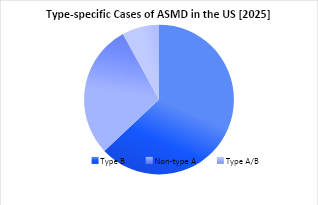
- In 2024, ASMD type B was the predominant subtype, accounting for ~63%, while non-type A cases represented ~29% and ASMD type A/B accounted for 8.2%.
- ASMD impacts both males and females equally, showing no significant gender disparity in its prevalence.
Scope of the Report
- The report covers a segment of a descriptive overview of ASMD, explaining their causes, signs and symptoms, and pathogenesis.
- Comprehensive insight has been provided into the epidemiology segments and forecasts, the future growth potential of the diagnosis rate, and disease progression.
Report Insights
Acid Sphingomyelinase Deficiency (ASMD) Patient Population Forecast
Report Key Strengths
- Epidemiology‑based (Epi‑based) Bottom‑up Forecasting
- 11-year Forecast
- Patient Burden Trends (by geography)
FAQs
- What are the disease risks, burdens, and unmet needs of ASMD? What will be the growth opportunities across the 7MM concerning the patient population with ASMD?
- What is the historical and forecasted ASMD patient pool in the US, EU4 (Germany, France, Italy, and Spain), the UK, and Japan?
Reasons to Buy
- Insights on patient burden/disease prevalence, evolution in diagnosis, and factors contributing to the change in the epidemiology of the disease during the forecast years.
- To understand key opinion leaders’ perspectives around the diagnostic challenges to overcome barriers in the future.
- Detailed insights on various factors hampering disease diagnosis and other existing diagnostic challenges.

-market.png&w=256&q=75)
-pipeline.png&w=256&q=75)

