
Acute Kidney Injury Pipeline
DelveInsight’s, “Acute Kidney Injury Pipeline Insight, 2026” report provides comprehensive insights about 20+ companies and 25+ pipeline drugs in Acute Kidney Injury pipeline landscape. It covers the pipeline drug profiles, including clinical and nonclinical stage products. It also covers the therapeutics assessment by product type, stage, route of administration, and molecule type. It further highlights the inactive pipeline products in this space.
Geography Covered
- Global coverage
Acute Kidney Injury Understanding
Acute Kidney Injury Overview
Acute kidney injury (AKI), also known as acute renal failure (ARF), is a sudden episode of kidney failure or kidney damage that happens within a few hours or a few days. AKI causes a build-up of waste products in blood and makes it hard for kidneys to keep the right balance of fluid in body. AKI can also affect other organs such as the brain, heart, and lungs. Acute kidney injury is common in patients who are in the hospital, in intensive care units, and especially in older adults. There are rarely any symptoms until the condition has progressed to a late stage. However, if there are symptoms, the most common one is a decrease in urine output.
Acute Kidney Injury (AKI) is a sudden decline in kidney function, leading to the accumulation of waste products in the blood. Common signs and symptoms include decreased urine output, swelling in the legs or ankles, fatigue, confusion, and shortness of breath. Patients may also experience nausea, chest pain, or irregular heartbeat. AKI often occurs rapidly and may be triggered by dehydration, infection, medications, or underlying health conditions. The pathophysiology of Acute Kidney Injury (AKI) involves a rapid decline in glomerular filtration rate (GFR), leading to impaired clearance of waste and electrolyte imbalance. It can result from prerenal (decreased blood flow), intrinsic (direct kidney damage), or postrenal (obstruction) causes. Cellular injury, inflammation, and ischemia contribute to tubular dysfunction and necrosis. This disrupts the kidney’s ability to regulate fluid, electrolytes, and acid-base balance, potentially progressing to chronic kidney disease if unresolved.
Common risk factors include diseases that affects blood flow to the kidneys or causes kidney damage such as chronic kidney disease, impaired left ventricular systolic function, advanced age (over 75 years old), diabetes, and dehydration. Other risk factors include time spent in a heart-lung machine, use of an intra-aortic balloon pump, the need for blood transfusions and hemodilution. The pathophysiology of Acute Kidney Injury (AKI) involves a rapid decline in glomerular filtration rate (GFR), leading to impaired clearance of waste and electrolyte imbalance. It can result from prerenal (decreased blood flow), intrinsic (direct kidney damage), or postrenal (obstruction) causes. Cellular injury, inflammation, and ischemia contribute to tubular dysfunction and necrosis. This disrupts the kidney’s ability to regulate fluid, electrolytes, and acid-base balance, potentially progressing to chronic kidney disease if unresolved.
The diagnosis of Acute Kidney Injury (AKI) is primarily based on clinical history, laboratory findings, and imaging studies. Key diagnostic criteria include a sudden rise in serum creatinine (≥0.3 mg/dL within 48 hours or ≥1.5 times baseline within 7 days) and/or a decrease in urine output (<0.5 mL/kg/hr for 6 hours). Blood urea nitrogen (BUN), electrolyte levels, and urinalysis are also assessed to evaluate kidney function and underlying causes. Imaging such as renal ultrasound may be used to detect obstructions or structural abnormalities. Additional tests like fractional excretion of sodium (FENa) help differentiate between prerenal and intrinsic causes. Early and accurate diagnosis is critical for prompt intervention and preventing progression. Treatment of Acute Kidney Injury (AKI) focuses on addressing the underlying cause, restoring kidney function, and preventing complications. This includes optimizing fluid balance—either through hydration in prerenal AKI or avoiding fluid overload in intrinsic/postrenal types. Electrolyte imbalances, especially hyperkalemia and acidosis, are corrected as needed. Nephrotoxic drugs are discontinued, and appropriate antibiotics or interventions are given for infections or obstructions. In severe cases, renal replacement therapy (dialysis) may be required to support kidney function temporarily. Close monitoring of renal function, urine output, and hemodynamic status is essential throughout treatment.
"Acute Kidney Injury Pipeline Insight, 2026" report by DelveInsight outlays comprehensive insights of present scenario and growth prospects across the indication. A detailed picture of the Acute Kidney Injury pipeline landscape is provided which includes the disease overview and Acute Kidney Injury treatment guidelines. The assessment part of the report embraces, in depth Acute Kidney Injury commercial assessment and clinical assessment of the pipeline products under development. In the report, detailed description of the drug is given which includes mechanism of action of the drug, clinical studies, NDA approvals (if any), and product development activities comprising the technology, Acute Kidney Injury collaborations, licensing, mergers and acquisition, funding, designations and other product related details.
Discover the latest Acute Kidney Injury pipeline insights, emerging therapies, and clinical advancements shaping the future of treatment in 2026.
Acute Kidney Injury Pipeline Report Highlights
The companies and academics are working to assess challenges and seek opportunities that could influence Acute Kidney Injury R&D. The therapies under development are focused on novel approaches to treat/improve Acute Kidney Injury.
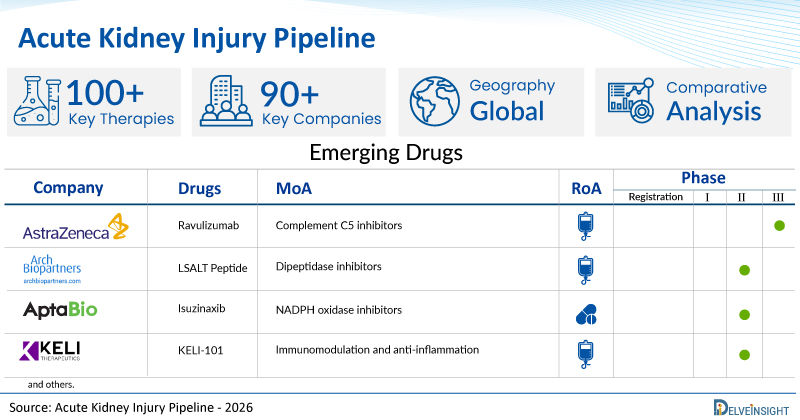
Acute Kidney Injury Emerging Drugs Analysis
This segment of the Acute Kidney Injury report encloses its detailed analysis of various drugs in different stages of clinical development, including Phase III, II, I, Preclinical and Discovery. It also helps to understand clinical trial details, expressive pharmacological action, agreements and collaborations, and the latest news and press releases.
Acute Kidney Injury Emerging Drugs
Ravulizumab: AstraZeneca
Ravulizumab (Ultomiris) is a long-acting monoclonal antibody developed by AstraZeneca (Alexion) that inhibits complement protein C5, preventing downstream inflammatory damage. It is currently being evaluated in the Phase III ARTEMIS trial for the prevention of acute kidney injury (AKI) in patients with chronic kidney disease undergoing cardiac surgery. By blocking terminal complement activation, ravulizumab aims to reduce ischemia-reperfusion injury and lower the incidence of major adverse kidney events (MAKE) post-surgery. This represents a novel, targeted approach to address a major unmet need in perioperative renal protection. Currently, the drug is in the Phase III stage of its development for the treatment of Acute Kidney Injury.
RMC-035: Guard Therapeutics AB
RMC-035, developed by Guard Therapeutics AB, is a first-in-class investigational biologic therapy based on a recombinant form of the endogenous protein alpha-1-microglobulin (A1M). It is designed to protect kidney cells from oxidative stress and damage, particularly during conditions such as open-heart surgery that can lead to acute kidney injury (AKI). The drug is administered via intravenous infusion as a short-term hospital treatment, aiming to reduce the risk of permanent kidney damage, dialysis, or death in high-risk patients. Currently, RMC-035 is in Phase 2b clinical development, following promising Phase II data showing improvements in long-term kidney function and reduction in major adverse kidney events. It has also received FDA Fast Track designation and IND clearance, highlighting its potential to address a significant unmet need in kidney protection. Currently the drug is in Phase II stage of its development.
KELI-101: Keli Therapeutics
KELI-101, developed by Keli Therapeutics, is an investigational allogeneic placental mesenchymal stromal cell therapy designed to treat acute kidney injury (AKI). It is derived from a proprietary placental cell platform with strong immunomodulatory, anti-inflammatory, and regenerative properties, aiming to protect and repair kidney tissue. Preclinical studies have demonstrated that KELI-101 can improve survival, restore kidney function, and reduce inflammation and oxidative stress, supporting its therapeutic potential in AKI. Currently, the therapy is being evaluated in a Phase Ib/II clinical trial, particularly in patients at risk of kidney injury following cardiac surgery, reflecting its advancement into early clinical development.
Further product details are provided in the report……..
Acute Kidney Injury Drug Therapeutic Assessment
This segment of the report provides insights about the different Acute Kidney Injury drugs segregated based on following parameters that define the scope of the report, such as:
Major Acute Kidney Injury Players in Acute Kidney Injury
There are approx. 20+ key companies which are developing the therapies for Acute Kidney Injury. The companies which have their Acute Kidney Injury drug candidates in the most advanced stage, i.e. Phase III include, AstraZeneca.
Acute Kidney Injury Clinical Trial Phases
DelveInsight’s report covers around 25+ products under different phases of clinical development like
- Late stage products (Phase III)
- Mid-stage products (Phase II)
- Early-stage product (Phase I) along with the details of
- Pre-clinical and Discovery stage candidates
- Discontinued & Inactive candidates
Acute Kidney Injury Drug Route of Administration
Acute Kidney Injury pipeline report provides the therapeutic assessment of the pipeline drugs by the Route of Administration. Products have been categorized under various ROAs such as
- Oral
- Intravenous
- Subcutaneous
- Parenteral
- Topical
Acute Kidney Injury Product Molecule Type
Products have been categorized under various Molecule types such as
- Recombinant fusion proteins
- Small molecule
- Monoclonal antibody
- Peptide
- Polymer
- Gene therapy
Acute Kidney Injury Product Type
Drugs have been categorized under various product types like Mono, Combination and Mono/Combination.
Acute Kidney Injury Clinical Trial Activities
The Acute Kidney Injury Pipeline report provides insights into different Acute Kidney Injury Clinical Trials within Phase III, II, I, preclinical and discovery stage. It also analyses Acute Kidney Injury therapeutic drugs key players involved in developing key drugs.
Acute Kidney Injury Pipeline Development Activities
The Acute Kidney Injury Clinical Trial Analysis report covers the detailed information of collaborations, acquisition and merger, licensing along with a thorough therapeutic assessment of emerging Acute Kidney Injury drugs.
Acute Kidney Injury Pipeline Report Insights
- Acute Kidney Injury Pipeline Analysis
- Acute Kidney Injury Therapeutic Assessment
- Acute Kidney Injury Unmet Needs
- Impact of Acute Kidney Injury Drugs
Acute Kidney Injury Pipeline Report Assessment
- Acute Kidney Injury Pipeline Product Profiles
- Acute Kidney Injury Therapeutic Assessment
- Acute Kidney Injury Pipeline Assessment
- Acute Kidney Injury Inactive drugs assessment
- Acute Kidney Injury Market Unmet Needs
Discover actionable insights into the Acute Kidney Injury market trends, epidemiology trends, and forecast through 2036 to stay ahead in emerging therapies.
Key Questions Answered in the Acute Kidney Injury Pipeline Report:
- Current Treatment Scenario and Emerging Therapies:
- How many companies are developing Acute Kidney Injury drugs?
- How many Acute Kidney Injury drugs are developed by each company?
- How many emerging drugs are in mid-stage, and late-stage of development for the treatment of Acute Kidney Injury?
- What are the key collaborations (Industry–Industry, Industry–Academia), Mergers and acquisitions, licensing activities related to the Acute Kidney Injury therapeutics?
- What are the recent trends, drug types and novel technologies developed to overcome the limitation of existing therapies?
- What are the clinical studies going on for Acute Kidney Injury and their status?
- What are the key designations that have been granted to the emerging drugs?
Acute Kidney Injury Key Companies
- AstraZeneca
- Arch Biopartners
- Guard Therapeutics AB
- M2RLAB SL
- Keli Therapeutics
- Curacle
Acute Kidney Injury Key Products
- Ravulizumab
- LSALT Peptide
- RMC-035
- M2RLAB 001
- KELI-101
- MT 101
Explore comprehensive insights into Acute Kidney Injury epidemiology trends, patient population forecasts, and growth opportunities through 2036 for strategic decision-making.

