
Acute Myocardial Infraction Epidemiology
Acute Myocardial Infarction Epidemiology Insights and Trends
- According to DelveInsight’s analysis, the total incident cases of AMI were approximately 1,500,000 in the United States, the EU4 (Germany, France, Italy, and Spain), and the United Kingdom, and Japan in 2025.
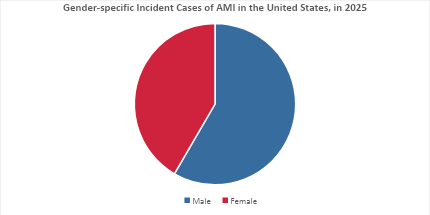
- The epidemiology of AMI in 2025 demonstrates strong age and gender dependence, with the average age at first MI being ~65.6 years in men and ~72.0 years in women, and incidence rates increasing sharply with age. Additionally, men account for the majority of cases (≈60–70%), with higher incidence rates across all age groups compared to women, although the gap narrows post-menopause.
- From a clinical subtype perspective, NSTEMI (Non–ST-Elevation Myocardial Infarction) represents the majority of AMI cases (~55–60%), while STEMI (ST-Elevation Myocardial Infarction) accounts for ~40–45%, though proportions vary by geography. Despite improvements in care, mortality remains substantial, with early deaths (within hours) and ~1-year mortality rates (e.g., ~15% in France) highlighting persistent unmet needs in early diagnosis, acute management, and secondary prevention.
- Longitudinal trends indicate a gradual decline in AMI hospitalization rates in developed markets (e.g., US ~232 per 100,000 and Germany ~225 per 100,000 in recent analyses), reflecting improvements in preventive care, risk factor management, and treatment strategies, although the overall burden remains high due to aging populations.
Acute Myocardial Infarction Epidemiology Forecast in the 7MM
- 2025 Incident Cases of AMI: ~1,500,000
- AMI Growth Rate (2026–2036): 0.6% CAGR
DelveInsight's ‘Acute Myocardial Infarction Epidemiology Forecast – 2036’ report delivers an in-depth understanding of the AMI, historical and forecasted epidemiology, in the United States, EU4 (Germany, Spain, Italy, and France), and the United Kingdom, and Japan.
Scope of the Acute Myocardial Infarction Epidemiology Report | |
|
Study Period |
2022–2036 |
|
Historical Year |
2022–2025 |
|
Forecast Period |
2026–2036 |
|
Base Year |
2026 |
|
Geographies Covered |
|
|
AMI Epidemiology CAGR (Forecast period) |
0.6% (2026–2036) |
|
AMI Epidemiology Segmentation Analysis |
Patient Burden Assessment
|
Acute Myocardial Infarction Understanding and Diagnosis Algorithm
Acute Myocardial Infarction Overview and Diagnosis
AMI is the ischemic necrosis of myocardial tissue, most commonly caused by coronary artery disease and acute plaque rupture with thrombosis. It typically presents as part of acute coronary syndrome (ACS) with symptoms such as chest pain, dyspnea, nausea, and diaphoresis. MI is broadly classified into STEMI and NSTEMI, as well as Type 1 MI (atherothrombotic) and Type 2 MI (oxygen supply–demand mismatch). Despite advances in care, AMI remains a leading cause of mortality globally, driven by key risk factors including hypertension, diabetes, smoking, and dyslipidemia.
Further details are provided in the report.
Acute Myocardial Infarction Diagnosis
Diagnosis of MI is based on a combination of clinical presentation, electrocardiography (ECG) findings, and elevation of cardiac biomarkers, particularly troponins, which are the most sensitive and specific indicators of myocardial injury. ECG plays a critical role in differentiating STEMI vs. NSTEMI and guiding urgent treatment decisions. Additional tools, such as echocardiography, help identify wall motion abnormalities, while coronary angiography provides a definitive diagnosis and enables revascularization. Early and accurate diagnosis is essential for timely reperfusion therapy and reducing complications.
Further details are provided in the report.
Acute Myocardial Infarction Epidemiology
Key Findings from Acute Myocardial Infarction Epidemiological Analysis and Forecast
- According to DelveInsight estimates, approximately ~1,500,000 incident cases of AMI were reported across the 7MM in 2025, with the highest number of cases in the US.
- AMI is more common in men than women, as there were 950,000 incident cases for males and 550,000 cases for females in the 7MM in 2025.
- Among the EU4 and the UK, Germany reported the highest number of incident cases of AMI in 2025, while Spain had the lowest.
- According to estimates, there were ~510,000 cases of STEMI and ~990,000 cases of NSTEMI in the 7MM in 2025.
- According to epidemiological estimates, STEMI accounts for a smaller proportion of total acute myocardial infarction cases compared to NSTEMI; however, STEMI is associated with higher immediate mortality and requires urgent reperfusion therapy, making it a critical focus of acute care management.
Acute Myocardial Infarction Epidemiology Segmentation in the 7MM
- Total Acute Myocardial Infarction Incident Cases
- Acute Myocardial Infarction Type-specific Incident Cases
- Acute Myocardial Infarction Gender-specific Incident Cases
Scope of the Acute Myocardial Infarction Epidemiology Report
- The Acute Myocardial Infarction epidemiology report covers a segment of a descriptive overview, explaining its causes, signs and symptoms, and pathogenesis.
- Comprehensive insight has been provided into the Acute Myocardial Infarction epidemiology segments and forecasts, the future growth potential of the diagnosis rate, and disease progression.
Acute Myocardial Infarction Epidemiology Report Insights
- Acute Myocardial Infarction Patient Population Forecast
Acute Myocardial Infarction Epidemiology Report Key Strengths
- Epidemiology‑based (Epi‑based) Bottom‑up Forecasting
- 11-year Forecast
- Patient Burden Trends (by geography)
Key Questions Answered in the Acute Myocardial Infarction Epidemiology Report
- What are the disease risks, burdens, and unmet needs of AMI? What will be the growth opportunities across the 7MM concerning the patient population with AMI?
- What is the historical and forecasted AMI patient pool in the US, EU4 (Germany, France, Italy, and Spain), the UK, and Japan?
Reasons to Buy the Acute Myocardial Infarction Epidemiology Report
- Insights on patient burden/disease Acute Myocardial Infarction Prevalence, evolution in diagnosis, and factors contributing to the change in the epidemiology of the disease during the forecast years.
- To understand key opinion leaders’ perspectives on the diagnostic challenges to overcome barriers in the future.
- Detailed insights into various factors hampering disease diagnosis and other existing diagnostic challenges.
Stay updated with us for Recent Articles @ New DelveInsight Blogs

