
Adhesion Barrier Market Summary
• The global adhesion barrier market was valued at USD 1.1 billion in 2025 and is projected to reach USD 2.0 billion by 2034.
• The market is expected to expand at a CAGR of 6.9% during the forecast period 2026-2034, supported by the rising volume of abdominal, pelvic, gynecological, and spine surgeries, growing surgeon and patient awareness of adhesion-related complications, the expanding clinical evidence base for hyaluronic acid and synthetic polymer barrier technologies, and the introduction of multifunctional products that combine hemostasis with adhesion prevention.
• By product type, the film and membrane barriers segment dominated the adhesion barrier market with a 39% share in 2025.
• By material, the hyaluronic acid and cellulose-based barriers segment dominated the adhesion barrier market with a 44% share in 2025.
• By application, the gynecological surgery segment dominated the adhesion barrier market with a 34% share in 2025.
• By end-user, the hospitals segment dominated the adhesion barrier market with a 71% share in 2025.
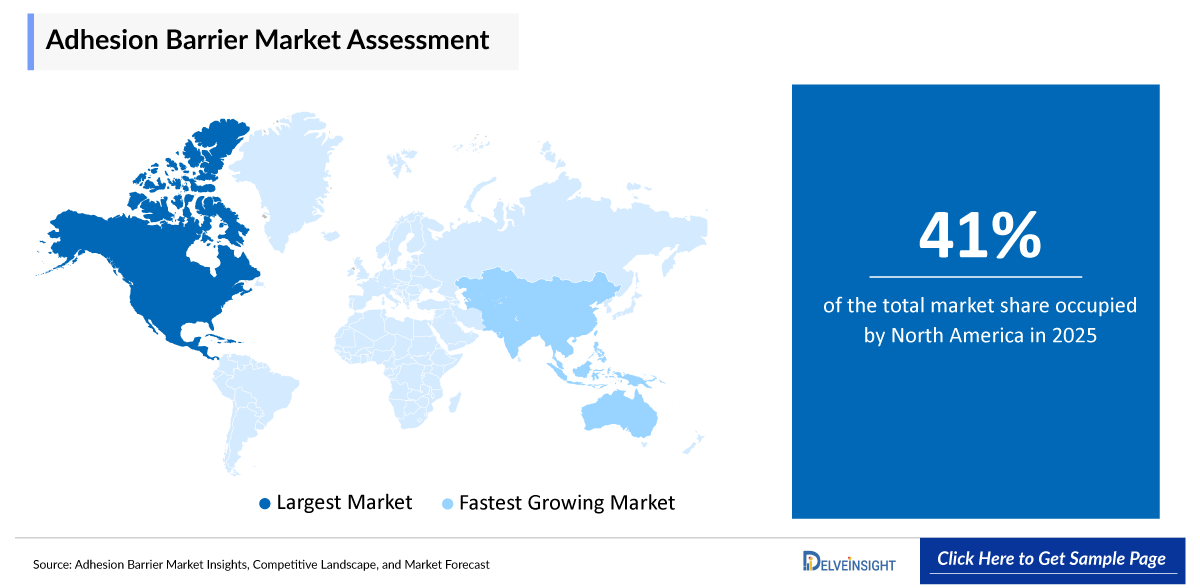
• North America accounted for the largest share of the adhesion barrier market at 41% in 2025, while Asia-Pacific is anticipated to register the fastest growth through 2034.
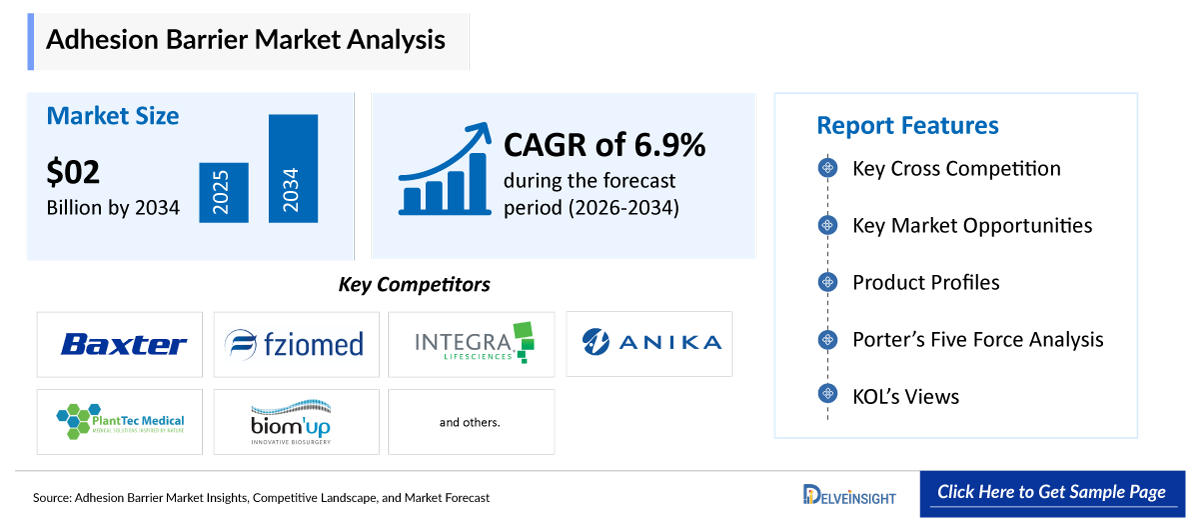
Adhesion barriers are medical devices applied intraoperatively to separate injured tissue surfaces during the healing period and reduce the incidence, extent, and severity of postoperative adhesions, the fibrous bands of scar tissue that form between organs and tissues following surgery. The scope encompasses hyaluronic acid and carboxymethylcellulose (HA/CMC) films such as Seprafilm from Baxter, oxidized regenerated cellulose barriers such as Interceed and Intercoat from Johnson & Johnson MedTech, icodextrin adhesion reduction solution such as Adept from Baxter, dual-polymer carboxymethylcellulose-polyethylene oxide gels and sprays such as the Oxiplex and SprayShield family from Fziomed, collagen-based dural adhesion barrier matrices such as DuraGen Plus from Integra LifeSciences, hyaluronic acid gels such as Hyalobarrier from Anika Therapeutics and distributed by Nordic Pharma, starch-based powder and gel barriers such as 4DryField PH from PlantTec Medical, and bioresorbable synthetic and collagen films for cardiovascular surgery such as Cova CARD from Biom'Up and CardioWrap from MAST Biosurgery. The market spans applications in gynecological, general and abdominal, orthopedic and spine, cardiovascular, neurological, and urological surgery.
Adhesion Barrier Market Key Growth Drivers
• Rising global volume of abdominal, pelvic, gynecological, and spine surgeries that create the primary demand base for intraoperative adhesion prevention.
• Growing surgeon and patient awareness of the incidence, cost, and morbidity of adhesion-related complications, including bowel obstruction, chronic pelvic pain, and infertility.
• Expanding clinical evidence base for hyaluronic acid, cellulose, and synthetic polymer barrier technologies that supports guideline inclusion and hospital purchasing decisions.
• Introduction of multifunctional products that combine hemostasis and adhesion prevention in a single application, simplifying surgical workflow.
• Rising incidence of repeat and revision abdominal and pelvic surgery, which increases the population of patients at elevated risk of adhesion-related morbidity.
• Increasing adoption of minimally invasive and laparoscopic surgical techniques that expand the addressable procedure base for gel and spray-format barriers.
• Growing hospital and ambulatory surgical center investment in surgical adjuncts that reduce readmission and reoperation rates and support value-based care objectives.
Key Companies in Adhesion Barrier Market
The leading participants in the adhesion barrier market include the following:
• Baxter International Inc.
• Fziomed, Inc.
• Integra LifeSciences Holdings Corporation
• Medical Devices Business Services, Inc. (Johnson & Johnson MedTech)
• Anika Therapeutics, Inc.
• PlantTec Medical GmbH
• Biom'Up SA
• MAST Biosurgery USA, Inc.
• Nordic Pharma
• Actamax Surgical Materials, LLC
Factors Contributing to the Growth of the Adhesion Barrier Market
Market Drivers
Rising Volume of Abdominal, Pelvic, Gynecological, and Spine Surgeries
The foundational driver of the adhesion barrier market is the sustained global growth in the volume of abdominal, pelvic, gynecological, and spine surgical procedures, each of which carries a meaningful risk of postoperative adhesion formation. Studies cited by manufacturers including Baxter indicate that up to 93% of patients develop adhesions following laparotomy, and adhesion-related complications drive an estimated USD 2 billion or more in annual surgical costs in the United States alone. As the volume of hysterectomy, myomectomy, bowel resection, cesarean section, and lumbar spine procedures grows with the aging population and the rising prevalence of gynecological and colorectal conditions, the population of patients eligible for adjunctive adhesion barrier use expands correspondingly. Surgeons increasingly incorporate adhesion barriers as a routine adjunct in high-risk procedures, particularly repeat abdominal and pelvic surgery, sustaining demand for adhesion barrier products across the forecast period.
Growing Awareness of Adhesion-Related Morbidity and Cost
Growing surgeon and health system awareness of the clinical and economic burden of postoperative adhesions is a powerful driver of adhesion barrier adoption. Adhesions are a leading cause of small bowel obstruction, chronic pelvic pain, and secondary infertility, and they substantially increase the complexity, duration, and risk of complications in reoperative surgery. Despite this burden, publicly cited studies indicate that only a minority of patients undergoing abdominopelvic surgery are counseled about adhesion risk or prevention options, indicating substantial headroom for adoption as awareness grows. As hospitals and surgeons increasingly recognize the downstream cost of adhesion-related readmission and reoperation, the use of adhesion barriers as a preventive adjunct in high-risk procedures is expected to expand, sustaining demand across the forecast period.
Market Restraints
The adhesion barrier market faces several interrelated restraints that temper its growth. The foremost is the inconsistent and, in some cases, contradictory clinical evidence across barrier technologies regarding real-world reduction in clinically meaningful adhesion-related outcomes such as reoperation and bowel obstruction, which limits the strength of guideline recommendations and reimbursement support in several markets. Product-specific safety considerations, including reports of inflammatory response associated with certain film barriers and reduced efficacy in the presence of blood or body fluid, require careful patient selection and surgical technique and can limit use in contaminated or bleeding surgical fields. The relatively high per-unit cost of film, gel, and spray barrier products relative to standard surgical technique constrains adoption in cost-sensitive and lower-resource healthcare settings. Only a minority of eligible abdominopelvic surgery patients are currently counseled about adhesion risk and prevention options, reflecting limited routine integration of adhesion barrier use into standard surgical protocols. Regulatory and reimbursement pathways vary considerably by geography and by product category, and coverage determinations for newer indications, such as Fziomed's 2025 authorization for lumbar spine pain reduction, will take time to translate into broad clinical uptake. Together, these factors moderate the pace of adoption and require vendors to demonstrate consistent, procedure-specific clinical benefit and favorable health-economic outcomes to sustain growth.
Adhesion Barrier Market Segment Analysis
The global adhesion barrier market is segmented by product type (film and membrane barriers, gel barriers, solution and liquid barriers, and powder and spray barriers), by material (hyaluronic acid and cellulose-based barriers, synthetic polymer-based barriers, collagen-based barriers, and starch and polysaccharide-based barriers), by application (gynecological surgery, general and abdominal surgery, orthopedic and spine surgery, cardiovascular surgery, neurological surgery, urological surgery, and others), by end-user (hospitals, ambulatory surgical centers, specialty clinics, and others), and by geography (North America, Europe, Asia-Pacific, and the Rest of the World).
By Product Type
Dominant Subsegment: Film and Membrane Barriers.
The film and membrane barriers category is expected to dominate the market. The film and membrane barriers segment accounted for a 39% share of the adhesion barrier market in 2025. Film and membrane barriers, including Baxter's Seprafilm HA/CMC membrane, Johnson & Johnson MedTech's Interceed oxidized regenerated cellulose barrier, Integra LifeSciences' DuraGen Plus collagen matrix, and Biom'Up's Cova CARD cardiac film, are the leading product category because they provide a physical, mechanically stable barrier that is straightforward to place precisely over the surgical site during open procedures and because they benefit from the longest-established and most extensive clinical evidence base among adhesion barrier formats. The dominance of the segment reflects the breadth of established, widely distributed film products across abdominopelvic, neurological, and cardiac surgery, and the preference of surgeons for a barrier that remains in place without migration during open laparotomy and sternotomy procedures. While gel, solution, powder, and spray barriers are substantial and, in the case of gel and spray formats compatible with laparoscopic delivery, faster-growing categories, the clinical familiarity, precision of placement, and evidence depth of film and membrane barriers sustain the leadership of the segment across the forecast period.
By Material
Dominant Subsegment: Hyaluronic Acid and Cellulose-Based Barriers.
The hyaluronic acid and cellulose-based barriers category is expected to dominate the market. The segment accounted for a 44% share of the adhesion barrier market in 2025. Hyaluronic acid and cellulose-based barriers, including Baxter's Seprafilm and Sepraspray HA/CMC products, Johnson & Johnson MedTech's Interceed and Intercoat oxidized regenerated cellulose barriers, and Anika Therapeutics' Hyalobarrier hyaluronic acid gel distributed by Nordic Pharma, are the leading material category because hyaluronic acid and cellulose polymers are naturally resorbable, biocompatible, and supported by the deepest body of comparative clinical evidence among adhesion barrier materials. The dominance of the segment reflects the multi-decade commercial history and regulatory approval breadth of HA/CMC and oxidized regenerated cellulose technologies across the United States, Europe, and Asia. While synthetic polymer-based barriers such as Fziomed's dual-polymer CMC-PEO gels and Baxter's icodextrin-based Adept solution, collagen-based barriers, and starch-based barriers such as PlantTec Medical's 4DryField PH are significant and, in several cases, faster-growing categories, the evidence depth and regulatory maturity of hyaluronic acid and cellulose-based barriers sustain the leadership of the segment across the forecast period.
Adhesion Barrier Market Region Analysis
Dominant Region: North America
North America accounted for a 41% share of the global adhesion barrier market in 2025, representing the highest regional market share globally. The leadership of the region reflects the concentration of leading manufacturers including Baxter, Fziomed, Integra LifeSciences, and Johnson & Johnson MedTech, the high volume of abdominal, pelvic, and spine surgery, advanced reimbursement and hospital purchasing infrastructure, and the depth of FDA premarket approval and de novo authorization activity, exemplified by Fziomed's November 2025 FDA authorization of Oxiplex gel for lumbar spine surgery. The United States is the largest national market, supported by the concentration of adhesion barrier manufacturers, comprehensive hospital distribution networks, and growing surgeon awareness of adhesion-related morbidity and cost. The concentration of vendors, regulatory leadership, and surgical volume reinforce the position of North America as the largest regional market across the forecast period.
Fastest Growing Region: Asia-Pacific
Asia-Pacific is projected to register the fastest compound annual growth rate through 2034. The region is expanding and modernizing its surgical infrastructure, increasing the volume of gynecological, abdominal, and spine surgery, and adopting adhesion barrier products from a growing base. China, Japan, and India are the principal national markets, supported by the construction and modernization of hospitals, the expansion of laparoscopic and minimally invasive surgical capacity, and the presence of Baxter's Seprafilm, which maintains commercial distribution in Japan, China, and South Korea. As hospitals build surgical capacity and as awareness of adhesion-related complications increases, the region increases its adoption of adhesion barrier products from a growing base, positioning Asia-Pacific as the fastest-growing regional market.
Regional Commentary
North America
North America leads the market, supported by the concentration of leading vendors, high surgical volume, and advanced regulatory and reimbursement infrastructure. The United States dominates the region through its concentration of manufacturers and hospital distribution networks and through continued FDA authorization of new indications.
Europe
Europe is a substantial market shaped by CE marking pathways, established reimbursement for surgical adjuncts, and the presence of vendors including Baxter, Johnson & Johnson MedTech, PlantTec Medical, Biom'Up, and Nordic Pharma. Germany, the United Kingdom, France, Italy, and Spain are the principal national markets, and PlantTec Medical's starch-based 4DryField PH platform is anchored in the region.
Asia-Pacific
Asia-Pacific is the fastest-growing region, driven by hospital modernization, the expansion of laparoscopic and minimally invasive surgical capacity, and the growth of gynecological, abdominal, and spine surgery volumes across China, Japan, and India.
Rest of World
The Rest of World, spanning Latin America, the Middle East, and Africa, represents an emerging opportunity as surgical infrastructure expands, though adoption varies by market and remains concentrated in leading private and academic hospitals.
Adhesion Barrier Market Competitive Landscape
The global adhesion barrier market is classified as Moderately Consolidated. A group of established medical technology companies holds a substantial share of the market through comprehensive surgical adjunct portfolios and long-standing hospital relationships, while specialist vendors compete on differentiated single-technology platforms across gel, spray, and starch-based formats. Competition centers on the breadth of the product portfolio across film, gel, solution, and powder formats, clinical evidence and regulatory authorization for specific surgical indications, compatibility with laparoscopic and minimally invasive delivery, and price. The competitive landscape is evaluated across the following dimensions:
• Market concentration: Moderately consolidated, with Baxter and Johnson & Johnson MedTech holding a substantial share through their film, solution, and cellulose barrier portfolios, alongside specialist vendors including Fziomed, Integra LifeSciences, Anika Therapeutics, PlantTec Medical, Biom'Up, MAST Biosurgery, Nordic Pharma, and Actamax Surgical Materials.
• Leading players: Baxter leads with its Seprafilm, Adept, and Coseal portfolio; Johnson & Johnson MedTech leads in oxidized regenerated cellulose with Interceed and Intercoat; Fziomed leads in dual-polymer gel and spray barriers with Oxiplex and SprayShield; and Integra LifeSciences leads in collagen-based dural adhesion barriers with DuraGen Plus.
• Geographic reach: Baxter and Johnson & Johnson MedTech operate global commercial and regulatory organizations, while specialist vendors including PlantTec Medical, Biom'Up, and Nordic Pharma maintain more concentrated footprints centered on Europe.
• Product portfolio strength: Competitive advantage rests on the breadth across film, gel, solution, and powder and spray formats, and on the range of surgical specialties addressed, from gynecological and abdominal surgery to cardiovascular and neurological surgery.
• Pipeline strength: Development is concentrated in laparoscopic-compatible gel and spray delivery, multifunctional hemostasis and adhesion prevention products, and expanded indications such as Fziomed's 2025 authorization for lumbar spine pain reduction.
• Strategic partnerships: Collaboration spans distribution partnerships, exemplified by Nordic Pharma's distribution of Anika Therapeutics' Hyalobarrier across Europe, and clinical research collaborations with academic surgical centers.
• M&A activity: Consolidation has shaped the field, exemplified by Baxter's 2020 acquisition of the Seprafilm product family from Sanofi for USD 350 million and continued portfolio bolt-on activity among diversified surgical technology companies.
• Innovation focus: Innovation is concentrated in laparoscopic and minimally invasive-compatible delivery formats, multifunctional hemostasis and adhesion prevention products, and expanded procedure-specific indications supported by new clinical evidence.
• Regulatory standing: FDA premarket approval and de novo classification, CE marking, and alignment with surgical society guidance are decisive competitive credentials, with Fziomed's 2025 FDA authorization of Oxiplex for lumbar spine pain reduction representing a notable recent regulatory milestone.
Adhesion Barrier Market Recent Developmental Activities
• In November 2025, Fziomed initiated commercialization in the United States of Oxiplex gel following FDA marketing authorization for reducing postoperative leg pain and neurological symptoms in adult patients undergoing lumbar spine procedures. Strategic significance: the authorization was the first FDA authorization specifically for this indication and broadened Fziomed's addressable market into spine surgery pain reduction.
• In 2020, Baxter completed its acquisition of the Seprafilm adhesion barrier product family and related assets from Sanofi for USD 350 million. Strategic significance: the acquisition brought a leading, globally distributed HA/CMC adhesion barrier franchise into Baxter's advanced surgery portfolio alongside its hemostat and sealant business.
Adhesion Barrier Market Segmentation
Adhesion Barrier Market Assessment by Product Type
• Film and Membrane Barriers
• Gel Barriers
• Solution and Liquid Barriers
• Powder and Spray Barriers
Adhesion Barrier Market Assessment by Material
• Hyaluronic Acid and Cellulose-Based Barriers
• Synthetic Polymer-Based Barriers
• Collagen-Based Barriers
• Starch and Polysaccharide-Based Barriers
Adhesion Barrier Market Assessment by Application
• Gynecological Surgery
• General and Abdominal Surgery
• Orthopedic and Spine Surgery
• Cardiovascular Surgery
• Neurological Surgery
• Urological Surgery
• Others
Adhesion Barrier Market Assessment by End-User
• Hospitals
• Ambulatory Surgical Centers
• Specialty Clinics
• Others
Adhesion Barrier Market Assessment by Geography
• North America
United States Adhesion Barrier Market Size in USD million (2023-2034)
Canada Adhesion Barrier Market Size in USD million (2023-2034)
Mexico Adhesion Barrier Market Size in USD million (2023-2034)
• Europe
Germany Adhesion Barrier Market Size in USD million (2023-2034)
United Kingdom Adhesion Barrier Market Size in USD million (2023-2034)
France Adhesion Barrier Market Size in USD million (2023-2034)
Italy Adhesion Barrier Market Size in USD million (2023-2034)
Spain Adhesion Barrier Market Size in USD million (2023-2034)
Rest of Europe Adhesion Barrier Market Size in USD million (2023-2034)
• Asia-Pacific
China Adhesion Barrier Market Size in USD million (2023-2034)
Japan Adhesion Barrier Market Size in USD million (2023-2034)
India Adhesion Barrier Market Size in USD million (2023-2034)
Australia Adhesion Barrier Market Size in USD million (2023-2034)
South Korea Adhesion Barrier Market Size in USD million (2023-2034)
Rest of Asia-Pacific Adhesion Barrier Market Size in USD million (2023-2034)
• Rest of the World
Middle East Adhesion Barrier Market Size in USD million (2023-2034)
Africa Adhesion Barrier Market Size in USD million (2023-2034)
South America Adhesion Barrier Market Size in USD million (2023-2034)
Key Takeaways from the Adhesion Barrier Market Report Study
• Market size analysis for the current adhesion barrier market size (2025), and market forecast for 9 years (2026 to 2034).
• Top key product and technology developments, mergers, acquisitions, partnerships, and joint ventures that happened over the last 3 years.
• Key companies dominating the global adhesion barrier market.
• Various opportunities available for competitors in the adhesion barrier market space.
• What are the top-performing segments in 2025? How will these segments perform in 2034?
• Which are the top-performing regions and countries in the current adhesion barrier market scenario?
• Which are the regions and countries where companies should concentrate their opportunities for adhesion barrier market growth in the future?
Target audience who can benefit from this adhesion barrier market report study
• Adhesion barrier and surgical device providers
• Research organizations and consulting companies
• Surgical, gynecological, and related organizations, associations, forums, and other alliances
• Government and corporate offices
• Start-up companies, venture capitalists, and private equity firms
• Distributors and traders dealing in adhesion barrier devices
• Various end-users who want to know more about the adhesion barrier market and the latest technological developments in the adhesion barrier market.

