
Advanced Visualization System Market Summary
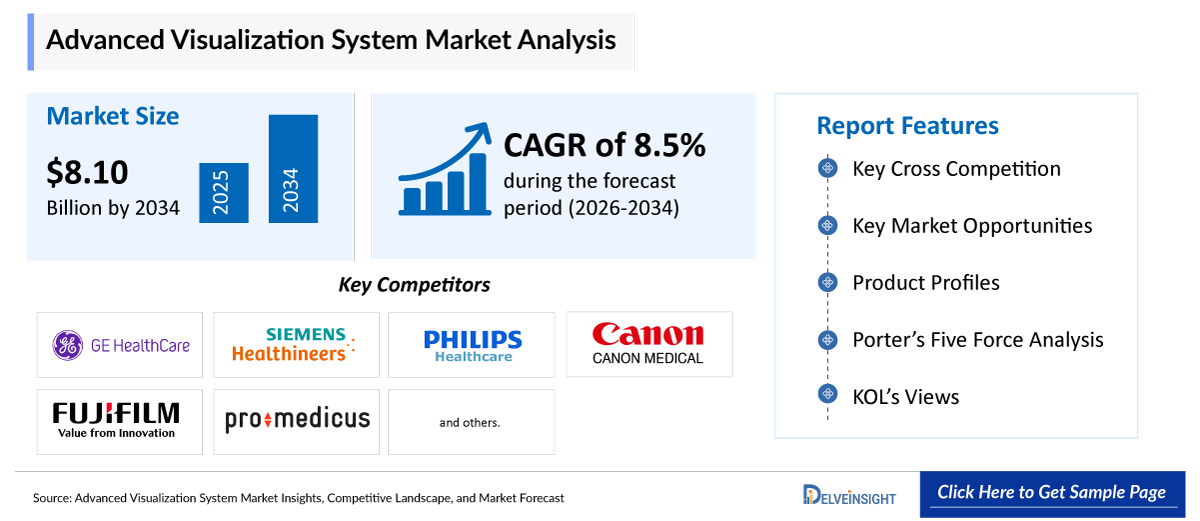
- The global advanced visualization system market size was valued at USD 3.90 billion in 2025 and is projected to reach USD 8.10 billion by 2034.
- The market is expected to expand at a CAGR of 8.5% during the forecast period 2026-2034, supported by the rising volume and complexity of medical imaging data, the shift toward enterprise server-based advanced visualization, the integration of artificial intelligence and automation, and the growth of structural heart and complex interventions.
- By solution type, the thin-client segment dominated the advanced visualization system market with a 60% share in 2025.
- By component, the software segment dominated the advanced visualization system market with a 60% share in 2025.
- By clinical application, the cardiology segment dominated the advanced visualization system market with a 28% share in 2025.
- By end-user, the hospitals segment dominated the advanced visualization system market with a 68% share in 2025.
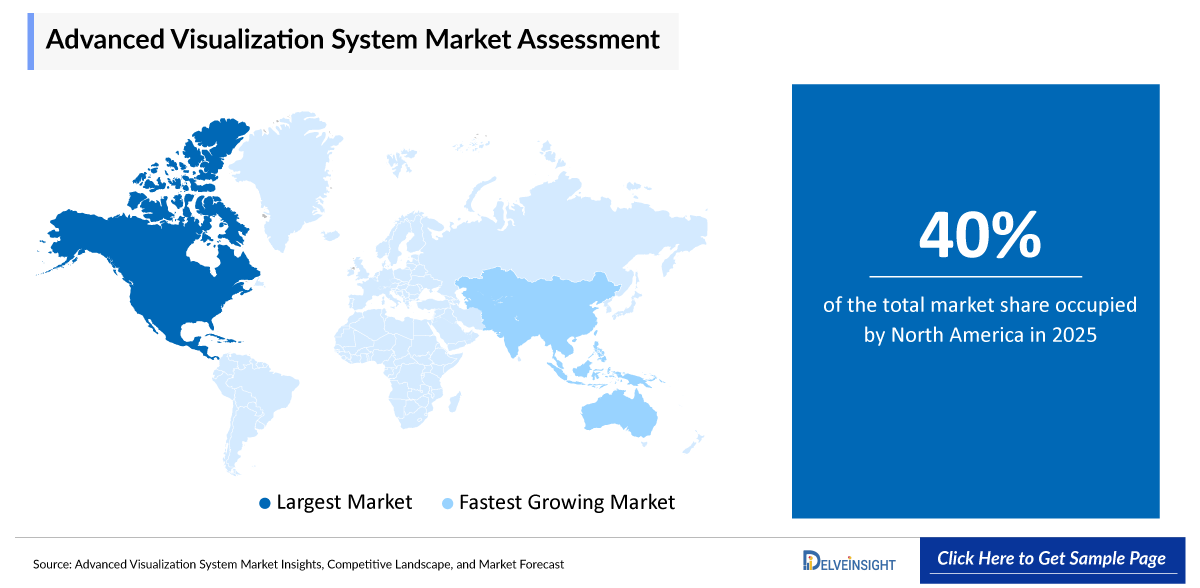
- North America accounted for the largest share of the advanced visualization system market at 40% in 2025, while Asia-Pacific is anticipated to register the fastest growth through 2034.
An advanced visualization system is the software, and in some deployments the dedicated workstation hardware, that processes raw imaging data from modalities such as computed tomography, magnetic resonance imaging, positron emission tomography, single-photon emission computed tomography, and ultrasound into two-dimensional, three-dimensional, and four-dimensional reconstructions and clinical analyses. The core capabilities include multiplanar reformatting, maximum intensity projection, volume rendering, image fusion and registration, quantification, and specialized clinical applications for cardiology, oncology, neurology, vascular, and other specialties.
Advanced visualization is delivered in two principal architectures, the thick-client standalone workstation, on which processing occurs locally, and the thin-client enterprise platform, based on a server-client architecture that centralizes processing on the server and provides access across the enterprise. Leading systems include the GE HealthCare Advantage Workstation and its server configurations, the Siemens Healthineers syngo.via multimodality reading solution, the Philips IntelliSpace Portal, the Canon Medical Vitrea platform, and the Fujifilm Synapse 3D solution, together with the TeraRecon platform. The systems integrate with picture archiving and communication systems and radiology and cardiology information systems, and the contemporary market is defined by the shift to enterprise and cloud deployment and by the integration of artificial intelligence across the imaging workflow.
Advanced Visualization System Market Key Growth Drivers
- Rising volume and complexity of medical imaging, with the growth of thin-slice computed tomography, magnetic resonance imaging, and hybrid imaging generating large datasets that require advanced visualization for interpretation.
- The shift toward enterprise server-based advanced visualization that centralizes processing and provides access across the enterprise, exemplified by the GE HealthCare Advantage Workstation server configurations, Siemens syngo.via, and Philips IntelliSpace Portal.
- Integration of artificial intelligence and automation, with vendors embedding automated segmentation, quantification, and artificial intelligence-assisted analysis across the imaging workflow.
- Growth of structural heart and complex interventions that require advanced visualization for planning, with vendors introducing simulations for transcatheter valve and left atrial appendage procedures.
- Adoption of cloud and software-as-a-service delivery that provides scalable, accessible advanced visualization.
- Rising burden of cardiovascular disease, cancer, and neurological disorders that drives the demand for advanced imaging and visualization.
- Integration of advanced visualization with picture archiving and communication systems and enterprise imaging that streamlines the diagnostic workflow.
Key Companies in Advanced Visualization System Market
The leading participants in the advanced visualization system market include the following:
- GE HealthCare Technologies Inc.
- Siemens Healthineers AG
- Koninklijke Philips N.V.
- Canon Medical Systems Corporation
- Fujifilm Holdings Corporation
- Pro Medicus Limited
- Sectra AB
- Agfa-Gevaert N.V.
- TeraRecon, Inc.
- Intelerad Medical Systems Incorporated, and others
For illustrative purposes, only the top 10 companies are listed in the Table of Contents. The report may include analysis and references to additional companies relevant to the market assessment.
Advanced Visualization System Market Size
The following table summarizes the headline market metrics for the global advanced visualization system market across the base year and the forecast horizon.
|
Report Metrics |
Details |
|
2025 Market Size |
USD 3.90 billion |
|
2034 Projected Market Size |
USD 8.10 billion |
|
Growth Rate (2026-2034) |
8.5% CAGR |
|
Largest Market |
North America (40% share in 2025) |
|
Fastest Growing Market |
Asia-Pacific |
|
Market Structure |
Consolidated |
All market values are expressed in USD and represent DelveInsight estimates synthesized from primary and secondary research.
Factors Contributing to the Growth of the Advanced Visualization System Market
Advanced Visualization System Market Drivers
- Rising Volume and Complexity of Medical Imaging: The foundational driver of the advanced visualization system market is the rising volume and complexity of medical imaging, which generates datasets that cannot be interpreted efficiently without advanced visualization. Modern computed tomography and magnetic resonance imaging scanners produce thin-slice, high-resolution studies comprising hundreds and thousands of images per examination, and hybrid modalities such as positron emission tomography combined with computed tomography and single-photon emission computed tomography combined with computed tomography generate multimodality datasets that require fusion and quantification. The growth of imaging volumes, driven by the aging population, the rising burden of chronic disease, and the expansion of imaging in diagnosis and screening, increases the number of complex studies that radiologists and clinicians must interpret. Advanced visualization systems provide the multiplanar reformatting, maximum intensity projection, volume rendering, fusion, and quantification required to interpret these datasets, and they replace the manual reconstruction that thin-slice and multimodality imaging would otherwise require. Radiologists commonly read computed tomography angiography using automated vessel segmentation, magnetic resonance angiography using maximum intensity projection, and positron emission tomography studies using fusion and quantification, all of which require advanced visualization. As imaging volumes and dataset complexity continue to rise, the requirement for advanced visualization to interpret them grows in step. The relentless growth in the volume and complexity of medical imaging sustains steady demand for advanced visualization systems across radiology and cardiology.
- Shift Toward Enterprise Server-Based Advanced Visualization: The shift from standalone workstations toward enterprise server-based advanced visualization is a defining driver that expands access and concentrates demand in thin-client solutions. Enterprise platforms based on a server-client architecture centralize the intensive data processing on the server and deliver advanced visualization to any workstation across the enterprise, replacing the model in which processing was confined to dedicated standalone workstations in a three-dimensional laboratory. This architecture provides access to advanced visualization across radiology, cardiology, and other departments, integrates with picture archiving and communication systems, and enables the sharing of results across the enterprise. The major imaging original equipment manufacturers have developed enterprise platforms, and the GE HealthCare Advantage Workstation in its server configurations, the Siemens syngo.via multimodality reading solution, the Philips IntelliSpace Portal, the Canon Vitrea enterprise platform, and the Fujifilm Synapse 3D solution deliver advanced visualization on a server-client architecture, while specialist vendors pioneered the enterprise model. Enterprise deployment lowers the cost of providing advanced visualization to many users, streamlines the workflow by integrating with the enterprise imaging system, and enables the consistent application of tools across the institution. As institutions adopt enterprise advanced visualization to expand access, streamline workflow, and integrate with enterprise imaging, demand concentrates in thin-client solutions. The shift toward enterprise server-based advanced visualization expands the market and sustains the leadership of thin-client solutions across the forecast period.
- Integration of Artificial Intelligence and Automation: The integration of artificial intelligence and automation is transforming advanced visualization and driving investment in modern platforms. Vendors have embedded automated segmentation, quantification, and artificial intelligence-assisted analysis across the imaging workflow to accelerate interpretation, reduce manual effort, and improve consistency. Automated segmentation isolates anatomical structures such as vessels, organs, and lesions, quantification measures and tracks them, and artificial intelligence supports detection, characterization, and reporting, reducing the manual work of advanced visualization and improving reproducibility. The TeraRecon advanced visualization platform delivers artificial intelligence-driven automations and allows the integration of third-party segmentation models, and the major vendors have integrated artificial intelligence applications into their enterprise platforms, with machine learning applied to reading protocols and the display of artificial intelligence findings. Artificial intelligence addresses the central challenge of rising imaging volumes and the manual effort of advanced visualization, and it shifts competition toward the intelligence and automation of the platform. As vendors embed artificial intelligence across segmentation, quantification, detection, and reporting, and as institutions adopt these capabilities to manage volume and improve consistency, demand concentrates in artificial intelligence-enabled advanced visualization. This modernization cycle drives replacement and upgrade of systems and expands the value delivered per deployment, sustaining growth in the market.
- Growth of Structural Heart and Complex Interventions: The growth of structural heart procedures and complex minimally invasive interventions is a major driver that requires advanced visualization for planning and guidance. Transcatheter procedures, including transcatheter aortic valve replacement, transcatheter mitral valve repair and replacement, transcatheter tricuspid valve replacement, and left atrial appendage closure, require detailed three-dimensional visualization and measurement of cardiac anatomy from computed tomography for planning, device sizing, and procedural guidance. The expansion of these procedures to larger populations and to additional valves and indications increases the demand for the cardiac advanced visualization that supports them, and vendors have introduced dedicated structural heart applications, with the TeraRecon platform introducing structural heart imaging simulations for transcatheter tricuspid valve replacement, transcatheter mitral valve repair, and left atrial appendage procedures. Beyond structural heart, complex vascular, oncologic, and surgical interventions require three-dimensional planning and visualization, and image-guided and minimally invasive procedures increasingly depend on advanced visualization. As structural heart and complex interventions grow and as they require advanced visualization for planning and guidance, demand for cardiac and interventional advanced visualization grows. The growth of structural heart and complex interventions sustains demand for advanced visualization and reinforces the leadership of the cardiology application across the forecast period.
- Adoption of Cloud and Software-as-a-Service Delivery: The adoption of cloud and software-as-a-service delivery expands access to advanced visualization and drives investment in modern platforms. Cloud deployment provides scalable processing and storage, enables access to advanced visualization from any location, and lowers the infrastructure burden of maintaining local processing; vendors have introduced cloud-hosted advanced visualization alongside on-premise options. Fujifilm offers cloud-hosted delivery for its full imaging portfolio, including three-dimensional advanced visualization; the TeraRecon platform offers cloud deployment and a software-as-a-service model with a secure, cloud-based infrastructure that integrates with any picture archiving and communication system; and the major vendors have added cloud access and cloud-stored imaging to their platforms. Cloud delivery is particularly valuable for providing advanced visualization across distributed sites, for enabling remote reading, and for supporting the integration of artificial intelligence services. The transition to cloud lowers the cost and complexity of providing advanced visualization, enables scalability, and supports the integration of analytics and artificial intelligence. As institutions adopt cloud and software-as-a-service advanced visualization to expand access, reduce infrastructure, and enable remote and distributed reading, demand concentrates in cloud-enabled platforms. The adoption of cloud and software-as-a-service delivery expands the market and sustains demand across the forecast period.
- Rising Burden of Cardiovascular Disease, Cancer, and Neurological Disorders: The rising burden of cardiovascular disease, cancer, and neurological disorders drives the demand for advanced imaging and the visualization required to interpret it. Cardiovascular disease is the leading cause of death worldwide, cancer imposes a large and rising burden, and neurological disorders affect a growing population; the diagnosis, staging, treatment planning, and monitoring of these conditions depend heavily on medical imaging. Cardiac imaging requires advanced visualization for coronary and structural assessment, oncologic imaging requires it for tumor detection, measurement, and response assessment across positron emission tomography and computed tomography, and neurological imaging requires it for the assessment of the brain and cerebral vasculature. The growth of these disease burdens, driven by the aging population and by lifestyle and demographic factors, increases the volume of advanced imaging and the demand for the visualization that supports its interpretation. Screening programs and the earlier and more frequent use of imaging in diagnosis and monitoring further increase imaging volumes. As the burden of cardiovascular disease, cancer, and neurological disorders rises and as imaging plays a central role in their management, the demand for the advanced visualization required to interpret the imaging grows. The rising burden of these diseases sustains demand for advanced visualization across cardiology, oncology, and neurology throughout the forecast period.
- Integration with Enterprise Imaging and Workflow: The integration of advanced visualization with picture archiving and communication systems and enterprise imaging streamlines the diagnostic workflow and drives adoption. Advanced visualization systems increasingly integrate with the picture archiving and communication system, the radiology and cardiology information systems, and the enterprise imaging platform, so that advanced visualization tools are available within the reading workflow rather than requiring a separate workstation or third-party software. The Siemens syngo.via integrates with the picture archiving and communication systems of all major vendors and provides direct access to advanced tools; the Fujifilm Synapse 3D integrates with the Synapse picture archiving and communication system to eliminate the need for third-party software, and the Canon Vitrea platform has evolved into a full enterprise imaging platform integrating cardiology, radiology, and other departments. Integration streamlines the workflow by providing advanced visualization within the reading environment, preserving results across the workflow, and enabling the sharing of results across the enterprise and with referring physicians through web-based viewers. The consolidation of advanced visualization within enterprise imaging platforms and the elimination of separate workstations and third-party software improve efficiency and reduce cost. As institutions consolidate imaging on enterprise platforms and require advanced visualization within the workflow, demand for integrated advanced visualization grows. The integration of advanced visualization with enterprise imaging and workflow sustains demand across the forecast period.
Advanced Visualization System Market Restraints
The advanced visualization system market faces several interrelated restraints that temper its growth. The foremost is the high cost of advanced visualization systems, licenses, and the integration and infrastructure they require, which can be substantial for enterprise deployments and can be prohibitive for smaller institutions and imaging centers, particularly when combined with the cost of the underlying imaging equipment and information systems. Integration and interoperability challenges persist, since advanced visualization must integrate with picture archiving and communication systems, radiology and cardiology information systems, and modalities from many vendors, and incomplete interoperability creates complexity and cost.
The regulatory clearance burden, since advanced visualization software is regulated as a medical device requiring clearance under the United States Food and Drug Administration and conformity under the European Union Medical Device Regulation, adds time and cost to the introduction and updating of applications. Data security and privacy obligations add compliance burden and constrain the movement of imaging data to cloud environments, requiring protection of sensitive imaging and patient data.
The adoption of advanced visualization and artificial intelligence depends on radiologist and clinician acceptance, training, and workflow integration, and resistance, learning curves, and workflow disruption can slow adoption. Reimbursement for advanced three-dimensional post-processing is limited and varies, which can constrain the financial return on advanced visualization for some applications. The consolidation of the market among the major imaging original equipment manufacturers can limit the reach of smaller specialist vendors and constrain choice. The information technology infrastructure, including servers, networks, and storage, required to support enterprise and cloud advanced visualization is substantial. Together, these factors moderate the pace and scope of adoption and require vendors to demonstrate clinical value, integration, and efficiency to sustain growth.
Advanced Visualization System Market Segment Analysis
The global advanced visualization system market is segmented by solution type (thin-client and thick-client), by component (hardware, software, and services), by clinical application (cardiology, oncology, neurology, vascular, orthopedics, and others), by imaging modality (CT, MRI, PET/CT, ultrasound, nuclear medicine, x-ray, and others), by deployment mode (on-premise, cloud based, and hybrid), by end-users (hospitals, diagnostic imaging centers, and ambulatory surgical centers, and others), and by geography (North America, Europe, Asia-Pacific, and the Rest of the World).
By Solution Type
Dominant Subsegment: Thin-Client.
The thin-client category is expected to dominate the market. The thin-client segment accounted for a 60% share of the advanced visualization system market in 2025. Thin-client advanced visualization, based on a server-client architecture that centralizes processing on the server and delivers advanced visualization to any workstation across the enterprise, has become the dominant solution type as institutions move from standalone workstations toward enterprise deployment. The dominance of the segment reflects the value of providing advanced visualization across the enterprise, the integration of thin-client solutions with picture archiving and communication systems and enterprise imaging, and the strategy of the major vendors to develop and market enterprise platforms. The server-client architecture centralizes the intensive processing on the server, provides access to advanced visualization from any workstation, and enables the sharing of results across radiology, cardiology, and other departments, replacing the model in which processing was confined to dedicated standalone workstations. The GE HealthCare Advantage Workstation server configurations, the Siemens syngo.via, the Philips IntelliSpace Portal, the Canon Vitrea enterprise platform, and the Fujifilm Synapse 3D deliver advanced visualization on a thin-client architecture, and cloud delivery extends the model further. As institutions adopt enterprise advanced visualization to expand access, streamline workflow, and integrate with enterprise imaging, demand concentrates in thin-client solutions. The value of enterprise access, the integration with enterprise imaging, and the strategy of the major vendors sustain the leadership of the thin-client segment across the forecast period.
By Component
Dominant Subsegment: Software.
The software category is expected to dominate the market. The software segment accounted for a 60% share of the advanced visualization system market in 2025. Software comprises the advanced visualization applications, including multiplanar reformatting, maximum intensity projection, volume rendering, fusion, quantification, and clinical applications that constitute the system, and it is the core deliverable that institutions license and deploy. The dominance of the segment reflects the central role of the software in processing and analyzing imaging data, the shift toward server-based and cloud delivery in which software rather than dedicated workstation hardware is the deliverable, and the recurring nature of software licensing and subscription revenue. The leading vendors deliver advanced visualization as software, whether integrated within an enterprise imaging platform or as a standalone application, and the software embodies the reconstruction, quantification, and clinical applications that define the system. While workstation hardware and the services of implementation, integration, training, and support are components of the market, the software application is the foundation on which the system is delivered, and the primary object of the investment, and the shift toward thin-client and cloud delivery increases the prominence of software relative to dedicated hardware. The addition of artificial intelligence applications to the software, and the shift toward subscription and cloud licensing, reinforce the leadership of the software component. Its centrality to advanced visualization and the recurring nature of software revenue sustain its leadership across the forecast period.
By Clinical Application
Dominant Subsegment: Cardiology.
The cardiology category is expected to dominate the market. The cardiology segment accounted for a 28% share of the advanced visualization system market in 2025. Cardiology is the leading clinical application of advanced visualization because cardiac imaging is among the most demanding and highest-volume uses of advanced visualization, spanning coronary computed tomography angiography, structural heart assessment, cardiac magnetic resonance, and nuclear cardiology. The dominance of the segment reflects the intensity of advanced visualization in cardiac imaging, the growth of structural heart and transcatheter procedures that require three-dimensional planning, and the breadth of cardiac applications across modalities. Coronary computed tomography angiography requires advanced visualization for vessel analysis and plaque assessment, structural heart procedures require detailed three-dimensional visualization and measurement for planning and device sizing, and cardiac magnetic resonance and nuclear cardiology require quantification and analysis. Vendors provide extensive cardiac advanced visualization, and the introduction of structural heart imaging simulations for transcatheter valve and left atrial appendage procedures reflects the depth of cardiac applications. The growth of cardiovascular disease, the expansion of structural heart and transcatheter procedures, and the intensity of advanced visualization in cardiac imaging sustain the leadership of the cardiology segment. Its intensity, breadth, and growth sustain its leadership across the forecast period and anchor demand for the cardiac applications that the vendors provide.
By End-User
Dominant Subsegment: Hospitals.
The hospitals category is expected to dominate the market. The hospitals segment accounted for a 68% share of the advanced visualization system market in 2025. Hospitals, including academic medical centers and large health systems, are the principal deployers of advanced visualization systems because they perform the large majority of advanced imaging, operate the radiology and cardiology departments that require advanced visualization, and have the scale and infrastructure to deploy enterprise systems, which concentrates market value in this segment. The dominance of the segment reflects the concentration of advanced imaging in hospitals, the deployment of enterprise advanced visualization across hospital departments, and the investment hospitals make in imaging equipment, information systems, and advanced visualization. Hospitals perform the complex cardiac, oncologic, neurological, and vascular imaging that requires advanced visualization, and they deploy enterprise platforms that provide advanced visualization across radiology, cardiology, and other departments and integrate with enterprise imaging. Academic medical centers also drive the adoption of advanced applications and artificial intelligence. While diagnostic imaging centers and ambulatory care centers are important end-users that perform imaging and adopt advanced visualization, the concentration of advanced imaging, the deployment of enterprise systems, and the depth of investment in hospitals sustain the leadership of the hospitals segment across the forecast period, and it shapes the direction of the market.
Advanced Visualization System Market Region Analysis
Dominant Region: North America
North America accounted for a 40% share of the global advanced visualization system market in 2025, representing the highest regional market share globally. The leadership of the region reflects the advanced adoption of medical imaging and advanced visualization, the concentration of the leading vendors, the high volume of imaging, and a well-defined regulatory framework. The United States is the largest national market, supported by the scale of its imaging infrastructure, the high volume of computed tomography, magnetic resonance imaging, and hybrid imaging, the early adoption of enterprise and cloud advanced visualization and artificial intelligence, and the presence of the leading vendors. The United States Food and Drug Administration regulates advanced visualization software as a medical device and clears advanced visualization and artificial intelligence applications, and the reimbursement environment and clinical adoption support the use of advanced visualization in cardiology, oncology, and neurology. The leading vendors, including GE HealthCare, Siemens Healthineers, Philips, Canon Medical, Fujifilm, and the specialist advanced visualization companies, operate extensively in the region, and academic medical centers drive the adoption of advanced applications and artificial intelligence. The scale of imaging, the maturity of advanced visualization adoption, the regulatory framework, and the concentration of vendors reinforce the leadership of the region. The combination of imaging volume, adoption maturity, regulatory clarity, and vendor presence sustains the position of North America as the largest regional market across the forecast period.
Fastest Growing Region: Asia-Pacific
Asia-Pacific is projected to register the fastest compound annual growth rate through 2034. The region is expanding its imaging infrastructure, modernizing its hospitals, and adopting advanced imaging and visualization, which drives the growth of the advanced visualization system market. China, Japan, and India are the principal national markets, supported by growing healthcare investment, the construction and modernization of hospitals, the rising installed base of computed tomography and magnetic resonance imaging, and the rising burden of cardiovascular disease and cancer that drives advanced imaging. The expansion of imaging capacity, the adoption of enterprise and increasingly cloud-advanced visualization, and the modernization of radiology and cardiology enlarge the demand for advanced visualization. As health systems invest in imaging equipment and adopt advanced visualization to interpret it, and as the burden of disease drives imaging volumes, the region increases its adoption of advanced visualization from a growing base. The combination of imaging infrastructure expansion, hospital modernization, rising disease burden, and adoption of advanced visualization positions Asia-Pacific as the fastest-growing regional market, and it attracts investment and commercial focus from the leading global vendors seeking presence in high-growth national markets.
Advanced Visualization System Market Regional Commentary
North America
North America leads the market, supported by the advanced adoption of medical imaging and advanced visualization, the concentration of the leading vendors, and a well-defined regulatory framework. The United States dominates the region through the scale of its imaging infrastructure, the high volume of advanced imaging, and the early adoption of enterprise, cloud, and artificial intelligence-enabled advanced visualization. The regulation of advanced visualization software by the United States Food and Drug Administration and the adoption of advanced visualization in cardiology, oncology, and neurology sustain demand.
Europe
Europe is a substantial market shaped by advanced healthcare systems, the adoption of medical imaging and advanced visualization, and the presence of leading vendors including Siemens Healthineers, Philips, Sectra, and Agfa-Gevaert. Germany, the United Kingdom, France, Italy, and Spain are the principal national markets, supported by strong imaging infrastructure, the adoption of enterprise imaging and advanced visualization, and the conformity requirements of the European Union Medical Device Regulation. Demand is sustained by the modernization of imaging and by the burden of cardiovascular disease and cancer.
Asia-Pacific
Asia-Pacific is the fastest-growing region, driven by the expansion of imaging infrastructure, the modernization of hospitals, and the adoption of advanced imaging and visualization across China, Japan, and India. Growing healthcare investment, the rising installed base of imaging equipment, and the rising burden of disease sustain demand, and the region attracts commercial focus from the leading global vendors.
Rest of World
The Rest of World, spanning Latin America, the Middle East, and Africa, represents an emerging opportunity as imaging infrastructure expands and as hospitals modernize. Growth is supported by investment in imaging equipment, the adoption of enterprise and cloud advanced visualization, and the rising burden of disease, though adoption varies by market. Vendors pursue these markets through enterprise and cloud solutions suited to expanding imaging infrastructure.
Advanced Visualization System Market Competitive Landscape
The global advanced visualization system market is classified as Consolidated. A small group of major imaging original equipment manufacturers holds a large share of the market through advanced visualization integrated within their imaging and enterprise imaging platforms, supported by strong installed bases and global reach, while specialist advanced visualization and enterprise imaging vendors compete on differentiated technology, interoperability, and enterprise and cloud delivery. Competition centers on the breadth and depth of clinical applications, the architecture of enterprise and cloud delivery, artificial intelligence and automation, interoperability with imaging systems, and integration with enterprise imaging, and product launches, artificial intelligence introductions, and acquisitions intensify the contest.
The competitive landscape is evaluated across the following dimensions:
- Market concentration: Consolidated, with a small group of major imaging original equipment manufacturers holding a large share through integrated advanced visualization, alongside a tier of specialist advanced visualization and enterprise imaging vendors.
- Leading players: GE HealthCare, Siemens Healthineers, Philips, Canon Medical, and Fujifilm lead through advanced visualization integrated within their imaging and enterprise platforms, while Pro Medicus, Sectra, Agfa-Gevaert, TeraRecon, and Intelerad compete as specialist advanced visualization and enterprise imaging vendors.
- Geographic reach: The leading original equipment manufacturers maintain global commercial and service organizations, and specialist vendors serve markets through enterprise and cloud solutions and interoperability with the systems of many vendors.
- Product portfolio strength: Competitive advantage rests on the breadth and depth of clinical applications across cardiology, oncology, neurology, and vascular imaging, the architecture of enterprise and cloud delivery, and the integration of artificial intelligence within a platform that interoperates with imaging systems.
- Pipeline strength: Development is concentrated in artificial intelligence and automation, cloud and software-as-a-service delivery, structural heart and interventional applications, and integration with enterprise imaging.
- Strategic partnerships: Collaboration spans integration with picture archiving and communication systems and enterprise imaging, partnerships for artificial intelligence and third-party segmentation models, and alliances that extend clinical applications and reach.
- M&A activity: Consolidation has shaped the field, exemplified by the acquisition of specialist advanced visualization companies by imaging original equipment manufacturers, including the acquisition of Vital Images by Canon and the integration of TeraRecon within a broader artificial intelligence company, alongside continued consolidation of enterprise imaging assets.
- Innovation focus: Innovation is shifting toward embedded artificial intelligence and automation, cloud-native and software-as-a-service delivery, structural heart and interventional applications, and integration within enterprise imaging platforms.
- Regulatory standing: Clearance of advanced visualization software by the United States Food and Drug Administration, conformity under the European Union Medical Device Regulation, and support for imaging standards including Digital Imaging and Communications in Medicine are decisive competitive credentials and a principal axis of competition among the leaders.
Advanced Visualization System Market Recent Developmental Activities
- In November 2025, TeraRecon, Inc. introduced its advanced visualization solution with artificial intelligence-driven automations, structural heart imaging simulations for transcatheter tricuspid valve replacement, transcatheter mitral valve repair, and left atrial appendage procedures, three-dimensional batching, a software-as-a-service delivery option, and integration with third-party three-dimensional segmentation models. Strategic significance: the launch advanced artificial intelligence, structural heart applications, and cloud delivery in a leading specialist advanced visualization platform.
- In November 2025, GE HealthCare Technologies Inc. unveiled its Genesis Radiology Workspace, anchored by a zero-footprint viewer that received clearance from the United States Food and Drug Administration and provides direct access to the company's advanced visualization applications, machine learning reading protocols, and access to cloud-stored imaging. Strategic significance: the workspace modernized the reading environment and integrated advanced visualization and artificial intelligence within a unified, cloud-connected platform.
- In 2024 and 2025, Fujifilm Holdings Corporation advanced its Synapse 3D advanced visualization and its Synapse 7x enterprise imaging platform, uniting advanced visualization with the picture archiving and communication system and a vendor-neutral archive on one viewer, with cloud-hosted and on-premise delivery and an artificial intelligence platform. Strategic significance: the developments reinforced the integration of advanced visualization within enterprise imaging and the shift to cloud and artificial intelligence.
- In 2024 and 2025, Siemens Healthineers AG advanced its syngo.via multimodality reading and advanced visualization solution with automated pre-processing, quantification, and artificial intelligence applications across oncology, cardiology, and neurology. Strategic significance: the developments reinforced the position of a leading enterprise advanced visualization platform and advanced automation across clinical applications.
- In 2024 and 2025, Koninklijke Philips N.V. advanced its IntelliSpace Portal and advanced visualization solutions with multimodality applications and artificial intelligence across cardiology, oncology, and neurology. Strategic significance: the developments reinforced the position of a leading enterprise advanced visualization platform.
- In 2024 and 2025, Canon Medical Systems Corporation advanced its Vitrea advanced visualization and enterprise imaging platform, integrating cardiology, radiology, and other departments with interoperability across vendors and web-based access. Strategic significance: the developments reinforced the evolution of advanced visualization into a full enterprise imaging platform.
- In 2024 and 2025, Pro Medicus Limited advanced its Visage advanced visualization and enterprise imaging platform with high-speed server-side rendering and cloud delivery, and expanded its adoption among large health systems. Strategic significance: the developments reinforced the position of a specialist vendor in high-performance, cloud-enabled advanced visualization and enterprise imaging.
- In 2024 and 2025, the leading vendors integrated artificial intelligence applications, including automated segmentation and quantification and the display of artificial intelligence findings, into their advanced visualization and enterprise imaging platforms. Strategic significance: the integration of artificial intelligence became a defining axis of competition and advanced the automation of the imaging workflow.
- In 2024 and 2025, the leading vendors expanded cloud and software-as-a-service delivery of advanced visualization, providing scalable, accessible, and remotely available advanced visualization alongside on-premise deployment. Strategic significance: the expansion of cloud delivery broadened access to advanced visualization and supported distributed and remote reading.
- In 2024 and 2025, Sectra AB and Agfa-Gevaert N.V. advanced their enterprise imaging and advanced visualization solutions with integrated applications and interoperability across imaging systems. Strategic significance: the developments reinforced the role of enterprise imaging vendors in delivering integrated advanced visualization.
- In 2024 and 2025, the vendors expanded structural heart and interventional advanced visualization applications to support the growth of transcatheter and minimally invasive procedures. Strategic significance: the expansion of structural heart and interventional applications reinforced the leadership of cardiology and the role of advanced visualization in procedural planning.
- In 2024 and 2025, the leading vendors advanced artificial intelligence, cloud delivery, structural heart applications, and integration with enterprise imaging across their advanced visualization platforms. Strategic significance: the convergence of the leaders on artificial intelligence, cloud, structural heart, and enterprise integration confirmed these as the defining axes of competition and signaled a market advancing toward intelligent, cloud-enabled, and integrated advanced visualization.
Advanced Visualization System Market Segmentation
- Advanced Visualization System Market Assessment by Solution Type
- Thin-Client
- Thick-Client
- Advanced Visualization System Market Assessment by Component
- Hardware
- Software
- Services
- Advanced Visualization System Market Assessment by Clinical Application
- Cardiology
- Oncology
- Neurology
- Vascular
- Orthopedics
- Others
- Advanced Visualization System Market Assessment by Imaging Modality
- Computed Tomography (CT)
- Magnetic Resonance Imaging (MRI)
- PET/CT
- Ultrasound
- Nuclear Medicine
- X-Ray
- Others
- Advanced Visualization System Market Assessment by Deployment Mode
- On-Premise
- Bloud-Based
- Hybrid
- Advanced Visualization System Market Assessment by End-User
- Hospitals
- Diagnostic Imaging Centers
- Ambulatory Care Centers
- Others
Advanced Visualization System Market Assessment by Geography
- North America Advanced Visualization System Market Assessment
- United States Advanced Visualization System Market Size in USD million (2023-2034)
- Canada Advanced Visualization System Market Size in USD million (2023-2034)
- Mexico Advanced Visualization System Market Size in USD million (2023-2034)
- Europe Advanced Visualization System Market Assessment
- Germany Advanced Visualization System Market Size in USD million (2023-2034)
- United Kingdom Advanced Visualization System Market Size in USD million (2023-2034)
- France Advanced Visualization System Market Size in USD million (2023-2034)
- Italy Advanced Visualization System Market Size in USD million (2023-2034)
- Spain Advanced Visualization System Market Size in USD million (2023-2034)
- Rest of Europe Advanced Visualization System Market Size in USD million (2023-2034)
- Asia-Pacific Advanced Visualization System Market Assessment
- China Advanced Visualization System Market Size in USD million (2023-2034)
- Japan Advanced Visualization System Market Size in USD million (2023-2034)
- India Advanced Visualization System Market Size in USD million (2023-2034)
- Australia Advanced Visualization System Market Size in USD million (2023-2034)
- South Korea Advanced Visualization System Market Size in USD million (2023-2034)
- Rest of Asia-Pacific Advanced Visualization System Market Size in USD million (2023-2034)
- Rest of the World Advanced Visualization System Market Assessment
- Middle East Advanced Visualization System Market Size in USD million (2023-2034)
- Africa Advanced Visualization System Market Size in USD million (2023-2034)
- South America Advanced Visualization System Market Size in USD million (2023-2034)
Advanced Visualization System Market Recent Industry Trends and Milestones (2023-2026):
|
Category |
Key Developments |
|
Advanced Visualization System Market Product Approval |
The period was defined by the clearance and launch of artificial intelligence-enabled and cloud-connected advanced visualization. GE HealthCare secured clearance from the United States Food and Drug Administration for a zero-footprint viewer anchoring its Genesis Radiology Workspace with access to advanced visualization applications, TeraRecon launched an artificial intelligence-driven platform with structural heart simulations and software-as-a-service delivery, and Fujifilm advanced its Synapse 3D and Synapse 7x platform. The major original equipment manufacturers advanced syngo.via, IntelliSpace Portal, and Vitrea with artificial intelligence and enterprise integration. Together, these releases concentrated competition in intelligent, cloud-enabled, and enterprise-integrated advanced visualization. |
|
Advanced Visualization System Market Product Expansion |
Product expansion advanced along three axes. The first is artificial intelligence and automation, as vendors embedded automated segmentation, quantification, and artificial intelligence-assisted analysis and enabled integration with third-party segmentation models. The second is cloud and software-as-a-service delivery, as vendors offered cloud-hosted advanced visualization alongside on-premise deployment. The third is structural heart and interventional applications, as vendors introduced simulations and planning tools for transcatheter valve and left atrial appendage procedures. Vendors also deepened enterprise integration, uniting advanced visualization with the picture archiving and communication system, the vendor-neutral archive, and enterprise imaging on unified viewers. |
|
Advanced Visualization System Market Investment |
Investment was shaped by the integration of artificial intelligence and the shift to enterprise and cloud delivery. Vendors invested in artificial intelligence, cloud platforms, and structural heart and interventional applications, and institutions invested in enterprise advanced visualization integrated with enterprise imaging. Consolidation continued as imaging original equipment manufacturers integrated specialist advanced visualization, exemplified by the integration of Vital Images within Canon and TeraRecon within a broader artificial intelligence company. Investment also flowed into the clearance and conformity required to introduce artificial intelligence applications and into the infrastructure required for enterprise and cloud advanced visualization. |
|
Company Strategy |
The unifying strategic theme is the integration of artificial intelligence-enabled advanced visualization within enterprise imaging and cloud platforms. GE HealthCare is advancing its Genesis Workspace and advanced visualization applications; Siemens Healthineers is advancing syngo.via, Philips is advancing IntelliSpace Portal, Canon is advancing Vitrea as an enterprise platform, and Fujifilm is advancing Synapse 3D within Synapse 7x. TeraRecon, Pro Medicus, Sectra, and Agfa-Gevaert are competing as specialists on artificial intelligence, high-performance rendering, cloud delivery, and interoperability. Across the field, strategy centers on artificial intelligence, cloud, structural heart, and enterprise integration. |
|
Emerging Technologies |
The defining emerging technologies are artificial intelligence and automation that segment, quantify, and analyze imaging and display artificial intelligence findings within the workflow; cloud-native and software-as-a-service platforms that provide scalable and remotely accessible advanced visualization; structural heart and interventional applications that support transcatheter and minimally invasive procedures; and integration with enterprise imaging that unifies advanced visualization with the picture archiving and communication system and the vendor-neutral archive. Supporting these are the integration of third-party segmentation models, high-performance server-side rendering, and web-based access for referring physicians. Across these, the trajectory is toward advanced visualization that is intelligent, cloud-enabled, and integrated within enterprise imaging, improving the speed, consistency, and accessibility of image interpretation across cardiology, oncology, and neurology. |
Advanced Visualization System Market Startup Funding and Investment Trends
Investment in the advanced visualization field has concentrated on technologies that make image interpretation more automated, more accessible, and more integrated, namely artificial intelligence for segmentation, quantification, and analysis, cloud-native and software-as-a-service advanced visualization, and specialized applications for structural heart and interventional procedures. Because the core market is consolidated among the major imaging original equipment manufacturers and established specialists, most innovators pursue differentiated artificial intelligence or cloud technologies that integrate with enterprise imaging or that a larger vendor can absorb. The table below summarizes representative companies advancing the next generation of advanced visualization and imaging artificial intelligence.
|
Company |
Total Funding |
Funding Stage |
Main Product/Offering |
Core Technology |
|
TeraRecon, Inc. |
Backed by ConcertAI |
Commercial stage |
TeraRecon advanced visualization |
Artificial intelligence advanced visualization |
|
Pro Medicus Limited |
Publicly listed |
Commercial stage |
Visage advanced visualization |
High-performance server-side rendering |
|
Request for unlocking the report of the @ Advanced Visualization System Market Insights | ||||
|
| ||||
Capital formation in this field is shaped by the consolidation of the market among the major imaging original equipment manufacturers and established specialists, so investors have favored companies that introduce differentiated artificial intelligence for image analysis, cloud-native advanced visualization, or specialized clinical applications that integrate with enterprise imaging rather than those contesting the core platforms. Artificial intelligence for segmentation, quantification, and analysis is the clearest technology thesis, seeking to automate the manual work of advanced visualization and to improve consistency. Cloud-native and software-as-a-service advanced visualization constitutes a second thesis, providing scalable and accessible advanced visualization, and specialized applications for structural heart, cardiovascular, and interventional imaging a third. The archetypal outcome is acquisition by an imaging original equipment manufacturer or an enterprise imaging or artificial intelligence company seeking to add capability, exemplified by the consolidation of specialist advanced visualization, which provides a defined exit that sustains earlier-stage investment. The principal risks are the entrenched platforms and installed bases of the major vendors, the regulatory clearance and conformity required for imaging software, the integration required with enterprise imaging, and the consolidation of the market.
Key Takeaways from the Advanced Visualization System Market Report Study
- Market size analysis for the current advanced visualization system market size (2025), and market forecast for 9 years (2026 to 2034).
- Top key product and technology developments, mergers, acquisitions, partnerships, and joint ventures that happened over the last 3 years.
- Key companies dominating the global advanced visualization system market.
- Various opportunities available for competitors in the advanced visualization system market space.
- What are the top-performing segments in 2025? How will these segments perform in 2034?
- Which are the top-performing regions and countries in the current advanced visualization system market scenario?
- Which are the regions and countries where companies should concentrate their opportunities for advanced visualization system market growth in the future?
Target audience who can benefit from this advanced visualization system market report study
- Advanced visualization system and imaging software providers
- Research organizations and consulting companies
- Advanced visualization and medical imaging-related organizations, associations, forums, and other alliances
- Government and corporate offices
- Start-up companies, venture capitalists, and private equity firms
- Distributors and traders dealing in advanced visualization systems
- Various end-users who want to know more about the advanced visualization system market and the latest technological developments in the advanced visualization system market.

