Airway Stent Market Summary
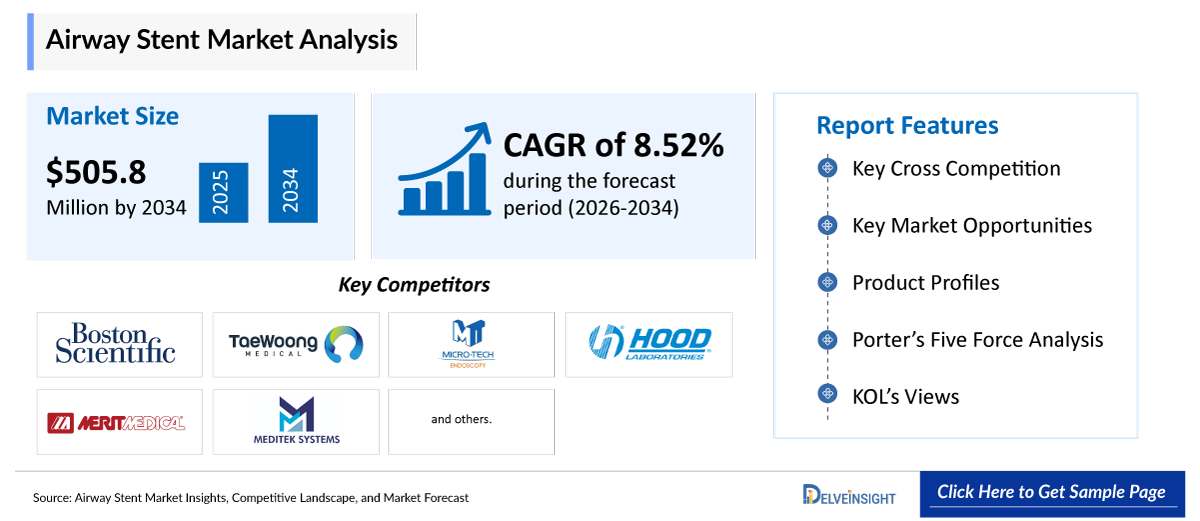
- The Airway Stent market is estimated at USD 241.98 million in 2025 and is projected to reach USD 505.08 million by 2034. Growth is anchored in the rising global burden of respiratory disease and lung cancer, the accelerating shift toward minimally invasive interventional pulmonology, and continuous innovation in stent material and design.
- The global Airway Stent market is growing at a CAGR of 8.52% during the forecast period from 2026 to 2034.
- By type, the tracheobronchial stents segment dominated the Airway Stent market with a 65% share in 2025.
- By material type, the metal stents segment dominated the Airway Stent market with a 55% share in 2025, with nitinol stents the leading metal sub-type on account of their shape-memory and superelastic properties.
- By product type, the self-expandable stents segment dominated the Airway Stent market with a 75% share in 2025.
- By end-user, the hospitals segment dominated the Airway Stent market with a 66% share in 2025.
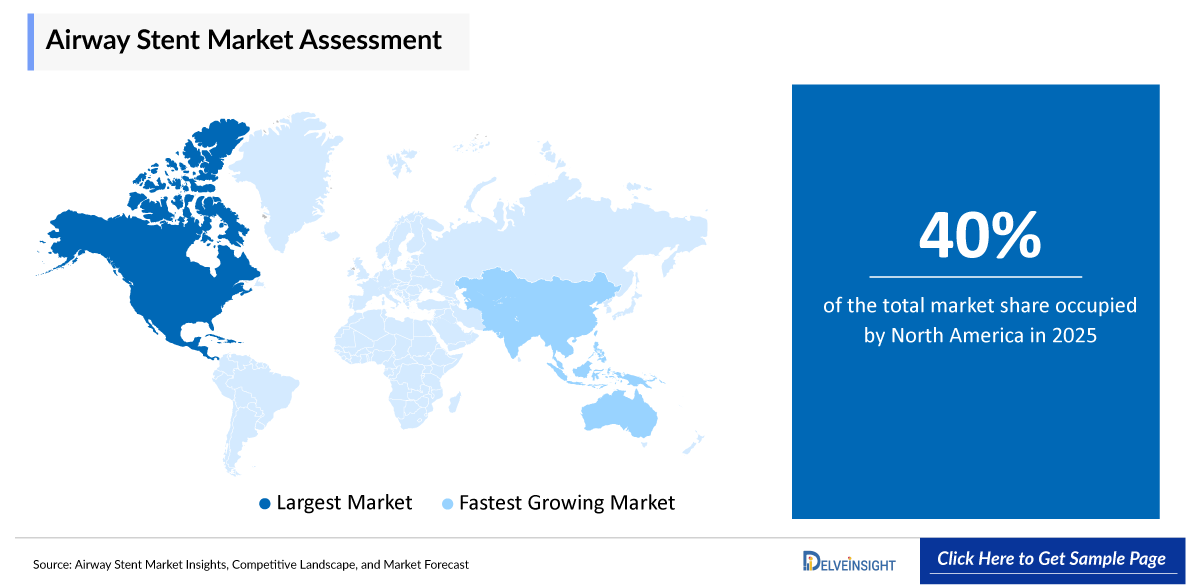
- North America dominated the global Airway Stent market revenue with a 40% share in 2025, representing the highest regional market share globally.
An airway stent is a hollow, tube-shaped medical device inserted endoscopically into the trachea or bronchi to restore and maintain airway patency in patients with central airway obstruction. Airway stents are used to manage both malignant obstruction, most commonly caused by lung cancer, esophageal cancer, and metastatic disease, and benign conditions such as post-intubation and post-tracheostomy tracheal stenosis, tracheobronchomalacia, and post-transplant airway complications. Placement is typically performed via flexible or rigid bronchoscopy under mechanical debridement, laser resection, or balloon dilation support, and the choice of device is guided by the site, length, and etiology of the obstruction. The market is organized by type across tracheobronchial and laryngeal stents; by material across metal stents (nitinol, stainless steel, and other metal alloys), silicone stents, and hybrid stents; by product type across self-expandable and non-expandable stents; and by end-user, led by hospitals. Driven by the rising incidence of lung cancer and chronic respiratory disease, the growing preference for minimally invasive bronchoscopic intervention over open surgery, and continuous advances in stent material science, including drug-eluting coatings and patient-specific 3D-printed designs, airway stents have become an essential tool in the interventional pulmonology treatment pathway.
Airway Stent Market Key Growth Drivers
- The rising global prevalence of respiratory disorders, including chronic obstructive pulmonary disease, lung cancer, and tracheobronchial tuberculosis, is expanding the pool of patients requiring central airway obstruction management.
- Growing lung cancer incidence is directly increasing demand, as malignant central airway obstruction accounted for the majority of stenting procedures in 2025, with palliative stenting a first-line option for inoperable tumors.
- The accelerating shift toward minimally invasive interventional pulmonology, supported by advances in flexible and rigid bronchoscopy, is displacing open surgical airway reconstruction for both malignant and benign indications.
- Technological advancement in stent design, including nitinol hybrid stents, drug-eluting and anti-granulation coatings, and early-stage 3D-printed patient-specific and bioresorbable stents, is improving patency rates and reducing complication-driven re-intervention.
- An aging global population with higher susceptibility to airway strictures, post-intubation tracheal stenosis, and smoking-related airway disease is broadening the addressable patient base across developed markets.
- Expanding hospital and interventional pulmonology infrastructure, and rising healthcare investment across Asia-Pacific and the Middle East, are improving access to bronchoscopic stenting procedures in historically underserved markets.
- Active new-product launches and portfolio expansion by established and emerging manufacturers, spanning self-expanding metallic, hybrid, and silicone platforms, are sustaining competitive innovation and broadening clinician choice across indications.
Key Companies in Airway Stent Market
The competitive landscape is led by the following active manufacturers:
- Boston Scientific Corporation
- TAEWOONG
- MICRO-TECH (Nanjing) Co., Ltd.
- Novatech SA
- Boston Medical Products Inc.
- HOOD LABORATORIES
- Merit Medical Systems
- Cook
- Meditek Systems Pvt. Ltd.
- Stening SRL
For illustrative purposes, only the top 10 companies are listed in the Table of Contents. The report may include analysis and references to additional companies relevant to the market assessment.
Airway Stent Market Size
The following snapshot summarizes the principal report metrics for the Airway Stent market.
|
Report Metrics |
Details |
|
2025 Market Size |
USD 241.98 million |
|
2034 Projected Market Size |
USD 505.08 million |
|
Growth Rate (2026-2034) |
8.52% CAGR |
|
Largest Market |
North America |
|
Fastest Growing Market |
Asia-Pacific |
|
Market Structure |
Moderately Fragmented |
All market values are expressed in USD and represent DelveInsight estimates synthesized from primary and secondary research.
Factors Contributing to the Growth of the Airway Stent Market
Market Drivers
Rising Global Burden of Lung Cancer and Central Airway Obstruction
The single most powerful driver of the Airway Stent market is the rising global burden of lung cancer and the central airway obstruction it produces. Malignant tumors of the trachea, bronchi, and mediastinum, together with esophageal cancer invading the airway, frequently narrow or occlude the central airway, and palliative stenting is often the fastest and least invasive way to relieve dyspnea and restore ventilation in patients who are not surgical candidates. Malignant central airway obstruction accounted for the majority of global stenting procedures in 2025. As global cancer incidence continues to climb and more patients present with advanced, inoperable disease, demand for palliative airway stenting is expected to expand steadily, anchoring market growth through 2034.
Growing Adoption of Minimally Invasive Interventional Pulmonology
A structural shift toward minimally invasive bronchoscopic intervention, in place of open tracheal or bronchial reconstruction surgery, is a central growth engine for the market. Flexible and rigid bronchoscopy allow airway stents to be placed under direct visualization with shorter procedure times, reduced patient morbidity, and faster recovery than open surgery, making stenting an attractive first-line option for both malignant and benign obstruction. As interventional pulmonology training programs expand and more hospitals build dedicated bronchoscopy suites, procedural volumes and associated stent demand are rising across both developed and emerging markets.
Rising Prevalence of Chronic Respiratory and Benign Airway Disease
Beyond malignancy, a growing incidence of benign airway conditions, including post-intubation and post-tracheostomy tracheal stenosis, tracheobronchomalacia, tracheobronchial tuberculosis, and post-lung-transplant airway complications, is broadening the addressable patient population. Rising rates of prolonged mechanical ventilation and intensive care admissions increase the incidence of iatrogenic tracheal stenosis, while chronic obstructive pulmonary disease and smoking-related airway remodeling add to the pool of patients requiring airway support. This diversified disease base sustains demand for airway stents beyond the oncology setting and supports steady utilization across the forecast period.
Continuous Innovation in Stent Material and Design
Ongoing advances in stent material science are improving clinical outcomes and expanding the range of treatable indications. Third-generation hybrid nitinol stents combine the flexibility and conformability of self-expanding metal with a silicone or polymer covering that reduces tumor and granulation tissue ingrowth, while manufacturers continue to refine silicone stent geometry to lower migration risk. Early-stage development of drug-eluting coatings that inhibit granulation tissue formation, biodegradable stents that dissolve once the airway has healed, and 3D-printed patient-specific stents is expanding the innovation pipeline and is expected to open new revenue pools as these technologies mature and gain regulatory clearance.
Aging Population and Expanding Healthcare Infrastructure
An aging global population is more susceptible to airway strictures, post-intubation tracheal injury, and smoking-related respiratory disease, expanding the patient base for airway stenting in mature markets such as the United States, Germany, and Japan. At the same time, expanding hospital infrastructure, rising healthcare expenditure, and growing interventional pulmonology capability across China, India, and the Middle East are extending access to bronchoscopic stenting procedures in markets that historically relied on surgical management or lacked access to advanced airway care altogether.
Active Product Launches and Portfolio Expansion by Manufacturers
Established players and specialized manufacturers alike continue to broaden their airway stent portfolios across self-expanding metallic, hybrid, and silicone platforms, extending size ranges, refining delivery systems for greater placement accuracy, and pursuing regulatory clearances in new geographies. This sustained pace of product introduction and portfolio broadening keeps clinician choice wide, supports replacement and upgrade demand, and reinforces competitive intensity across both premium and value-tier segments of the market.
Market Restraints
Despite favorable underlying demand, the Airway Stent market faces material constraints. Stent-related complications, including granulation tissue formation, mucus plugging, stent migration, and secondary infection, remain common across both metal and silicone devices and can necessitate repeat bronchoscopic intervention, tempering long-term adoption in benign disease where alternative treatments exist. The U.S. Food and Drug Administration's historical caution around metallic stents in benign airway disease, stemming from migration and removal difficulties associated with early uncovered designs, continues to shape prescribing patterns and slows adoption of metal stents outside malignant indications. High procedure and device costs, combined with uneven reimbursement for interventional pulmonology procedures across emerging markets, restrict access in price-sensitive geographies. A global shortage of trained interventional pulmonologists capable of performing rigid bronchoscopy and complex stent placement constrains procedural volume growth even where device availability is not a limiting factor. Competition from alternative palliative modalities, including laser ablation, cryotherapy, photodynamic therapy, and endobronchial brachytherapy, which can be used alone or ahead of stenting, moderates the pace of stent-specific demand growth. Together, these clinical, regulatory, cost, workforce, and competitive-modality factors temper the pace of growth, even as the underlying drivers of cancer burden, minimally invasive adoption, and material innovation remain firmly intact.
Airway Stent Market Segment Analysis
The airway stent market by type (tracheobronchial stents, laryngeal stents), material type (metal stents [nitinol stents, stainless steel stents, other metal stents], silicone stents, hybrid stents), product type (self-expandable stents, non-expandable stents), end-user (hospitals, ambulatory surgical centers, others), and geography (North America, Europe, Asia-Pacific, and Rest of World).
By Type
Dominant Subsegment: Tracheobronchial Stents.
The tracheobronchial stents segment accounted for 65% of the Airway Stent market in 2025. Tracheobronchial stents are the leading type because they address the trachea and main bronchi, the most common sites of both malignant central airway obstruction and benign post-intubation stenosis, and because the segment spans a wide range of device configurations, including straight, Y-shaped, and covered designs, that suit the majority of clinical presentations. Their use in lung cancer palliation, tracheal stenosis repair, and post-transplant airway complications gives the segment broad and recurring procedural demand across oncology and pulmonology practice. Laryngeal stents, used specifically for glottic and subglottic stenosis, address a comparatively narrower anatomical indication and clinician base, which keeps the segment smaller despite steady demand from laryngotracheal stenosis and airway reconstruction cases. The breadth of indications, device configurations, and clinical familiarity secure the tracheobronchial segment's leadership across the forecast period.
By Material Type
Dominant Subsegment: Metal Stents.
The metal stents segment accounted for 55% of the Airway Stent market in 2025. Metal stents, led by nitinol devices, are the leading material category because nitinol's shape-memory and superelastic properties allow low-profile delivery through a bronchoscope followed by full self-expansion at body temperature, combined with the radial strength needed to hold open tumor-narrowed or scarred airways. Nitinol stents dominate the metal sub-category and are widely used in third-generation hybrid designs that pair a nitinol frame with a silicone or polyurethane covering to reduce tumor and granulation tissue ingrowth. Stainless steel stents retain a smaller share, used selectively where higher radial force is required, while other metal alloys serve niche applications. Silicone stents remain the preferred choice for benign disease and removable applications given their ease of repositioning and extraction, and hybrid stents are the fastest-growing material category as third-generation designs gain clinical adoption in both benign and malignant indications. Nonetheless, the versatility, deliverability, and broad indication range of metal, and nitinol in particular, secure its leadership across the forecast period.
By Product Type
Dominant Subsegment: Self-Expandable Stents.
The self-expandable stents segment accounted for 75% of the Airway Stent market in 2025. Self-expandable stents are the leading product type because they do not require balloon inflation or surgical implantation, deploying automatically once released from a constrained delivery catheter, which reduces procedural complexity and shortens bronchoscopy time. Their automatic expansion also allows better conformity to irregular or tapering airway anatomy than fixed-diameter devices, a meaningful advantage in tumor-related strictures. Non-expandable, or fixed-diameter, stents, most commonly silicone tube designs, remain important in specific clinical scenarios requiring precise, operator-controlled sizing and straightforward removability, particularly in benign disease, but their placement typically requires rigid bronchoscopy under general anesthesia, limiting their share relative to self-expandable designs. The combination of procedural simplicity, broad anatomical applicability, and compatibility with flexible bronchoscopy secures the self-expandable segment's leadership across the forecast period.
By End-User
Dominant Subsegment: Hospitals.
The hospitals segment accounted for 66% of the Airway Stent market in 2025. Hospitals are the leading end-user because airway stent placement typically requires bronchoscopy suites, rigid bronchoscopy capability, anesthesia support, and multidisciplinary access to thoracic surgery, oncology, and critical care, infrastructure concentrated in hospital settings. Tertiary and academic hospitals in particular manage the majority of complex central airway obstruction cases, given their case volumes and access to interventional pulmonology specialists. Ambulatory surgical centers are expanding their role as select lower-complexity procedures migrate to outpatient settings, supported by advances in flexible bronchoscopy and sedation protocols, and this segment is expected to post the fastest growth over the forecast period. Other end-users, including specialty pulmonology and cancer clinics, address a smaller share of procedure volume. The complexity of airway stent placement and the need for comprehensive peri-procedural support keep hospitals the dominant end-user across the forecast period.
Airway Stent Market Region Analysis
Dominant Region: North America
North America accounted for 40% of the global Airway Stent market revenue in 2025, representing the highest regional market share globally. The region's dominance reflects a mature interventional pulmonology ecosystem, a high concentration of thoracic oncology and lung cancer cases, well-established reimbursement pathways for bronchoscopic procedures, and the presence of leading device manufacturers such as Boston Scientific, Merit Medical Systems, Cook, and Boston Medical Products headquartered in the United States. North America hosts the largest base of tertiary hospitals equipped with dedicated bronchoscopy suites and rigid bronchoscopy capability, supporting high procedural volumes for both malignant and benign airway obstruction. Continued new-product introductions, physician training programs, and the region's aging, high-smoking-history population sustain robust demand and anchor the region's continued leadership across the forecast period.
Fastest Growing Region: Asia-Pacific
Asia-Pacific is the fastest-growing region in the Airway Stent market. The region's elevated CAGR is driven by rising lung cancer incidence linked to smoking and air pollution, rapid expansion of hospital and interventional pulmonology infrastructure, and growing healthcare investment across China, Japan, India, South Korea, and Australia. China and India are expanding bronchoscopy suite capacity and interventional pulmonology training, Japan's dense network of respiratory specialty hospitals supports early adoption of hybrid and covered stent designs, and South Korea's device manufacturers, including TAEWOONG and MICRO-TECH's regional partners, are scaling local production and export capacity. Growing awareness of minimally invasive bronchoscopic treatment options, expanding insurance coverage, and rising government healthcare spending are accelerating adoption across the region, positioning Asia-Pacific as the principal source of incremental growth over the forecast period.
Regional Commentary
North America
North America accounted for 40% of the global Airway Stent market revenue in 2025. The United States dominates on the strength of its interventional pulmonology infrastructure, high lung cancer incidence, established reimbursement for bronchoscopic procedures, and the domestic presence of leading manufacturers, while ongoing physician training and product innovation reinforce its leadership.
Europe
Europe is a large and advanced regional market, supported by strong interventional pulmonology centers in Germany, France, and the United Kingdom, established CE-marking and reimbursement frameworks, and the regional presence of manufacturers including Novatech SA, Stening SRL, and HOOD LABORATORIES' European distribution. Silicone stents retain a comparatively larger share in Europe given the region's long clinical tradition around the Dumon silicone stenting technique.
Asia-Pacific
Asia-Pacific is the fastest-growing region, propelled by rising lung cancer incidence, rapid interventional pulmonology infrastructure build-out, and growing healthcare investment across China, Japan, India, South Korea, and Australia. Domestic manufacturers such as TAEWOONG and MICRO-TECH (Nanjing) are scaling regional production of nitinol and hybrid stents, supporting both local adoption and export growth.
Rest of World
The Rest of World region, spanning Latin America, the Middle East, and Africa, is an emerging growth frontier. Expanding hospital and interventional pulmonology infrastructure, rising lung cancer and tuberculosis-related airway stenosis burden, and growing access to affordable stent platforms from manufacturers such as Meditek Systems and Stening SRL are gradually broadening access across the region.
Airway Stent Market Competitive Landscape
The Airway Stent market is classified as Moderately Fragmented. A group of large, diversified medical device companies with global distribution, including Boston Scientific Corporation, Cook, and Merit Medical Systems, anchors the top tier through broad product portfolios and established hospital relationships, while specialized, single-focus manufacturers such as Novatech SA, TAEWOONG, MICRO-TECH (Nanjing) Co., Ltd., HOOD LABORATORIES, Boston Medical Products Inc., Meditek Systems Pvt. Ltd., and Stening SRL compete through clinical heritage, material specialization, and regional distribution strength, sustaining intense competition across both premium and value-tier segments.
The competitive landscape can be evaluated across the following dimensions:
- Market concentration: Moderately fragmented, with diversified global device makers leading and a wide field of specialized silicone- and metal-stent manufacturers.
- Leading players: Boston Scientific Corporation, Cook, and Merit Medical Systems anchor the top tier through broad interventional pulmonology portfolios and global distribution.
- Geographic reach: Leaders operate global commercial networks, while regional specialists such as TAEWOONG and MICRO-TECH (Nanjing) Co., Ltd. hold strong positions across Asia-Pacific.
- Product portfolio strength: Top players offer end-to-end tracheobronchial and laryngeal stent portfolios spanning metal, silicone, and hybrid designs across self-expandable and non-expandable formats.
- Clinical heritage: Novatech SA's Dumon silicone stent, distributed in the United States through Boston Medical Products Inc., remains a clinical reference standard, providing durable brand equity.
- Material specialization: HOOD LABORATORIES and Stening SRL compete on custom and made-to-measure silicone stent capability, while TAEWOONG and MICRO-TECH lead in nitinol and hybrid stent design.
- Emerging-market access: Meditek Systems Pvt. Ltd. and other regional manufacturers extend affordable stent access across price-sensitive markets in South Asia, the Middle East, and Latin America.
- Innovation focus: Hybrid nitinol-silicone stent design, anti-granulation and drug-eluting coatings, and early-stage 3D-printed and bioresorbable stent development are key competitive differentiators.
Airway Stent Market Recent Developmental Activities
In 2026, Merit Medical Systems launched the Resilience Through-the-Scope Stent platform in the United States, extending its non-vascular stenting technology base across its interventional endoscopy and airway product lines. Strategic significance: Broadens Merit's minimally invasive stent platform and reinforces its position across non-vascular interventional stenting.
In 2025, MICRO-TECH (Nanjing) Co., Ltd., expanded availability of its self-expanding metallic airway stents for the management of malignant and benign tracheobronchial strictures across additional healthcare markets. Strategic significance: Broadens self-expandable stent access across export markets and strengthens the company's Asia-Pacific manufacturing base.
In 2024, Cook advanced its airway stent delivery systems with design refinements intended to enhance placement accuracy during bronchoscopic procedures. Strategic significance: Improves procedural precision and reinforces Cook's position in tracheobronchial stent delivery technology.
In 2025, Boston Scientific Corporation continued to broaden the size range and regulatory footprint of its Ultraflex Tracheobronchial Stent System and Polyflex self-expanding silicone airway stent across international markets. Strategic significance: Extends Boston Scientific's global commercial reach in nitinol and silicone airway stenting.
In 2025, TAEWOONG expanded the size range of its Bonastent hybrid nitinol tracheobronchial stent to support more precise anatomical matching across a broader range of patients. Strategic significance: Strengthens Taewoong's position in the hybrid self-expanding metallic stent category.
In 2024, Novatech SA continued to broaden clinical distribution of its Dumon and Silmet stent lines through its long-standing partnership with Boston Medical Products Inc. in the United States. Strategic significance: Reinforces the Dumon silicone stent's role as a clinical reference standard and sustains Novatech's transatlantic distribution model.
In 2024, HOOD LABORATORIES continued to expand its custom and made-to-measure silicone tracheal and bronchial stent manufacturing capability for complex benign airway reconstruction cases. Strategic significance: Supports differentiated, patient-specific stent supply for complex benign airway indications.
In 2025, Meditek Systems Pvt. Ltd. expanded export distribution of its metal and silicone airway stent portfolio across South Asian and Middle Eastern markets. Strategic significance: Improves access to affordable airway stenting technology in price-sensitive, high-unmet-need markets.
In 2024, Stening SRL broadened its tracheobronchial stent portfolio to include additional hybrid and metal configurations for the European and Latin American markets. Strategic significance: Extends Stening's regional footprint and diversifies its stent material offering.
Airway Stent Market Segmentation
Airway Stent Market by Type
- Tracheobronchial Stents
- Laryngeal Stents
Airway Stent Market by Material Type
- Metal Stents
- Nitinol Stents
- Stainless Steel Stents
- Other Metal Stents
- Silicone Stents
- Hybrid Stents
Airway Stent Market by Product Type
- Self-Expandable Stents
- Non-Expandable Stents
Airway Stent Market by End-Users
- Hospitals
- Ambulatory Surgical Centers
- Others
Airway Stent Market by Geography
- North America Airway Stent Market
- United States Airway Stent Market Size in USD million (2023-2034)
- Canada Airway Stent Market Size in USD million (2023-2034)
- Mexico Airway Stent Market Size in USD million (2023-2034)
- Europe Airway Stent Market
- Germany Airway Stent Market Size in USD million (2023-2034)
- United Kingdom Airway Stent Market Size in USD million (2023-2034)
- France Airway Stent Market Size in USD million (2023-2034)
- Italy Airway Stent Market Size in USD million (2023-2034)
- Spain Airway Stent Market Size in USD million (2023-2034)
- Rest of Europe Airway Stent Market Size in USD million (2023-2034)
- Asia-Pacific Airway Stent Market
- China Airway Stent Market Size in USD million (2023-2034)
- Japan Airway Stent Market Size in USD million (2023-2034)
- India Airway Stent Market Size in USD million (2023-2034)
- Australia Airway Stent Market Size in USD million (2023-2034)
- South Korea Airway Stent Market Size in USD million (2023-2034)
- Rest of Asia-Pacific Airway Stent Market Size in USD million (2023-2034)
- Rest of the World (RoW) Airway Stent Market
- Middle East Airway Stent Market Size in USD million (2023-2034)
- Africa Airway Stent Market Size in USD million (2023-2034)
- South America Airway Stent Market Size in USD million (2023-2034)
Airway Stent Market Recent Industry Trends and Milestones (2023-2026)
|
Category |
Key Developments |
|
Airway Stent Market Product Approval |
Manufacturers continue to broaden regulatory clearances for hybrid nitinol and silicone stent platforms across the United States, Europe, and Asia-Pacific. Boston Scientific's Ultraflex Tracheobronchial Stent System and Polyflex silicone stent, Taewoong's Bonastent, and Novatech's Dumon and Silmet lines continue to expand approved size ranges and indications, sustaining durable demand for compliant, hospital-grade device supply. |
|
Airway Stent Market Expansion |
Device makers broadened manufacturing and distribution capacity across the value chain. Micro-Tech expanded availability of self-expanding metallic airway stents, Meditek Systems and Stening SRL extended export distribution into South Asia, the Middle East, and Latin America, and Cook advanced delivery-system design to improve bronchoscopic placement accuracy. |
|
Airway Stent Market Investment |
Established players continued to reinvest in product development and delivery-system refinement rather than pursue large-scale M&A, reflecting the market's moderately fragmented, clinically driven competitive structure. Merit Medical Systems extended its broader non-vascular stenting platform, indirectly reinforcing its airway and interventional endoscopy stent business. |
|
Company Strategy |
Boston Scientific, Inc.: Global portfolio leadership across nitinol and silicone platforms. Cook: Delivery-system innovation and hospital relationship depth. Merit Medical Systems: Broader non-vascular stenting platform expansion. Novatech SA and Boston Medical Products Inc.: Clinical heritage and transatlantic distribution of the Dumon silicone stent. TAEWOONG and MICRO-TECH (Nanjing) Co., Ltd.: Asia-Pacific manufacturing scale and hybrid nitinol design leadership. HOOD LABORATORIES and Stening SRL: Custom and made-to-measure silicone stent specialization. Meditek Systems Pvt. Ltd.: Affordable stent access across emerging markets. |
|
Emerging Technologies |
Hybrid nitinol-silicone stent design is the leading edge of clinical adoption, reducing tumor and granulation tissue ingrowth relative to earlier uncovered metal designs. Early-stage development of drug-eluting and anti-granulation coatings, bioresorbable stents that dissolve once the airway has healed, and 3D-printed patient-specific stents is emerging, alongside growing interest in improved bronchoscopic imaging and navigation to support more precise stent placement. |
Airway Stent Market Startup Funding and Investment Trends
|
Company |
Total Funding |
Funding Stage |
Main Offering |
Core Technology |
|
Meditek Systems Pvt. Ltd. |
- |
Manufacturing capacity expansion |
Metal and silicone airway stents |
Affordable self-expanding and silicone stent platforms |
|
Request for unlocking the report of the @ Airway Stent Market | ||||
Investment activity in the Airway Stent ecosystem has concentrated on hybrid stent design refinement, delivery-system innovation, and expansion of manufacturing and export capacity by regionally focused players, rather than large headline financings typical of higher-growth therapeutic device categories. The following companies illustrate representative recent investment and technology focus.
Capital deployment in the sector is weighted toward the established players that already hold clinical credibility, including Boston Scientific, Cook, and Merit Medical Systems, which continue to fund incremental delivery-system and coating innovation from existing device franchises. Specialized manufacturers such as Meditek Systems Pvt. Ltd. and Stening SRL are investing in manufacturing capacity and export distribution to extend affordable stent access into underserved geographies. Collectively, these investments signal that hybrid design refinement, delivery-system precision, and emerging-market manufacturing capacity will define the next phase of competitive advantage in the global Airway Stent market.
Key Takeaways from the Airway Stent Market Report Study
- Market size analysis for the current Airway Stent market size (2025), and market forecast for 9 years (2026 to 2034).
- Top key product/technology developments, mergers, acquisitions, partnerships, and joint ventures that happened over the last 3 years.
- Key companies dominating the global Airway Stent market.
- Various opportunities available for competitors in the Airway Stent market space.
- What are the top-performing segments in 2025? How will these segments perform in 2034?
- Which are the top-performing regions and countries in the current Airway Stent market scenario?
- Which are the regions and countries where companies should concentrate their opportunities for Airway Stent market growth in the future?
Target audience who can benefit from this Airway Stent market report study
- Airway Stent product providers
- Research organizations and consulting companies
- Airway Stent -related organizations, associations, forums, and other alliances
- Government and corporate offices
- Start-up companies, venture capitalists, and private equity firms
- Distributors and traders dealing in Airway Stent
- Various end-users who want to know more about the Airway Stent market and the latest technological developments in the Airway Stent market.