
Alglucosidase alfa Summary
Key Factors Driving Alglucosidase alfa Growth
1. Market Share Gains and New Patient Starts
- Alglucosidase alfa (Myozyme/Lumizyme) is the foundational enzyme replacement therapy (ERT) for Pompe disease (glycogen storage disease type II) and remains one of the most widely used therapies in this rare metabolic disorder.
- New patient starts are driven by expanded newborn screening programs, increased disease awareness, and earlier genetic diagnosis, particularly for infantile-onset Pompe disease.
- Sanofi (Genzyme) continues to support uptake through global rare disease infrastructure, physician education initiatives, and patient support programs.
2. Expansion Across Key Indications
- Primary indication - Pompe disease: Alglucosidase alfa is approved for the treatment of both infantile-onset and late-onset Pompe disease, addressing the underlying acid alpha-glucosidase deficiency.
- Long-term studies have shown that earlier treatment initiation significantly improves survival and motor outcomes, especially in infantile-onset patients.
- While Pompe disease remains the sole indication, Myozyme/Lumizyme has shaped the clinical management framework for lysosomal storage disorders, serving as a benchmark for next-generation therapies.
3. Geographic Expansion
- United States and Europe: Core commercial markets with long-standing regulatory approvals and strong reimbursement under orphan drug policies.
- Asia-Pacific: Increasing uptake driven by government-supported newborn screening programs, improved access to diagnostics, and rising healthcare investments, especially in Japan, China, and South Korea.
- Emerging markets: Gradual expansion via Sanofi’s global rare disease footprint and partnerships with regional healthcare systems.
4. New Indication Approvals
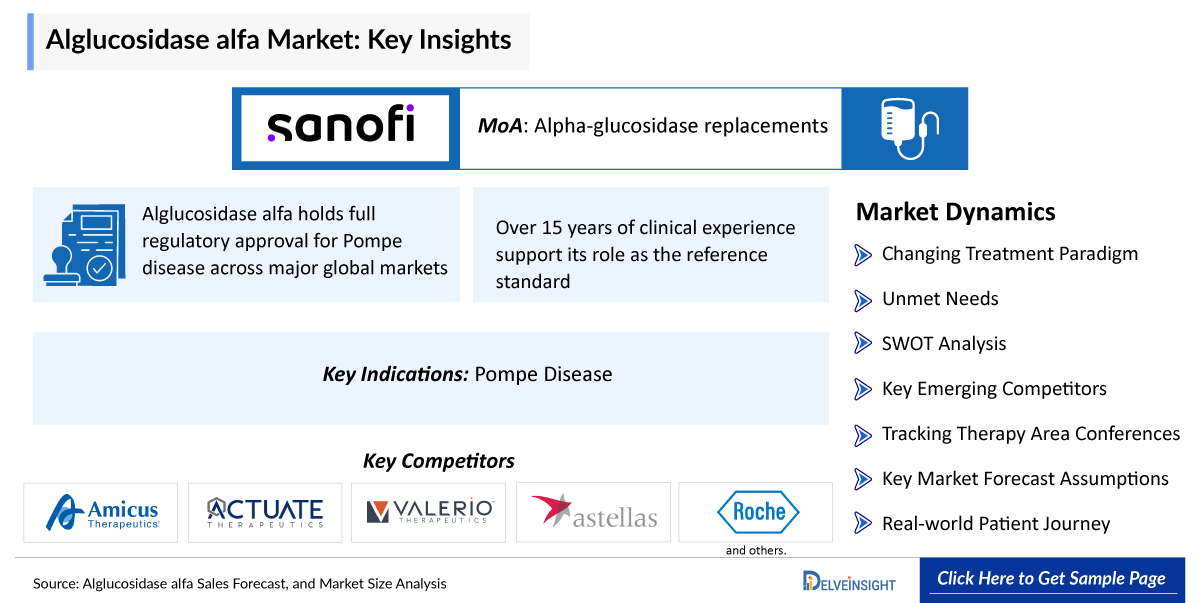
- Alglucosidase alfa holds full regulatory approval for Pompe disease across major global markets.
- No additional disease indications have been approved; regulatory focus remains on early diagnosis, improved access, and long-term disease modification rather than expansion into unrelated indications.
5. Strong Pompe Disease Treatment Momentum
- Clinical trials demonstrated significant survival benefits, improved cardiac outcomes, and better motor function in infantile-onset patients.
- Long-term real-world data confirms slower disease progression and stabilization of respiratory function in late-onset patients.
- Registry studies highlight a favorable long-term safety profile, reinforcing clinician confidence in lifelong therapy.
6. Competitive Differentiation and Market Trends
- First-in-class ERT for Pompe disease: Myozyme/Lumizyme established the modern treatment paradigm for Pompe.
- Proven long-term efficacy: Over 15 years of clinical experience supports its role as the reference standard.
- Rare disease trends: Expansion of newborn screening, genomic diagnostics, and orphan drug frameworks continues to support sustained relevance.
- Growing competition from next-generation ERTs (e.g., avalglucosidase alfa, cipaglucosidase alfa) and gene therapies is reshaping the market, but alglucosidase alfa remains widely used.
Alglucosidase alfa Recent Developments
Alglucosidase alfa have focused on its role as a benchmark comparator in next-generation Pompe therapies. Sanofi has increasingly positioned Myozyme/Lumizyme as a legacy and standard reference therapy, while transitioning new patients toward improved ERTs such as Nexviazyme (avalglucosidase alfa) in certain markets. Long-term registry and real-world evidence continue to confirm durable clinical benefits, and alglucosidase alfa remains a critical component of global Pompe disease management, particularly in regions where access to newer agents is limited.
“Alglucosidase alfa Sales Forecast, and Market Size Analysis – 2034” report provides comprehensive insights of Alglucosidase alfa for approved indication like Glycogen storage disease type II in the 7MM. A detailed picture of Alglucosidase alfa’s existing usage in anticipated entry and performance in approved indications in the 7MM, i.e., the United States, EU4 (Germany, France, Italy, and Spain) and the United Kingdom, and Japan for the study period 2020 –2034 is provided in this report along with a detailed description of the Alglucosidase alfa for approved indications. The Alglucosidase alfa market report provides insights about Alglucosidase alfa’s sales forecast, mechanism of action (MoA), dosage and administration, as well as research and development including regulatory milestones, along with other developmental activities. Further, it also consists of historical and current Alglucosidase alfa performance, future market assessments inclusive of the Alglucosidase alfa market forecast analysis for approved indications in the 7MM, SWOT, analysts’ views, comprehensive overview of market competitors, and brief about other emerging therapies in respective indications. It also provides analysis of Alglucosidase alfa sales forecasts, along with factors driving its market.
Alglucosidase alfa Drug Summary
Alglucosidase alfa is a recombinant human acid alpha-glucosidase (GAA) enzyme produced in Chinese hamster ovary (CHO) cells via recombinant DNA technology, marketed as Myozyme (for patients under 8 years) or Lumizyme (for those 8 years and older) by Sanofi Genzyme for biweekly intravenous infusion as enzyme replacement therapy (ERT) in Pompe disease (glycogen storage disease type II), a lysosomal storage disorder caused by GAA deficiency leading to glycogen accumulation in muscles and vital organs. It catalyzes the hydrolysis of α-1,4- and α-1,6-glycosidic linkages in lysosomal glycogen, providing an exogenous source of functional GAA that binds to mannose-6-phosphate receptors for cellular uptake, proteolytic activation, and degradation of accumulated glycogen to mitigate progressive muscle weakness, respiratory failure, and cardiomyopathy, particularly in infantile-onset forms. FDA-approved in 2006 (Myozyme for infantile-onset Pompe) with expanded labeling for late-onset disease, it improves ventilator-free survival, motor function, and cardiac status in clinical studies, though high-titer anti-drug antibodies may reduce efficacy and infusion-associated reactions require management. The report provides Alglucosidase alfa’s sales, growth barriers and drivers, post usage and approvals in multiple indications.
Scope of the Alglucosidase alfa Market Report
The report provides insights into:
- A comprehensive product overview including the Alglucosidase alfa MoA, description, dosage and administration, research and development activities in approved indication like Glycogen storage disease type II.
- Elaborated details on Alglucosidase alfa regulatory milestones and other development activities have been provided in Alglucosidase alfa market report.
- The report also highlights Alglucosidase alfa‘s cost estimates and regional variations, reported and estimated sales performance, research and development activities in approved indications across the United States, Europe, and Japan.
- The Alglucosidase alfa market report also covers the patents information, generic entry and impact on cost cut.
- The Alglucosidase alfa market report contains current and forecasted Alglucosidase alfa sales for approved indications till 2034.
- Comprehensive coverage of the late-stage emerging therapies for respective indications.
- The Alglucosidase alfa market report also features the SWOT analysis with analyst views for Alglucosidase alfa in approved indications.
Methodology
The Alglucosidase alfa market report is built using data and information sourced primarily from internal databases, primary and secondary research and in-house analysis by DelveInsight’s team of industry experts. Information and data from the secondary sources have been obtained from various printable and nonprintable sources like search engines, news websites, global regulatory authorities websites, trade journals, white papers, magazines, books, trade associations, industry associations, industry portals and access to available databases.
Alglucosidase alfa Analytical Perspective by DelveInsight
In-depth Alglucosidase alfa Market Assessment
This Alglucosidase alfa sales market forecast report provides a detailed market assessment of Alglucosidase alfa for approved indication like Glycogen storage disease type II in the seven major markets, i.e., the United States, EU4 (Germany, France, Italy, and Spain) and the United Kingdom, and Japan. This segment of the report provides current and forecasted Alglucosidase alfa sales data uptil 2034.
Alglucosidase alfa Clinical Assessment
The Alglucosidase alfa market report provides the clinical trials information of Alglucosidase alfa for approved indications covering trial interventions, trial conditions, trial status, start and completion dates.
Alglucosidase alfa Competitive Landscape
The report provides Insights on competitors and marketed products within the domain, along with a summary of emerging products and their respective launch dates, posing significant competition in the market.
Alglucosidase alfa Market Potential & Revenue Forecast
- Projected market size for the Alglucosidase alfa and its key indications
- Estimated Alglucosidase alfa sales potential (Alglucosidase alfa peak sales forecasts)
- Alglucosidase alfa Pricing strategies and reimbursement landscape
Alglucosidase alfa Competitive Intelligence
- Number of competing drugs in development (pipeline analysis)
- Alglucosidase alfa Market positioning compared to existing treatments
- Alglucosidase alfa Strengths & weaknesses relative to competitors
Alglucosidase alfa Regulatory & Commercial Milestones
- Alglucosidase alfa Key regulatory approvals & expected launch timelines
- Commercial partnerships, licensing deals, and M&A activity
Alglucosidase alfa Clinical Differentiation
- Alglucosidase alfa Efficacy & safety advantages over existing drugs
- Alglucosidase alfa Unique selling points
Alglucosidase alfa Market Report Highlights
- In the coming years, the Alglucosidase alfa market scenario is set to change due to strong adoption, increased prescriptions and broader uptake in multiple immunological indications; which would expand the size of the market.
- The Alglucosidase alfa companies are developing therapies that focus on novel approaches to treat/improve the disease condition, assess challenges, and seek opportunities that could influence Alglucosidase alfa’s dominance.
- Other emerging products for Glycogen storage disease type II are expected to give tough market competition to Alglucosidase alfa and launch of late-stage emerging therapies in the near future will significantly impact the market.
- A detailed description of regulatory milestones, and developmental activities, provide the current development scenario of Alglucosidase alfa in approved indications.
- Analyse Alglucosidase alfa cost, pricing trends and market positioning to support strategic decision-making in the immunology landscape.
- Our in-depth analysis of the forecasted Alglucosidase alfa sales data uptil 2034 will support the clients in decision-making process regarding their therapeutic portfolio by identifying the overall scenario of Alglucosidase alfa in approved indications.
Key Questions Answered In The Alglucosidase alfa Market Report
- What is the class of therapy, route of administration and mechanism of action of Alglucosidase alfa? How strong is Alglucosidase alfa’s clinical and commercial performance?
- What is Alglucosidase alfa’s clinical trial status in each individual indications such as Glycogen storage disease type II and study completion date?
- What are the key collaborations, mergers and acquisitions, licensing and other activities related to the Alglucosidase alfa Manufacturers?
- What are the key designations that have been granted to Alglucosidase alfa for approved indications? How are they going to impact Alglucosidase alfa’s penetration in various geographies?
- What is the current and forecasted Alglucosidase alfa market scenario for approved indications? What are the key assumptions behind the forecast?
- What are the current and forecasted sales of Alglucosidase alfa in the seven major countries, including the United States, Europe (Germany, France, Italy, Spain) and the United Kingdom, and Japan?
- What are the other emerging products available and how are these giving competition to Alglucosidase alfa for approved indications?
- Which are the late-stage emerging therapies under development for the treatment of approved indications?
- How cost-effective is Alglucosidase alfa? What is the duration of therapy and what are the geographical variations in cost per patient?