
Alzheimer's Disease Market
Key Highlights
- As per DelveInsight’s estimates, in 2024, there were approximately 16 million diagnosed prevalent cases of Alzheimer’s disease in the 7MM, reflecting a significant disease burden. This high prevalence underscores the need for innovative treatments to address the rising impact on healthcare systems and patient care.
- In 2024, among the EU4 and the UK, Germany accounted for the highest diagnosed prevalent cases of Alzheimer’s disease, representing approximately 30% of the total cases, followed by France (24%). Analysis by DelveInsight’s experts indicates that the overall diagnosed prevalent cases of Alzheimer’s disease are expected to rise in the coming years.
- According to DelveInsight analysis, nearly 2.4 million males and 5 million females were affected with Alzheimer’s disease in the US in 2024. DelveInsight estimates that these numbers will increase by 2034.
- According to DelveInsight’s epidemiological model, in 2024, the 75–84 age group in the EU4 and the UK had the highest Alzheimer’s disease cases, nearly 2 million. In contrast, the under 65 age group had the fewest cases, with nearly 130 thousand recorded.
Factors affecting Alzheimer's Disease Market Growth
-
Rising Prevalence of Alzheimer’s Disease
Growing aging population worldwide increases the number of patients diagnosed with AD.
-
Increasing Awareness and Early Diagnosis
Public education campaigns and improved cognitive assessment tools support early detection and treatment.
-
Advancements in Therapeutic Options
Development of disease-modifying therapies, monoclonal antibodies, and novel drugs drives market growth.
-
Growing Geriatric Population
Higher life expectancy and age-related neurodegeneration expand the target patient pool.
-
Rising Incidence of Dementia-Related Disorders
Increased reporting and diagnosis of cognitive disorders contribute to treatment demand.
-
Government and NGO Initiatives
Funding for research, early screening programs, and public awareness campaigns promote diagnosis and treatment.
-
Technological Advancements in Diagnostics
PET scans, MRI, and biomarker-based testing improve accuracy and early intervention.
-
Integration of Digital Health and Telemedicine
Remote monitoring, cognitive apps, and online consultations enhance patient management.
-
Strategic Collaborations & Research Partnerships
Pharma and biotech collaborations accelerate drug development and clinical trials.
-
Patient Advocacy and Support Programs
Awareness initiatives and caregiver support programs increase treatment adherence and market penetration.
DelveInsight’s estimates indicate that in 2024, Japan had approximately 2.5 million diagnosed prevalent cases of agitation associated with Alzheimer’s disease, a figure expected to grow by 2034. This behavioral symptom, marked by restlessness, irritability, aggression, and anxiety, significantly diminishes patient quality of life and heightens caregiver strain.
DelveInsight’s “Alzheimer’s Disease Epidemiology Forecast – 2034” report delivers an in-depth understanding of Alzheimer’s Disease, historical and forecasted epidemiology of Alzheimer’s Disease in the United States, EU4 (Germany, France, Italy, and Spain) and the United Kingdom, and Japan.
Geography Covered
- The United States
- EU4 (Germany, France, Italy, and Spain) and the United Kingdom
- Japan
Study Period: 2020–2034
Alzheimer’s Disease Understanding
Alzheimer’s Disease Overview
Alzheimer’s disease is a progressive, irreversible neurological disorder, primarily impacting memory, reasoning, and cognitive abilities. It is the leading cause of dementia, responsible for roughly 60–80% of all cases. Though often emerging in the mid-60s, early-onset Alzheimer’s can affect individuals as young as their 40s or 50s, albeit rarely. Initial symptoms commonly include memory loss that significantly interferes with daily life, followed by confusion, language difficulties, impaired judgment, and behavioral changes. The disease’s exact cause remains unknown, but it is associated with abnormal accumulations of Amyloid Beta protein plaques and tau protein tangles in the brain, which disrupt cellular communication and lead to cell death. Increasing age and family history are recognized as key risk factors for Alzheimer’s disease.
Alzheimer’s Disease Diagnosis
Diagnosing Alzheimer’s disease remains challenging due to its gradual onset and overlapping symptoms with other cognitive disorders. The diagnosis primarily relies on clinical assessments, including a detailed medical history, cognitive tests, and evaluations of memory, reasoning, and language skills. Neuroimaging techniques, like MRI and PET scans, help detect structural brain changes, while biomarkers in cerebrospinal fluid can reveal amyloid and tau protein abnormalities. However, definitive diagnosis often occurs post-mortem through brain tissue examination.
The complexity of Alzheimer’s disease diagnosis is compounded by variability in symptom progression and the absence of a single diagnostic test. Additionally, the need for specialized tools and resources makes early diagnosis difficult, especially in low-resource settings. Misdiagnosis risks are high, which can delay appropriate interventions and add stress for patients and caregivers. Improved diagnostic accuracy through advancements in biomarker research and neuroimaging is critical to enabling timely, targeted treatments and addressing these diagnostic challenges in Alzheimer’s disease.
Further details related to diagnosis are provided in the report...
Alzheimer’s Disease Epidemiology
For the purpose of designing the patient-based model for Alzheimer’s Disease, the report provides historical as well as forecasted epidemiology segmented by total diagnosed prevalent cases of Alzheimer’s disease, total prevalent cases of preclinical Alzheimer’s disease, gender-specific diagnosed prevalent cases of Alzheimer’s disease, age-specific diagnosed prevalent cases of Alzheimer’s disease, Severity-specific diagnosed prevalent cases of Alzheimer’s disease, genotype-specific diagnosed prevalent cases of Alzheimer’s disease, diagnosed prevalent cases of agitation in Alzheimer’s disease, and diagnosed prevalent cases of psychosis in Alzheimer’s disease in the 7MM covering the United States, EU4 countries (Germany, France, Italy, and Spain) and the United Kingdom, and Japan, from 2020 to 2034.
- DelveInsight’s analyst estimate that approximately 16 million diagnosed prevalent cases of Alzheimer’s disease were found in 2024 in the 7MM.
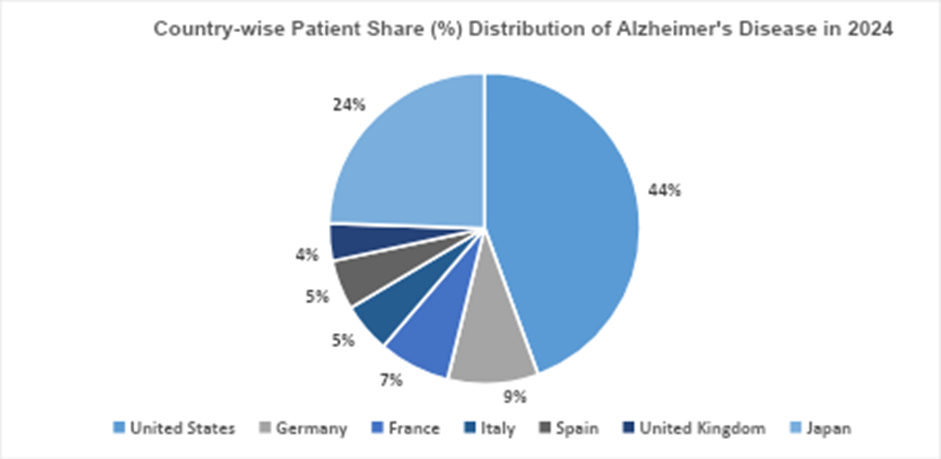
- In 2024, the US accounted for about 44% of diagnosed Alzheimer’s disease cases across the 7MM, totalling around 7 million cases. DelveInsight forecasts a rise in this figure by 2034, reflecting the growing burden of the disease. This trend underscores the increasing healthcare challenge posed by Alzheimer’s in the US during the forecast period.
- In the US, age-specific cases are divided into four groups: under 65, 65–74, 75–84, and 85+ years. In 2024, the under-65 group had nearly 180 thousand cases, while the 65–74 group recorded around 1.6 million cases. The 75–84 group had nearly 3 million cases, and the 85+ group also reported around 2.5 million cases.
- Alzheimer’s disease is also classified by severity: mild cognitive impairment (MCI), mild, moderate, and severe dementia. Within EU4 and the UK, the MCI stage had the highest prevalence with around 2.6 million cases in 2024, while severe dementia showed the lowest with around 650 thousand cases.
- In Germany, the genotype-specific diagnosed prevalent cases of Alzheimer’s disease include homozygous, heterozygous, and non-carrier cases, with cases around 180, 790, and 560 thousand, respectively.
- In France, around 5 million people have preclinical Alzheimer's disease, showing early brain changes without noticeable symptoms.
- In 2024, Spain documented approximately 460 thousand diagnosed cases of agitation linked to Alzheimer’s disease, with projections indicating a continued rise by 2034. This growing prevalence highlights the escalating need for targeted interventions to manage agitation symptoms in Alzheimer’s patients, addressing both psychological and behavioral aspects of the disease.
- In the assessment done by DelveInsight, the estimated total diagnosed prevalent cases of Alzheimer’s disease in Japan was nearly 4 million in 2024.
- In 2024, Japan recorded nearly 1.4 million diagnosed cases of Alzheimer’s disease in males and 2.5 million in females, reflecting a clear gender difference in disease prevalence. This disparity underscores the importance of considering gender-specific factors when addressing Alzheimer’s disease, including tailored treatment and care strategies for male and female patients.
- In Japan, approximately 2 million cases of psychosis related to Alzheimer’s disease were reported in 2024, with the number expected to increase in the coming years. This upward trend emphasizes the growing burden of Alzheimer’s disease-associated psychosis and the need for effective treatments to manage these complex symptoms within the Japanese population.
Latest KOL Views on Alzheimer’s Disease
To gaze into the epidemiology insights of the real world, we take KOLs and SMEs’ opinions working in the domain through primary research to fill the data gaps and validate our secondary research on disease prevalence.
DelveInsight’s analysts connected with 20+ KOLs to gather insights; however, interviews were conducted with 10+ KOLs in the 7MM. Centers such as the Washington University School of Medicine, St. Louis, US; University of Nevada, US; Hannover Medical School, Germany; Universite Paris Saclay, France; Università di Palermo, Italy; Hospital Virgen De La Salud, Spain; University College London, the UK; Kyoto University, Japan and others were contacted. Their opinion helps understand and validate current disease prevalence, gender involved with the disease, diagnosis rate, and diagnostic criteria.
Scope of the Alzheimer’s Disease Report
- The report covers a segment of executive summary, descriptive overview of Alzheimer’s disease, explaining its causes, signs and symptoms, and currently available diagnostic algorithms and guidelines.
- Comprehensive insight has been provided into the epidemiology segments and forecasts, the future growth potential of diagnosis rate, disease progression, and diagnosis guidelines.
- The report provides an edge for understanding trends, expert insights/KOL views, and patient journeys in the 7MM.
- A detailed review of current challenges in establishing the diagnosis.
Alzheimer’s Disease Report Insights
- Patient Population
- Country-wise Epidemiology Distribution
- Total Diagnosed Prevalent Cases of Alzheimer’s Disease
- Total Prevalent Cases of Preclinical Alzheimer’s Disease
- Gender-specific Diagnosed Prevalent Cases of Alzheimer’s Disease
- Age-specific Diagnosed Prevalent Cases of Alzheimer’s Disease
- Severity-specific Diagnosed Prevalent Cases of Alzheimer’s Disease
- Genotype-specific Diagnosed Prevalent Cases of Alzheimer’s Disease
- Diagnosed Prevalent Cases of Agitation in Alzheimer’s Disease
- Diagnosed Prevalent Cases of Psychosis in Alzheimer’s Disease
Alzheimer’s Disease Report Key Strengths
- 10 years Forecast
- The 7MM Coverage
- Alzheimer’s Disease Epidemiology Segmentation
Alzheimer’s Disease Report Assessment
- Current Diagnostic Practices
- Patient Segmentation
Epidemiology Insights
- What are the disease risk, burdens, and unmet needs of Alzheimer’s disease? What will be the growth opportunities across the 7MM concerning the patient population of Alzheimer’s disease?
- What is the historical and forecasted Alzheimer’s disease patient pool in the United States, EU4 (Germany, France, Italy, and Spain) and the United Kingdom, and Japan?
- Why is the diagnosed prevalent cases of Alzheimer’s disease in Japan lower than the US?
- Which country has a high patient share for Alzheimer’s disease?
Reasons to Buy Alzheimer’s Disease Report
- Insights on patient burden/disease, evolution in diagnosis, and factors contributing to the change in the epidemiology of the disease during the forecast years.
- To understand the Alzheimer’s disease prevalence cases in varying geographies over the coming years.
- A detailed overview of Gender and Age-specific diagnosed prevalence of Alzheimer’s Disease, along with diagnosed prevalence of Alzheimer’s Disease Based on severity and genotype.
- To understand the perspective of key opinion leaders around the current challenges with establishing the diagnosis options.
- Detailed insights on various factors hampering disease diagnosis and other existing diagnostic challenges.
Frequently Asked Questions
1. What is the forecast period covered in the report?
The Alzheimer’s disease Epidemiology report for the 7MM covers the forecast period from 2025 to 2034, providing a projection of epidemiology dynamics and trends during this timeframe.
2. Out of all EU4 countries and the UK, which country had the highest population of Alzheimer’s disease cases in 2024?
The highest cases of Alzheimer’s disease was found in the Germany among EU4 and the UK in 2024.
3. How is epidemiological data collected and analyzed for forecasting purposes?
Epidemiological data is collected through surveys, clinical studies, health records, and other sources. It is then analyzed to calculate disease rates, identify trends, and project future disease burdens using mathematical models.
4. Out of all 7MM countries, which country had the highest population of Alzheimer’s disease cases in 2024?
The highest cases of Alzheimer’s disease were found in the US among the 7MM in 2024