
Amifampridine Market Summary
Key Factors Driving Amifampridine Growth
1. Market Share Gains and New Patient Starts
- Amifampridine (marketed as FIRDAPSE by Catalyst Pharmaceuticals and Ruzurgi by SERB) is the standard-of-care symptomatic therapy for Lambert–Eaton Myasthenic Syndrome (LEMS).
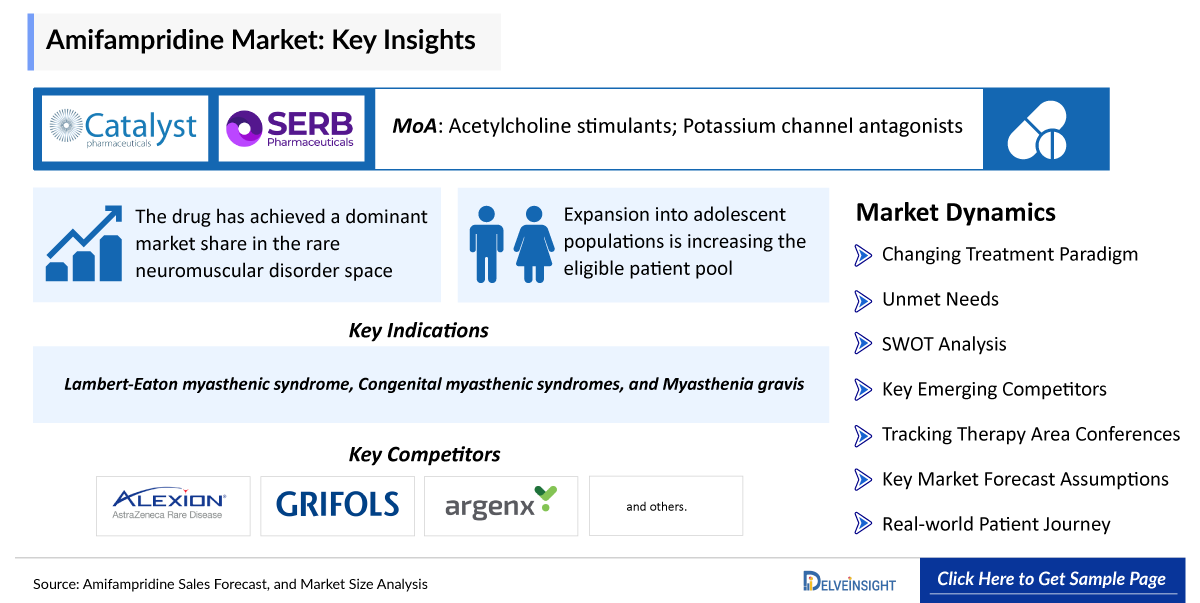
- The drug has achieved dominant market share in the rare neuromuscular disorder space, driven by regulatory exclusivity, strong specialist adoption, and limited therapeutic alternatives.
- Rising diagnostic rates for LEMS and increased neurologist awareness are contributing to steady growth in new patient starts, particularly in the U.S. and Europe.
2. Expansion Across Key Indications
- Lambert–Eaton Myasthenic Syndrome (LEMS): Amifampridine significantly improves neuromuscular transmission, leading to better muscle strength and functional outcomes.
- Pediatric LEMS (where approved): Expansion into adolescent populations is increasing the eligible patient pool.
- Other presynaptic neuromuscular disorders: Investigator-initiated studies continue to explore off-label and pipeline applications, sustaining clinical interest.
3. Geographic Expansion
- Amifampridine is commercialized across the US, Europe, and select international markets, with strong uptake in specialized neuromuscular centers.
- Europe remains a key growth region, supported by rare-disease reimbursement frameworks and centralized diagnosis networks.
- Market expansion is supported by patient assistance programs, medical education initiatives, and neurologist outreach.
4. New Indication Approvals
- Regulatory agencies have granted orphan drug designations and extended exclusivity for amifampridine in LEMS.
- Expanded labeling in certain regions (e.g., pediatric use) has broadened the treatment-eligible population.
- These regulatory milestones have strengthened the drug’s competitive moat and long-term revenue visibility.
5. Strong Volume Momentum
- Prescription volumes remain stable-to-growing in rare disease neurology clinics due to long-term treatment dependency.
- Continued real-world use confirms sustained improvements in mobility, strength, and quality of life, supporting high therapy persistence.
- Growing referral patterns from oncologists (for paraneoplastic LEMS) are also supporting patient flow.
6. Competitive Differentiation and Market Trends
- Amifampridine is an oral, small-molecule potassium channel blocker, offering convenience compared with IV or immunotherapy-based approaches.
- Its targeted symptomatic mechanism provides rapid functional improvement, making it indispensable in LEMS management.
- Broader trends toward rare-disease specialization, orphan drug incentives, and real-world outcome tracking continue to support its positioning.
- Increasing reliance on real-world evidence (RWE) is reinforcing payer and prescriber confidence.
Amifampridine Recent Developments
- Catalyst Pharmaceuticals has continued to report strong commercial performance for FIRDAPSE, driven by stable demand in the US LEMS market and expanded patient support programs. The company has invested in long-term safety registries and post-marketing studies, reinforcing clinical confidence. In parallel, global rare-disease company SERB has strengthened European access to Ruzurgi through regulatory harmonization and distribution partnerships. Continued attention to neuromuscular rare diseases and orphan drug policy support has sustained long-term growth expectations for the amifampridine franchise.
“Amifampridine Sales Forecast, and Market Size Analysis – 2034” report provides comprehensive insights of Amifampridine for approved indication like Lambert-Eaton myasthenic syndrome; as well as potential indications like Congenital myasthenic syndromes and Myasthenia gravis in the 7MM. A detailed picture of Amifampridine’s existing usage in approved and anticipated entry and performance in potential indications in the 7MM, i.e., the United States, EU4 (Germany, France, Italy, and Spain) and the United Kingdom, and Japan for the study period 2020 –2034 is provided in this report along with a detailed description of the Amifampridine for approved and potential indications. The Amifampridine market report provides insights about Amifampridine’s sales forecast, mechanism of action (MoA), dosage and administration, as well as research and development including regulatory milestones, along with other developmental activities. Further, it also consists of historical and current Amifampridine performance, future market assessments inclusive of the Amifampridine market forecast analysis for approved and potential indications in the 7MM, SWOT, analysts’ views, comprehensive overview of market competitors, and brief about other emerging therapies in respective indications. It also provides analysis of Amifampridine sales forecasts, along with factors driving its market.
Amifampridine Drug Summary
Amifampridine (FIRDAPSE) is a potassium channel blocker approved for treating Lambert-Eaton myasthenic syndrome (LEMS) in adults and pediatric patients aged 6 years and older, a rare autoimmune disorder often paraneoplastic with small-cell lung cancer where autoantibodies target presynaptic voltage-gated calcium channels (VGCCs) at neuromuscular junctions, reducing acetylcholine release and causing proximal muscle weakness, fatigue, autonomic dysfunction (dry mouth, impotence), and reduced reflexes that improve post-exercise. By selectively blocking voltage-dependent potassium channels on motor nerve terminals, it prolongs the presynaptic action potential duration, enhances calcium influx through residual VGCCs, increases acetylcholine vesicle release and quantal content, thereby improving neuromuscular transmission, muscle strength (e.g., QMG and SG scores improved by 3-5 points in trials), and functional status without affecting underlying autoimmunity. Administered orally as 10 mg film-coated tablets starting at 15-30 mg/day in divided doses (max 80 mg/day, titrated based on response and tolerability), with common side effects including paresthesia, upper respiratory infection, abdominal pain, nausea, diarrhea, headache, and elevated liver enzymes; contraindicated in seizure history due to proconvulsant risk, requiring ECG monitoring in cardiac conditions. The report provides Amifampridine’s sales, growth barriers and drivers, post usage and approvals in multiple indications.
Scope of the Amifampridine Market Report
The report provides insights into:
- A comprehensive product overview including the Amifampridine MoA, description, dosage and administration, research and development activities in approved indications like Lambert-Eaton myasthenic syndrome; as well as potential indications like Congenital myasthenic syndromes and Myasthenia gravis.
- Elaborated details on Amifampridine regulatory milestones and other development activities have been provided in Amifampridine market report.
- The report also highlights Amifampridine‘s cost estimates and regional variations, reported and estimated sales performance, research and development activities in approved and potential indications across the United States, Europe, and Japan.
- The Amifampridine market report also covers the patents information, generic entry and impact on cost cut.
- The Amifampridine market report contains current and forecasted Amifampridine sales for approved and potential indications till 2034.
- Comprehensive coverage of the late-stage emerging therapies for respective indications.
- The Amifampridine market report also features the SWOT analysis with analyst views for Amifampridine in approved and potential indications.
Methodology
The Amifampridine market report is built using data and information sourced primarily from internal databases, primary and secondary research and in-house analysis by DelveInsight’s team of industry experts. Information and data from the secondary sources have been obtained from various printable and nonprintable sources like search engines, news websites, global regulatory authorities websites, trade journals, white papers, magazines, books, trade associations, industry associations, industry portals and access to available databases.
Amifampridine Analytical Perspective by DelveInsight
In-depth Amifampridine Market Assessment
This Amifampridine sales market forecast report provides a detailed market assessment of Amifampridine for approved indication like Lambert-Eaton myasthenic syndrome; as well as potential indications like Congenital myasthenic syndromes and Myasthenia gravis in the seven major markets, i.e., the United States, EU4 (Germany, France, Italy, and Spain) and the United Kingdom, and Japan. This segment of the report provides current and forecasted Amifampridine sales data uptil 2034.
Amifampridine Clinical Assessment
The Amifampridine market report provides the clinical trials information of Amifampridine for approved and potential indications covering trial interventions, trial conditions, trial status, start and completion dates.
Amifampridine Competitive Landscape
The report provides Insights on competitors and marketed products within the domain, along with a summary of emerging products and their respective launch dates, posing significant competition in the market.
Amifampridine Market Potential & Revenue Forecast
- Projected market size for the Amifampridine and its key indications
- Estimated Amifampridine sales potential (Amifampridine peak sales forecasts)
- Amifampridine Pricing strategies and reimbursement landscape
Amifampridine Competitive Intelligence
- Number of competing drugs in development (pipeline analysis)
- Amifampridine Market positioning compared to existing treatments
- Amifampridine Strengths & weaknesses relative to competitors
Amifampridine Regulatory & Commercial Milestones
- Amifampridine Key regulatory approvals & expected launch timelines
- Commercial partnerships, licensing deals, and M&A activity
Amifampridine Clinical Differentiation
- Amifampridine Efficacy & safety advantages over existing drugs
- Amifampridine Unique selling points
Amifampridine Market Report Highlights
- In the coming years, the Amifampridine market scenario is set to change due to strong adoption, increased prescriptions and broader uptake in multiple immunological indications; which would expand the size of the market.
- The Amifampridine companies are developing therapies that focus on novel approaches to treat/improve the disease condition, assess challenges, and seek opportunities that could influence Amifampridine’s dominance.
- Other emerging products for Lambert-Eaton myasthenic syndrome; as well as potential indications like Congenital myasthenic syndromes and Myasthenia gravis are expected to give tough market competition to Amifampridine and launch of late-stage emerging therapies in the near future will significantly impact the market.
- A detailed description of regulatory milestones, and developmental activities, provide the current development scenario of Amifampridine in approved and potential indications.
- Analyse Amifampridine cost, pricing trends and market positioning to support strategic decision-making in the immunology landscape.
- Our in-depth analysis of the forecasted Amifampridine sales data uptil 2034 will support the clients in decision-making process regarding their therapeutic portfolio by identifying the overall scenario of Amifampridine in approved and potential indications.
Key Questions Answered In The Amifampridine Market Report:
- What is the class of therapy, route of administration and mechanism of action of Amifampridine? How strong is Amifampridine’s clinical and commercial performance?
- What is Amifampridine’s clinical trial status in each individual indications such as Lambert-Eaton myasthenic syndrome; as well as potential indications like Congenital myasthenic syndromes and Myasthenia gravis and study completion date?
- What are the key collaborations, mergers and acquisitions, licensing and other activities related to the Amifampridine Manufacturers?
- What are the key designations that have been granted to Amifampridine for approved and potential indications? How are they going to impact Amifampridine’s penetration in various geographies?
- What is the current and forecasted Amifampridine market scenario for approved and potential indications? What are the key assumptions behind the forecast?
- What are the current and forecasted sales of Amifampridine in the seven major countries, including the United States, Europe (Germany, France, Italy, Spain) and the United Kingdom, and Japan?
- What are the other emerging products available and how are these giving competition to Amifampridine for approved and potential indications?
- Which are the late-stage emerging therapies under development for the treatment of approved and potential indications?
- How cost-effective is Amifampridine? What is the duration of therapy and what are the geographical variations in cost per patient?
-Market.png&w=256&q=75)
-Market.png&w=256&q=75)

