
Amylin analogs and Combination therapies Competitive landscape
- The Amylin Analogs and Combination Therapies Competitive Landscape is evolving rapidly, driven by increasing investments in metabolic disease research and the growing demand for innovative obesity and diabetes treatments.
- The leading Amylin Analogs and Combination Therapies Companies include AstraZeneca, Novo Nordisk, Zealend Pharma, AbbVie Inc., Verdiva Bio Limited, Ascletis Pharma, Eli Lilly and company, Sciwind Biosciences, Structure Therapeutics, Inc., KeyBioscience AG, Viking Therapeutics, F. Hoffmann-La Roche Ltd, and others.
Request for Unlocking the Sample Page of the “Amylin Analogs and Combination Therapies Report”
Key Factors Driving the Growth of the Amylin Analogs and Combination Therapies Competitive Landscape
-
Rising Burden of Obesity and Type 2 Diabetes
The increasing prevalence of obesity and type 2 diabetes worldwide is fueling the demand for innovative therapies that provide effective weight management and glycemic control. This growing patient population is encouraging companies to expand their amylin analog and combination therapy pipelines.
-
Growing Preference for Combination Therapies
The shift toward combination therapies, particularly those integrating amylin analogs with GLP-1 receptor agonists and other metabolic targets, is driving competitive activity. These therapies offer the potential for improved efficacy, better metabolic outcomes, and enhanced patient adherence compared to monotherapies.
-
Advancements in Peptide Engineering and Drug Delivery
Innovations in peptide design, formulation technologies, and long-acting drug delivery systems are enhancing the efficacy, safety, and convenience of amylin analog therapies. These technological advancements are enabling the development of differentiated products and intensifying market competition.
-
Expanding Clinical Pipeline and Positive Trial Outcomes
A growing number of pipeline candidates progressing through clinical development, coupled with encouraging efficacy and safety data, is boosting confidence among investors, developers, and healthcare providers. Positive clinical outcomes continue to attract new entrants and increase competitive intensity.
-
Rising Focus on Precision Medicine
The growing emphasis on personalized treatment approaches for metabolic disorders is encouraging the development of targeted combination therapies that address multiple disease pathways, creating new opportunities for innovation and market expansion.
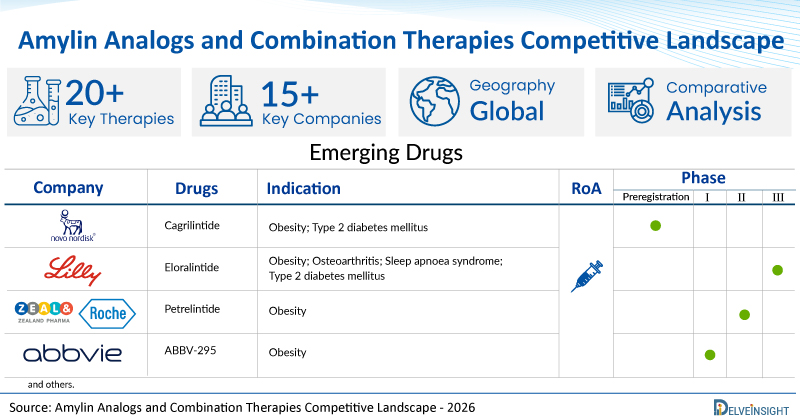
DelveInsight’s “Amylin analogs and Combination therapies Competitive landscape 2026” report provides comprehensive insights about 15+ companies and 20+ drugs in the Amylin analogs and Combination therapies Competitive landscape. It covers the therapeutics assessment by product type, stage, route of administration, and molecule type. It further highlights the inactive pipeline products in this space.
Geography Covered
- Global coverage
Amylin analogs and Combination Therapies Disease Understanding
Amylin analogs and Combination Therapies Overview
Amylin, also known as islet amyloid polypeptide (IAPP), is a 37-amino acid peptide hormone co-secreted with insulin by the pancreatic beta cells in response to nutrient ingestion. It plays a multifaceted role in glucose homeostasis by slowing gastric emptying, suppressing postprandial glucagon secretion, and promoting satiety through central nervous system pathways — particularly via receptors in the area postrema and hypothalamus.
Together, these actions complement insulin's effects and help regulate the rate at which glucose enters the bloodstream following a meal, making amylin an important, though often overlooked, component of normal metabolic physiology.
In individuals with Type 1 diabetes, amylin is virtually absent due to the autoimmune destruction of beta cells, while in Type 2 diabetes, amylin secretion is markedly reduced and its function is further impaired. This deficiency contributes to unregulated postprandial glucose excursions, inappropriate glucagon release, accelerated gastric emptying, and impaired satiety signaling all of which exacerbate glycemic instability and promote weight gain.
The recognition of amylin deficiency as a distinct pathophysiological component of diabetes has provided a compelling rationale for therapeutic replacement through pharmacological analogs.
Amylin analogs exert their effects by binding to amylin receptors, which are heterodimeric complexes formed by the calcitonin receptor and receptor activity-modifying proteins (RAMPs 1, 2, or 3). Activation of these receptors, particularly in the brainstem and hypothalamus, triggers signaling cascades that suppress glucagon secretion from pancreatic alpha cells, delay gastric emptying to blunt postprandial glucose peaks, and reduce food intake by enhancing feelings of fullness.
The net result is a coordinated dampening of postprandial hyperglycemia alongside a reduction in caloric consumption, distinguishing amylin analogs from purely insulin-centric approaches to glucose management.
No single hormonal pathway fully addresses the complexity of metabolic dysregulation seen in diabetes and obesity, which has spurred interest in combining amylin analogs with other agents that target complementary mechanisms. GLP-1 receptor agonists, for instance, reduce appetite and improve insulin secretion but do not fully replicate amylin's postprandial glucagon suppression or gastric emptying effects.
By pairing amylin analogs with GLP-1 RAs, insulin, or GIP agonists, clinicians and researchers aim to achieve synergistic improvements in glycemic control and body weight reduction that surpass what either agent can deliver alone, while potentially allowing dose reductions that improve tolerability.
Clinical investigations into amylin analog-based combinations have consistently demonstrated meaningful improvements across key metabolic parameters, including reductions in HbA1c, fasting glucose, postprandial glucose excursions, and body weight. These benefits have generally exceeded those observed with monotherapy, supporting the hypothesis that targeting multiple hormonal pathways simultaneously yields additive or synergistic outcomes.
Importantly, the degree of weight loss observed in several combination trials has been particularly notable, positioning amylin-based regimens as promising options not only for glycemic management but also for the broader treatment of obesity and cardiometabolic risk.
Amylin analogs and Combination therapies Pipeline Report Highlights
- In March 2026, Roche announced positive topline results from the Phase II ZUPREME-1 trial evaluating investigational petrelintide (a amylin analog) versus placebo in 493 people living with overweight and obesity in a gender-balanced trial population.
- In March 2026, Ascletis Pharma Inc. announced that it has selected ASC39, a potent and amylin-selective oral small molecule amylin receptor agonist, as a clinical development candidate. Ascletis expects to submit an Investigational New Drug Application (IND) to the US Food and Drug Administration (FDA) for ASC39 oral tablets for the treatment of obesity in the third quarter of 2026.
- In December 2025, Novo Nordisk announced the submission of a New Drug Application (NDA) to the U.S. Food and Drug Administration (FDA) for once-weekly CagriSema (cagrilintide 2.4 mg and semaglutide 2.4 mg) injection, to be used with a reduced-calorie diet and increased physical activity, to reduce excess body weight and maintain weight reduction long term in adults with obesity or overweight in the presence of at least one weight-related comorbid condition.If approved, CagriSema would become the first injectable GLP-1 receptor agonist and amylin analogue combination treatment.
- In December 2025, Structure Therapeutics Inc. announced that it has initiated a first-in-human Phase I clinical study of ACCG-2671, the company’s lead oral small molecule amylin receptor agonist for the treatment of obesity. ACCG-2671 was designed via the company’s next generation structure-based drug discovery platform to harness the established metabolic benefits of amylin biology in an oral, once-daily small molecule, with the potential to improve scalability, combinability, and patient access.
- In November 2025, Eli Lilly and Company announced positive results from a Phase II trial evaluating the safety and efficacy of eloralintide, an investigational once-weekly, selective amylin receptor agonist, in 263 adults with obesity or overweight with at least one obesity-related comorbidity and without type 2 diabetes.
- In November 2025, Pfizer completed its acquisition of Metsera for roughly USD 7 billion, securing a portfolio of next-generation obesity treatments. Key to this deal is MET-233i, a monthly, ultra-long-acting amylin analog, which early studies suggest could offer superior and faster weight loss compared to existing therapies.
- In June 2025, Verdiva Bio announced preclinical data for VRB-103, its investigational once-weekly oral amylin analog, at the American Diabetes Association (ADA) 85th Scientific Sessions. The data demonstrated that VRB-103 showed efficacy as a monotherapy and produced additive body weight reduction when combined with VRB-101, the company’s oral GLP-1 receptor agonist candidate, in preclinical in vivo models.
- In March 2025, AbbVie and Gubra A/S announced a license agreement to develop GUB014295, a potential best-in-class, long-acting amylin analog for the treatment of obesity.
- In March 2025, Roche announced that it has entered into an exclusive collaboration and licensing agreement with Zealand Pharm. Under the terms of this agreement, the two companies will collaborate to co-develop and co-commercialise petrelintide, Zealand Pharma’s amylin analog as a standalone therapy as well as a fixed-dose combination with Roche’s lead incretin asset CT-388.
- In January 2025, Hangzhou Sciwind Biosciences Co. announced a licensing and collaboration agreement for the global development and commercialization of a portfolio of metabolic diseases therapies in territories outside of Greater China and South Korea, with Verdiva Bio Limited, a clinical-stage biopharmaceutical company specialized in developing innovative treatments for obesity and other cardiometabolic disorders.
Amylin analogs and Combination Therapies: Company and Product Profiles (Marketed Therapies)
1. Company Overview: AstraZeneca
AstraZeneca is a global biopharmaceutical company focused on the discovery, development, and commercialization of prescription medicines across major therapeutic areas including oncology, cardiovascular, renal and metabolism, respiratory and immunology, rare diseases, and vaccines.
Headquartered in Cambridge, United Kingdom, the company operates in more than 100 countries and has a strong research-driven approach centered on innovative science and advanced therapeutic platforms. AstraZeneca is recognized for its extensive portfolio of biologics, small molecules, and precision medicines, with leading products in cancer and chronic disease management
Product Description: Symlin (pramlintide)
Pramlintide is a synthetic amylin analog approved for the management of type 1 and type 2 diabetes mellitus as an adjunct to mealtime insulin therapy. The drug was developed to mimic the activity of amylin, a naturally occurring hormone co-secreted with insulin by pancreatic beta cells that is deficient in individuals with diabetes.
Pramlintide acts by activating amylin receptors, leading to delayed gastric emptying, suppression of postprandial glucagon secretion, and increased satiety, which together help improve post-meal glucose control. Marketed under the brand name Symlin, the drug is administered through subcutaneous injection prior to meals.
Amylin analogs and Combination therapies: Company and Product Profiles (Pipeline Therapies)
1. Company Overview: Novo Nordisk
Novo Nordisk is a global healthcare and pharmaceutical company headquartered in Bagsværd, primarily focused on the development and commercialization of therapies for diabetes, obesity, rare endocrine disorders, and other chronic diseases. Founded in 1923, the company has established itself as one of the world’s leading producers of insulin and metabolic disease treatments.
The company has played a significant role in advancing amylin-based therapeutics through the development of next-generation amylin analogs designed to improve appetite regulation, satiety, and body weight management. By leveraging its expertise in peptide engineering and metabolic biology, Novo Nordisk has expanded its pipeline to include long-acting amylin analog candidate which are being investigated for obesity and related metabolic disorders.
Product Description: Cagrilintide
Cagrilintide is a once-weekly long-acting amylin analog developed for the management of obesity and other metabolic disorders. It is structurally engineered to mimic the physiological actions of the endogenous hormone amylin, which is normally co-secreted with insulin from pancreatic β-cells.
Amylin plays an important role in energy balance by regulating appetite, promoting satiety, slowing gastric emptying, and reducing postprandial glucagon secretion. Cagrilintide has been modified to extend its half-life, enabling prolonged receptor activation and convenient once-weekly administration.
Pharmacologically, the drug acts as an agonist at amylin receptors as well as calcitonin receptors, contributing to appetite suppression and reduced caloric intake. The drug is currently in the preregistration stage of development for the treatment of Obesity.
2. Company Overview: Zealand Pharma/ F. Hoffmann-La Roche Ltd.
Zealand Pharma and Roche are collaboratively developing Petrelintide as part of their strategic partnership focused on next-generation obesity and metabolic disease therapies. Zealand Pharma, a Denmark-based biotechnology company, specializes in the discovery and development of peptide-based medicines targeting metabolic and gastrointestinal disorders, with expertise in peptide engineering and hormone analog development.
The company originated Petrelintide as a long-acting amylin analog designed for chronic weight management. Roche, a global healthcare and pharmaceutical leader headquartered in Switzerland, is recognized for its broad portfolio across pharmaceuticals and diagnostics, with increasing investment in obesity and cardiometabolic diseases.
Product Description: Petrelintide
Petrelintide is a long-acting amylin analog designed for the treatment of obesity and overweight. The drug mimics the action of amylin, a naturally occurring pancreatic hormone that is co-secreted with insulin after food intake and plays an important role in regulating satiety and energy balance. The drug acts primarily by activating amylin receptors, leading to increased feelings of fullness, reduced appetite, slower gastric emptying, and lower caloric intake. Unlike GLP-1 receptor agonists, which mainly suppress appetite through incretin pathways, Petrelintide works through the amylin signaling pathway and may also help restore leptin sensitivity, thereby enhancing weight regulation. The drug is currently in Phase III stage of development for the treatment of Obesity.
3. Company Overview: AbbVie
AbbVie is a global biopharmaceutical company headquartered in North Chicago, Illinois, United States, focused on the discovery, development, and commercialization of innovative medicines and therapies across multiple therapeutic areas. Established in 2013 as a spin-off from Abbott Laboratories, AbbVie has built a strong portfolio in immunology, oncology, neuroscience, aesthetics, and eye care.
The company is widely recognized for developing blockbuster therapies such as Humira, Skyrizi, Rinvoq, and Botox through its acquisition of Allergan. In recent years, AbbVie has expanded its research efforts into metabolic diseases and obesity, including the development of novel amylin-based therapies
Product Description: ABBV-295
ABBV-295 is a long-acting amylin analog and acts as an agonist of amylin and calcitonin receptors, mimicking the effects of the natural satiety hormone amylin to suppress appetite, reduce food intake, and delay gastric emptying. The drug represents a non-incretin mechanism for chronic weight management.
The drug was originally discovered by Gubra as GUB014295 and was licensed to AbbVie in 2025 as part of the company’s expansion into the obesity therapeutics field. The drug is currently in Phase I stage of development for the treatment of Obesity.
4. Company Overview: Verdiva Bio Limited
Verdivia Bio limited is a clinical-stage biopharmaceutical company focused on developing next-generation therapies for obesity, cardiometabolic disorders, and related metabolic complications. Headquartered in London and San Francisco, the company is advancing a portfolio of oral and injectable peptide-based therapies with potential first-in-class or best-in-class profiles. Verdiva’s pipeline includes once-weekly oral GLP-1 and amylin-based therapies designed to improve efficacy, tolerability, patient convenience, and long-term weight management.
The company utilizes proprietary oral delivery technology to support less frequent dosing and scalable manufacturing. Verdiva was launched in 2025 with over USD 410 million in Series A financing and acquired global development and commercialization rights outside Greater China and South Korea for several metabolic disease assets from Sciwind Biosciences.
Product Description: VRB-101 + VRB-103
VRB-101 + VRB-103 is an investigational oral combination therapy being developed for the treatment of obesity and cardiometabolic disorders. The therapy combines VRB-103, a potentially once-weekly oral amylin analog, with VRB-101, a once-weekly oral GLP-1 peptide analog, to target complementary metabolic pathways involved in appetite regulation and weight management.
The company has also stated that the combination is being developed as a co-formulated single-tablet oral therapy utilizing the company’s proprietary oral delivery technology, T2026, which is designed to enable systemic absorption of peptide-based medicines through convenient once-weekly oral administration. The therapy is currently in Preclinical stage of development for the treatment of Obesity.
Further product details are provided in the report……..
Amylin analogs and Combination therapies Analytical Perspective by DelveInsight
-
In-depth Commercial Assessment: Amylin analogs and Combination therapies Collaboration Analysis by Companies
The Report provides in-depth commercial assessment of drugs that have been included, which comprises collaboration, agreement, licensing and acquisition – deals values trends. The sub-segmentation is described in the report which provide company-company collaboration (licensing/partnering), company academic collaboration and acquisition analysis in tabulated form.
Amylin analogs and Combination Therapies Competitive Landscape
The Amylin Analogs and Combination Therapies competitive landscape report comprises a comparative assessment of Companies (by therapy, development stage, and technology).
Amylin analogs and Combination therapies Report Assessment
- Company Analysis
- Therapeutic Assessment
- Pipeline Assessment
- Inactive drugs assessment
- Unmet Needs
Key Questions Answered In The Amylin analogs and Combination therapies Pipeline Report
Current Amylin Analogs and Combination Therapies Treatment Scenario and Emerging Therapies:
- How many companies are developing Amylin analogs and combination therapy drugs?
- How many Amylin analogs and Combination therapies drugs are developed by each company?
- How many emerging drugs are in mid-stage, and late-stage of development for the treatment of Amylin analogs and Combination therapies?
- What are the key collaborations (Industry–Industry, Industry–Academia), Mergers and acquisitions, licensing activities related to the Amylin analogs and Combination therapies therapeutics?
- What are the recent trends, drug types and novel technologies developed to overcome the limitation of existing therapies?
- What are the clinical studies going on for Amylin analogs and Combination therapies and their status?
- What are the key designations that have been granted to the emerging and approved drugs?
Amylin analogs and Combination Therapies Companies
- AstraZeneca
- Novo Nordisk
- Zealend pharma
- AbbVie Inc.
- Verdiva Bio Limited
- Ascletis Pharma
- Eli Lilly and company
- Sciwind Biosciences
- Structure Therapeutics, Inc.
- KeyBioscience AG
- Viking Therapeutics
- F. Hoffmann-La Roche Ltd.
Amylin analogs and Combination therapies Key Products
- Symlin (pramlintide)
- Cagrilintide
- Petrelintide
- ABBV-295
- VRB-101 + VRB-103
- ASC 39
- Eloralintide
- XW015
- ACCG-3535
- KBP-336
- VK3019
- CagriSema
- NN9638 ( Amylin 355)
- NN9839(Amylin 1213)
- Zenagamtide
Stay updated with us for Recent Articles @ New DelveInsight Blogs

