ANCA Vasculitis Pipeline
DelveInsight’s, “ANCA Vasculitis Pipeline Insight, 2026” report provides comprehensive insights about 12+ companies and 12+ pipeline drugs in ANCA Vasculitis pipeline landscape. It covers the pipeline drug profiles, including clinical and nonclinical stage products. It also covers the therapeutics assessment by product type, stage, route of administration, and molecule type. It further highlights the inactive pipeline products in this space.
Geography Covered
- Global coverage
ANCA Vasculitis Understanding
ANCA Vasculitis Overview
Antineutrophilic cytoplasmic antibody (ANCA) associated Vasculitis are a heterogeneous group of rare autoimmune conditions that causes an inflammation of blood vessels with various manifestations. It includes three main diseases, which are granulomatosis with polyangiitis (GPA; formerly known as Wegener granulomatosis), eosinophilic granulomatosis with polyangiitis (EGPA; previously known as Churg-Strauss syndrome), and microscopic polyangiitis (MPA). Other ANCA-associated diseases are drug-induced vasculitis and renal limited vasculitis.
Signs and symptoms of ANCA vasculitis include fatigue, fever, weight loss, and muscle or joint pain. It can cause specific organ involvement, leading to respiratory issues like cough or shortness of breath and kidney problems such as blood in the urine. Skin manifestations, including rashes or ulcers, may also occur. Additionally, patients may experience nerve damage, resulting in numbness or weakness, and gastrointestinal symptoms like abdominal pain or diarrhea.
It is still unknown how the antineutrophilic cytoplasmic antibody (ANCA) antibodies develop. Some studies suggest a genetic role. In two studies, there was an association between the anti-PR3-ANCA and HLA-DP, PRTN3 (the gene encoding proteinase-3), and anti-MPO ANCA was associated mainly with HLA-DQ polymorphisms. Some studies link the development of ANCA antibodies to environmental causes or infections, proposing the molecular mimicry model. In vitro studies showed that neutrophils are initially primed (partially stimulated) with TNF-alpha, lipopolysaccharide (LPS), or complement (C5a), then it will be activated once it is bound to the ANCA. After activation, it will degranulate and mediate endothelial cell damage. The diagnosis of vasculitis needs a high index of suspicion because of the rarity of the disease and the multisystemic nature of vasculitis. A detailed history and physical examination are key in the management of vasculitis. A complete workup is required to establish the diagnosis, rule out other causes, and evaluate the severity of the disease and organ involvement. To establish the diagnosis, a combination of clinical assessment with serological testing is needed, and a tissue biopsy many times confirms the diagnosis.
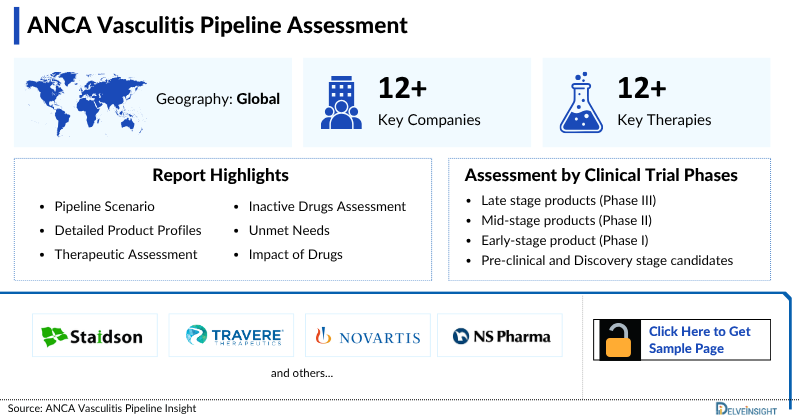
"ANCA Vasculitis Pipeline Insight, 2026" report by DelveInsight outlays comprehensive insights of present scenario and growth prospects across the indication. A detailed picture of the ANCA Vasculitis pipeline landscape is provided which includes the disease overview and ANCA Vasculitis treatment guidelines. The assessment part of the report embraces, in depth ANCA Vasculitis commercial assessment and clinical assessment of the pipeline products under development. In the report, detailed description of the drug is given which includes mechanism of action of the drug, clinical studies, NDA approvals (if any), and product development activities comprising the technology, ANCA Vasculitis collaborations, licensing, mergers and acquisition, funding, designations and other product related details.
ANCA Vasculitis Pipeline Report Highlights
The companies and academics are working to assess challenges and seek opportunities that could influence ANCA Vasculitis R&D. The therapies under development are focused on novel approaches to treat/improve ANCA Vasculitis.
ANCA Vasculitis Emerging Drugs Analysis
This segment of the ANCA Vasculitis report encloses its detailed analysis of various drugs in different stages of clinical development, including phase III, II, I, preclinical and Discovery. It also helps to understand clinical trial details, expressive pharmacological action, agreements and collaborations, and the latest news and press releases.
ANCA Vasculitis Emerging Drugs
BDB-001: Staidson (Beijing) Biopharmaceutical
BDB-001 is an investigational anti-complement C5a monoclonal antibody being developed by Staidson (Beijing) Biopharmaceuticals for the treatment of ANCA-associated vasculitis (AAV). By selectively neutralizing C5a, a key mediator of complement activation that drives neutrophil priming, inflammation, and vascular injury in AAV, BDB-001 aims to suppress disease activity while potentially reducing patients' dependence on high-dose glucocorticoids. The therapy has previously demonstrated an acceptable safety profile and pharmacodynamic inhibition of circulating C5a in early clinical studies, supporting its continued development. BDB-001 is currently being evaluated in a Phase III for the treatment of ANCA Associated Vasculitis.
Sparsentan: Travere Therapeutics
Sparsentan is a dual endothelin and angiotensin II receptor antagonist used to reduce proteinuria in adults with primary immunoglobulin A nephropathy (IgAN) at risk of rapid disease progression. Sparsentan acts as a dual antagonist of the endothelin type A receptor (ETAR) and the angiotensin II type 1 receptor (AT1R), which are involved in the pathogenesis of IgAN. It selectively blocks the action of endothelin-1 (ET-1) and angiotensin II (Ang II) at their respective receptors, thereby reducing proteinuria. The drug is currently in Phase II of clinical trial evaluation for the treatment of ANCA Associated Vasculitis.
Further product details are provided in the report……..
ANCA Vasculitis Drug Therapeutic Assessment
This segment of the report provides insights about the different ANCA Vasculitis drugs segregated based on following parameters that define the scope of the report, such as:
Major ANCA Vasculitis Players in ANCA Vasculitis
There are approx. 12+ key companies which are developing the therapies for ANCA Vasculitis. The companies which have their ANCA Vasculitis drug candidates in the most advanced stage, i.e. Phase III include,Staidson (Beijing) Biopharmaceutical, and others.
ANCA Vasculitis Clinical Trial Phases
DelveInsight’s report covers around 12+ products under different phases of clinical development like
- Late stage products (Phase III)
- Mid-stage products (Phase II)
- Early-stage product (Phase I) along with the details of
- Pre-clinical and Discovery stage candidates
- Discontinued & Inactive candidates
ANCA Vasculitis Drug Route of Administration
ANCA Vasculitis pipeline report provides the therapeutic assessment of the pipeline drugs by the Route of Administration. Products have been categorized under various ROAs such as
- Oral
- Intravenous
- Subcutaneous
- Parenteral
- Topical
ANCA Vasculitis Product Molecule Type
Products have been categorized under various Molecule types such as
- Recombinant fusion proteins
- Small molecule
- Monoclonal antibody
- Peptide
- Polymer
- Gene therapy
ANCA Vasculitis Product Type
Drugs have been categorized under various product types like Mono, Combination and Mono/Combination.
ANCA Vasculitis Clinical Trial Activities
The ANCA Vasculitis Pipeline report provides insights into different ANCA Vasculitis Clinical Trial within phase III, II, I, preclinical and discovery stage. It also analyses ANCA Vasculitis therapeutic drugs key players involved in developing key drugs.
ANCA Vasculitis Pipeline Development Activities
The ANCA Vasculitis Clinical Trial Analysis report covers the detailed information of collaborations, acquisition and merger, licensing along with a thorough therapeutic assessment of emerging ANCA Vasculitis drugs.
ANCA Vasculitis Report Insights
- ANCA Vasculitis Pipeline Analysis
- ANCA Vasculitis Therapeutic Assessment
- ANCA Vasculitis Unmet Needs
- Impact of ANCA Vasculitis Drugs
ANCA Vasculitis Report Assessment
- ANCA Vasculitis Pipeline Product Profiles
- ANCA Vasculitis Therapeutic Assessment
- ANCA Vasculitis Pipeline Assessment
- ANCA Vasculitis Inactive drugs assessment
- ANCA Vasculitis Market Unmet Needs
Key Questions Answered in the ANCA Vasculitis Pipeline Report
- Current Treatment Scenario and Emerging Therapies:
- How many companies are developing ANCA Vasculitis drugs?
- How many ANCA Vasculitis drugs are developed by each company?
- How many emerging drugs are in mid-stage, and late-stage of development for the treatment of ANCA Vasculitis?
- What are the key collaborations (Industry–Industry, Industry–Academia), Mergers and acquisitions, licensing activities related to the ANCA Vasculitis therapeutics?
- What are the recent trends, drug types and novel technologies developed to overcome the limitation of existing therapies?
- What are the clinical studies going on for ANCA Vasculitis and their status?
- What are the key designations that have been granted to the emerging drugs?
ANCA Vasculitis Key Players
- Staidson (Beijing) Biopharmaceutical
- Travere Therapeutics
- Novartis Pharmaceuticals
- NS Pharma
- Staidson Biopharmaceuticals Co., Ltd
ANCA Vasculitis Key Products
- BDB-001
- Sparsentan
- Iptacopan
- NS-229
- STSA-1002