Androgenetic Alopecia Pipeline
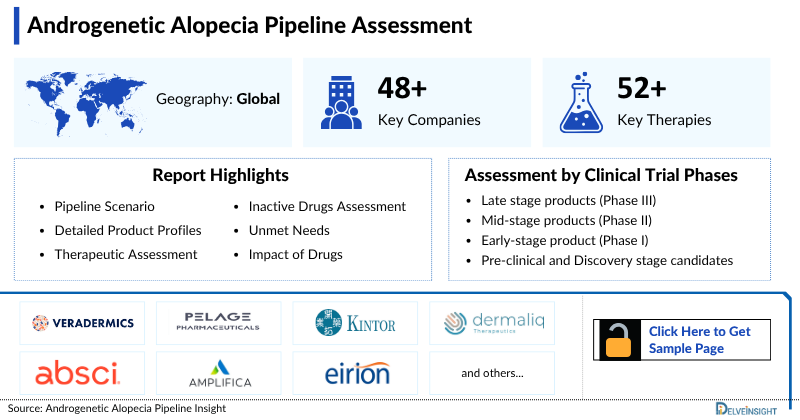
DelveInsight’s, “Androgenetic Alopecia Pipeline Insight, 2026” report provides comprehensive insights about 48+ companies and 52+ pipeline drugs in Androgenetic Alopecia pipeline landscape. It covers the pipeline drug profiles, including clinical and nonclinical stage products. It also covers the therapeutics assessment by product type, stage, route of administration, and molecule type. It further highlights the inactive pipeline products in this space.
Geography Covered
- Global coverage
Androgenetic Alopecia Understanding
Androgenetic Alopecia Overview
Androgenetic alopecia, commonly referred to as male or female pattern baldness, is the most prevalent form of hair loss and is driven by genetic susceptibility and androgen hormones, particularly dihydrotestosterone (DHT). The condition follows characteristic patterns, with frontal hairline recession and crown thinning in men, and diffuse thinning over the central scalp in women. DHT shortens the anagen (growth) phase of the hair cycle, leading to progressive follicular miniaturization. Additional factors such as inflammation, perifollicular fibrosis, and altered follicular metabolism further contribute to disease progression.
Clinically, androgenetic alopecia presents as gradual hair thinning with replacement of thick terminal hairs by finer vellus hairs and increased hair shedding. In men, it typically manifests as bitemporal recession and vertex thinning, while women experience diffuse central thinning with preservation of the frontal hairline. The scalp remains non-scarring with visible follicular openings but reduced hair density. Symptoms are usually asymptomatic, though some individuals may report mild itching or scalp sensitivity.
Diagnosis of Androgenetic alopecia is primarily clinical, based on characteristic patterns of gradual hair thinning along with a relevant family history. In men, it typically presents as frontal hairline recession and vertex thinning, while women show diffuse central scalp thinning with preservation of the frontal hairline. Trichoscopy is commonly used to support diagnosis by revealing variation in hair shaft diameter and miniaturized follicles without signs of scarring. Additional investigations, such as scalp biopsy or laboratory testing, are reserved for atypical presentations or when alternative diagnoses need to be excluded.
Management focuses on slowing disease progression and promoting hair regrowth through a combination of medical and procedural approaches. First-line therapies include topical minoxidil and oral finasteride, often used together for enhanced efficacy. Procedural options such as hair transplantation, platelet-rich plasma therapy, and low-level laser therapy can further improve follicular survival and hair density. Emerging regenerative strategies, including growth factor concentrates and stem cell–based therapies, are under investigation, with optimal outcomes typically achieved through sustained, multimodal treatment approaches.
"Androgenetic Alopecia Pipeline Insight, 2026" report by DelveInsight outlays comprehensive insights of present scenario and growth prospects across the indication. A detailed picture of the Androgenetic Alopecia pipeline landscape is provided which includes the disease overview and Androgenetic Alopecia treatment guidelines. The assessment part of the report embraces, in depth Androgenetic Alopecia commercial assessment and clinical assessment of the pipeline products under development. In the report, detailed description of the drug is given which includes mechanism of action of the drug, clinical studies, NDA approvals (if any), and product development activities comprising the technology, Androgenetic Alopecia collaborations, licensing, mergers and acquisition, funding, designations and other product related details.
Discover the latest Androgenetic Alopecia pipeline insights, emerging therapies, and clinical advancements shaping the future of treatment in 2026.
Androgenetic Alopecia Report Highlights
The companies and academics are working to assess challenges and seek opportunities that could influence Androgenetic Alopecia R&D. The therapies under development are focused on novel approaches to treat/improve Androgenetic Alopecia.
Androgenetic Alopecia Emerging Drugs Analysis
This segment of the Androgenetic Alopecia report encloses its detailed analysis of various drugs in different stages of clinical development, including Phase III, II, I, Preclinical and Discovery. It also helps to understand clinical trial details, expressive pharmacological action, agreements and collaborations, and the latest news and press releases.
Androgenetic Alopecia Emerging Drugs
VDPHL01: Veradermics
VDPHL01 is an investigational, orally administered extended-release minoxidil tablet currently in Phase III development for the treatment of pattern hair loss in both men and women. It is a non-hormonal therapy designed using proprietary extended-release technology to enhance both efficacy and safety. The formulation incorporates a gel matrix system that enables a controlled, sustained release of minoxidil, promoting consistent systemic exposure. This approach helps minimize peak drug concentrations seen with immediate-release formulations while maintaining drug levels above the threshold required for hair growth. If approved, VDPHL01 could become the first FDA-approved oral non-hormonal therapy for pattern hair loss, supported by a strong patent portfolio extending to at least 2043.
PP405: Pelage Pharmaceuticals
PP405 is a novel, non-invasive topical small molecule therapy developed to stimulate hair regrowth by reactivating dormant hair follicle stem cells. It targets key metabolic pathways that control the activation cycles of these stem cells, thereby promoting the transition to active hair growth. Early Phase I clinical data demonstrated that PP405 was well tolerated and achieved statistically significant activation of hair follicle stem cells. The intellectual property for PP405 and related compounds was licensed by Pelage Pharmaceuticals from University of California, Los Angeles in 2018. The therapy is currently being evaluated in Phase II clinical trials for the treatment of Androgenetic Alopecia.
ABS-201: Absci Corp
ABS-201 is an investigational therapeutic being developed for the treatment of Androgenetic Alopecia. It is designed to promote hair regrowth by targeting underlying biological mechanisms involved in follicle miniaturization and hair cycle disruption. The therapy aims to improve hair density and thickness while maintaining a favorable safety profile. ABS-201 is currently under clinical evaluation, reflecting its potential as a novel treatment option for patients with pattern hair loss. Currently, ABS-201 is in Phase I/II stage of its development for Androgenetic Alopecia.
ET-02: Eirion Therapeutics, Inc.
ET-02 is a topical small molecule therapy being developed for the treatment of Androgenetic Alopecia. It utilizes a novel mechanism of action aimed at correcting dysfunction in hair follicle stem cells, which are believed to play a key role in the development of alopecia. By targeting this underlying cause, ET-02 is designed to promote hair regrowth and restore normal follicle function. According to the company’s pipeline the drug is currently in Phase I stage of development.
YR-001: YIRUI Pharmaceutical Technology
YR-001 is an investigational topical therapy being developed for the treatment of Androgenetic Alopecia. It is designed to target potassium channel pathways (Kv1.3), which are implicated in hair follicle function and cycling. By modulating these pathways, YR-001 aims to promote hair regrowth and improve follicle health. The drug is currently under evaluation, highlighting its potential as a novel non-invasive treatment option for pattern hair loss. The drug is in preclinical stage of its development for the treatment of alopecia.
Further product details are provided in the report……..
Androgenetic Alopecia Drug Therapeutic Assessment
This segment of the report provides insights about the different Androgenetic Alopecia drugs segregated based on following parameters that define the scope of the report, such as:
Major Androgenetic Alopecia Players in Androgenetic Alopecia
There are approx. 48+ key companies which are developing the therapies for Androgenetic Alopecia. The companies which have their Androgenetic Alopecia drug candidates in the most advanced stage, i.e. Phase III include, Veradermics.
Androgenetic Alopecia Clinical Trial Phases
DelveInsight’s report covers around 52+ products under different phases of clinical development like
- Late stage products (Phase III)
- Mid-stage products (Phase II)
- Early-stage product (Phase I) along with the details of
- Pre-clinical and Discovery stage candidates
- Discontinued & Inactive candidates
Androgenetic Alopecia Drug Route of Administration
Androgenetic Alopecia pipeline report provides the therapeutic assessment of the pipeline drugs by the Route of Administration. Products have been categorized under various ROAs such as
- Oral
- Intravenous
- Subcutaneous
- Parenteral
- Topical
Androgenetic Alopecia Product Molecule Type
Products have been categorized under various Molecule types such as
- Recombinant fusion proteins
- Small molecule
- Monoclonal antibody
- Peptide
- Polymer
- Gene therapy
Androgenetic Alopecia Product Type
Drugs have been categorized under various product types like Mono, Combination and Mono/Combination.
Androgenetic Alopecia Clinical Trial Activities
The Androgenetic Alopecia Pipeline report provides insights into different Androgenetic Alopecia Clinical Trials within Phase III, II, I, preclinical and discovery stage. It also analyses Androgenetic Alopecia therapeutic drugs key players involved in developing key drugs.
Androgenetic Alopecia Pipeline Development Activities
The Androgenetic Alopecia Clinical Trial Analysis report covers the detailed information of collaborations, acquisition and merger, licensing along with a thorough therapeutic assessment of emerging Androgenetic Alopecia drugs.
Androgenetic Alopecia Pipeline Report Insights
- Androgenetic Alopecia Pipeline Analysis
- Androgenetic Alopecia Therapeutic Assessment
- Androgenetic Alopecia Unmet Needs
- Impact of Androgenetic Alopecia Drugs
Androgenetic Alopecia Pipeline Report Assessment
- Androgenetic Alopecia Pipeline Product Profiles
- Androgenetic Alopecia Therapeutic Assessment
- Androgenetic Alopecia Pipeline Assessment
- Androgenetic Alopecia Inactive drugs assessment
- Androgenetic Alopecia Market Unmet Needs
Discover actionable insights into the Androgenetic Alopecia market trends, epidemiology trends, and forecast through 2034 to stay ahead in emerging therapies.
Key Questions Answered In The Androgenetic Alopecia Pipeline report
- Current Treatment Scenario and Emerging Therapies:
- How many companies are developing Androgenetic Alopecia drugs?
- How many Androgenetic Alopecia drugs are developed by each company?
- How many emerging drugs are in mid-stage, and late-stage of development for the treatment of Androgenetic Alopecia?
- What are the key collaborations (Industry–Industry, Industry–Academia), Mergers and acquisitions, licensing activities related to the Androgenetic Alopecia therapeutics?
- What are the recent trends, drug types and novel technologies developed to overcome the limitation of existing therapies?
- What are the clinical studies going on for Androgenetic Alopecia and their status?
- What are the key designations that have been granted to the emerging drugs?
Androgenetic Alopecia Key Companies
- Veradermics
- Pelage Pharmaceuticals
- Suzhou Kintor Pharmaceuticals
- Dermaliq
- Absci Corp
- YIRUI Pharmaceutical Technology
- Amplifica
- Eirion Therapeutics, Inc.
- BioResearch Pharma S.A.
- AnHorn Medicines Co. Ltd.,
- Triple Hair Group Inc
- Moogene Medi Co., Ltd
- OliX Pharmaceuticals
- Xtressé
- Hope Medicine
Androgenetic Alopecia Key Products
- VDPHL01
- PP405
- GT20029
- DLQ01
- ABS-201
- YR 001
- AMP 601
- ET-02
- BRP-011
- AH-001
- TH07
- AD-303A
- OLX72021
- Xvie
- HMI-115
Explore comprehensive insights into Androgenetic Alopecia epidemiology trends, patient population forecasts, and growth opportunities through 2034 for strategic decision-making.