
Antibacterial Orthopedic Implants Market Summary
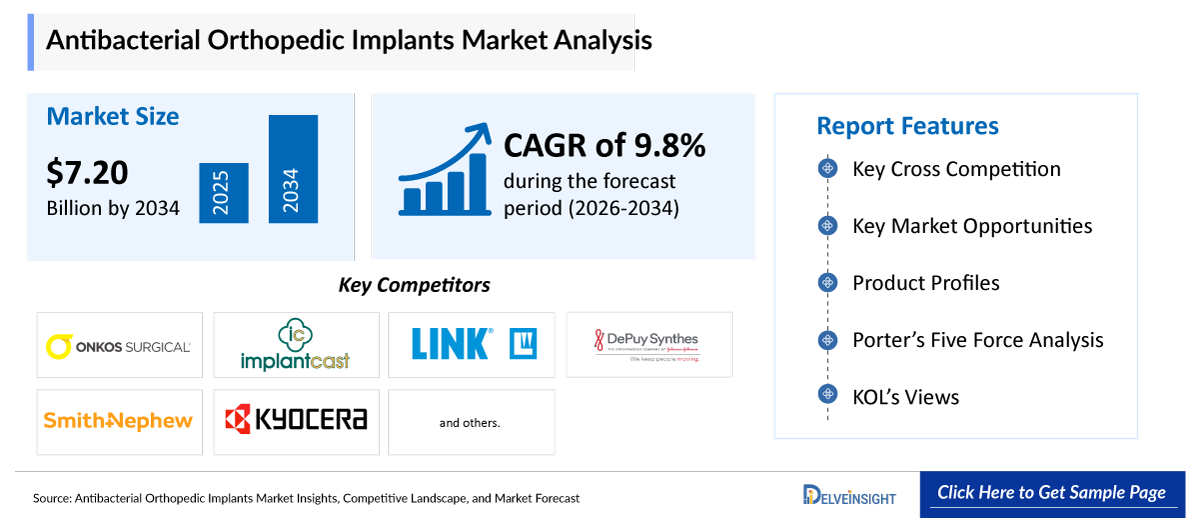
- The Antibacterial Orthopedic Implants market is estimated at USD 3.10 billion in 2025 and is projected to reach USD 7.20 billion by 2034. Growth is anchored in the rising burden of periprosthetic joint infections, the expanding volume of joint replacement and trauma surgeries, and the fast adoption of silver, antibiotic-eluting, and iodine-based coating technologies.
- The global Antibacterial Orthopedic Implants market is growing at a CAGR of 9.8% during the forecast period from 2026 to 2034.
- By product type, the joint replacement implants segment dominated the Antibacterial Orthopedic Implants market with a 54% share in 2025.
- By antibacterial technology, the silver-based coatings segment dominated the Antibacterial Orthopedic Implants market with a 41% share in 2025.
- By material, the titanium segment dominated the Antibacterial Orthopedic Implants market with a 63% share in 2025.
- By end-user, the hospitals & clinics segment dominated the Antibacterial Orthopedic Implants market with a 67% share in 2025.
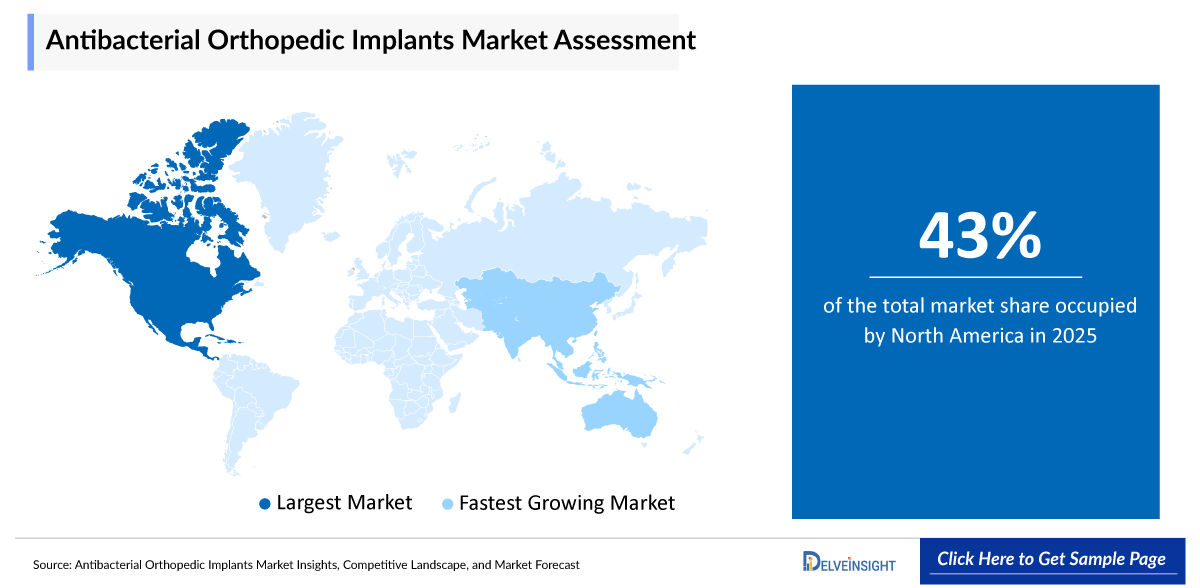
- North America dominated the global Antibacterial Orthopedic Implants market revenue with a 43% share in 2025, representing the highest regional market share globally.
Antibacterial orthopedic implants are joint replacement, trauma fixation, and spinal implants that are engineered, treated, or coated with antimicrobial technologies designed to reduce the risk of periprosthetic joint infection (PJI) and surgical site infection (SSI) following orthopedic surgery. Because infected implants are associated with high revision rates, prolonged hospitalization, amputation risk in severe cases, and mortality that can exceed several common cancers, hospitals and device manufacturers increasingly favor implants with built-in infection resistance over conventional uncoated devices. These technologies span non-eluting noble-metal and silver ion coatings, antibiotic-eluting coatings that release local antimicrobial agents at the surgical site, and iodine-coated implants that provide broad-spectrum, non-antibiotic infection resistance. The market is organized by product type across joint replacement implants, trauma fixation implants, and spinal implants; by antibacterial technology, including silver-based coatings, antibiotic-eluting coatings, and iodine-coated implants; by material across titanium and PEEK (polyether ether ketone); by end-user, led by hospitals and clinics alongside orthopedic specialty centers; and by geography. Driven by the rising volume of joint replacement and trauma procedures, the growing clinical and economic burden of implant-associated infection, rising antimicrobial resistance, and accelerating regulatory support for non-antibiotic antibacterial technologies, antibacterial orthopedic implants are moving from a niche, high-risk-case solution toward a mainstream infection-prevention standard across orthopedic surgery.
Antibacterial Orthopedic Implants Market Key Growth Drivers
- The rising clinical and economic burden of periprosthetic joint infection is driving adoption of infection-resistant implants; industry estimates put the cost of treating implant-related infections in the United States alone at approaching USD 2 billion by 2030, with five-year PJI mortality exceeding that of several common cancers.
- The growing global volume of joint replacement and trauma fixation procedures, driven by an aging population, rising osteoarthritis prevalence, and increasing sports- and trauma-related injuries, is expanding the addressable base for antibacterial implants.
- Rising antimicrobial resistance is shifting demand toward non-antibiotic antibacterial technologies, including silver ion and iodine-based coatings that reduce biofilm formation without relying on systemic or local antibiotics.
- Regulatory momentum is accelerating adoption, including FDA Breakthrough Device Designation and Japanese regulatory approval in 2025 for an iodine-treated total hip system, and a first-of-its-kind FDA De Novo grant for a non-eluting antibacterial surface treatment on a permanent orthopedic device.
- Strategic partnerships between coating-technology specialists and global implant manufacturers, such as long-running noble-metal coating collaborations spanning trauma nailing and joint reconstruction, are expanding commercial access to antibacterial technology.
- Sustained investment in surface-coating research, manufacturing scale-up, and consolidation, including the 2025 acquisition of a leading silver-coating specialist by a global surface-technology group, is expanding production capacity and technology breadth.
- Growing revision-surgery volumes, where infection risk and reoperation cost are highest, are increasing preference for silver-, antibiotic-eluting, and iodine-coated implants over conventional uncoated devices.
- The convergence of rising infection burden, surgical volume growth, antimicrobial resistance, and regulatory support is expected to sustain strong growth in the market through 2034.
Key Companies in Antibacterial Orthopedic Implants Market
The competitive landscape is led by the following active manufacturers:
- Onkos Surgical
- implantcast GmbH
- Waldemar LINK GmbH
- DePuy Synthes (Johnson & Johnson MedTech)
- Smith+Nephew
- KYOCERA Corporation
- aap Implantate AG
- Bactiguard AB
- Accentus Medical
- Biorad Medisys Pvt Ltd.
For illustrative purposes, only the top 10 companies are listed in the Table of Contents. The report may include analysis and references to additional companies relevant to the market assessment.
Antibacterial Orthopedic Implants Market Size
The following snapshot summarizes the principal report metrics for the Antibacterial Orthopedic Implants market.
|
Report Metrics |
Details |
|
2025 Market Size |
USD 3.10 billion |
|
2034 Projected Market Size |
USD 7.20 billion |
|
Growth Rate (2026-2034) |
9.8% CAGR |
|
Largest Market |
North America |
|
Fastest Growing Market |
Asia-Pacific |
|
Market Structure |
Moderately Fragmented |
All market values are expressed in USD and represent DelveInsight estimates synthesized from primary and secondary research.
Factors Contributing to the Growth of the Antibacterial Orthopedic Implants Market
Market Drivers
Rising Clinical and Economic Burden of Periprosthetic Joint Infection
The most powerful driver of the Antibacterial Orthopedic Implants market is the escalating clinical and economic burden of periprosthetic joint infection. PJI is one of the most feared complications in orthopedic surgery, with a five-year mortality rate that industry clinicians note exceeds that of several common cancers, including breast cancer and melanoma. The economic impact is equally significant, with the cost of treating implant-related infections in the United States alone projected to approach USD 2 billion by 2030. Infection typically necessitates prolonged antibiotic therapy, staged revision surgery, extended hospitalization, and, in severe cases, amputation, making infection prevention a top clinical priority. As hospitals and surgeons increasingly recognize that prevention at the implant surface is more effective and less costly than treating an established infection, demand for antibacterial joint replacement, trauma, and spinal implants continues to expand, anchoring market growth through 2034.
Growing Volume of Joint Replacement and Trauma Fixation Procedures
The rising global volume of orthopedic procedures is expanding the addressable base for antibacterial implants. An aging population, increasing prevalence of osteoarthritis, and a growing incidence of high-energy trauma and sports-related injuries are driving sustained growth in joint replacement and fracture fixation surgeries worldwide. Each procedure carries meaningful infection risk, and megaprosthesis and revision procedures in particular have been associated with infection rates historically reported as high as 30 to 50%. As procedure volumes climb, particularly in orthopedic oncology, complex revision surgery, and trauma care, the population of patients for whom antibacterial technology is clinically indicated grows in parallel, translating directly into rising demand for silver-, antibiotic-eluting, and iodine-coated implants across the forecast period.
Rising Antimicrobial Resistance Favoring Non-Antibiotic Technologies
The growing global prevalence of antimicrobial-resistant pathogens is reshaping implant technology preferences. Because antibiotic-eluting coatings depend on systemic or local antibiotic activity that resistant organisms can increasingly evade, surgeons and hospital infection-control committees are showing rising interest in non-antibiotic antibacterial technologies such as silver ion and iodine-based coatings, which act through direct antimicrobial and biofilm-disrupting mechanisms rather than antibiotic exposure. Noble-metal and silver coating technologies generate localized antimicrobial effects with limited susceptibility to resistance development, while iodine-coated implants offer broad-spectrum protection suited to high-risk revision and oncologic reconstruction. As antimicrobial stewardship becomes a growing institutional priority, this shift toward non-antibiotic antibacterial technologies is expected to broaden adoption across both trauma and joint reconstruction segments through the forecast period.
Accelerating Regulatory Support for Antibacterial Implant Technologies
A growing wave of regulatory recognition is increasing commercial momentum for antibacterial orthopedic implants. In 2025, an iodine-treated total hip replacement system received regulatory approval in Japan and was granted Breakthrough Device Designation by the FDA, marking a first-to-world clearance for this technology class. Separately, a non-eluting antibacterial surface treatment for orthopedic spinal implants received a De Novo grant from the FDA, reportedly the first such grant for a coating designed to actively kill bacteria on the surface of a permanent medical device. These regulatory milestones validate antibacterial technology as a distinct, reimbursable product category rather than an experimental add-on, encouraging further clinical adoption and investment across the industry.
Strategic Partnerships Between Coating Specialists and Global Implant Manufacturers
Long-running and expanding partnerships between antibacterial surface-technology specialists and global orthopedic implant manufacturers are broadening commercial access to antibacterial technology. Established collaborations pairing noble-metal and silver coating providers with major trauma and joint reconstruction manufacturers span both orthopedic trauma nailing and, more recently, joint reconstruction and sports medicine devices. These partnerships allow implant majors to embed clinically validated antibacterial technology into existing product portfolios without developing coating science in-house, while coating specialists gain scale and distribution reach. As additional device categories are added to these partnerships and independent clinical studies continue to expand the evidence base, adoption is expected to accelerate across the forecast period.
Investment in Surface-Coating R&D, Manufacturing Scale-Up, and Consolidation
Sustained capital investment in surface-coating research and manufacturing capacity is expanding the antibacterial implant supply base. In 2025, a leading silver and hydroxyapatite antimicrobial coating specialist was acquired by a global surface-technology group to expand manufacturing footprint and accelerate healthcare-sector growth, while coating providers continue to launch combined silver-ion technologies that extend antimicrobial coverage across soft-tissue and osseointegrating implant surfaces. This wave of investment and consolidation is expanding production capacity, broadening technology portfolios, and improving the reliability of antibacterial-coated implant supply for global orthopedic manufacturers through 2034.
Rising Healthcare Expenditure and Infrastructure Investment in Emerging Markets
Expanding healthcare expenditure and orthopedic infrastructure investment in emerging economies is broadening access to antibacterial implants beyond established markets. Rising surgical volumes in Asia-Pacific and Latin America, combined with growing local manufacturing capability and increasing awareness of infection-prevention technology among surgeons and hospital administrators, are extending demand beyond North America and Europe. As regional manufacturers scale GMP-compliant coating and implant production and align with international quality standards, antibacterial implants are expected to see accelerating penetration in price-sensitive, high-volume emerging markets across the forecast period.
Market Restraints
Despite strong momentum, the Antibacterial Orthopedic Implants market faces material constraints. The premium pricing of antibacterial-coated implants relative to conventional uncoated devices is a significant barrier, particularly in cost-constrained healthcare systems and emerging markets where reimbursement for infection-prevention technology remains inconsistent. Regulatory pathways for combination products that integrate a device with an antimicrobial agent or surface treatment are typically longer and more complex than those for standard implants, lengthening time to market and raising development costs. Long-term clinical outcome data remain limited for several newer antibacterial coating technologies, and safety considerations such as localized argyria associated with certain silver coatings, while generally reported as non-toxic, continue to warrant ongoing surveillance. There is also a theoretical risk of resistance development to silver and antibiotic-eluting technologies with widespread long-term use, which requires continued clinical monitoring. Manufacturing complexity and quality-control requirements for uniform, durable antibacterial coatings raise production costs and can constrain smaller manufacturers, while incomplete surface coverage on complex implant geometries can leave uncoated areas susceptible to colonization. Together, these cost, regulatory, evidentiary, and manufacturing barriers temper the pace of adoption, even as the underlying drivers of infection burden, procedure volume growth, and regulatory support remain firmly intact.
Antibacterial Orthopedic Implants Market Segment Analysis
The antibacterial orthopedic implants by product type (joint replacement implants, trauma fixation implants, spinal implants, and others), antibacterial technology (silver-based coatings, antibiotic-eluting coatings, iodine-coated implants, and others), material (titanium, peek, and others), end-users (hospitals & clinics, orthopedic specialty centers, and others), and Geography (North America, Europe, Asia-Pacific, and Rest of World).
By Product Type
Dominant Subsegment: Joint Replacement Implants.
The joint replacement implants segment accounted for 54% of the Antibacterial Orthopedic Implants market in 2025. Joint replacement implants lead the market because hip and knee arthroplasty procedures are performed in very high and rising volumes worldwide, and because periprosthetic joint infection following arthroplasty carries some of the highest clinical and cost consequences in orthopedic surgery, including staged revision, prolonged antibiotic therapy, and elevated mortality risk. Complex revision arthroplasty and oncologic megaprosthesis reconstruction, where reported infection rates have historically ranged from 5% to as high as 50%, have driven early and sustained adoption of silver-coated implants in this segment. The breadth of established silver-coated megaprosthesis systems, combined with newer iodine-coated hip systems securing regulatory breakthroughs, reinforces the segment's scale. While trauma fixation and spinal implants are growing quickly as antibacterial technology extends into new device categories, the sheer procedure volume and infection-cost exposure of joint replacement secure its leadership across the forecast period.
By Antibacterial Technology
Dominant Subsegment: Silver-based Coatings.
The silver-based coatings segment accounted for 41% of the Antibacterial Orthopedic Implants market in 2025. Silver-based coatings are the leading antibacterial technology because they have the longest clinical track record of any orthopedic antimicrobial surface treatment, with commercially available silver-coated megaprosthesis systems in clinical use since the early 1990s and supported by an extensive body of published safety and efficacy data. Silver ion and non-eluting noble-metal technologies offer broad-spectrum antimicrobial activity with relatively limited susceptibility to resistance development, making them well suited to high-risk revision and oncologic reconstruction as well as trauma nailing. Established licensing and manufacturing partnerships between coating specialists and global implant manufacturers have further expanded commercial availability. Antibiotic-eluting coatings and iodine-coated implants are both growing rapidly, the former benefiting from targeted local antimicrobial release and the latter gaining momentum following recent regulatory breakthroughs, but the clinical maturity, safety record, and breadth of adoption of silver-based technology secure its leadership across the forecast period.
By Material
Dominant Subsegment: Titanium.
The titanium segment accounted for 63% of the Antibacterial Orthopedic Implants market in 2025. Titanium is the leading implant material because its favorable strength-to-weight ratio, biocompatibility, and proven osseointegration properties make it the substrate of choice for the large majority of joint replacement, trauma fixation, and spinal implants. Titanium surfaces are also highly compatible with established antibacterial coating processes, including anodized silver ion treatment, galvanic silver deposition, and iodine surface treatment, all of which are optimized for titanium and titanium alloy substrates. This compatibility has made titanium the default platform on which antibacterial technology has been clinically developed and commercialized. PEEK is growing steadily, particularly in spinal implants where its radiolucency and bone-mimicking modulus are valued, and antibacterial PEEK formulations are an emerging area of development, but the depth of clinical experience and coating compatibility of titanium secure its leadership across the forecast period.
By End-Users
Dominant Subsegment: Hospitals & Clinics.
The hospitals & clinics segment accounted for 67% of the Antibacterial Orthopedic Implants market in 2025. Hospitals and clinics are the leading end-user because the large majority of joint replacement, trauma fixation, and spinal procedures, including complex revision and oncologic reconstruction requiring antibacterial implants, are performed in hospital settings with the surgical, anesthesia, and infection-control infrastructure necessary for high-risk cases. Hospitals also carry the greatest institutional exposure to the cost of treating implant-associated infection, giving procurement committees strong incentive to standardize on infection-resistant devices. Orthopedic specialty centers are growing quickly as outpatient and specialized surgical volumes expand and as these centers compete on surgical outcomes and infection-prevention performance, but the scale, complexity, and infection-cost exposure of hospital-based orthopedic surgery secure the segment's leadership across the forecast period.
Antibacterial Orthopedic Implants Market Region Analysis
Dominant Region: North America
North America accounted for 43% of the global Antibacterial Orthopedic Implants market revenue in 2025, representing the highest regional market share globally. The region's dominance reflects a high volume of joint replacement and trauma surgeries, a mature reimbursement environment for advanced orthopedic technologies, concentrated presence of leading implant manufacturers, and proactive FDA engagement, including Breakthrough Device Designation for novel antibacterial implant technology. The United States alone performs well over a million orthopedic implant procedures annually, and rising awareness of the clinical and economic burden of periprosthetic joint infection among hospital systems and surgeons is driving standardization toward antibacterial-coated devices. Strong presence of global implant majors and antibacterial-technology specialists, combined with active clinical research and regulatory engagement, anchors the region's continued leadership across the forecast period.
Fastest Growing Region: Asia-Pacific
Asia-Pacific is the fastest-growing region in the Antibacterial Orthopedic Implants market. The region's elevated CAGR is driven by a large and aging population, rising prevalence of osteoarthritis and orthopedic trauma, rapidly expanding healthcare infrastructure, and growing local manufacturing capability across China, Japan, India, South Korea, and Australia. Japan has moved early on regulatory approval of next-generation iodine-coated implant technology, China is expanding orthopedic surgical capacity and domestic implant manufacturing, and India offers a growing base of cost-competitive implant production alongside rising surgical volumes. Government healthcare investment, expanding insurance coverage, and rising surgeon awareness of infection-prevention technology are accelerating adoption, while regional manufacturers scale GMP-compliant production and pursue international quality certifications. This combination of high procedure-volume growth, infrastructure build-out, and rising awareness positions Asia-Pacific as the principal source of incremental growth over the forecast period.
Regional Commentary
North America
North America accounted for 43% of the global Antibacterial Orthopedic Implants market revenue in 2025. The United States leads on the strength of its high orthopedic surgical volumes, mature reimbursement landscape, concentration of global implant manufacturers, and proactive FDA regulatory engagement, including Breakthrough Device Designation and De Novo pathways for novel antibacterial technologies, while growing institutional focus on reducing periprosthetic joint infection reinforces adoption.
Europe
Europe is a large and clinically advanced regional market, anchored by Germany's strong orthopedic device manufacturing base and long-standing clinical use of silver-coated megaprosthesis systems, alongside established EMA regulatory frameworks. Germany, the United Kingdom, France, Italy, and Spain represent the region's largest national markets, supported by decades of published clinical evidence on silver ion and noble-metal coating technologies originating from European academic and manufacturing centers.
Asia-Pacific
Asia-Pacific is the fastest-growing region, propelled by rising orthopedic disease and trauma burden, expanding surgical infrastructure, and growing healthcare investment across China, Japan, India, South Korea, and Australia. Japan's regulatory approval of iodine-coated implant technology, China's expanding cyclotron of orthopedic manufacturing capacity, and India's growing base of cost-competitive implant production are accelerating regional adoption and clinical-trial activity.
Rest of World
The Rest of World region, spanning Latin America, the Middle East, and Africa, is an emerging growth frontier. Expanding orthopedic and trauma-care infrastructure, rising demand for joint replacement and fracture fixation procedures, and gradual alignment of regulatory frameworks with global standards are broadening access, while growing local and international partnerships support the build-out of regional antibacterial implant supply.
Antibacterial Orthopedic Implants Market Competitive Landscape
The Antibacterial Orthopedic Implants market is classified as Moderately Fragmented. Diversified global implant majors with broad joint reconstruction and trauma portfolios, including DePuy Synthes (Johnson & Johnson MedTech), Smith+Nephew, and KYOCERA Corporation, compete alongside specialized antibacterial-technology and coating providers such as Bactiguard, Accentus Medical, and Onkos Surgical, and regional implant manufacturers including Implantcast, Waldemar LINK, aap Implantate, and Biorad Medisys, increasing competitive intensity across both established and emerging antibacterial technology categories.
The competitive landscape can be evaluated across the following dimensions:
- Market concentration: Moderately fragmented, with diversified global implant manufacturers competing alongside specialized antibacterial surface-technology providers and regional players.
- Leading players: DePuy Synthes, Smith+Nephew, and KYOCERA Corporation anchor the top tier through broad joint reconstruction and trauma portfolios, while Bactiguard and Accentus Medical lead in dedicated antibacterial coating technology.
- Geographic reach: Leaders operate global manufacturing and distribution networks, while specialized coating providers extend reach through licensing partnerships with implant majors across North America, Europe, and Asia-Pacific.
- Technology portfolio strength: Top players offer silver ion, non-eluting noble-metal, antibiotic-eluting, and iodine-based antibacterial technologies across joint replacement, trauma, and spinal implant platforms.
- Clinical evidence base: Decades of published clinical data on silver-coated megaprosthesis systems provide a decisive advantage for established coating technologies over newer entrants.
- Strategic partnerships: Long-running licensing and supply collaborations between coating specialists and global implant manufacturers extend commercial reach across trauma and joint reconstruction.
- M&A activity: Active consolidation, including the 2025 acquisition of Accentus Medical by STS Group, is expanding manufacturing footprint and technology breadth.
- Manufacturing capabilities: Anodized and galvanic silver deposition, thermal plasma spray coating, and iodine surface treatment processes are key competitive moats.
- Innovation focus: Iodine-coated implant scale-up, combined multi-technology coatings, and antibacterial PEEK development are key areas of ongoing innovation.
Antibacterial Orthopedic Implants Market Recent Developmental Activities
In 2026, Bactiguard AB published new independent clinical studies expanding the evidence base for its noble-metal antibacterial coating technology on orthopedic trauma products used across the United Kingdom and Europe. Strategic significance: Strengthens the clinical evidence base supporting adoption of non-eluting antibacterial coatings in trauma fixation.
In 2025, Onkos Surgical continued development and clinical positioning of its NanoCept™ antibacterial surface technology, highlighting the clinical and economic burden of periprosthetic joint infection to support broader adoption of infection-resistant oncologic and revision implants. Strategic significance: Reinforces the company's focus on infection prevention in high-risk oncologic and revision reconstruction.
In 2025, Accentus Medical was acquired by STS Group to expand manufacturing footprint and accelerate growth in the healthcare surface-coatings sector, while continuing to develop combined Agluna® and Acusure Ag® silver ion technologies for enhanced implant surface coverage. Strategic significance: Expands global manufacturing capacity and technology breadth for silver antimicrobial surface treatments.
In 2025, Accentus Medical showcased its Agluna® and Acusure Ag® surface technologies at the International Consensus Meeting on Infection in Istanbul, reinforcing clinical engagement around infection-prevention technology. Strategic significance: Strengthens clinical and industry visibility for silver ion antibacterial coatings.
In 2025, implantcast GmbH continued to expand clinical utilization of its silver-coated MUTARS Modular Universal Tumor and Revision System, the longest-established silver-coated megaprosthesis platform, now used across Europe, Australia, and multiple Asian markets. Strategic significance: Sustains Implantcast's leadership in silver-coated oncologic and revision implant technology.
In 2025, Waldemar LINK GmbH continued clinical support of its PorAg® silver-coated MegaC® revision and tumor endoprosthesis system, supported by published data demonstrating a protective effect against reinfection in revision settings. Strategic significance: Reinforces Waldemar LINK's position in silver-coated revision and oncologic implants.
In 2025, DePuy Synthes (Johnson & Johnson MedTech) continued to broaden its global trauma fixation and joint reconstruction portfolio, with ongoing evaluation of antimicrobial surface technologies to address rising institutional focus on infection prevention. Strategic significance: Strengthens the company's competitive position across mainstream trauma and joint reconstruction segments.
In 2025, Smith+Nephew continued to invest in its orthopedic trauma and joint reconstruction portfolio alongside its broader infection-management business, supporting cross-portfolio positioning in infection-resistant surgical technology. Strategic significance: Leverages existing infection-management expertise to support antibacterial implant adoption.
In 2025, KYOCERA Corporation continued to expand its orthopedic implant portfolio, leveraging its ceramics and materials science expertise to support development of advanced, infection-resistant implant surfaces. Strategic significance: Extends KYOCERA's materials science capabilities into the antibacterial implant technology space.
In 2025, aap Implantate AG continued to expand its trauma fixation portfolio, including plate and screw systems, with ongoing focus on surface technologies to support infection-resistant fracture care. Strategic significance: Broadens aap Implantate's trauma fixation portfolio with infection-prevention positioning.
In 2025, Biorad Medisys Pvt Ltd. continued to expand its orthopedic implant manufacturing capacity in India, supporting rising domestic and export demand for cost-competitive joint replacement and trauma fixation devices. Strategic significance: Strengthens regional manufacturing capacity to serve growing Asia-Pacific procedure volumes.
Antibacterial Orthopedic Implants Market Segmentation
Antibacterial Orthopedic Implants Market by Product Type
- Joint Replacement Implants
- Trauma Fixation Implants
- Spinal Implants
- Others
Antibacterial Orthopedic Implants Market by Antibacterial Technology
- Silver-based Coatings
- Antibiotic-eluting Coatings
- Iodine-coated Implants
- Others
Antibacterial Orthopedic Implants Market by Material
- Titanium
- PEEK
- Others
Antibacterial Orthopedic Implants Market by End-Users
- Hospitals & Clinics
- Orthopedic Specialty Centers
- Others
Antibacterial Orthopedic Implants Market by Geography
- North America Antibacterial Orthopedic Implants Market
- United States Antibacterial Orthopedic Implants Market Size in USD million (2023-2034)
- Canada Antibacterial Orthopedic Implants Market Size in USD million (2023-2034)
- Mexico Antibacterial Orthopedic Implants Market Size in USD million (2023-2034)
- Europe Antibacterial Orthopedic Implants Market
- Germany Antibacterial Orthopedic Implants Market Size in USD million (2023-2034)
- United Kingdom Antibacterial Orthopedic Implants Market Size in USD million (2023-2034)
- France Antibacterial Orthopedic Implants Market Size in USD million (2023-2034)
- Italy Antibacterial Orthopedic Implants Market Size in USD million (2023-2034)
- Spain Antibacterial Orthopedic Implants Market Size in USD million (2023-2034)
- Rest of Europe Antibacterial Orthopedic Implants Market Size in USD million (2023-2034)
- Asia-Pacific Antibacterial Orthopedic Implants Market
- China Antibacterial Orthopedic Implants Market Size in USD million (2023-2034)
- Japan Antibacterial Orthopedic Implants Market Size in USD million (2023-2034)
- India Antibacterial Orthopedic Implants Market Size in USD million (2023-2034)
- Australia Antibacterial Orthopedic Implants Market Size in USD million (2023-2034)
- South Korea Antibacterial Orthopedic Implants Market Size in USD million (2023-2034)
- Rest of Asia-Pacific Antibacterial Orthopedic Implants Market Size in USD million (2023-2034)
- Rest of the World (RoW) Antibacterial Orthopedic Implants Market
- Middle East Antibacterial Orthopedic Implants Market Size in USD million (2023-2034)
- Africa Antibacterial Orthopedic Implants Market Size in USD million (2023-2034)
- South America Antibacterial Orthopedic Implants Market Size in USD million (2023-2034)
Antibacterial Orthopedic Implants Market Recent Industry Trends and Milestones (2023-2026)
|
Category |
Key Developments |
|
Antibacterial Orthopedic Implants Market Product Approval |
Regulatory momentum is expanding commercial adoption. In 2025, an iodine-treated total hip replacement system received regulatory approval in Japan and was granted Breakthrough Device Designation by the FDA, a first-to-world clearance for this technology class. Separately, a non-eluting antibacterial surface treatment received a De Novo grant from the FDA for use on permanent orthopedic spinal implants, reportedly the first such grant for a coating designed to actively kill bacteria on a permanent medical device. Each approval creates durable demand for compliant, clinically validated antibacterial implant technology. |
|
Antibacterial Orthopedic Implants Market Expansion |
Manufacturers and coating specialists broadened capability across the value chain. Bactiguard expanded clinical evidence on its noble-metal coating across trauma nailing and, since 2022, joint reconstruction devices. Accentus Medical launched combined Agluna® and Acusure Ag® silver-ion technologies for enhanced implant surface coverage. Implantcast and Waldemar LINK continued to expand clinical utilization of established silver-coated megaprosthesis platforms across Europe, Australia, and Asia. |
|
Antibacterial Orthopedic Implants Market Investment |
Capital investment and consolidation accelerated. STS Group acquired Accentus Medical in 2025 to expand manufacturing footprint and healthcare-sector growth. Regional manufacturers, including Biorad Medisys, continued to expand production capacity in Asia-Pacific to serve rising domestic and export demand for cost-competitive antibacterial implants. |
|
Company Strategy |
DePuy Synthes, Smith+Nephew, and KYOCERA Corporation: Broad trauma and joint reconstruction portfolios with growing antimicrobial surface technology evaluation. Bactiguard and Accentus Medical: Specialized noble-metal and silver ion coating technology leadership. Onkos Surgical: Oncologic and revision implant focus through NanoCept™ technology. Implantcast and Waldemar LINK: Established silver-coated megaprosthesis leadership. aap Implantate and Biorad Medisys: Regional trauma and joint implant manufacturing with growing infection-prevention focus. |
|
Emerging Technologies |
Iodine-coated implants are the leading edge of regulatory innovation, following 2025 breakthrough designations. Combined multi-technology coatings pairing silver ion treatment across both soft-tissue and osseointegrating implant surfaces are expanding antimicrobial coverage. Antibacterial PEEK formulations are an emerging development area for spinal implants, while growing collaboration between coating specialists, academic institutions, and hospital systems is accelerating clinical evidence generation for next-generation antibacterial technologies. |
Antibacterial Orthopedic Implants Market Startup Funding and Investment Trends
Investment in the Antibacterial Orthopedic Implants ecosystem has concentrated on silver ion and noble-metal coating technology, iodine-coated implant scale-up following recent regulatory breakthroughs, and regional manufacturing expansion in Asia-Pacific. The following companies illustrate recent funding and investment activity and technology focus.
|
Company |
Total Funding |
Funding Stage |
Main Offering |
Core Technology |
|
Bactiguard AB |
Publicly listed (Nasdaq Stockholm) |
Established / Public |
Noble-metal antibacterial coatings |
Non-eluting noble-metal (gold-silver-palladium) surface technology |
|
Request for unlocking the report of the @ Antibacterial Orthopedic Implants Market | ||||
Capital is flowing toward providers that combine clinically validated antibacterial technology with scalable manufacturing. The 2025 acquisition of Accentus Medical by STS Group underscores the strategic value of established silver-coating technology and manufacturing infrastructure. Emerging and specialized providers such as Onkos Surgical are scaling oncologic and revision-focused antibacterial technology, while regional manufacturers including Biorad Medisys expand cost-competitive production capacity to serve rising Asia-Pacific procedure volumes. Collectively, these investments signal conviction that clinical evidence depth, regulatory breakthrough technologies such as iodine coatings, and manufacturing scale will define the next phase of competitive advantage in the global Antibacterial Orthopedic Implants market.
Key Takeaways from the Antibacterial Orthopedic Implants Market Report Study
- Market size analysis for the current antibacterial orthopedic implants market size (2025), and market forecast for 9 years (2026 to 2034).
- Top key product/technology developments, mergers, acquisitions, partnerships, and joint ventures that happened over the last 3 years.
- Key companies dominating the global antibacterial orthopedic implants market.
- Various opportunities available for competitors in the antibacterial orthopedic implants market space.
- What are the top-performing segments in 2025? How will these segments perform in 2034?
- Which are the top-performing regions and countries in the current antibacterial orthopedic Implants market scenario?
- Which are the regions and countries where companies should concentrate their opportunities for antibacterial orthopedic implants market growth in the future?
Target audience who can benefit from this antibacterial orthopedic implants market report study
- Antibacterial orthopedic implants product providers
- Research organizations and consulting companies
- Antibacterial orthopedic implants-related organizations, associations, forums, and other alliances
- Government and corporate offices
- Start-up companies, venture capitalists, and private equity firms
- Distributors and traders dealing in antibacterial orthopedic implants
- Various end-users who want to know more about the antibacterial orthopedic implants market and the latest technological developments in the antibacterial orthopedic implants market.

