Antibody Drug Conjugates Contract Manufacturing Market Summary
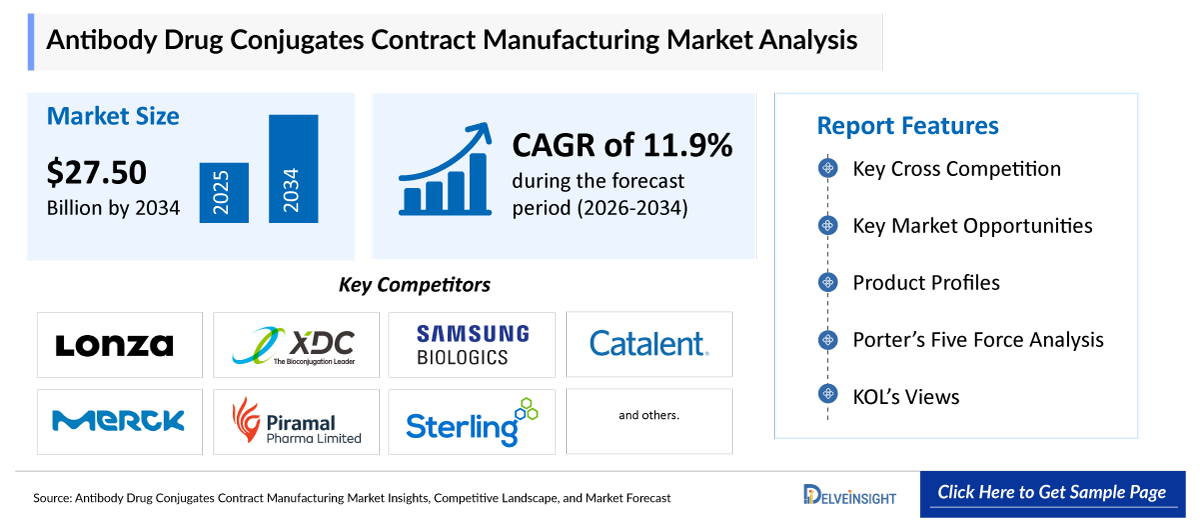
- The Antibody Drug Conjugates Contract Manufacturing market is estimated at USD 10.00 billion in 2025 and is projected to reach USD 27.50 billion by 2034. Growth is anchored in the surging ADC oncology pipeline, the scarcity of specialized conjugation and high-potency capacity, and rising outsourcing of complex, multi-step bioconjugate manufacturing.
- The global Antibody Drug Conjugates Contract Manufacturing market is growing at a CAGR of 11.9% during the forecast period from 2026 to 2034.
- By workflow component, the antibody manufacturing segment dominated the Antibody Drug Conjugates Contract Manufacturing market with a 40% share in 2025.
- By target indication, the solid tumors segment dominated the Antibody Drug Conjugates Contract Manufacturing market with an 80% share in 2025.
- By scale of operation, the clinical scale segment dominated the Antibody Drug Conjugates Contract Manufacturing market with a 56% share in 2025.
- By end user, the pharmaceutical companies segment dominated the Antibody Drug Conjugates Contract Manufacturing market with a 62% share in 2025.
- North America dominated the global Antibody Drug Conjugates Contract Manufacturing market revenue with a 45% share in 2025, representing the highest regional market share globally.
Antibody drug conjugates (ADC) contract manufacturing refers to the outsourced development and production of antibody-drug conjugates, precision oncology biologics that link a targeting monoclonal antibody to a potent cytotoxic payload through a chemical linker. ADC manufacturing is uniquely complex, combining biologic antibody production, high-potency active pharmaceutical ingredient and cytotoxic payload synthesis, conjugation and linker chemistry, and aseptic fill-finish, all under stringent containment and quality systems. Contract development and manufacturing organizations provide these capabilities across the value chain, from process and analytical development and clinical supply to commercial drug-substance and drug-product manufacturing, supported by deep regulatory expertise. Because few providers hold validated, inspected experience across the full biologic, chemistry, and conjugation spectrum within one harmonized quality system, specialist ADC capacity is scarce and strategically valuable. The market spans the antibody, payload, conjugation and linker, and fill-finish workflow components, mammalian antibody and high-potency chemistry capabilities, clinical and commercial scales, and applications dominated by oncology. Propelled by a deep and growing ADC pipeline, a wave of approvals, limited specialized capacity, and rising outsourcing, ADC contract manufacturing has become one of the fastest-growing and most technically demanding segments in pharmaceutical outsourcing.
Antibody Drug Conjugates Contract Manufacturing Market Key Growth Drivers
- The surging ADC oncology pipeline, with several hundred candidates in clinical development and a growing number of approvals, is driving demand for specialized development and manufacturing capacity.
- The scarcity of CDMOs with validated antibody, high-potency chemistry, conjugation, and aseptic fill-finish capabilities within one quality system makes specialist ADC capacity strategically valuable.
- The rising global cancer burden is driving ADC demand, with the International Agency for Research on Cancer projecting cancer cases to rise from 20 million in 2022 to 35 million by 2050.
- High outsourcing rates for ADCs, reflecting their complexity and the cost of building dedicated high-containment infrastructure, are shifting production to specialist CDMOs.
- Substantial capacity investment in bioconjugation suites, high-potency facilities, and fill-finish lines is expanding global ADC manufacturing supply.
- Clinical advances, including ADCs moving toward first-line therapy and replacing chemotherapy in key indications, are expanding commercial volumes and manufacturing demand.
- The convergence of pipeline growth, capacity scarcity, oncology demand, and outsourcing is expected to sustain strong double-digit growth in the market through 2034.
Key Companies in Antibody Drug Conjugates Contract Manufacturing Market
The competitive landscape is led by the following active developers and manufacturers:
- Lonza Group AG
- WuXi XDC Cayman Inc.
- Samsung Biologics Co., Ltd.
- Catalent, Inc.
- Merck KGaA (MilliporeSigma)
- Piramal Pharma Limited
- Sterling Pharma Solutions Limited
- Abzena Ltd.
- Sartorius AG
- Lotte Biologics Co., Ltd.
For illustrative purposes, only the top 10 companies are listed in the Table of Contents. The report may include analysis and references to additional companies, where relevant to the market assessment.
Antibody Drug Conjugates Contract Manufacturing Market Size
The following snapshot summarizes the principal report metrics for the Antibody Drug Conjugates Contract Manufacturing market.
|
Report Metrics |
Details |
|---|---|
|
2025 Market Size |
USD 10.00 billion |
|
2034 Projected Market Size |
USD 27.50 billion |
|
Growth Rate (2026-2034) |
11.9% CAGR |
|
Largest Market |
North America |
|
Fastest Growing Market |
Asia-Pacific |
|
Market Structure |
Moderately Concentrated |
All market values are expressed in USD and represent DelveInsight estimates synthesized from primary and secondary research.
Factors Contributing to the Growth of the Antibody Drug Conjugates Contract Manufacturing Market
Antibody Drug Conjugates Contract Manufacturing Market Drivers
- Surging ADC Oncology Pipeline and Approvals
The most powerful driver of the ADC contract manufacturing market is the rapidly expanding pipeline of antibody-drug conjugates in oncology. Several hundred ADC candidates are in clinical development worldwide, and the number of approved products continues to climb as agencies clear new conjugates across solid and hematologic tumors, including the 2025 approval of AbbVie's telisotuzumab vedotin for non-small-cell lung cancer. Each clinical and commercial program requires specialized development and manufacturing of the antibody, payload, conjugation, and drug product, and the breadth of targets and modalities, including next-generation linker-payload formats and bispecific conjugates, deepens demand. As ADCs demonstrate strong clinical benefit and move into earlier lines of therapy, more programs advance from discovery into clinical and commercial supply. This deep and broadening pipeline anchors sustained demand for specialized ADC contract manufacturing through the forecast period.
- Scarcity of Specialized Conjugation and High-Potency Capacity
A defining driver is the scarcity of contract manufacturers able to deliver the full ADC workflow within one harmonized quality system. ADC production uniquely combines biologic antibody manufacturing, high-potency active pharmaceutical ingredient and cytotoxic payload synthesis, conjugation and linker chemistry, and aseptic fill-finish, each demanding specialized containment, analytics, and expertise. Few CDMOs hold validated, inspected experience across all these disciplines, making genuine end-to-end ADC capacity far more limited than general biologics capacity. This scarcity positions specialist providers as strategic partners rather than commodity suppliers and supports premium pricing and long-term relationships. Sponsors prioritize providers that genuinely understand protein engineering, conjugation technologies, and next-generation ADC formats, and the limited pool of such partners concentrates demand. As pipelines grow faster than specialized capacity, this scarcity sustains strong demand and pricing for ADC contract manufacturing across the forecast period.
- Rising Global Cancer Burden
The rising global cancer burden is a powerful underlying driver, since ADCs are precision oncology therapeutics and oncology is overwhelmingly the leading indication. The International Agency for Research on Cancer recorded 20 million new cancer cases in 2022 and projects 35 million by 2050, and ADCs are increasingly central to treatment across solid tumors such as breast, lung, bladder, and gastric cancers and across hematologic malignancies. As cancer incidence climbs with aging populations and improving diagnosis, the patient pool for ADC therapies expands, increasing the volume of conjugate that must be manufactured. The clinical shift toward using ADCs earlier in treatment, including efforts to replace chemotherapy with conjugates in first-line settings, further enlarges demand. As oncology biologics proliferate and ADC adoption grows, contract manufacturers that can produce these complex therapies at scale capture rising demand, anchoring market expansion through the forecast period.
- High Outsourcing Rates for Complex Bioconjugate Manufacturing
High outsourcing rates are a central growth engine, as the complexity and capital intensity of ADC manufacturing push developers to rely on specialist CDMOs. Building and validating dedicated high-containment facilities for cytotoxic payloads, conjugation, and aseptic ADC drug product requires enormous investment and specialized expertise that most sponsors, particularly emerging biotechs, cannot justify in-house. A large share of ADC programs is therefore outsourced, and developers increasingly seek one-stop providers able to handle antibody, payload, conjugation, and fill-finish under a single quality system to simplify technology transfer and accelerate timelines. Outsourcing converts heavy fixed investment into variable cost, de-risks capacity decisions, and provides access to scarce conjugation expertise. As ADC pipelines expand and modalities grow more complex, outsourcing penetration deepens, reinforcing demand for ADC contract manufacturing across the forecast period.
- Large-Scale Capacity Investment in Bioconjugation and High Potency
Substantial capacity investment is expanding global ADC manufacturing supply and reshaping the competitive landscape. Leading CDMOs are building bioconjugation suites, high-potency facilities, and dedicated ADC fill-finish lines, including Lonza's large new bioconjugation suites at Visp, MilliporeSigma's expansion of its St. Louis Bioconjugation Center of Excellence, Piramal's Grangemouth expansion, Sterling Pharma's Deeside bioconjugation capacity, and WuXi XDC's integrated bioconjugate operations at a new Singapore site. Lotte Biologics is advancing integrated ADC services in the United States and South Korea, and Samsung Biologics has added dedicated ADC capacity. This wave of investment addresses the scarcity of specialized capacity, supports both clinical and commercial supply, and responds to reshoring and supply-security priorities. Expanding, modernized conjugation and high-potency capacity enables CDMOs to win large, long-term contracts, supporting market growth across the forecast period.
- Clinical Advances and the Shift Toward First-Line Therapy
Clinical advances are expanding commercial volumes and, in turn, manufacturing demand. ADCs are demonstrating superior efficacy over standard chemotherapy in pivotal trials, and developers are increasingly designing studies to position conjugates as first-line therapy. Landmark results, such as trials showing that trastuzumab deruxtecan combinations outperform chemotherapy in HER2-positive metastatic breast cancer, are driving rapid uptake and expanding eligible patient populations. As ADCs move from later-line to earlier-line and broader use, the volume of commercial conjugate required rises substantially, increasing demand for large-scale, commercial-ready manufacturing capacity. Next-generation payloads, novel linkers, and improved therapeutic indices are broadening the range of treatable cancers and supporting durable demand. This clinical momentum, translating efficacy into larger commercial volumes, reinforces the need for scalable ADC contract manufacturing across the forecast period.
- Technological Advances in Conjugation, Linkers, and Analytics
Advances in conjugation chemistry, linker design, payload engineering, and analytics are enhancing the capability and value of ADC contract manufacturers. Site-specific conjugation, novel cleavable and non-cleavable linkers, and next-generation payloads improve therapeutic index, homogeneity, and manufacturability, while platform technologies such as those acquired by leading CDMOs accelerate development. Advanced analytical characterization, essential given the complexity of ADCs, and the adoption of automation, process analytical technology, and increasingly artificial intelligence for antibody selection, linker design, and conjugation optimization improve quality, consistency, and speed. CDMOs that offer differentiated conjugation platforms and deep analytical expertise can attract complex programs and command premium positioning. As conjugation, linker, and analytical technologies mature, they expand the range of programs CDMOs can serve and strengthen their economics, reinforcing the market's long-term growth trajectory across the forecast period.
Antibody Drug Conjugates Contract Manufacturing Market Restraints
Despite strong momentum, the ADC contract manufacturing market faces material constraints. High capital intensity is a defining challenge, as building and validating high-potency, containment-grade ADC facilities, including conjugation suites and aseptic fill-finish, requires enormous investment and specialized infrastructure that few providers can absorb, limiting the pool of qualified manufacturers. Regulatory complexity is acute, since ADCs combine biologics and cytotoxic small molecules and therefore face stringent and overlapping requirements from the FDA, EMA, and ICH covering biologic, chemistry, containment, and aseptic standards, lengthening timelines and raising the cost of compliance. Lengthy and complex technology-transfer processes, driven by the multi-step nature of ADC production and the need to coordinate antibody, payload, conjugation, and fill-finish, slow program initiation and add risk. A shortage of skilled talent across protein engineering, high-potency chemistry, conjugation science, and ADC-specific analytics constrains expansion and raises staffing and validation risk at new sites. Limited global capacity for specialized linker-payload synthesis can create bottlenecks, and stringent containment and safety requirements increase operational cost. Client concentration and dependence on a limited number of programs expose providers to revenue volatility, while geopolitical and trade dynamics, including reshoring pressures and proposed biosecurity legislation affecting certain manufacturers, add uncertainty. Together, these capital, regulatory, technology-transfer, talent, and geopolitical barriers temper the pace of growth, even as the underlying drivers of pipeline expansion and capacity scarcity remain firmly intact.
Antibody Drug Conjugates Contract Manufacturing Market Segment Analysis
The Antibody Drug Conjugates Contract Manufacturing Market by Workflow Component (Antibody Manufacturing, Conjugation and Linker, Payload and HPAPI Manufacturing, Fill-Finish and Packaging), Target Indication (Solid Tumors, Hematologic Malignancies), Scale of Operation (Clinical Scale, Commercial Scale), End User (Pharmaceutical Companies, Biotechnology Companies), and Geography (North America, Europe, Asia-Pacific, Rest of World).
By Workflow Component
Dominant Subsegment: Antibody Manufacturing. The antibody manufacturing category is expected to dominate the market.
Dominant: Antibody Manufacturing ~ 40%
The antibody manufacturing segment accounted for 40% of the Antibody Drug Conjugates Contract Manufacturing market in 2025. Antibody manufacturing is the leading workflow component because the targeting monoclonal antibody is the largest, most capital-intensive, and highest-value building block of an ADC, requiring large-scale mammalian cell culture, purification, and rigorous characterization. The antibody represents the bulk of the bill of materials and manufacturing effort, anchoring its share of contract spend. The conjugation and linker component is the next-largest and a defining specialty of ADC manufacturing, where the antibody is chemically linked to the payload under high containment, and it is a primary focus of recent capacity investment. The payload and high-potency active pharmaceutical ingredient component, involving cytotoxic synthesis under stringent containment, and the aseptic fill-finish of the final drug product complete the workflow and are critical, specialized steps. While conjugation, payload, and fill-finish grow rapidly as dedicated capacity expands, the scale and value of antibody manufacturing secure its leadership across the forecast period.
By Target Indication
Dominant Subsegment: Solid Tumors. The solid tumors category is expected to dominate the market.
Dominant: Solid Tumors ~ 80%
The solid tumors segment accounted for 80% of the Antibody Drug Conjugates Contract Manufacturing market in 2025. Solid tumors are the dominant target indication because most commercialized ADC therapeutics and the large majority of late-stage clinical candidates target solid cancers such as breast, lung, bladder, gastric, and ovarian cancer. Landmark products and trials in HER2-positive breast cancer and other solid tumors have established ADCs as transformative therapies, driving the bulk of manufacturing demand. The breadth of solid-tumor targets, the large patient populations involved, and the movement of ADCs toward earlier lines of therapy reinforce the segment's dominance and expand commercial volumes. Hematologic malignancies represent an important and established indication, anchored by early ADC approvals in lymphoma and leukemia, and the segment is growing at a strong pace as new conjugates advance. Nonetheless, the scale, pipeline depth, and large patient populations of solid-tumor ADC programs secure the segment's clear leadership across the forecast period.
By Scale of Operation
Dominant Subsegment: Clinical Scale. The clinical scale category is expected to dominate the market.
Dominant: Clinical Scale ~ 56%
The clinical scale segment accounted for 56% of the Antibody Drug Conjugates Contract Manufacturing market in 2025. Clinical scale is the leading scale of operation because the ADC field is characterized by a very deep pipeline of programs in preclinical and clinical development relative to the smaller number of approved, commercial products. Several hundred ADC candidates are in clinical trials, each requiring process and analytical development, clinical drug-substance and drug-product supply, and technology transfer, generating sustained demand for clinical-scale manufacturing and development services. Emerging biotechs, which drive much of ADC innovation, rely on CDMOs for clinical supply, reinforcing the segment. Commercial scale is growing rapidly as a wave of approvals moves products into commercial supply and as ADCs expand into earlier lines of therapy with larger volumes, and commercial revenue per program is substantial. While commercial-scale manufacturing is the faster-growing segment over time, the sheer number of pipeline programs secures the leadership of clinical-scale activity in 2025 and across much of the forecast period.
By End User
Dominant Subsegment: Pharmaceutical Companies. The pharmaceutical companies category is expected to dominate the market.
Dominant: Pharmaceutical Companies ~ 62%
The pharmaceutical companies segment accounted for 62% of the Antibody Drug Conjugates Contract Manufacturing market in 2025. Pharmaceutical companies are the leading end user because large pharmaceutical firms own most approved and late-stage commercial ADCs and account for the largest share of high-value manufacturing contracts. Major commercial conjugates in breast, lung, bladder, and other cancers are held by large pharmaceutical companies, which outsource antibody, conjugation, and fill-finish to specialist CDMOs to access scarce capacity and accelerate supply, generating substantial, durable revenue. These companies also pursue strategic, long-term capacity agreements to secure supply for growing commercial volumes. Biotechnology companies are a large and fast-growing end user, as emerging and mid-sized biotechs drive much of ADC innovation and depend heavily on CDMOs for clinical and early commercial supply because they lack in-house high-potency capacity. While biotech demand grows quickly, the scale and value of commercial programs held by pharmaceutical companies secure their leadership across the forecast period.
Antibody Drug Conjugates Contract Manufacturing Market Region Analysis
Dominant Region: North America
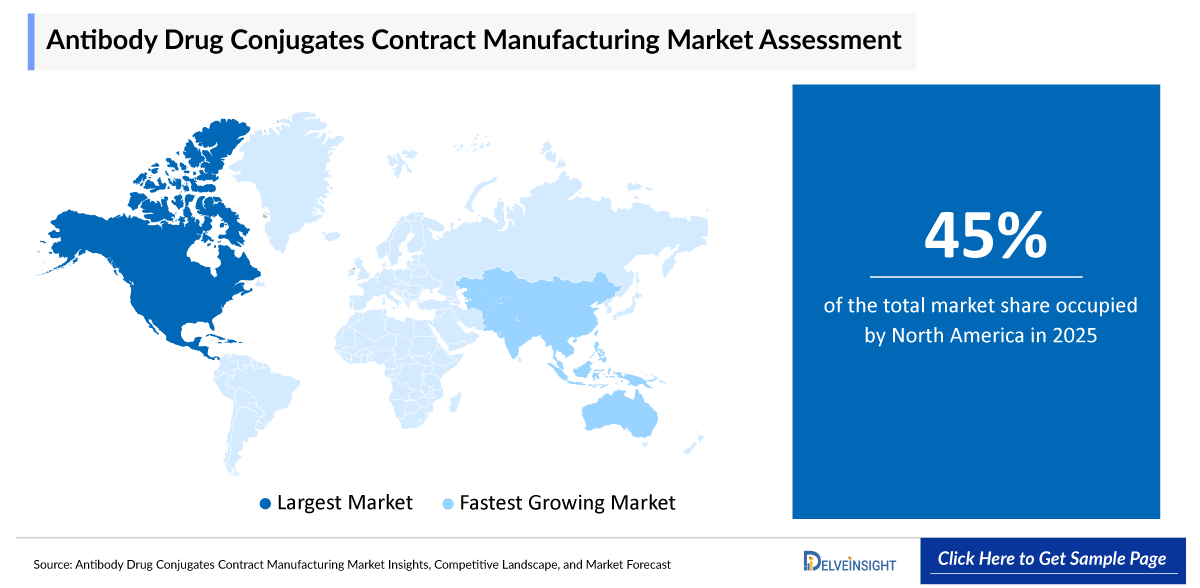
North America accounted for 45% of the global Antibody Drug Conjugates Contract Manufacturing market revenue in 2025, representing the highest regional market share globally. The region's dominance reflects a strong biopharmaceutical ecosystem, a high concentration of oncology-focused and ADC-innovating companies, advanced high-potency and conjugation infrastructure, and early adoption of complex biologics, particularly in the United States. North America hosts a deep pool of ADC innovators and contract manufacturers, robust oncology pipelines, significant research funding, and mature regulatory frameworks that enable faster development and approvals. The region is the focus of intense capacity investment and reshoring, exemplified by MilliporeSigma's expansion of its St. Louis Bioconjugation Center of Excellence, Lotte Biologics' integrated ADC services at its Syracuse Bio Campus in New York, and Siegfried's acquisition of a high-potency site in Wisconsin. Strong funding, experienced contract manufacturing, supportive regulation, and growing ADC clinical pipelines anchor the region's continued leadership across the forecast period.
Dominant: North America ~ 45% (Largest)
Fastest Growing Region: Asia-Pacific
Asia-Pacific is the fastest-growing region in the Antibody Drug Conjugates Contract Manufacturing market. The region's elevated CAGR is driven by expanding biopharmaceutical manufacturing capacity, competitive cost structures, rising oncology research, and increasing outsourcing to cost-efficient CDMOs across China, South Korea, India, Japan, and Singapore. Asia-based providers such as WuXi XDC, Samsung Biologics, Lotte Biologics, and Syngene are scaling integrated bioconjugate capacity, with WuXi XDC anchoring a new Singapore facility and Lotte advancing a large South Korean campus. Government support, improving regulatory standards, skilled scientific talent, and growing investment in advanced biologics and ADC capabilities are attracting global pharmaceutical companies to shift ADC development and production to the region. India in particular is emerging rapidly on cost competitiveness and expanding capacity. The combination of capacity expansion, cost advantage, and government support positions Asia-Pacific as the principal source of incremental growth over the forecast period.
Regional Commentary
North America
North America accounted for 45% of the global Antibody Drug Conjugates Contract Manufacturing market revenue in 2025. The United States dominates on the strength of its concentration of ADC innovators, advanced conjugation and high-potency capabilities, robust oncology pipelines, significant funding, and mature regulatory frameworks, supported by capacity expansion and reshoring, while Canada contributes through specialized early-phase and ancillary services.
Europe
Europe is a large and advanced regional market, led by Switzerland, the United Kingdom, Germany, Ireland, and Italy. Growth is anchored by major ADC CDMOs and high-potency specialists such as Lonza, Piramal Pharma Solutions, Sterling Pharma Solutions, and Merck KGaA, supported by a harmonized EU regulatory framework, deep technical expertise, and significant bioconjugation capacity investment across Switzerland, the United Kingdom, and Scotland.
Asia-Pacific
Asia-Pacific is the fastest-growing region, propelled by expanding manufacturing capacity, cost competitiveness, rising oncology research, and increasing outsourcing across China, South Korea, India, Japan, and Singapore. WuXi XDC, Samsung Biologics, Lotte Biologics, and Syngene scale integrated bioconjugate capacity, while government support and growing investment attract global ADC development and production to the region.
Rest of World
The Rest of World region, spanning Latin America, the Middle East, and Africa, is an emerging contributor. Growing oncology demand, expanding healthcare access, and interest in regional biomanufacturing are creating early opportunities, while partnerships, technology transfer, and capacity building gradually extend access to specialized ADC manufacturing across these markets over the forecast period.
Antibody Drug Conjugates Contract Manufacturing Market Competitive Landscape
The Antibody Drug Conjugates Contract Manufacturing market is classified as Moderately Concentrated. A group of large-scale leaders with end-to-end capabilities, including Lonza, WuXi XDC, Samsung Biologics, and Catalent, holds a substantial share through integrated antibody, conjugation, and fill-finish capacity, while a broad field of specialized high-potency and bioconjugation providers, including Merck KGaA, Piramal, Sterling Pharma, Abzena, and Lotte Biologics, competes on conjugation expertise, scale, and geography, keeping the long tail of the market fragmented and competitive.
The competitive landscape can be evaluated across the following dimensions:
- Market concentration: Moderately concentrated, with a few integrated leaders alongside a fragmented field of specialized high-potency and conjugation providers.
- Leading players: Lonza, WuXi XDC, Samsung Biologics, and Catalent anchor the top tier through end-to-end ADC capabilities and scale.
- Geographic reach: Leaders operate global networks across North America, Europe, and Asia-Pacific, with reshoring and capacity investment reshaping footprints.
- Service portfolio strength: Top players offer integrated antibody, payload, conjugation, and aseptic fill-finish within harmonized quality systems.
- Conjugation and high-potency capability: Validated bioconjugation suites, HPAPI synthesis, and containment expertise are decisive and scarce competitive assets.
- Strategic partnerships: Long-term capacity agreements and platform collaborations, such as Lonza's Synaffix acquisition, underpin growth.
- M&A activity: Moderate consolidation as large CDMOs acquire conjugation platforms and high-potency sites to expand capability and capacity.
- Capacity investment: Major investment in bioconjugation suites, high-potency facilities, and ADC fill-finish lines across Europe, the United States, and Asia.
- Innovation focus: Site-specific conjugation, novel linkers and payloads, advanced analytics, and AI-assisted antibody, linker, and conjugation design.
Antibody Drug Conjugates Contract Manufacturing Market Recent Developmental Activities
- In late 2025, WuXi XDC Cayman Inc., commenced integrated bioconjugate operations as the first tenant at WuXi Biologics' new USD 1.4 billion Singapore facility in Tuas, offering end-to-end antibody, payload, linker, and bioconjugate drug-substance and drug-product services. Strategic significance: Expanded Asia-Pacific ADC capacity and reinforced WuXi XDC's integrated end-to-end position.
- In 2026, Lonza Group AG, is bringing online two new bioconjugation suites at its Visp, Switzerland site, expected to be one of the largest bioconjugation facilities globally at 1,500 square meters. Strategic significance: Substantially expanded scarce conjugation capacity and strengthened Lonza's ADC manufacturing leadership.
- In October 2024, Merck KGaA (MilliporeSigma), announced a USD 76 million expansion of its Bioconjugation Center of Excellence in St. Louis, Missouri, tripling capacity across process and analytical development, quality control, and manufacturing for early-stage and commercial bioconjugates. Strategic significance: Expanded United States commercial ADC capacity at a leading bioconjugation site.
- In December 2023, Piramal Pharma Solutions, opened a GBP 45 million expansion of its ADC manufacturing facility in Grangemouth, Scotland, increasing capacity by 70% to 80% with two new manufacturing suites to enable commercial-scale ADC batches. Strategic significance: Strengthened European commercial ADC capacity and broadened lifecycle support for sponsors.
- In October 2024, Sterling Pharma Solutions Limited, announced a second phase of expansion at its Deeside, United Kingdom site, investing over GBP 10 million to increase GMP bioconjugation capacity for ADC development. Strategic significance: Added dedicated United Kingdom bioconjugation capacity and deepened Sterling's ADC service offering.
- In July 2024, Siegfried Holding AG, acquired an early-phase drug-substance and high-potency manufacturing site in Grafton, Wisconsin from Curia, developing it into an early-phase CDMO hub including services for high-potency active pharmaceutical ingredients. Strategic significance: Expanded United States high-potency capacity that underpins ADC payload manufacturing.
- In 2025, Lotte Biologics Co., Ltd., advanced integrated ADC services at its Syracuse Bio Campus in New York, with over USD 100 million invested, housing 40,000 liters of antibody capacity and on-site conjugation, and is building a 120,000-liter facility in Songdo, South Korea targeted to be GMP-ready by 2027. Strategic significance: Established end-to-end ADC capacity across the United States and South Korea.
- In April 2025, Lotte Biologics Co., Ltd., signed a manufacturing agreement with an Asia-based biotechnology company for a clinical-stage ADC candidate, offering comprehensive one-stop ADC development and manufacturing services. Strategic significance: Validated Lotte's integrated ADC offering and added clinical-stage program volume.
- In January 2024, Samsung Biologics Co., Ltd., launched a dedicated ADC manufacturing facility, adding bioconjugation capability to its large-scale biologics offering. Strategic significance: Extended a leading biologics CDMO into ADC manufacturing and broadened Asia-Pacific conjugation capacity.
- In June 2023, Lonza Group AG, acquired Synaffix B.V., a company with a platform technology for ADCs, bispecific antibodies, and other targeted therapeutics, and established a Center of Excellence for Bioconjugate Technology Development. Strategic significance: Added differentiated linker-payload technology and strengthened Lonza's end-to-end ADC platform.
- In 2025, Abzena Ltd., expanded its sponsor-centric ADC contract development and manufacturing capabilities, including its AbZelectPRO platform, across integrated bioconjugation services. Strategic significance: Strengthened a specialist ADC CDMO positioned on technical alignment and flexibility for sponsors.
- In June 2025, AbbVie Inc., received FDA approval for Emrelis (telisotuzumab vedotin) for locally advanced or metastatic non-squamous non-small-cell lung cancer. Strategic significance: Expanded the approved-ADC base in a large solid-tumor indication and increased demand for commercial ADC manufacturing.
Antibody Drug Conjugates Contract Manufacturing Market Segmentation
- Antibody Drug Conjugates Contract Manufacturing Market by Workflow Component
- Antibody Manufacturing
- Conjugation and Linker
- Payload and HPAPI Manufacturing
- Fill-Finish and Packaging
- Antibody Drug Conjugates Contract Manufacturing Market by Target Indication
- Solid Tumors
- Hematologic Malignancies
- Antibody Drug Conjugates Contract Manufacturing Market by Scale of Operation
- Clinical Scale
- Commercial Scale
- Antibody Drug Conjugates Contract Manufacturing Market by End User
- Pharmaceutical Companies
- Biotechnology Companies
- Antibody Drug Conjugates Contract Manufacturing Market by Payload Type
- Auristatins (MMAE, MMAF)
- Maytansinoids
- Camptothecins and Topoisomerase Inhibitors
- Calicheamicins
- Other Payloads
- Antibody Drug Conjugates Contract Manufacturing Market by Linker Type
- Cleavable Linkers
- Non-Cleavable Linkers
Antibody Drug Conjugates Contract Manufacturing Market by Geography
- North America Antibody Drug Conjugates Contract Manufacturing Market
- United States Antibody Drug Conjugates Contract Manufacturing Market Size in USD million (2023-2034)
- Canada Antibody Drug Conjugates Contract Manufacturing Market Size in USD million (2023-2034)
- Mexico Antibody Drug Conjugates Contract Manufacturing Market Size in USD million (2023-2034)
- Europe Antibody Drug Conjugates Contract Manufacturing Market
- Germany Antibody Drug Conjugates Contract Manufacturing Market Size in USD million (2023-2034)
- United Kingdom Antibody Drug Conjugates Contract Manufacturing Market Size in USD million (2023-2034)
- Switzerland Antibody Drug Conjugates Contract Manufacturing Market Size in USD million (2023-2034)
- France Antibody Drug Conjugates Contract Manufacturing Market Size in USD million (2023-2034)
- Italy Antibody Drug Conjugates Contract Manufacturing Market Size in USD million (2023-2034)
- Rest of Europe Antibody Drug Conjugates Contract Manufacturing Market Size in USD million (2023-2034)
- Asia-Pacific Antibody Drug Conjugates Contract Manufacturing Market
- China Antibody Drug Conjugates Contract Manufacturing Market Size in USD million (2023-2034)
- South Korea Antibody Drug Conjugates Contract Manufacturing Market Size in USD million (2023-2034)
- Japan Antibody Drug Conjugates Contract Manufacturing Market Size in USD million (2023-2034)
- India Antibody Drug Conjugates Contract Manufacturing Market Size in USD million (2023-2034)
- Australia Antibody Drug Conjugates Contract Manufacturing Market Size in USD million (2023-2034)
- Rest of Asia-Pacific Antibody Drug Conjugates Contract Manufacturing Market Size in USD million (2023-2034)
- Rest of the World (RoW) Antibody Drug Conjugates Contract Manufacturing Market
-
- Middle East Antibody Drug Conjugates Contract Manufacturing Market Size in USD million (2023-2034)
- Africa Antibody Drug Conjugates Contract Manufacturing Market Size in USD million (2023-2034)
- South America Antibody Drug Conjugates Contract Manufacturing Market Size in USD million (2023-2034)
Antibody Drug Conjugates Contract Manufacturing Market Recent Industry Trends and Milestones (2023-2026)
|
Category |
Key Developments |
|---|---|
|
ADC Manufacturing Approvals and Pipeline |
The approved-ADC base expanded as agencies cleared new conjugates across solid and hematologic tumors, including AbbVie's telisotuzumab vedotin for non-small-cell lung cancer (June 2025), while several hundred ADC candidates advanced in clinical trials. Pivotal results, such as trastuzumab deruxtecan combinations outperforming chemotherapy in HER2-positive breast cancer, pushed ADCs toward earlier lines of therapy and larger commercial volumes. The deep pipeline and growing commercial base drove sustained demand for clinical and commercial ADC manufacturing capacity across regions. |
|
ADC Manufacturing Capacity Expansion |
Capacity expansion accelerated across the workflow. Lonza added large bioconjugation suites at Visp, Switzerland, and MilliporeSigma expanded its St. Louis Bioconjugation Center of Excellence. Piramal expanded its Grangemouth, Scotland ADC facility, and Sterling Pharma added GMP bioconjugation at Deeside. WuXi XDC anchored a new Singapore site, Lotte Biologics advanced integrated ADC services in New York and South Korea, Samsung Biologics launched dedicated ADC capacity, and Siegfried acquired a United States high-potency site, collectively addressing the scarcity of specialized conjugation and high-potency capacity. |
|
ADC Manufacturing Investment |
Investment focused on bioconjugation, high-potency, and integrated end-to-end capacity. Lonza acquired the Synaffix linker-payload platform and built a Center of Excellence for Bioconjugate Technology Development, while MilliporeSigma committed USD 76 million to triple St. Louis capacity and Lotte invested over USD 100 million in its Syracuse Bio Campus. Reshoring and supply-security priorities channeled capital into United States and European capacity, and Asia-Pacific providers expanded aggressively, reflecting strong sponsor demand for scarce, validated ADC manufacturing capacity. |
|
Company Strategy |
Lonza Group AG: End-to-end ADC leadership through bioconjugation expansion and the Synaffix platform. WuXi XDC Cayman Inc.: Integrated, end-to-end bioconjugate CRDMO model across antibody, payload, linker, and drug product. Samsung Biologics Co., Ltd.: Dedicated ADC capacity alongside large-scale biologics. Catalent, Inc.: Integrated biologics and ADC services. Merck KGaA (MilliporeSigma): Bioconjugation Center of Excellence and high-potency leadership. Piramal, Sterling Pharma, Abzena, Lotte Biologics, and Sartorius: Specialized conjugation, high-potency, and integrated ADC services across regions. |
|
Emerging Technologies |
Site-specific and next-generation conjugation chemistries, novel cleavable and non-cleavable linkers, and advanced payloads improve therapeutic index, homogeneity, and manufacturability. Platform technologies such as Lonza's Synaffix accelerate development, and advanced analytical characterization addresses ADC complexity. Automation, process analytical technology, and artificial intelligence increasingly support antibody selection, linker design, and conjugation optimization. High-containment and single-use bioconjugation, integrated one-stop CRDMO models, and capacity for next-generation formats including bispecific and dual-payload conjugates are expanding across the industry. |
Antibody Drug Conjugates Contract Manufacturing Market Startup Funding and Investment Trends
Because ADC contract manufacturing is capital-intensive and dominated by established CDMOs and strategic investors, investment activity centers on capacity expansion, platform acquisitions, and high-potency infrastructure rather than early-stage venture funding. The following companies illustrate recent investment and capacity activity and technology focus.
|
Company |
Investment Scale |
Funding Stage |
Main Offering |
Core Technology |
|
Lonza Group AG |
Visp suites and Synaffix deal |
Public (capacity investment) |
End-to-end ADC services |
Bioconjugation and linker platforms |
|
WuXi XDC Cayman Inc. |
Singapore site (with WuXi) |
Public (capacity investment) |
Integrated bioconjugate CRDMO |
End-to-end conjugation |
|
Request for unlocking the report of the @ Antibody Drug Conjugates Contract Manufacturing Market | ||||
Capital is flowing toward scarce, validated conjugation and high-potency capacity rather than early-stage venture funding, reflecting the industrial and specialized nature of ADC manufacturing. Lonza's expansion of bioconjugation capacity at Visp and its acquisition of the Synaffix platform, WuXi XDC's integrated Singapore operations, Lotte Biologics' Syracuse and Songdo investments, MilliporeSigma's St. Louis expansion, and Piramal's Grangemouth expansion illustrate the premium placed on end-to-end, high-containment ADC capability. Reshoring and supply-security priorities are channeling investment into United States and European facilities, while Asia-Pacific providers expand on cost competitiveness. Collectively, these investments signal conviction that integrated, validated, and technologically differentiated conjugation capacity will define competitive advantage in the global Antibody Drug Conjugates Contract Manufacturing market.
Key Takeaways from the Antibody Drug Conjugates Contract Manufacturing Market Report Study
- Market size analysis for the current antibody drug conjugates contract manufacturing market size (2025), and market forecast for 9 years (2026 to 2034).
- Top key product/technology developments, mergers, acquisitions, partnerships, and joint ventures that happened over the last 3 years.
- Key companies dominating the global antibody drug conjugates contract manufacturing market.
- Various opportunities available for competitors in the antibody drug conjugates contract manufacturing market space.
- What are the top-performing segments in 2025? How will these segments perform in 2034?
- Which are the top-performing regions and countries in the current antibody drug conjugates contract manufacturing market scenario?
- Which are the regions and countries where companies should concentrate their opportunities for antibody drug conjugates contract manufacturing market growth in the future?
Target audience who can benefit from this antibody drug conjugates contract manufacturing market report study
- Antibody Drug Conjugates Contract Manufacturing product providers
- Research organizations and consulting companies
- Antibody Drug Conjugates Contract Manufacturing-related organizations, associations, forums, and other alliances
- Government and corporate offices
- Start-up companies, venture capitalists, and private equity firms
- Distributors and traders dealing in antibody drug conjugates contract manufacturing
- Various end-users who want to know more about the antibody drug conjugates contract manufacturing market and the latest technological developments in the antibody drug conjugates contract manufacturing market.

