-market.png&w=256&q=75)
Antiphospholipid Syndrome (APS) Insights and Trends
- According to DelveInsight’s analysis, among the 7MM antiphospholipid syndrome (APS) market the US was found to be the highest contributor in 2025.
-
A significant proportion of APS burden is associated with comorbid autoimmune conditions such as Systemic Lupus Erythematosus, along with cardiovascular risk factors, highlighting the need for integrated disease management, early diagnosis, and targeted prevention strategies to reduce thrombotic events and improve outcomes.
-
The frequency of antiphospholipid antibodies reportedly increases with age, but it remains unclear if these antibodies are pathogenic or an epiphenomenon of a malignancy or other underlying process.
-
There is no curative treatment for APS, as management primarily focuses on preventing thrombosis and pregnancy complications using anticoagulants such as Warfarin and Heparin, often combined with low-dose Aspirin.
-
Rituximab and IVIG may be considered in difficult-to-treat APS patients, particularly those with catastrophic APS (CAPS) or recurrent hematological non-criteria manifestations such as thrombocytopenia. However, these therapies are not considered a standard of care for APS.
-
Despite improvements in treatment with blood thinners (anticoagulants), a subset of patients with APS experiences recurrent thrombotic events despite being on standard anticoagulant therapy.
-
A limited number of emerging therapies, including investigational agents such as RAY121 (Chugai Pharmaceutical), anifrolumab (SAPHNELO) (AstraZeneca), and other immunomodulatory approaches, are currently under clinical development, aiming to address the underlying autoimmune mechanisms of the disease.
Antiphospholipid Syndrome (APS) Market Size and Forecast in the 7MM
-
2025 APS Market Size: ~USD XXXX million
-
APS Growth Rate (2026–2036): ~XX% CAGR
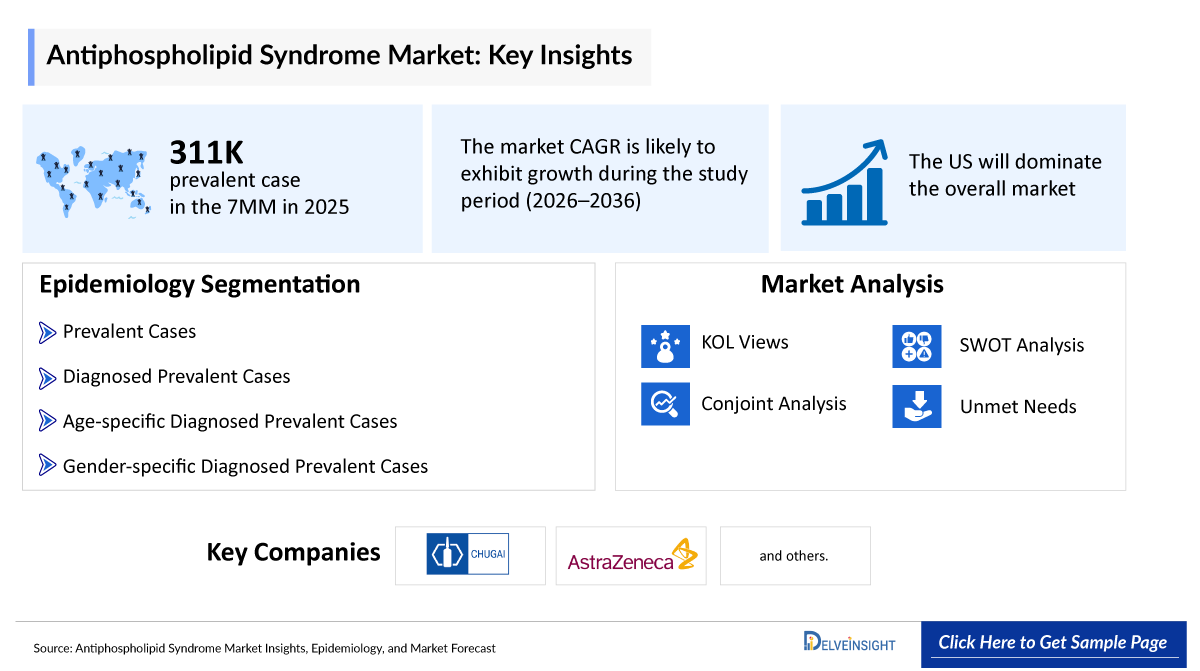
DelveInsight's ‘Antiphospholipid Syndrome (APS) Market Insights, Epidemiology and Market Forecast – 2036’ report delivers an in-depth understanding of the APS, historical and forecasted epidemiology, as well as the APS market trends in the United States, EU4 (Germany, Spain, Italy, and France) and the United Kingdom, and Japan.
The APS market report delivers a comprehensive analysis of the current treatment landscape, including standards of care, clinical practices, and evolving therapeutic algorithms. It evaluates, APS patient burden trends, revenue & market share dynamics, peak patient share & therapy uptake analysis, and provides an in-depth market size assessment, and growth rate projections (Historical & Forecast 2022–2036) across global regions. The report highlights key unmet medical needs in APS and maps the competitive and clinical landscape to uncover high‑value opportunities, providing a clear outlook on future market growth potential.
|
Study Period |
2022–2036 |
|
Historical Year |
2022–2025 |
|
Forecast Period |
2026–2036 |
|
Base Year |
2026 |
|
Geographies Covered |
|
|
APS Market CAGR (Study period/Forecast period) |
~XX% (2026–2036) |
|
APS Epidemiology Segmentation Analysis |
Patient Burden Assessment
|
|
APS Companies |
Chugai Pharmaceutical, AstraZeneca, and others |
|
APS Therapies |
RAY121, anifrolumab (SAPHNELO), and others |
|
APS Market |
Segmented by
|
|
Analysis |
|
Key Factors Driving the Antiphospholipid Syndrome (APS) Market
Rising APS prevalence
The increasing prevalence of APS, particularly among females, is a primary driver of APS market expansion.
Rising Opportunities in Targeted Therapies for APS
Growing understanding of immune-driven mechanisms in APS is creating opportunities for targeted therapies that go beyond anticoagulation, focusing on reducing antibody activity and preventing recurrent thrombosis with improved long-term outcomes.
Antiphospholipid Syndrome (APS) Understanding and Treatment Algorithm
Antiphospholipid Syndrome (APS) Overview and Diagnosis
APS is an autoimmune disorder in which abnormal antibodies increase the risk of blood clots in arteries and veins. It can lead to complications such as deep vein thrombosis, stroke, and recurrent pregnancy loss. APS is caused by immune system dysfunction and may occur alone or with other autoimmune diseases. Diagnosis is based on blood tests for specific antibodies, and treatment mainly involves long-term anticoagulation to prevent clot formation.
Antiphospholipid Syndrome (APS) Diagnosis
APS is diagnosed based on clinical history and blood tests, often suspected in patients with unexplained blood clots or recurrent pregnancy loss. Diagnosis is confirmed by detecting antiphospholipid antibodies such as lupus anticoagulant, anti-cardiolipin, and anti-β2 glycoprotein I on two occasions at least 12 weeks apart. Imaging tests may be used to identify associated thrombosis.
Further details are provided in the report.
Antiphospholipid Syndrome (APS) Treatment
The primary goals of APS treatment are to prevent thrombotic events, reduce pregnancy-related complications, manage underlying autoimmune activity, and minimize the risk of recurrence. Management is largely preventive and follows a risk-based approach, with long-term anticoagulation using Warfarin as the standard first-line therapy for patients with a history of thrombosis. In acute settings or during pregnancy, Heparin or low-molecular-weight heparin is preferred due to its safety profile. Low-dose Aspirin is often used adjunctively, particularly in high-risk or obstetric APS patients. In individuals with coexisting autoimmune conditions such as Systemic Lupus Erythematosus, immunomodulatory agents like Hydroxychloroquine and corticosteroids may be incorporated. In severe or catastrophic cases, intensive interventions including plasma exchange and intravenous immunoglobulin (IVIG) are required. Despite these options, treatment primarily relies on repurposed therapies rather than disease-specific agents, emphasizing the need for targeted and disease-modifying treatments.
Further details related to country-based variations are provided in the report.
Antiphospholipid Syndrome (APS) Unmet Needs
The section “unmet needs of APS” outlines the critical gaps between the current state of patient care, diagnosis, and the ideal & effective management of the disease. It highlights the obstacles experienced by patients, clinicians, and researchers and identifies potential solutions for future progress.
-
Delayed and complex diagnosis
-
Limited targeted therapies beyond long-term anticoagulation
-
Risk of recurrent thrombosis despite standard treatment
-
Challenges in managing pregnancy-related complications, and others…..
Comprehensive unmet needs insights in Antiphospholipid Syndrome (APS) and their strategic implications are provided in the full report.
Antiphospholipid Syndrome (APS) Epidemiology
Key Findings from Antiphospholipid Syndrome (APS) Epidemiological Analysis and Forecast
-
According to DelveInsight’s estimates, the total prevalent cases of APS in the 7MM were approximately 310,800 in 2025.
-
Among the EU4, Germany accounted for the highest number of prevalent cases of APS, followed by France, whereas Italy accounted for the lowest number of cases in 2025.
-
The observed female predominance and earlier onset of APS highlight the importance of early screening, timely diagnosis, and tailored management strategies, particularly in women of reproductive age, to reduce thrombotic risk and improve pregnancy outcomes.
-
The prevalence of APS was 51.18% in the US population. Males had a lower prevalence of APS than females.
Antiphospholipid Syndrome (APS) Drug Chapters & Competitive Analysis
The APS drug chapter provides a detailed, market-focused review of approved therapies and the emerging pipeline across Phase I–III clinical trials. It covers the mechanism of action, clinical trial data, regulatory approvals, patents, collaborations, and strategic partnerships for each therapy, along with their advantages, limitations, and recent developments. This section offers critical insights into the APS treatment landscape, supporting market assessment, competitive analysis, and growth forecasting for the APS therapeutics market.
Note: Detailed marketed therapies assessment will be provided in the final report.
Therapies for Antiphospholipid Syndrome (APS)
Clinical management of APS is largely preventive, focusing on reducing thrombosis risk using anticoagulants such as Warfarin and Heparin, often combined with low-dose Aspirin, especially in high-risk and pregnant patients. Severe cases may require intensive therapies like corticosteroids, plasma exchange, or IVIG. However, there are no recently approved targeted therapies for APS, and current treatment mainly relies on supportive and repurposed approaches, highlighting a significant unmet need.
Antiphospholipid Syndrome (APS) Pipeline Analysis
RAY121: Chugai Pharmaceutical
RAY121, developed by Chugai Pharmaceutical, is an investigational therapy for APS designed to target key immune-mediated pathways involved in thrombosis. The therapy aims to modulate pathogenic antiphospholipid antibody activity and reduce abnormal clot formation. By addressing the underlying autoimmune mechanisms rather than only preventing clots, RAY121 has the potential to improve disease control, lower recurrence risk, and offer a more targeted treatment approach compared to conventional anticoagulation therapies.
|
Comparison of Emerging Drugs Under Development | |||||||
|
Drug Name |
Company |
Highest Phase |
Indication |
RoA |
MoA |
Molecule Type |
Anticipated Launch in the US |
|
RAY121 |
Chugai Pharmaceutical |
Ib |
APS |
SC |
Targets immune-mediated pathways involved in antiphospholipid antibody–driven thrombosis |
mAbs |
Information is available in the full report |
|
Anifrolumab (SAPHNELO) |
AstraZeneca |
II |
APS |
SC |
Inhibits type 1 interferon receptors |
mAbs |
Information is available in the full report |
|
Note: Launch insights are provisional and may change with future report updates or the occurrence of major key catalysts. | |||||||
Note: A detailed emerging therapies assessment will be provided in the final report
Antiphospholipid Syndrome (APS) Key Players, Market Leaders and Emerging Companies
Chugai Pharmaceutical, and others
Recent Development
In Sep 2026, UCB received US FDA Breakthrough Therapy Designation for Cimzia (certolizumab pegol) to treat pregnant women with antiphospholipid syndrome (APS). The designation relies on clinical data showing Cimzia reduces pregnancy complications like preeclampsia and fetal loss in high-risk patients. Being an Fc-free anti-TNF agent, it minimizes placental transfer, addressing a critical unmet medical need.
Drug Class Insights
Antiphospholipid Syndrome (APS) Market Outlook
The APS market is gradually evolving from a predominantly anticoagulation-based management approach toward more targeted, mechanism-driven therapeutic strategies aimed at addressing the underlying autoimmune pathology and thrombotic risk. Current treatment paradigms rely heavily on long-term use of anticoagulants such as Warfarin, Heparin, and adjunctive low-dose Aspirin; however, increasing research into novel therapies, including monoclonal antibodies, complement inhibitors, and immune-modulating agents, reflects a shift toward targeting pathogenic antiphospholipid antibodies and reducing immune-mediated thrombosis. These advancements highlight a growing emphasis on disease modification rather than solely preventing recurrent clotting events, thereby improving long-term outcomes and clinical management.
With continued progress in pipeline therapies designed to modulate immune pathways and minimize thrombotic complications, the APS treatment landscape is gradually aligning with other autoimmune disorders where targeted biologics are transforming care. Among the major markets, the US dominates due to higher diagnosis rates, advanced healthcare infra-structure, and greater adoption of long-term anticoagulation strategies, while regions such as EU4 and the UK, and Japan are witnessing steady improvements in awareness, diagnostic capabilities, and patient management practices.
Overall, the emergence of innovative pipeline candidates, increasing recognition of APS-related complications, growing focus on autoimmune disease management, and advancements in precision medicine are expected to drive moderate growth in the 7MM APS market from 2022–2036. This evolving landscape presents significant opportunities for both established anticoagulant therapies and novel targeted treatments aimed at improving disease control and reducing morbidity.
-
According to the estimates, the largest market size of APS was captured by the United States, i.e., ~USD XXXX million in 2025.
-
The APS market remains largely dependent on conventional anticoagulation therapies such as Warfarin and Heparin, with adjunct use of low-dose Aspirin, while emerging pipeline therapies are increasingly focusing on targeted immunomodulation to address the underlying autoimmune mechanisms and reduce thrombotic risk.
-
Regional market dynamics indicate that the United States leads in terms of market size and treatment adoption, whereas regions such as Europe and Japan are experiencing steady growth driven by improved awareness, earlier diagnosis, and gradual uptake of advanced therapeutic approaches.
Further details will be provided in the report….
Drug Class/Insights into Leading Emerging and Marketed Therapies in Antiphospholipid Syndrome (APS) (2022–2036 Forecast)
The APS treatment landscape comprises long-term anticoagulation therapies, antiplatelet agents, immunomodulatory approaches, and supportive care strategies, each addressing thrombosis prevention, autoimmune activity, and complication management.
-
Long-term anticoagulation (standard of care): Agents such as Warfarin and Heparin remain the mainstay of treatment, effectively reducing thrombotic risk but requiring careful monitoring and dose adjustments due to bleeding risks and variability in response.
-
Antiplatelet therapy: Low-dose Aspirin is commonly used, particularly in high-risk or asymptomatic patients, offering additional protection against arterial thrombosis with a favorable safety profile.
Conventional anticoagulation therapies dominate the APS treatment paradigm, while the lack of targeted, disease-modifying therapies highlights a significant unmet need, with emerging pipeline agents focusing on immune-mediated mechanisms expected to shape future innovation.
Further details will be provided in the report….
Antiphospholipid Syndrome (APS) Drug Uptake
This section focuses on the uptake rate of potential drugs expected to be launched in the market during the forecast period (2026–2036). The analysis covers the APS market's uptake by drugs, patient uptake by therapy, and sales of each drug.
The uptake of therapies in APS is expected to remain dominated by anticoagulants such as Warfarin and Heparin, along with adjunctive Aspirin, due to their established role in preventing thrombosis. However, emerging therapies targeting underlying immune mechanisms are anticipated to see gradual uptake, driven by the limitations of current treatments, including bleeding risk, lifelong therapy requirements, and lack of disease-modifying options.
Further detailed analysis of emerging therapies' drug uptake in the report…
Market Access and Reimbursement of APS
Reimbursement is a crucial factor that affects the drug’s access to the market. Often, the decision to reimburse comes down to the price of the drug relative to the benefit it produces in treated patients. To reduce the healthcare burden of these high-cost therapies, many payment models are being considered by payers and other industry insiders.
Further details are provided in the final report….
Antiphospholipid Syndrome (APS) Therapies Price Scenario & Trends
Pricing and analogue assessment of APS therapies highlights evolving price dynamics structures. This section summarizes the cost of approved treatments, closest and most appropriate analogue selection for emerging therapies, and understanding of how pricing influences market access, adherence, and long-term uptake.
Further details are provided in the final report….
Industry Experts and Physician Views for Antiphospholipid Syndrome (APS)
To keep up with APS market trends, we take Key Opinion Leaders (KOLs) and Subject Matter Experts (SMEs) opinions working in the domain through primary research to fill the data gaps and validate our secondary research. Industry experts were contacted for insights on the APS emerging therapies, evolving treatment landscape, patient adherence to conventional therapies, therapy switching trends, drug adoption and uptake, accessibility challenges, and epidemiology and real-world prescription patterns in APS, including MD, PhD, Instructor, Postdoctoral Researcher, Professor, Researcher, and others.
DelveInsight’s analysts connected with 10+ KOLs to gather insights; however, interviews were conducted with 6+ KOLs in the 7MM. Centers such as the Harvard Medical School, University of Nottingham, and Japanese Red Cross Central Blood Institute, etc. were contacted. Their opinion helps understand and validate current and emerging APS therapies, highlight unmet medical needs, provide epidemiological context, and support strategic decisions for market access, therapy adoption, and pipeline prioritization in APS.
|
Region |
Key Opinion Leaders (KOLs) and Subject Matter Experts (SMEs) |
|
United Kingdom |
“Management of Antiphospholipid Syndrome (APS) continues to rely heavily on long-term anticoagulation, particularly with vitamin K antagonists, as they remain the most effective strategy to prevent recurrent thrombotic events. However, challenges persist in optimizing treatment for patients with recurrent thrombosis despite adequate therapy, highlighting the need for more targeted and safer therapeutic options.” |
|
United States |
“The complexity of APS, especially in patients with triple-positive antibodies, underscores the importance of risk stratification and individualized treatment approaches. While direct oral anticoagulants offer convenience, their role in high-risk APS remains limited due to concerns about efficacy compared to traditional therapies.” |
Qualitative Analysis: SWOT and Conjoint Analysis
We perform qualitative and market Intelligence analysis using various approaches, such as SWOT analysis and conjoint analysis.
In the SWOT analysis of Antiphospholipid Syndrome (APS), strengths, weaknesses, opportunities, and threats in terms of disease diagnosis, patient awareness, patient burden, competitive landscape, cost-effectiveness, and geographical accessibility of therapies are provided.
Conjoint analysis analyzes emerging therapies based on relevant attributes such as safety, efficacy, frequency of administration, route of administration, and order of entry. Scoring is given based on these parameters to analyze the effectiveness of therapy.
The team of analysts analyzes promising emerging therapies based on relevant attributes such as safety, efficacy, frequency of administration, route of administration, and order of entry. In efficacy, the trial’s primary and secondary outcome measures are evaluated, whereas the therapies’ safety is evaluated, wherein the acceptability, tolerability, and adverse events are majorly observed. In addition, the scoring is also based on the route of administration, order of entry, probability of success, and the addressable patient pool for each therapy. According to these parameters, the final weightage score and the ranking of the emerging therapies are decided.
Scope of the Report
-
The report covers a segment of key events, an executive summary, a descriptive overview of APS, explaining its causes, signs and symptoms, pathogenesis, and currently available treatments.
-
Comprehensive insight has been provided into the epidemiology segments and forecasts, the future growth potential of the diagnosis rate, and disease progression along treatment guidelines.
-
Additionally, an all-inclusive account of both the current and emerging treatments, along with the elaborative profiles of late-stage and prominent therapies, will have an impact on the current treatment landscape.
-
A detailed review of the APS market, historical and forecasted market size, market share by therapies, detailed assumptions, and rationale behind our approach is included in the report, covering the 7MM drug outreach.
-
The report provides an edge while developing business strategies by understanding trends through SWOT analysis and expert insights/KOL views, patient journey, and treatment preferences that help in shaping and driving the 7MM APS market.
Report Insights
-
Antiphospholipid Syndrome (APS) Patient Population Forecast
-
Antiphospholipid Syndrome (APS) Therapeutics Market Size
-
Antiphospholipid Syndrome (APS) Pipeline Analysis
-
Antiphospholipid Syndrome (APS) Market Size and Trends
-
Antiphospholipid Syndrome (APS) Market Opportunity (Current and forecasted)
Report Key Strengths
-
Epidemiology‑based (Epi‑based) Bottom‑up Forecasting
-
Artificial Intelligence (AI)-enabled Market Research Report
-
11-year Forecast
-
Antiphospholipid Syndrome (APS) Market Outlook (North America, Europe, Asia-Pacific)
-
Patient Burden Trends (by geography)
-
Antiphospholipid Syndrome (APS) Treatment Addressable Market (TAM)
-
Antiphospholipid Syndrome (APS) Competitive Landscape
-
Antiphospholipid Syndrome (APS) Major Companies Insights
-
Antiphospholipid Syndrome (APS) Price Trends and Analogue Assessment
-
Antiphospholipid Syndrome (APS) Therapies Drug Adoption/Uptake
-
Antiphospholipid Syndrome (APS) Therapies Peak Patient Share analysis
Report Assessment
-
Antiphospholipid Syndrome (APS) Current Treatment Practices
-
Antiphospholipid Syndrome (APS) Unmet Needs
-
Antiphospholipid Syndrome (APS) Clinical Development Analysis
-
Antiphospholipid Syndrome (APS) Emerging Drugs Product Profiles
-
Antiphospholipid Syndrome (APS) Market Attractiveness
-
Antiphospholipid Syndrome (APS) Qualitative Analysis (SWOT and Conjoint Analysis)
FAQs
Market Insights
-
What was the Antiphospholipid Syndrome (APS) market size, the market size by therapies, market share (%) distribution in 2025, and what would it look like by 2036? What are the contributing factors for this growth?
-
What are the anticipated pricing variations among different geographies for the emerging therapies in the future?
-
What can be the future treatment paradigm of Antiphospholipid Syndrome (APS)?
-
What are the disease risks, burdens, and unmet needs of Antiphospholipid Syndrome (APS)? What will be the growth opportunities across the 7MM concerning the patient population with Antiphospholipid Syndrome (APS)?
-
Who is the major future competitor in the market, and how will the competitors affect their market share?
-
What are the current options for the treatment of Antiphospholipid Syndrome (APS)? What are the current guidelines for treating Antiphospholipid Syndrome (APS) in the US, Europe, and Japan?
Reasons to Buy
-
The report will help in developing business strategies by understanding the latest trends and changing treatment dynamics driving the Antiphospholipid Syndrome (APS) market.
-
Bottom-up forecasting builds from the affected population to product forecasts, delivering a robust, data-driven approach ideal for new therapies and novel classes.
-
Insights on patient burden/disease incidence, evolution in diagnosis, and factors contributing to the change in the epidemiology of the disease during the forecast years.
-
Understand the existing market opportunities in varying geographies and the growth potential over the coming years.
-
Identifying strong upcoming players in the market will help devise strategies to help get ahead of competitors.
-
Detailed analysis and ranking of class-wise potential current and emerging therapies under the conjoint analysis section to provide visibility around leading classes.
-
To understand KOLs’ perspectives on the accessibility, acceptability, and compliance-related challenges of existing treatment to overcome barriers in the future.
-
Detailed insights on the unmet needs of the existing market so that the upcoming players can strengthen their development and launch strategy.
-
This Artificial Intelligence (AI) - enabled report summarize and simplify complex datasets within the report into clear, actionable insights for stakeholders, investors, and healthcare providers, enabling faster, data-driven decisions.

-pipeline.png&w=256&q=75)

