Antithrombotic Drugs Market Summary
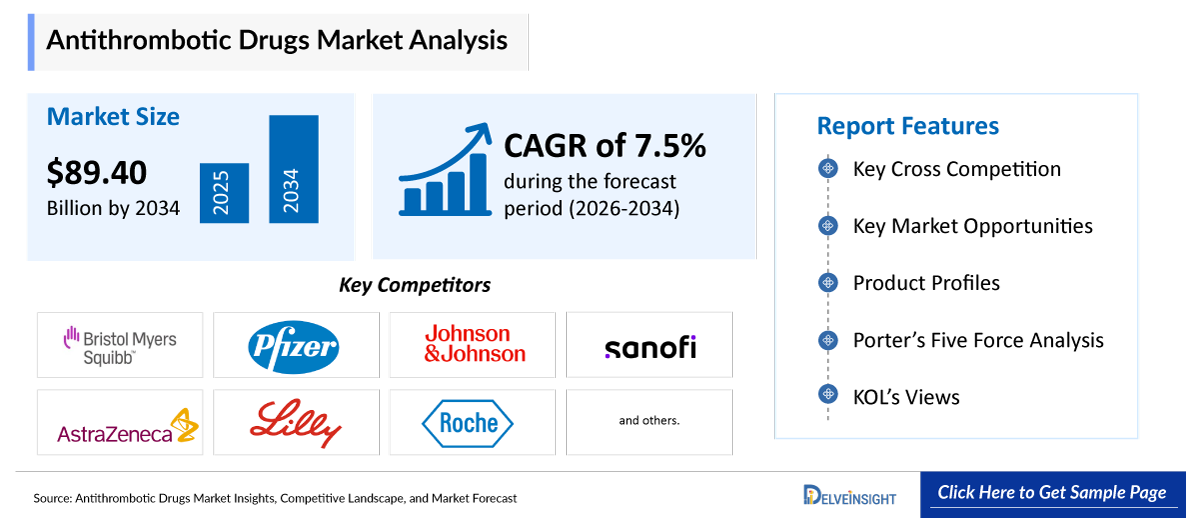
● The Antithrombotic Drugs market is estimated at USD 46.80 billion in 2025 and is projected to reach USD 89.40 billion by 2034. Growth is anchored in the rising global burden of atrial fibrillation and venous thromboembolism, continued conversion from vitamin K antagonists to direct oral anticoagulants (DOACs), and an advancing pipeline of Factor XI/XIa-targeted agents designed to deliver hemostasis-sparing anticoagulation.
● The global Antithrombotic Drugs market is growing at a CAGR of 7.5% during the forecast period from 2026 to 2034.
● By drug class, the anticoagulants segment dominated the Antithrombotic Drugs market with a 59% share in 2025.
● By mechanism of action, the thrombin/factor Xa pathway inhibitors segment dominated the Antithrombotic Drugs market with a 47% share in 2025.
● By route of administration, the oral segment dominated the Antithrombotic Drugs market with a 66% share in 2025.
● By indication, the cardiovascular disorders segment dominated the Antithrombotic Drugs market with a 41% share in 2025.
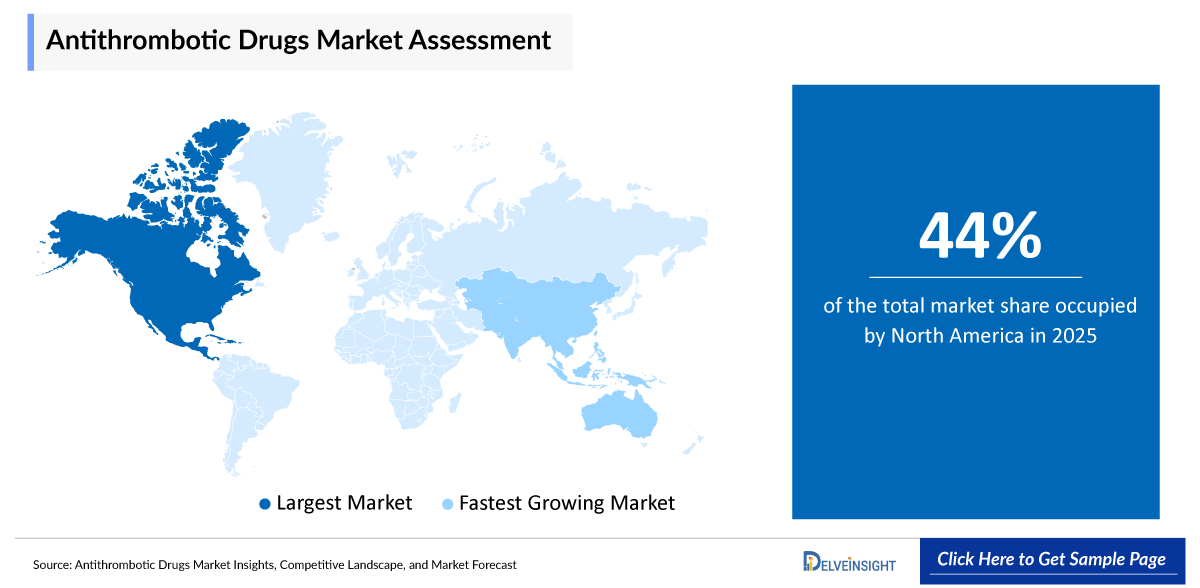
● North America dominated the global Antithrombotic Drugs Market revenue with a 44% share in 2025, representing the highest regional market share globally.
Antithrombotic drugs are pharmacologic agents used to prevent and treat pathological blood clot formation, spanning anticoagulants, antiplatelet drugs, and thrombolytics/fibrinolytics that act on distinct points of the coagulation and platelet-activation cascades. Because thromboembolic disease, including atrial fibrillation, venous thromboembolism, and acute coronary syndromes, is a leading global cause of morbidity and mortality, antithrombotic therapy is among the most widely prescribed classes of cardiovascular medicine. The market is organized by drug class across anticoagulants, antiplatelet drugs, and thrombolytics/fibrinolytics; by mechanism of action, including coagulation factor inhibitors, vitamin K pathway inhibitors, thrombin/factor Xa pathway inhibitors, platelet aggregation inhibitors, and others; by route of administration across oral, subcutaneous, and intravenous delivery; and by indication, led by cardiovascular disorders alongside venous thromboembolism, arterial thromboembolism, and other indications. Driven by an aging population, the continued shift from warfarin to direct oral anticoagulants, expanding dual and triple antithrombotic regimens in percutaneous coronary intervention, and a maturing pipeline of Factor XI/XIa inhibitors aimed at reducing bleeding risk, antithrombotic drugs remain a cornerstone of cardiovascular and thromboembolic disease management even as blockbuster branded therapies approach patent expiry.
Antithrombotic Drugs Market Key Growth Drivers
• The rising global burden of atrial fibrillation and venous thromboembolism is driving demand, with direct oral anticoagulants such as apixaban and rivaroxaban continuing to anchor stroke-prevention and VTE treatment regimens.
• The continued clinical shift from vitamin K antagonists such as warfarin to direct oral anticoagulants is expanding the addressable prescription base across atrial fibrillation and VTE indications.
• Growing use of dual and triple antithrombotic therapy combining anticoagulants and antiplatelet agents in acute coronary syndrome and post-PCI care is broadening treatment intensity and prescription volume.
• An advancing pipeline of Factor XI/XIa inhibitors, including milvexian, asundexian, and abelacimab, is targeting hemostasis-sparing anticoagulation with the potential to reduce bleeding risk relative to existing DOACs.
• Rising surgical volumes, particularly major orthopedic procedures such as hip and knee arthroplasty, are sustaining demand for perioperative thromboprophylaxis.
• An aging global population with rising cardiovascular comorbidity is expanding the population at risk of arterial and venous thromboembolic events.
• Strategic life-cycle management and portfolio diversification by originator companies ahead of major DOAC patent cliffs are shaping competitive dynamics through the forecast period.
Key Companies in Antithrombotic Drugs Market
The competitive landscape is led by the following active manufacturers:
• Bristol Myers Squibb
• Pfizer
• Bayer
• Johnson & Johnson
• Sanofi
• Boehringer Ingelheim
• Daiichi Sankyo
• AstraZeneca
• Eli Lilly and Company
• Roche
Factors Contributing to the Growth of the Antithrombotic Drugs Market
Market Drivers
Rising Global Burden of Atrial Fibrillation and Venous Thromboembolism
The most powerful driver of the Antithrombotic Drugs market is the growing global burden of atrial fibrillation and venous thromboembolism, both of which require sustained anticoagulant therapy to prevent stroke and recurrent clot formation. Atrial fibrillation prevalence is rising with an aging population, and direct oral anticoagulants such as apixaban and rivaroxaban have become the guideline-preferred standard of care for stroke prevention given their favorable dosing convenience relative to warfarin. Venous thromboembolism, encompassing deep vein thrombosis and pulmonary embolism, similarly requires extended anticoagulant treatment, and rising surgical volumes, cancer-associated thrombosis, and prolonged immobility continue to expand the treated population. As the at-risk population grows and diagnostic detection improves, demand for anticoagulant and supportive antithrombotic therapy expands directly, anchoring market growth through 2034.
Continued Shift from Vitamin K Antagonists to Direct Oral Anticoagulants
A structural shift away from warfarin and other vitamin K antagonists toward direct oral anticoagulants continues to reshape prescribing patterns. DOACs such as apixaban, rivaroxaban, dabigatran, and edoxaban offer fixed dosing, fewer food and drug interactions, and reduced need for routine coagulation monitoring compared with warfarin, driving sustained conversion among both newly diagnosed and previously warfarin-treated patients. This conversion has been a primary engine of anticoagulant segment growth over the past decade and continues to support unit volume even as pricing pressure intensifies with generic entry. As clinical guidelines increasingly favor DOACs as first-line therapy across atrial fibrillation and VTE indications, the shift continues to broaden the prescription base and reinforce anticoagulants as the leading drug class.
Market Restraints
Despite strong underlying demand, the Antithrombotic Drugs market faces material constraints. Patent expirations across leading branded anticoagulants are a significant headwind: rivaroxaban's core US patent lapsed in 2025 with generic versions approved shortly thereafter, and apixaban's European exclusivity expires in 2026 with US generic entry anticipated from 2028, together threatening substantial branded revenue erosion. Bleeding risk remains an intrinsic limitation of all antithrombotic mechanisms, requiring careful patient selection, dose adjustment in renal impairment, and management of drug-drug interactions, which constrains adoption in higher-risk populations and contributes to underuse in eligible patients. Clinical setbacks in the emerging Factor XI/XIa inhibitor class, including the early discontinuation of a Factor XIa program in atrial fibrillation on safety grounds and a Phase 3 acute coronary syndrome trial that was stopped for futility in late 2025, illustrate the scientific and regulatory uncertainty facing next-generation candidates. High costs of branded DOACs relative to generic warfarin continue to create access and reimbursement challenges in price-sensitive and emerging markets, while adherence challenges, particularly for lifelong anticoagulation, and the logistical complexity of bridging and reversal protocols add further friction. Stringent regulatory and pharmacovigilance requirements around bleeding-related adverse events lengthen development timelines for new entrants. Together, these patent, safety, cost, and regulatory barriers temper the pace of growth, even as the underlying drivers of demographic aging, cardiovascular disease burden, and DOAC conversion remain firmly intact.
Antithrombotic Drugs Market Segment Analysis
The antithrombotic drugs market by drug class (anticoagulants, antiplatelet drugs, thrombolytics/fibrinolytics), mechanism of action (coagulation factor inhibitors, vitamin k pathway inhibitors, thrombin/factor xa pathway inhibitors, platelet aggregation inhibitors, others), route of administration (oral, subcutaneous, intravenous), indication (venous thromboembolism, arterial thromboembolism, cardiovascular disorders, others), and geography (North America, Europe, Asia-Pacific, and Rest of World).
Drug Class
Dominant Subsegment: Anticoagulants.
The anticoagulants segment accounted for 59% of the Antithrombotic Drugs market in 2025. Anticoagulants are the leading drug class because they anchor first-line, chronic therapy for the two largest thromboembolic indications, atrial fibrillation and venous thromboembolism, and because direct oral anticoagulants such as apixaban, rivaroxaban, dabigatran, and edoxaban are prescribed continuously over years rather than episodically. The established clinical dominance of DOACs over vitamin K antagonists, combined with broad guideline endorsement and payer coverage, sustains great and recurring demand. Injectable anticoagulants, including low molecular weight heparins, remain essential for perioperative prophylaxis and acute hospital-based treatment. While antiplatelet drugs post steady demand from cardiovascular secondary prevention and thrombolytics remain the fastest-growing class given their essential role in acute stroke and myocardial infarction reperfusion, the sheer chronicity, breadth of indications, and prescription volume of anticoagulant therapy secure the anticoagulants segment's leadership across the forecast period.
By Mechanism of Action
Dominant Subsegment: Thrombin/Factor Xa Pathway Inhibitors.
The thrombin/factor Xa pathway inhibitors segment accounted for 47% of the Antithrombotic Drugs market in 2025. This mechanism, which underpins the leading direct oral anticoagulants apixaban, rivaroxaban, edoxaban, and dabigatran, is the leading mode of action because it delivers effective anticoagulation with more predictable pharmacokinetics and fewer monitoring requirements than vitamin K pathway inhibition. Broad guideline adoption of factor Xa and direct thrombin inhibitors as first-line stroke-prevention and VTE therapy, together with continued conversion of warfarin-treated patients, sustains the segment's scale. Platelet aggregation inhibitors, spanning P2Y12 inhibitors and other antiplatelet mechanisms, remain essential in acute coronary syndrome and post-PCI care, while vitamin K pathway inhibition continues to decline as a share of new prescriptions. Emerging coagulation factor inhibitors targeting Factor XI and XIa represent the fastest-growing mechanism as the pipeline matures, but the established scale and breadth of thrombin/factor Xa inhibition secure its leadership across the forecast period.
Antithrombotic Drugs Market Region Analysis
Dominant Region: North America
North America accounted for 44% of the global Antithrombotic Drugs market revenue in 2025, representing the highest regional market share globally. The region's dominance reflects a high prevalence of atrial fibrillation and cardiovascular disease, early and broad adoption of direct oral anticoagulants, strong reimbursement coverage, and the concentrated presence of leading originator companies including Bristol Myers Squibb, Pfizer, Johnson & Johnson, and Eli Lilly. The United States hosts the largest base of DOAC prescribing globally, supported by well-established clinical guidelines and extensive payer formulary coverage. Ongoing patent-cliff dynamics, including generic rivaroxaban entry following the 2025 US patent expiry and anticipated apixaban generic entry from 2028, are beginning to reshape the competitive and pricing landscape, even as originators pursue direct-to-patient and life-cycle strategies to defend share. High surgical volumes, an aging population, and deep clinical-trial infrastructure supporting next-generation Factor XI/XIa candidates further anchor the region's continued leadership across the forecast period.
Fastest Growing Region: Asia-Pacific
Asia-Pacific is the fastest-growing region in the Antithrombotic Drugs market. The region's elevated CAGR is driven by rising cardiovascular disease incidence, an expanding and aging population, growing healthcare investment, and increasing diagnosis and treatment rates for atrial fibrillation and venous thromboembolism across China, Japan, India, South Korea, and Australia. China is expanding domestic DOAC manufacturing and broadening reimbursement coverage, Japan maintains a mature but growing anticoagulant market supported by its aging population, and India offers a large and underpenetrated patient population alongside cost-competitive generic and branded-generic manufacturing capacity. Rising awareness of thromboembolic disease, expanding hospital and cardiology infrastructure, and growing local production of generic anticoagulants and antiplatelet agents are accelerating adoption across the region. The combination of high disease burden, demographic aging, and healthcare infrastructure build-out positions Asia-Pacific as the principal source of incremental growth over the forecast period.
Regional Commentary
North America
North America accounted for 44% of the global Antithrombotic Drugs market revenue in 2025. The United States dominates on the strength of high atrial fibrillation and cardiovascular disease prevalence, broad DOAC adoption, strong reimbursement, and the concentrated presence of leading originators, while ongoing generic erosion following rivaroxaban's patent expiry and the approaching apixaban patent cliff are reshaping competitive dynamics.
Europe
Europe is a large and mature regional market, supported by established EMA regulatory pathways, broad national health-system reimbursement, and a well-developed base of cardiology and thrombosis care. Apixaban's loss of European exclusivity in May 2026 and the earlier entry of generic rivaroxaban are accelerating generic competition and pricing pressure across Germany, France, the United Kingdom, Italy, and Spain, even as underlying disease-driven demand remains stable.
Asia-Pacific
Asia-Pacific is the fastest-growing region, propelled by rising cardiovascular disease incidence, an aging population, and expanding healthcare investment across China, Japan, India, South Korea, and Australia. Broadening reimbursement, growing local generic and branded-generic manufacturing capacity, and rising diagnosis rates for atrial fibrillation and venous thromboembolism are accelerating regional market growth.
Rest of World
The Rest of World region, spanning Latin America, the Middle East, and Africa, is an emerging growth frontier. Expanding cardiovascular care infrastructure, rising awareness and diagnosis of thromboembolic disease, and gradually improving access to both branded and generic antithrombotic therapies are broadening the treated population, while affordability and reimbursement constraints continue to shape adoption pace across the region.
Antithrombotic Drugs Market Competitive Landscape
The Antithrombotic Drugs market is classified as Moderately Concentrated. A group of large, diversified pharmaceutical companies with blockbuster branded anticoagulants and antiplatelet portfolios, including Bristol Myers Squibb, Pfizer, Bayer, and Johnson & Johnson, anchors the top tier through apixaban and rivaroxaban, while Boehringer Ingelheim, Daiichi Sankyo, Sanofi, AstraZeneca, Eli Lilly and Company, and Roche compete through established anticoagulant, antiplatelet, and thrombolytic brands and, increasingly, through next-generation Factor XI/XIa pipeline programs, intensifying competition ahead of major patent expirations.
The competitive landscape can be evaluated across the following dimensions:
• Market concentration: Moderately concentrated, with blockbuster DOAC originators leading and a broad field of antiplatelet, thrombolytic, and next-generation pipeline competitors.
• Leading players: Bristol Myers Squibb, Pfizer, Bayer, and Johnson & Johnson anchor the top tier through apixaban and rivaroxaban, the two leading direct oral anticoagulants.
• Geographic reach: Leaders operate global commercial infrastructure spanning North America, Europe, and Asia-Pacific, essential for defending share against regional generic entrants.
• Portfolio breadth: Top players offer coverage across anticoagulant, antiplatelet, and, in Roche's case, thrombolytic mechanisms, supporting cross-indication commercial reach.
• Pipeline depth: Investment in Factor XI/XIa inhibitors, including Bristol Myers Squibb and Johnson & Johnson's milvexian and Bayer's asundexian programs, is a decisive long-term competitive differentiator.
• Strategic partnerships: Co-marketing alliances, such as the Bristol Myers Squibb-Pfizer apixaban partnership, the Bayer-Johnson & Johnson rivaroxaban partnership, and the Daiichi Sankyo-Eli Lilly prasugrel partnership, extend commercial reach and shared development risk.
• Patent and life-cycle management: Active defense of branded DOAC revenue through direct-to-patient programs, formulation life-cycle management, and next-generation candidate development ahead of the apixaban and rivaroxaban patent cliffs.
• Manufacturing capabilities: Established small-molecule and, for abelacimab-class candidates, biologics manufacturing capacity underpin large-scale global supply.
• Innovation focus: Factor XI/XIa inhibition, hemostasis-sparing anticoagulation, combination antithrombotic regimens, and continued life-cycle management of legacy DOAC and antiplatelet brands.
Antithrombotic Drugs Market Recent Developmental Activities
In 2026, Bristol Myers Squibb and Johnson & Johnson reported final Phase 3 LIBREXIA ACS results at the European Society of Cardiology Congress showing the Factor XIa inhibitor milvexian did not reduce cardiovascular events when added to standard antiplatelet therapy after acute coronary syndrome, following the trial's discontinuation for futility in November 2025. Strategic significance: Signals continued scientific uncertainty in the Factor XIa class while informing ongoing trials of milvexian in atrial fibrillation and stroke prevention.
In May 2026, Bristol Myers Squibb and Pfizer saw Eliquis (apixaban) lose regulatory market exclusivity across the European Union, opening the region to generic apixaban competition. Strategic significance: Marks the beginning of a major patent cliff for the world's leading anticoagulant brand and accelerates originator life-cycle and portfolio-defense strategies.
In March 2025, Bayer and Johnson & Johnson saw the FDA approve the first generic versions of rivaroxaban 2.5 mg tablets following the expiry of Xarelto's core US patent. Strategic significance: Begins US generic erosion for the second-leading branded direct oral anticoagulant and reshapes competitive pricing dynamics.
Antithrombotic Drugs Market Segmentation
Antithrombotic Drugs Market by Drug Class
• Anticoagulants
• Antiplatelet Drugs
• Thrombolytics / Fibrinolytics
Antithrombotic Drugs Market by Mechanism of Action
• Coagulation Factor Inhibitors
• Vitamin K Pathway Inhibitors
• Thrombin/Factor Xa Pathway Inhibitors
• Platelet Aggregation Inhibitors
• Others
Antithrombotic Drugs Market by Route of Administration
• Oral
• Subcutaneous
• Intravenous
Antithrombotic Drugs Market by Indication
• Venous Thromboembolism
• Arterial Thromboembolism
• Cardiovascular Disorders
• Others
Antithrombotic Drugs Market by Geography
• North America Antithrombotic Drugs Market
▪ United States Antithrombotic Drugs Market Size in USD million (2023-2034)
▪ Canada Antithrombotic Drugs Market Size in USD million (2023-2034)
▪ Mexico Antithrombotic Drugs Market Size in USD million (2023-2034)
• Europe Antithrombotic Drugs Market
▪ Germany Antithrombotic Drugs Market Size in USD million (2023-2034)
▪ United Kingdom Antithrombotic Drugs Market Size in USD million (2023-2034)
▪ France Antithrombotic Drugs Market Size in USD million (2023-2034)
▪ Italy Antithrombotic Drugs Market Size in USD million (2023-2034)
▪ Spain Antithrombotic Drugs Market Size in USD million (2023-2034)
▪ Rest of Europe Antithrombotic Drugs Market Size in USD million (2023-2034)
• Asia-Pacific Antithrombotic Drugs Market
▪ China Antithrombotic Drugs Market Size in USD million (2023-2034)
▪ Japan Antithrombotic Drugs Market Size in USD million (2023-2034)
▪ India Antithrombotic Drugs Market Size in USD million (2023-2034)
▪ Australia Antithrombotic Drugs Market Size in USD million (2023-2034)
▪ South Korea Antithrombotic Drugs Market Size in USD million (2023-2034)
▪ Rest of Asia-Pacific Antithrombotic Drugs Market Size in USD million (2023-2034)
• Rest of the World (RoW) Antithrombotic Drugs Market
▪ Middle East Antithrombotic Drugs Market Size in USD million (2023-2034)
▪ Africa Antithrombotic Drugs Market Size in USD million (2023-2034)
▪ South America Antithrombotic Drugs Market Size in USD million (2023-2034)
Key Takeaways from the Antithrombotic Drugs Market Report Study
• Market size analysis for the current Antithrombotic Drugs market size (2025), and market forecast for 9 years (2026 to 2034).
• Top key product/technology developments, mergers, acquisitions, partnerships, and joint ventures that happened over the last 3 years.
• Key companies dominating the global Antithrombotic Drugs market.
• Various opportunities available for competitors in the Antithrombotic Drugs market space.
• What are the top-performing segments in 2025? How will these segments perform in 2034?
• Which are the top-performing regions and countries in the current Antithrombotic Drugs market scenario?
• Which are the regions and countries where companies should concentrate their opportunities for Antithrombotic Drugs market growth in the future?
Target audience who can benefit from this Antithrombotic Drugs market report study
• Antithrombotic Drugs product providers
• Research organizations and consulting companies
• Antithrombotic Drugs -related organizations, associations, forums, and other alliances
• Government and corporate offices
• Start-up companies, venture capitalists, and private equity firms
• Distributors and traders dealing in Antithrombotic Drugs
• Various end-users who want to know more about the Antithrombotic Drugs market and the latest technological developments in the Antithrombotic Drugs market.

