
Antithymocyte globulin Market Summary
Key Factors Driving Antithymocyte globulin Growth
1. Rising Number of Solid Organ Transplantations Worldwide
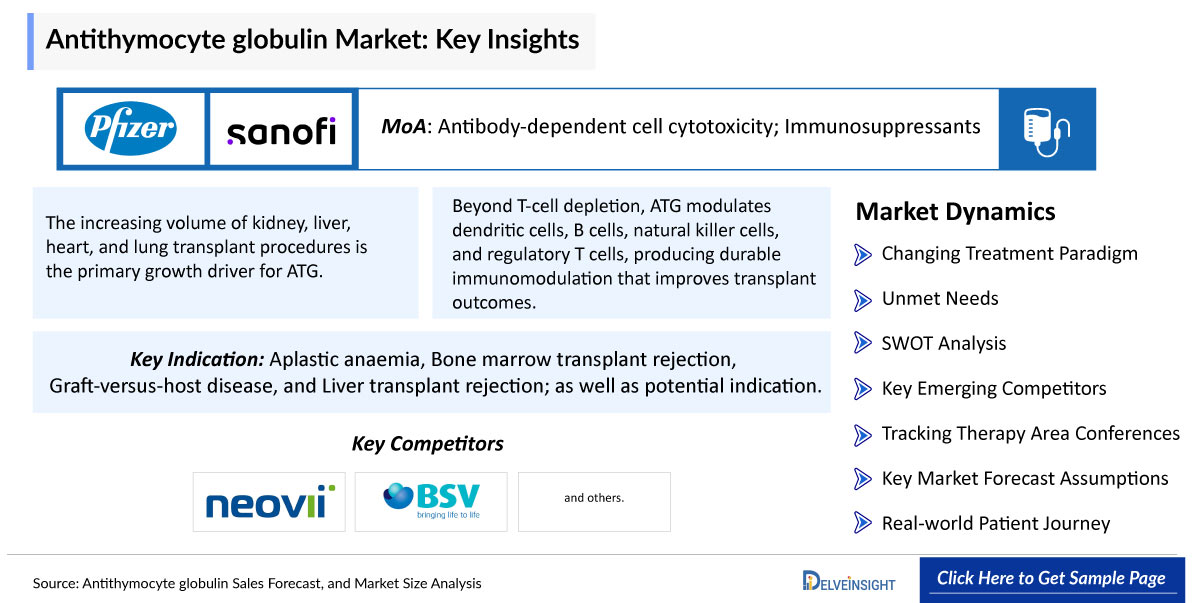
The increasing volume of kidney, liver, heart, and lung transplant procedures is the primary growth driver for ATG. Rabbit antithymocyte globulin (rATG) remains one of the most widely used induction immunosuppressive agents in kidney transplantation, particularly for patients at moderate-to-high immunologic risk. Clinical reviews report that antibody induction therapy is used in the majority of kidney transplant recipients in the U.S., with Thymoglobulin being the leading lymphocyte-depleting induction agent due to its ability to significantly reduce acute rejection and improve graft survival. This expanding transplant population directly supports sustained demand for ATG.
2. Strong Clinical Evidence Supporting Superior Rejection Prevention
Multiple randomized trials and long-term clinical reviews have demonstrated that ATG reduces the incidence of acute cellular rejection compared with non-depleting induction therapies, especially in high-risk transplant recipients. Beyond T-cell depletion, ATG modulates dendritic cells, B cells, natural killer cells, and regulatory T cells, producing durable immunomodulation that improves transplant outcomes. These well-established efficacy data have led to broad incorporation into international transplant protocols, sustaining physician confidence and continued utilization.
3. Expanding Use in Hematopoietic Stem Cell Transplantation (HSCT)
ATG is increasingly incorporated into conditioning regimens for allogeneic hematopoietic stem cell transplantation (HSCT) to reduce both acute and chronic graft-versus-host disease (GVHD). Published studies have consistently shown that ATG lowers GVHD incidence, particularly in unrelated or mismatched donor transplants, while improving transplant success. As the number of HSCT procedures continues to rise globally for leukemia, lymphoma, aplastic anemia, and inherited blood disorders, ATG utilization is expected to remain strong across hematology centers.
4. Continued Role in Severe Aplastic Anemia Treatment
Equine ATG (ATGAM®), combined with cyclosporine, remains the standard first-line immunosuppressive therapy for patients with severe aplastic anemia who are not eligible for stem cell transplantation. Long-term clinical studies have demonstrated durable hematologic response rates, and major hematology guidelines continue to recommend ATG-based immunosuppression. The persistent unmet need in aplastic anemia and ongoing use in treatment algorithms provide an additional stable source of demand beyond transplantation.
5. Favorable Regulatory Position and Broad Clinical Acceptance
Rabbit ATG (Thymoglobulin®) has maintained regulatory approvals for the prophylaxis and treatment of acute rejection in kidney transplantation and has accumulated more than three decades of clinical experience. Continuous FDA label updates and extensive real-world evidence reinforce physician familiarity and institutional adoption. Its established safety and efficacy profile, coupled with widespread inclusion in transplant center protocols, creates a significant competitive advantage over newer immunosuppressive agents.
Antithymocyte globulin Recent Developments
Beyond type 1 diabetes, ATG continues to have established clinical use in transplantation and hematology, and recent publications keep expanding discussion of its role in immune-mediated cytopenias and other T-cell-mediated conditions. The broader pattern is incremental clinical repurposing and dose optimization rather than a brand-new commercial expansion program.
“Antithymocyte globulin Sales Forecast, and Market Size Analysis – 2034” report provides comprehensive insights of Antithymocyte globulin for approved indication like Aplastic anaemia, Bone marrow transplant rejection, Graft-versus-host disease, and Liver transplant rejection; as well as potential indication like Heart transplant rejection, Myelodysplastic syndromes, and Type 1 diabetes mellitus in the 7MM. A detailed picture of Antithymocyte globulin’s existing usage in approved and anticipated entry and performance in potential indications in the 7MM, i.e., the United States, EU4 (Germany, France, Italy, and Spain) and the United Kingdom, and Japan for the study period 2020 –2034 is provided in this report along with a detailed description of the Antithymocyte globulin for approved and potential indications. The Antithymocyte globulin market report provides insights about Antithymocyte globulin’s sales forecast, mechanism of action (MoA), dosage and administration, as well as research and development including regulatory milestones, along with other developmental activities. Further, it also consists of historical and current Antithymocyte globulin performance, future market assessments inclusive of the Antithymocyte globulin market forecast analysis for approved and potential indications in the 7MM, SWOT, analysts’ views, comprehensive overview of market competitors, and brief about other emerging therapies in respective indications. It also provides analysis of Antithymocyte globulin sales forecasts, along with factors driving its market.
Antithymocyte globulin Drug Summary
Antithymocyte globulin is a polyclonal antibody-based immunosuppressive therapy derived from rabbits or horses immunized with human thymocytes or T-cell lines, and is widely used for the prevention and treatment of graft-versus-host disease (GVHD) in patients undergoing allogeneic hematopoietic cell transplantation, as well as for the prevention of organ transplant rejection and the treatment of severe aplastic anemia. Administered by intravenous infusion, ATG binds to multiple antigens expressed on human T lymphocytes, resulting in profound T-cell depletion through complement-mediated lysis, antibody-dependent cellular cytotoxicity, and apoptosis, thereby reducing alloreactive immune responses that drive GVHD. In the transplant setting, ATG is typically incorporated into conditioning regimens before transplantation to lower the incidence and severity of both acute and chronic GVHD, particularly in unrelated or mismatched donor transplants. Although highly effective as an immunosuppressant, its use is associated with an increased risk of infections, viral reactivation (especially cytomegalovirus and Epstein–Barr virus), infusion-related reactions, and delayed immune reconstitution, necessitating careful patient monitoring and supportive care. Rabbit-derived formulations, such as Thymoglobulin, are the most commonly used in current clinical practice and are recommended in several international transplantation guidelines. The report provides Antithymocyte globulin’s sales, growth barriers and drivers, post usage and approvals in multiple indications.
Scope of the Antithymocyte globulin Market Report
The report provides insights into:
- A comprehensive product overview including the Antithymocyte globulin MoA, description, dosage and administration, research and development activities in approved indications like Aplastic anaemia, Bone marrow transplant rejection, Graft-versus-host disease, and Liver transplant rejection; as well as potential indication like Heart transplant rejection, Myelodysplastic syndromes, and Type 1 diabetes mellitus.
- Elaborated details on Antithymocyte globulin regulatory milestones and other development activities have been provided in Antithymocyte globulin market report.
- The report also highlights Antithymocyte globulin‘s cost estimates and regional variations, reported and estimated sales performance, research and development activities in approved and potential indications across the United States, Europe, and Japan.
- The Antithymocyte globulin market report also covers the patents information, generic entry and impact on cost cut.
- The Antithymocyte globulin market report contains current and forecasted Antithymocyte globulin sales for approved and potential indications till 2034.
- Comprehensive coverage of the late-stage emerging therapies for respective indications.
- The Antithymocyte globulin market report also features the SWOT analysis with analyst views for Antithymocyte globulin in approved and potential indications.
Methodology
The Antithymocyte globulin market report is built using data and information sourced primarily from internal databases, primary and secondary research and in-house analysis by DelveInsight’s team of industry experts. Information and data from the secondary sources have been obtained from various printable and nonprintable sources like search engines, news websites, global regulatory authorities websites, trade journals, white papers, magazines, books, trade associations, industry associations, industry portals and access to available databases.
Antithymocyte globulin Analytical Perspective by DelveInsight
- In-depth Antithymocyte globulin Market Assessment
This Antithymocyte globulin sales market forecast report provides a detailed market assessment of Antithymocyte globulin for approved indication like Aplastic anaemia, Bone marrow transplant rejection, Graft-versus-host disease, and Liver transplant rejection; as well as potential indication like Heart transplant rejection, Myelodysplastic syndromes, and Type 1 diabetes mellitus in the seven major markets, i.e., the United States, EU4 (Germany, France, Italy, and Spain) and the United Kingdom, and Japan. This segment of the report provides current and forecasted Antithymocyte globulin sales data uptil 2034.
- Antithymocyte globulin Clinical Assessment
The Antithymocyte globulin market report provides the clinical trials information of Antithymocyte globulin for approved and potential indications covering trial interventions, trial conditions, trial status, start and completion dates.
Antithymocyte globulin Competitive Landscape
The report provides Insights on competitors and marketed products within the domain, along with a summary of emerging products and their respective launch dates, posing significant competition in the market.
Antithymocyte globulin Market Potential & Revenue Forecast
- Projected market size for the Antithymocyte globulin and its key indications
- Estimated Antithymocyte globulin sales potential (Antithymocyte globulin peak sales forecasts)
- Antithymocyte globulin Pricing strategies and reimbursement landscape
Antithymocyte globulin Competitive Intelligence
- Number of competing drugs in development (pipeline analysis)
- Antithymocyte globulin Market positioning compared to existing treatments
- Antithymocyte globulin Strengths & weaknesses relative to competitors
Antithymocyte globulin Regulatory & Commercial Milestones
- Antithymocyte globulin Key regulatory approvals & expected launch timelines
- Commercial partnerships, licensing deals, and M&A activity
Antithymocyte globulin Clinical Differentiation
- Antithymocyte globulin Efficacy & safety advantages over existing drugs
- Antithymocyte globulin Unique selling points
Antithymocyte globulin Market Report Highlights
- In the coming years, the Antithymocyte globulin market scenario is set to change due to strong adoption, increased prescriptions and broader uptake in multiple immunological indications; which would expand the size of the market.
- The Antithymocyte globulin companies are developing therapies that focus on novel approaches to treat/improve the disease condition, assess challenges, and seek opportunities that could influence Antithymocyte globulin’s dominance.
- Other emerging products for Aplastic anaemia, Bone marrow transplant rejection, Graft-versus-host disease, and Liver transplant rejection; as well as potential indication like Heart transplant rejection, Myelodysplastic syndromes, and Type 1 diabetes mellitus are expected to give tough market competition to Antithymocyte globulin and launch of late-stage emerging therapies in the near future will significantly impact the market.
- A detailed description of regulatory milestones, and developmental activities, provide the current development scenario of Antithymocyte globulin in approved and potential indications.
- Analyse Antithymocyte globulin cost, pricing trends and market positioning to support strategic decision-making in the immunology landscape.
- Our in-depth analysis of the forecasted Antithymocyte globulin sales data uptil 2034 will support the clients in decision-making process regarding their therapeutic portfolio by identifying the overall scenario of Antithymocyte globulin in approved and potential indications.
Key Questions
- What is the class of therapy, route of administration and mechanism of action of Antithymocyte globulin? How strong is Antithymocyte globulin’s clinical and commercial performance?
- What is Antithymocyte globulin’s clinical trial status in each individual indications such as Aplastic anaemia, Bone marrow transplant rejection, Graft-versus-host disease, and Liver transplant rejection; as well as potential indication like Heart transplant rejection, Myelodysplastic syndromes, and Type 1 diabetes mellitus and study completion date?
- What are the key collaborations, mergers and acquisitions, licensing and other activities related to the Antithymocyte globulin Manufacturers?
- What are the key designations that have been granted to Antithymocyte globulin for approved and potential indications? How are they going to impact Antithymocyte globulin’s penetration in various geographies?
- What is the current and forecasted Antithymocyte globulin market scenario for approved and potential indications? What are the key assumptions behind the forecast?
- What are the current and forecasted sales of Antithymocyte globulin in the seven major countries, including the United States, Europe (Germany, France, Italy, Spain) and the United Kingdom, and Japan?
- What are the other emerging products available and how are these giving competition to Antithymocyte globulin for approved and potential indications?
- Which are the late-stage emerging therapies under development for the treatment of approved and potential indications?
- How cost-effective is Antithymocyte globulin? What is the duration of therapy and what are the geographical variations in cost per patient?

