Assisted Reproductive Technology Market Summary
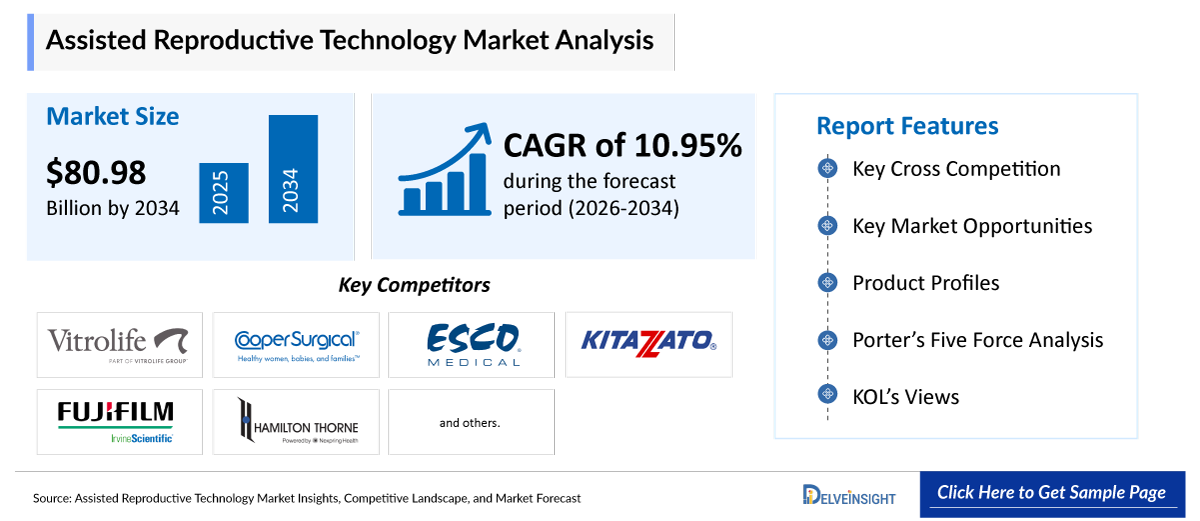
- The Assisted Reproductive Technology (ART) market is estimated at USD 31.63 billion in 2025 and is projected to reach USD 80.58 billion by 2034. Growth is anchored in rising global infertility prevalence, expanding acceptance of donor-based family building, rapid technology adoption such as AI-assisted embryo selection and time-lapse imaging, and sustained expansion of fertility clinic networks worldwide.
- The global ART market is growing at a CAGR of 10.95% during the forecast period from 2026 to 2034.
- By product type, the consumables segment dominated the ART market with a 58% share in 2025.
- By technology, the In Vitro Fertilization (IVF) segment dominated the ART market with a 65% share in 2025.
- By donor type, the Non-Donor ART segment dominated the ART market with an 82% share in 2025.
- By end-users, the Fertility and IVF Clinics segment dominated the ART market with a 61% share in 2025.
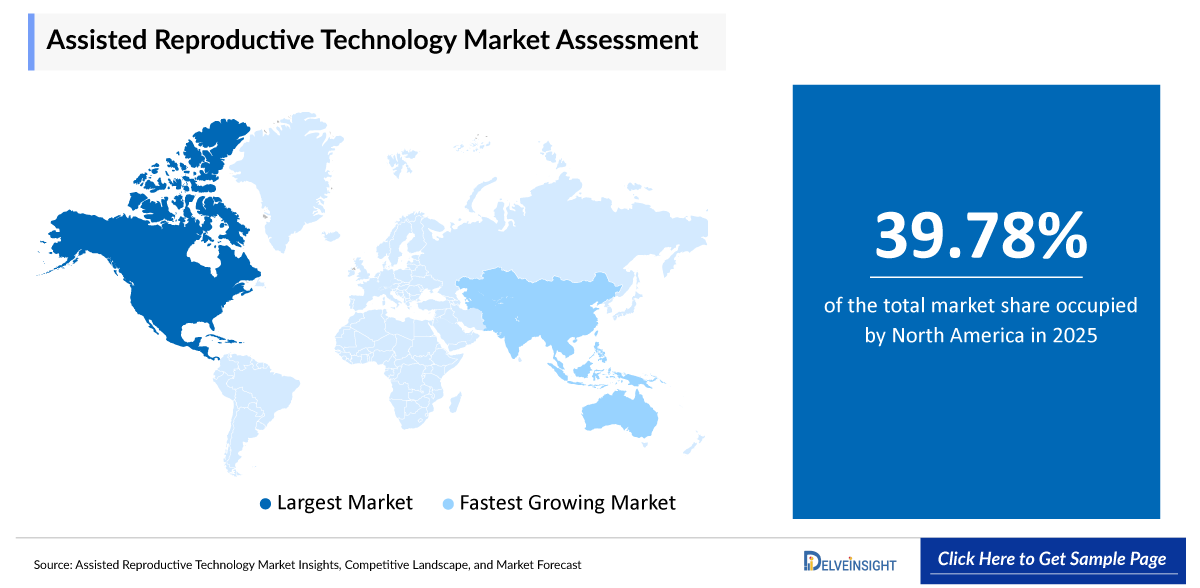
- Europe dominated the global ART market revenue with a 39.78% share in 2025, representing the highest regional market share globally.
Assisted Reproductive Technology (ART) encompasses a group of medical procedures and the specialized equipment and consumables used to handle human eggs, sperm, and embryos outside the body to help individuals and couples achieve conception. Because ART procedures require precision instruments, temperature- and time-sensitive culture media, cryopreservation systems, and rigorously validated laboratory workflows, fertility clinics and hospitals depend on specialized manufacturers to supply incubators, micromanipulation systems, imaging platforms, cryodevices, culture media, catheters, and other disposables that underpin every treatment cycle. The market is organized by product type across equipment and consumables; by technology, including In Vitro Fertilization (IVF), Intracytoplasmic Sperm Injection (ICSI), Frozen Embryo Transfer (FET), Preimplantation Genetic Testing (PGT), Intrauterine Insemination (IUI), and others; by donor type across non-donor ART, donor egg ART, donor sperm ART, and donor embryo ART; and by end-users, led by fertility and IVF clinics. Driven by rising infertility prevalence, delayed parenthood, technological innovation in embryology labs, and growing consolidation among device and consumable manufacturers, the ART market has become essential infrastructure underpinning the global fertility care ecosystem.
Assisted Reproductive Technology Market Key Growth Drivers
• Rising global infertility prevalence is expanding demand for fertility care, with the World Health Organization estimating that approximately 17.5% of the global adult population, roughly 1 in 6 individuals, experiences infertility.
• The growing trend of delayed parenthood, particularly in developed economies, is increasing the incidence of age-related infertility and driving greater reliance on IVF, ICSI, and donor-based ART procedures.
• Rapid technological advancement, including AI-driven embryo selection reaching 70-97% accuracy, time-lapse incubation, and next-generation vitrification media, is improving success rates and expanding clinical adoption.
• Growing social acceptance of donor egg, donor sperm, and donor embryo programs, along with rising demand from same-sex couples and single-parent family building, is broadening the addressable patient base.
• Expanding government funding and insurance coverage for fertility treatment, including Poland's 2025 policy reversal restoring public ART funding, is improving access and reducing out-of-pocket barriers across Europe.
• Rapid clinic network expansion and medical tourism in Asia-Pacific, supported by cost arbitrage in India and pro-fertility policies in China, are accelerating regional procedure volumes.
• Active consolidation among ART device and consumable manufacturers, exemplified by Astorg's formation of an integrated ART MedTech platform, is expanding product breadth and global distribution reach.
• The convergence of rising infertility prevalence, technological innovation, donor-program acceptance, and manufacturer consolidation is expected to sustain strong double-digit growth in the market through 2034.
Key Companies in Assisted Reproductive Technology Market
The competitive landscape is led by the following active manufacturers:
• Vitrolife Group
• CooperSurgical
• Esco Medical
• Kitazato Corporation
• FUJIFILM Irvine Scientific
• Hamilton Thorne Ltd. / Hamilton Thorne Group
• ASTEC Co., Ltd.
• Vitromed GmbH
• Cook Medical
• Thermo Fisher Scientific
Factors Contributing to the Growth of the Assisted Reproductive Technology Market
Market Drivers
Rising Global Infertility Prevalence and Delayed Parenthood
The most powerful driver of the ART market is the rising global prevalence of infertility. The World Health Organization estimates that approximately 17.5% of the adult population, roughly 1 in 6 individuals worldwide, experiences infertility at some point in their reproductive lives. Delayed marriage and childbearing, particularly across North America, Europe, and increasingly urban Asia-Pacific, are increasing the incidence of age-related infertility linked to declining ovarian reserve and sperm quality. As more individuals and couples turn to IVF, ICSI, and other ART procedures to achieve conception, demand for the equipment, culture media, and disposables that support every treatment cycle expands directly, anchoring market growth through 2034.
Technological Advancement in Embryology and Laboratory Automation
Continuous innovation in embryology laboratory technology is expanding treatment efficacy and clinical adoption. AI-driven embryo selection tools are reaching 70-97% accuracy in identifying viable embryos, reducing laboratory workload while improving clinical decision-making. Time-lapse imaging incubators allow continuous, undisturbed embryo monitoring, while advances in vitrification media and cryopreservation devices have markedly improved frozen embryo transfer outcomes. Preimplantation genetic testing is increasingly integrated into IVF workflows to screen for chromosomal abnormalities, further improving success rates. As clinics adopt these advanced platforms to remain competitive and improve live-birth rates, demand for precision equipment and validated consumables rises in step.
Market Restraints
Despite strong momentum, the ART market faces material constraints. The high cost of ART procedures and associated consumables remains a significant barrier to access, particularly in markets lacking insurance coverage or government subsidy, excluding lower-income patients and slowing adoption in emerging economies. Limited insurance coverage and uneven reimbursement frameworks across geographies constrain procedure volumes even where clinical infrastructure exists. Cultural, ethical, and religious considerations restrict ART adoption, and in some cases donor-gamete procedures, across parts of the Middle East, Africa, and conservative regions elsewhere. A persistent shortage of skilled embryologists and reproductive endocrinologists constrains clinic capacity and scale-up, while the comparatively low per-cycle success rate of ART procedures often requires multiple treatment cycles, raising cumulative cost and emotional burden for patients. The temperature- and time-sensitive nature of culture media and gametes demands rigorous cold-chain logistics and validated laboratory environments, adding operational complexity and cost. Complex and evolving regulatory frameworks governing donor gametes, embryo handling, and cross-border reproductive care lengthen approval timelines in several jurisdictions. Together, these cost, access, workforce, regulatory, and logistical barriers temper the pace of growth, even as the underlying drivers of rising infertility prevalence, technological innovation, and clinic expansion remain firmly intact.
Assisted Reproductive Technology Market Segment Analysis
The assisted reproductive technology market by product type (equipment, consumables), technology (in vitro fertilization (ivf), intracytoplasmic sperm injection (icsi), frozen embryo transfer (fet), preimplantation genetic testing (pgt), intrauterine insemination (iui), and others), donor type (non-donor art, donor egg art, donor sperm art, donor embryo art), end-users (fertility and ivf clinics, hospitals, and others), and geography (North America, Europe, Asia-Pacific, and Rest of World).
By Product Type
Dominant Subsegment: Consumables.
The consumables segment accounted for 58% of the ART market in 2025. Consumables, including culture media, cryopreservation and vitrification media, catheters, petri dishes, sperm-processing media, and disposable handling supplies, are the leading product type because they are consumed repeatedly with every treatment cycle, making them an indispensable and recurring cost within ART procedures regardless of the equipment already installed at a clinic. Their relatively low unit cost combined with high per-cycle usage across a large and growing base of fertility clinics sustains steady, high-frequency demand. The critical role of validated, embryo-safe culture media in determining fertilization and implantation outcomes further reinforces clinics' reliance on trusted consumable suppliers. While equipment is the faster-growing product type, propelled by adoption of AI-enabled time-lapse incubators and automated micromanipulation systems, the sheer volume and recurrence of consumable usage secures the segment's leadership across the forecast period.
By Technology
Dominant Subsegment: In Vitro Fertilization (IVF).
The IVF segment accounted for 65% of the ART market in 2025. IVF is the leading technology because it remains the most widely adopted and clinically established ART procedure, forming the foundation of most fertility treatment pathways, including procedures that incorporate ICSI, FET, or PGT as adjunct steps. Its established efficacy across a broad range of infertility causes, combined with continuous improvements in culture media, incubation technology, and laboratory protocols, sustains its position as the primary revenue-generating technology for equipment and consumable manufacturers. IVF's compatibility with fresh and frozen cycles, and its role as the base procedure onto which advanced technologies such as PGT are layered, reinforces its scale. While Preimplantation Genetic Testing is the fastest-growing technology, driven by rising demand for genetic screening and improved implantation outcomes, the breadth and volume of IVF procedures secure its clear leadership across the forecast period.
Assisted Reproductive Technology Market Region Analysis
Dominant Region: Europe
Europe accounted for 39.78% of the global ART market revenue in 2025, representing the highest regional market share globally. The region's dominance reflects a mature fertility-care ecosystem, well-established reproductive medicine regulatory frameworks, and broadening public funding for ART, including Poland's 2025 restoration of national ART financing that eliminated a significant coverage gap, even as waiting lists continue to vary widely across countries. Europe hosts a dense network of accredited fertility clinics and embryology laboratories across Germany, France, the United Kingdom, Italy, and Spain, supported by strong clinical-research infrastructure and long-standing adoption of advanced culture media, cryopreservation, and genetic testing technologies. Leading equipment and consumable manufacturers, including Vitrolife Group and Vitromed GmbH, maintain deep regional manufacturing and distribution footprints. Expanding insurance coverage, rising public funding, and steady clinic-network growth anchor the region's continued leadership across the forecast period.
Fastest Growing Region: Asia-Pacific
Asia-Pacific is the fastest-growing region in the ART market, registering a CAGR of 12.51% during the forecast period. The region's elevated growth is driven by rising infertility prevalence, rapid clinic-network expansion, and growing healthcare investment across China, Japan, India, South Korea, and Australia. India offers substantial cost arbitrage that attracts both domestic and international patients seeking affordable, competent fertility care; China's pro-fertility policies following demographic shifts are expanding treatment access, and Japan continues to scale advanced ART infrastructure and genetic testing adoption. Government healthcare investment, expanding urban middle-class patient populations, and growing awareness of fertility treatment options are accelerating adoption, while regional clinics scale embryology laboratory capacity and increasingly adopt internationally validated equipment and consumables. The combination of high unmet need, infrastructure build-out, and medical-tourism inflows positions Asia-Pacific as the principal source of incremental growth over the forecast period.
Regional Commentary
North America
North America is a large and technologically advanced regional market, supported by a mature fertility-clinic network, strong adoption of AI-driven embryo selection and time-lapse imaging, and the presence of leading equipment and consumable manufacturers, including CooperSurgical, Cook Medical, and Thermo Fisher Scientific. Rising employer-sponsored fertility benefits and growing insurance coverage in select states continue to broaden patient access across the United States, Canada, and Mexico.
Europe
Europe is the largest regional market, supported by broad public funding frameworks, deep clinical-research infrastructure, and established regulatory pathways for donor gametes and embryo handling. Manufacturers including Vitrolife Group and Vitromed GmbH maintain strong regional footprints across Germany, France, the United Kingdom, Italy, and Spain, while continued expansion of national reimbursement, exemplified by Poland's 2025 policy reversal, is broadening access across the region.
Asia-Pacific
Asia-Pacific is the fastest-growing region, propelled by rising infertility prevalence, rapid clinic-network expansion, and growing healthcare investment across China, Japan, India, South Korea, and Australia. Regional manufacturers including Kitazato Corporation and ASTEC Co., Ltd. supply vitrification, cryopreservation, and laboratory equipment that underpin the region's expanding embryology infrastructure, while India's cost arbitrage and China's pro-fertility policies accelerate procedure volumes.
Rest of World
The Rest of World region, spanning Latin America, the Middle East, and Africa, is an emerging growth frontier. Expanding fertility-clinic infrastructure, rising awareness of ART as a treatment option, and gradual improvements in reimbursement and regulatory frameworks are broadening access, while international manufacturers and distributors support the build-out of regional embryology laboratory capacity, including in Saudi Arabia, where demographic shifts and healthcare modernization aligned with Vision 2030 are creating strong demand for advanced reproductive solutions.
Assisted Reproductive Technology Market Competitive Landscape
The ART market is classified as Moderately Concentrated. A group of integrated players with broad equipment-and-consumable portfolios and multi-region reach, including Vitrolife Group, CooperSurgical, Thermo Fisher Scientific, and the combined Hamilton Thorne Ltd. / Hamilton Thorne Group and Cook Medical platform, anchors the top tier, while specialized providers such as Esco Medical, Kitazato Corporation, FUJIFILM Irvine Scientific, ASTEC Co., Ltd., and Vitromed GmbH compete through focused strength in incubation, vitrification, culture media, and micromanipulation technology, increasing competition in fast-growing niches such as time-lapse imaging and cryopreservation.
The competitive landscape can be evaluated across the following dimensions:
• Market concentration: Moderately concentrated, with integrated, multi-portfolio players leading and a growing field of specialized equipment and consumable providers.
• Leading players: Vitrolife Group, CooperSurgical, Thermo Fisher Scientific, and the combined Hamilton Thorne / Cook Medical platform anchor the top tier through broad product portfolios and global distribution networks.
• Geographic reach: Leaders operate global, regionally distributed distribution and service networks; the combined Hamilton Thorne / Cook Medical Reproductive Health platform serves customers in over 115 countries.
• Product portfolio strength: Top players offer end-to-end incubation, micromanipulation, imaging, cryopreservation, culture media, and laboratory software solutions.
• Technology access: Ownership of validated culture media formulations, time-lapse incubation platforms, and vitrification systems is a decisive advantage in securing long-term clinic relationships.
• Strategic partnerships: Tie-ups between equipment makers, culture media specialists, and fertility clinic networks, such as Hamilton Thorne's acquisition of FUJIFILM Irvine Scientific's reproductive health assets, extend reach.
• M&A activity: Active consolidation, including Astorg's take-private of Hamilton Thorne and concurrent acquisition of Cook Medical's Reproductive Health business, and CooperSurgical's acquisition of a fertility clinic in California.
• Manufacturing capabilities: Precision micromanipulation systems, validated cleanroom media production, and automated time-lapse incubators are key competitive moats.
• Innovation focus: AI-driven embryo selection, time-lapse imaging, next-generation vitrification media, and integrated laboratory information and automation software.
Assisted Reproductive Technology Market Recent Developmental Activities
In 2026, Vitrolife Group expanded its AI-powered time-lapse incubation and embryo assessment platform to strengthen global embryology laboratory automation offerings. Strategic significance: Reinforces Vitrolife's position as an integrated, technology-led leader in laboratory equipment.
In 2026, Thermo Fisher Scientific expanded its reproductive health consumables manufacturing capacity to support rising global IVF cycle volumes and diversified culture media supply. Strategic significance: Strengthens consumable supply reliability across the ART value chain.
Assisted Reproductive Technology Market Segmentation
Assisted Reproductive Technology Market by Product Type
• Equipment
• Consumables
Assisted Reproductive Technology (ART) Market by Technology
• In Vitro Fertilization (IVF)
• Intracytoplasmic Sperm Injection (ICSI)
• Frozen Embryo Transfer (FET)
• Preimplantation Genetic Testing (PGT)
• Intrauterine Insemination (IUI)
• Others
Assisted Reproductive Technology (ART) Market by Donor Type
• Non-Donor ART
• Donor Egg ART
• Donor Sperm ART
• Donor Embryo ART
Assisted Reproductive Technology (ART) Market by End-Users
• Fertility and IVF Clinics
• Hospitals
• Others
Assisted Reproductive Technology Market by Geography
• North America Assisted Reproductive Technology Market
▪ United States Assisted Reproductive Technology Market Size in USD million (2023-2034)
▪ Canada Assisted Reproductive Technology Market Size in USD million (2023-2034)
▪ Mexico Assisted Reproductive Technology Market Size in USD million (2023-2034)
• Europe Assisted Reproductive Technology Market
▪ Germany Assisted Reproductive Technology Market Size in USD million (2023-2034)
▪ United Kingdom Assisted Reproductive Technology Market Size in USD million (2023-2034)
▪ France Assisted Reproductive Technology Market Size in USD million (2023-2034)
▪ Italy Assisted Reproductive Technology Market Size in USD million (2023-2034)
▪ Spain Assisted Reproductive Technology Market Size in USD million (2023-2034)
▪ Rest of Europe Assisted Reproductive Technology Market Size in USD million (2023-2034)
• Asia-Pacific Assisted Reproductive Technology Market
▪ China Assisted Reproductive Technology Market Size in USD million (2023-2034)
▪ Japan Assisted Reproductive Technology Market Size in USD million (2023-2034)
▪ India Assisted Reproductive Technology Market Size in USD million (2023-2034)
▪ Australia Assisted Reproductive Technology Market Size in USD million (2023-2034)
▪ South Korea Assisted Reproductive Technology Market Size in USD million (2023-2034)
▪ Rest of Asia-Pacific Assisted Reproductive Technology Market Size in USD million (2023-2034)
• Rest of the World (RoW) Assisted Reproductive Technology Market
▪ Middle East Assisted Reproductive Technology Market Size in USD million (2023-2034)
▪ Africa Assisted Reproductive Technology Market Size in USD million (2023-2034)
▪ South America Assisted Reproductive Technology Market Size in USD million (2023-2034)
Key Takeaways from the Assisted Reproductive Technology Market Report Study
• Market size analysis for the current Assisted Reproductive Technology market size (2025), and market forecast for 9 years (2026 to 2034).
• Top key product/technology developments, mergers, acquisitions, partnerships, and joint ventures that happened over the last 3 years.
• Key companies dominating the global Assisted Reproductive Technology market.
• Various opportunities available for competitors in the Assisted Reproductive Technology market space.
• What are the top-performing segments in 2025? How will these segments perform in 2034?
• Which are the top-performing regions and countries in the current Assisted Reproductive Technology market scenario?
• Which are the regions and countries where companies should concentrate their opportunities for Assisted Reproductive Technology market growth in the future?
Target audience who can benefit from this Assisted Reproductive Technology market report study
• Assisted Reproductive Technology product providers
• Research organizations and consulting companies
• Neurodegenerative disease therapeutics-related organizations, associations, forums, and other alliances
• Government and corporate offices
• Start-up companies, venture capitalists, and private equity firms
• Distributors and traders dealing in Assisted Reproductive Technology
• Various end-users who want to know more about the Assisted Reproductive Technology market and the latest technological developments in the Assisted Reproductive Technology market.

