Atrial Fibrillation Devices Market Summary
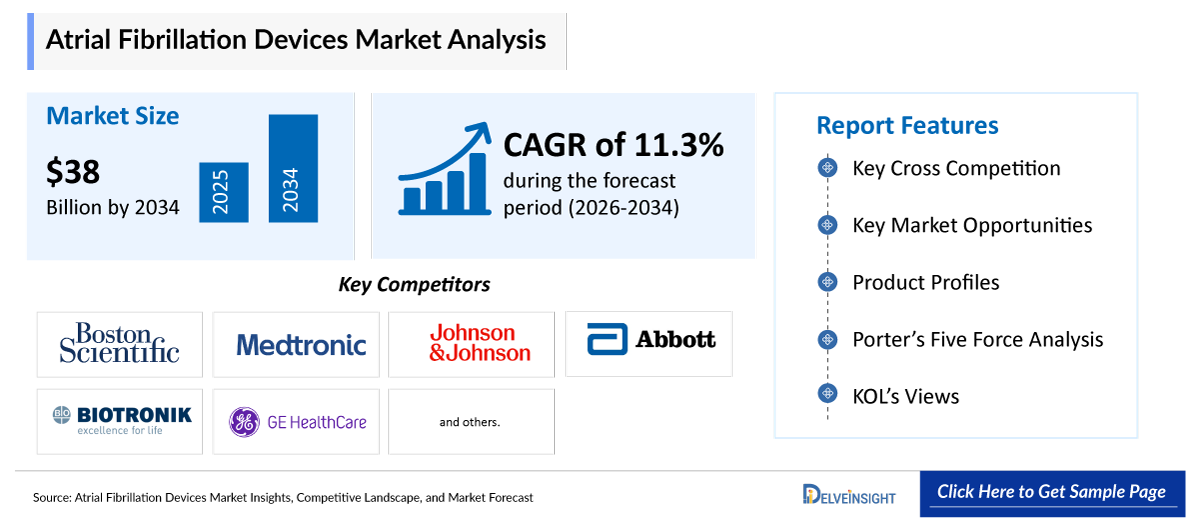
- The global atrial fibrillation devices market size was valued at USD 14.50 billion in 2025 and is projected to reach USD 38.00 billion by 2034.
- The market is expected to expand at a CAGR of 11.3% during the forecast period 2026-2034, supported by the rising prevalence of atrial fibrillation with the aging population, the rapid adoption of pulsed field ablation, the growth of left atrial appendage closure for stroke prevention, and the expansion of diagnosis and continuous monitoring.
- By product, the ablation devices segment dominated the atrial fibrillation devices market with a 48% share in 2025.
- By ablation technology, the pulsed field ablation segment dominated the atrial fibrillation devices market with a 46% share in 2025.
- By indication, the paroxysmal atrial fibrillation segment dominated the atrial fibrillation devices market with a 54% share in 2025.
- By end-user, the hospitals segment dominated the atrial fibrillation devices market with a 66% share in 2025.
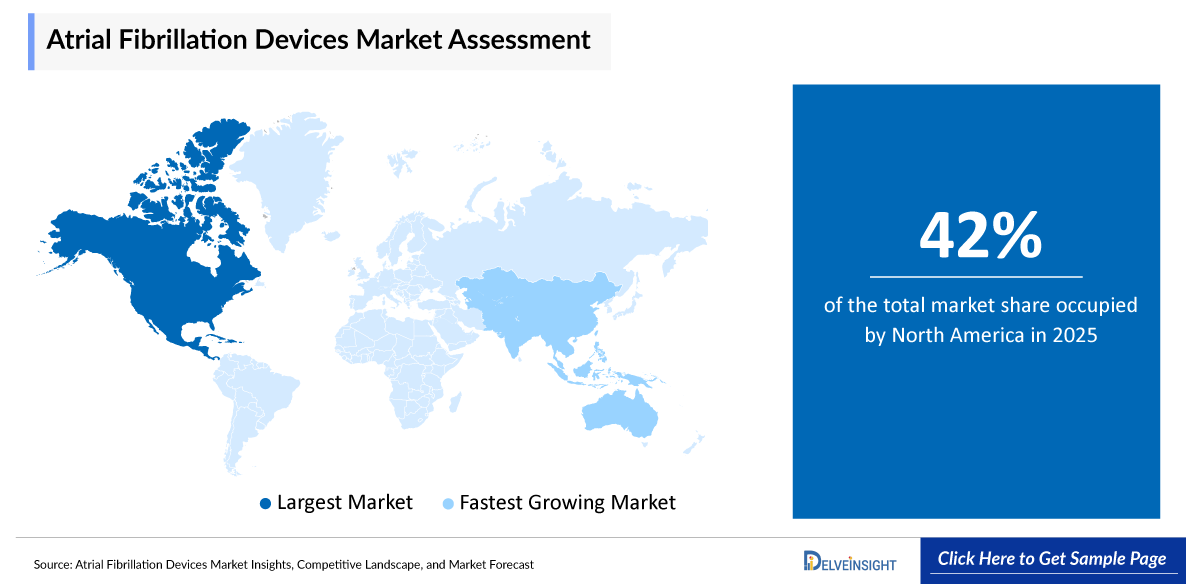
- North America accounted for the largest share of the atrial fibrillation devices market at 42% in 2025, while Asia-Pacific is anticipated to register the fastest growth through 2034.
Atrial fibrillation devices are the diagnostic and therapeutic devices used to detect, monitor, and treat atrial fibrillation, the most common sustained cardiac arrhythmia. The scope encompasses ablation devices, including the catheters, generators, and consoles that use radiofrequency, cryoablation, and pulsed field energy to isolate the pulmonary veins and eliminate the arrhythmia, mapping and recording systems that guide ablation, left atrial appendage closure devices that prevent stroke, and diagnostic and monitoring devices, including implantable loop recorders and external monitors.
Leading products include the Boston Scientific FARAPULSE and WATCHMAN, the Medtronic PulseSelect and cryoballoon, the Johnson and Johnson MedTech Biosense Webster VARIPULSE and CARTO, the Abbott portfolio including the Amulet and EnSite, and the monitoring devices of Medtronic and others. The market is undergoing a rapid transition to pulsed field ablation, which selectively ablates cardiac tissue while sparing surrounding structures, and the contemporary market is defined by the adoption of pulsed field ablation, the growth of left atrial appendage closure, and the expansion of monitoring.
Atrial Fibrillation Devices Market Key Growth Drivers
- Rising prevalence of atrial fibrillation with the aging population, affecting a substantial share of the elderly and rising in incidence.
- Rapid adoption of pulsed field ablation, which selectively ablates cardiac tissue while sparing the esophagus and phrenic nerve.
- Growth of left atrial appendage closure for stroke prevention as an alternative to oral anticoagulation.
- Expansion of diagnosis and continuous monitoring, including implantable loop recorders and wearable and external monitors.
- Increasing procedural volume of catheter ablation as a first-line and effective rhythm control therapy.
- Advances in mapping, imaging, and integration that improve the safety and efficacy of ablation.
- Strong clinical evidence and guideline support for ablation and left atrial appendage closure.
Key Companies in Atrial Fibrillation Devices Market
The competitive field is led by cardiac rhythm and electrophysiology device companies, challenged by monitoring and specialty ablation companies. The leading participants in the atrial fibrillation devices market include the following:
- Boston Scientific Corporation
- Medtronic plc
- Johnson & Johnson MedTech
- Abbott Laboratories
- AtriCure, Inc.
- Biotronik SE & Co. KG
- MicroPort Scientific Corporation
- Koninklijke Philips N.V.
- GE HealthCare Technologies Inc.
- Stereotaxis, Inc., and others
For illustrative purposes, only the top 10 companies are listed in the Table of Contents. The report may include analysis and references to additional companies relevant to the market assessment.
Atrial Fibrillation Devices Market Size
The following table summarizes the headline market metrics for the global atrial fibrillation devices market across the base year and the forecast horizon.
|
Report Metrics |
Details |
|
2025 Market Size |
USD 14.50 billion |
|
2034 Projected Market Size |
USD 38.00 billion |
|
Growth Rate (2026-2034) |
11.3% CAGR |
|
Largest Market |
North America (42% share in 2025) |
|
Fastest Growing Market |
Asia-Pacific |
|
Market Structure |
Consolidated |
All market values are expressed in USD and represent DelveInsight estimates synthesized from primary and secondary research.
Factors Contributing to the Growth of the Atrial Fibrillation Devices Market
Atrial Fibrillation Devices Market Drivers
- Rising Prevalence of Atrial Fibrillation with the Aging Population: The foundational driver of the atrial fibrillation devices market is the rising prevalence of atrial fibrillation, driven by the aging of the population. Atrial fibrillation is the most common sustained cardiac arrhythmia, affecting a substantial share of the population that rises steeply with age; a small percentage of the general population, a larger share of those over sixty-five, and a substantial share of those over eighty, and the incidence and prevalence of atrial fibrillation have risen over recent decades. The aging of the population increases the number of people with atrial fibrillation, and the rising prevalence of the risk factors of atrial fibrillation, including hypertension, obesity, diabetes, and heart failure, further increases its incidence. Atrial fibrillation increases the risk of stroke, heart failure, and mortality, and the large and growing population of patients with atrial fibrillation requires diagnosis, monitoring, and treatment, driving the demand for atrial fibrillation devices. The rising prevalence of atrial fibrillation, driven by aging and the growth of risk factors, enlarges the population requiring the diagnosis and treatment that atrial fibrillation devices provide. As the population ages and as the prevalence of atrial fibrillation rises, the number of patients requiring atrial fibrillation devices grows in step. The rising prevalence of atrial fibrillation with the aging population anchors the growth of the atrial fibrillation devices market across the forecast period.
- Rapid Adoption of Pulsed Field Ablation: The rapid adoption of pulsed field ablation is a defining driver that is transforming the ablation market and accelerating the growth of atrial fibrillation devices. Pulsed field ablation uses tissue-selective electrical energy to ablate the cardiac tissue that causes atrial fibrillation while sparing the surrounding structures, including the esophagus and phrenic nerve, that thermal ablation can damage, and it offers a safer and faster approach to pulmonary vein isolation. Pulsed field ablation has been adopted rapidly since its introduction, with the first pulsed field ablation system approved for atrial fibrillation and multiple systems now available, and it is expected to account for the majority of ablation procedures, displacing radiofrequency and cryoablation. The leading device companies have developed and launched pulsed field ablation systems, including the Boston Scientific FARAPULSE, the Medtronic PulseSelect, the Johnson and Johnson MedTech VARIPULSE, and the Abbott system, and the rapid adoption of these systems drives the growth and the shift of the ablation market. The safety, speed, and efficacy of pulsed field ablation, and its rapid adoption by electrophysiologists, drive the growth of the ablation segment and the market. As pulsed field ablation is adopted rapidly and as it displaces thermal ablation, the ablation market grows and shifts toward pulsed field ablation. The rapid adoption of pulsed field ablation sustains and accelerates the growth of the atrial fibrillation devices market across the forecast period.
- Growth of Left Atrial Appendage Closure for Stroke Prevention: The growth of left atrial appendage closure for stroke prevention is a powerful driver that expands the atrial fibrillation device market beyond rhythm control into stroke prevention. The left atrial appendage is the primary site of the thrombus that causes the majority of strokes in atrial fibrillation, and left atrial appendage closure devices seal the appendage to prevent stroke, providing an alternative to lifelong oral anticoagulation for patients who cannot tolerate or prefer to avoid it. Left atrial appendage closure has grown as an established therapy, supported by clinical evidence and guideline recognition, and the leading devices, including the Boston Scientific WATCHMAN and the Abbott Amulet, are implanted in growing numbers. The growth of left atrial appendage closure is driven by the large population of atrial fibrillation patients at risk of stroke, the limitations and bleeding risk of oral anticoagulation, the clinical evidence of the efficacy of closure, and the advances in the devices and the procedure, including the combination of closure with ablation. The demand for stroke prevention that avoids the bleeding risk of anticoagulation, and the clinical validation and advances of closure devices, drive the growth of left atrial appendage closure. As left atrial appendage closure grows as a therapy for stroke prevention, demand for closure devices grows. The growth of left atrial appendage closure for stroke prevention sustains demand for atrial fibrillation devices across the forecast period.
- Expansion of Diagnosis and Continuous Monitoring: The expansion of diagnosis and continuous monitoring drives the detection of atrial fibrillation and the demand for diagnostic and monitoring devices. Atrial fibrillation is frequently asymptomatic and intermittent, and its detection requires monitoring; the expansion of diagnosis and continuous monitoring, including implantable loop recorders, external and wearable monitors, and the integration of artificial intelligence, increases the detection of atrial fibrillation and the identification of patients requiring treatment. Implantable loop recorders provide continuous long-term monitoring that detects symptomatic and asymptomatic episodes and guides management; external and wearable monitors screen and detect atrial fibrillation, and the detection of atrial fibrillation drives the diagnosis and the referral for treatment. The growth of monitoring, the detection of previously undiagnosed atrial fibrillation, and the use of monitoring to guide the management of diagnosed patients drive the demand for diagnostic and monitoring devices and, through increased detection, for treatment devices. The expansion of screening and continuous monitoring, and the integration of artificial intelligence in detection, increase the diagnosis of atrial fibrillation and the demand for devices. As diagnosis and continuous monitoring expand and as they detect more atrial fibrillation, demand for monitoring and treatment devices grows. The expansion of diagnosis and continuous monitoring sustains demand for atrial fibrillation devices across the forecast period.
- Increasing Procedural Volume of Catheter Ablation: The increasing procedural volume of catheter ablation, driven by its efficacy and its adoption as a first-line therapy, drives the growth of the ablation device market. Catheter ablation isolates the pulmonary veins to eliminate the source of atrial fibrillation, and it is an effective rhythm control therapy that reduces the recurrence of atrial fibrillation and improves symptoms and outcomes; clinical evidence has established its efficacy and supported its use earlier in the course of disease and as a first-line therapy. The volume of catheter ablation procedures has grown with the efficacy of ablation, the evidence supporting its early and first-line use, the growth of the atrial fibrillation population, and the improvement and simplification of the procedure, particularly with pulsed field ablation. The growth of procedural volume drives the demand for ablation catheters, generators, mapping systems, and consumables, and each procedure consumes catheters and consumables, generating recurring demand. The efficacy of ablation, the evidence for its early use, and the growth and simplification of the procedure drive the increasing volume of catheter ablation and the demand for ablation devices. As the volume of catheter ablation grows, demand for ablation devices grows. The increasing procedural volume of catheter ablation sustains demand for atrial fibrillation devices across the forecast period.
- Advances in Mapping, Imaging, and Integration: Advances in mapping, imaging, and integration improve the safety and efficacy of ablation and drive the adoption of advanced systems. Electroanatomic mapping systems create three-dimensional maps of the heart that guide the placement of ablation and improve the precision, safety, and efficacy of the procedure, and the advancement of mapping, imaging, and their integration with ablation catheters enhances the ablation procedure. Mapping systems, including the Johnson and Johnson MedTech CARTO and the Abbott EnSite, integrate with ablation catheters, including pulsed field ablation catheters, to visualize the anatomy and guide ablation, and the integration of mapping with pulsed field ablation and the advances in imaging improve the procedure. The advance of mapping, imaging, and integration improves the precision, safety, efficacy, and efficiency of ablation, and it supports the adoption of advanced ablation and the growth of the mapping and integration segment. The value of mapping and imaging in guiding ablation, and the integration of mapping with pulsed field ablation, drive the adoption of advanced mapping and integration systems. As mapping, imaging, and integration advance and improve the ablation procedure, demand for advanced systems grows. The advances in mapping, imaging, and integration sustain demand for atrial fibrillation devices across the forecast period.
- Strong Clinical Evidence and Guideline Support: The strong clinical evidence and guideline support for ablation and left atrial appendage closure drive the adoption and reimbursement of atrial fibrillation devices. Clinical trials have established the efficacy and safety of catheter ablation for rhythm control and of left atrial appendage closure for stroke prevention, and the accumulation of evidence has supported the expansion of ablation to earlier and first-line use and the recognition of left atrial appendage closure as an alternative to anticoagulation. Recent trials have demonstrated the superiority of ablation over antiarrhythmic drugs and the efficacy of closure, and clinical guidelines recognize and recommend ablation and closure for appropriate patients, supporting their adoption and reimbursement. The strong and growing clinical evidence, the demonstration of the superiority and safety of ablation and closure, and the guideline support drive the confidence, adoption, and reimbursement of atrial fibrillation devices. The evidence and guideline support reduce the barriers to adoption, expand the indications, and support the reimbursement of devices and procedures. As clinical evidence accumulates and as guidelines support ablation and closure, the adoption and reimbursement of atrial fibrillation devices grow. The strong clinical evidence and guideline support sustain demand for atrial fibrillation devices across the forecast period.
Atrial Fibrillation Devices Market Restraints
The atrial fibrillation devices market faces several interrelated restraints that temper its growth. The foremost is the cost of devices and procedures, since ablation and left atrial appendage closure devices and procedures are costly, requiring expensive catheters, consoles, mapping systems, implants, specialized facilities and staff, and the cost can constrain access, particularly in cost-constrained systems and lower-resource settings. The requirement for specialized electrophysiology facilities, equipment, and trained electrophysiologists constrains the capacity to perform ablation and closure, and the shortage of trained electrophysiologists and the capacity of electrophysiology laboratories limit procedural volume. The complexity of ablation and closure procedures, the learning curve of new technologies such as pulsed field ablation, and the risk of procedural complications require training and experience and can limit adoption. The recurrence of atrial fibrillation after ablation, particularly in persistent atrial fibrillation, and the need for repeat procedures temper the outcomes and the value proposition for some patients. Reimbursement, while generally supportive, varies across systems and procedures and can constrain access and adoption. The competition of devices with drug therapy and the appropriate selection of patients for device therapy shape the addressable population. The rapid pace of technological change, particularly the transition to pulsed field ablation, requires continuous investment and can strand prior technology. The variability of access to electrophysiology and device therapy across regions, particularly in emerging markets, constrains the market. Together, these factors moderate the pace and scope of adoption and require manufacturers to demonstrate safety, efficacy, cost-effectiveness, and value and to support training and capacity to sustain growth.
Atrial Fibrillation Devices Market Segment Analysis
The global atrial fibrillation devices market is segmented by product (ablation devices, mapping and recording devices, left atrial appendage closure devices, diagnostic and monitoring devices), by ablation technology (pulsed field ablation, radiofrequency ablation, cryoablation, others), by indication (paroxysmal atrial fibrillation, persistent atrial fibrillation, long-standing persistent atrial fibrillation), by end-users (hospitals, ambulatory surgical centers, specialized cardiac clinics, and others), and by geography (North America, Europe, Asia-Pacific, and the Rest of the World).
By Product
Dominant Subsegment: Ablation Devices.
The ablation devices category is expected to dominate the market. The ablation devices segment accounted for a 48% share of the atrial fibrillation devices market in 2025. Ablation devices, including the catheters, generators, and consoles that ablate the cardiac tissue causing atrial fibrillation, are the leading product category because catheter ablation is the principal interventional therapy for atrial fibrillation and the ablation procedure consumes high-value catheters and consumables in growing volume. The dominance of the segment reflects the central role of catheter ablation in the treatment of atrial fibrillation, the high value of ablation catheters and systems, and the rapid growth and transition of ablation driven by pulsed field ablation. Ablation devices isolate the pulmonary veins to eliminate the source of atrial fibrillation using radiofrequency, cryoablation, and pulsed field energy, and the leading companies provide ablation catheters, generators, and consoles, including the rapidly adopted pulsed field ablation systems. The central role of ablation, the value of the devices, the growth of procedural volume, and the transition to pulsed field ablation drive the ablation devices segment. While mapping and recording systems, left atrial appendage closure devices, and diagnostic and monitoring devices are important product categories, the centrality, value, and growth of ablation devices sustain the leadership of the ablation devices segment across the forecast period.
By Ablation Technology
Dominant Subsegment: Pulsed Field Ablation.
The pulsed field ablation category is expected to dominate the market. The pulsed field ablation segment accounted for a 46% share of the atrial fibrillation devices ablation market in 2025. Pulsed field ablation, which uses tissue-selective electrical energy to ablate cardiac tissue while sparing surrounding structures, is the leading ablation technology because it has been adopted rapidly since its introduction and is displacing radiofrequency and cryoablation to become the predominant ablation modality. The dominance of the segment reflects the rapid adoption of pulsed field ablation, its safety and speed advantages over thermal ablation, and its embrace by electrophysiologists and the leading device companies. Pulsed field ablation spares the esophagus and phrenic nerve that thermal ablation can damage, isolates the pulmonary veins safely and quickly, and has been adopted rapidly, with the leading companies launching pulsed field ablation systems and the technology expected to account for the majority of ablation procedures. The safety, speed, efficacy, and rapid adoption of pulsed field ablation, and the investment of the leading companies, drive the segment. While radiofrequency ablation, the established modality, and cryoablation remain significant and widely used, the rapid adoption, advantages, and momentum of pulsed field ablation sustain the leadership of the pulsed field ablation segment across the forecast period, and it defines the direction of the ablation market.
By Indication
Dominant Subsegment: Paroxysmal Atrial Fibrillation.
The paroxysmal atrial fibrillation category is expected to dominate the market. The paroxysmal atrial fibrillation segment accounted for a 54% share of the atrial fibrillation devices market in 2025. Paroxysmal atrial fibrillation, in which episodes of atrial fibrillation begin and terminate spontaneously, is the leading indication because it is the most common and the most effectively treated form of atrial fibrillation with ablation, achieving the highest success rates with pulmonary vein isolation. The dominance of the segment reflects the prevalence of paroxysmal atrial fibrillation, the high efficacy of ablation in paroxysmal atrial fibrillation, and the strong evidence and guideline support for ablation in this indication. Paroxysmal atrial fibrillation is effectively treated by the isolation of the pulmonary veins, which are the principal source of the arrhythmia in this form, and ablation achieves high success rates in paroxysmal atrial fibrillation, making it the leading indication for ablation. The prevalence of paroxysmal atrial fibrillation, the efficacy of ablation, and the evidence and guideline support drive the segment. While persistent and long-standing atrial fibrillation are significant and growing indications, requiring more extensive ablation and representing an area of development, the prevalence and the efficacy of ablation in paroxysmal atrial fibrillation sustain the leadership of the paroxysmal atrial fibrillation segment across the forecast period.
By End-User
Dominant Subsegment: Hospitals.
The hospitals category is expected to dominate the market. The hospitals segment accounted for a 66% share of the atrial fibrillation devices market in 2025. Hospitals, including their electrophysiology laboratories and cardiac centers, are the leading end-user because they are the principal sites where catheter ablation, left atrial appendage closure, and device implantation are performed, requiring the specialized facilities, equipment, and electrophysiologists that these procedures demand. The dominance of the segment reflects the concentration of electrophysiology and interventional procedures in hospitals, the requirement for specialized laboratories and equipment, and the complexity of ablation and closure procedures. Hospitals perform catheter ablation, left atrial appendage closure, and the implantation of monitoring devices in their electrophysiology laboratories and cardiac catheterization laboratories, and they possess the mapping systems, imaging, and specialized staff that these procedures require, concentrating the market in hospitals. The concentration of specialized procedures, the requirement for laboratories and equipment, and the complexity of the procedures drive the hospitals segment. While ambulatory surgical centers and specialized cardiac clinics are growing end-users, particularly as procedures simplify, the concentration of electrophysiology procedures, the requirement for specialized facilities, and the complexity of the procedures sustain the leadership of the hospitals segment across the forecast period, and it shapes the direction of the market.
Atrial Fibrillation Devices Market Region Analysis
Dominant Region: North America
North America accounted for a 42% share of the global atrial fibrillation devices market in 2025, representing the highest regional market share globally. The leadership of the region reflects the high prevalence and diagnosis of atrial fibrillation, the advanced adoption of ablation and left atrial appendage closure, the presence and headquarters of the leading device companies, and supportive reimbursement. The United States is the largest national market, supported by the high prevalence and diagnosis of atrial fibrillation, the advanced electrophysiology infrastructure, the rapid adoption of pulsed field ablation and left atrial appendage closure, the presence of the leading device companies, and the supportive reimbursement of ablation and closure. The advanced electrophysiology infrastructure, the high procedural volume, the rapid adoption of new technologies, and the strong reimbursement drive the market, and the leading device companies are headquartered and conduct extensive development and commercialization in the region. The high prevalence and diagnosis, the advanced adoption, the presence of the leading companies, and the supportive reimbursement reinforce the leadership of the region. The combination of disease burden, adoption maturity, company presence, and reimbursement sustains the position of North America as the largest regional market across the forecast period.
Fastest Growing Region: Asia-Pacific
Asia-Pacific is projected to register the fastest compound annual growth rate through 2034. The region combines large and aging populations, the rising prevalence and diagnosis of atrial fibrillation, the expansion of electrophysiology infrastructure, and the growing adoption of ablation and closure, which drives the fast growth of the market. China, Japan, and India are the principal national markets, supported by the aging of large populations, the rising prevalence and diagnosis of atrial fibrillation, the expansion of electrophysiology laboratories and cardiac centers, the adoption of ablation and left atrial appendage closure, and the growth of healthcare investment and access. The growth of the atrial fibrillation population, the expansion of electrophysiology infrastructure, and the adoption of advanced devices enlarge the demand for atrial fibrillation devices. As populations age, as the diagnosis of atrial fibrillation increases, and as electrophysiology infrastructure and the adoption of ablation and closure expand, the region increases its demand from a growing base, and the scale of the population and the expansion of infrastructure create substantial long-term demand. The combination of population scale, rising disease burden, infrastructure expansion, and device adoption positions Asia-Pacific as the fastest-growing regional market, and it attracts investment and commercial focus from the leading global device companies.
Atrial Fibrillation Devices Market Regional Commentary
North America
North America leads the market, supported by the high prevalence and diagnosis of atrial fibrillation, the advanced adoption of ablation and left atrial appendage closure, the presence of the leading device companies, and supportive reimbursement. The United States dominates the region through its advanced electrophysiology infrastructure, the rapid adoption of pulsed field ablation and closure, and the presence of the leading companies. The high procedural volume and reimbursement sustain demand.
Europe
Europe is a substantial market shaped by advanced healthcare systems, the adoption of ablation and left atrial appendage closure, and the presence and development of the leading device companies. Germany, the United Kingdom, France, Italy, and Spain are the principal national markets, supported by the prevalence of atrial fibrillation, the adoption of pulsed field ablation and closure, and the electrophysiology infrastructure. Demand is sustained by the disease burden, the adoption of advanced devices, and the support of clinical evidence and guidelines.
Asia-Pacific
Asia-Pacific is the fastest-growing region, driven by large and aging populations, the rising prevalence and diagnosis of atrial fibrillation, the expansion of electrophysiology infrastructure, and the growing adoption of ablation and closure across China, Japan, and India. Aging populations, rising disease burden, and infrastructure expansion sustain rapid growth, and the region attracts commercial focus from the leading global device companies.
Rest of World
The Rest of World, spanning Latin America, the Middle East, and Africa, represents an emerging opportunity as the diagnosis of atrial fibrillation and electrophysiology infrastructure grow. Growth is supported by the rising prevalence and diagnosis of atrial fibrillation, the expansion of cardiac and electrophysiology infrastructure, and the growing adoption of ablation and closure, though access and infrastructure vary by market. Device companies pursue these markets through devices and training suited to expanding electrophysiology.
Atrial Fibrillation Devices Market Competitive Landscape
The global atrial fibrillation devices market is classified as Consolidated. A small group of large cardiac rhythm and electrophysiology device companies holds the majority of the market through comprehensive portfolios spanning ablation, mapping, closure, and monitoring, while specialty ablation, monitoring, and robotics companies compete in specific segments. Competition centers on the performance and safety of ablation, particularly the transition to pulsed field ablation, the integration of ablation with mapping, the breadth of the portfolio across ablation, closure, and monitoring, clinical evidence, and the training and support of electrophysiologists. The pulsed field ablation transition, product launches, and clinical trials intensify the contest.
The competitive landscape is evaluated across the following dimensions:
- Market concentration: Consolidated, with a small group of large cardiac rhythm and electrophysiology device companies holding the majority of the market, alongside specialty ablation, monitoring, and robotics companies.
- Leading players: Boston Scientific, Medtronic, Johnson & Johnson MedTech through Biosense Webster, and Abbott lead across ablation, mapping, closure, and monitoring, and AtriCure, Biotronik, MicroPort, Philips, GE HealthCare, and Stereotaxis contest ablation, imaging, monitoring, and robotics.
- Geographic reach: The leading companies operate global commercial, clinical, and training organizations, with the strongest presence in North America and Europe and an expanding presence in Asia-Pacific.
- Product portfolio strength: Competitive advantage rests on the breadth and performance of the portfolio across ablation, particularly pulsed field ablation, mapping and integration, left atrial appendage closure, and monitoring, and on the clinical evidence supporting the devices.
- Pipeline strength: Development is concentrated in pulsed field ablation, the integration of pulsed field ablation with mapping, next-generation left atrial appendage closure, and monitoring and artificial intelligence.
- Strategic partnerships: Collaboration spans the integration of ablation and mapping, partnerships and acquisitions that add pulsed field ablation and closure technology, and clinical trial collaborations.
- M&A activity: Consolidation has shaped the field, with the leading companies acquiring pulsed field ablation, closure, and mapping technologies to build comprehensive portfolios, exemplified by acquisitions that added pulsed field ablation capability.
- Innovation focus: Innovation is shifting toward pulsed field ablation and its integration with mapping, next-generation closure devices, combined ablation and closure, and monitoring and artificial intelligence.
- Regulatory standing: Approval and clearance by the Food and Drug Administration and conformity under the European Union Medical Device Regulation, and the strong clinical evidence supporting ablation and closure, are decisive competitive credentials and a principal axis of competition among the leaders.
Atrial Fibrillation Devices Market Recent Developmental Activities
- In late 2023, Medtronic plc received Food and Drug Administration approval for the PulseSelect pulsed field ablation system, the first pulsed field ablation system approved for atrial fibrillation in the United States. Strategic significance: the approval marked the arrival of pulsed field ablation in the United States and initiated the rapid transition of the ablation market.
- In 2024, Boston Scientific Corporation advanced and commercialized the FARAPULSE pulsed field ablation system, which achieved rapid adoption and strong clinical outcomes in pulmonary vein isolation. Strategic significance: the commercialization of FARAPULSE established a leading position in pulsed field ablation and drove the transition of the ablation market.
- In 2024, Johnson & Johnson MedTech advanced the Biosense Webster VARIPULSE pulsed field ablation platform, integrated with the CARTO mapping system, and received regulatory clearances. Strategic significance: the advance of VARIPULSE, integrated with mapping, reinforced the position of a leading electrophysiology company in pulsed field ablation.
- In 2024 and 2025, Abbott Laboratories advanced its pulsed field ablation catheters and its EnSite mapping system, collecting regulatory clearances, and advanced its next-generation Amulet left atrial appendage occlusion device. Strategic significance: the developments advanced the pulsed field ablation and closure portfolio of a leading cardiovascular company.
- In January 2025, Boston Scientific Corporation presented late-breaking data supporting the WATCHMAN FLX left atrial appendage closure device, including sequential closure following ablation that reduced non-procedural bleeding compared to oral anticoagulation. Strategic significance: the data reinforced the evidence for left atrial appendage closure and the combination of closure with ablation.
- In 2025, the transition to pulsed field ablation accelerated, with pulsed field ablation expected to account for the majority of atrial fibrillation ablation procedures, displacing radiofrequency and cryoablation. Strategic significance: the acceleration of the pulsed field ablation transition reshaped the ablation market and concentrated competition in pulsed field ablation.
- In 2026, Boston Scientific Corporation presented data from the AVANT GUARD trial demonstrating the superiority of pulsed field ablation with the FARAPULSE system over antiarrhythmic drugs in persistent atrial fibrillation. Strategic significance: the trial supported the expansion of pulsed field ablation into persistent atrial fibrillation and first-line therapy.
- In 2026, Abbott Laboratories presented data on its next-generation Amulet left atrial appendage occlusion device, demonstrating high rates of complete closure and implant success. Strategic significance: the data advanced the next-generation closure device and reinforced the growth of left atrial appendage closure.
- In 2024 and 2025, the leading companies integrated pulsed field ablation with electroanatomic mapping systems, combining tissue-selective ablation with three-dimensional mapping to guide the procedure. Strategic significance: the integration of pulsed field ablation and mapping improved the procedure and reinforced the value of comprehensive electrophysiology portfolios.
- In 2024 and 2025, monitoring and diagnostic devices advanced, including implantable loop recorders enhanced with artificial intelligence and external and wearable monitors that detect atrial fibrillation. Strategic significance: The advance of monitoring increased the detection of atrial fibrillation and the identification of patients for treatment.
- In 2024 and 2025, specialty and adjacent companies including AtriCure, Inc., Biotronik SE & Co. KG, MicroPort Scientific Corporation, and Stereotaxis, Inc. advanced their ablation, surgical ablation, monitoring, and robotic navigation technologies. Strategic significance: the developments reinforced the competition among specialty and adjacent companies in ablation, monitoring, and procedural navigation.
- In 2024 and 2025, the leading companies advanced pulsed field ablation, mapping integration, left atrial appendage closure, and monitoring across atrial fibrillation devices. Strategic significance: the convergence of the leaders on pulsed field ablation, mapping, closure, and monitoring confirmed these as the defining axes of competition and signaled a market transformed by pulsed field ablation and advancing toward comprehensive rhythm control and stroke prevention.
Atrial Fibrillation Devices Market Segmentation
- Atrial Fibrillation Devices Market Assessment by Product
- Ablation Devices
- Mapping and Recording Devices
- Left Atrial Appendage Closure Devices
- Diagnostic and Monitoring Devices
- Atrial Fibrillation Devices Market Assessment by Ablation Technology
- Pulsed Field Ablation
- Radiofrequency Ablation
- Cryoablation
- Others
- Atrial Fibrillation Devices Market Assessment by Indication
- Paroxysmal Atrial Fibrillation
- Persistent Atrial Fibrillation
- Long-Standing Persistent Atrial Fibrillation
- Atrial Fibrillation Devices Market Assessment by End-User
- Hospitals
- Ambulatory Surgical Centers
- Specialized Cardiac Clinics
- Others
Atrial Fibrillation Devices Market Assessment by Geography
- North America Atrial Fibrillation Devices Market Assessment
- United States Atrial Fibrillation Devices Market Size in USD million (2023-2034)
- Canada Atrial Fibrillation Devices Market Size in USD million (2023-2034)
- Mexico Atrial Fibrillation Devices Market Size in USD million (2023-2034)
- Europe Atrial Fibrillation Devices Market Assessment
- Germany Atrial Fibrillation Devices Market Size in USD million (2023-2034)
- United Kingdom Atrial Fibrillation Devices Market Size in USD million (2023-2034)
- France Atrial Fibrillation Devices Market Size in USD million (2023-2034)
- Italy Atrial Fibrillation Devices Market Size in USD million (2023-2034)
- Spain Atrial Fibrillation Devices Market Size in USD million (2023-2034)
- Rest of Europe Atrial Fibrillation Devices Market Size in USD million (2023-2034)
- Asia-Pacific Atrial Fibrillation Devices Market Assessment
- China Atrial Fibrillation Devices Market Size in USD million (2023-2034)
- Japan Atrial Fibrillation Devices Market Size in USD million (2023-2034)
- India Atrial Fibrillation Devices Market Size in USD million (2023-2034)
- Australia Atrial Fibrillation Devices Market Size in USD million (2023-2034)
- South Korea Atrial Fibrillation Devices Market Size in USD million (2023-2034)
- Rest of Asia-Pacific Atrial Fibrillation Devices Market Size in USD million (2023-2034)
- Rest of the World Atrial Fibrillation Devices Market Assessment
- Middle East Atrial Fibrillation Devices Market Size in USD million (2023-2034)
- Africa Atrial Fibrillation Devices Market Size in USD million (2023-2034)
- South America Atrial Fibrillation Devices Market Size in USD million (2023-2034)
Atrial Fibrillation Devices Market Recent Industry Trends and Milestones (2023-2026):
|
Category |
Key Developments |
|
Atrial Fibrillation Devices Market Product Advancement |
The period was defined by the transition to pulsed field ablation and the advance of closure and monitoring. Medtronic gained the first pulsed field ablation approval with PulseSelect, Boston Scientific commercialized FARAPULSE and advanced WATCHMAN, Johnson & Johnson MedTech advanced VARIPULSE integrated with CARTO, and Abbott advanced pulsed field ablation, EnSite, and the next-generation Amulet. Companies integrated pulsed field ablation with mapping and advanced monitoring with artificial intelligence. Together, these advances concentrated competition in pulsed field ablation, integrated mapping, closure, and monitoring. |
|
Atrial Fibrillation Devices Market Product Expansion |
Product expansion advanced along three axes. The first is pulsed field ablation, as companies launched and expanded pulsed field ablation systems that spare surrounding structures and accelerate the procedure. The second is left atrial appendage closure, as companies advanced next-generation closure devices and the combination of closure with ablation. The third is mapping, integration, and monitoring, as companies integrated ablation with mapping and advanced monitoring and artificial intelligence. Companies also expanded ablation into persistent atrial fibrillation and first-line therapy. |
|
Atrial Fibrillation Devices Market Investment |
Investment was shaped by the transition to pulsed field ablation and the growth of closure. The leading companies invested in pulsed field ablation development, acquisition, and commercialization, in next-generation closure devices, and in mapping and monitoring. Clinical trials generated the evidence supporting pulsed field ablation, closure, and first-line therapy, and investment flowed into pulsed field ablation, mapping integration, closure, and monitoring and artificial intelligence, reshaping the electrophysiology portfolios of the leaders. |
|
Company Strategy |
The unifying strategic theme is the delivery of comprehensive rhythm control and stroke prevention centered on pulsed field ablation. Boston Scientific, Medtronic, Johnson & Johnson MedTech, and Abbott are advancing pulsed field ablation, mapping, closure, and monitoring, and AtriCure, Biotronik, MicroPort, Philips, GE HealthCare, and Stereotaxis are advancing ablation, surgical ablation, imaging, monitoring, and robotics. Across the field, strategy centers on pulsed field ablation, mapping integration, closure, and monitoring, supported by clinical evidence. |
|
Emerging Technologies |
The defining emerging technologies are pulsed field ablation that ablates cardiac tissue selectively while sparing surrounding structures; the integration of pulsed field ablation with electroanatomic mapping that guides the procedure; next-generation left atrial appendage closure and the combination of closure with ablation; and monitoring and artificial intelligence that detect atrial fibrillation and guide management. Supporting these are advanced imaging, robotic and remote navigation, and the expansion of ablation into persistent atrial fibrillation and first-line therapy. Across these, the trajectory is toward atrial fibrillation care that is safer, faster, and more comprehensive, spanning detection, rhythm control, and stroke prevention. |
Atrial Fibrillation Devices Market Startup Funding and Investment Trends
Investment in the atrial fibrillation device field has concentrated on technologies that make the treatment of atrial fibrillation safer, faster, and more comprehensive, namely pulsed field ablation, left atrial appendage closure, mapping and navigation, and monitoring and artificial intelligence. Because the market is consolidated among large cardiac rhythm and electrophysiology companies, innovators pursue differentiated ablation, closure, mapping, or monitoring technologies that a larger company can acquire, and acquisition by the leaders is the dominant path. The table below summarizes representative companies advancing the next generation of atrial fibrillation devices.
|
Company |
Total Funding |
Funding Stage |
Main Product/Offering |
Core Technology |
|
Field Medical, Inc. |
Venture-backed |
Clinical stage |
Pulsed field ablation system |
Focal pulsed field ablation |
|
CardioFocus, Inc. |
Venture-backed |
Commercial stage |
Ablation catheter systems |
Laser and ablation technology |
|
Request for unlocking the report of the @ Atrial Fibrillation Devices Market Insights | ||||
Capital formation in this field is shaped by the dominance of the large cardiac rhythm and electrophysiology companies, so investors and innovators have favored differentiated technologies in pulsed field ablation, closure, mapping and navigation, and monitoring that the leaders can acquire to enhance their portfolios. Pulsed field ablation is a clear thesis, offering safer and faster ablation, and novel pulsed field ablation systems and focal and integrated approaches attract investment. Left atrial appendage closure and combined therapy constitute a second thesis, and mapping, navigation, and monitoring and artificial intelligence a third. The archetypal outcome is acquisition by one of the leaders seeking to enhance its portfolio, exemplified by the acquisitions that added pulsed field ablation capability, which provides a clear exit that sustains earlier-stage investment. The principal risks are the scale, portfolios, and clinical evidence of the leaders, the rapid pace of the pulsed field ablation transition, the clinical evidence and regulatory approval required, and the capital intensity of device development. Source: company disclosures.
Key Takeaways from the Atrial Fibrillation Devices Market Report Study
- Market size analysis for the current atrial fibrillation devices market size (2025), and market forecast for 9 years (2026 to 2034).
- Top key device and technology developments, approvals, clinical trials, and acquisitions that happened over the last 3 years.
- Key companies dominating the global atrial fibrillation devices market.
- Various opportunities available for competitors in the atrial fibrillation devices market space.
- What are the top-performing segments in 2025? How will these segments perform in 2034?
- Which are the top-performing regions and countries in the current atrial fibrillation devices market scenario?
- Which are the regions and countries where companies should concentrate their opportunities for atrial fibrillation devices market growth in the future?
Target audience who can benefit from this atrial fibrillation devices market report study
- Atrial fibrillation device, electrophysiology, and cardiac rhythm management providers
- Research organizations and consulting companies
- Cardiology and electrophysiology-related organizations, associations, forums, and other alliances
- Government and corporate offices
- Start-up companies, venture capitalists, and private equity firms
- Hospitals, cardiac centers, and distributors dealing in atrial fibrillation devices
- Various end-users who want to know more about the atrial fibrillation devices market and the latest technological developments in the atrial fibrillation devices market.

