
Balloon Catheters Market
Factors affecting Balloon Catheters Market Growth
-
Rising Prevalence of Cardiovascular Diseases
Increasing cases of coronary artery disease, peripheral artery disease, and other vascular disorders drive demand for balloon catheters.
-
Advancements in Balloon Catheter Technology
Development of drug-coated, high-pressure, and specialty balloons improves procedural outcomes.
-
Growing Adoption of Minimally Invasive Procedures
Preference for angioplasty and other catheter-based interventions over open surgery boosts market growth.
-
Increasing Geriatric Population
Older adults are more prone to cardiovascular disorders, increasing the need for interventional devices.
-
Expansion of Healthcare Infrastructure
Better access to cardiac care centers and trained interventional cardiologists supports adoption.
-
Rising Awareness of Heart Health
Early diagnosis and preventive care encourage use of advanced interventional devices.
Balloon Catheters Market by Product Type (PTA, PTCA, Occlusion, Foley, Nephrostomy, Drug-Eluting, and Others), Catheter Type (Fixed Wire, Over-The-Wire, and Rapid Exchange), Balloon Type (Non-Compliant, Semi-Compliant, and Compliant), End-User (Hospitals, Specialty Clinics, and Others), and Geography (North America, Europe, Asia-Pacific, and Rest of the World) is expected to grow at a steady CAGR forecast till 2032 owing to the rising prevalence of cardiovascular diseases, growing prevalence of brain aneurysms, increasing prevalence of cancers in the pelvic region, and increase in product development activities by key market players across the globe.
The balloon catheters market was valued at USD 4,972.01 million in 2024, growing at a CAGR of 7.63% during the forecast period from 2025 to 2032, to reach USD 8,928.76 million by 2032. The rising prevalence of cardiovascular diseases, brain aneurysms, and pelvic region cancers is significantly boosting the market for balloon catheters. As cardiovascular conditions become more common, the demand for balloon catheters increases. Additionally, balloon catheters are vital in managing brain aneurysms and enhancing drug delivery in pelvic cancers. Concurrently, advancements in product development by key market players are leading to innovative technologies, such as drug-eluting and bioresorbable balloons. These combined factors are driving the balloon catheter market as healthcare providers seek effective solutions to address the growing clinical needs of diverse patient populations. Collectively, these factors are expected to boost the market for balloon catheters during the forecast period from 2025 to 2032.
|
Report Metrics |
Details |
|
Study Period |
2020 to 2030 |
|
Forecast Period |
2024-2030 |
|
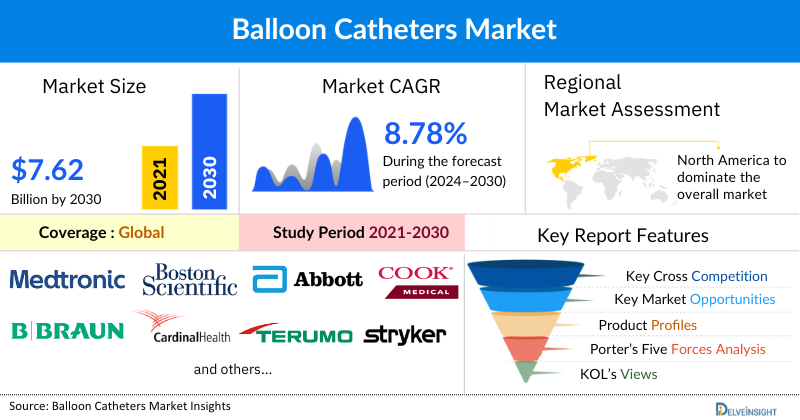
CAGR |
8.78% |
|
Balloon Catheters Market |
~USD 7.62 billion by 2030 |
|
Key Balloon Catheters Companies |
Medtronic, Boston Scientific Corporation, Abbott, Cook, B. Braun Melsungen AG, Cardinal Health, Terumo Corporation, Stryker, Teleflex Incorporated, Microport Scientific Corporation, BIOTRONIK, Nipro Medical Corporation, BD, Coloplast, Summit Medical (Innovia Medical) Well Lead Medical Co., Ltd, Smiths Medical, BACTIGUARD AB, JOTEC GmbH, Lepu Medical Technology(Beijing)Co.,Ltd, Merit Medical, Cardiovasuclar Systems Inc and others. |
Balloon Catheters Market Dynamics:
According to recent data from the British Heart Foundation (2025), an estimated 640 million people worldwide approximately 1 in 12 individuals were living with heart and circulatory diseases. Further data from the British Heart Foundation (2024) highlighted that coronary (ischemic) heart disease was the most commonly diagnosed cardiovascular condition globally, affecting around 200 million people, including approximately 110 million men and 80 million women. Additionally, there were about 56 million female and 45 million male stroke survivors globally. Moreover, at least 13 million individuals lived with congenital heart disease, with millions potentially remaining undiagnosed.
The increasing global prevalence of cardiovascular disorders such as coronary artery disease, peripheral artery disease, and strokes is driving demand for effective, minimally invasive interventions. One such intervention is percutaneous transluminal coronary angioplasty (PTCA), which uses balloon catheters to open narrowed or blocked arteries and restore blood flow, thereby reducing the risk of heart attacks and strokes. As the burden of cardiovascular disease continues to rise, the number of PTCA and PCI procedures is expected to grow, directly fueling the demand for PTCA balloon catheters and supporting market expansion.
Beyond cardiovascular applications, balloon catheters also play a critical role in managing cancer-related complications. According to GLOBOCAN (2022), there were approximately 435,000 new cases of kidney cancer globally, a number projected to rise to 693,000 by 2045. Similarly, new bladder cancer cases were estimated at 614,000 in 2022, with projections reaching 1.12 million by 2045. Cancers in the pelvic region can obstruct the ureters, impairing urine flow from the kidneys to the bladder. This leads to a buildup of urine and potential kidney damage. In such cases, nephrostomy procedures are performed, often requiring nephrostomy balloon catheters to create a passage for urine drainage. As the incidence of pelvic cancers rises, the demand for these devices is expected to increase, contributing further to the growth of the global balloon catheter market.
Additionally, ongoing product innovation and regulatory approvals are boosting market momentum. For example, in July 2024, Teleflex Incorporated received FDA 510(k) clearance for its Ringer™ Perfusion Balloon Catheter (PBC) the only commercially available PTCA perfusion balloon catheter. Featuring a rapid-exchange design and helical balloon that forms a hollow cylinder when inflated, the device allows continuous coronary blood flow during prolonged inflations and is used for dilating coronary arteries or bypass graft stenoses where distal perfusion is necessary.
However, the market does face challenges. Risks associated with balloon catheter procedures such as arterial dissection, vessel perforation, or embolism can lead to serious complications. Moreover, increasing product recalls due to quality and safety issues may hinder future market growth.
In summary, while the global balloon catheters market is poised for significant growth due to rising cardiovascular and cancer cases and increasing innovation, ongoing vigilance regarding device safety and quality remains critical to sustaining long-term market expansion.
Balloon Catheters Market Segment Analysis:
Balloon Catheters Market by Product Type (PTA, PTCA, Occlusion, Foley, Nephrostomy, Drug-Eluting, and Others), Catheter Type (Fixed Wire, Over-The-Wire, and Rapid Exchange), Balloon Type (Non-Compliant, Semi-Compliant, and Compliant), End-User (Hospitals, Specialty Clinics, and Others), and Geography (North America, Europe, Asia-Pacific, and Rest of the World)
In the balloon type segment of the balloon catheters market, the non-compliant balloon catheter category is expected to hold the largest share in the year 2024. Non-compliant balloons maintain their shape and size, providing a more predictable and controlled dilation of narrowed or obstructed vessels. This characteristic makes them particularly valuable in high-pressure applications, such as in the treatment of coronary artery disease, where precise balloon sizing is critical in achieving optimal results without damaging the surrounding tissue. The enhanced performance of non-compliant balloons leads to better outcomes in procedures like angioplasty, reducing the risk of complications such as balloon rupture or vessel trauma. As healthcare providers increasingly recognize the benefits of these specialized devices, the demand for non-compliant balloon catheters has grown.
Additionally, advancements in material technology and design are making non-compliant balloons more effective and versatile, further driving their adoption across various medical fields. This shift towards non-compliant balloon catheters not only enhances procedural success rates but also supports the expansion of the balloon catheter market as a whole. For instance, in September 2023, Kossel Medtech’s Sabelly® non-compliant peripheral balloon dilatation catheter received market approval from China’s NMPA. Designed for angioplasty in the peripheral vascular system, it became the first domestically produced large-diameter balloon catheter approved, helping to reduce reliance on imported products.
Hence, all the above-mentioned factors are expected to generate considerable revenue for the segment pushing the overall growth of the global balloon catheters market during the forecast period.
North America is expected to dominate the overall balloon catheter market:
Among all the regions, North America is expected to hold the largest share of the global balloon catheters market in 2024. The key driving factors of the balloon catheters market are the increasing prevalence of brain aneurysms, urological disorders such as bladder cancers, benign prostatic hyperplasia, urinary retention, increasing prevalence of lifestyle disorders leading to the development of various cardiovascular diseases as well as growing focus on product development activities in the region. Collectively, these factors are expected to boost the overall market of balloon catheters across the region.
As per the data stated by the American Heart Association (2023), over 500,000 percutaneous coronary interventions were performed in the United States annually of which percutaneous transluminal coronary angioplasty holds a considerable share. Therefore, the rising prevalence of cardiovascular disorders as well as the subsequent increase in the number of PCI procedures being performed are further expected to boost the demand for scoring and cutting balloon catheters. This is estimated to contribute to the regional growth of the balloon catheters market in North America.
Another factor contributing to the regional growth of the North America balloon catheters market is the rising prevalence of brain aneurysms in the country. As per the statistics provided by the Brain Aneurysm Foundation (2023), approximately 30,000 people in the country suffer from a brain aneurysm rupture each year. In another set of data provided by the American Cancer Society, in 2023, it has been estimated that approximately 24,350 malignant tumors of the brain or spinal cord may occur in the US. It also estimated that in 2023, approximately 18,600 people were expected to succumb to brain and spinal cord tumors in the country. These indications are usually treated with occlusion balloon catheters specially devised for the administration in the neurovasculature. Therefore, the rising prevalence of brain aneurysms is also expected to drive the demand for such catheters, eventually boosting the growth of the market for balloon catheters in North America.
Additionally, product development activities across the region are further expected to boost the overall market of balloon catheters across the region. For instance, in August 2023, Shanghai MicroPort Medical (MicroPort® Coronary) received FDA approval for its Firefighter™ NC Pro PTCA Balloon Catheter. This next-generation high-pressure balloon was designed for dilating narrowed coronary arteries and post-stent procedures. With a three-layer composite balloon and a burst pressure of up to 22 atm, it effectively treated resistant lesions like calcifications.
Therefore, the factors mentioned above in the region are expected to boost the North America balloon catheters market during the forecast period.
Balloon Catheters Market Key Players:
Some of the key market players operating in the balloon catheters market include Medtronic, Boston Scientific Corporation, Abbott, Cook, B. Braun Melsungen AG, Cardinal Health, Terumo Corporation, Stryker, Teleflex Incorporated, Microport Scientific Corporation, BIOTRONIK, Nipro Medical Corporation, BD, Coloplast, Summit Medical (Innovia Medical) Well Lead Medical Co., Ltd., Smiths Medical, BACTIGUARD AB, JOTEC GmbH, Lepu Medical Technology(Beijing)Co., Ltd., and others.
Recent Developmental Activities in the Balloon Catheters Market:
- In March 2024, Boston Scientific Corporation announced the approval of the FDA for the AGENT™ Drug-Coated Balloon (DCB) catheter, which is indicated to treat coronary in-stent restenosis (ISR) in patients with coronary artery disease.
- In May 2022, Medtronic announced the approval from the U.S. Food and Drug Administration (FDA) for the IN.PACT 018 Paclitaxel-Coated Percutaneous Transluminal Angioplasty (PTA) Balloon Catheter, a drug-coated balloon (DCB), indicated for the interventional treatment of peripheral arterial disease (PAD) in the superficial femoral and popliteal arteries.
Key takeaways from the balloon catheters market report study:
- Market size analysis for current balloon catheters size (2024), and market forecast for 8 years (2025 to 2032)
- Top key product/technology developments, mergers, acquisitions, partnerships, and joint ventures happened over the last 3 years.
- Key companies dominating the balloon catheters market.
- Various opportunities available for the other competitors in the balloon catheters market space.
- What are the top-performing segments in 2024? How these segments will perform in 2030?
- Which are the top-performing regions and countries in the current balloon catheter market scenario?
- Which are the regions and countries where companies should have concentrated on opportunities for balloon catheter market growth in the coming future?
Target audience who can benefit from this balloon catheter market report study:
- Balloon catheter product providers
- Research organizations and consulting companies
- Balloon catheters-related organizations, associations, forums, and other alliances
- Government and corporate offices
- Start-up companies, venture capitalists, and private equity firms
- Distributors and traders dealing in balloon catheters
- Various end-users who want to know more about the balloon catheters market and the latest technological developments in the balloon catheters market.
Frequently Asked Questions for the Balloon Catheters Market:
1. What are balloon catheters?
- A balloon catheter is a type of soft catheter that has a balloon attached at the tip of the catheter. This type of catheter is used in various minimally invasive diagnostic and therapeutic procedures such as opening of blockages, dilating vessels, and stent delivery among others.
2. What is the market for balloon catheters?
- The balloon catheters market was valued at USD 4,972.01 million in 2024, growing at a CAGR of 7.63% during the forecast period from 2025 to 2032, to reach USD 8,928.76 million by 2032.
3. What are the drivers for the balloon catheter market?
- The rising prevalence of cardiovascular diseases, brain aneurysms, and pelvic region cancers is significantly boosting the market for balloon catheters. As cardiovascular conditions become more common, the demand for balloon catheters increases. Additionally, balloon catheters are vital in managing brain aneurysms and enhancing drug delivery in pelvic cancers. Concurrently, advancements in product development by key market players are leading to innovative technologies, such as drug-eluting and bioresorbable balloons. These combined factors are driving the balloon catheter market as healthcare providers seek effective solutions to address the growing clinical needs of diverse patient populations. Collectively, these factors are expected to boost the market for balloon catheters during the forecast period from 2025 to 2032.
4. Who are the key players operating in the balloon catheters market?
- Some of the key market players operating in the balloon catheters market include Medtronic, Boston Scientific Corporation, Abbott, Cook, B. Braun Melsungen AG, Cardinal Health, Terumo Corporation, Stryker, Teleflex Incorporated, Microport Scientific Corporation, BIOTRONIK, Nipro Medical Corporation, BD, Coloplast, Summit Medical (Innovia Medical) Well Lead Medical Co., Ltd., Smiths Medical, BACTIGUARD AB, JOTEC GmbH, Lepu Medical Technology(Beijing)Co., Ltd., and others.
5. Which region has the highest share in the balloon catheters market?
- Among all the regions, North America is expected to hold the largest share of the global balloon catheters market in 2024. The key driving factors of the balloon catheters market are the increasing prevalence of brain aneurysms, urological disorders such as bladder cancers, benign prostatic hyperplasia, urinary retention, increasing prevalence of lifestyle disorders leading to the development of various cardiovascular diseases as well as growing focus on product development activities in the region. Collectively, these factors are expected to boost the overall market of balloon catheters across the region.

