
BESREMi Market Summary
Key Factors Driving BESREMi Growth
1. Preferred disease-modifying therapy for Polycythemia Vera (PV):
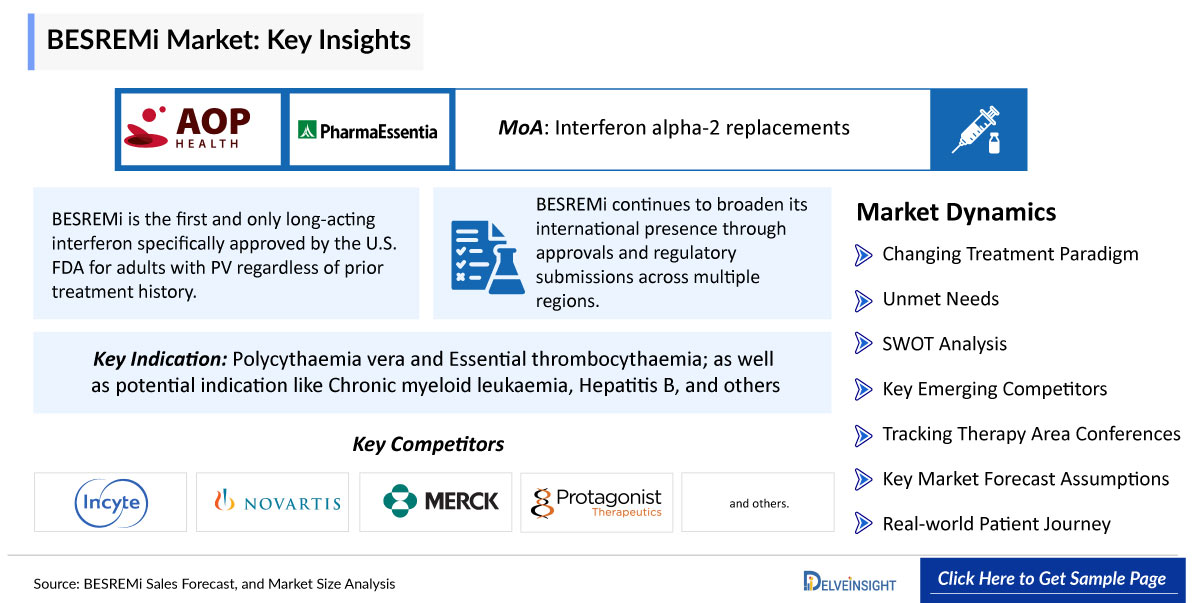
BESREMi is the first and only long-acting interferon specifically approved by the U.S. FDA for adults with PV regardless of prior treatment history. Unlike conventional cytoreductive therapies such as hydroxyurea, ropeginterferon alfa-2b has demonstrated durable hematologic responses, significant reductions in JAK2 V617F allele burden, and the potential to modify disease biology rather than simply controlling blood counts. Long-term data from the Phase III PROUD-PV and CONTINUATION-PV studies published in peer-reviewed journals have shown sustained efficacy for over 7 years, supporting increasing physician confidence and wider adoption.
2. Potential expansion into Essential Thrombocythemia (ET):
The largest near-term commercial catalyst is the anticipated expansion into ET, another major myeloproliferative neoplasm with a substantially larger eligible patient population than PV. PharmaEssentia reported positive topline Phase IIb EXCEED-ET results, and the FDA assigned an August 30, 2026 PDUFA date for the supplemental Biologics License Application (sBLA). In addition, updated NCCN Clinical Practice Guidelines have already incorporated ropeginterferon alfa-2b as a recommended treatment option for ET, which could accelerate physician adoption following approval.
3. Expanding global regulatory approvals and geographic commercialization:
BESREMi continues to broaden its international presence through approvals and regulatory submissions across multiple regions. Recent milestones include approval of a high-dose dosing regimen in Japan, approval in Hong Kong, authorization in Argentina, acceptance of a New Drug Submission in Canada, and regulatory filings in China for both PV and ET. These approvals expand the addressable market and diversify revenue beyond the United States and Europe.
4. Improved dosing convenience enhances patient adherence:
BESREMi is administered subcutaneously every 2–4 weeks, offering a more convenient schedule than earlier pegylated interferons that typically require weekly administration. In 2026, Japan approved a 250–350–500 μg high-dose initiation regimen, enabling patients to reach the maintenance dose more rapidly while maintaining an acceptable safety profile. Simplified dosing and fewer injections are expected to improve patient adherence and physician preference, supporting long-term market penetration.
5. Manufacturing expansion supports long-term commercial growth:
To meet increasing global demand, PharmaEssentia announced a US$46 million investment to establish a dedicated manufacturing facility in Puerto Rico, with operations planned to begin in 2027 pending regulatory approvals. The facility is intended to strengthen US supply security, increase production capacity, and support anticipated growth from both existing PV sales and future ET commercialization.
BESREMi Recent Developments
In July 2026, PharmaEssentia Corporation announced that its wholly owned subsidiary, FORUS Therapeutics Inc, had received a Notice of Compliance (NOC) authorizing BESREMi (ropeginterferon alfa-2b) for the treatment of adults with polycythemia vera (PV). BESREMi® is expected to become commercially available in Canada in the coming weeks.
“BESREMi Sales Forecast, and Market Size Analysis – 2034” report provides comprehensive insights of BESREMi for approved indication like Polycythaemia vera and Essential thrombocythaemia; as well as potential indication like Chronic myeloid leukaemia, Hepatitis B, Hepatitis C, Myelofibrosis, Liver cancer in the 7MM. A detailed picture of BESREMi’s existing usage in approved and anticipated entry and performance in potential indications in the 7MM, i.e., the United States, EU4 (Germany, France, Italy, and Spain) and the United Kingdom, and Japan for the study period 2020 –2034 is provided in this report along with a detailed description of the BESREMi for approved and potential indications. The BESREMi market report provides insights about BESREMi’s sales forecast, mechanism of action (MoA), dosage and administration, as well as research and development including regulatory milestones, along with other developmental activities. Further, it also consists of historical and current BESREMi performance, future market assessments inclusive of the BESREMi market forecast analysis for approved and potential indications in the 7MM, SWOT, analysts’ views, comprehensive overview of market competitors, and brief about other emerging therapies in respective indications. It also provides analysis of BESREMi sales forecasts, along with factors driving its market.
BESREMi Drug Summary
BESREMi (ropeginterferon alfa-2b-njft) is a long-acting, monopegylated interferon alfa-2b developed by PharmaEssentia for the treatment of adults with polycythemia vera (PV). Administered as a subcutaneous injection every two weeks during dose titration and every four weeks once stable, BESREMi exerts its therapeutic effect by activating interferon signaling pathways that suppress abnormal hematopoietic stem cell proliferation and reduce the burden of malignant clones, including those harboring the JAK2 V617F mutation. Clinical studies have demonstrated durable hematologic responses, progressive reductions in JAK2 allele burden, and the potential for long-term disease modification with a favorable tolerability profile compared with conventional interferons. The drug received regulatory approval in Europe and the United States for polycythemia vera and is positioned as an important treatment option for both newly diagnosed and previously treated patients, offering convenient dosing, sustained efficacy, and the potential to alter the natural course of this chronic myeloproliferative neoplasm. The report provides BESREMi’s sales, growth barriers and drivers, post usage and approvals in multiple indications.
Scope of the BESREMi Market Report
The report provides insights into:
- A comprehensive product overview including the BESREMi MoA, description, dosage and administration, research and development activities in approved indications like Polycythaemia vera and Essential thrombocythaemia; as well as potential indication like Chronic myeloid leukaemia, Hepatitis B, Hepatitis C, Myelofibrosis, Liver cancer.
- Elaborated details on BESREMi regulatory milestones and other development activities have been provided in BESREMi market report.
- The report also highlights BESREMi‘s cost estimates and regional variations, reported and estimated sales performance, research and development activities in approved and potential indications across the United States, Europe, and Japan.
- The BESREMi market report also covers the patents information, generic entry and impact on cost cut.
- The BESREMi market report contains current and forecasted BESREMi sales for approved and potential indications till 2034.
- Comprehensive coverage of the late-stage emerging therapies for respective indications.
- The BESREMi market report also features the SWOT analysis with analyst views for BESREMi in approved and potential indications.
Methodology
The BESREMi market report is built using data and information sourced primarily from internal databases, primary and secondary research and in-house analysis by DelveInsight’s team of industry experts. Information and data from the secondary sources have been obtained from various printable and nonprintable sources like search engines, news websites, global regulatory authorities websites, trade journals, white papers, magazines, books, trade associations, industry associations, industry portals and access to available databases.
BESREMi Analytical Perspective by DelveInsight
- In-depth BESREMi Market Assessment
This BESREMi sales market forecast report provides a detailed market assessment of BESREMi for approved indication like Polycythaemia vera and Essential thrombocythaemia; as well as potential indication like Chronic myeloid leukaemia, Hepatitis B, Hepatitis C, Myelofibrosis, Liver cancer in the seven major markets, i.e., the United States, EU4 (Germany, France, Italy, and Spain) and the United Kingdom, and Japan. This segment of the report provides current and forecasted BESREMi sales data uptil 2034.
- BESREMi Clinical Assessment
The BESREMi market report provides the clinical trials information of BESREMi for approved and potential indications covering trial interventions, trial conditions, trial status, start and completion dates.
BESREMi Competitive Landscape
The report provides Insights on competitors and marketed products within the domain, along with a summary of emerging products and their respective launch dates, posing significant competition in the market.
BESREMi Market Potential & Revenue Forecast
- Projected market size for the BESREMi and its key indications
- Estimated BESREMi sales potential (BESREMi peak sales forecasts)
- BESREMi Pricing strategies and reimbursement landscape
BESREMi Competitive Intelligence
- Number of competing drugs in development (pipeline analysis)
- BESREMi Market positioning compared to existing treatments
- BESREMi Strengths & weaknesses relative to competitors
BESREMi Regulatory & Commercial Milestones
- BESREMi Key regulatory approvals & expected launch timelines
- Commercial partnerships, licensing deals, and M&A activity
BESREMi Clinical Differentiation
- BESREMi Efficacy & safety advantages over existing drugs
- BESREMi Unique selling points
BESREMi Market Report Highlights
- In the coming years, the BESREMi market scenario is set to change due to strong adoption, increased prescriptions and broader uptake in multiple immunological indications; which would expand the size of the market.
- The BESREMi companies are developing therapies that focus on novel approaches to treat/improve the disease condition, assess challenges, and seek opportunities that could influence BESREMi’s dominance.
- Other emerging products for Polycythaemia vera and Essential thrombocythaemia; as well as potential indication like Chronic myeloid leukaemia, Hepatitis B, Hepatitis C, Myelofibrosis, Liver cancer are expected to give tough market competition to BESREMi and launch of late-stage emerging therapies in the near future will significantly impact the market.
- A detailed description of regulatory milestones, and developmental activities, provide the current development scenario of BESREMi in approved and potential indications.
- Analyse BESREMi cost, pricing trends and market positioning to support strategic decision-making in the immunology landscape.
- Our in-depth analysis of the forecasted BESREMi sales data uptil 2034 will support the clients in decision-making process regarding their therapeutic portfolio by identifying the overall scenario of BESREMi in approved and potential indications.
Key Questions
- What is the class of therapy, route of administration and mechanism of action of BESREMi? How strong is BESREMi’s clinical and commercial performance?
- What is BESREMi’s clinical trial status in each individual indications such as Polycythaemia vera and Essential thrombocythaemia; as well as potential indication like Chronic myeloid leukaemia, Hepatitis B, Hepatitis C, Myelofibrosis, Liver cancer and study completion date?
- What are the key collaborations, mergers and acquisitions, licensing and other activities related to the BESREMi Manufacturers?
- What are the key designations that have been granted to BESREMi for approved and potential indications? How are they going to impact BESREMi’s penetration in various geographies?
- What is the current and forecasted BESREMi market scenario for approved and potential indications? What are the key assumptions behind the forecast?
- What are the current and forecasted sales of BESREMi in the seven major countries, including the United States, Europe (Germany, France, Italy, Spain) and the United Kingdom, and Japan?
- What are the other emerging products available and how are these giving competition to BESREMi for approved and potential indications?
- Which are the late-stage emerging therapies under development for the treatment of approved and potential indications?
- How cost-effective is BESREMi? What is the duration of therapy and what are the geographical variations in cost per patient?

