Biliary Stents Market Summary
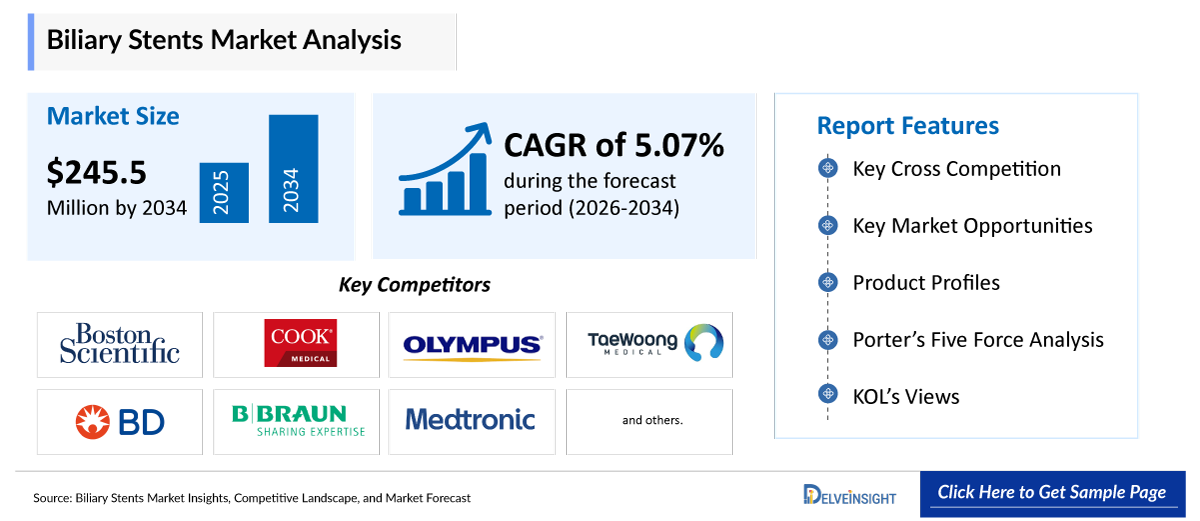
● The Biliary Stents market is estimated at USD 157.3 million in 2025 and is projected to reach USD 245.5 million by 2034. Growth is anchored in the escalating global burden of pancreatic and biliary neoplasms (including cholangiocarcinoma and gallbladder cancer), rising incidence of gallstone-related choledocholithiasis, increasing post-operative and post-transplant anastomotic strictures, and continuous migration toward minimally invasive endoscopic retrograde cholangiopancreatography (ERCP) and percutaneous transhepatic biliary drainage (PTBD) procedures.
● The global Biliary Stents market is growing at a CAGR of 5.07% during the forecast period from 2026 to 2034.
● By Product Type, Self-Expanding Biliary Stents dominate the revenue share (with Self-Expanding Metal Stents [SEMS] holding over 66% of total market revenue) due to their wider luminal diameter, reduced occlusion rates, and superior functional patency.
● By Material, Metal Biliary Stents accounted for the largest revenue share (~58%), while Plastic Stents maintain high procedure volume (accounting for ~42% of revenue and the majority of unit placements) owing to lower unit cost and established utility in benign biliary diseases and temporary leak management.
● By Application, Malignant Biliary Obstruction (pancreatic ductal adenocarcinoma, cholangiocarcinoma, gallbladder carcinoma, and metastatic compression) dominated the market, accounting for approximately 46% of overall market share in 2025.
● By End-User, the Hospitals segment dominated the Biliary Stents market with roughly 46% share in 2025, reflecting the requisite concentration of specialized endoscopy suites, fluoroscopic catheterization suites, advanced ERCP infrastructure, and gastrointestinal surgical units.
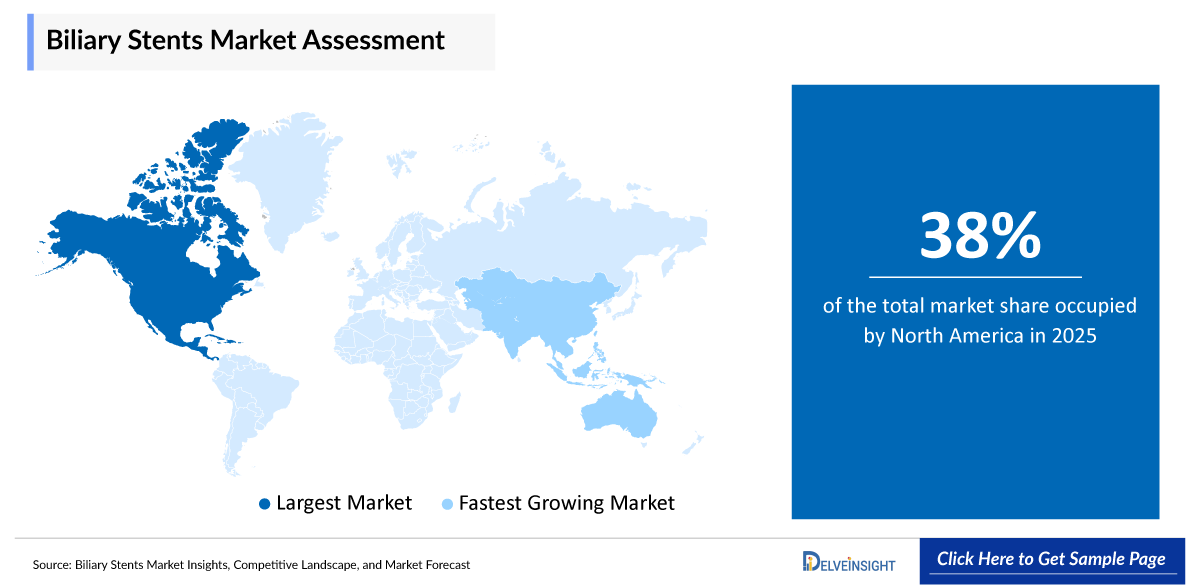
● North America dominated the global Biliary Stents market revenue with approximately a 38% share in 2025, representing the highest regional market share globally.
● Asia-Pacific is registering the fastest CAGR among all regions, propelled by high endemic incidence of gallbladder cancer and cholangiocarcinoma in East and South Asia, expanding health insurance coverage, and rapid modernization of interventional endoscopy infrastructure across China, Japan, and India.
Biliary stents are specialized tubular endoprostheses designed to relieve obstruction, restore bilio-pancreatic luminal flow, and prevent cholemic complications (such as cholangitis, obstructive jaundice, and secondary biliary cirrhosis) in patients with benign or malignant bile duct conditions. Stents are manufactured in rigid and flexible configurations from medical polymers (polyethylene, polyurethane, Teflon/PTFE) and superelastic metal alloys (principally nitinol).
Biliary Stents Market Key Growth Drivers
• Rising Global Burden of Pancreatic and Biliary Cancers: According to GLOBOCAN 2024 epidemiological data, there were an estimated 510,992 new cases of pancreatic cancer and 122,491 new cases of gallbladder and biliary tract cancers in 2022, projected to surge to over 910,600 and 210,000 cases respectively by 2045. Since >70% of these patients present with unresectable biliary obstruction, stenting remains standard-of-care palliative and pre-operative management.
• Transition toward Endoscopic Minimally Invasive Interventions: Growing clinical preference for ERCP-guided stent placement and EUS-guided biliary drainage over open bilio-enteric bypass surgery significantly reduces intraoperative complications, intensive care requirements, and length of hospital stay.
• Evolution in Stent Design and Coverings: Transition toward Fully Covered Self-Expanding Metal Stents (FCSEMS) prevents tumor and hyperplastic tissue ingrowth, prolongs patency intervals to 6-12 months, and allows removable placement in benign strictures, reducing repeat hospitalization rates.
• Rising Volumes of Liver Transplantations and Complex Hepatobiliary Surgeries: Increasing frequency of post-liver transplant anastomotic biliary strictures and post-laparoscopic cholecystectomy bile leaks drives recurring procedural demand for single and multi-stenting protocols.
• Development of Bioresorbable and Drug-Eluting Endoprostheses: Advances in bioabsorbable polymers (such as magnesium- or PLA-based biliary scaffolds) eliminate the need for secondary retrieval procedures, addressing stent clogging and bacterial biofilm encrustation.
• Expansion of Interventional Endoscopy Across Emerging Markets: Accelerating installation of advanced fluoroscopy suites and growing numbers of trained interventional gastroenterologists across China, India, and Southeast Asia are significantly expanding accessible patient populations.
Key Companies in Biliary Stents Market
The competitive landscape is led by the following active manufacturers:
• Boston Scientific Corporation
• Cook Group Incorporated (Cook Medical)
• Olympus Corporation
• Taewoong Medical Co., Ltd.
• Becton, Dickinson and Company (BD Interventional)
• Merit Medical Systems, Inc.
• Micro-Tech Endoscopy
• B. Braun SE
• Medtronic plc
• ELLA-CS, s.r.o.
Factors Contributing to the Growth of the Biliary Stents Market
Market Drivers
Rising Global Burden of Pancreatobiliary Neoplasms: Extrinsic and intrinsic bilio-pancreatic malignancies (cholangiocarcinoma, ampullary tumors, gallbladder cancer, and pancreatic head carcinomas) are direct contributors to obstructive jaundice. Palliative biliary decompression is essential to prevent septic cholangitis, alleviate intolerable pruritus, normalize bilirubin for systemic chemotherapy, and sustain survival quality.
Shift toward Minimally Invasive ERCP and Percutaneous Transhepatic Techniques: Interventional endoscopic stenting via ERCP and interventional radiology drainage (PTBD) have supplanted morbid open surgical bypass (such as hepaticojejunostomy) as the global standard of care. Modern catheter deliverability, low profile (down to 6 Fr delivery systems), and fluoroscopic radiopacity allow outpatient or short-stay treatment.
Market Restraints
Biliary Sepsis, Occlusion, and Stent Migration Complications: Bacterial colonization rapidly forms thick biofilms and biliary sludge, causing late occlusion in plastic stents (median lifespan 3 months). Covered metal stents present high migration rates (up to 10–14%), which can trigger recurrent obstruction, duodenal perforation, and acute pancreatitis.
High Device Acquisition Costs: Self-expanding metal stents command a substantial price premium over simple plastic stents, posing reimbursement and cost constraints in low-to-middle-income healthcare systems and capitated reimbursement settings.
Shortage of Trained Interventional Gastroenterologists and Advanced Facilities: ERCP and EUS-guided stenting are technically challenging procedures requiring multi-year fellowship training, skilled endoscopists, fluoroscopy equipment, and high-end processing units, limiting utilization in rural or underfunded community hospital networks.
Biliary Stents Market Segment Analysis
The biliary stents market is segmented by product type (self-expanding biliary stents [uncovered sems, partially covered sems, fully covered sems] and balloon-expandable biliary stents), material (metal stents [nitinol, stainless steel], plastic stents [polyethylene, polyurethane, PTFE], and biodegradable/bioresorbable stents), application (malignant biliary obstruction, benign biliary strictures, biliary leaks & fistulae, choledocholithiasis/gallstones, and others), end-user (hospitals, specialty centers, ambulatory surgical centers, and others), and geography (North America, Europe, Asia-Pacific, and Rest of World).
By Product Type
Dominant Subsegment: Self-Expanding Biliary Stents (SEMS).
Self-expanding biliary stents hold the dominant revenue position in the global market. Engineered predominantly from superelastic shape-memory nickel-titanium (nitinol) alloy, self-expanding stents provide continuous, gentle radial outward force that self-adapts to tortuous biliary anatomy. SEMS deliver large expanded diameters (8 mm to 10 mm) while deploying through narrow 6 Fr–8 Fr endoscopic working channels, offering superior patency (up to 10–12 months) compared to plastic stents. Within this category, Fully Covered SEMS (FCSEMS) represent the most rapidly expanding subcategory because the silicone or ePTFE polymer membrane eliminates tissue ingrowth, facilitates non-traumatic endoscopic repositioning or removal, and proves highly effective for benign conditions and cystic duct leak sealings. Balloon-expandable stents retain a smaller, niche footprint primarily in rigid percutaneous interventional radiology applications.
By Material
Dominant Subsegment: Metal Biliary Stents
Metal stents account for the highest value share of 63% of global sales in 2025. Despite plastic stents commanding greater volume placements due to their low production costs and ubiquitous use as temporary drainage tools, the high average selling price (ASP) and extended clinical efficacy of nitinol metal endoprostheses drive revenue dominance. Metal stents remain the mandatory standard for unresectable malignant bile duct obstructions, reducing repeat hospitalizations for jaundice and cholangitis.
Biliary Stents Market Region Analysis
Dominant Region: North America
North America accounted for 38% of global biliary stents market revenue in 2025. Regional dominance is underpinned by high incidence of pancreatic ductal adenocarcinoma and choledocholithiasis, extensive deployment of modern ERCP and endoscopic ultrasound (EUS) suites, and favorable procedural reimbursement policies through Medicare and private payers. The region also benefits from the headquarters and primary R&D centers of market leaders such as Boston Scientific, Cook Medical, Merit Medical, and BD Interventional, ensuring rapid domestic commercialization and widespread physician training.
Fastest Growing Region: Asia-Pacific
Asia-Pacific is projected to exhibit the highest CAGR during the forecast period. East and South Asian countries (including China, South Korea, Japan, and parts of India) experience some of the world’s highest age-standardized incidence rates of gallbladder cancer, cholangiocarcinoma, and gallstone disease. Expanding national healthcare infrastructure, rising disposable incomes, and the expansion of medical tourism for complex endoscopic interventions across China, India, and Thailand position the Asia-Pacific territory as the primary engine of incremental volume demand through 2034.
Regional Commentary
North America
North America accounted for 38% of global revenue in 2025. Driven by high procedural volumes of ERCP, rapid clinical adoption of covered SEMS in benign diseases, and clear reimbursement coding for complex endoscopic procedures.
Europe
Europe represents the second-largest share of global sales. Advanced public and private health infrastructures across Germany, the UK, France, and Italy support early adoption of next-generation bioabsorbable and drug-eluting biliary stents. The implementation of the EU Medical Device Regulation (MDR) has increased post-market compliance requirements.
Asia-Pacific
Asia-Pacific is the fastest-growing region, supported by substantial patient volumes, indigenous manufacturing centers (such as Taewoong Medical in South Korea and Micro-Tech in China), and government health modernization initiatives in second- and third-tier hospitals.
Rest of World
The Rest of World region, spanning the Middle East, Africa, and South America, is an emerging growth frontier. Growth is supported by investment in tertiary gastroenterology centers in Brazil, Mexico, Saudi Arabia, and the UAE, though tempered by supply chain dependencies and constrained healthcare budgets in rural regions.
Biliary Stents Market Competitive Landscape
The Biliary Stents market is classified as Moderately Concentrated. A handful of tier-one multinational medical device corporations, most notably Boston Scientific Corporation and Cook Medical / Olympus Corporation, command extensive market share through comprehensive product pipelines, longstanding relationships with key opinion leaders, proprietary delivery technologies, and global distribution logistics. Specialist regional and international innovators (such as Taewoong Medical, Merit Medical, and Micro-Tech Endoscopy) compete with specialized stent geometry, anti-migration flared ends, anti-reflux valve mechanisms, and competitive pricing.
The competitive landscape can be evaluated across the following dimensions:
• Market concentration: Moderately concentrated, with multinational device companies dominating alongside specialized Asian and European stent manufacturers.
• Leading players: Boston Scientific, Cook Group, Olympus Corporation, Taewoong Medical, and BD Interventional lead in total unit and dollar volumes.
• Geographic reach: Top manufacturers operate comprehensive multinational footprints, servicing hospitals and endoscopy centers across North America, the European Union, and Asia-Pacific.
• Product portfolio strength: Comprehensive product suites spanning multi-size plastic biliary endoprostheses (Cotton-Leung, Zimmon, Cotton-Huibregtse), bare-metal nitinol stents, and fully covered self-expanding metal stents (e.g., WallFlex, Hanarostent, Evolution).
• Technology leadership: Anti-migration anchor struts, anti-reflux bile valves, low-profile 6 Fr deployment catheter delivery systems, and biocompatible silicone/ePTFE coatings.
• Strategic consolidation & distribution: Global distribution alignments and tuck-in acquisitions, such as Olympus distributing and partnering on specialized stent assets, and BD's expansion in peripheral/interventional biliary stenting.
• Manufacturing capabilities: Precision nitinol laser micromachining, automated polymer membrane spray-coating, and cleanroom stent-loading assemblies.
• Innovation focus: Bioresorbable biliary stents (poly-L-lactic acid and magnesium alloy), paclitaxel-eluting biliary stents for localized tumor inhibition, and dedicated lumen-apposing metal stents (LAMS) for EUS-guided choledochoduodenostomy.
Biliary Stents Market Recent Developmental Activities
• In November 2024, Taewoong Medical highlighted expanded clinical data for its Niti-S Biliary S-Type and Bumpy fully covered stents, demonstrating reduced distal and proximal stent migration rates in benign biliary strictures. Strategic significance: Strengthens market differentiation in anti-migration stent geometries.
• In April 2024, Boston Scientific announced post-market multicenter registry outcomes reinforcing the durability and low occlusion rates of its WallFlex™ Biliary RX Stents in malignant extrahepatic biliary stenosis. Strategic significance: Reinforces category leadership in self-expanding metal endoprostheses.
Biliary Stents Market Segmentation
Biliary Stents Market by Product Type
• Self-Expanding Biliary Stents
▪ Fully Covered Self-Expanding Metal Stents (FCSEMS)
▪ Partially Covered Self-Expanding Metal Stents (PCSEMS)
▪ Uncovered Self-Expanding Metal Stents (USEMS)
• Balloon-Expandable Biliary Stents
Biliary Stents Market by Material
• Metal Biliary Stents
▪ Nitinol (Nickel-Titanium Alloy)
▪ Stainless Steel & Others
• Plastic Biliary Stents
▪ Polyethylene (PE)
▪ Polyurethane (PU)
▪ Fluoropolymers (PTFE/FEP)
• Biodegradable / Bioresorbable Biliary Stents
Biliary Stents Market by Application
• Malignant Biliary Obstruction
▪ Pancreatic Cancer
▪ Cholangiocarcinoma (Bile Duct Cancer)
▪ Gallbladder Cancer
▪ Metastatic & Extrinsic Compression
• Benign Biliary Strictures
▪ Post-Surgical & Post-Cholecystectomy Strictures
▪ Post-Liver Transplant Anastomotic Strictures
▪ Chronic Pancreatitis Strictures
• Biliary Leaks & Fistulae
• Choledocholithiasis / Gallstone-Related Obstruction
• Other Applications (Biliary Atresia, Sphincter of Oddi Dysfunction)
Biliary Stents Market by End-Users
• Hospitals
• Specialty Centers
• Ambulatory Surgical Centers (ASCs)
• Others
Biliary Stents Market by Geography
• North America Biliary Stents Market
▪ United States Biliary Stents Market Size in USD million (2023-2034)
▪ Canada Biliary Stents Market Size in USD million (2023-2034)
▪ Mexico Biliary Stents Market Size in USD million (2023-2034)
• Europe Biliary Stents Market
▪ Germany Biliary Stents Market Size in USD million (2023-2034)
▪ United Kingdom Biliary Stents Market Size in USD million (2023-2034)
▪ France Biliary Stents Market Size in USD million (2023-2034)
▪ Italy Biliary Stents Market Size in USD million (2023-2034)
▪ Spain Biliary Stents Market Size in USD million (2023-2034)
▪ Rest of Europe Biliary Stents Market Size in USD million (2023-2034)
• Asia-Pacific Biliary Stents Market
▪ China Biliary Stents Market Size in USD million (2023-2034)
▪ Japan Biliary Stents Market Size in USD million (2023-2034)
▪ India Biliary Stents Market Size in USD million (2023-2034)
▪ Australia Biliary Stents Market Size in USD million (2023-2034)
▪ South Korea Biliary Stents Market Size in USD million (2023-2034)
▪ Rest of Asia-Pacific Biliary Stents Market Size in USD million (2023-2034)
• Rest of the World (RoW) Biliary Stents Market
▪ Middle East Biliary Stents Market Size in USD million (2023-2034)
▪ Africa Biliary Stents Market Size in USD million (2023-2034)
▪ South America Biliary Stents Market Size in USD million (2023-2034)
Key Takeaways from the Biliary Stents Market Report Study
• Market size analysis for the current Biliary Stents market size (2025), and market forecast for 9 years (2026 to 2034).
• Top key product/technology developments, mergers, acquisitions, partnerships, and joint ventures that have happened over the last 3 years.
• Key companies dominating the global Biliary Stents market.
• Various opportunities available for competitors in the Biliary Stents market space.
• What are the top-performing segments in 2025? How will these segments perform in 2034?
• Which are the top-performing regions and countries in the current Biliary Stents market scenario?
• Which are the regions and countries where companies should concentrate their opportunities for Biliary Stents market growth in the future?
Target audience who can benefit from this Biliary Stents market report study
• Biliary Stents product providers
• Research organizations and consulting companies
• Biliary Stents -related organizations, associations, forums, and other alliances
• Government and corporate offices
• Start-up companies, venture capitalists, and private equity firms
• Distributors and traders dealing in Biliary Stents
• Various end-users who want to know more about the Biliary Stents market and the latest technological developments in the Biliary Stents market.

