Biologics CDMO Market Summary
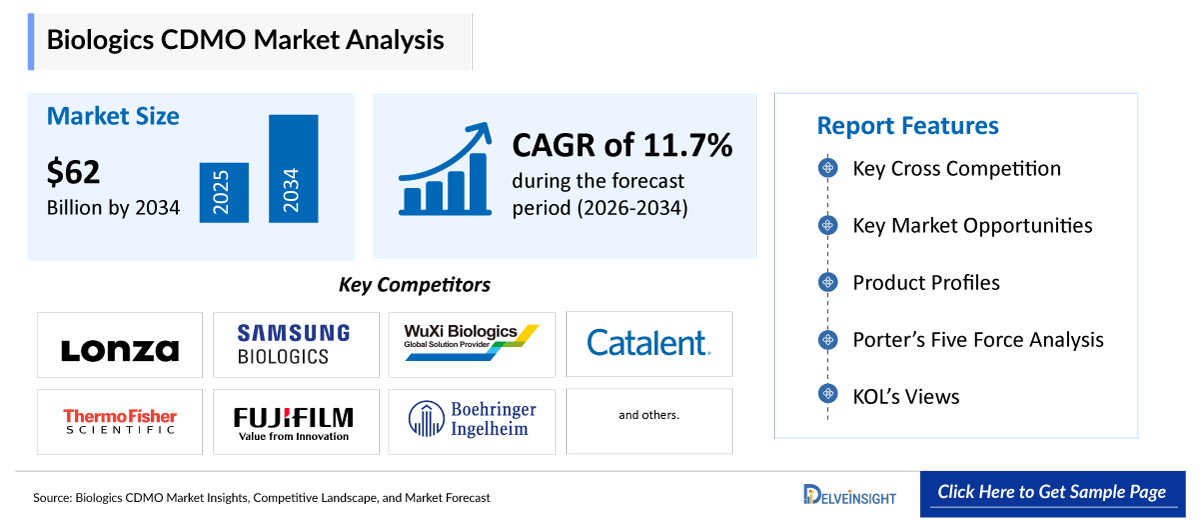
- The Biologics CDMO market is estimated at USD 23.00 billion in 2025 and is projected to reach USD 62.00 billion by 2034. Growth is anchored in the expanding biologics pipeline, rising outsourcing by pharmaceutical and biotechnology companies, and a wave of large-scale capacity investment and consolidation among leading contract developers and manufacturers.
- The global Biologics CDMO market is growing at a CAGR of 11.7% during the forecast period from 2026 to 2034.
- By product type, the monoclonal antibodies segment dominated the Biologics CDMO market with a 57% share in 2025.
- By service type, the contract manufacturing segment dominated the Biologics CDMO market with a 58% share in 2025.
- By source, the mammalian expression segment dominated the Biologics CDMO market with a 70% share in 2025.
- By indication, the oncology segment dominated the Biologics CDMO market with a 40% share in 2025.
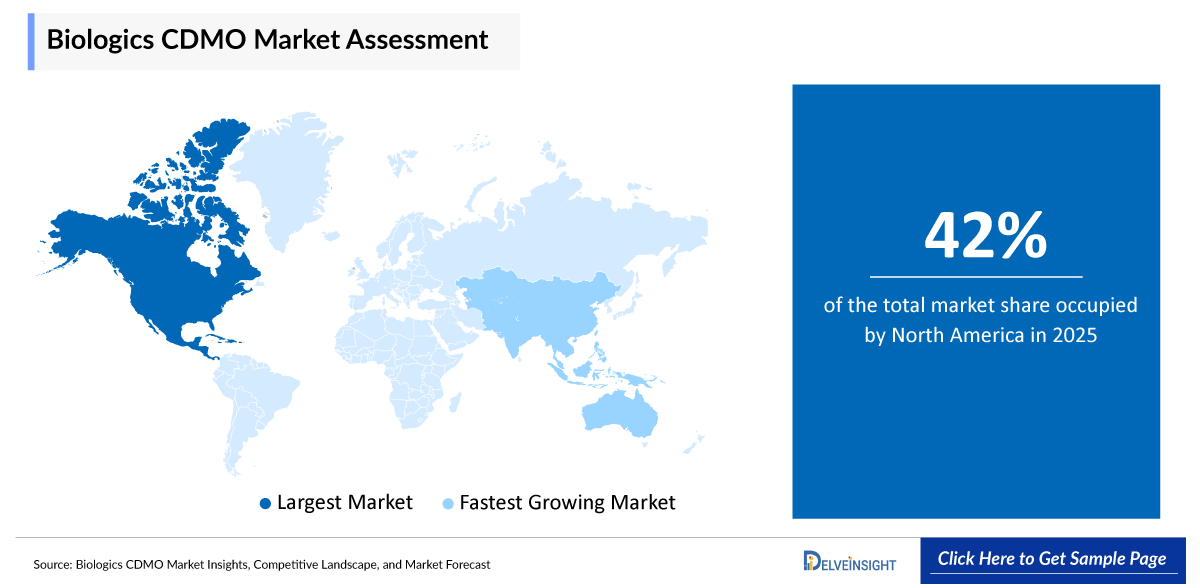
- North America dominated the global Biologics CDMO market revenue with a 42% share in 2025, representing the highest regional market share globally.
A biologics contract development and manufacturing organization (CDMO) provides outsourced development, manufacturing, and related services for biologic medicines, including monoclonal antibodies, recombinant proteins, vaccines, antibody-drug conjugates, and cell and gene therapy products. Biologics CDMOs support pharmaceutical and biotechnology companies across the value chain, from cell-line development, process and analytical development, and clinical-scale supply to commercial drug-substance and drug-product manufacturing, fill-finish, packaging, and quality and regulatory services. Production relies on living systems, predominantly mammalian cell culture and, for certain proteins, microbial fermentation, and demands specialized facilities, single-use and stainless-steel bioreactors, rigorous quality systems, and deep regulatory expertise. By outsourcing to CDMOs, drug developers access specialized capabilities and large-scale capacity without heavy capital investment, accelerate time to market, and manage the complexity of novel modalities. The market spans contract development and contract manufacturing services, mammalian and microbial expression systems, and applications across oncology, immunology, infectious disease, and other therapeutic areas. Propelled by a growing biologics and biosimilar pipeline, rising outsourcing penetration, the ADC and cell-and-gene-therapy boom, and substantial capacity expansion and consolidation, biologics CDMOs have become indispensable infrastructure for the global biopharmaceutical industry.
Biologics CDMO Market Key Growth Drivers
- The expanding biologics pipeline, led by monoclonal antibodies, antibody-drug conjugates, and cell and gene therapies, is increasing demand for specialized development and manufacturing capacity.
- Rising outsourcing by pharmaceutical and biotechnology companies, now estimated at 40% of pharmaceutical manufacturing, is shifting biologics production to CDMOs to access expertise and capacity without heavy capital investment.
- The rising global cancer burden is driving demand for oncology biologics, with the International Agency for Research on Cancer projecting cancer cases to rise from 20 million in 2022 to 35 million by 2050.
- The growth of biosimilars, as major biologics lose exclusivity, is expanding manufacturing demand for high-volume, cost-competitive production.
- Large-scale capacity investment and consolidation, including multi-billion-dollar acquisitions and new plants, are expanding global biologics manufacturing supply.
- Emerging biotechnology companies, which often lack in-house manufacturing, increasingly rely on CDMOs to advance programs and shorten time to market.
- The convergence of pipeline growth, outsourcing, oncology and biosimilar demand, and capacity expansion is expected to sustain strong double-digit growth in the market through 2034.
Key Companies in Biologics CDMO Market
The competitive landscape is led by the following active developers and manufacturers:
- Lonza Group AG
- Samsung Biologics Co., Ltd.
- WuXi Biologics (Cayman) Inc.
- Catalent, Inc.
- Thermo Fisher Scientific Inc.
- FUJIFILM Diosynth Biotechnologies
- Boehringer Ingelheim (BioXcellence)
- AGC Biologics
- Rentschler Biopharma SE
- Syngene International Limited
For illustrative purposes, only the top 10 companies are listed in the Table of Contents. The report may include analysis and references to additional companies, where relevant to the market assessment.
Biologics CDMO Market Size
The following snapshot summarizes the principal report metrics for the Biologics CDMO market.
|
Report Metrics |
Details |
|
2025 Market Size |
USD 23.00 billion |
|
2034 Projected Market Size |
USD 62.00 billion |
|
Growth Rate (2026-2034) |
11.7% CAGR |
|
Largest Market |
North America |
|
Fastest Growing Market |
Asia-Pacific |
|
Market Structure |
Moderately Concentrated |
All market values are expressed in USD and represent DelveInsight estimates synthesized from primary and secondary research.
Factors Contributing to the Growth of the Biologics CDMO Market
Biologics CDMO Market Drivers
- Expanding Biologics and Advanced-Modality Pipeline
The most powerful driver of the Biologics CDMO market is the expanding pipeline of biologic medicines and advanced modalities. Monoclonal antibodies remain the largest and fastest-growing class, while antibody-drug conjugates, bispecific antibodies, recombinant proteins, vaccines, and cell and gene therapies are proliferating across clinical and commercial pipelines. These products are complex to develop and manufacture, requiring specialized expression systems, bioreactors, conjugation and fill-finish capabilities, and rigorous quality and regulatory expertise that many developers do not hold in-house. As the number and diversity of biologics in development grow, demand for outsourced development and manufacturing capacity rises in parallel, and the shift toward novel modalities raises the technical bar in ways that favor specialized CDMOs. This deep and broadening pipeline, spanning antibodies through cell and gene therapies, anchors sustained demand for biologics CDMO services through the forecast period.
- Rising Outsourcing by Pharmaceutical and Biotechnology Companies
Rising outsourcing is a central growth engine, as pharmaceutical and biotechnology companies increasingly shift biologics development and manufacturing to CDMOs. Outsourcing now accounts for an estimated 40% of pharmaceutical manufacturing, and the share is higher and rising for complex biologics. Faced with high capital costs, complex and uncertain pipelines, and pressure to accelerate time to market, developers turn to CDMOs to access specialized expertise, advanced technologies, and large-scale capacity without committing to heavy fixed investment in plants that may sit underused if a program fails. Outsourcing converts capital expenditure into variable cost, de-risks capacity decisions, and provides flexibility across modalities and scales. Emerging biotechnology companies in particular depend on CDMOs to manufacture clinical and commercial supply. As outsourcing penetration deepens across the industry, demand for biologics CDMO services expands steadily, reinforcing market growth across the forecast period.
- Rising Global Cancer Burden and Oncology Biologics Demand
The rising global cancer burden is a powerful driver, as oncology is the largest therapeutic area for biologics and the leading source of CDMO demand. The International Agency for Research on Cancer recorded 20 million new cancer cases in 2022 and projects 35 million by 2050, and the World Health Organization recognizes biologic therapies, including monoclonal antibodies and antibody-drug conjugates, as central to modern cancer treatment. The surge in oncology antibodies, conjugates, and bispecifics entering clinical development and commercial supply directly increases demand for specialized manufacturing, including high-potency and conjugation capabilities. Aging populations and improving diagnosis further expand the oncology patient pool and the volume of biologics required. As cancer incidence climbs and oncology biologics proliferate, CDMOs that can manufacture these complex therapies at scale capture growing demand, anchoring market expansion through the forecast period.
- Growth of Biosimilars and Patent Expiries
The expanding biosimilars market is a significant driver of biologics CDMO demand. As major biologic medicines lose patent exclusivity, a growing pipeline of biosimilars enters development and commercialization, requiring high-volume, cost-competitive manufacturing that many biosimilar developers prefer to outsource. Biosimilar programs favor CDMOs with efficient mammalian cell-culture platforms, strong analytical and comparability capabilities, and global regulatory experience, since cost and scale are decisive in these price-sensitive markets. The wave of upcoming biologic patent expiries, including high-volume antibodies, expands the addressable opportunity for contract manufacturing. CDMOs also support biosimilar developers in navigating complex regulatory pathways and achieving the analytical rigor required to demonstrate similarity. As biosimilar adoption grows and more reference biologics lose exclusivity, demand for scalable, cost-efficient biologics manufacturing expands, reinforcing market growth across the forecast period.
- Large-Scale Capacity Investment and Consolidation
Substantial capacity investment and consolidation are expanding global biologics manufacturing supply and reshaping the competitive landscape. Leading CDMOs are investing billions in new and expanded facilities, including Lonza's USD 1.2 billion acquisition of a large-scale mammalian site in Vacaville, California, Samsung Biologics' expansion to 784,000 liters with its fifth plant and a sixth under review, Fujifilm Biotechnologies' new large-scale Holly Springs site and Hillerod expansion, and WuXi Biologics' new Singapore facility. Consolidation is equally striking, exemplified by Novo Holdings' USD 16.5 billion acquisition of Catalent. This wave of investment adds drug-substance, drug-product, and fill-finish capacity, supports next-generation modalities, and addresses reshoring and supply-security priorities. Expanding, modernized capacity enables CDMOs to win large, long-term contracts and meet rising demand, while scale and integration strengthen leading players, supporting market growth across the forecast period.
- Reliance of Emerging Biotechnology Companies on CDMOs
The growing reliance of emerging biotechnology companies on CDMOs is a durable source of demand. Small and mid-sized biotechs, which drive a large and growing share of biologics innovation, typically lack in-house manufacturing and the capital to build it, making CDMOs essential partners from early development through commercial supply. By outsourcing, these companies access cell-line development, process and analytical development, and clinical and commercial manufacturing on flexible terms, allowing them to focus resources on discovery and clinical development while shortening time to market. Integrated CRDMO models that combine research, development, and manufacturing under one roof are particularly attractive to biotechs seeking a single partner across the value chain. As venture and strategic capital continue to fund biotech innovation and pipelines expand, demand from emerging companies for biologics CDMO services grows steadily, reinforcing market expansion across the forecast period.
- Technological Advances in Bioprocessing and Digital Manufacturing
Advances in bioprocessing and digital manufacturing are enhancing the capability, efficiency, and value of biologics CDMOs. Innovations include high-titer mammalian cell-culture processes, single-use and intensified bioprocessing, continuous manufacturing supported by evolving regulatory frameworks such as ICH Q13, and advanced conjugation platforms for antibody-drug conjugates. Digital biomanufacturing, automation, process analytical technology, and the use of digital twins improve yield, quality, consistency, and speed while reducing cost. These capabilities allow CDMOs to manufacture complex modalities more reliably and at greater scale, differentiate on technical performance, and shorten development timelines for clients. As process intensification, continuous manufacturing, and digital tools mature, they expand the range of products CDMOs can serve and improve their economics, attracting more outsourced programs and reinforcing the market's long-term growth trajectory across the forecast period.
Biologics CDMO Market Restraints
Despite strong momentum, the Biologics CDMO market faces material constraints. High capital intensity is a defining challenge, as building and operating biologics facilities requires enormous investment in bioreactors, clean-room infrastructure, single-use systems, and quality systems, and capacity decisions carry significant risk, since plants can sit underused if client pipelines slip or programs fail, while shortages can constrain growth when demand surges. Long facility construction and validation timelines, often spanning several years, limit how quickly supply can respond to demand. A shortage of skilled biomanufacturing talent, including process scientists, engineers, and quality professionals, constrains expansion and raises staffing and validation risk at new sites. Stringent and evolving regulatory requirements across the United States, Europe, and Asia demand rigorous quality systems, comparability, and ongoing inspection readiness, lengthening timelines and raising the cost of compliance. Client concentration and dependence on a limited number of large programs expose CDMOs to revenue volatility if contracts are lost or delayed. Geopolitical and trade dynamics, including supply-chain dependencies, reshoring pressures, tariffs, and proposed biosecurity legislation affecting certain manufacturers, add uncertainty and may reshape sourcing. Pricing pressure in competitive segments such as biosimilars compresses margins, and overcapacity in some modalities can intensify competition. Together, these capital, talent, regulatory, concentration, and geopolitical barriers temper the pace of growth, even as the underlying drivers of pipeline expansion and outsourcing remain firmly intact.
Biologics CDMO Market Segment Analysis
The Biologics CDMO Market by Product Type (Monoclonal Antibodies, Recombinant Proteins, Vaccines, Antibody-Drug Conjugates, Cell and Gene Therapy Products, Other Biologics), Service Type (Contract Manufacturing, Contract Development, Analytical and Quality Services, Fill-Finish and Packaging), Source (Mammalian, Microbial, Other Expression Systems), Indication (Oncology, Autoimmune and Inflammatory, Infectious Diseases, Metabolic, Others), and Geography (North America, Europe, Asia-Pacific, Rest of World).
By Product Type
Dominant Subsegment: Monoclonal Antibodies. The monoclonal antibodies category is expected to dominate the market.
Dominant: Monoclonal Antibodies ~ 57%
The monoclonal antibodies segment accounted for 57% of the Biologics CDMO market in 2025. Monoclonal antibodies are the leading product type because they represent the largest and most established class of biologics by revenue and pipeline, spanning oncology, immunology, and infectious disease, and because they require large-scale mammalian manufacturing that CDMOs are well positioned to provide. The high and growing volume of approved and pipeline antibodies, including a broad biosimilar wave as reference products lose exclusivity, sustains substantial demand for drug-substance and drug-product manufacturing. Antibodies also anchor the largest capacity investments by leading CDMOs, reflecting their central role in outsourced biologics production. Adjacent classes are growing quickly, with antibody-drug conjugates and bispecifics expanding rapidly from a smaller base and cell and gene therapy products representing the fastest-growing and most strategically important modality, while recombinant proteins and vaccines remain significant. Nonetheless, the scale, maturity, and biosimilar tailwind of monoclonal antibodies secure their clear leadership across the forecast period.
By Service Type
Dominant Subsegment: Contract Manufacturing. The contract manufacturing category is expected to dominate the market.
Dominant: Contract Manufacturing ~ 58%
The contract manufacturing segment accounted for 58% of the Biologics CDMO market in 2025. Contract manufacturing is the leading service type because commercial and clinical drug-substance and drug-product manufacturing represents the largest, most capital-intensive, and highest-value portion of the biologics CDMO value chain. Manufacturing generates recurring, volume-linked revenue across long-term supply agreements, and the scale of investment in bioreactor capacity by leading CDMOs underscores its dominance. As biologics move from development into commercial supply and as biosimilars demand high-volume, cost-competitive production, manufacturing demand expands. Contract development, including cell-line, process, and analytical development, is essential and fast-growing as it feeds the manufacturing pipeline and anchors long-term client relationships, while analytical and quality services and fill-finish and packaging are critical adjacent segments, with fill-finish capacity a particular focus of recent investment. While development and specialized services grow rapidly, the scale, recurring economics, and capacity intensity of contract manufacturing secure its leadership across the forecast period.
By Source
Dominant Subsegment: Mammalian. The mammalian expression category is expected to dominate the market.
Dominant: Mammalian ~ 70%
The mammalian expression segment accounted for 70% of the Biologics CDMO market in 2025. Mammalian expression is the dominant source because most biologics, including the great majority of monoclonal antibodies, antibody-drug conjugates, and many recombinant proteins, require mammalian cell culture, typically Chinese hamster ovary cells, to achieve the complex glycosylation and folding needed for efficacy and safety. The scale and value of antibody manufacturing make mammalian capacity the centerpiece of the biologics CDMO industry, and the largest facility investments, such as Lonza's Vacaville site and Samsung Biologics' multi-plant campuses, are predominantly mammalian. High-titer processes, single-use systems, and intensified bioprocessing continue to improve mammalian productivity and economics. Microbial fermentation remains important for simpler proteins, peptides, and certain modalities and grows steadily, while other expression systems serve niche applications. Nonetheless, the centrality of antibodies and complex proteins to the biologics pipeline secures the clear leadership of mammalian expression across the forecast period.
By Indication
Dominant Subsegment: Oncology. The oncology category is expected to dominate the market.
Dominant: Oncology ~ 40%
The oncology segment accounted for 40% of the Biologics CDMO market in 2025. Oncology is the leading indication because it is the largest and fastest-expanding therapeutic area for biologics, drawing on a deep pipeline of monoclonal antibodies, antibody-drug conjugates, bispecifics, and cell and gene therapies. The rising global cancer burden, with cancer cases projected to climb from 20 million in 2022 to 35 million by 2050, drives sustained demand for oncology biologics and the specialized manufacturing they require, including high-potency and conjugation capabilities that command premium pricing. Oncology programs dominate clinical pipelines and increasingly reach commercial scale, anchoring CDMO demand. Autoimmune and inflammatory diseases form a large and stable indication anchored by high-volume antibodies, while infectious diseases, including vaccines, and metabolic and other indications contribute meaningfully and grow with pipeline activity. Nonetheless, the scale, pipeline depth, and rising cancer burden underpinning oncology biologics secure the segment's leadership across the forecast period.
Biologics CDMO Market Region Analysis
Dominant Region: North America
North America accounted for 42% of the global Biologics CDMO market revenue in 2025, representing the highest regional market share globally. The region's dominance reflects the world's largest biopharmaceutical industry, the deepest biologics pipeline, strong demand for domestic manufacturing, and substantial CDMO capacity, particularly in the United States. North America hosts the headquarters and major operations of leading developers and CDMOs and is the focus of intense capacity investment and reshoring, exemplified by Lonza's USD 1.2 billion acquisition of the large-scale Vacaville, California site, Fujifilm Biotechnologies' new Holly Springs, North Carolina facility anchored by Johnson & Johnson and Regeneron, and Thermo Fisher's planned acquisition of a Sanofi sterile site in New Jersey. The region benefits from a robust FDA regulatory framework, strong innovation and capital, and supply-security and reshoring priorities that favor domestic manufacturing. A dense base of developers, deep demand, and accelerating investment anchor the region's continued leadership across the forecast period.
Dominant: North America ~ 42% (Largest)
Fastest Growing Region: Asia-Pacific
Asia-Pacific is the fastest-growing region in the Biologics CDMO market. The region's elevated CAGR is driven by large-scale capacity expansion, competitive cost structures, a growing domestic biopharmaceutical industry, and strong government support across South Korea, China, India, Singapore, and Japan. Samsung Biologics has expanded to 784,000 liters with its fifth plant and is reviewing a sixth, WuXi Biologics has opened a large new Singapore facility, and Syngene International is expanding its footprint, while Lotte Biologics and others add capacity. The region combines world-scale mammalian manufacturing, integrated CRDMO models, and cost advantages that attract global outsourcing, alongside rising domestic demand and biosimilar production. Despite geopolitical and trade uncertainties affecting some manufacturers, the scale of investment, cost competitiveness, and government support position Asia-Pacific as the principal source of incremental growth over the forecast period.
Regional Commentary
North America
North America accounted for 42% of the global Biologics CDMO market revenue in 2025. The United States dominates on the strength of the world's largest biopharmaceutical industry, the deepest biologics pipeline, a robust FDA framework, strong capital, and accelerating capacity investment and reshoring, while Canada contributes through specialized manufacturing and development capacity.
Europe
Europe is a large and advanced regional market, led by Switzerland, Germany, the United Kingdom, Ireland, and Denmark. Growth is anchored by major CDMOs such as Lonza, Boehringer Ingelheim, Rentschler Biopharma, and Fujifilm Diosynth's Hillerod site, supported by strong manufacturing infrastructure, the EMA regulatory framework, and significant capacity investment across the region.
Asia-Pacific
Asia-Pacific is the fastest-growing region, propelled by large-scale capacity expansion, cost competitiveness, a growing domestic biopharmaceutical industry, and government support across South Korea, China, India, Singapore, and Japan. Samsung Biologics, WuXi Biologics, Syngene International, and Lotte Biologics anchor world-scale mammalian manufacturing and integrated CRDMO models that attract global outsourcing.
Rest of World
The Rest of World region, spanning Latin America, the Middle East, and Africa, is an emerging contributor. Growing local biopharmaceutical demand, expanding healthcare access, and interest in regional manufacturing and supply security are creating early opportunities, while partnerships, technology transfer, and biosimilar production gradually build capacity across these markets.
Biologics CDMO Market Competitive Landscape
The Biologics CDMO market is classified as Moderately Concentrated. A group of large-scale leaders, including Lonza, Samsung Biologics, WuXi Biologics, and Catalent, holds a substantial share of global capacity and revenue, supported by world-scale facilities and integrated service offerings, while a broad field of specialized and regional providers, including Thermo Fisher, Fujifilm Diosynth, Boehringer Ingelheim, AGC Biologics, Rentschler Biopharma, and Syngene, competes across modalities, scales, and geographies, keeping the long tail of the market fragmented and competitive.
The competitive landscape can be evaluated across the following dimensions:
- Market concentration: Moderately concentrated, with a few world-scale leaders alongside a broad, fragmented field of specialized and regional CDMOs.
- Leading players: Lonza, Samsung Biologics, WuXi Biologics, and Catalent anchor the top tier through scale, capacity, and integrated services.
- Geographic reach: Leaders operate global manufacturing networks across North America, Europe, and Asia-Pacific, with reshoring and capacity investment reshaping footprints.
- Service portfolio strength: Top players offer integrated development, manufacturing, fill-finish, and analytical services across mammalian and microbial platforms.
- Capacity and scale: Large-scale bioreactor capacity, exemplified by Samsung's 784,000 liters and Lonza's Vacaville site, is a decisive competitive asset.
- Strategic partnerships: Long-term supply agreements with major pharma and biotech, such as Fujifilm's agreements with Regeneron and Johnson & Johnson, underpin growth.
- M&A activity: Active consolidation, including Novo Holdings' USD 16.5 billion acquisition of Catalent and Lonza's USD 1.2 billion Vacaville purchase.
- Manufacturing capabilities: Mammalian and microbial expertise, single-use and intensified bioprocessing, ADC conjugation, and emerging continuous manufacturing.
- Innovation focus: High-titer processes, continuous bioprocessing under ICH Q13, integrated CRDMO models, ADC and cell-and-gene capacity, and digital biomanufacturing.
Biologics CDMO Market Recent Developmental Activities
- In December 2024, Novo Holdings, completed its USD 16.5 billion acquisition of Catalent, after which Novo Nordisk acquired three Catalent fill-finish sites for USD 11 billion while Catalent continued to operate as a CDMO. Strategic significance: Marked the largest consolidation in the CDMO sector and reshaped global fill-finish capacity dynamics.
- In 2024, Lonza Group AG, acquired Genentech's large-scale Vacaville, California biologics manufacturing site from Roche for USD 1.2 billion, adding total bioreactor capacity of about 330,000 liters, and committed CHF 500 million to upgrade the plant. Strategic significance: Substantially expanded Lonza's large-scale mammalian capacity and strengthened its commercial-manufacturing leadership.
- In December 2024, Lonza Group AG, completed its restructuring into a pure-play CDMO organized into three business platforms, Integrated Biologics, Advanced Synthesis, and Specialized Modalities, after exiting non-CDMO businesses. Strategic significance: Sharpened Lonza's focus as the world's largest pure-play CDMO and aligned its structure with biologics outsourcing demand.
- In April 2025, Samsung Biologics Co., Ltd., began operations at its fifth plant within Bio Campus II in Songdo, Incheon, raising total capacity to 784,000 liters, with a sixth plant under review that would expand capacity to 964,000 liters. Strategic significance: Reinforced Samsung Biologics as one of the world's largest biologics manufacturers and supported rising mammalian and ADC demand.
- In 2024, Samsung Biologics Co., Ltd., reached record total annual contract value exceeding USD 3.3 billion, including the largest single manufacturing contract in its history. Strategic significance: Demonstrated strong demand for large-scale outsourced biologics manufacturing and underpinned continued capacity expansion.
- At the end of 2025, FUJIFILM Diosynth Biotechnologies, commenced operations at its large-scale Holly Springs, North Carolina facility, equipped with multiple 20,000-liter mammalian bioreactors and anchored by capacity commitments from Johnson & Johnson and Regeneron. Strategic significance: Added major United States biologics capacity and elevated Fujifilm among the top CDMOs by biologics capacity.
- In April 2025, Regeneron Pharmaceuticals and FUJIFILM Diosynth Biotechnologies, signed a supply agreement valued at USD 3.0 billion for the manufacture of commercial biologics at Holly Springs. Strategic significance: Secured a major anchor customer for new United States capacity and validated large-scale reshoring of biologics manufacturing.
- In November 2024, FUJIFILM Diosynth Biotechnologies, completed the first phase of its Hillerod, Denmark expansion, doubling capacity to twelve 20,000-liter mammalian bioreactors, with fill-finish operations planned to follow. Strategic significance: Expanded European large-scale capacity and strengthened Fujifilm's global manufacturing network.
- In late 2025, WuXi Biologics (Cayman) Inc., commenced operations at its new USD 1.4 billion Singapore facility in Tuas, adding 120,000 liters of bioreactor capacity, with its antibody-drug conjugate subsidiary as the first tenant. Strategic significance: Expanded Asia-Pacific capacity and integrated conjugation capabilities for the growing ADC market.
- In 2025, Thermo Fisher Scientific Inc., agreed to acquire Sanofi's sterile manufacturing site in Ridgefield, New Jersey, adding United States fill-finish capacity alongside a continuity supply commitment. Strategic significance: Strengthened Thermo Fisher's drug-product and fill-finish capacity and supported domestic manufacturing.
- In 2024, Lonza Group AG, completed the first GMP product batches at its expanded single-use facility in Portsmouth, New Hampshire, a USD 220 million investment for small-scale manufacturing. Strategic significance: Added flexible United States single-use capacity for clinical and small-scale commercial supply.
- In 2025, Syngene International Limited, expanded its United States biologics manufacturing footprint through the acquisition of a biologics facility in Baltimore, Maryland. Strategic significance: Extended Syngene's integrated CRDMO model into the United States and broadened its global capacity.
Biologics CDMO Market Segmentation
- Biologics CDMO Market by Product Type
- Monoclonal Antibodies
- Recombinant Proteins
- Vaccines
- Antibody-Drug Conjugates
- Cell and Gene Therapy Products
- Other Biologics
- Biologics CDMO Market by Service Type
- Contract Manufacturing
- Contract Development
- Analytical and Quality Services
- Fill-Finish and Packaging
- Biologics CDMO Market by Source
- Mammalian
- Microbial
- Other Expression Systems
- Biologics CDMO Market by Indication
- Oncology
- Autoimmune and Inflammatory
- Infectious Diseases
- Metabolic
- Others
- Biologics CDMO Market by Scale of Operation
- Clinical Scale
- Commercial Scale
Biologics CDMO Market by Geography
- North America Biologics CDMO Market
-
- United States Biologics CDMO Market Size in USD million (2023-2034)
- Canada Biologics CDMO Market Size in USD million (2023-2034)
- Mexico Biologics CDMO Market Size in USD million (2023-2034)
- Europe Biologics CDMO Market
- Germany Biologics CDMO Market Size in USD million (2023-2034)
- United Kingdom Biologics CDMO Market Size in USD million (2023-2034)
- France Biologics CDMO Market Size in USD million (2023-2034)
- Italy Biologics CDMO Market Size in USD million (2023-2034)
- Spain Biologics CDMO Market Size in USD million (2023-2034)
- Rest of Europe Biologics CDMO Market Size in USD million (2023-2034)
- Asia-Pacific Biologics CDMO Market
- China Biologics CDMO Market Size in USD million (2023-2034)
- Japan Biologics CDMO Market Size in USD million (2023-2034)
- India Biologics CDMO Market Size in USD million (2023-2034)
- South Korea Biologics CDMO Market Size in USD million (2023-2034)
- Australia Biologics CDMO Market Size in USD million (2023-2034)
- Rest of Asia-Pacific Biologics CDMO Market Size in USD million (2023-2034)
- Rest of the World (RoW) Biologics CDMO Market
- Middle East Biologics CDMO Market Size in USD million (2023-2034)
- Africa Biologics CDMO Market Size in USD million (2023-2034)
- South America Biologics CDMO Market Size in USD million (2023-2034)
Biologics CDMO Market Recent Industry Trends and Milestones (2023-2026)
|
Category |
Key Developments |
|
Biologics CDMO Market Capacity and Site Activity |
Capacity expansion accelerated across regions. Lonza acquired Genentech's large-scale Vacaville, California site (about 330,000 liters) and completed first GMP batches at its Portsmouth, New Hampshire single-use facility. Samsung Biologics brought its fifth plant online, raising capacity to 784,000 liters, with a sixth under review toward 964,000 liters. Fujifilm Biotechnologies opened its Holly Springs, North Carolina facility and doubled capacity at Hillerod, Denmark, while WuXi Biologics opened a USD 1.4 billion Singapore site and Lotte Biologics advanced its Songdo biocampus. |
|
Biologics CDMO Market Service and Modality Expansion |
CDMOs broadened services and modalities. Leading players expanded drug-substance, drug-product, and fill-finish capacity and added antibody-drug conjugate and conjugation capabilities, exemplified by WuXi's ADC-focused Singapore tenant. Integrated CRDMO models that combine development and manufacturing under one roof gained traction with biotech clients. Mammalian capacity remained the centerpiece, while microbial, ADC, and cell-and-gene capabilities expanded. Reshoring and supply-security priorities drove new United States and European capacity, and digital biomanufacturing and process intensification advanced across networks. |
|
Biologics CDMO Market Investment |
Investment and consolidation reshaped the sector. Novo Holdings completed a USD 16.5 billion acquisition of Catalent, with Novo Nordisk taking three fill-finish sites for USD 11 billion, and Lonza invested USD 1.2 billion to acquire the Vacaville site plus CHF 500 million in upgrades. Thermo Fisher agreed to acquire a Sanofi sterile site in New Jersey, Regeneron and Fujifilm signed a supply agreement of USD 3.0 billion, and Syngene expanded into the United States via a Baltimore acquisition. Strong client demand underpinned record contract values, including over USD 3.3 billion at Samsung Biologics in 2024. |
|
Company Strategy |
Lonza Group AG: Pure-play CDMO across Integrated Biologics, Advanced Synthesis, and Specialized Modalities, with large-scale mammalian leadership. Samsung Biologics Co., Ltd.: World-scale capacity expansion and ADC services. WuXi Biologics (Cayman) Inc.: Integrated CRDMO model and global capacity, including Singapore. Catalent, Inc.: Operating under Novo Holdings ownership. Thermo Fisher Scientific Inc.: Drug-substance, drug-product, and fill-finish expansion. FUJIFILM Diosynth Biotechnologies: Large-scale United States and European capacity anchored by major clients. Boehringer Ingelheim, AGC Biologics, Rentschler Biopharma, and Syngene: Specialized and regional biologics manufacturing. |
|
Emerging Technologies |
High-titer mammalian cell-culture processes, single-use and intensified bioprocessing, and continuous manufacturing supported by ICH Q13 are improving yield, quality, and cost. Advanced conjugation platforms support the growing antibody-drug conjugate market, and integrated CRDMO models streamline development through commercial supply. Digital biomanufacturing, automation, process analytical technology, and digital twins enhance efficiency and consistency. Reshoring, supply-security, and biosecurity considerations are reshaping sourcing and capacity decisions, while cell-and-gene-therapy and ADC capabilities expand to serve next-generation modalities across the industry. |
Biologics CDMO Market Startup Funding and Investment Trends
Because the Biologics CDMO sector is capital-intensive and dominated by large public companies and strategic investors, investment activity centers on capacity expansion, mergers and acquisitions, and growth capital rather than early-stage venture funding. The following companies illustrate recent investment and capacity activity and technology focus.
|
Company |
Investment Scale |
Funding Stage |
Main Offering |
Core Technology |
|
Catalent, Inc. |
USD 16.5 billion acquisition |
Acquired (Novo Holdings) |
Biologics and fill-finish |
Drug substance and drug product |
|
Lonza Group AG |
USD 1.2 billion site purchase |
Public (capacity investment) |
Integrated biologics CDMO |
Large-scale mammalian |
|
Request for unlocking the report of the @ Biologics CDMO Market | ||||
Capital is flowing toward scale, integration, and capacity rather than early-stage venture funding, reflecting the industrial nature of biologics manufacturing. The defining transaction of the period is Novo Holdings' USD 16.5 billion acquisition of Catalent, while Lonza's USD 1.2 billion Vacaville purchase, Samsung Biologics' multi-plant campuses, WuXi Biologics' USD 1.4 billion Singapore site, and Syngene's United States expansion illustrate the premium placed on large-scale, modern capacity. Strategic supply agreements, such as Regeneron's USD 3.0 billion commitment to Fujifilm, anchor new investment, and reshoring and supply-security priorities are channeling capital into United States and European facilities. Collectively, these investments signal conviction that integrated, large-scale, and technologically advanced capacity will define competitive advantage in the global Biologics CDMO market.
Key Takeaways from the Biologics CDMO Market Report Study
- Market size analysis for the current biologics CDMO market size (2025), and market forecast for 9 years (2026 to 2034).
- Top key product/technology developments, mergers, acquisitions, partnerships, and joint ventures that happened over the last 3 years.
- Key companies dominating the global biologics CDMO market.
- Various opportunities available for competitors in the biologics CDMO market space.
- What are the top-performing segments in 2025? How will these segments perform in 2034?
- Which are the top-performing regions and countries in the current biologics CDMO market scenario?
- Which are the regions and countries where companies should concentrate their opportunities for biologics CDMO market growth in the future?
Target audience who can benefit from this biologics CDMO market report study
- Biologics CDMO product providers
- Research organizations and consulting companies
- Biologics CDMO-related organizations, associations, forums, and other alliances
- Government and corporate offices
- Start-up companies, venture capitalists, and private equity firms
- Distributors and traders dealing in biologics CDMO
- Various end-users who want to know more about the biologics CDMO market and the latest technological developments in the biologics CDMO market.

