
Biosimulation Market Summary
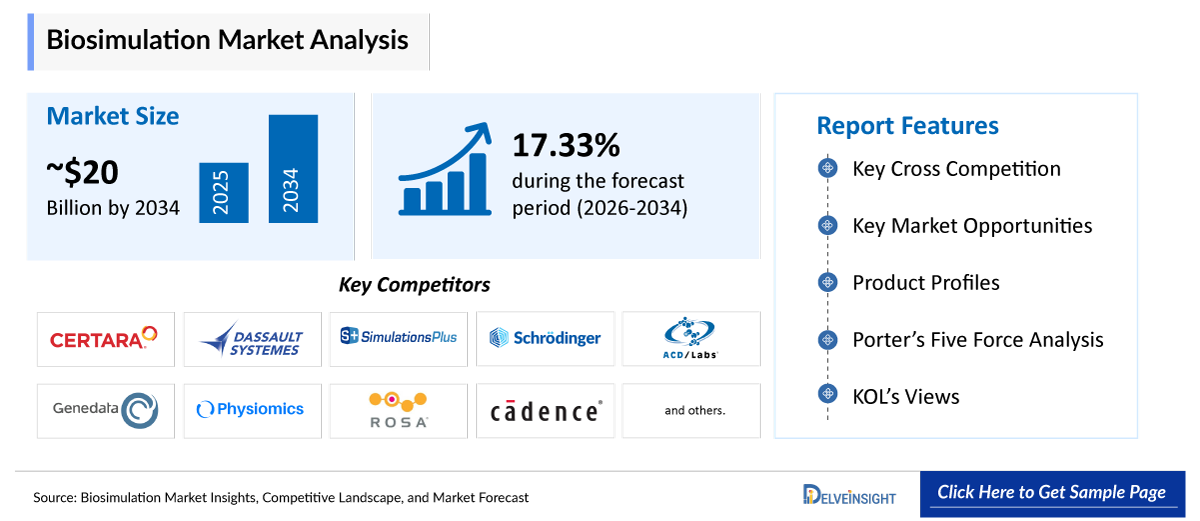
- The global biosimulation market size is expected to increase from USD 4,787.27 million in 2025 to USD 20,058.56 million by 2034, reflecting strong and sustained growth.
- The global biosimulation market is growing at a CAGR of 17.33% during the forecast period from 2026 to 2034.
- The biosimulation market is experiencing significant growth due to the combined impact of rising adoption of model-informed drug development (MIDD), increasing complexity of drug development, and the growing focus on personalized and precision medicine. MIDD approaches are enabling pharmaceutical companies to use advanced computational models to predict drug behavior, optimize dosing, and reduce reliance on costly clinical trials, thereby accelerating development timelines. At the same time, the increasing complexity of drug development driven by biologics, gene therapies, and multi-target treatments has heightened the need for sophisticated simulation tools to assess safety, efficacy, and pharmacokinetics. Additionally, the shift toward personalized and precision medicine, which requires tailoring therapies based on individual patient characteristics, is further driving demand for biosimulation platforms that can model patient-specific responses. Collectively, these factors are enhancing R&D efficiency, reducing costs, and improving success rates, thereby boosting the overall growth of the biosimulation market.
- The leading companies operating in the biosimulation market include Certara, Inc., Dassault Systèmes (BIOVIA), Simulations Plus, Inc., Schrödinger, Inc., Advanced Chemistry Development (ACD/Labs), Genedata AG, Physiomics Plc, Rosa & Co. LLC, BioSimulation Consulting Inc., InSilico Biotechnology AG, Cadence, and Cellworks. life, and others.
- North America is expected to dominate the biosimulation market due to the strong presence of leading pharmaceutical and biotechnology companies, advanced healthcare infrastructure, and early adoption of innovative technologies such as model-informed drug development (MIDD). The region benefits from significant R&D investments, particularly in the United States, along with supportive regulatory initiatives by agencies like the U.S. Food and Drug Administration that encourage the use of biosimulation in drug development. Additionally, the growing focus on precision medicine, increasing clinical trial activity, and the presence of key market players further contribute to the region’s dominance in the biosimulation market.
- In the product segment of the biosimulation market, the software category is estimated to account for the largest market share in 2025.
Factors Contributing to the Growth of the Biosimulation Market
- Rising adoption of model-informed drug development: The rising adoption of model-informed drug development (MIDD) is significantly boosting the biosimulation market by enabling pharmaceutical and biotechnology companies to leverage computational modeling and simulation to streamline drug development processes. MIDD helps in predicting drug safety, efficacy, and optimal dosing early in the development cycle, reducing the need for extensive clinical trials and minimizing late-stage failures. Regulatory support from agencies such as the U.S. Food and Drug Administration, which actively promotes the use of modeling and simulation in regulatory submissions, has further accelerated its adoption. As a result, companies are increasingly investing in biosimulation tools to improve decision-making, reduce development costs, and accelerate time-to-market, thereby driving overall market growth.
- Increasing complexity of drug development escalating the market of biosimulation: The increasing complexity of drug development is significantly escalating the biosimulation market, as modern therapeutics such as biologics, cell and gene therapies, and multi-target drugs require a deeper understanding of complex biological systems. Traditional trial-and-error approaches are often insufficient to evaluate these advanced therapies, leading to greater reliance on biosimulation tools to model pharmacokinetics, pharmacodynamics, and disease progression. These tools enable researchers to simulate various clinical scenarios, optimize trial design, and predict potential outcomes with higher accuracy. As drug pipelines become more intricate and data-intensive, the demand for advanced biosimulation platforms continues to rise, driving overall market growth.
- Growing focus on personalized and precision medicine: The growing focus on personalized and precision medicine is significantly boosting the biosimulation market, as these approaches require tailoring treatments based on individual patient characteristics such as genetics, biomarkers, and disease profiles. Biosimulation tools enable researchers to model patient-specific responses, predict drug efficacy and safety across different populations, and optimize dosing strategies for targeted therapies. This capability is particularly important in areas like oncology and rare diseases, where variability in treatment response is high. As healthcare continues to shift toward more individualized treatment approaches, the demand for advanced biosimulation platforms is increasing, thereby driving overall market growth.
Biosimulation Market Report Segmentation
This biosimulation market report offers a comprehensive overview of the global biosimulation market, highlighting key trends, growth drivers, challenges, and opportunities. It covers detailed market segmentation by Component (Software and Services), Deployment Mode (Cloud-based and On-premises), Application (Drug Discovery and Development, Disease Modelling, Pharmacokinetics/Pharmacodynamics (PK/PD) Modeling, and Others), Delivery Model (Subscription Models, Ownership Models, and Service-Based Models), End-Users (Pharmaceutical & Biotechnology Companies, Contract Research Organizations (CROs), and Others), and geography. The report provides valuable insights into the competitive landscape, regulatory environment, and market dynamics across major markets, including North America, Europe, and Asia-Pacific. Featuring in-depth profiles of leading industry players and recent product innovations, this report equips businesses with essential data to identify market potential, develop strategic plans, and capitalize on emerging opportunities in the rapidly growing biosimulation market.
Biosimulation is the use of computer-based mathematical models and simulations to study and predict biological processes, particularly how drugs interact with the human body. It integrates data from biology, pharmacology, physiology, and mathematics to simulate disease progression, drug behavior, and treatment outcomes without relying solely on laboratory or clinical experiments.
The biosimulation market is growing rapidly due to the combined impact of model-informed drug development (MIDD), increasing drug complexity, and the shift toward personalized medicine. MIDD enables companies to use advanced computational models to predict drug behavior, optimize dosing, and reduce reliance on costly clinical trials, improving efficiency and accelerating timelines. At the same time, the rising complexity of therapies such as biologics and gene therapies is increasing the need for sophisticated simulation tools to assess safety, efficacy, and pharmacokinetics. Additionally, the growing focus on personalized and precision medicine is driving demand for biosimulation platforms that can model patient-specific responses. Supported by initiatives from organizations like the U.S. Food and Drug Administration, these factors are collectively enhancing R&D productivity, reducing costs, and boosting the overall biosimulation market growth.
Get More Insights into the Report @ Biosimulation Market Insights
What are the latest biosimulation market dynamics and trends?
The rising adoption of Model-Informed Drug Development (MIDD) is significantly boosting the overall growth of the biosimulation market, as pharmaceutical and biotechnology companies increasingly rely on computational modeling and simulation to improve the efficiency and success rate of drug development.
MIDD integrates quantitative models of pharmacokinetics (PK), pharmacodynamics (PD), disease progression, and clinical trial data to guide key decisions throughout the drug development lifecycle, including dose selection, trial design, and regulatory submissions. By enabling researchers to simulate how drugs behave in the human body before conducting large-scale clinical trials, biosimulation tools help reduce development costs, shorten timelines, and minimize the risk of late-stage clinical failures.
Regulatory agencies such as the U.S. Food and Drug Administration and the European Medicines Agency actively encourage the use of MIDD approaches to support evidence-based drug development and optimize clinical study designs.
For instance, several pharmaceutical companies use advanced biosimulation platforms such as the Simcyp Simulator developed by Certara to predict drug interactions and determine appropriate dosing strategies in special populations, including pediatric and geriatric patients. Similarly, modeling tools such as GastroPlus from Simulations Plus are widely used to evaluate drug absorption, distribution, metabolism, and elimination during early-stage drug discovery.
These platforms allow researchers to perform virtual experiments, reducing the need for extensive in vivo testing. In oncology research, biosimulation models are increasingly used to simulate tumor growth and predict therapeutic responses, enabling companies to design more targeted and efficient clinical trials.
Additionally, the increasing product development activities are further escalating the market adoption. For example, in March, 2026, Certara, Inc. announced the launch of Simcyp® Simulator Version 25, the latest update to its physiologically-based pharmacokinetic (PBPK) modeling platform used to simulate drug behavior in virtual populations, thereby streamlining regulatory submissions and drug development.
Furthermore, as drug pipelines expand to include complex biologics, gene therapies, and precision medicines, the need for sophisticated modeling tools has grown substantially. Pharmaceutical companies are therefore investing heavily in biosimulation technologies to support MIDD strategies, optimize clinical development programs, and improve regulatory success rates.
Additionally, the increasing complexity of drug development is significantly boosting the biosimulation market, as modern therapies such as biologics, gene therapies, and multi-target drugs involve intricate biological interactions that are difficult to evaluate using traditional methods. Biosimulation tools enable researchers to model complex pharmacokinetics, pharmacodynamics, and disease pathways, allowing virtual testing of multiple scenarios and reducing dependency on lengthy and expensive clinical trials. This is becoming essential as companies face rising R&D costs and lower success rates in drug pipelines, pushing them toward more efficient, simulation-based approaches.
A recent example highlighting this trend is the development of AI-designed drug Rentosertib by Insilico Medicine, which progressed from discovery to early clinical trials in under 30 months and was officially named in March 2025. This rapid development was enabled by advanced computational modeling and simulation techniques, demonstrating how increasing drug complexity is accelerating the adoption of biosimulation technologies across the pharmaceutical industry.
Thus, the factors mentioned above are expected to boost the overall market of biosimulation during the forecast period from 2026 to 2034.
However, the biosimulation market faces notable limitations due to the limited availability of high-quality biological and clinical data and ongoing regulatory uncertainty. Accurate biosimulation models rely heavily on comprehensive, standardized, and high-quality datasets; however, data fragmentation, variability in clinical data, and restricted access to real-world patient data can reduce model reliability and predictive accuracy. Additionally, despite growing support from agencies like the U.S. Food and Drug Administration, regulatory acceptance of biosimulation results is still evolving, with inconsistent guidelines across regions creating uncertainty for companies. This lack of universal regulatory clarity and data limitations can slow adoption, hinder validation of models, and act as key restraining factors for the overall growth of the biosimulation market.
Biosimulation Market Segment Analysis
Biosimulation Market by Component (Software and Services), Deployment Mode (Cloud-based and On-premises), Application (Drug Discovery and Development, Disease Modelling, Pharmacokinetics/Pharmacodynamics (PK/PD) Modeling, and Others), Delivery Model (Subscription Models, Ownership Models, and Service-Based Models), End-Users (Pharmaceutical & Biotechnology Companies, Contract Research Organizations (CROs), and Others), and Geography (North America, Europe, Asia-Pacific, and Rest of the World)
Biosimulation Market Regional Analysis
North America Biosimulation Market Trends
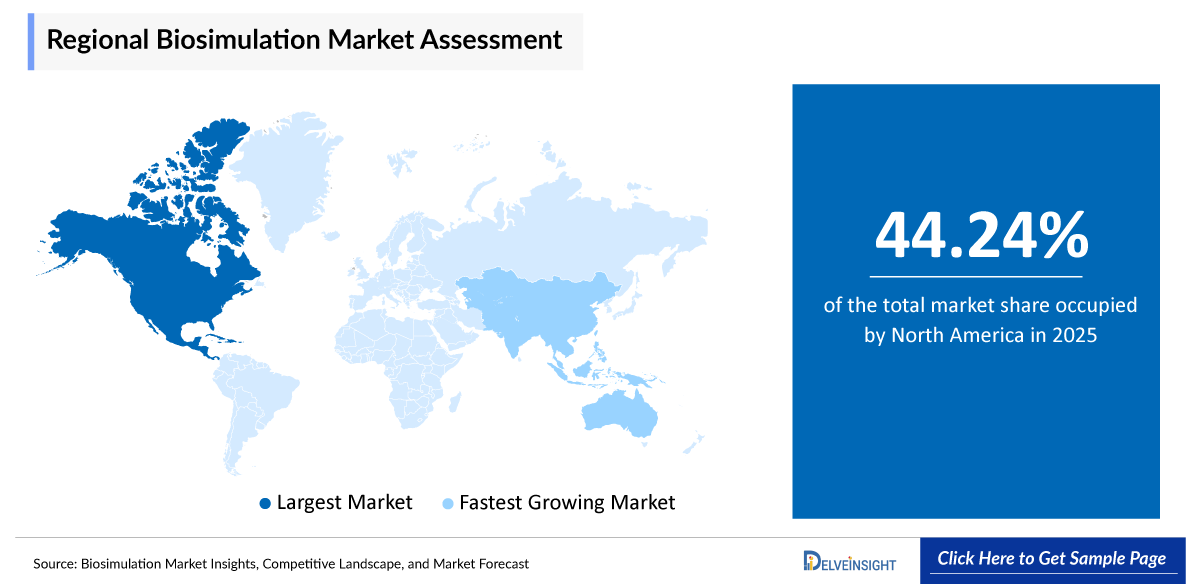
North America is expected to account for the highest proportion of 44.24% of the Biosimulation market in 2025, out of all regions, due to its strong pharmaceutical and biotechnology ecosystem, advanced healthcare infrastructure, high research and development investments, and the widespread adoption of computational technologies in drug discovery and development.
The country hosts many leading biosimulation and life-science technology companies, such as Certara, Simulations Plus, and Schrödinger, Inc., which continuously develop innovative modeling platforms for pharmaceutical research.
In addition, strong regulatory support from the U.S. Food and Drug Administration for model-informed drug development (MIDD) has encouraged pharmaceutical companies to integrate biosimulation tools in clinical trial design, dose optimization, and safety evaluation.
The United States also benefits from the presence of numerous contract research organizations, academic research institutes, and biotechnology startups that increasingly utilize biosimulation to reduce drug development costs and accelerate innovation.
Recent technological developments further demonstrate the country’s leadership in this field. For example, in October 2025, Certara launched Certara IQ™, an AI-powered Quantitative Systems Pharmacology (QSP) biosimulation platform, which integrates artificial intelligence with systems biology models to improve drug-disease modeling, optimize dosing strategies, and enhance pharmaceutical R&D productivity.
Additionally, in December 2025, the company announced a leadership transition with Jon Resnick appointed as Chief Executive Officer effective January 2026, reflecting continued strategic focus on expanding biosimulation and model-informed drug development capabilities across the pharmaceutical and biotechnology sectors.
These ongoing innovations, combined with strong industry investment and regulatory support, are reinforcing the United States’ dominant position in the global biosimulation market and driving continued market expansion.
Europe Biosimulation Market Trends
In Europe, the growth of the biosimulation market is being strongly driven by supportive regulatory frameworks, increasing adoption of model-informed drug development, and strong collaborations between pharmaceutical companies and technology providers. Regulatory bodies such as the European Medicines Agency are playing a crucial role by actively promoting the use of biosimulation in drug development and approval processes. For instance, in May 2024, the EMA approved the use of biosimulation data in regulatory decision-making for marketing authorization applications, marking a significant step toward wider acceptance of simulation-based approaches.
Further strengthening this trend, in April 2025, the EMA introduced new initiatives to streamline the development and evaluation of biosimilars, including reducing the need for extensive clinical data through advanced modeling and simulation techniques. Additionally, in August 2025, Certara’s Simcyp® Simulator became one of the first platforms to receive formal EMA qualification for physiologically based pharmacokinetic (PBPK) modeling, enabling its use in regulatory submissions across Europe.
Moreover, strategic collaborations are also accelerating market growth, for example, in April 2025, a partnership between Ginkgo Bioworks and Merck KGaA’s BioReliance expanded capabilities in biosimulation-driven biologics development. Along with strong R&D investments and the presence of leading pharmaceutical companies, these developments are fostering innovation, improving drug development efficiency, and significantly driving the expansion of the biosimulation market across Europe.
Asia-Pacific Biosimulation Market Trends
The Asia Pacific region is emerging as a significant growth driver for the biosimulation market due to rapid expansion in pharmaceutical and biotechnology R&D, strong government support, and increasing adoption of advanced computational modeling technologies across countries such as China, India, and Japan. The region benefits from rising investments in precision medicine, AI-integrated drug discovery, and cost-efficient in silico modeling, which are enabling faster and more accurate drug development processes. Governments are also actively supporting this shift. For instance, India’s National Biotechnology Development Strategy (2021–2025) has allocated substantial funding to strengthen digital and computational capabilities in drug research, encouraging the adoption of biosimulation tools across the country.
Recent developments further highlight this growth trend. In September 2024, Certara expanded its presence in Asia by hosting its “Certainty” conferences across China, Japan, and South Korea, aimed at accelerating collaboration and adoption of biosimulation and model-informed drug development in the region. Additionally, increasing partnerships between pharmaceutical companies and biosimulation providers, along with the integration of AI-driven modeling platforms in 2025, are enhancing predictive accuracy and reducing drug development timelines across the Asia Pacific. Furthermore, the strong presence of regional pharmaceutical giants and CROs, combined with growing demand for personalized medicine and biologics, continues to accelerate the uptake of biosimulation technologies. Collectively, these factors and recent initiatives are positioning the Asia Pacific as one of the fastest-growing regions in the global biosimulation market.
Who are the major players in the biosimulation market?
The following are the leading companies in the biosimulation market. These companies collectively hold the largest market share and dictate industry trends.
- Certara, Inc.
- Dassault Systèmes (BIOVIA)
- Simulations Plus, Inc.
- Schrödinger, Inc.
- Advanced Chemistry Development (ACD/Labs)
- Genedata AG
- Physiomics Plc
- Rosa & Co. LLC
- BioSimulation Consulting Inc.
- InSilico Biotechnology AG
- Cadence
- Cellworks. life, and Others
How is the competitive landscape shaping the Biosimulation market?
The competitive landscape of the biosimulation market is characterized by moderate concentration and intense competition, with a mix of established global players and emerging niche technology firms driving innovation. Leading companies such as Certara, Dassault Systèmes, Simulation Plus, and Schrödinger, Inc. hold significant market shares; however, no single player dominates the market, with none accounting for more than one-third of total revenue, indicating a moderately fragmented structure. The market is highly innovation-driven, where companies compete based on advanced modeling capabilities (such as PBPK and QSP), integration of AI and machine learning, regulatory acceptance, and the ability to provide end-to-end drug development solutions rather than competing solely on pricing.
Additionally, strategic initiatives such as mergers, acquisitions, and product launches are shaping the competitive dynamics. For instance, Certara acquired ChemAxon in October 2024 to strengthen its molecular modeling capabilities, while also launching AI-enabled platforms like Certara IQ in October 2025 to enhance predictive drug development. The presence of high entry barriers due to the need for specialized scientific expertise, regulatory validation, and advanced computational infrastructure further consolidates the position of key players. Overall, while the market remains moderately concentrated, continuous technological advancements and the entry of innovative startups are intensifying competition and driving rapid evolution in the biosimulation market.
Recent Developmental Activities in the Biosimulation Market
- In March 2026, Certara, Inc. announced the launch of Simcyp® Simulator Version 25, the latest update to its physiologically-based pharmacokinetic (PBPK) modeling platform used to simulate drug behavior in virtual populations, thereby streamlining regulatory submissions and drug development.
- In October 2025, Certara launched Certara IQ™, an AI-powered Quantitative Systems Pharmacology (QSP) biosimulation platform, which integrates artificial intelligence with systems biology models to improve drug-disease modeling, optimize dosing strategies, and enhance pharmaceutical R&D productivity.
- In August 2025, Certara’s Simcyp® Simulator became one of the first platforms to receive formal EMA qualification for physiologically based pharmacokinetic (PBPK) modeling, enabling its use in regulatory submissions across Europe.
Biosimulation Market Segmentation
Biosimulation by Component Exposure
Software
Services
Biosimulation Deployment Mode Exposure
Cloud-based
On-premises
Biosimulation Application Exposure
Drug Discovery and Development
Disease Modelling
Pharmacokinetics/Pharmacodynamics (PK/PD) Modeling
Others
Biosimulation Delivery Model Exposure
Subscription Models
Ownership Models
Service-Based Models
Biosimulation End-Users Exposure
Pharmaceutical & Biotechnology Companies
Contract Research Organizations (CROs)
Others
Biosimulation Geography Exposure
North America Biosimulation Market
United States Biosimulation Market
Canada Biosimulation Market
Mexico Biosimulation Market
Europe Biosimulation Market
United Kingdom Biosimulation Market
Germany Biosimulation Market
France Biosimulation Market
Italy Biosimulation Market
Spain Biosimulation Market
Rest of Europe Biosimulation Market
Asia-Pacific Biosimulation Market
China Biosimulation Market
Japan Biosimulation Market
India Biosimulation Market
Australia Biosimulation Market
South Korea Biosimulation Market
Rest of Asia-Pacific Biosimulation Market
Rest of the World Biosimulation Market
South America Biosimulation Market
Middle East Biosimulation Market
Africa Biosimulation Market
Impact Analysis
AI-Powered Innovations and Applications:
AI-powered innovations are transforming the biosimulation market by enabling more accurate, scalable, and data-driven drug development processes. The integration of artificial intelligence and machine learning with biosimulation platforms allows researchers to analyze large and complex biological datasets, identify hidden patterns, and generate highly predictive models for drug behavior, safety, and efficacy. AI is widely used in applications such as target identification, lead optimization, and predictive toxicology, where it enhances the accuracy of pharmacokinetic (PK) and pharmacodynamic (PD) simulations. It also plays a crucial role in developing virtual patient populations and digital twins, supporting personalized medicine by predicting individual treatment responses. Furthermore, AI-driven biosimulation is accelerating virtual clinical trials, optimizing trial design, and improving patient stratification, thereby reducing costs and development timelines. Companies like Certara, Schrödinger, Inc., and Dassault Systèmes are increasingly embedding AI into their platforms to enhance predictive capabilities and automate complex workflows. Overall, AI-powered biosimulation is improving decision-making, increasing R&D productivity, and driving innovation across the pharmaceutical and biotechnology industries.
U.S. Tariff Impact Analysis on Biosimulation Market:
The impact of U.S. tariffs on the biosimulation market is primarily indirect, influencing the broader technological and life sciences ecosystem rather than the software itself. Biosimulation platforms are largely digital or cloud-based, so they are not directly affected by tariffs; however, the hardware infrastructure required to support these platforms, such as high-performance computing systems, servers, and advanced processors, can become more expensive due to import duties. This increase in infrastructure costs can raise operational expenses for pharmaceutical companies and biosimulation providers.
As a result, organizations are increasingly shifting toward cloud-based solutions to reduce dependence on costly physical infrastructure and improve scalability. Tariffs also contribute to higher overall drug development costs by affecting the supply chain for research equipment and materials, which can put pressure on R&D budgets. At the same time, this environment encourages greater adoption of biosimulation, as companies look for more efficient and cost-effective alternatives to traditional experimental methods. Overall, U.S. tariffs create both challenges and opportunities, indirectly shaping the growth and adoption of biosimulation technologies.
How This Analysis Helps Clients
- Cost Management: By understanding the tariff landscape, clients can anticipate cost increases and adjust pricing strategies accordingly, ensuring profitability.
- Supply Chain Optimization: Clients can identify alternative sourcing options and diversify their supply chains to reduce dependency on high-tariff regions, enhancing resilience.
- Regulatory Navigation: Expert guidance on navigating the evolving regulatory environment helps clients maintain compliance and avoid potential legal challenges.
- Strategic Planning: Insights into tariff impacts enable clients to make informed decisions about manufacturing locations, partnerships, and market entry strategies.
Key takeaways from the Biosimulation market report study
- Market size analysis for the current biosimulation market size (2025), and market forecast for 8 years (2026 to 2034)
- Top key product/technology developments, mergers, acquisitions, partnerships, and joint ventures happened over the last 3 years.
- Key companies dominating the biosimulation market.
- Various opportunities available for the other competitors in the biosimulation market space.
- What are the top-performing segments in 2025? How these segments will perform in 2034?
- Which are the top-performing regions and countries in the current biosimulation market scenario?
- Which are the regions and countries where companies should have concentrated on opportunities for the biosimulation market growth in the future?
Frequently Asked Questions for the Biosimulation Market
1. What is the growth rate of the biosimulation market?
The biosimulation market is estimated to grow at a CAGR of 17.33% during the forecast period from 2026 to 2034.
2. What is the market size for biosimulation?
The global biosimulation market size is expected to increase from USD 4,787.27 million in 2025 to USD 20,058.56 million by 2034.
3. Which region has the highest share in the biosimulation market?
North America is expected to dominate the biosimulation market due to the strong presence of leading pharmaceutical and biotechnology companies, advanced healthcare infrastructure, and early adoption of innovative technologies such as model-informed drug development (MIDD). The region benefits from significant R&D investments, particularly in the United States, along with supportive regulatory initiatives by agencies like the U.S. Food and Drug Administration that encourage the use of biosimulation in drug development. Additionally, the growing focus on precision medicine, increasing clinical trial activity, and the presence of key market players further contribute to the region’s dominance in the biosimulation market.
4. What are the drivers for the biosimulation market?
The biosimulation market is experiencing significant growth due to the combined impact of rising adoption of model-informed drug development (MIDD), increasing complexity of drug development, and the growing focus on personalized and precision medicine. MIDD approaches are enabling pharmaceutical companies to use advanced computational models to predict drug behavior, optimize dosing, and reduce reliance on costly clinical trials, thereby accelerating development timelines. At the same time, the increasing complexity of drug development driven by biologics, gene therapies, and multi-target treatments has heightened the need for sophisticated simulation tools to assess safety, efficacy, and pharmacokinetics. Additionally, the shift toward personalized and precision medicine, which requires tailoring therapies based on individual patient characteristics, is further driving demand for biosimulation platforms that can model patient-specific responses. Collectively, these factors are enhancing R&D efficiency, reducing costs, and improving success rates, thereby boosting the overall growth of the biosimulation market.
5. Who are the key players operating in the biosimulation market?
Some of the key biosimulation companies operating in the market include - Certara, Inc., Dassault Systèmes (BIOVIA), Simulations Plus, Inc., Schrödinger, Inc., Advanced Chemistry Development (ACD/Labs), Genedata AG, Physiomics Plc, Rosa & Co. LLC, BioSimulation Consulting Inc., InSilico Biotechnology AG, Cadence, and Cellworks. life, and others.

