Biotechnology Instruments Market Summary
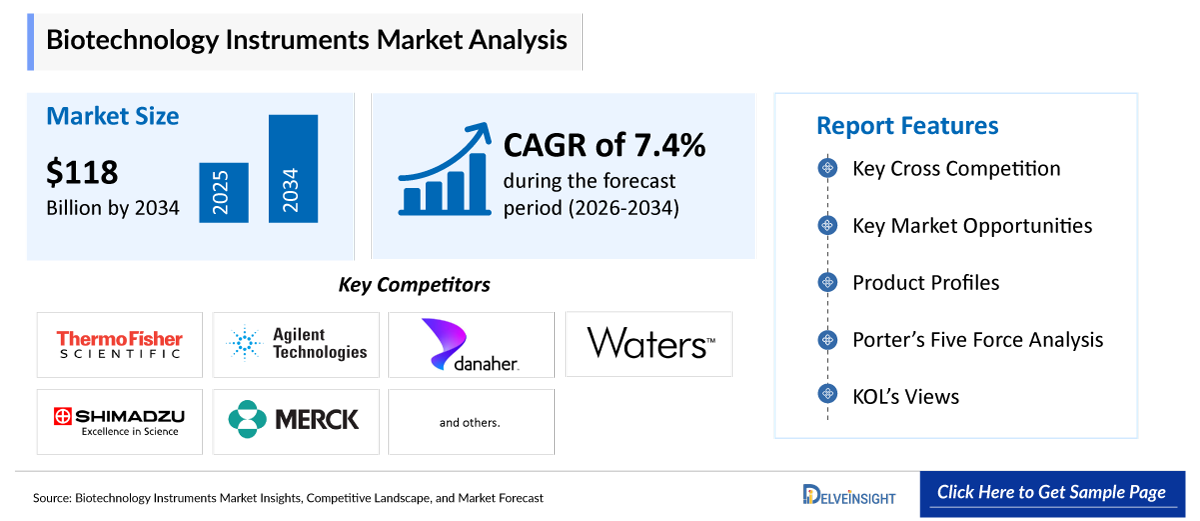
- The global biotechnology instruments market size was valued at USD 62.00 billion in 2025 and is projected to reach USD 118.00 billion by 2034.
- The market is expected to expand at a CAGR of 7.4% during the forecast period 2026-2034, supported by the growth of pharmaceutical and biotechnology research and development, the advancement of genomics, proteomics, and cell analysis, the integration of automation and artificial intelligence, and the expansion of bioprocessing and biomanufacturing.
- By technology, the spectroscopy segment dominated the biotechnology instruments market with a 26% share in 2025.
- By application, the research applications segment dominated the biotechnology instruments market with a 44% share in 2025.
- By product, the analytical and separation instruments segment dominated the biotechnology instruments market with a 40% share in 2025.
- By end-user, the pharmaceutical and biotechnology companies segment dominated the biotechnology instruments market with a 48% share in 2025.
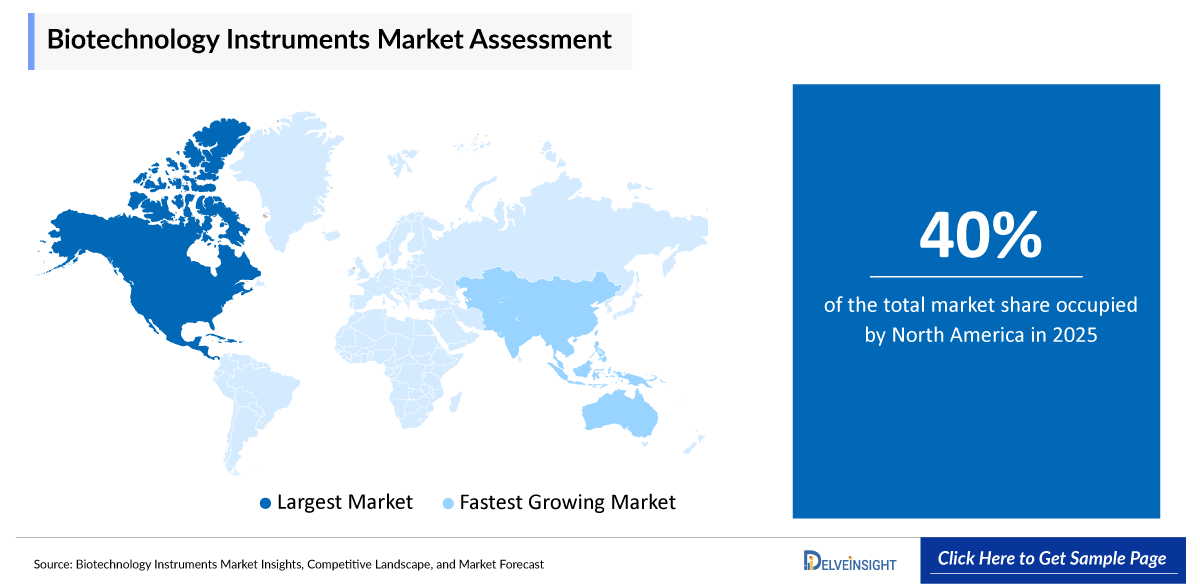
- North America accounted for the largest share of the biotechnology instruments market at 40% in 2025, while Asia-Pacific is anticipated to register the fastest growth through 2034.
Biotechnology instruments are the analytical, separation, amplification, sequencing, and cell analysis instruments used across biotechnology and life science research, development, quality control, and bioproduction to prepare, separate, identify, measure, and analyze biological and chemical samples. The scope encompasses spectroscopy and mass spectrometry, chromatography, polymerase chain reaction and amplification, next-generation sequencing, flow cytometry, electrophoresis, cell analysis and imaging, microscopy, and the associated automation and informatics that enable the workflows of genomics, proteomics, metabolomics, cell biology, and bioprocessing.
Leading products span the mass spectrometers, chromatography systems, sequencers, polymerase chain reaction and quantitative polymerase chain reaction platforms, flow cytometers, spectrometers, and microscopes of the leading instrument companies, and the market is served by Thermo Fisher Scientific, Danaher, Agilent Technologies, Bio-Rad Laboratories, and the other leading providers. The contemporary market is shaped by the growth of pharmaceutical and biotechnology research, the advance of genomics, proteomics, and cell analysis, and the integration of automation and artificial intelligence.
Biotechnology Instruments Market Key Growth Drivers
- Growth of pharmaceutical and biotechnology research and development, driving demand for analytical, separation, and analysis instruments.
- Advances in genomics, proteomics, metabolomics, and cell analysis that require sophisticated instrumentation.
- Integration of automation and artificial intelligence that improve the throughput, precision, and interpretation of instruments.
- Expansion of bioprocessing and biomanufacturing that require process analytics and quality control instruments.
- Growth of precision medicine, biologics, and advanced therapies that require high-performance characterization and analysis.
- Rising research funding and investment from government, private, and biopharmaceutical sources.
- Expansion of research and laboratory infrastructure in emerging markets.
Key Companies in Biotechnology Instruments Market
The competitive field is led by diversified life science and analytical instrument companies, challenged by specialized technology providers. The leading participants in the biotechnology instruments market include the following:
- Thermo Fisher Scientific Inc.
- Danaher Corporation
- Agilent Technologies, Inc.
- Bio-Rad Laboratories, Inc.
- Bruker Corporation
- Waters Corporation
- Shimadzu Corporation
- Revvity, Inc.
- Merck KGaA
- QIAGEN N.V., and others
For illustrative purposes, only the top 10 companies are listed in the Table of Contents. The report may include analysis and references to additional companies relevant to the market assessment.
Biotechnology Instruments Market Size
The following table summarizes the headline market metrics for the global biotechnology instruments market across the base year and the forecast horizon.
|
Report Metrics |
Details |
|
2025 Market Size |
USD 62.00 billion |
|
2034 Projected Market Size |
USD 118.00 billion |
|
Growth Rate (2026-2034) |
7.4% CAGR |
|
Largest Market |
North America (40% share in 2025) |
|
Fastest Growing Market |
Asia-Pacific |
|
Market Structure |
Fragmented |
All market values are expressed in USD and represent DelveInsight estimates synthesized from primary and secondary research.
Factors Contributing to the Growth of the Biotechnology Instruments Market
Biotechnology Instruments Market Drivers
- Growth of Pharmaceutical and Biotechnology Research and Development: The foundational driver of the biotechnology instruments market is the growth of pharmaceutical and biotechnology research and development, which drives the demand for the analytical, separation, and analysis instruments that research and development require. Pharmaceutical and biotechnology companies, supported by government funding and private capital, are expanding their research pipelines and manufacturing infrastructure, and the growth of drug discovery, development, and biomanufacturing drives the demand for high-performance analytical, separation, imaging, and automation instruments. The expansion of research and development increases the demand for the instruments that discover, characterize, and analyze drugs and biological systems, including mass spectrometers, chromatography systems, sequencers, and cell analysis instruments, and the surge in research activity leads to greater demand for high-throughput screening, molecular characterization, and data-driven optimization. The growth of research and development, the expansion of research pipelines, and the investment in research and manufacturing drive the demand for biotechnology instruments. The scale and growth of pharmaceutical and biotechnology research, and the instrument-intensive nature of drug discovery and development, sustain the demand for instruments. As pharmaceutical and biotechnology research and development grow, demand for the instruments they require grows in step. The growth of pharmaceutical and biotechnology research and development anchors the growth of the biotechnology instruments market across the forecast period.
- Advance of Genomics, Proteomics, Metabolomics, and Cell Analysis: The advance of genomics, proteomics, metabolomics, and cell analysis is a defining driver that drives the demand for the sophisticated instruments these fields require. The study of complex biological systems through genomics, proteomics, and metabolomics requires advanced analytical and imaging technologies, and the advance of these fields, driven by the growth of precision medicine, drug discovery, and biological research, drives the demand for sequencing, mass spectrometry, chromatography, cell analysis, and imaging instruments. Genomics requires sequencing and amplification instruments, proteomics and metabolomics require mass spectrometry and chromatography, and cell biology requires flow cytometry, imaging, and cell analysis, and the advance of these fields and the growth of the research they support drive the demand for the specialized instruments each requires. The expanding research pipeline for genomics, proteomics, metabolomics, and structural and cell biology drives the adoption of the analytical and imaging instruments these fields depend on. The advance of these fields, the growth of the research they support, and the sophistication of the instruments they require drive the demand for biotechnology instruments. As genomics, proteomics, metabolomics, and cell analysis advance and as the research they support grows, demand for the instruments they require grows. The advance of genomics, proteomics, metabolomics, and cell analysis sustains demand for biotechnology instruments across the forecast period.
- Integration of Automation and Artificial Intelligence: The integration of automation and artificial intelligence, which improve the throughput, precision, and interpretation of instruments, is a powerful driver that modernizes instruments and expands their capability. Laboratory automation, the integration of instruments into automated workflows, and the incorporation of artificial intelligence and machine learning into instruments and data analysis improve the throughput, precision, reproducibility, and interpretation of instruments, and the integration of automation and artificial intelligence enhances the value and capability of instruments. Automation increases the throughput and reproducibility of instrument workflows, artificial intelligence and machine learning improve the interpretation of data and the precision of analysis, and the integration of instruments, automation, and informatics delivers end-to-end laboratory workflows. The demand for higher throughput, greater precision, and better data interpretation, and the value of automation and artificial intelligence in delivering them, drive the adoption of automated and intelligent instruments and the replacement of older instruments. The integration of automation and artificial intelligence improves the capability, throughput, and value of instruments, and it drives the modernization and adoption of instruments. As automation and artificial intelligence are integrated into instruments and workflows, demand for advanced and modernized instruments grows. The integration of automation and artificial intelligence sustains demand and modernization of the biotechnology instruments market across the forecast period.
- Expansion of Bioprocessing and Biomanufacturing: The expansion of bioprocessing and biomanufacturing, which require process analytics and quality control instruments, drives the demand for the instruments that support the production of biologics and advanced therapies. The growth of biologics, biosimilars, cell and gene therapies, and other advanced therapies expands the bioprocessing and biomanufacturing that produce them, and the production and quality control of these therapies require process analytics, characterization, and quality control instruments that monitor and analyze the manufacturing process and the product. Bioprocessing and biomanufacturing require the instruments that characterize and control the quality of biologics and advanced therapies, including chromatography, mass spectrometry, cell analysis, and process analytical instruments, and the expansion of biomanufacturing drives the demand for these instruments. The growth of biologics and advanced therapies, the expansion of biomanufacturing, and the requirement for process analytics and quality control drive the demand for the instruments that biomanufacturing requires. The bioprocess monitoring and quality control of biomanufacturing represent a fast-growing application of instruments. As bioprocessing and biomanufacturing expand and as they require process analytics and quality control instruments, demand for these instruments grows. The expansion of bioprocessing and biomanufacturing sustains demand for biotechnology instruments across the forecast period.
- Growth of Precision Medicine, Biologics, and Advanced Therapies: The growth of precision medicine, biologics, and advanced therapies, which require high-performance characterization and analysis, drives the demand for sophisticated instruments. Precision medicine requires the genomic, proteomic, and molecular analysis that identifies and characterizes disease and guides treatment, and the growth of biologics, biosimilars, and cell and gene therapies requires the high-performance characterization and analysis of complex molecules and products. The prominence of biologics, biosimilars, and personalized medicine increases the demand for the precise instruments that support proteomics, genomics, and cell analysis, and the complexity of biologics and advanced therapies requires sophisticated characterization and quality control. Precision medicine and advanced therapies drive the demand for sequencing, mass spectrometry, chromatography, and cell analysis instruments that characterize disease, molecules, and products, and the growth of these fields sustains the demand for high-performance instruments. The growth of precision medicine and advanced therapies, and the requirement for high-performance characterization and analysis, drive the demand for biotechnology instruments. As precision medicine, biologics, and advanced therapies grow and as they require sophisticated characterization and analysis, demand for high-performance instruments grows. The growth of precision medicine, biologics, and advanced therapies sustains demand for biotechnology instruments across the forecast period.
- Rising Research Funding and Investment: The rising research funding and investment from government, private, and biopharmaceutical sources drive the acquisition of instruments and the growth of the market. Research and development in the life sciences is funded by government agencies, private and philanthropic sources, and biopharmaceutical companies, and the growth of research funding and investment, driven by the priority placed on health, life science, and biotechnology research, drives the acquisition of the instruments that research requires. Government funding of academic and public research, private and venture investment in biotechnology, and the research and development spending of biopharmaceutical companies fund the acquisition of instruments, and the growth of funding and investment drives the demand for instruments. The expansion of research pipelines and manufacturing infrastructure, supported by funding and capital, increases the demand for high-performance instruments. The growth of research funding and investment, and the instrument-intensive nature of the research it supports, drive the demand for biotechnology instruments. As research funding and investment grow and as they support the acquisition of instruments, demand for instruments grows. The rising research funding and investment sustain demand for biotechnology instruments across the forecast period.
- Expansion of Research and Laboratory Infrastructure in Emerging Markets: The expansion of research and laboratory infrastructure in emerging markets drives the growth of the market and the adoption of instruments in fast-growing regions. Emerging markets, particularly in Asia-Pacific, are expanding their research, pharmaceutical, biotechnology, and laboratory infrastructure, supported by government investment, the growth of the pharmaceutical and biotechnology industry, and the development of research and manufacturing capacity; this expansion of infrastructure drives the acquisition of instruments. The growth of the biotechnology and pharmaceutical industry, the establishment of research institutes and laboratories, and the expansion of manufacturing in emerging markets drive the demand for the instruments that research and manufacturing require, and the expansion of infrastructure from a growing base creates substantial demand. The investment in research and laboratory infrastructure, the growth of the life science industry, and the development of research and manufacturing capacity in emerging markets drive the demand for instruments. The expansion of infrastructure and the growth of the life science industry in emerging markets drive the adoption of instruments. As research and laboratory infrastructure expands in emerging markets, demand for instruments grows. The expansion of research and laboratory infrastructure in emerging markets sustains the growth of the biotechnology instruments market across the forecast period.
Biotechnology Instruments Market Restraints
The biotechnology instruments market faces several interrelated restraints that temper its growth. The foremost is the high cost of instruments, since advanced analytical, separation, and analysis instruments require substantial capital investment, and the cost of instruments, their maintenance, and their consumables can constrain acquisition, particularly for smaller laboratories, academic institutions, and organizations in cost-constrained settings. The dependence of the market on research funding and budgets exposes it to the cyclicality and constraints of government, academic, and biopharmaceutical funding, and reductions or fluctuations in research budgets can affect the acquisition of instruments. The requirement for skilled operators and the shortage of trained personnel constrain the adoption and use of sophisticated instruments, since advanced instruments require expertise to operate, maintain, and interpret, and the shortage of skilled personnel can limit their use. The complexity of instruments, the requirement for method development and validation, and the burden of regulatory compliance and data integrity, particularly in regulated pharmaceutical and clinical settings, add cost and complexity. The long replacement cycles of durable instruments, and the reliance on consumables and service for recurring revenue, shape the revenue model and can slow the adoption of new instruments. The competition and consolidation among the leading companies and the pricing pressure in the market constrain margins. The integration of instruments, automation, and informatics is technically complex and requires investment. The variability of research funding and infrastructure across regions constrains the market in some settings. Together, these factors moderate the pace and scope of adoption and require manufacturers to demonstrate performance, value, and total cost of ownership and to support their instruments with service, consumables, and training to sustain growth.
Biotechnology Instruments Market Segment Analysis
The global biotechnology instruments market is segmented by technology (spectroscopy, chromatography, polymerase chain reaction and amplification, next-generation sequencing, flow cytometry, and others), by application (research applications, clinical and diagnostic applications, bioprocessing and quality control applications, and others), by product (analytical and separation instruments, amplification and sequencing instruments, cell analysis and imaging instruments, and others), by end-users (pharmaceutical and biotechnology companies, academic and research institutes, hospitals and diagnostic laboratories, and others), and by geography (North America, Europe, Asia-Pacific, and the Rest of the World).
By Technology
Dominant Subsegment: Spectroscopy.
The spectroscopy category is expected to dominate the market. The spectroscopy segment accounted for a 26% share of the biotechnology instruments market in 2025. Spectroscopy, including mass spectrometry, ultraviolet-visible, infrared, and nuclear magnetic resonance spectroscopy, is the leading technology because it is the most widely used and versatile analytical technology across research, pharmaceutical, and industrial applications, enabling delicate observation at the atomic and molecular level. The dominance of the segment reflects the breadth of spectroscopy applications, the demand for sophisticated analytical techniques in pharmaceutical and biotechnology research, and the central role of spectroscopy, particularly mass spectrometry, in proteomics, metabolomics, and molecular analysis. Spectroscopy enables qualitative and quantitative analysis in fundamental and applied research, and the demand for spectroscopic methods, including mass spectrometry, nuclear magnetic resonance, and infrared spectroscopy, in precision medicine, drug development, and molecular analysis drives the segment. The breadth of applications, the demand for sophisticated analysis, and the central role of spectroscopy and mass spectrometry drive the segment. While chromatography, polymerase chain reaction, sequencing, flow cytometry, and other technologies are important and widely used, the breadth, versatility, and demand for spectroscopy sustain the leadership of the spectroscopy segment across the forecast period.
By Application
Dominant Subsegment: Research Applications.
The research applications category is expected to dominate the market. The research applications segment accounted for a 44% share of the biotechnology instruments market in 2025. Research applications, spanning the genomics, proteomics, metabolomics, and cell and structural biology research of academic, government, and biopharmaceutical laboratories, are the leading application because research is the largest and most instrument-intensive use of biotechnology instruments, requiring the analytical, separation, and imaging instruments that research depends on. The dominance of the segment reflects the scale of research, the instrument-intensive nature of genomics, proteomics, and metabolomics research, and the growth of research funding and pipelines. Research applications require analytical and imaging instruments to study complex biological systems through genomics, proteomics, and metabolomics, and the growth of research and the sophistication of the instruments it requires drive the segment. The scale of research, the instrument-intensive nature of advanced research, and the growth of research funding and pipelines drive the research applications segment. While clinical and diagnostic applications and other applications, including bioprocessing and quality control, are significant and growing, with bioprocess monitoring growing rapidly, the scale and instrument intensity of research applications sustain the leadership of the research applications segment across the forecast period.
By Product
Dominant Subsegment: Analytical and Separation Instruments.
The analytical and separation instruments category is expected to dominate the market. The analytical and separation instruments segment accounted for a 40% share of the biotechnology instruments market in 2025. Analytical and separation instruments, including chromatography, mass spectrometry, spectroscopy, and electrophoresis systems, are the leading product category because they are the core instruments used to separate, identify, measure, and analyze biological and chemical samples across research, development, and quality control. The dominance of the segment reflects the central role of analytical and separation instruments in the workflows of the life sciences, the breadth of their applications, and their high value and recurring consumable demand. Analytical and separation instruments separate and analyze samples across genomics, proteomics, metabolomics, drug development, and quality control, and they are the core instruments of the analytical laboratory, generating high instrument and consumable revenue. The central role of analytical and separation instruments, the breadth of their applications, and their value and consumable demand drive the segment. While amplification and sequencing instruments, cell analysis and imaging instruments, and other product categories are important and growing, the centrality, breadth, and value of analytical and separation instruments sustain the leadership of the analytical and separation instruments segment across the forecast period.
By End-User
Dominant Subsegment: Pharmaceutical and Biotechnology Companies.
The pharmaceutical and biotechnology companies category is expected to dominate the market. The pharmaceutical and biotechnology companies segment accounted for a 48% share of the biotechnology instruments market in 2025. Pharmaceutical and biotechnology companies are the leading end-user because they are the largest purchasers and users of biotechnology instruments, requiring analytical, separation, analysis, and process instruments across drug discovery, development, and biomanufacturing. The dominance of the segment reflects the scale of pharmaceutical and biotechnology research and development and manufacturing, the instrument-intensive nature of drug discovery, development, and quality control, and the growth of biologics and advanced therapies. Pharmaceutical and biotechnology companies use instruments across drug discovery, development, characterization, and biomanufacturing quality control, and the growing prominence of biologics, biosimilars, and personalized medicine increases their demand for precise instruments for proteomics, genomics, and cell analysis. The scale of research, development, and manufacturing, the instrument intensity of these activities, and the growth of biologics and advanced therapies concentrate demand in pharmaceutical and biotechnology companies. While academic and research institutes, hospitals and diagnostic laboratories, and other end-users are significant, the scale, instrument intensity, and growth of pharmaceutical and biotechnology companies sustain the leadership of the pharmaceutical and biotechnology companies segments across the forecast period, and it shapes the direction of the market.
Biotechnology Instruments Market Region Analysis
Dominant Region: North America
North America accounted for a 40% share of the global biotechnology instruments market in 2025, representing the highest regional market share globally. The leadership of the region reflects the concentration of pharmaceutical, biotechnology, and research activity, the strength of research funding and investment, the presence and headquarters of the leading instrument companies, and the advanced research and laboratory infrastructure. The United States is the largest national market, supported by the concentration of pharmaceutical and biotechnology companies and research institutes, the strength of government, private, and biopharmaceutical research funding, the presence of the leading instrument companies, and the advanced research and laboratory infrastructure. The scale of research and development, the strength of funding, the concentration of the industry, and the presence of the leading companies drive the market, and the leading instrument companies are headquartered and conduct extensive development and manufacturing in the region. The concentration of research and industry, the strength of funding, the presence of the leading companies, and the advanced infrastructure reinforce the leadership of the region. The combination of research concentration, funding strength, company presence, and infrastructure sustains the position of North America as the largest regional market across the forecast period.
Fastest Growing Region: Asia-Pacific
Asia-Pacific is projected to register the fastest compound annual growth rate through 2034. The region combines the rapid growth of its pharmaceutical and biotechnology industry, the expansion of research and laboratory infrastructure, the growth of research funding and investment, and the increasing adoption of instruments, which drives the fast growth of the market. China, Japan, India, and South Korea are the principal national markets, supported by the rapid growth of the pharmaceutical and biotechnology industry, the expansion of research institutes and laboratories, the growth of government and private research investment, and the development of research and manufacturing capacity. The growth of the life science industry, the expansion of research and laboratory infrastructure, and the investment in research and manufacturing enlarge the demand for biotechnology instruments. As the pharmaceutical and biotechnology industry grows, as research and laboratory infrastructure expands, and as research investment increases, the region increases its adoption from a growing base, and the scale of the industry and the expansion of infrastructure create substantial long-term demand. The combination of industry growth, infrastructure expansion, and research investment positions Asia-Pacific as the fastest-growing regional market, and it attracts investment and the expansion of the leading global instrument companies.
Biotechnology Instruments Market Regional Commentary
North America
North America leads the market, supported by the concentration of pharmaceutical, biotechnology, and research activity, the strength of research funding and investment, the presence of the leading instrument companies, and the advanced research and laboratory infrastructure. The United States dominates the region through its concentration of industry and research, the strength of funding, and the presence of the leading companies. The scale of research and development sustains demand.
Europe
Europe is a substantial market shaped by a strong pharmaceutical, biotechnology, and research base, the presence of instrument companies including Merck, Bruker, and others, and the strength of research funding and infrastructure. Germany, the United Kingdom, France, Italy, and Spain are the principal national markets, supported by the pharmaceutical and biotechnology industry, research institutes, and research funding, and by data integrity and quality requirements that drive the adoption of advanced instruments. Demand is sustained by research, industry, and quality requirements.
Asia-Pacific
Asia-Pacific is the fastest-growing region, driven by the rapid growth of the pharmaceutical and biotechnology industry, the expansion of research and laboratory infrastructure, and the growth of research investment across China, Japan, India, and South Korea. Industry growth, infrastructure expansion, and research investment sustain rapid growth, and the region attracts investment and the expansion of the leading global instrument companies.
Rest of World
The Rest of World, spanning Latin America, the Middle East, and Africa, represents an emerging opportunity as research, pharmaceutical, and laboratory infrastructure grow. Growth is supported by the growth of the life science industry, the expansion of research and clinical laboratories, and the adoption of instruments, though funding and infrastructure vary by market, and leasing and instrument-as-a-service models help bridge capital constraints. Companies pursue these markets through instruments and services suited to growing research and clinical laboratories.
Biotechnology Instruments Market Competitive Landscape
The global biotechnology instruments market is classified as Fragmented. A group of large diversified life science and analytical instrument companies holds substantial shares through broad portfolios, while specialized technology providers compete in specific techniques, and no single company holds a dominant share of the broad and diverse market. Competition centers on the performance and breadth of the instrument portfolio, the depth and integration of the workflow from sample preparation through analysis and informatics, the innovation of technology, the service, consumables, and support, and the total cost of ownership; product launches, acquisitions, and the integration of automation and artificial intelligence intensify the contest.
The competitive landscape is evaluated across the following dimensions:
- Market concentration: Fragmented, with a group of large diversified life science and analytical instrument companies holding substantial shares alongside specialized technology providers, and no single company holding a dominant share of the broad market.
- Leading players: Thermo Fisher Scientific, Danaher, Agilent Technologies, and Waters lead across analytical instruments, and Bio-Rad, Bruker, Shimadzu, Revvity, Merck, and QIAGEN contest spectroscopy, chromatography, sequencing, cell analysis, and molecular technologies.
- Geographic reach: The leading companies operate global commercial, service, and manufacturing organizations, with the strongest presence in North America and Europe and an expanding presence in Asia-Pacific.
- Product portfolio strength: Competitive advantage rests on the breadth and performance of the instrument portfolio, the integration of instruments, automation, and informatics into workflows, and the depth of service and consumables.
- Pipeline strength: Development is concentrated in advanced mass spectrometry, chromatography, sequencing, cell analysis, and the integration of automation and artificial intelligence.
- Strategic partnerships: Collaboration spans partnerships with pharmaceutical, biotechnology, and research organizations, technology and software integrations, and alliances that extend workflows and applications.
- M&A activity: Consolidation has shaped the field, with the leading companies acquiring technologies and companies to broaden their portfolios and enter new techniques and applications, alongside continued investment.
- Innovation focus: Innovation is shifting toward advanced and hyphenated analytical instruments, the integration of automation and artificial intelligence, higher throughput and sensitivity, and workflow depth and integration.
- Regulatory standing: Compliance with the data integrity, quality, and validation requirements of regulated pharmaceutical and clinical settings, and the reliability and support of instruments, are competitive credentials and a principal axis of competition among the leaders.
Biotechnology Instruments Market Recent Developmental Activities
- In February 2024, Thermo Fisher Scientific Inc. launched the Thermo Scientific Dionex Inuvion ion chromatography system, designed to make ion analysis simpler and more intuitive for laboratories of all sizes. Strategic significance: the launch advanced accessible ion chromatography and reinforced the position of the leading analytical instrument company.
- In April 2024, LICORbio launched two Odyssey F biomolecular imaging systems, offering faster scans, expanded assay support, and a wide dynamic range for optical imaging. Strategic significance: the launch advanced biomolecular imaging and the cell analysis and imaging segment.
- In June 2024, Agilent Technologies, Inc. launched the 7010D Triple Quadrupole gas chromatography mass spectrometry system at the conference on mass spectrometry, advancing its gas chromatography mass spectrometry portfolio. Strategic significance: the launch advanced high-performance mass spectrometry and reinforced the position of a leading analytical instrument company.
- In 2024, Thermo Fisher Scientific Inc. advanced its portfolio of mass spectrometry, chromatography, electron microscopy, and molecular biology instruments and integrated automation and informatics across its workflows. Strategic significance: the developments reinforced the breadth and integration of the leading instrument company across analytical and life science instruments.
- In May 2025, Bruker Corporation launched the timsMetabo four-dimensional metabolomics mass spectrometer, with enhanced sensitivity, separation, and annotation for small molecules. Strategic significance: the launch advanced high-performance mass spectrometry for metabolomics and reinforced the position of a leading mass spectrometry company.
- In May 2025, Revvity, Inc. introduced the IDS i20 analytical random access platform, enabling the automation of chemiluminescence immunoassays and the consolidation of specialty tests on a single instrument. Strategic significance: the launch advanced automated immunoassay and analytical instrumentation and the position of a diversified life science company.
- In May 2025, Agilent Technologies, Inc. launched a partnership combining its liquid chromatography and mass spectrometry systems and analytical tools with a therapeutics platform to accelerate targeted protein degradation and antibody-drug conjugate research. Strategic significance: the partnership advanced the application of analytical instruments in advanced drug discovery.
- In 2024 and 2025, Danaher Corporation advanced its life science and diagnostics portfolio spanning chromatography, flow cytometry, mass spectrometry, and cell analysis across its operating companies. Strategic significance: the developments reinforced the breadth and depth of a leading diversified life science company across techniques and applications.
- In 2024 and 2025, Waters Corporation advanced its liquid chromatography, mass spectrometry, and ion mobility instruments for pharmaceutical, biopharmaceutical, and research applications. Strategic significance: the developments reinforced the position of a leading separation and mass spectrometry company in pharmaceutical and biopharmaceutical analysis.
- In 2024 and 2025, the leading companies integrated artificial intelligence, machine learning, and automation into their instruments and workflows, and advanced cloud-connected instruments with data integrity and audit trails. Strategic significance: the integration of automation and artificial intelligence modernized instruments and advanced end-to-end and compliant laboratory workflows.
- In 2024 and 2025, specialized and adjacent companies including Bio-Rad Laboratories, Inc., Shimadzu Corporation, Merck KGaA, and QIAGEN N.V. advanced their spectroscopy, chromatography, polymerase chain reaction, sequencing, and sample preparation instruments and consumables. Strategic significance: the developments reinforced the competition among diversified and specialized companies across the techniques of the biotechnology instruments market.
- In 2024 and 2025, the leading participants advanced analytical instruments, the integration of automation and artificial intelligence, workflow depth, and the applications of genomics, proteomics, and bioprocessing across biotechnology instruments. Strategic significance: the convergence of the leaders on advanced instruments, automation and artificial intelligence, workflow integration, and expanding applications confirmed these as the defining axes of competition and signaled a market advancing toward more capable, automated, integrated, and intelligent instruments.
Biotechnology Instruments Market Segmentation
- Biotechnology Instruments Market Assessment by Technology
- Spectroscopy
- Chromatography
- Polymerase Chain Reaction and Amplification
- Next-Generation Sequencing
- Flow Cytometry
- Others
- Biotechnology Instruments Market Assessment by Application
- Research Applications
- Clinical and Diagnostic Applications
- Bioprocessing and Quality Control Applications
- Others
- Biotechnology Instruments Market Assessment by Product
- Analytical and Separation Instruments
- Amplification and Sequencing Instruments
- Cell Analysis and Imaging Instruments
- Others
- Biotechnology Instruments Market Assessment by End-User
- Pharmaceutical and Biotechnology Companies
- Academic and Research Institutes
- Hospitals and Diagnostic Laboratories
- Others
Biotechnology Instruments Market Assessment by Geography
- North America Biotechnology Instruments Market Assessment
- United States Biotechnology Instruments Market Size in USD million (2023-2034)
- Canada Biotechnology Instruments Market Size in USD million (2023-2034)
- Mexico Biotechnology Instruments Market Size in USD million (2023-2034)
- Europe Biotechnology Instruments Market Assessment
- Germany Biotechnology Instruments Market Size in USD million (2023-2034)
- United Kingdom Biotechnology Instruments Market Size in USD million (2023-2034)
- France Biotechnology Instruments Market Size in USD million (2023-2034)
- Italy Biotechnology Instruments Market Size in USD million (2023-2034)
- Spain Biotechnology Instruments Market Size in USD million (2023-2034)
- Rest of Europe Biotechnology Instruments Market Size in USD million (2023-2034)
- Asia-Pacific Biotechnology Instruments Market Assessment
- China Biotechnology Instruments Market Size in USD million (2023-2034)
- Japan Biotechnology Instruments Market Size in USD million (2023-2034)
- India Biotechnology Instruments Market Size in USD million (2023-2034)
- Australia Biotechnology Instruments Market Size in USD million (2023-2034)
- South Korea Biotechnology Instruments Market Size in USD million (2023-2034)
- Rest of Asia-Pacific Biotechnology Instruments Market Size in USD million (2023-2034)
- Rest of the World Biotechnology Instruments Market Assessment
- Middle East Biotechnology Instruments Market Size in USD million (2023-2034)
- Africa Biotechnology Instruments Market Size in USD million (2023-2034)
- South America Biotechnology Instruments Market Size in USD million (2023-2034)
Biotechnology Instruments Market Recent Industry Trends and Milestones (2023-2026):
|
Category |
Key Developments |
|
Biotechnology Instruments Market Product Advancement |
The period was defined by the advancement of analytical instruments and the integration of automation and artificial intelligence. Thermo Fisher advanced ion chromatography and its analytical portfolio, Agilent advanced gas chromatography mass spectrometry, Bruker advanced metabolomics mass spectrometry, Revvity advanced automated immunoassay, and LICORbio advanced biomolecular imaging. Danaher and Waters advanced chromatography, mass spectrometry, and cell analysis. Together, these advances concentrated competition in capable, automated, and integrated analytical instruments. |
|
Biotechnology Instruments Market Product Expansion |
Product expansion advanced along three axes. The first is advanced analytical instruments, as companies advanced mass spectrometry, chromatography, and hyphenated techniques. The second is automation and artificial intelligence, as companies integrated automation, machine learning, and cloud connectivity into instruments and workflows. The third is workflow depth and applications, as companies extended instruments across genomics, proteomics, cell analysis, and bioprocessing. Companies also expanded instruments for advanced therapies and biomanufacturing. |
|
Biotechnology Instruments Market Investment |
Investment was shaped by the growth of pharmaceutical and biotechnology research and the integration of technology. Companies invested in advanced analytical instruments, automation and artificial intelligence, and workflow integration, and partnerships with pharmaceutical, biotechnology, and research organizations advanced applications. The growth of research funding and the priority placed on life science research supported investment, and investment flowed into mass spectrometry, chromatography, sequencing, cell analysis, and automation and informatics. |
|
Company Strategy |
The unifying strategic theme is the delivery of capable, automated, integrated, and intelligent analytical instruments and workflows. Thermo Fisher, Danaher, Agilent, and Waters are advancing analytical instruments and integrated workflows, and Bio-Rad, Bruker, Shimadzu, Revvity, Merck, and QIAGEN are advancing spectroscopy, chromatography, sequencing, cell analysis, and molecular technologies. Across the field, strategy centers on advanced instruments, automation and artificial intelligence, workflow integration, and expanding applications, supported by service and consumables. |
|
Emerging Technologies |
The defining emerging technologies are advanced and hyphenated analytical instruments, particularly high-performance and four-dimensional mass spectrometry and chromatography; the integration of automation, artificial intelligence, and machine learning that improve throughput, precision, and interpretation; cloud-connected instruments with data integrity and audit trails; and the extension of instruments into genomics, proteomics, cell analysis, and bioprocessing. Supporting these are laboratory automation, informatics, and instrument-as-a-service models. Across these, the trajectory is toward biotechnology instruments that are more capable, automated, integrated, and intelligent, supporting the advance of life science research, drug development, and biomanufacturing. |
Biotechnology Instruments Market Startup Funding and Investment Trends
Investment in the biotechnology instruments field has concentrated on technologies that advance the capability, throughput, and intelligence of instruments, namely advanced mass spectrometry and spectroscopy, single-cell and spatial analysis, sequencing, and the integration of automation and artificial intelligence. Because the market is fragmented across large diversified companies and specialized providers, innovators pursue differentiated instruments and technologies that serve defined applications or that a larger company can acquire to broaden its portfolio. The table below summarizes representative companies advancing the next generation of biotechnology instruments.
|
Company |
Total Funding |
Funding Stage |
Main Product/Offering |
Core Technology |
|
Nautilus Biotechnology, Inc. |
Publicly listed |
Commercial stage |
Single-molecule proteomics platform |
Proteome analysis instrumentation |
|
Bruker Cellular Analysis |
Part of Bruker |
Commercial stage |
Single-cell analysis systems |
Single-cell and spatial biology |
|
Request for unlocking the report of the @ Biotechnology Instruments Market Insights | ||||
Capital formation in this field is shaped by the presence of large diversified instrument companies and a broad ecosystem of specialized technology providers, so investors and acquirers have favored companies that introduce differentiated instruments and technologies in advanced mass spectrometry, single-cell and spatial analysis, sequencing, and automation that serve defined applications or that a larger company can acquire. Advanced analytical instruments and mass spectrometry are a clear thesis, improving the sensitivity and capability of analysis. Single-cell, spatial, and proteomic analysis constitute a second thesis, opening new dimensions of biological analysis, and automation and artificial intelligence a third, improving throughput and interpretation. The archetypal outcome is acquisition by one of the large diversified companies seeking to broaden its portfolio and enter new techniques, or growth into a specialized instrument company, though the scale, portfolios, and service networks of the leaders are formidable. The principal risks are the scale and breadth of the leading companies, the dependence on research funding, the capital intensity of instrument development, and the requirement to build service and consumable ecosystems. Source: company disclosures.
Key Takeaways from the Biotechnology Instruments Market Report Study
- Market size analysis for the current biotechnology instruments market size (2025), and market forecast for 9 years (2026 to 2034).
- Top key instrument and technology developments, launches, partnerships, and investments that happened over the last 3 years.
- Key companies dominating the global biotechnology instruments market.
- Various opportunities available for competitors in the biotechnology instruments market space.
- What are the top-performing segments in 2025? How will these segments perform in 2034?
- Which are the top-performing regions and countries in the current biotechnology instruments market scenario?
- Which are the regions and countries where companies should concentrate their opportunities for biotechnology instruments market growth in the future?
Target audience who can benefit from this biotechnology instruments market report study
- Biotechnology instrument, analytical instrument, and life science technology providers
- Research organizations and consulting companies
- Biotechnology and analytical instrument-related organizations, associations, forums, and other alliances
- Government and corporate offices
- Start-up companies, venture capitalists, and private equity firms
- Pharmaceutical, biotechnology, academic, and research organizations dealing in laboratory instruments
- Various end-users who want to know more about the biotechnology instruments market and the latest technological developments in the biotechnology instruments market.

