Bone Anchored Hearing Systems Market Summary
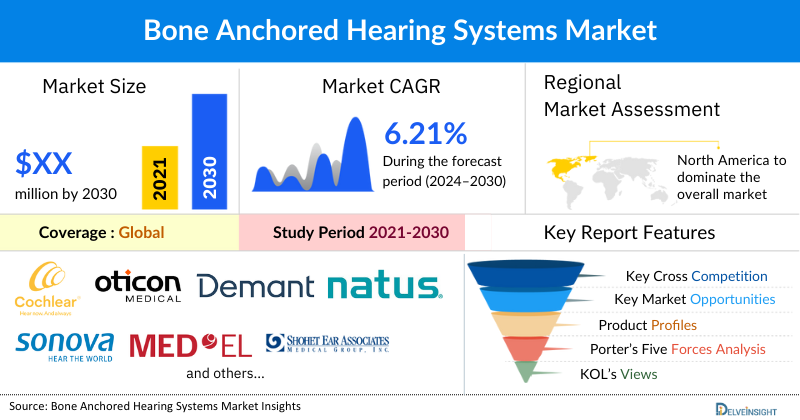
- The global bone-anchored hearing systems market is estimated to grow at a CAGR of 6.21% during the forecast period from 2024 to 2030.
- The demand for bone-anchored hearing systems is primarily being boosted by the rising number of cases of hearing loss owing to various factors such as hearing disorders, hereditary disorders, and birth complications.
Bone Anchored Hearing Systems Market Trends & Insights
- North America is expected to account for the highest proportion of the bone-anchored hearing systems market in 2023, out of all regions. This is due to the presence of developed and sophisticated healthcare infrastructure, and the high prevalence of hearing disorders in the region.
- Some of the key market players operating in the Bone Anchored Hearing Systems market include Cochlear Ltd., Oticon Medical, Demant, Natus Medical Incorporated, Auditdata, Big Sky Audiology, Sonova, MED-EL Medical Electronics, WS Audiology, Shohet Ear Associates Medical Group, Inc. and Others.
- In the material type segment of the bone anchored hearing systems market, the titanium alloy category is estimated to amass a significant revenue share in the Bone Anchored Hearing Systems market in 2023
Bone Anchored Hearing Systems Market Size and Forecasts
- Growth Rate (2024-2030): 6.21% CAGR
- Largest Market: North America
- Fastest Growing Market: Asia-Pacific
- Market Structure: Moderately Consolidated
Factors Contributing to the Growth of Bone Anchored Hearing Systems
Rising Prevalence of Hearing Loss
The increasing global burden of conductive and mixed hearing loss, along with single-sided deafness (SSD), is a major driver for BAHS adoption. Aging populations and noise-induced hearing damage further contribute to expanding patient pools.
Limitations of Conventional Hearing Aids
Traditional air-conduction hearing aids are often ineffective or uncomfortable for patients with chronic ear infections, ear canal malformations, or atresia. BAHS bypass the outer and middle ear, offering a clinically effective alternative.
Technological Advancements
Continuous innovations such as smaller implants, improved osseointegration, wireless connectivity, and digital sound processors have significantly enhanced sound quality, comfort, and patient outcomes, boosting acceptance among both patients and clinicians.
Expanding Indications and Patient Eligibility
BAHS are increasingly being recommended not only for conductive hearing loss but also for single-sided deafness and pediatric patients, broadening the target population and driving market growth.
Growing Awareness and Early Diagnosis
Improved newborn hearing screening programs, better audiological diagnostics, and increased awareness among ENT specialists and audiologists are leading to earlier intervention and higher BAHS adoption rates.
Favorable Reimbursement Policies in Developed Markets
In regions such as North America and Europe, supportive reimbursement frameworks and insurance coverage for implantable hearing devices are encouraging patient uptake and supporting market expansion.
Rising Demand for Minimally Invasive Solutions
Advances in surgical techniques have made BAHS implantation less invasive with shorter recovery times, reducing procedural risks and increasing patient willingness to opt for implantable solutions.
Pediatric Adoption and Long-Term Benefits
Early implantation in children improves speech development and cognitive outcomes, making BAHS a preferred long-term solution in pediatric audiology.
Strong Industry Investment and R&D Activity
Leading medical device companies are investing heavily in product innovation, clinical trials, and geographic expansion, accelerating technological progress and market penetration.
Improved Quality of Life Outcomes
Clinical evidence demonstrating better speech recognition, sound localization, and overall quality of life compared to conventional hearing aids continues to strengthen clinician and patient confidence in BAHS.
Bone Anchored Hearing Systems Market By Material Type (Titanium Alloy, Ceramics Composites, And Others), Application (Sensorineural Hearing Loss, Conductive Hearing Loss, Mixed Hearing Loss, And Single Sided Deafness), And Geography (North America, Europe, Asia-Pacific, And Rest Of The World) is expected to grow at a steady CAGR forecast till 2030 owing to the increasing prevalence of hearing loss due to hearing disorders, hereditary disorders, and birth complications and surge in government and non-government programs for raising awareness regarding hearing disorders
The global bone-anchored hearing systems (BAHS) market is estimated to grow at a CAGR of 6.21% during the forecast period from 2024 to 2030. The demand for bone-anchored hearing systems is primarily being boosted by the rising number of cases of hearing loss owing to various factors such as hearing disorders, hereditary disorders, and birth complications. Additionally, the rise in the surge in government and non-government programs for raising awareness regarding hearing disorders and growing geriatric population are some of the contributing factors to the growth of the bone-anchored hearing systems market during the forecast period from 2024-2030.
What are the latest Bone Anchored Hearing Systems Market Dynamics and Trends?
According to the data published by the World Health Organization 2023, it was estimated that nearly 2.5 billion people will be suffering from some degree of hearing loss by 2050, globally. According to the same source, it was estimated that 1 in every 10 people will have disabling hearing loss by 2050, globally.
Additionally, the World Health Organization 2019 data stated that in East Asia the number of people with disabling hearing loss is projected to increase to around 189 million by the year 2050.
Also, there will be around 72 million cases of hearing loss in high-income countries, 44 million in the Middle East and North Africa, and 46 million in Central/East Europe and Central Asia by 2050.
Thus, the rising prevalence of hearing disorders due to various factors such as hereditary disorders, birth complications, and others will create a need for the management and treatment of hearing disorders, thus resulting in the positive growth of the bone anchored hearing systems market.
Further, as per the statistics provided by the World Health Organization 2021, it was estimated that approximately 16% of hearing loss in adults results from exposure to excessive noise in the workplace, globally. Thus, increasing noise pollution is also one of the factors contributing to the increasing prevalence of hearing loss, which in turn will contribute to the growth of the bone anchored hearing systems market.
However, disadvantages associated with the bone anchored hearing systems such as skin irritation or infection at the implant site and high cost associated with the bone anchored hearing systems are some of the key constraints that may limit the growth of the bone anchored hearing systems market.
Bone Anchored Hearing Systems Market Report Segmentation
This Bone Anchored Hearing Systems Market report offers a comprehensive overview of the global Bone Anchored Hearing Systems, highlighting key trends, growth drivers, challenges, and opportunities. It covers detailed market segmentation by Bone Anchored Hearing Systems market by material type (Titanium Alloy, Ceramics Composites, and Others), Application (Sensorineural Hearing Loss, Conductive Hearing Loss, Mixed Hearing Loss, and Single Sided Deafness), and Geography (North America, Europe, Asia-Pacific, and Rest of the World). The report provides valuable insights into the competitive landscape, regulatory environment, and market dynamics across major markets, including North America, Europe, and Asia-Pacific. Featuring in-depth profiles of leading industry players and recent product innovations, this report equips businesses with essential data to identify market potential, develop strategic plans, and capitalize on emerging opportunities in the rapidly growing Bone Anchored Hearing Systems Market
Bone Anchored Hearing Systems Market Segment Analysis
Bone Anchored Hearing Systems market by material type (Titanium Alloy, Ceramics Composites, and Others), Application (Sensorineural Hearing Loss, Conductive Hearing Loss, Mixed Hearing Loss, and Single Sided Deafness), and Geography (North America, Europe, Asia-Pacific, and Rest of the World)
In the material type segment of the bone anchored hearing systems market, the titanium alloy category is estimated to amass a significant revenue share in the Bone Anchored Hearing Systems market in 2023. This can be attributed to the various advantages provided by the Titanium Alloy. Titanium alloy is highly biocompatible and is well tolerated by the human body and causes minimal allergic or immune reactions. This is crucial for any implantable medical device, especially those intended for long-term use. Additionally, titanium alloy possesses an excellent strength-to-weight ratio and durability, which is important for BAHS as it ensures the device can withstand the stresses and strains associated with implantation and long-term use without fracturing or deforming. Further, titanium alloy is highly resistant to corrosion, even in harsh physiological environments within the body. This property helps ensure the long-term stability and integrity of the BAHS, reducing the risk of corrosion-related complications.
Therefore, owing to the above-mentioned factors, the titanium alloy category is expected to register significant growth, thereby driving the growth of the overall bone anchored hearing systems market during the forecast period.
Bone-Anchored Hearing Systems Market Regional Analysis
North America Bone-Anchored Hearing Systems Market Trends
North America Is Expected To Dominate The Overall Bone-Anchored Hearing Systems Market
North America is expected to account for the highest proportion of the bone-anchored hearing systems market in 2023, out of all regions. This is due to the presence of developed and sophisticated healthcare infrastructure, and the high prevalence of hearing disorders in the region. Additionally, the presence of advanced healthcare infrastructure, robust research and development initiatives, and a highly potent market in terms of product development, and launches are some of the factors driving the growth of the bone anchored hearing systems market in North America.
As per data from the Centers for Disease Control and Prevention 2020, hearing loss is the third most common chronic physical condition in the United States and is twice as prevalent as diabetes or cancer. Further, the same source stated that around 40 million adults aged 20-69 years are living with noise-induced hearing loss in the United States.
Additionally, according to statistics provided National Council on Aging 2023, around 15.5% of adults 18 years and above, were suffering from some kind of hearing issues, during the period 2019 to 2022 in the US.
Thus, this indicates a huge need for the management and treatment of hearing conditions, therefore leading to the growth of the Bone Anchored Hearing Systems market in the United States, which will further propel the bone anchored hearing systems market in North America.
Therefore, the factors mentioned above are responsible for driving the overall market for bone anchored hearing systems in North America during the forecast period.
Europe Bone-Anchored Hearing Systems Market Trends
In recent years, the Europe Bone-Anchored Hearing Systems market has shown steady and sustained growth, driven by several region-specific trends that reflect both demographic and healthcare dynamics. As one of the key regional markets globally, Europe benefits from a well-established public healthcare infrastructure and favorable reimbursement policies that make advanced hearing solutions more accessible to patients with conductive, mixed hearing loss, or single-sided deafness. Countries such as Germany, the United Kingdom, and France are leading contributors, supported by increasing awareness of implantable hearing solutions among clinicians and patients, robust early diagnosis programs, and a strong emphasis on audiological rehabilitation. The aging population across Europe further underpins demand, as age-related hearing impairments become more prevalent and conventional hearing aids prove insufficient for many candidates. Technological innovation, including wireless connectivity and improved sound processors, has enhanced patient outcomes and boosted adoption rates, while supportive regulatory frameworks such as CE marking and harmonized device standards help streamline product introductions and build clinician confidence. Public health campaigns and ENT specialist endorsements continue to expand market penetration, resulting in a healthy projected growth trajectory for BAHS adoption across major European healthcare systems.
Who are the major players in Bone Anchored Hearing Systems?
The following are the leading companies in Bone Anchored Hearing Systems. These companies collectively hold the largest Bone Anchored Hearing Systems market share and dictate industry trends.
Bone Anchored Hearing Systems Companies
Recent Developmental Activities In The Bone Anchored Hearing Systems Market
- In April 2022, Cochlear Limited, a global leader in implantable hearing solutions acquired Oticon Medical for a sum of DKK850 million.
- In September 2021, Oticon Medical has introduced the Ponto 5 Mini, a novel sound processor featuring OpenSound Navigator, which is poised to revolutionize the experience of users with bone-anchored hearing aids.
Scope of the Bone Anchored Hearing Systems Market | |
|
Report Metrics |
Details |
|
Study Period |
2020 to 2030 |
|
Base Year |
2021 |
|
Forecast Period |
2024 to 2030 |
|
CAGR |
6.21% |
|
Bone Anchored Hearing Systems Market Size |
Download Free Sample Report |
|
Bone Anchored Hearing Systems Companies | Cochlear Ltd., Oticon Medical, Demant, Natus Medical Incorporated, Auditdata, Big Sky Audiology, Sonova, MED-EL Medical Electronics, WS Audiology, Shohet Ear Associates Medical Group, Inc. and Others. |
Bone Anchored Hearing Systems Market Segmentation
Bone Anchored Hearing Systems Market by Material Type
- Titanium Alloy
- Ceramics Composites
- And Others
Bone Anchored Hearing Systems Market Application Exposure
- Sensorineural Hearing Loss
- Conductive Hearing Loss
- Mixed Hearing Loss
- Single Sided Deafness
- Others
Bone Anchored Hearing Systems Market End-Users Exposure
- Hospitals
- Others
Bone Anchored Hearing Systems Market Geography Exposure
-
North America Bone Anchored Hearing Systems Market
- United States Bone Anchored Hearing Systems Market
- Canada Bone Anchored Hearing Systems Market
- Mexico Bone Anchored Hearing Systems Market
-
Europe Bone Anchored Hearing Systems Market
- United Kingdom Bone Anchored Hearing Systems Market
- Germany Bone Anchored Hearing Systems Market
- France Bone Anchored Hearing Systems Market
- Italy Bone Anchored Hearing Systems Market
- Spain Bone Anchored Hearing Systems Market
- Rest of Europe
-
Asia-Pacific Bone Anchored Hearing Systems Market
- China Bone Anchored Hearing Systems Market
- Japan Bone Anchored Hearing Systems Market
- India Bone Anchored Hearing Systems Market
- Australia Bone Anchored Hearing Systems Market
- South Korea Bone Anchored Hearing Systems Market
- Rest of Asia-Pacific
-
Rest of the World
- South America Bone Anchored Hearing Systems Market
- Middle East Bone Anchored Hearing Systems Market
- Africa Bone Anchored Hearing Systems Market
Bone Anchored Hearing Systems Market Recent Industry Trends and Milestones (2022-2025) | |
|---|---|
| Category | Recent Industry Trends & Milestones (2022–2025) |
| Bone Anchored Hearing Systems Market – Product Launches |
|
| Bone Anchored Hearing Systems Market – Regulatory Approvals |
|
| Partnerships in the Bone Anchored Hearing Systems |
|
| Acquisitions in the Bone Anchored Hearing Systems |
|
| Company Strategy |
|
| Emerging Technology |
|
Impact Analysis
What is the impact of AI on the Bone Anchored Hearing Systems
AI-Powered Innovations and Applications:
Startup Funding & Investment Trends in Structural Heart Devices Market | ||||
|---|---|---|---|---|
| Company Name | Total Funding | Main Products | Stage of Development | Core Technology |
| HearNU | Undisclosed (Angel / Early-stage funding) | Non-surgical bone conduction hearing device | Seed / Early Commercialization | Bone conduction hearing technology offering a non-surgical alternative to traditional BAHS |
| Sophono (Historic) | ~USD 7 Million (Series B) | Bone-anchored hearing devices (Alpha series) | Clinical-stage (pre-acquisition) | Implantable bone-anchored hearing system technology |
| Advanced Bionics (Adjacent Market) | ~USD 128 Million (Historic funding) | Cochlear implants and hearing solutions | Growth / Acquired | Implantable hearing technologies including bone and cochlear stimulation |
| IotaMotion (Adjacent Market) | ~USD 2 Million (Seed) | Robotic-assisted surgical platform for hearing implants | Early-stage / Clinical development | Precision surgical tools for implantable hearing systems |
| Emerging Academic & Research Spin-offs | Grant-funded / Variable | Prototype bone conduction and AI-based hearing platforms | Research / Prototype | AI-driven sound processing, MEMS sensors, and advanced bone conduction interfaces |
Key Takeaways From The Bone Anchored Hearing Systems Market Report Study
- Market size analysis for current Bone Anchored Hearing Systems Market size (2023), and market forecast for 6 years (2024-2030)
- Top key product/technology developments, mergers, acquisitions, partnerships, and joint ventures happened for the last 3 years
- Key companies dominating the Bone Anchored Hearing Systems market.
- Various opportunities available for the other competitors in the Bone Anchored Hearing Systems Market space.
- What are the top-performing segments in 2023? How these segments will perform in 2030?
- Which are the top-performing regions and countries in the current Bone Anchored Hearing Systems market scenario?
- Which are the regions and countries where companies should have concentrated on opportunities for Bone Anchored Hearing Systems market growth in the coming future?
Target Audience Who Can Be Benefited From This Bone Anchored Hearing Systems Market Report Study
- Bone Anchored Hearing Systems product providers
- Research organizations and consulting companies
- Bone Anchored Hearing Systems -related organizations, associations, forums, and other alliances
- Government and corporate offices
- Start-up companies, venture capitalists, and private equity firms
- Distributors and Traders dealing in Bone Anchored Hearing Systems
- Various End-users who want to know more about the Bone Anchored Hearing Systems Market and the latest technological developments in the Bone Anchored Hearing Systems market.

