
Bone Cement Market
Bone Cement Market By Product Type (Polymethyl Methacrylate (Pmma) Cement, Glass Polyalkenoate Cement, And Calcium Phosphate Cement), By Joints (Knee, Hip, Shoulder, Spine, And Other), Procedure Type (Arthroplasty, Kyphoplasty/Vertebroplasty), End-User (Hospitals, Clinics, And Others), And Geography (North America, Europe, Asia-Pacific, And Rest Of The World) is expected to grow at a steady CAGR forecast till 2030 owing to rise in the prevalence of bone-related disorders such as osteoporosis and growing cases of sport-related injuries
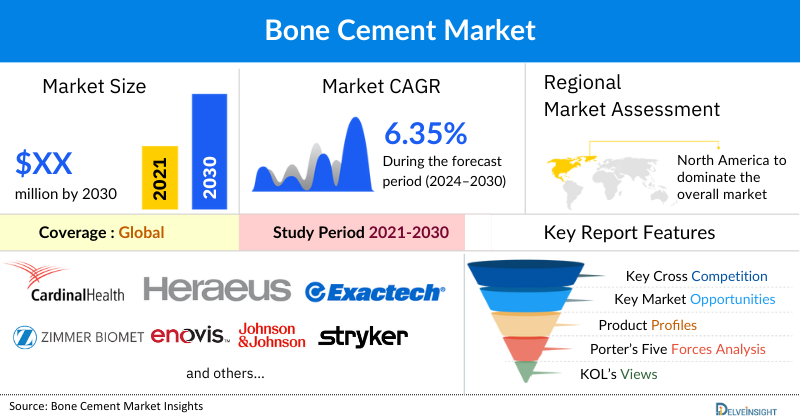
The bone cement market is estimated to grow at a CAGR of 6.35% during the forecast period from 2024 to 2030. The rising demand for bone cement is being fueled by several significant factors. These include the escalating prevalence of conditions like osteoporosis and osteoarthritis, the uptick in fractures resulting from accidents, and the surge in sports-related injuries. These trends are expected to persist and contribute to the heightened demand for bone cement from 2024 to 2030.
Bone Cement Market Dynamics:
According to data provided by the International Osteoporosis Foundation in 2023, it was estimated that approximately one-third of women and one-fifth of men aged 50 or older globally would experience a bone fracture due to osteoporosis in their lifetime. Additionally, osteoporosis results in over 8.9 million bone fractures annually, equating to a fracture occurring every 3 seconds on average. Furthermore, more than 55% of individuals who suffer a hip fracture exhibit signs of a prior spinal fracture worldwide. As osteoporosis weakens bones, it increases the risk of fractures, especially in the spine and hips. These fractures often necessitate medical procedures involving bone cement, such as vertebroplasty, kyphoplasty, and replacement surgeries. As the number of individuals experiencing osteoporosis-related fractures continues to rise, the demand for bone cement in surgical interventions is increasing.
According to data provided by the World Health Organization (WHO) for the year 2023, around 20 to 50 million people worldwide suffer non-fatal injuries every year due to road traffic accidents. The increase in accidents, especially those that result in traumatic injuries, can contribute to the growth of the bone cement market. This is because fractures and joint damage from accidents often require surgical intervention, and bone cement is a crucial material used in orthopedic surgeries to repair these injuries. The rising number of orthopedic procedures, such as joint replacements, fracture fixation, and spinal surgeries, also increases the demand for bone cement.
Moreover, another factor contributing to the growth of the bone cement market is the increase in product approval initiatives. For instance, in April 2024, Heraeus Medical announced that its antibiotic-infused bone cement, COPAL® G+C, has been approved under the new Medical Device Regulation (MDR).
Therefore, the demand for bone cement is likely to increase which is expected to propel the growth of the overall bone cement market during the forecast period from 2024-2030.
However, allergic reactions caused by bone cement may restrict the growth of the overall Bone cement market.
Bone Cement Market Segment Analysis:
Bone Cement Market by Product Type (Polymethyl Methacrylate (PMMA) Cement, Glass Polyalkenoate Cement, and Calcium Phosphate Cement), Joints (Knee, Hip, Shoulder, Spine, and Other), Procedure Type (Arthroplasty, Kyphoplasty/Vertebroplasty), End-User (Hospitals, Clinics, and Others) and Geography (North- America, Europe, Asia-Pacific, and Rest of the World)
In the product type segment of the bone cement market, the Polymethyl Methacrylate (PMMA) Cement category is expected to hold the largest share in the year 2023. The large market share of Polymethyl Methacrylate (PMMA) cement is driven by its numerous advantages, fueling high demand among end users. Polymethyl Methacrylate Cement is a synthetic resin used in medical and dental procedures due to its numerous advantages. It is resistance to environmental factors like moisture and temperature fluctuations ensures its durability within the body. This quality, combined with low shrinkage during setting, makes it an excellent material for creating strong, lasting bonds with bones and implants. PMMA cement's ease of handling allows surgeons to adjust its consistency for specific surgical needs, facilitating efficient operations.
Another significant advantage of PMMA cement is its radiopacity, which facilitates accurate placement and monitoring through X-rays or other imaging techniques. The stability and longevity of PMMA cement contribute to its reliability, as it maintains its structural integrity over time, which is crucial for long-term medical applications, PMMA cement is generally biocompatible, minimizing the risk of adverse reactions when used appropriately.
Furthermore, as the demand for this segment grows, various novel products are getting regulatory approval from various regulatory organizations across the world. For example, in May 2022, OGM was approved by the U.S. Food and Drug Administration (FDA) 510 (k) clearance for its OGM® 1 product. OGM@ 1 is a PMMA bone cement intended for use in arthroplasty procedures of the hip, knee, and other joints for the fixation of polymer or metallic prosthetic implants to living bone.
Therefore, owing to the aforementioned advantages associated with the Polymethyl Methacrylate Cement procedure the demand for bone cement is expected to increase, thereby propelling the overall market for bone cement during the forecast period from 2024-2030.
North America Is Expected To Dominate The Overall Bone Cement Market:
Among all the regions, North America is expected to hold the largest share of the global bone cement market in 2023. The North America bone cement market is experiencing growth due to several key factors. Firstly, the region has a large aging population, with a significant proportion of individuals susceptible to conditions such as osteoporosis and osteoarthritis, which often require orthopedic procedures utilizing bone cement. Moreover, advancements in healthcare infrastructure and technology in North America have led to increased access to orthopedic surgeries, contributing to the demand for bone cement. Additionally, rising awareness about the benefits of minimally invasive surgical techniques, which often involve the use of bone cement, has fueled market growth. Furthermore, the prevalence of sports-related injuries and accidents in the region has bolstered the need for orthopedic interventions, further driving the demand for bone cement. Overall, collectively these factors are propelling the growth of the bone cement market in North America.
For instance, according to the data provided by National Safety Council (NSC), (2022), in 2022, exercise equipment was responsible for an estimated 445,642 injuries, making it the top source of injuries among all sports and recreation activities in the United States. Sports-related injuries make up about one-third of all childhood injuries, with sprains and strains being the most prevalent types. Sports injuries can drive the growth of the bone cement market by increasing the demand for orthopedic and reconstructive surgeries. As athletes and active individuals are prone to bone fractures, ligament tears, or joint damage, these injuries often require surgical intervention where bone cement plays a critical role. It is used to stabilize fractures, secure implants, or fill bone voids, contributing to its increased usage.
Additionally, sports-related wear-and-tear can lead to joint damage, necessitating joint replacement surgeries such as hip or knee arthroplasty, where bone cement is essential for anchoring prosthetic components.
Another key factor behind the growth of the bone cement market is rising strategic activities such as product approval. For instance, in April 2024, OsteoRemedies® LLC, an orthopedic company received FDA approval to use the SPECTRUM® GV Bone Cement for a wider range of treatments.
Therefore, the interplay of all the aforementioned factors is expected to boost the growth of the bone cement market in the North America region during the forecast period from 2024 - 2030.
Bone Cement Market Key Players:
Some of the key market players operating in the bone cement market include Cardinal Health, Heraeus Holding, EXACTECH, Zimmer Biomet, Enovis Corporation, Johnson & Johnson Services, Inc., Stryker, Smith+Nephew, Wright Medical Group N.V., Ecres S.p.A., Medtronic, Atrivion, Inc, Globus Medical, OSTEOREMEDIES, OSARTIS GmbH, Mathys AG Bettlach, Teknimed, Biocomposites, Makevale Group companies, and others.
Recent Developmental Activities In The Bone Cement Market:
- In May 2022, Granulab (M) Sdn Bhd, a subsidiary of KPower Bhd, introduced Malaysia's first halal-certified synthetic bone cement, called Prosteomax. This product is a novel synthetic calcium phosphate bone cement that has received halal certification
Key Takeaways From The Bone Cement Market Report Study
Market size analysis for current Bone Cement Market size (2023), and market forecast for 6 years (2024-2030)
- Top key product/services/technology developments, mergers, acquisitions, partnerships, and joint ventures happened for the last 3 years
- Key companies dominating the global Bone cement market.
- Various opportunities available for the other competitor in the Bone Cement market space.
- What are the top-performing segments in 2023? How these segments will perform in 2030?
- Which are the top-performing regions and countries in the current Bone Cement market scenario?
- Which are the regions and countries where companies should have concentrated on opportunities for Bone cement market growth in the coming future?
Target Audience Who Can Be Benefited From This Bone Cement Market Report Study
- Bone Cement market products providers
- Research organizations and consulting companies
- Bone Cement organizations, associations, forums, and other alliances
- Government and corporate offices
- Start-up companies, venture capitalists, and private equity firms
- Distributors and traders dealing in bone cement
- Various end-users who want to know more about the Bone Cement market and the latest technological developments in the Bone Cement market.
Frequently Asked Questions For The Bone Cement Market:
1. What is Bone Cements?
Bone cement is a medical material used to bind or fix components in orthopedic and spinal surgeries. Despite its name, it doesn't act like traditional adhesives.
2. What is the market for global Bone Cement markets?
The bone cement market is estimated to grow at a CAGR of 6.35% during the forecast period from 2024 to 2030.
3. What are the drivers for the global Bone cement market?
The rising demand for bone cement is being fueled by several significant factors. These include the escalating prevalence of conditions like osteoporosis and osteoarthritis, the uptick in fractures resulting from accidents, and the surge in sports-related injuries. These trends are expected to persist and contribute to the heightened demand for bone cement from 2024 to 2030.
4. Who are the key players operating in the global Bone cement market?
Some of the key market players operating in the Bone Cement market include Cardinal Health, Heraeus Holding, EXACTECH, Zimmer Biomet, Enovis Corporation, Johnson & Johnson Services, Inc., Stryker, Smith+Nephew, Wright Medical Group N.V., Ecres S.p.A., Medtronic, Atrivion, Inc, Globus Medical, OSTEOREMEDIES, OSARTIS GmbH, Mathys AG Bettlach, Teknimed, Biocomposites, Makevale Group companies, and others.
5. Which region has the highest share in the Bone Cement market?
North America is expected to hold the largest share of the global bone cement market in 2023. The North America bone cement market is experiencing growth due to several key factors. Firstly, the region has a large aging population, with a significant proportion of individuals susceptible to conditions such as osteoporosis and osteoarthritis, which often require orthopedic procedures utilizing bone cement. Moreover, advancements in healthcare infrastructure and technology in North America have led to increased access to orthopedic surgeries, contributing to the demand for bone cement.

