Brain Imaging Devices Market Summary
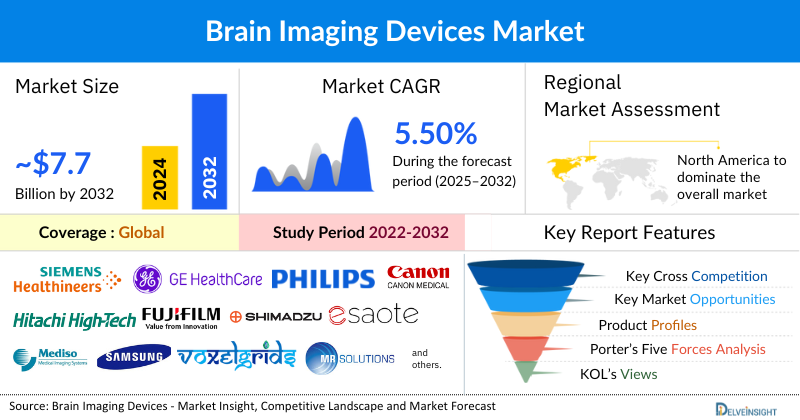
- The global brain imaging devices market is expected to increase from USD 5,091.71 million in 2024 to USD 7,779.85 million by 2032, reflecting strong and sustained growth.
- The global brain imaging devices market is growing at a CAGR of 5.50% during the forecast period from 2025 to 2032.
Brain Imaging Devices Market Trends & Insights
- The global brain imaging devices market is driven by the rising prevalence of neurological disorders, technological advancements, especially AI and ML integration, and increasing product development activities by key market players, including innovations in MRI, CT, and PET technologies.
- The leading companies operating in the brain imaging devices market include Siemens Healthcare Private Limited, GE HealthCare, Koninklijke Philips N.V., CANON MEDICAL SYSTEMS CORPORATION, Hitachi High-Tech Corporation, Fujifilm Holdings Corporation, Shimadzu Corporation, Esaote SPA, Mediso Ltd., Samsung Electronics Co. Ltd, MinFound Medical Systems Co., Ltd., Shanghai United Imaging Healthcare Co., Ltd., Voxelgrids Innovations Private Limited, MR Solutions, PerkinElmer, Kindsway Biotech Co., Ltd., SCHILLER, Neusoft Medical Systems Co., Ltd., Time Medical Holding, Koning Health, and others.
- The North American brain imaging devices market is a dominant force globally, driven by the high prevalence of neurological disorders, strong R&D investment, advanced healthcare infrastructure, and continuous innovation by leading medical device companies.
- In the product type segment of the brain imaging devices market, the devices category is estimated to account for the largest market share in 2024.
Brain Imaging Devices Market Size and Forecasts
- 2024 Market Size: USD 5,091.71 million
- 2032 Projected Market Size: USD 7,779.85 million
- Growth Rate (2025-2032): 5.50% CAGR
- Largest Market: North America
- Fastest Growing Market: Asia-Pacific
- Market Structure: Consolidated
Factors Contributing to the Growth of the Brain Imaging Devices Market
The rising prevalence of neurological disorders is leading to a surge in the brain imaging devices market:
Neurological conditions such as Alzheimer’s disease, Parkinson’s disease, epilepsy, stroke, multiple sclerosis, and brain tumors are increasing globally, primarily due to aging populations and lifestyle-related risk factors like obesity, stress, and cardiovascular disease. These disorders require accurate diagnosis and continuous monitoring, making brain imaging devices such as MRI, CT, and PET scanners essential. For instance, MRI helps detect brain shrinkage in Alzheimer’s, while CT and PET are crucial for stroke detection and tumor evaluation. The growing patient pool directly drives the demand for advanced brain imaging technologies in both clinical and research settings.
Technological advancements such as the integration of AI and ML lead to higher adoption of brain imaging devices:
Artificial intelligence (AI) and machine learning (ML) are transforming brain imaging by improving image quality, enhancing diagnostic precision, and reducing reporting time. AI-powered tools can detect subtle abnormalities, automate image segmentation, and even predict disease progression, supporting earlier and more personalized treatment decisions. For example, AI-integrated MRI and PET systems are now capable of identifying amyloid and tau protein deposits linked to Alzheimer’s disease. Additionally, workflow automation enabled by AI reduces clinician workload, improves efficiency, and expands access to imaging services, particularly in high-volume hospitals and tele-radiology platforms.
Increase in product development activities among key players:
Leading medical device companies and startups are heavily investing in the development of innovative brain imaging solutions. These include portable MRI devices for point-of-care diagnostics, hybrid PET/MRI platforms for more comprehensive imaging, and advanced CT systems with low-dose radiation and faster scanning capabilities. Companies like Philips, Siemens Healthineers, GE Healthcare, and Hyperfine are at the forefront of introducing next-generation devices equipped with AI, enhanced hardware, and specialized neuroimaging applications. Continuous product launches and regulatory approvals not only expand clinical utility but also increase adoption across hospitals, diagnostic centers, and research institutes, boosting overall market growth.
Brain Imaging Devices Market Report Segmentation
This brain imaging devices market report offers a comprehensive overview of the global Brain Imaging Devices market, highlighting key trends, growth drivers, challenges, and opportunities. It covers detailed market segmentation Brain Imaging Devices Market by Product Type (Devices [Magnetic Resonance Imaging (MRI), Computed Tomography (CT/SPECT), Positron Emission Tomography (PET), and Others] and Accessories & Consumables), Portability (Stationary and Portable), Application (Stroke, Brain Tumor, Epilepsy, and Others), End-User (Hospitals, Diagnostic Imaging Centers, Ambulatory Surgery Centers, and Others), and geography. The report provides valuable insights into the competitive landscape, regulatory environment, and market dynamics across major markets, including North America, Europe, and Asia-Pacific. Featuring in-depth profiles of leading industry players and recent product innovations, this report equips businesses with essential data to identify market potential, develop strategic plans, and capitalize on emerging opportunities in the rapidly growing Brain Imaging Devices market.
Brain imaging devices are advanced diagnostic tools used to visualize the structure and function of the brain, playing a crucial role in detecting and monitoring neurological disorders such as Alzheimer’s, stroke, epilepsy, Parkinson’s disease, and brain tumors. Key modalities include MRI, CT, PET, EEG, and MEG, each offering unique capabilities for structural, functional, and metabolic imaging. The market is growing rapidly, fueled by rising neurological disease prevalence, an aging population, and continuous technological advancements such as AI-powered imaging, portable MRI systems, and hybrid PET/MRI platforms. These innovations are improving diagnostic accuracy, enabling early detection, and expanding access to high-quality neuroimaging across both developed and emerging healthcare systems.
The brain imaging devices market is witnessing steady growth, driven by multiple factors. The rising prevalence of neurological disorders such as Alzheimer’s disease, Parkinson’s disease, stroke, epilepsy, and brain tumors has created a strong demand for advanced imaging solutions that enable accurate diagnosis and effective treatment planning. An aging global population, coupled with lifestyle-related risk factors, is further contributing to the growing incidence of these conditions. Technological advancements, particularly the integration of artificial intelligence and machine learning into MRI, CT, and PET systems, are improving imaging accuracy, speed, and diagnostic capabilities, thereby enhancing clinical outcomes. In addition, leading market players are intensifying product development activities, introducing innovative devices such as portable MRI systems, hybrid PET/MRI platforms, and AI-driven imaging software to expand clinical applications and accessibility. These factors, combined with increasing awareness of early diagnosis and rising healthcare investments, continue to propel the growth of the brain imaging devices market worldwide.
What are the latest Brain Imaging Devices Market Dynamics and Trends?
The brain imaging devices market is experiencing significant growth, largely driven by the increasing prevalence of neurological disorders such as brain tumors, strokes, Alzheimer’s disease, Parkinson’s disease, and epilepsy. This trend is fueled by both aging demographics and lifestyle-related risk factors. Technological advancements, particularly the integration of artificial intelligence (AI) and machine learning (ML), are further enhancing imaging accuracy, diagnostic speed, and clinical decision-making, enabling earlier detection and more personalized treatment strategies. In parallel, continuous product development and innovation in MRI, CT, and PET technologies by leading players are broadening the scope of applications and improving overall efficiency, collectively propelling market expansion.
According to DelveInsight, around 50.5 million people worldwide are affected by epilepsy, with nearly 80% residing in low- and middle-income countries. Brain imaging modalities such as MRI, CT, and PET scans play a crucial role in detecting structural abnormalities, lesions, tumors, or scarring responsible for seizures. This growing reliance on advanced imaging to support accurate epilepsy diagnosis is emerging as a key driver of global market growth. Similarly, analysts estimate that nearly 21 million people globally are living with intracerebral hemorrhage (ICH). In such cases, rapid and precise imaging is essential to identify the location, size, and cause of bleeding, guide urgent medical or surgical interventions, and distinguish ICH from ischemic stroke. CT and MRI remain indispensable tools in emergency care for monitoring hematoma development and treatment response.
The integration of AI and ML is accelerating market momentum by refining diagnostic precision and streamlining workflows. Companies such as Hyperfine with its Swoop® Portable MRI, Philips with Smart Quant Neuro 3D, and Fujifilm with ECHELON Synergy are embedding AI capabilities into MRI, CT, and PET platforms to optimize image quality and automate reporting. In December 2024, Canon Medical Systems USA expanded its AI-enabled CT portfolio by launching tools such as INSTINX and Vitrea, designed to accelerate diagnostic processes and improve clinical accuracy. The portfolio also featured specialized clinical packages, including a Stroke CT Package with applications for intracerebral hemorrhage (ICH), large vessel occlusion (LVO), and CT brain perfusion.
Therefore, these factors, including rising disease prevalence, growing demand for precise diagnostics, and rapid technological innovation, are expected to drive strong growth in the global brain imaging devices market throughout the forecast period of 2025 to 2032.
Despite the growing demand, the brain imaging devices market faces several restraints that could hinder its expansion. One of the primary challenges is the high cost of equipment and ongoing maintenance, as advanced imaging modalities like MRI, CT, and PET scanners require significant capital investment, specialized infrastructure, and continuous servicing. This creates a barrier for smaller hospitals and diagnostic centers, particularly in developing regions. Another concern is the risk of radiation exposure associated with modalities such as CT and PET, which raises patient safety issues, especially for vulnerable groups requiring repeated scans. These factors not only influence purchasing decisions but also drive regulatory scrutiny and limit widespread adoption, thereby impacting overall market growth.
Brain Imaging Devices Market Segment Analysis
Brain Imaging Devices Market by Product Type (Devices [Magnetic Resonance Imaging (MRI), Computed Tomography (CT/SPECT), Positron Emission Tomography (PET), and Others] and Accessories & Consumables), Portability (Stationary and Portable), Application (Stroke, Brain Tumor, Epilepsy, and Others), End-User (Hospitals, Diagnostic Imaging Centers, Ambulatory Surgery Centers, and Others), and Geography (North America, Europe, Asia-Pacific, and Rest of the World)
Brain Imaging Devices Market Segmentation By Product Type
By Product Type: Devices Category Dominates the Market
The devices category represents the dominant segment in the brain imaging devices market, accounting for a substantial share of approximately 80% in 2024. Within this category, Magnetic Resonance Imaging (MRI) devices hold the largest share, driven by their wide-ranging advantages and clinical applications. MRI provides high-resolution, detailed images of internal body structures, particularly soft tissues that are often difficult to visualize with other imaging modalities such as X-ray or CT. Unlike CT scans, MRI does not use ionizing radiation, making it a safer option for repeated examinations, especially for vulnerable populations like children and pregnant women. Its superior contrast resolution allows for clear differentiation between tissues such as gray and white matter, muscles, fat, and ligaments, while its ability to capture images from multiple planes—axial, sagittal, and coronal without repositioning the patient ensures comprehensive anatomical assessment. Advanced techniques such as contrast-enhanced MRI and functional MRI (fMRI) further extend its utility by visualizing blood flow, mapping neural activity, and supporting functional assessments.
The applications of MRI are particularly critical in the diagnosis and management of neurological conditions. It enables the detection and characterization of brain tumors, provides accurate insights into stroke type and severity, and visualizes demyelinating plaques in multiple sclerosis. In epilepsy, MRI is invaluable for identifying structural abnormalities underlying seizure activity, while in neurodegenerative diseases such as Alzheimer’s and Parkinson’s, it helps track progressive brain atrophy. Functional MRI also plays an essential role in pre-surgical planning and cognitive research, highlighting brain activity patterns with precision.
Technological innovation continues to strengthen the MRI segment’s leadership. For example, at RSNA in November 2024, Philips introduced its next-generation 1.5T BlueSeal MRI, the industry’s first wide-bore, helium-free scanner with full AI integration. Incorporating advanced features such as SmartExam, SmartSpeed, and zero-click AI reporting, the system delivers faster, high-resolution imaging and automated diagnostics, setting new benchmarks for efficiency and accuracy.
Brain Imaging Devices Market Segmentation By Portability
By Portability: Stationary Dominates the Market
In the brain imaging devices market, the stationary category held the largest market share in 2024. The stationary category in the brain imaging devices market is boosting growth due to its widespread adoption in hospitals, diagnostic centers, and research institutions for high-precision neurological assessments. Stationary systems such as MRI, CT, and PET scanners remain the gold standard for diagnosing complex brain disorders, including Alzheimer’s disease, stroke, epilepsy, and brain tumors, as they deliver superior image quality, high-resolution scans, and advanced functional imaging capabilities. These devices are equipped with cutting-edge technologies, including AI-powered software, hybrid imaging platforms, and advanced contrast techniques, which enhance diagnostic accuracy and support personalized treatment planning. Moreover, the demand for stationary systems is reinforced by their ability to handle high patient volumes in clinical settings, a critical factor in regions with rising cases of neurological disorders. Continuous product innovations, regulatory approvals, and investments in upgrading imaging infrastructure across developed markets are further strengthening the dominance of the stationary segment, making it a key driver of overall market expansion.
Brain Imaging Devices Market Segmentation By Application
By Application: Brain Tumor Dominates the Market
In the brain imaging devices market, the brain tumor category held the largest market share in 2024. The brain tumor category is significantly boosting the brain imaging devices market due to the rising incidence of both malignant and benign tumors, which demand advanced and accurate imaging for effective diagnosis and treatment planning. Brain tumors require precise visualization of their size, location, and impact on surrounding brain structures, making modalities such as MRI, CT, and PET indispensable. MRI, in particular, is considered the gold standard for brain tumor detection because of its superior soft tissue contrast, enabling detailed assessment of tumor boundaries and infiltration. With an increasing number of patients requiring surgical intervention, radiation therapy, and ongoing monitoring, the demand for high-resolution and functional imaging systems continues to grow. Furthermore, advancements in AI-driven image analysis, functional MRI, and hybrid PET/MRI are enhancing diagnostic accuracy and supporting personalized treatment strategies, thereby accelerating the adoption of brain imaging devices. This growing clinical need, coupled with technological innovation, positions the brain tumor segment as a key driver of market expansion.
Brain Imaging Devices Market Segmentation By End-User
By End-User: Hospitals Dominate the Market
The hospital category held the largest market share in 2024. This is because hospitals serve as the primary centers for advanced diagnostic and treatment services, handling a high volume of patients with neurological disorders such as Alzheimer’s disease, stroke, epilepsy, and brain tumors. Hospitals are equipped with state-of-the-art imaging infrastructure, including MRI, CT, and PET scanners, which require significant investment and are more accessible in these settings compared to smaller clinics or diagnostic centers. In addition, hospitals often collaborate with research institutes and participate in clinical trials, driving the adoption of next-generation technologies such as AI-powered imaging platforms and hybrid PET/MRI systems. The availability of skilled radiologists, neurosurgeons, and multidisciplinary teams further strengthens hospitals as key end-users, as they can integrate imaging into comprehensive patient care pathways. Moreover, favorable reimbursement policies, growing healthcare expenditure, and hospital investments in digital and cloud-based imaging solutions are accelerating device adoption, thereby reinforcing the hospital category’s dominant role in propelling market growth.
Brain Imaging Devices Market Regional Analysis
North America Brain Imaging Devices Market Trends
North America, led by the United States, dominates the global brain imaging devices market, accounting for approximately 41% of the total market share in 2024. The North American brain imaging devices market is expanding steadily, driven by the high prevalence of neurological disorders, strong R&D investments, advanced healthcare infrastructure, and continuous innovation from leading medical device companies. The region’s dominance is further reinforced by growing awareness of early diagnosis and broad adoption of cutting-edge imaging technologies, securing its leading position in the global landscape.
According to DelveInsight analysis, more than 7.5 million people in the U.S. were living with Alzheimer’s disease in the reported year, with the number projected to nearly double to 13 million by 2050. Approximately one in nine individuals aged 65 and above is affected, with women facing a higher risk. Brain imaging plays a vital role in detecting Alzheimer-related changes, such as hippocampal shrinkage, cortical thinning, and the accumulation of harmful proteins like amyloid and tau. Modalities such as magnetic resonance imaging (MRI) and positron emission tomography (PET), particularly amyloid PET and tau PET, are extensively used in clinical and research settings to identify early markers of neurodegeneration, track disease progression, and assess treatment efficacy.
In addition, the burden of brain tumors further highlights the critical need for advanced imaging technologies. As of 2023, nearly one million people in the U.S. were living with a brain tumor. Both malignant and benign tumors require high-resolution imaging to determine size, location, and relationship to surrounding brain structures, which is crucial for surgical planning, radiation therapy, and ongoing monitoring. MRI remains the gold standard for tumor detection, offering exceptional soft tissue contrast that enables accurate delineation of tumor boundaries and assessment of potential infiltration.
Beyond disease prevalence, the North American market benefits significantly from rapid technological innovation and frequent product launches. For instance, in December 2024 at RSNA, Philips introduced its AI-powered CT 5300 system in North America. The system integrates advanced hardware with AI-driven Smart Workflow solutions to enhance diagnostic confidence, reduce scan time, and improve accessibility to high-quality imaging. Features such as automated patient positioning, precise brain and cardiac imaging, and optimized radiation dosing make it particularly suitable for both neurological and cardiovascular applications, as well as low-dose screening programs.
Europe Brain Imaging Devices Market Trends
The Europe brain imaging devices market is witnessing strong growth driven by rising cases of neurological disorders such as Alzheimer’s disease, dementia, stroke, and epilepsy, which are increasingly prevalent in the region’s aging population. Governments and healthcare systems across Europe are investing heavily in early diagnosis and advanced neuroimaging infrastructure, supported by favorable reimbursement frameworks in countries like Germany, France, and the U.K. A major trend shaping the market is the integration of artificial intelligence into MRI, CT, PET, and EEG systems, which enhances diagnostic precision and streamlines clinical workflows.
In addition, collaborations between leading medtech companies, research institutes, and universities are accelerating the adoption of hybrid imaging technologies such as PET/MRI and low-field portable MRI solutions. The region is also seeing significant uptake of cloud-based imaging platforms and tele-radiology services, which improve access to specialized diagnostics, particularly in underserved areas. Furthermore, increased funding for neuroscience research under EU programs like Horizon Europe is driving innovation, while regulatory support for AI-based medical devices is creating opportunities for startups and digital health companies.
Hence, the Europe brain imaging devices market is characterized by steady growth, shaped by aging demographics, advanced healthcare systems, and a strong focus on innovative diagnostic and imaging solutions.
Asia-Pacific Brain Imaging Devices Market Trends
The Asia-Pacific brain imaging devices market is witnessing rapid expansion, reflecting a robust CAGR of 6.87% during the forecast period from 2025 to 2032, driven by the rising prevalence of neurological disorders, increasing healthcare investments, and rapid adoption of advanced diagnostic technologies. Countries such as China, Japan, India, and South Korea are emerging as key contributors, with expanding hospital infrastructure, government initiatives for early diagnosis, and growing awareness about brain health fueling demand. Japan continues to lead in technological innovation with strong adoption of high-end MRI and PET systems, while China is rapidly expanding its domestic manufacturing capabilities to reduce reliance on imports. In India, the increasing burden of stroke and dementia, coupled with improving access to advanced imaging modalities in urban centers, is creating significant opportunities. Additionally, the integration of AI-driven imaging solutions, tele-radiology, and portable devices is gaining traction across the region, making neuroimaging more accessible even in rural areas. Strategic partnerships between global device manufacturers and local players, along with favorable regulatory reforms and supportive medical tourism trends, are further shaping the market outlook in Asia-Pacific.
Who are the major players in the Brain Imaging Devices Market?
The following are the leading companies in the brain imaging devices market. These companies collectively hold the largest market share and dictate industry trends.
Brain Imaging Devices Companies are:
- Siemens Healthcare Private Limited
- GE HealthCare
- Koninklijke Philips N.V.
- CANON MEDICAL SYSTEMS CORPORATION
- Hitachi High-Tech Corporation
- Fujifilm Holdings Corporation
- Shimadzu Corporation
- Esaote SPA
- Mediso Ltd.
- Samsung Electronics Co. Ltd
- MinFound Medical Systems Co., Ltd.
- Shanghai United Imaging Healthcare Co., Ltd.
- Voxelgrids Innovations Private Limited
- MR Solutions
- PerkinElmer
- Kindsway Biotech Co., Ltd.
- SCHILLER
- Neusoft Medical Systems Co., Ltd.
- Time Medical Holding
- Koning Health
How is the competitive landscape shaping the Brain Imaging Devices Market?
The competitive landscape of the brain imaging devices market is characterized by a high degree of market concentration with the presence of leading global medical technology companies, specialized imaging firms, and emerging innovators focusing on AI-driven solutions. Established players such as Siemens Healthineers, GE Healthcare, Philips Healthcare, and Canon Medical Systems dominate the market through extensive product portfolios in MRI, CT, and PET imaging, along with strong global distribution networks. At the same time, niche companies and startups are contributing with advancements in portable EEG, MEG, and functional imaging devices, as well as software that enhances diagnostic accuracy through machine learning and data integration. Strategic collaborations, mergers and acquisitions, and partnerships with research institutions are increasingly shaping competition, as firms seek to expand their clinical applications in neurology, oncology, and psychiatry. Moreover, the push towards hybrid imaging systems and non-invasive techniques, combined with growing demand in emerging economies, is intensifying rivalry while opening avenues for technological differentiation and market expansion.
Recent Developmental Activities in the Brain Imaging Devices Market
- In September 2025, Hyperfine, Inc., a pioneering health technology company that revolutionized brain imaging with the launch of the Swoop® system, the first FDA-cleared AI-powered portable MRI for the brain, announced that its Optive AI™ software received both CE Marking and UK Conformity Assessment (UKCA) approval.
- In March 2025, Hyperfine partnered with NVIDIA to enhance the artificial intelligence capabilities of its Swoop Portable MRI system. Recognized as the world’s first FDA-approved portable magnetic resonance brain imaging device, Swoop represents a breakthrough in accessible neuroimaging.
Scope of the Brain Imaging Devices market | |
|
Study Period |
2022 to 2032 |
|
Base Year |
2024 |
|
Forecast Period |
2025 to 2032 |
|
Brain Imaging Devices Market CAGR |
5.50% |
|
Key Companies in the Brain Imaging Devices Market |
Siemens Healthcare Private Limited, GE HealthCare, Koninklijke Philips N.V., CANON MEDICAL SYSTEMS CORPORATION, Hitachi High-Tech Corporation, Fujifilm Holdings Corporation, Shimadzu Corporation, Esaote SPA, Mediso Ltd., Samsung Electronics Co., Ltd, MinFound Medical Systems Co., Ltd., Shanghai United Imaging Healthcare Co., Ltd., Voxelgrids Innovations Private Limited, MR Solutions, PerkinElmer, Kindsway Biotech Co., Ltd., SCHILLER, Neusoft Medical Systems Co., Ltd., Time Medical Holding, Koning Health, and others |
|
Brain Imaging Devices Market Segments |
by Product Type, by Portability, by Application, by End-User, and by Geography |
|
Brain Imaging Devices Regional Scope |
North America, Europe, Asia Pacific, Middle East, Africa, and South America |
|
Brain Imaging Devices Country Scope |
U.S., Canada, Mexico, Germany, United Kingdom, France, Italy, Spain, China, Japan, India, Australia, South Korea, and key Countries |
Brain Imaging Devices Market Segmentation
Brain Imaging Devices by Product Type Exposure
- Device
- Magnetic Resonance Imaging (MRI)
- Computed Tomography (CT/SPECT)
- Positron Emission Tomography (PET)
- Others
- Accessories and Consumables
Brain Imaging Devices Portability Exposure
- Staionary
- Portable
Brain Imaging Devices Application Exposure
- Stroke
- Brain Tumor
- Epilepsy
- Others
Brain Imaging Devices End-User Exposure
- Hospitals
- Diagnostic Imaging Centers
- Ambulatory Surgery Centers
- Others
Brain Imaging Devices Geography Exposure
- North America Brain Imaging Devices Market
- United States Brain Imaging Devices Market
- Canada Brain Imaging Devices Market
- Mexico Brain Imaging Devices Market
- Europe Brain Imaging Devices Market
- United Kingdom Brain Imaging Devices Market
- Germany Brain Imaging Devices Market
- France Brain Imaging Devices Market
- Italy Brain Imaging Devices Market
- Spain Brain Imaging Devices Market
- Rest of Europe Brain Imaging Devices Market
- Asia-Pacific Brain Imaging Devices Market
- China Brain Imaging Devices Market
- Japan Brain Imaging Devices Market
- India Brain Imaging Devices Market
- Australia Brain Imaging Devices Market
- South Korea Brain Imaging Devices Market
- Rest of Asia-Pacific Brain Imaging Devices Market
- Rest of the World Brain Imaging Devices Market
- South America Brain Imaging Devices Market
- Middle East Brain Imaging Devices Market
- Africa Brain Imaging Devices Market
Brain Imaging Devices Market Recent Industry Trends and Milestones (2022-2025) | |
|
Category |
Key Developments |
|
Brain Imaging Devices Product Launches |
Hyperfine launched the Swoop Portable MRI, the world’s first FDA-approved bedside MRI system; GE Healthcare introduced its Omni Legend PET/CT scanner for improved neuroimaging; Siemens Healthineers unveiled the MAGNETOM Free. Max, a low-field MRI designed for broader accessibility |
|
Brain Imaging Devices Regulatory Approvals |
FDA clearance for Brainomix 360 AI stroke imaging platform; CE Mark approval for QuSpin’s optically pumped magnetometer (OPM)-based MEG system; regulatory clearances for AI-powered image analysis software from companies such as Viz.ai and Aidoc |
|
Partnerships in the Brain Imaging Devices Market |
Hyperfine and NVIDIA collaboration to enhance AI-driven imaging capabilities; Philips Healthcare partnered with Mayo Clinic for AI-powered neuroimaging research; Siemens Healthineers entered into alliances for cloud-based imaging and stroke diagnostics. |
|
Acquisitions in the Brain Imaging Devices Market |
Canon Medical Systems acquired NordicNeuroLab to strengthen advanced neuroimaging solutions; strategic acquisitions by AI firms such as Brainomix and CureMetrix to expand imaging analytics capabilities. |
|
Company Strategy |
Major players expanding focus on AI integration, portable imaging solutions, and hybrid PET/MRI platforms; emphasis on cloud-based diagnostics and neuro-oncology imaging for precision treatment. |
|
Setbacks in the Brain Imaging Devices Market |
Product recalls and technical challenges in certain MRI and CT devices due to software glitches and patient safety concerns; high installation costs in low-resource settings are slowing adoption. |
|
Emerging Technology |
Growing adoption of AI-powered neuroimaging software; development of wearable and portable EEG/MEG systems; advances in low-field MRI for cost-effective imaging; expansion of cloud-based data integration platforms to support remote diagnostics and research |
Impact Analysis
What is the impact of AI on the Brain Imaging Devices Market?
AI-Powered Innovations and Applications:
AI-powered innovations are transforming the brain imaging devices market by enhancing diagnostic accuracy, improving workflow efficiency, and enabling new clinical applications. Advanced algorithms integrated into MRI, CT, PET, EEG, and MEG systems are now capable of detecting subtle abnormalities, automating image interpretation, and providing predictive insights into neurological conditions such as stroke, Alzheimer’s disease, epilepsy, and brain tumors. These tools reduce diagnostic errors, accelerate decision-making, and support early intervention strategies. Additionally, AI-driven platforms are increasingly being used in tele-radiology and cloud-based imaging solutions, expanding access to high-quality neuroimaging in underserved regions. Beyond diagnostics, AI is also playing a vital role in research and drug development, allowing for precise mapping of brain activity, monitoring treatment outcomes, and supporting clinical trials. By integrating deep learning and machine learning models with brain imaging modalities, the industry is moving toward more personalized and data-driven approaches to neurological care.
U.S. Tariff Impact Analysis on the Brain Imaging Devices Market:
The imposition of U.S. tariffs on medical devices, including components used in brain imaging systems such as MRI, CT, and PET scanners, has had a notable impact on the market. Many brain imaging devices rely on specialized parts, advanced semiconductors, and high-precision electronics that are often sourced from overseas, particularly from regions like China, Japan, and the European Union. Tariffs on these imports increase manufacturing and procurement costs, ultimately driving up the overall price of brain imaging systems. This not only puts pressure on manufacturers to absorb or pass on additional costs but also affects purchasing decisions by hospitals, diagnostic centers, and research institutions, especially smaller facilities with limited budgets. Moreover, higher equipment prices may slow down the adoption of next-generation imaging technologies in the U.S., potentially widening the gap in accessibility between large urban hospitals and smaller or rural healthcare providers. At the same time, these tariffs could encourage domestic innovation and local sourcing strategies, as companies seek to reduce dependency on imported components, thereby reshaping the competitive landscape over the long term.
How This Analysis Helps Clients
- Cost Management: By understanding the tariff landscape, clients can anticipate cost increases and adjust pricing strategies accordingly, ensuring profitability
- Supply Chain Optimization: Clients can identify alternative sourcing options and diversify their supply chains to reduce dependency on high-tariff regions, enhancing resilience
- Regulatory Navigation: Expert guidance on navigating the evolving regulatory environment helps clients maintain compliance and avoid potential legal challenges.
- Strategic Planning: Insights into tariff impacts enable clients to make informed decisions about manufacturing locations, partnerships, and market entry strategies.
Startup Funding & Investment Trends in Brain Imaging Devices Market | ||||
|
Company Name |
Total Funding |
Main Products |
Stage of Development |
Core Technology |
|
Cerebelly (Startup in Brain Monitoring) |
Early-stage Funding |
Portable EEG and brain monitoring systems for neurodevelopmental assessment |
Pilot & Clinical Trials |
Wearable EEG, AI-based developmental analytics |
Key takeaways from the Brain Imaging Devices market report study
- ● Market size analysis for the current brain imaging devices market size (2024), and market forecast for 8 years (2025 to 2032)
- ● Top key product/technology developments, mergers, acquisitions, partnerships, and joint ventures happened over the last 3 years.
- ● Key companies dominating the brain imaging devices market.
- ● Various opportunities available for the other competitors in the brain imaging devices market space.
- ● What are the top-performing segments in 2024? How these segments will perform in 2032?
- ● Which are the top-performing regions and countries in the current brain imaging devices market scenario?
- ● Which are the regions and countries where companies should have concentrated on opportunities for the brain imaging devices market growth in the future?

