
Bunion Market Summary
Bunion Treatment Market Key Highlights
- The Bunion Treatment Market is anticipated to witness a substantial positive shift owing to better uptake of existing drugs, the expected market launch of therapies, and raised awareness.
- Hallux Valgus, commonly known as a Bunion, is one of the most common progressive forefoot deformities across the globe. A bunion is a “bump” that develops at the joint of the big toe—the metatarsophalangeal (MTP) joint.
- Currently, the treatment paradigm for Hallux includes non-surgical treatments, surgical treatments, management by physiotherapy, and self-care.
- The Bunion Market is dominated by surgical procedures and devices like Magnezix, Lapiplasty 3-Dimensional Bunion Correction, PROstep Minimally Invasive Surgery System, and many others are used to correct this unwanted deformity.
- In the 7MM, the Hallux Valgus Prevalent Cases accounted for ~190 million cases in 2023.
- The United States accounts for the largest Bunion Market Size in comparison to EU4 (Germany, Spain, Italy, France) and the United Kingdom, and Japan.
- In 2023, there were approximately 100 million cases of mild Hallux Valgus, ~40 million cases of moderate Hallux Valgus, and ~10 million cases of severe Hallux Valgus, in the US.
- The risk of hallux valgus is 2 to 3 times higher in females compared to males.
- Inadequate Bunion Pipeline activity has been observed for Hallux Valgus, and a few current emerging therapies are focusing on symptomatic relief like PRF-110, and CPL-01 and not treating the actual underlying cause.
- In August 2024, PainReform announced the successful identification of the optimal delivery method for PRF-110 in bunionectomy procedures. This milestone advances PRF-110 as a leading solution for post-surgical pain management.
Factors Impacting the Bunion Treatment Market Growth
- Severity and Progression of the Bunion: The size of the bunion, degree of hallux valgus deformity, and associated joint misalignment significantly influence treatment choice. Mild cases are typically managed conservatively, while advanced deformities often require surgical intervention.
- Patient Age and Activity Level: Younger and physically active patients may benefit from corrective procedures that preserve joint function, whereas elderly patients often prefer non-surgical or minimally invasive options due to slower healing and comorbidities.
- Pain Intensity and Functional Limitation: The level of pain, difficulty in walking, and impact on daily activities determine the urgency and aggressiveness of treatment. Severe pain and reduced mobility increase the likelihood of opting for surgical correction.
- Footwear and Lifestyle Factors: Regular use of narrow, tight, or high-heeled footwear can worsen bunion symptoms and affect treatment outcomes. Lifestyle modifications, including proper footwear and orthotics, play a crucial role in conservative management success.
- Presence of Comorbid Conditions: Conditions such as diabetes, arthritis, obesity, and poor circulation can limit treatment options and slow recovery. These comorbidities must be carefully considered when planning surgical or long-term treatment strategies.
Request for Sample Page of the "Bunion Treatment Market"
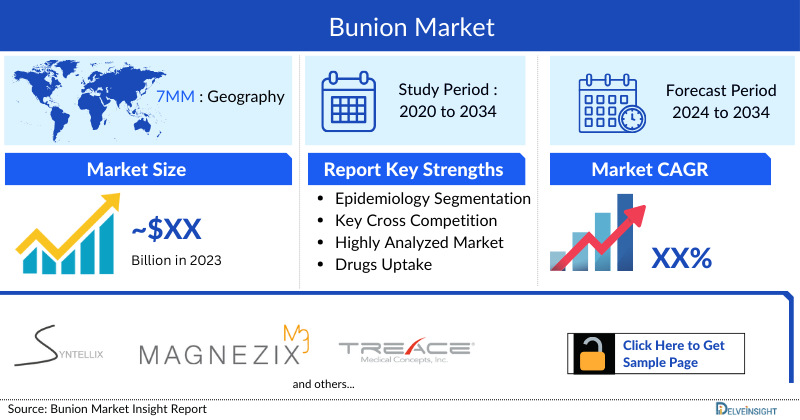
DelveInsight's “Bunion Treatment Market Insights, Epidemiology and Market Forecast – 2034” report delivers an in-depth understanding of Bunion, historical and forecasted epidemiology as well as the Bunion market trends in the United States, EU4 (Germany, France, Italy, and Spain) and the United Kingdom, and Japan.
Bunion Treatment Market Report provides real-world prescription pattern analysis, emerging drugs, market share of individual therapies, and historical and forecasted 7MM Bunion market size from 2020 to 2034. The report also covers current Bunion treatment practices/algorithms and unmet medical needs to curate the best opportunities and assess the market’s underlying potential.
|
Study Period |
2020–2034 |
|
Forecast Period |
2024–2034 |
|
Geographies Covered |
|
|
Bunion Epidemiology |
Segmented by:
|
|
Bunion Companies |
|
|
Bunion Drugs |
|
|
Bunion Market |
Segmented by:
|
|
Analysis |
|
Bunion Understanding
Hallux valgus, commonly known as a bunion, is a prevalent foot deformity characterized by the lateral deviation of the big toe (hallux) at the first metatarsophalangeal (MTP) joint, leading to a prominent bony bump on the inner side of the foot. This condition results from a combination of genetic, anatomical, and environmental factors, including the use of narrow or high-heeled footwear, which exacerbates the deformity. As the first metatarsal shifts medially, the hallux rotates laterally, causing pain and discomfort, particularly during weight-bearing activities.
The Bunion Diagnosis is primarily clinical, based on a physical examination and patient history. Patients typically present with pain, swelling, and redness over the bunion area, which may worsen with activity or tight footwear. A thorough examination includes assessing the position of the big toe, the degree of deviation, and any associated complications such as calluses or bursitis. Radiographic evaluation is essential for confirming the diagnosis and assessing the severity of the deformity, typically using plain X-rays to measure the hallux valgus angle (HVA) and the intermetatarsal angle (IMA). An HVA greater than 15 degrees is indicative of hallux valgus, with severity classified as mild, moderate, or severe based on the angles measured.
Bunion Treatment
Bunion Treatment can be conservative or surgical, depending on the severity of the condition and the level of pain experienced by the patient. Initial conservative management includes footwear modifications (such as wearing wider shoes), the use of orthotics, and anti-inflammatory medications to relieve pain and swelling. If conservative measures fail, surgical intervention may be necessary, with over 100 different surgical techniques available, including osteotomies and soft tissue balancing procedures. The choice of surgical technique is tailored to the individual based on the specific characteristics of the deformity and the patient's overall health. The primary goals of surgery are to alleviate pain, correct the deformity, and restore normal foot function.
Bunion Epidemiology
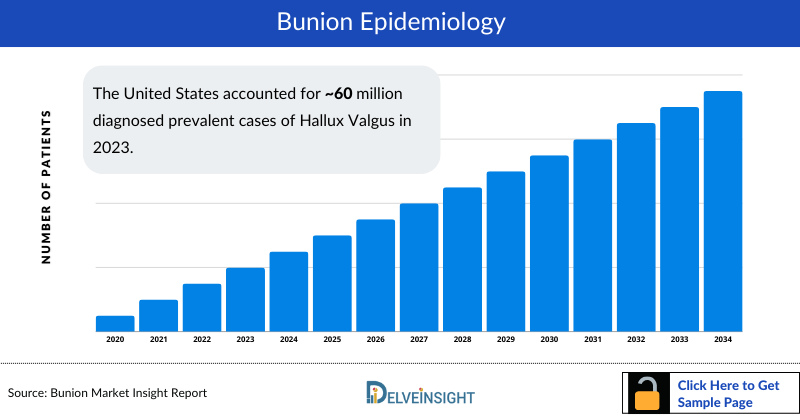
The Bunion epidemiology chapter in the report provides historical as well as forecasted in the 7MM covering the United States, EU4 (Germany, France, Italy, and Spain) and the United Kingdom, and Japan from 2020 to 2034. The Bunion epidemiology is segmented with detailed insights into total Bunion Diagnosed Prevalent Cases, Total Bunion Prevalent Cases by age, Bunion Gender-specific Prevalent Cases, total Bunion Severity-specific Cases, and total Bunion Treated Cases.
Key Findings from Bunion Treatment Epidemiological Analyses and Forecast
- The United States accounted for ~60 million bunion-diagnosed prevalent cases in 2023.
- In the 7MM, the total Bunion gender-specific prevalent cases were ~45 million for males and ~105 million for females in the year 2023.
- Among EU4 and the UK, the highest number of Bunion cases was in Germany, i.e., ~20 million cases in the year 2023.
- In the United States, Bunion-treated cases accounted for ~4 million in 2023, which will probably rise in the forecasted period.
Bunion Drugs Market Analysis
The drug chapter segment of the Bunion Therapeutics Market Report encloses a detailed analysis of Bunion marketed drugs and late-stage (Phase III and Phase II) Bunion pipeline drugs. It also deep dives into the Bunion Clinical Trials details, recent and expected market approvals, patent details, the latest news, and recent deals and collaborations.
Bunion Marketed Drugs
-
Magnezix CS: Syntellix
Magnezix, the world's first bioabsorbable metallic material for implants is a magnesium alloy (MgYREZr) with stable metallic properties but which can be completely bioresorbed in the body and replaced by endogenous tissue. Experimental studies have confirmed that magnesium has an osteoconductive effect and tends to inhibit infection. The alloy from the MgYREZr alloy system according to DIN EN 1753 has a magnesium content of over 90% and is manufactured using a so-called powder metallurgical process. This enables it to achieve a tensile strength that is much higher than that of the polymers (PLA/PGA) and lies in the range between bone and titanium. As a material for implants for osteosynthesis, this is an ideal combination of properties for providing temporary support. The mechanical properties are very similar to those of human bone. Syntellix offers a range of implants which include, Magnezix Compression Screws, Pins, CBS, and Starfuse.
-
Lapiplasty 3-Dimensional Bunion Correction: Treace Medical Concepts
Developed by Treace Medical Concepts, Lapiplasty 3-Dimensional Bunion Correction is a novel, advanced technology used to correct bunions surgically. Lapiplasty is the first and only procedure specifically developed to correct all 3-dimensions of the bunion deformity, at the root of the problem. Rather than cutting and shifting the bone over as traditional 2D surgery does, it uses advanced instrumentation to precisely reposition the entire misaligned bone back into normal 3D alignment, naturally removing the bump and straightening the toe.
The unique lapiplasty procedure naturally restores the patient’s natural anatomy. The procedure does not require cutting and shifting the normal metatarsal bone as with osteotomy (2D surgery). The entire metatarsal bone is simply rotated and shifted back into position, eliminating the unsightly bump. And, the unstable foundation is permanently secured with patented, titanium technology. This advanced procedure precisely corrects the 3D metatarsal alignment and secures the foundation, allowing the patient to walk within days of surgery.
Bunion Emerging Drugs
CPL-01: Cali Pharmaceuticals
CPL-01, developed by Cali Biosciences, is an innovative long-acting formulation of ropivacaine designed for post-operative pain management, particularly in bunion surgery. Currently undergoing a Phase III clinical trial (NCT05831449), CPL-01 aims to demonstrate its effectiveness in reducing pain and minimizing opioid use following surgical procedures. The extended-release properties of CPL-01 are expected to provide consistent pain relief, addressing concerns associated with existing pain management options. This product represents a significant advancement in perioperative care, focusing on enhancing patient outcomes and safety in surgical environments.
- In June 2023, Cali Biosciences announced the start of its second Phase III study of CPL-01 (long-acting ropivacaine) with dosing in bunion patients.
PRF-110: PainReform
PainReform's PRF-110 is a novel post-surgical pain management formulation currently undergoing a Phase III clinical trial (NCT05773846) specifically for bunionectomy procedures. This proprietary solution, based on ropivacaine, is designed to be administered directly into the surgical site, providing localized and sustained pain relief for up to 72 hours post-operation.
-
- In August 2024, PainReform announced encouraging early safety results from its Phase III bunionectomy study of PRF-110, its proprietary post-surgical pain formulation.
|
Therapy Name |
Company Name |
ROA |
MOA |
Phases |
Any Special Status |
|
CPL-01 |
Cali Pharmaceuticals |
Intraoperative administration directly into surgical sites |
Blocks sodium channels |
III |
N/A |
|
PRF-110 |
PainReform |
Intraoperative administration directly into surgical sites |
Blocks sodium channels |
III |
N/A |
Bunion Market Outlook
The leading Bunion Companies, such as Concentric Analgesics, Pacira Pharmaceuticals, Cali Pharmaceuticals, PainReform, and others, are evaluating their lead candidates in different stages of clinical development, respectively. They aim to investigate their products for the Bunion Treatment.
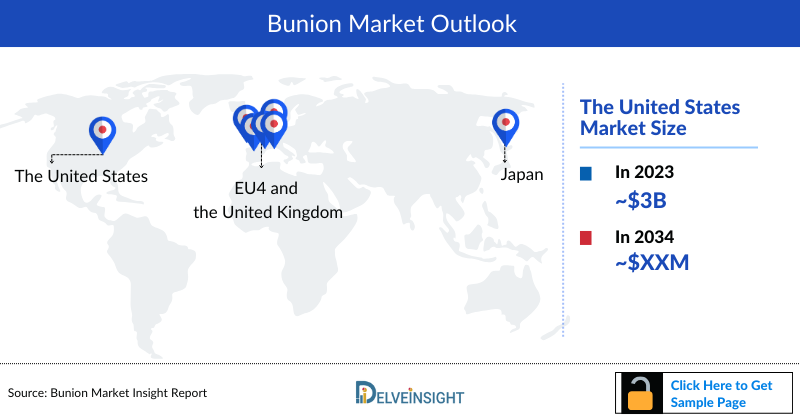
- According to Delveinsight’s estimates, the highest Bunion Treatment Market Size was found in the United States, i.e., ~USD 3 billion in 2023.
- In 2023, conservative treatment held the second-largest revenue share at ~40%, while Bunionectomy dominated the market with ~60% of the share in the 7MM.
- Among EU4 and the UK, Germany generated the highest revenue of ~ USD 700 million in 2023.
- France accounted for around 20% of the total EU4 and the UK Bunion Market Share in 2023.
Bunion Drugs Uptake
This section focuses on the uptake rate of potential Bunion drugs expected to be launched in the market during 2024–2034, which depends on the competitive landscape, safety, and efficacy data, along with an order of entry. It is important to understand that the key players evaluating their novel therapies in the pivotal and confirmatory trials should remain vigilant when selecting appropriate comparators to stand the greatest chance of a positive opinion from regulatory bodies, leading to approval, smooth launch, and rapid uptake.
Bunion Activities
The Bunion Therapeutics Market Report provides insights into different therapeutic candidates in the Phase III and Phase II stages. It also analyzes key Bunion Companies involved in developing targeted therapeutics.
Pipeline Development Activities
The Bunion Therapeutics Market Report covers information on collaborations, acquisitions and mergers, licensing, and patent details for Bunion emerging therapies.
Latest KOL Views on Bunion
To keep up with the real-world scenario in current and emerging market trends, we take opinions from Key Industry leaders working in the domain through primary research to fill the data gaps and validate our secondary research. Industry Experts were contacted for insights on the evolving treatment landscape, patient reliance on conventional therapies, patient therapy switching acceptability, and drug uptake along with challenges related to accessibility.
DelveInsight’s analysts connected with 25+ KOLs to gather insights; however, interviews were conducted with 10+ KOLs in the 7MM. Their opinion helps understand and validate current and emerging treatment patterns of Bunion. This will support the clients in potential upcoming novel treatments by identifying the overall scenario of the market and the unmet needs.
|
Region |
KOL Views |
|
United States |
Apart from wearing tight-narrow shoes, heredity and other inflammatory conditions, such as rheumatoid arthritis or a neuromuscular condition, such as polio, cause bunion in an individual. |
|
United Kingdom |
To alleviate surgical discomfort, the doctor will prescribe pain medication. Opioids are the most effective medicines for providing postoperative pain relief. However, these drugs are opioids and can be addictive. |
|
Japan |
Hallux valgus severity can be defined as the angulation of the big toe at the first metatarsophalangeal joint and classified as mild (20°–30°), moderate (30°–40°), and severe (>40°). |
Bunion Therapeutics Market: Qualitative Analysis
We perform Qualitative and market Intelligence analysis using various approaches, such as SWOT analysis and Conjoint Analysis. In the SWOT analysis, strengths, weaknesses, opportunities, and threats in terms of gaps in disease diagnosis, patient awareness, physician acceptability, competitive landscape, cost-effectiveness, and geographical accessibility of therapies are provided. Conjoint Analysis analyzes multiple approved and emerging therapies based on relevant attributes such as safety, efficacy, frequency of administration, route of administration, and order of entry. Scoring is given based on these parameters to analyze the effectiveness of therapy.
In efficacy, the trial’s primary and secondary outcome measures are evaluated; for instance, one of the most important primary outcome measures is the Sum of Pain Intensity Differences (SPID 24) and Foot and Ankle Ability Measure (FAAM). Further, the therapies’ safety is evaluated wherein the acceptability, tolerability, and adverse events are majorly observed, and it sets a clear understanding of the side effects posed by the drug in the trials. In addition, the scoring is also based on the probability of success, and the addressable patient pool for each therapy. According to these parameters, the final weightage score and the ranking of the emerging therapies are decided.
Bunion Therapeutics Market Access and Reimbursement
The Bunion Therapeutics Market Report further provides detailed insights on the country-wise accessibility and reimbursement scenarios, cost-effectiveness scenario of currently used therapies, programs making accessibility easier and out-of-pocket costs more affordable, insights on patients insured under federal or state government prescription drug programs, etc.
Scope of Bunion Therapeutics Market Report
- The Bunion therapeutics market report covers a segment of key events, an executive summary, descriptive overview of Bunion, explaining its causes, signs and symptoms, pathogenesis, and currently available therapies.
- Comprehensive insight has been provided into the epidemiology segments and forecasts, the future growth potential of diagnosis rate, and disease progression along with country-specific treatment guidelines.
- Additionally, an all-inclusive account of both the current and emerging therapies, along with the elaborative profiles of late-stage and prominent therapies, will have an impact on the current treatment landscape.
- A detailed review of the Bunion Treatment Market, historical and forecasted Bunion market size, Bunion Drugs Market Sxhare by therapies, detailed assumptions, and rationale behind our approach is included in the report, covering the 7MM drug outreach.
- The Bunion Therapeutics Market Report provides an edge while developing business strategies, by understanding trends, through SWOT analysis and expert insights/KOL views, patient journey, and treatment preferences that help in shaping and driving the 7MM Bunion Drugs Market.
Bunion Therapeutics Market Report Insights
- Patient-based Bunion Market Forecasting
- Therapeutic Approaches
- Bunion Pipeline Drugs Analysis
- Bunion Market Size and Trends
- Existing and future Bunion Drugs Market Opportunity
Bunion Therapeutics Market Report Key Strengths
- 11 Years Bunion Market Forecast
- 7MM Coverage
- Bunion Epidemiology Segmentation
- Inclusion of country-specific treatment guidelines
- KOL’s feedback on approved and emerging therapies
- Key Cross Competition
- Conjoint analysis
- Drugs Uptake and Key Bunion Market Forecast Assumptions
Bunion Therapeutics Market Report Assessment
- Current Bunion Treatment Market Practices
- Bunion Unmet Needs
- Bunion Pipeline Drugs Profiles
- Bunion Drugs Market Attractiveness
- Qualitative Analysis (SWOT and Conjoint Analysis)
FAQs
- What is the growth rate of the 7MM Bunion treatment market?
- What was the Bunion Treatment Market Size, the Bunion market size by therapies, the Bunion Drugs Market Share (%) distribution in 2020, and what would it look like in 2034? What are the contributing factors/key catalysts for this growth?
- Is there any unexplored patient setting that can open the window for growth in the future?
- What are the pricing variations among different geographies for approved and off-label therapies?
- How would the market drivers, barriers, and future opportunities affect the market dynamics and subsequent analysis of the associated trends? Although multiple expert guidelines recommend testing for targetable mutations before therapy initiation, why do barriers to testing remain high?
- What are the current and emerging options for the Bunion Treatment?
- How many companies are developing therapies for the Bunion Treatment?
- What are the recent novel therapies, targets, Bunion mechanisms of action, and technologies developed to overcome the limitations of existing therapies?
- Patient/physician acceptability in terms of preferred treatment options as per real-world scenarios?
- What are the country-specific accessibility issues of expensive, recently approved therapies?
Reasons to Buy the Bunion Therapeutics Market Report
- The Bunion Therapeutics Market Report will help in developing business strategies by understanding the latest trends and changing treatment dynamics driving the Bunion Drugs Market.
- Insights on patient burden/disease prevalence, evolution in diagnosis, and factors contributing to the change in the epidemiology of the disease during the forecast years
- Understand the existing Bunion Drugs Market opportunities in varying geographies and the growth potential over the coming years.
- Distribution of historical and current patient share based on real-world prescription data along with reported sales of approved products in the US, EU4 (Germany, France, Italy, and Spain), the United Kingdom, and Japan.
- Identifying strong upcoming players in the Bunion Drugs Market will help devise strategies to help get ahead of competitors.
- Detailed analysis and ranking of class-wise potential current and emerging therapies under the conjoint analysis section to provide visibility around leading classes.
- Highlights of access and reimbursement policies of approved therapies, barriers to accessibility of expensive off-label therapies, and patient assistance programs.
- To understand Key Opinion Leaders’ perspectives around the accessibility, acceptability, and compliance-related challenges of existing treatment to overcome barriers in the future.
- Detailed insights on the unmet needs of the existing Bunion Drugs Market so that the upcoming players can strengthen their development and launch strategy.
Stay Updated with us for Recent Articles @ Latest DelveInsight Blogs