Burn Pain Market
Key Highlights
- The United States, with the highest number of treated incident cases of burn pain, also captured the largest market share among the other 7MM countries, and is anticipated to continue the trend during the forecast period (2024–2034).
- In the 7MM, males exhibit a higher number of burn pain cases compared to females. This predominance can be attributed to several factors including occupational hazards, with males being overrepresented in high-risk professions such as firefighting and industrial work.
- In the United States, flame-related incidents contribute to a higher number of etiology-specific incident cases of burns compared to other causes, as per the assessment conducted by DelveInsight’s analysts. Etiology-specific cases were categorized into flame, contact, scald, electrical, chemical, and others.
- Severity Specific Incident Cases of Burns in the 7MM are more in the Second Degree category compared to First Degree, Third Degree, and Unspecified cases, possibly due to the deeper tissue involvement and increased likelihood of complications associated with Second Degree burns.
DelveInsight’s report titled “Burn Pain – Market Insights, Epidemiology, and Market Forecast – 2034” comprehensively analyzes Burn Pain. The report provides a comprehensive analysis of historical and projected epidemiological data, covering Incident cases of Burns requiring Treatment, Gender-specific Incident cases of Burns, Etiology-specific Incident cases of Burns, Severity-specific Incident cases of Burns, and Treated Incident cases of Burn requiring Pain Management Therapies.
The Burn Pain market report provides a comprehensive insight into different facets concerning the patient population, encompassing diagnosis, prescribing trends, physician viewpoints, market accessibility, therapy, and forthcoming market advancements across seven major markets: the United States, EU4 (Germany, France, Italy, and Spain) and the UK, and Japan spanning from 2020 to 2034.
The report examines current treatment methodologies and algorithms for Burn Pain, assessing the overall market potential, identifying business prospects, and addressing pertinent unmet medical requirements.
Burn Pain Overview
Burns are injuries to the skin or other tissues caused by heat, radiation, electricity, chemicals, friction, or other factors. Burn pain results from damage to peripheral sensory neurons and inflammatory processes, leading to complex symptoms such as ongoing background pain and procedural pain during treatment. Symptoms vary depending on the burn's depth, ranging from redness and pain in first-degree burns to skin swelling and discoloration in second-degree burns, and tissue destruction in third-degree burns, which can result in numbness and severe damage. Burn injuries can have local and systemic effects on the body, impacting organs and systems beyond the affected area. They cause physical, socioeconomic, and psychological effects, necessitating prompt interdisciplinary management to minimize adverse effects and promote recovery.
Burn Pain Diagnosis and Treatment Algorithm
Diagnosing burn pain involves clinical assessment, considering the nature and extent of the burn injury, along with the patient's reported symptoms. Diagnostic algorithms typically include evaluating the depth and severity of the burn, assessing for associated complications such as infection or nerve damage, and determining the appropriate treatment approach. Limitations in diagnosis may arise from variations in pain perception among individuals, challenges in accurately assessing pain severity, and the subjective nature of pain reporting. Additionally, underlying conditions or comorbidities may complicate the diagnostic process. Despite these limitations, a comprehensive evaluation by healthcare professionals can help guide effective management strategies for burn pain.
Burn pain presents unique challenges due to its intensity and duration, often requiring multifaceted approaches for effective management. Initially, severe acute burn pain is addressed with potent opioids and local anesthesia. As acute pain diminishes, injectable pain relievers are replaced with less potent oral opioids and peripheral-acting drugs. Ultimately, pain control may rely solely on peripherally-acting drugs like aspirin or NSAIDs. Multimodal analgesia, adjusting dosages to balance pain relief and side effects, is crucial for successful treatment. Continuous assessment of pain and treatment response is essential in optimizing patient care and quality of life.
Burn Pain Epidemiology
The epidemiology section on Burn Pain offers an analysis of past and present patient populations, along with projected trends across seven major countries (7MM). Drawing from multiple studies and expert opinions, it aims to elucidate the underlying factors driving current and anticipated trends. Additionally, this segment of the report presents data on the diagnosed patient population, highlighting trends and underlying assumptions.
Key Findings
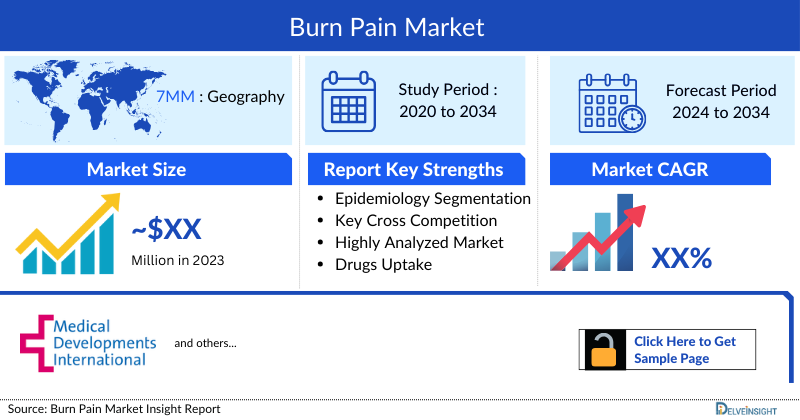
- Incident cases of burns in the US were found to be more than 2 million cases in 2023, which are expected to increase by 2034.
- In 2023, the treated incident cases of burns requiring pain management therapies in the US was estimated to be around 0.4 million cases, which is expected to change for the study period of 2020–2034.
- The gender distribution suggests a male predominance across the 7MM, approximately 0.29 million male and 0.26 million female cases were in the US in 2023.
- In the 7MM, the Etiology Specific Incident Cases of Burns suggest that Flame based etiology specific cases make up the majority of the Burn Pain cases.
- Among EU4 and the United Kingdom, Germany had the highest total treated incident cases of burns requiring pain management with approximately 0.15 million cases in 2023, while Italy had the lowest treated incident cases of burns requiring pain management with approximately 81 thousand cases in 2023.
Burn Pain Drug Chapters
The drug chapter segment of the Burn Pain report encloses the detailed analysis of Burn Pain marketed drugs, mid-phase, and late-stage pipeline drugs. It also helps to understand the Burn Pain clinical trial details, expressive pharmacological action, agreements and collaborations, approval, and patent details of each included drug, and the latest news and press releases.
Marketed Therapies for Burn Pain
The United States treatment market is devoid of any approved therapies which presents a lucrative opportunity for the key players to try their hands on in the therapeutic development of the Burn Pain pipeline in the US market.
However, Penthrox by Medical Developments International has recently gained approval in Europe, Latin America, and South Africa for providing emergency relief of moderate to severe pain in conscious adult patients experiencing trauma-related pain.
Emerging Therapies for Burn Pain
In light of the current market landscape where off-label medications dominate and the burn pain pipeline is lacking effective therapies, pharmaceutical companies have the opportunity to invest in research aimed at developing novel drugs with innovative mechanisms of action. These medications could offer more convenient and effective options tailored to the needs of patients suffering from burn pain.
Note: Detailed Drug Chapters assessment to be continued in the report….
Burn Pain Market Outlook
Burn pain, characterized by its intensity and duration, poses challenges in management due to its complex nature and varying components. Burn therapy aims to effectively and safely alleviate pain, minimize complications and side effects, preserve patients' functional capacity, and enhance their overall quality of life.
Initially, severe acute burn pain typically required potent opioids and local anesthesia. As acute pain subsided over time, injectable pain relief decreased, transitioning to less potent oral opioids and drugs targeting the peripheral nervous system. Eventually, pain control primarily relied on peripherally-acting drugs like aspirin or NSAIDs. Key to successful pharmacological treatment is multimodal analgesia, adjusting dosages to optimize pain relief while minimizing side effects. Continuous and thorough assessment of patient pain and treatment response remains essential.
In addition to pharmacological interventions, comprehensive pain management for burn patients encompasses a multidisciplinary approach. This includes collaboration among psychologists, psychotherapists, physical therapists, and pain specialists to address the complex nature of burn pain and its impact on patients' well-being.
Given the present market landscape, off-label medications have significantly dominated, while the burn pain pipeline remains notably lacking. Pharmaceutical companies have the opportunity to invest in research aimed at developing novel drugs with innovative modes of action, offering more convenient and effective options tailored to patients experiencing burn pain.
Note: Detailed Market Outlook to be continued in the report….
Burn Pain Market Segmentation
DelveInsight’s ‘Burn Pain – Market Insights, Epidemiology, and Market Forecast – 2034’ report provides a detailed outlook of the current and future Burn Pain market, segmented within countries and by therapies. Further, the market of each region is then segmented by each therapy to provide a detailed view of the current and future market share of all therapies.
Burn Pain Market Size by Countries
The total Burn Pain market size is analyzed for individual countries (the United States Market, EU4 (Germany, France, Italy, and Spain) and the UK market, and Japan). The United States accounted for a larger portion of the 7MM market for Burn Pain in 2023 due to the high incidence of the condition. This dominance is predicted to continue with the potential entry of new products.
Burn Pain Market Size by Therapies
The current burn pain treatment market is devoid of any exclusive branded approvals and the mainstay treatment modalities are attributed to off labels constructing the overall treatment landscape. In the current treatment paradigm, the overall treatment scope has been eminently demarcated into Inpatient treatment and Outpatient treatment setting together making up the treated patient pool for pain.
The market size of the United States for Burn Pain has been attributed to pharmacotherapy options that is vividly categorized into Inpatient treatment, and Outpatient treatment where both include Opioid analgesics, NSAIDS and related analgesics, Anesthetic agents, and other pain management therapies.
Key Findings
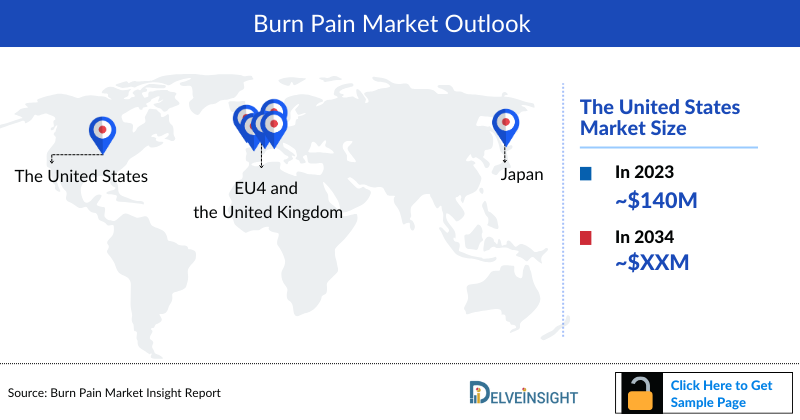
- The US consistently held the largest market share among the 7MM with USD 140 million in 2023. Projections suggest this trend will continue, with the US expected to further expand its market presence and retain its leading position by 2034.
- In 2023, both Germany and the UK in the EU4 and the UK, each secured a market share of over USD 20 million, closely trailed by France. Conversely, Italy recorded the lowest market share among these regions during the same period.
- Opioid analgesics captured the highest market combining both inpatient and outpatient treatment in the current treatment market, and was estimated to capture market of around USD 130 million, in 2023. With the launch of new therapies into various classes, scenario of Opioid analgesics is expected change by 2034.
- The burn pain pipeline remains notably sparse, highlighting the necessity for further development to address the unmet needs, ultimately fostering potential market growth.
Note: Detailed market segment assessment will be provided in the final report.
Burn Pain Drugs Uptake
This section focuses on the sales uptake of potential Burn Pain drugs that have recently launched or are anticipated to be launched in the Burn Pain market between 2020 and 2034. It estimates the market penetration of the Burn Pain drugs for a given country, examining their impact within and across classes and segments. It also touches upon the financial and regulatory decisions contributing to the drug’s probability of success (PoS) in the Burn Pain market.
Note: Detailed assessment of drug uptake will be provided in the full report on Burn Pain.
Burn Pain Pipeline Development Activities
The report provides insights into different therapeutic candidates in Phase III, Phase II, and Phase I stage. It also analyzes key players involved in developing targeted therapeutics.
Pipeline Development Activities
The report covers detailed information on collaborations, acquisitions and mergers, licensing, and patent details for Burn Pain emerging therapies.
KOL Views
To keep up with current Burn Pain market trends and fill gaps in secondary findings, we interview KOLs and SMEs working in the Burn Pain domain. Their opinion helps understand and validate current and emerging therapies and treatment patterns or Burn Pain market trends. This will support the clients in potential upcoming novel treatments by identifying the overall scenario of the market and the Burn Pain unmet needs.
Burn Pain: KOL Insights
DelveInsight’s analysts connected with 50+ KOLs to gather insights; however, interviews were conducted with 15+ KOLs in the 7MM. These KOLs were from organizations, institutes, and hospitals, such as Davis and Shriners Hospitals for Children Northern California, US; Centre for Plastic Surgery and Burns, Broomfield Hospital, Chelmsford, UK; SMBNOS Department, Bari Aldo Moro University, Bari, Italy; Hamburg University, Hamburg, Germany; and others.
“Pain commonly persists as a significant issue following burns, often inadequately addressed. Customized pain relief approaches, combined with supplementary therapies, prove efficacious in enhancing burn pain management.”
Note: Detailed assessment of KOL Views will be provided in the full report of Burn Pain.
Qualitative Analysis
We perform Qualitative and market Intelligence analysis using various approaches, such as SWOT analysis, and Conjoint Analysis. In the SWOT analysis, strengths, weaknesses, opportunities, and threats in terms of disease diagnosis, patient awareness, patient burden, competitive landscape, cost-effectiveness, and geographical accessibility of therapies are provided. These pointers are based on the Analyst’s discretion and assessment of the patient burden, cost analysis, and existing and evolving treatment landscape.
Conjoint Analysis is done to analyze multiple approved and emerging therapies based on relevant attributes such as safety, efficacy, frequency of administration, route of administration, and order of entry. Scoring is given based on these parameters to analyze the effectiveness of therapy.
Further, the therapies’ safety is evaluated wherein the acceptability, tolerability, and adverse events are majorly observed, and it sets a clear understanding of the side effects posed by the drug in the trials. In addition, the scoring is also based on the route of administration, order of entry and designation, probability of success, and the addressable patient pool for each therapy. According to these parameters, the final weightage score and the ranking of the emerging therapies are decided.
Note: Detailed assessment of SWOT analysis and conjoint analysis will be provided in the full report of Burn Pain
Market Access and Reimbursement
Reimbursement is a crucial point for any drug after its approval. Many drugs or therapies are not properly recognized by the reimbursement body and may fail to get reimbursed or their reimbursement process gets delayed.
The report further provides detailed insights on the country-wise accessibility and reimbursement scenarios, cost-effectiveness scenario of approved therapies, programs making accessibility easier and out-of-pocket costs more affordable, insights on patients insured under federal or state government prescription drug programs, etc.
Scope of the Report
- The report covers a segment of key events, an executive summary, descriptive overview of Burn Pain, explaining its causes, signs and symptoms, pathogenesis, and currently available therapies
- Comprehensive insight has been provided into the epidemiology segments and forecasts, the future growth potential of diagnosis rate, disease progression along with treatment guidelines
- Additionally, an all-inclusive account of both the current and emerging therapies along with the elaborative profiles of late-stage and prominent therapies will have an impact on the current treatment landscape
- A detailed review of the Burn Pain market; historical and forecasted market size, market share by therapies, detailed assumptions, and rationale behind our approach is included in the report, covering the 7MM drug outreach
- The report provides an edge while developing business strategies, by understanding trends, through SWOT analysis and expert insights/KOL views, patient journey, and treatment preference that help in shaping and driving the 7MM Burn Pain market
Burn Pain Report Insights
- Patient Population
- Therapeutic Approaches
- Burn Pain Pipeline Analysis
- Burn Pain Market Size and Trends
- Existing and future Market Opportunity
Burn Pain Report Key Strengths
- 11 Years Forecast
- 7MM Coverage
- Burn Pain Epidemiology Segmentation
- Key Cross Competition
- Conjoint analysis
- Drugs Uptake and Key Market Forecast Assumptions
Burn Pain Report Assessment
- Current Treatment Practices
- Unmet Needs
- Pipeline Product Profiles
- Market Attractiveness
- Qualitative Analysis (SWOT and Conjoint Analysis)
Key Questions
Market Insights:
- What was the Burn Pain total market size, the market size by therapies, and market share (%) distribution in 2020, and how it would all look in 2034? What are the contributing factors for this growth?
- What are the unmet needs are associated with the current treatment market of Burn Pain?
- How approval of emerging therapies going to contribute to the market of Burn Pain?
- Which drug is going to be the largest contributor in 2034?
- What are the pricing variations among different geographies for approved and off-label therapies?
- How would the market drivers, barriers, and future opportunities affect the market dynamics and subsequent analysis of the associated trends?
Epidemiology Insights:
- What are the disease risk, burden, and unmet needs of Burn Pain? What will be the growth opportunities across the 7MM concerning the patient population of Burn Pain?
- What is the historical and forecasted Burn Pain patient pool in the United States, EU4 (Germany, France, Italy, and Spain) the United Kingdom, and Japan?
- Why do only limited patients appear for diagnosis? Why is the current year diagnosis rate not high?
- What factors are affecting the diagnosis and treatment of the indication?
Current Treatment Scenario, Marketed Drugs, and Emerging Therapies:
- What are the current options for the treatment of Burn Pain? What are the current treatment guidelines for the treatment of Burn Pain in the US and Europe?
- How many companies are developing therapies for the treatment of Burn Pain?
- How many emerging therapies are in the mid-stage and late stage of development for the treatment of Burn Pain?
- What are the recent novel therapies, targets, mechanisms of action, and technologies developed to overcome the limitation of existing therapies?
- What are the key designations that have been granted for the emerging therapies for Burn Pain?
- Patient acceptability in terms of preferred treatment options as per real-world scenarios?
- What are the country-specific accessibility issues of expensive, recently approved therapies? Focus on reimbursement policies.
- What are the 7MM historical and forecasted market of Burn Pain?
Reasons to buy
- The report will help in developing business strategies by understanding the latest trends and changing treatment dynamics driving the Burn Pain Market
- Insights on patient burden/disease prevalence/incidence, evolution in diagnosis, and factors contributing to the change in the epidemiology of the disease during the forecast years
- To understand the existing market opportunity in varying geographies and the growth potential over the coming years.
- Distribution of historical and current patient share based on real-world prescription data along with reported sales of approved products in the US, EU4 (Germany, France, Italy, and Spain), the United Kingdom, and Japan.
- Identification of strong upcoming players in the market will help in devising strategies that will help in getting ahead of competitors.
- Detailed analysis and ranking of class-wise potential current and emerging therapies under the Conjoint analysis section to provide visibility around leading classes
- Highlights of Access and Reimbursement policies of approved therapies, barriers to accessibility of off-label expensive therapies, and patient assistance programs
- To understand the perspective of Key Opinion Leaders’ around the accessibility, acceptability, and compliance-related challenges of existing treatment to overcome barriers in future.
- Detailed insights on the unmet need of the existing market so that the upcoming players can strengthen their development and launch strategy


