
Burosumab Sales Market Forecast
Key Factors Driving Burosumab Growth
Market Share Gains and New Patient Starts
- Burosumab (CRYSVITA), developed by Kyowa Kirin and commercialized with Ultragenyx, is the first targeted therapy for X-linked hypophosphatemia (XLH) and has rapidly become the standard of care, displacing conventional phosphate and vitamin D regimens.
- Steady growth in new patient starts is being driven by earlier diagnosis, pediatric-to-adult treatment continuation, and strong physician confidence in its disease-modifying mechanism.
- Structured patient support programs and strong engagement with metabolic bone disease specialists have accelerated adoption across pediatric and adult treatment centers.
Expansion Across Key Indications
- X-linked Hypophosphatemia (XLH): Burosumab is widely used in both pediatric and adult XLH patients, improving phosphate homeostasis, bone mineralization, and physical function.
- Tumor-Induced Osteomalacia (TIO): The drug is also approved for adults with TIO, broadening its addressable patient base beyond inherited disease.
- Ongoing research continues to explore long-term outcomes, functional benefits, and quality-of-life improvements, reinforcing its role as a foundational therapy in FGF23-mediated disorders.
Geographic Expansion
- Burosumab is now approved and marketed across North America, Europe, Japan, and several Asia-Pacific countries, with continued rollout in emerging markets.
- The Asia-Pacific region is expected to show strong growth due to improved rare-disease diagnostics, national reimbursement programs, and higher awareness of metabolic bone disorders.
- Strategic partnerships between Kyowa Kirin and Ultragenyx continue to expand access through regional distribution and patient access agreements.
New Indication Approvals
- Regulatory agencies have expanded Burosumab’s label from pediatric XLH to include adult XLH and tumor-induced osteomalacia, significantly broadening its clinical utility.
- These approvals enhance its competitive position and allow treatment across the full disease spectrum, from childhood through adulthood.
Strong Volume Momentum
- XLH remains the primary growth driver, with high treatment persistence as patients transition from pediatric to adult care.
- Prescription volumes continue to rise as more patients are identified through genetic screening and specialist referral networks.
- Real-world evidence demonstrates sustained biochemical correction and functional improvements, supporting long-term treatment adoption.
Competitive Differentiation and Market Trends
- Burosumab is a monoclonal antibody against FGF23, directly targeting the root cause of phosphate wasting rather than providing symptomatic supplementation.
- Its biologic, disease-modifying profile differentiates it from legacy oral phosphate therapies, improving adherence and safety.
- Broader trends toward precision medicine, rare disease screening, and value-based reimbursement strongly favor Burosumab’s long-term positioning.
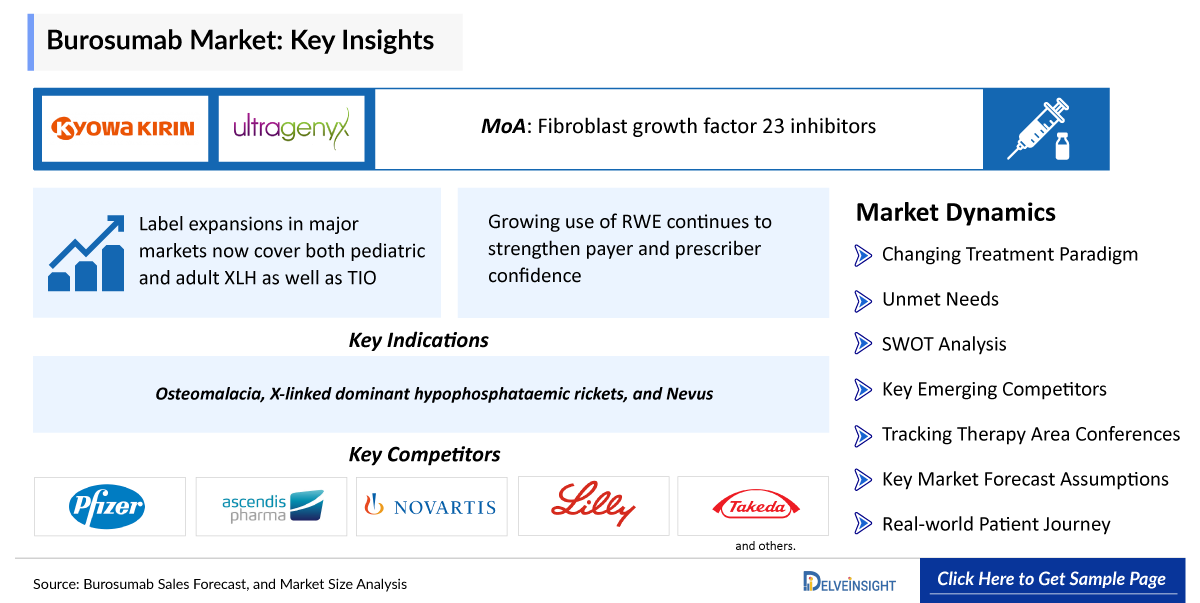
- Growing use of real-world evidence (RWE) continues to strengthen payer and prescriber confidence.
Burosumab Recent Developments
- Label expansions in major markets now cover both pediatric and adult XLH as well as TIO, reinforcing Burosumab’s leadership in phosphate-wasting disorders.
- Long-term real-world and extension trial data presented at international endocrinology and bone conferences continue to confirm durable efficacy and safety beyond five years of treatment.
- Kyowa Kirin and Ultragenyx have expanded reimbursement agreements in Europe and Asia, improving patient access in publicly funded healthcare systems.
“Burosumab Sales Forecast, and Market Size Analysis – 2034” report provides comprehensive insights of Burosumab for approved indications like Osteomalacia and X-linked dominant hypophosphataemic rickets; as well as potential indication like Nevus in the 7MM. A detailed picture of Burosumab’s existing usage in approved and anticipated entry and performance in potential indications in the 7MM, i.e., the United States, EU4 (Germany, France, Italy, and Spain) and the United Kingdom, and Japan for the study period 2020 –2034 is provided in this report along with a detailed description of the Burosumab for approved and potential indications.
The Burosumab market report provides insights about Burosumab’s sales forecast, mechanism of action (MoA), dosage and administration, as well as research and development including regulatory milestones, along with other developmental activities. Further, it also consists of historical and current Burosumab performance, future market assessments inclusive of the Burosumab market forecast analysis for approved and potential indications in the 7MM, SWOT, analysts’ views, comprehensive overview of market competitors, and brief about other emerging therapies in respective indications. It also provides analysis of Burosumab sales forecasts, along with factors driving its market.
Burosumab Drug Summary
Burosumab (CRYSVITA) is a fully human IgG1 monoclonal antibody that binds to and inhibits fibroblast growth factor 23 (FGF23), a phosphaturic hormone elevated in X-linked hypophosphatemia (XLH) due to PHEX gene mutations, thereby restoring renal phosphate reabsorption (increasing TmP/GFR), elevating serum 1,25-dihydroxyvitamin D levels to enhance intestinal phosphate and calcium absorption, and supporting bone mineralization to heal rickets/osteomalacia in children and adults with XLH. Administered subcutaneously every 4 weeks (e.g., 0.8 mg/kg up to 1.2 mg/kg max based on serum phosphorus, not exceeding 90 mg or 180 mg per dose), it significantly improves serum phosphorus, radiographic rickets severity (RSS score), growth velocity, and pain/walking ability as shown in Phase II/III trials (UX023-CL301, CL303), outperforming conventional phosphate/vitamin D therapy with a favorable safety profile though requiring monitoring for hyperphosphatemia and hypersensitivity. The report provides Burosumab’s sales, growth barriers and drivers, post usage and approvals in multiple indications.
Scope of the Burosumab Market Report
The report provides insights into:
- A comprehensive product overview including the Burosumab MoA, description, dosage and administration, research and development activities in approved indications like Osteomalacia and X-linked dominant hypophosphataemic rickets; as well as potential indication like Nevus.
- Elaborated details on Burosumab regulatory milestones and other development activities have been provided in Burosumab market report.
- The report also highlights Burosumab‘s cost estimates and regional variations, reported and estimated sales performance, research and development activities in approved and potential indications across the United States, Europe, and Japan.
- The Burosumab market report also covers the patents information, generic entry and impact on cost cut.
- The Burosumab market report contains current and forecasted Burosumab sales for approved and potential indications till 2034.
- Comprehensive coverage of the late-stage emerging therapies for respective indications.
- The Burosumab market report also features the SWOT analysis with analyst views for Burosumab in approved and potential indications.
Methodology
The Burosumab market report is built using data and information sourced primarily from internal databases, primary and secondary research and in-house analysis by DelveInsight’s team of industry experts. Information and data from the secondary sources have been obtained from various printable and nonprintable sources like search engines, news websites, global regulatory authorities websites, trade journals, white papers, magazines, books, trade associations, industry associations, industry portals and access to available databases.
Burosumab Analytical Perspective by DelveInsight
In-depth Burosumab Market Assessment
This Burosumab sales market forecast report provides a detailed market assessment of Burosumab for approved indications like Osteomalacia and X-linked dominant hypophosphataemic rickets; as well as potential indication like Nevus in the seven major markets, i.e., the United States, EU4 (Germany, France, Italy, and Spain) and the United Kingdom, and Japan. This segment of the report provides current and forecasted Burosumab sales data uptil 2034.
Burosumab Clinical Assessment
The Burosumab market report provides the clinical trials information of Burosumab for approved and potential indications covering trial interventions, trial conditions, trial status, start and completion dates.
Burosumab Competitive Landscape
The report provides Insights on competitors and marketed products within the domain, along with a summary of emerging products and their respective launch dates, posing significant competition in the market.
Burosumab Market Potential & Revenue Forecast
- Projected market size for the Burosumab and its key indications
- Estimated Burosumab sales potential (Burosumab peak sales forecasts)
- Burosumab Pricing strategies and reimbursement landscape
Burosumab Competitive Intelligence
- Number of competing drugs in development (pipeline analysis)
- Burosumab Market positioning compared to existing treatments
- Burosumab Strengths & weaknesses relative to competitors
Burosumab Regulatory & Commercial Milestones
- Burosumab Key regulatory approvals & expected launch timelines
- Commercial partnerships, licensing deals, and M&A activity
Burosumab Clinical Differentiation
- Burosumab Efficacy & safety advantages over existing drugs
- Burosumab Unique selling points
Burosumab Market Report Highlights
- In the coming years, the Burosumab market scenario is set to change due to strong adoption, increased prescriptions and broader uptake in multiple immunological indications; which would expand the size of the market.
- The Burosumab companies are developing therapies that focus on novel approaches to treat/improve the disease condition, assess challenges, and seek opportunities that could influence Burosumab’s dominance.
- Other emerging products for Osteomalacia and X-linked dominant hypophosphataemic rickets; as well as potential indication like Nevus are expected to give tough market competition to Burosumab and launch of late-stage emerging therapies in the near future will significantly impact the market.
- A detailed description of regulatory milestones, and developmental activities, provide the current development scenario of Burosumab in approved and potential indications.
- Analyse Burosumab cost, pricing trends and market positioning to support strategic decision-making in the immunology landscape.
- Our in-depth analysis of the forecasted Burosumab sales data uptil 2034 will support the clients in decision-making process regarding their therapeutic portfolio by identifying the overall scenario of Burosumab in approved and potential indications.
Key Questions Answered in the Burosumab Market Report
- What is the class of therapy, route of administration and mechanism of action of Burosumab? How strong is Burosumab’s clinical and commercial performance?
- What is Burosumab’s clinical trial status in each individual indications such as Osteomalacia and X-linked dominant hypophosphataemic rickets; as well as potential indication like Nevus and study completion date?
- What are the key collaborations, mergers and acquisitions, licensing and other activities related to the Burosumab Manufacturers?
- What are the key designations that have been granted to Burosumab for approved and potential indications? How are they going to impact Burosumab’s penetration in various geographies?
- What is the current and forecasted Burosumab market scenario for approved and potential indications? What are the key assumptions behind the forecast?
- What are the current and forecasted sales of Burosumab in the seven major countries, including the United States, Europe (Germany, France, Italy, Spain) and the United Kingdom, and Japan?
- What are the other emerging products available and how are these giving competition to Burosumab for approved and potential indications?
- Which are the late-stage emerging therapies under development for the treatment of approved and potential indications?
- How cost-effective is Burosumab? What is the duration of therapy and what are the geographical variations in cost per patient?

