
Cancer Pain Market Summary
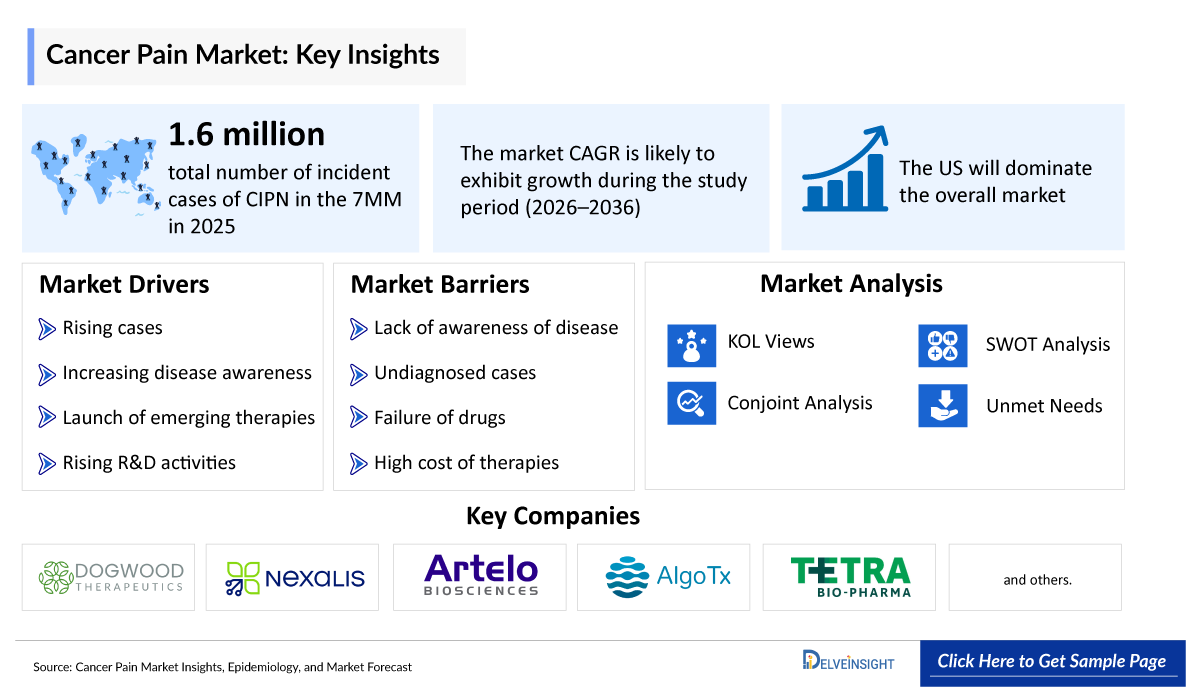
- According to DelveInsight’s analysis, the 7MM cancer pain market is anticipated to witness notable growth during the forecast period, driven by the increasing cancer burden, longer patient survival, rising prevalence of chronic and breakthrough cancer pain, greater integration of palliative care, and the development of novel non-opioid analgesics and targeted pain therapies.
- The leading Cancer Pain companies developing therapies in the treatment market include - InhaleRX, Dogwood Therapeutics, Artelo Biosciences, Tetra-Bio Pharma, Intellia Therapeutics, and others.
Cancer Pain Market & Epidemiology Insights
- Cancer pain remains a major unmet clinical need, affecting >70% of patients with advanced cancer, while improvements in cancer survival have increased the prevalence of persistent treatment- and disease-related pain; 5–10% of cancer survivors experience chronic severe pain that significantly impairs daily functioning.
- Chemotherapy-induced peripheral neuropathy (CIPN) is one of the most common and difficult-to-treat causes of cancer pain, affecting approximately two-thirds of the patients undergoing chemotherapeutic treatment for cancer suffer from CIPN.
- Currently, the cancer pain treatment primarily dominated by off-label analgesics, including opioids, non-opioids/Nonsteroidal Anti-Inflammatory Drugs (NSAIDs), and adjuvant analgesics. While opioids remain the standard for moderate-to-severe pain, their long-term use is limited by tolerance, dependence, and safety concerns, underscoring the need for safer alternatives. The discontinuation of FDA-approved Transmucosal Immediate-Release Fentanyl (TIRF) products has further widened the treatment gap for breakthrough cancer pain.
- The late-stage pipeline remains limited but increasingly focused on non-opioid innovation, with candidates such as IRX211 (InhaleRX/Nexalis Therapeutics), tetrodotoxin (HALNEURON; Dogwood Therapeutics), ATX01 (AlgoTx), and ART26.12 (Artelo Biosciences) aiming to address breakthrough cancer pain, neuropathic pain, and opioid-related limitations. The successful development of these agents could meaningfully reshape the future cancer pain therapeutic landscape.
- Despite advances in supportive care, current cancer pain therapies remain heavily reliant on opioids, which are associated with significant adverse effects, tolerance, and the risk of dependence, highlighting the need for innovative non-opioid therapies that provide sustained and effective pain relief while improving long-term patient outcomes and quality of life.
Cancer Pain Market Size and Forecast in the 7MM
- 2025 Cancer Pain Market Size: ~USD XX million
- 2036 Projected Cancer Pain Market Size: ~USD XX million
- Cancer Pain Growth Rate (2026–2036): ~XX% CAGR
Request for unlocking the sample page of the "Cancer Pain Market Forecast"
Key Factors Driving the Cancer Pain Market
- Expansion of palliative and supportive oncology care:The growing integration of palliative care into cancer treatment is increasing the adoption of comprehensive pain management strategies, improving access to pharmacological and interventional therapies across all stages of cancer.
- Shift toward opioid-sparing and targeted pain management approaches: Rising concerns regarding opioid-related adverse effects and dependency are accelerating the development and uptake of novel non-opioid analgesics, targeted therapies, and multimodal pain management regimens.
- Robust pipeline and increasing investment in innovative analgesics: Ongoing clinical development of next-generation pain therapies, coupled with increased investment from pharmaceutical companies and favorable regulatory support, is expected to expand treatment options for patients with moderate-to-severe cancer pain.
DelveInsight's "Cancer Pain Market Insights, Epidemiology and Market Forecast – 2036" report delivers an in-depth understanding of the cancer pain, historical and forecasted epidemiology, as well as the cancer pain therapeutics market trends in the United States, EU4 (Germany, Spain, Italy, and France) and the United Kingdom, and Japan.
The Cancer Pain market report delivers a comprehensive analysis of the current treatment landscape, including standards of care, clinical practices, and evolving therapeutic algorithms. It evaluates cancer pain patient burden trends, revenue & market share dynamics, peak patient share & therapy uptake analysis, and provides an in-depth market size assessment and growth rate projections (historical & forecast 2022–2036) across global regions. The report highlights key unmet medical needs in cancer pain and maps the competitive and clinical landscape to uncover high-value opportunities, providing a clear outlook on future market growth potential.
Scope of the Cancer Pain Market Report | |
|
Study Period |
2022–2036 |
|
Historical Year |
2022–2025 |
|
Forecast Period |
2026–2036 |
|
Base Year |
2026 |
|
Geographies Covered |
ü North America: The US; ü Europe: Germany, France, Italy, Spain, and the UK; ü Asia-Pacific: Japan |
|
Cancer Pain Market CAGR (Forecast period) |
~XX% (2026–2036) |
|
Cancer Pain Epidemiology Segmentation Analysis |
Patient Burden Assessment · Cancer Pain Prevalent Cases · Cancer Pain Cases by Etiology · Chemotherapy-induced Peripheral Neuropathy Incident Cases · Cancer Pain Cases by Severity · Cancer Pain Cases by Pathophysiology · Cancer Pain Cases by Temporal Variation · Breakthrough Cancer Pain (BTcP) Incident Cases |
|
Cancer Pain Companies |
· Dogwood Therapeutics · Nexalis Therapeutics · Artelo Biosciences · AlgoTx · Tetra-Bio Pharma · Intellia Therapeutics, and others |
|
Cancer Pain Therapies |
· IRX211 · Tetrodotoxin (HALNEURON) · WST-057 · ATX01 · ART26.12,and others |
|
Cancer Pain Market |
Segmented by · Region/Geographies · Drugs/Therapies |
|
Analysis |
• Addressable Patient Population • Market Drivers And Market Barriers • Cost Assumptions And Pricing Analogues • KOL Views • SWOT Analysis • Reimbursement • Conjoint Analysis • Unmet Needs |
Cancer Pain Disease Understanding
Cancer Pain Overview
Cancer pain is a multifactorial and debilitating condition experienced by patients at various stages of malignancy, resulting from the tumor itself, cancer-related treatments, or a combination of both. It is defined by the International Association for the Study of Pain (IASP) as "an unpleasant sensory and emotional experience associated with actual or potential tissue damage, or described in terms of such damage." Pain is among the most common and distressing symptoms in patients with cancer, with its prevalence increasing as the disease progresses, significantly impairing physical functioning, emotional well-being, and overall quality of life while also imposing a substantial burden on caregivers. The pathophysiology of cancer pain is heterogeneous and may involve nociceptive, neuropathic, inflammatory, or mixed mechanisms, making diagnosis and management particularly challenging.
Cancer Pain Diagnosis
Diagnosis relies on a comprehensive clinical assessment that includes a detailed pain history, physical examination, evaluation of pain characteristics such as intensity, location, duration, and quality, and identification of the underlying etiology. Standardized assessment tools, including the Numeric Rating Scale (NRS), Visual Analog Scale (VAS), Verbal Rating Scale (VRS), and the Brief Pain Inventory (BPI), are routinely used to quantify pain severity and evaluate its impact on daily activities. Imaging modalities such as CT, MRI, PET, or bone scans, along with relevant laboratory investigations, may be employed to identify disease progression or treatment-related complications contributing to pain. Accurate and ongoing pain assessment is essential for developing individualized pain management strategies and optimizing clinical outcomes in patients with cancer.
Further details are provided in the report...
Current Cancer Pain Treatment Landscape
The management of cancer pain requires a multimodal, individualized approach based on pain severity, cancer stage, and patient characteristics. Current treatment follows the WHO analgesic ladder, utilizing non-opioid analgesics (acetaminophen, NSAIDs) for mild pain and strong opioids (morphine, oxycodone, fentanyl, hydromorphone, methadone) for moderate-to-severe pain. Adjuvant therapies, including antidepressants, anticonvulsants, corticosteroids, and bisphosphonates, are commonly used for neuropathic and bone-related pain, while interventional procedures, radiotherapy, and surgery are reserved for refractory or localized pain. Non-pharmacological interventions, such as physical therapy, cognitive behavioral therapy, and palliative care, further support symptom management. Despite these options, opioid-related adverse effects, treatment variability, and inadequate pain control remain major challenges, underscoring the need for safer and more effective therapies.
Further details related to country-based variations are provided in the report...
Cancer Pain Unmet Needs
The section “unmet needs of Cancer Pain” outlines the critical gaps between the current state of patient care, diagnosis, and the ideal & effective management of the disease. It highlights the obstacles experienced by patients, clinicians, and researchers and identifies potential solutions for future progress.
1. Delayed Pain Recognition and Management
2. Inadequate Control of Neuropathic and Breakthrough Pain
3. Need for Opioid-Sparing Therapies
4. Lack of Durable, Disease-Modifying Pain Treatments, and others…..
Note: Comprehensive unmet needs insights in cancer pain and their strategic implications are provided in the full report...
Cancer Pain Epidemiology
The Cancer Pain epidemiology section provides insights about the historical and current Cancer Pain patient pool and forecasted trends for individual seven major countries. It helps to recognize the causes of current and forecasted trends by exploring numerous studies and views of key opinion leaders. This part of the Cancer Pain market report also provides the diagnosed patient pool and their trends along with assumptions undertaken.
Key Findings from Cancer Pain Epidemiological Analysis and Forecast
- According to DelveInsight’s estimates the total number of incident cases of CIPN in the 7MM were ~1.6 million, in 2025.
- Cancer pain affects approximately 20–50% of patients with cancer, with the prevalence increasing to nearly 80% among those with advanced-stage disease, the majority of whom experience moderate-to-severe pain.
- In the United States, the direct tumor involvement accounted for 61.5% of cancer pain cases, followed by cancer treatment-related pain (32.0%) and pain unrelated to cancer or its treatment (6.5%), indicating that tumor progression remains the predominant cause of pain.
- In the United States, chemotherapy induced peripheral neuropathy accounted for nearly 85% of the cancer pain cases associated with cancer therapy, in 2023.
- Among severity-specific cases of cancer pain, severe cases accounted for 43.3%, followed by moderate cases (34.5%), and mild cases (22.2%), in the United States.
Cancer Pain Epidemiology Segmentation
- Cancer Pain Prevalent Cases
- Cancer Pain Cases by Etiology
- Chemotherapy-induced Peripheral Neuropathy Incident Cases
- Cancer Pain Cases by Severity
- Cancer Pain Cases by Pathophysiology
- Cancer Pain Cases by Temporal Variation
- Breakthrough Cancer Pain (BTcP) Incident Cases
Recent Developments in the Cancer Pain Treatment Landscape:
- As per Dogwood Therapeutic’s latest presentation, HALNEURON Injection demonstrated statistically significant pain reduction in a completed Phase II study in general cancer pain.
- In May 2026, Dogwood Therapeutics announced commencement of a new Halneuron CINP Phase IIb extension study.
- In June 2026, Artelo Biosciences presented Phase I clinical data and translational biomarker findings supporting the development of ART26.12 at the International Cannabinoid Research Society 2026 Annual Symposium.
Cancer Pain Drug Analysis & Competitive Landscape
The Cancer Pain drug chapter provides a detailed, market-focused review of approved therapies and the emerging pipeline across Phase I–III clinical trials. It covers the mechanism of action, clinical trial data, patents, collaborations, and strategic partnerships, upcoming key catalysts for each therapy, along with their advantages, limitations, and recent developments. This section offers critical insights into the cancer pain treatment landscape, supporting market assessment, competitive analysis, and growth forecasting for the cancer pain therapeutics market.
Cancer Pain Pipeline Analysis
IRX211: Nexalis Therapeutics (formerly InhaleRX)
IRX-211 is an investigational, inhaled cannabinoid-based therapy being developed for the treatment of breakthrough cancer pain (BTcP). The therapy has successfully completed its Phase I clinical trial and is Phase II-ready. The therapy utilizes InhaleRx's proprietary inhalation drug-delivery platform to enable rapid pulmonary absorption, providing fast onset of analgesia during acute pain episodes. The drug is designed to offer a non-opioid alternative to conventional breakthrough pain treatments, with the potential to reduce opioid exposure while delivering effective pain relief.
Phase I data reported in 2024 demonstrated favorable safety, tolerability, and pharmacokinetics, with no serious adverse events, supporting its advancement into Phase II. The company also plans to generate real-world evidence through Australia's Special Access Scheme (SAS) to support future regulatory and commercial development.
Tetrodotoxin (HALNEURON): Dogwood Therapeutics
Tetrodotoxin is an investigational, first-in-class, non-opioid analgesic being developed for the treatment of cancer-related pain, including CIPN. As a highly selective voltage-gated sodium channel (Nav) blocker, it inhibits peripheral pain signal transmission without engaging opioid receptors, offering the potential for durable analgesia while minimizing opioid-related adverse effects, tolerance, and dependence. The therapy has demonstrated promising efficacy and safety in clinical studies and represents a novel approach to addressing the significant unmet need for safer, non-opioid pain management in patients with cancer. This drug has received US FTD designation for ongoing IIb trial.
The drug is currently being investigated in Phase II clinical trial with top-line results expected in third quarter of 2026, followed by FDA interactions in H2 2026 to discuss the regulatory pathway and planned Phase III development in 2027 using the synthetic formulation.
Comparison of Cancer Pain Emerging Drugs Under Development | ||||||
|
Drug Name |
Company |
Highest Phase |
Indication |
RoA |
Molecule Type |
Anticipated Launch in the US |
|
IRX211 |
Nexalis Therapeutics (formerly InhaleRX) |
II |
Cancer Pain |
Oral |
Small molecule |
Information is available in the full report |
|
Tetrodotoxin (HALNEURON) |
Dogwood Therapeutics |
II |
Cancer Pain |
Oral |
Small molecule |
Information is available in the full report |
|
ART26.12 |
Artelo Biospciences |
I |
Cancer Pain |
Oral |
Small molecule |
Information is available in the full report |
|
Note: Launch insights are provisional and may change with future report updates or the occurrence of major key catalysts. | ||||||
Note: Detailed emerging therapies assessment will be provided in the final report...
Cancer Pain Key Players, Market Leaders and Emerging Companies
- InhaleRX
- Dogwood Therapeutics
- Artelo Biosciences
- Tetra-Bio Pharma
- Intellia Therapeutics, and others
Cancer Pain Market Outlook
The cancer pain market is expected to experience significant growth over the forecast period, driven by the increasing global incidence of cancer, improved survival rates resulting from advances in oncology care, and the growing recognition of pain management as a fundamental component of comprehensive cancer treatment. The treatment landscape remains heavily dependent on off-label analgesics, with opioids serving as the standard of care for moderate-to-severe pain, supported by NSAIDs, acetaminophen, adjuvant analgesics (antidepressants and anticonvulsants), radiotherapy, interventional procedures, and non-pharmacological approaches. Despite a multimodal treatment paradigm, effective pain control remains challenging, particularly for patients with neuropathic, breakthrough, and mixed pain syndromes, while long-term opioid use is constrained by adverse effects, tolerance, dose escalation, and the risk of dependence. Notably, the discontinuation of FDA-approved TIRF products has further widened the treatment gap for breakthrough cancer pain, emphasizing the need for safer and more effective alternatives.
The pipeline is increasingly focused on non-opioid, mechanism-based therapies capable of addressing persistent unmet needs. IRX211 (Nexalis Therapeutics) has successfully completed Phase I and is Phase II-ready as a rapid-onset inhaled cannabinoid therapy for breakthrough cancer pain, while tetrodotoxin (HALNEURON; Dogwood Therapeutics) is being advanced as a first-in-class, non-opioid sodium channel blocker for CIPN and cancer-related pain. Following Dogwood Therapeutics' acquisition of HALNEURON from WEX Pharmaceuticals in positive Phase II data in general cancer pain, Phase IIb top-line CINP results expected in 2026, and the potential to become the first FDA-approved therapy specifically for CIPN. Additional pipeline candidates, including ATX01 (AlgoTx) and ART26.12 (Artelo Biosciences), further reflect growing investment in targeted, opioid-sparing pain therapies.
Overall, the cancer pain market is expected to witness substantial growth during the forecast period, driven by the rising global cancer burden, improved patient survival, increasing prevalence of chronic and breakthrough cancer pain, expanding integration of palliative care, and growing demand for effective non-opioid analgesics. Continued innovation, coupled with favorable regulatory support and anticipated launches of novel therapies, is expected to reshape the treatment paradigm and drive sustained market expansion.
Further details will be provided in the report...
Drug Class/Insights into Leading Emerging and Marketed Therapies in Cancer Pain (2022-2036)
The Cancer Pain pipeline comprises therapies aimed at providing rapid and sustained analgesia, reducing reliance on opioid-based treatments, improving the management of chronic and breakthrough pain, and overcoming the limitations of existing analgesics. These investigational approaches leverage novel mechanisms of action, targeted pain signaling pathways, and innovative drug delivery technologies to enhance pain control, minimize treatment-related adverse effects, improve patient functionality and adherence, and ultimately achieve better long-term quality of life for patients living with cancer pain.
- Voltage-gated sodium channel (Nav) blocker: These blocker such as Tetrodotoxin (HALNEURON), inhibit the influx of sodium ions through Nav channels, thereby reducing neuronal excitability and interrupting pain signal transmission. By selectively targeting these channels, HALNEURON has the potential to provide effective analgesia for cancer-related pain while minimizing the tolerance, dependence, and other adverse effects associated with opioid therapies.
- CB1/CB2 cannabinoid receptor agonist: Thee blockers such as IRX-211, activate CB1 and CB2 cannabinoid receptors to modulate pain signaling and inflammation. By reducing neuronal excitability and inflammatory responses, IRX-211 has the potential to provide effective analgesia for chronic and cancer-related pain while reducing opioid requirements and associated adverse effects.
Cancer Pain Drug Uptake
This section focuses on the uptake rate of potential Cancer Pain drugs expected to be launched in the market during the forecast period (2026–2036). The analysis covers the cancer pain drug’s uptake, performance at peak, factors affecting performance during prime years of growth, patient uptake by therapy, and anticipated sales generated by each drug.
Detailed insights into emerging therapies' drug uptake are included in the report...
Market Access and Reimbursement of Approved Therapies in Cancer Pain
The report further provides detailed insights on the country-wise accessibility and reimbursement scenarios, cost-effectiveness scenario of approved therapies, programs making accessibility easier and out-of-pocket costs more affordable, insights on patients insured under federal or state government prescription drug programs, etc.
Reimbursement is a crucial factor that affects the drug’s access to the market. Often, the decision to reimburse comes down to the price of the drug relative to the benefit it produces in treated patients. To reduce the healthcare burden of these high-cost therapies, many payment models are being considered by payers and other industry insiders.
The programs available in the US are:
- Vaccines for Children Program (VFC)
- Children’s Health Insurance Program (CHIP)
- Medicare and Medicaid Coverage
NOTE: Further Details are provided in the final report...
Cancer Pain Therapies Price Scenario & Trends
Pricing and analogue assessment of cancer pain therapies highlights evolving price dynamics structures. This section summarizes the cost of approved treatments, the closest and most appropriate analogue selection for emerging therapies, and the understanding of how pricing influences market access, adherence, and long-term uptake.
Industry Experts and Physician Views for Cancer Pain
To keep up with cancer pain market trends, we take Key Opinion Leaders (KOLs) and Subject Matter Experts (SMEs) opinions working in the domain through primary research to fill the data gaps and validate our secondary research. Industry Experts were contacted for insights on cancer pain emerging therapies, evolving treatment landscape, patient adherence to conventional therapies, therapy switching trends, drug adoption and uptake, accessibility challenges, and epidemiology and real-world prescription patterns in cancer pain , including MD, PhD, Instructor, Postdoctoral Researcher, Professor, Researcher, and others.
DelveInsight’s analysts connected with 10+ KOLs to gather insights; however, interviews were conducted with 6+ KOLs in the 7MM. Centers such as the Hillman Cancer Center, Université Centre Léon Bérard, Society of Hematology, Aichi Medical University, etc. were contacted. Their opinion helps understand and validate current and emerging cancer pain therapies, highlight unmet medical needs, provide epidemiological context, and support strategic decisions for market access, therapy adoption, and pipeline prioritization in cancer pain.
|
Region |
Key Opinion Leaders (KOLs) and Subject Matter Experts (SMEs) |
|
United States |
“Breakthrough cancer pain is a significant issue encountered by many cancer patients despite regular opiate use. Various pharmaceutical intervention techniques are available. Compared to oral opioids, fentanyl formulations have a rapid start and offset of analgesic effect, corresponding to the temporal characteristics of breakthrough cancer pain.” |
|
Spain |
“Due to the increase in life expectancy as a result of advancements in cancer treatment, chronic pain and pain impairment, which frequently accompany chemotherapy, will become more common, thus increasing opioid usage. In the cancer patient population, cannabis has shown potential not only for opioid weaning regimens but also for improving quality of life and lowering the risks associated.” |
Cancer Pain Report Qualitative Analysis: SWOT and Conjoint Analysis
We perform qualitative and market Intelligence analysis using various approaches, such as SWOT analysis and conjoint analysis.
In the SWOT analysis of Cancer Pain, strengths, weaknesses, opportunities, and threats in terms of disease diagnosis, patient awareness, patient burden, competitive landscape, cost-effectiveness, and geographical accessibility of therapies are provided.
Conjoint analysis analyzes emerging therapies based on relevant attributes such as safety, efficacy, frequency of administration, route of administration, and order of entry. Scoring is given based on these parameters to analyze the effectiveness of therapy.
The team of analysts analyzes promising emerging therapies based on relevant attributes such as safety, efficacy, frequency of administration, route of administration, and order of entry. In efficacy, the trial’s primary and secondary outcome measures are evaluated, whereas the therapies’ safety is evaluated, wherein the acceptability, tolerability, and adverse events are mainly observed. In addition, the scoring is also based on the route of administration, order of entry, probability of success, and the addressable patient pool for each therapy. According to these parameters, the final weightage score and the ranking of the emerging therapies are decided.
Scope of the Cancer Pain Market Report
- The report covers a segment of key events, an executive summary, a descriptive overview of cancer pain, explaining its causes, signs and symptoms, pathogenesis, and currently available treatments.
- Comprehensive insight has been provided into the epidemiology segments and forecasts, the future growth potential of the diagnosis rate, and disease progression along treatment guidelines.
- Additionally, an all-inclusive account of both the current and emerging treatments, along with the elaborative profiles of prominent therapies, will have an impact on the current treatment landscape.
- A detailed review of the cancer pain market, historical and forecasted market size, market share by therapies, detailed assumptions, and rationale behind our approach is included in the report, covering the 7MM drug outreach.
- The report provides an edge while developing business strategies by understanding trends through SWOT analysis and expert insights/KOL views, patient journey, and treatment preferences that help in shaping and driving the 7MM cancer pain market.
Cancer Pain Marekt Report Insights
- Cancer Pain Patient Population Forecast
- Cancer Pain Therapeutics Market Size
- Cancer Pain Pipeline Analysis
- Cancer Pain Market Size and Trends
- Cancer Pain Market Opportunity (Current and Forecasted)
Cancer Pain Market Report Key Strengths
- Cancer Pain Epidemiology-based (Epi-based) Bottom-up Forecasting
- Artificial Intelligence (AI)-Enabled Market Research Report
- 11-Year Forecast
- Cancer Pain Market Outlook (North America, Europe, Asia-Pacific)
- Cancer Pain Patient Burden Trends (By Geography)
- Cancer Pain Treatment Addressable Market (TAM)
- Cancer Pain Competitive Landscape
- Cancer Pain Major Companies Insights
- Cancer Pain Price Trends and Analogue Assessment
- Cancer Pain Therapies Drug Adoption/Uptake
- Cancer Pain Therapies Peak Patient Share Analysis
Cancer Pain Market Report Assessment
- Cancer Pain Current Treatment Practices
- Cancer Pain Unmet Needs
- Cancer Pain Clinical Development Analysis
- Cancer Pain Emerging Drugs Product Profiles
- Cancer Pain Market attractiveness
- Cancer Pain Qualitative Analysis (SWOT and Conjoint analysis)
- Cancer Pain Market Drivers
- Cancer Pain Market Barriers
FAQs Related to the Cancer Pain Market Report:
Cancer Pain Market Insights
- What was the cancer pain market size, the market size by therapies, market share (%) distribution in 2025, and what would it look like by 2036? What are the contributing factors for this growth?
- What are the anticipated pricing variations among different geographies for the emerging therapies in the future?
- What can be the future treatment paradigm of cancer pain?
- What are the disease risks, burdens, and unmet needs of cancer pain? What will be the growth opportunities across the 7MM concerning the cancer pain patient population?
- Who is the major future competitor in the market, and how will the competitors affect their market share?
- What are the current options for the treatment of cancer pain? What are the current guidelines for treating cancer pain in the US, Europe, and Japan?
Reasons to Buy Cancer Pain Market Forecast Report
- The report will help in developing business strategies by understanding the latest trends and changing treatment dynamics driving the cancer pain market.
- Bottom up forecasting builds from the affected population to product forecasts, delivering a robust, data driven approach ideal for new therapies and novel classes.
- Insights on patient burden/disease incidence, evolution in diagnosis, and factors contributing to the change in the epidemiology of the disease during the forecast years.
- Understand the existing market opportunities in varying geographies and the growth potential over the coming years.
- Identifying strong upcoming players in the market will help devise strategies to help get ahead of competitors.
- Detailed analysis and ranking of class-wise potential emerging therapies under the conjoint analysis section to provide visibility around leading classes.
- To understand KOLs’ perspectives on the accessibility, acceptability, and compliance-related challenges of existing treatment to overcome barriers in the future.
- Detailed insights on the unmet needs of the existing market so that the upcoming players can strengthen their development and launch strategy.
- This Artificial Intelligence (AI) enabled report summarizes and simplifies complex datasets within the report into clear, actionable insights for stakeholders, investors, and healthcare providers, enabling faster, data driven decisions.