Cannabis Testing Market Summary
• The global cannabis testing market was valued at USD 1.9 billion in 2025 and is projected to reach USD 5.6 billion by 2034.
• The market is expected to expand at a CAGR of 12.8% during the forecast period 2026-2034, supported by the continued expansion of medical and recreational cannabis legalization, tightening product safety and quality-control regulations, the evolving federal regulatory landscape in the United States, and rising investment in advanced analytical instrumentation and accredited laboratory infrastructure.
• By product and service type, the analytical instruments and consumables segment dominated the cannabis testing market with a 46% share in 2025.
• By testing type, the potency testing segment dominated the cannabis testing market with a 24% share in 2025, while terpene profiling represented the fastest-growing testing type.
• By end-user, the independent testing laboratories segment dominated the cannabis testing market with a 33% share in 2025, while pharmaceutical and research institutes represented the fastest-growing end-user category.
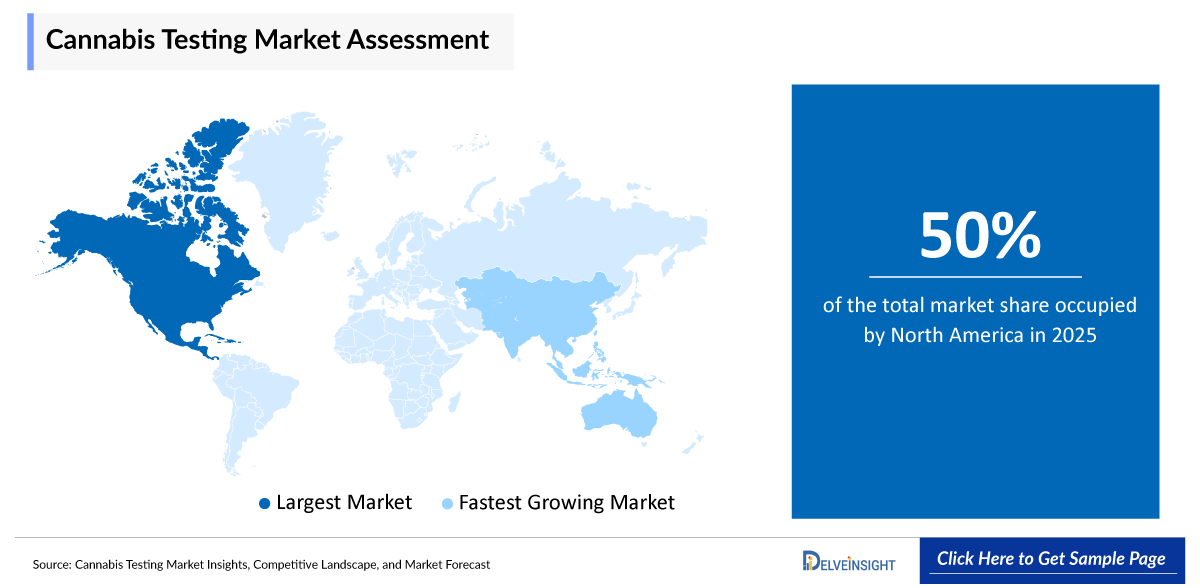
• North America accounted for the largest share of the cannabis testing market at 50% in 2025, while Asia-Pacific is anticipated to register the fastest growth through 2034.
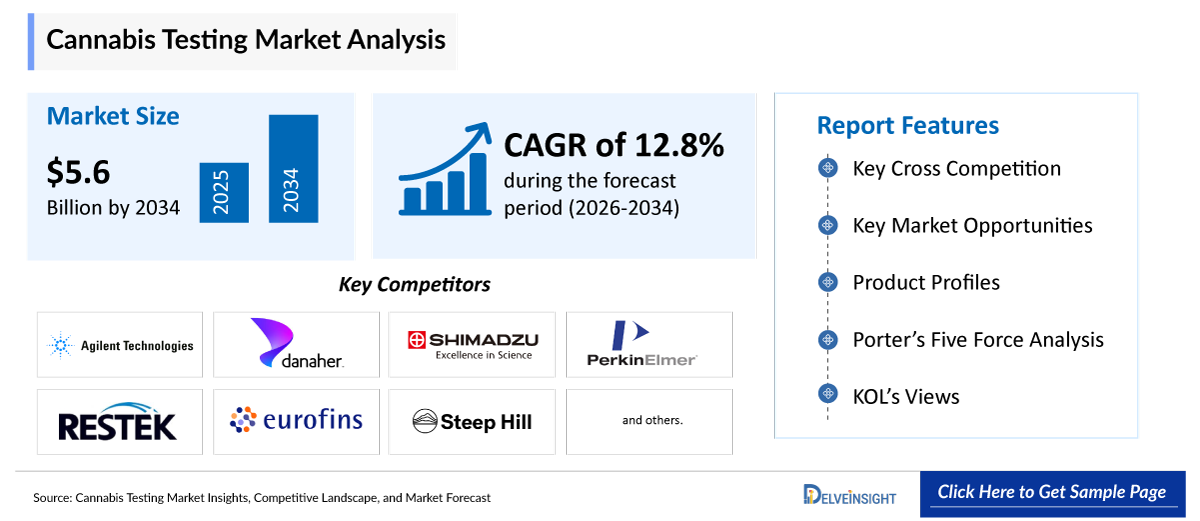
Cannabis testing encompasses the analytical instruments, consumables, laboratory services, and compliance software used to verify the potency, purity, and safety of cannabis and hemp products before they reach patients and consumers. The scope encompasses potency testing to quantify cannabinoid content such as THC and CBD; terpene profiling; pesticide screening; heavy metal testing; residual solvent testing; microbial and mycotoxin testing; genetic and DNA-based testing for strain authentication and pathogen screening, exemplified by Medicinal Genomics' StrainSEEK and PathoSEED platforms; and moisture content and foreign matter testing. Analytical instrumentation used across these testing categories includes gas and liquid chromatography, mass spectrometry, and inductively coupled plasma mass spectrometry systems from Agilent Technologies, Shimadzu, PerkinElmer, and Danaher's SCIEX, alongside cannabis-specific reference standards and chromatography columns from Restek Corporation. Independent testing laboratories, including Steep Hill, SC Laboratories, Eurofins Scientific, and SGS, perform accredited compliance testing for cannabis cultivators, processors, and manufacturers across jurisdictions with medical or recreational cannabis legalization.
Cannabis Testing Market Key Growth Drivers
• Continued expansion of medical and recreational cannabis legalization across US states and international markets, creating mandatory testing and certificate-of-analysis requirements for newly licensed cultivators, processors, and manufacturers.
• Tightening product safety and quality-control regulations, with states increasingly implementing seed-to-sale and in-process testing requirements and stricter accreditation standards, including ISO 17025 compliance and crackdowns on inconsistent inter-laboratory testing results.
• Evolving federal regulatory landscape in the United States, including the Department of Justice's April 2026 order moving FDA-approved marijuana products and state-licensed medical marijuana from Schedule I to Schedule III of the Controlled Substances Act, and the subsequent DEA hearing on broader rescheduling that concluded in July 2026.
• Rising investment in advanced analytical instrumentation, including mass spectrometry and chromatography systems purpose-built for cannabis testing applications, to meet expanding regulatory analyte lists.
• Growing pharmaceutical-grade cannabis production and clinical research activity that requires laboratory testing to standards comparable to conventional pharmaceutical manufacturing, particularly in markets with EU-GMP certification requirements.
• Expansion of genetic and DNA-based testing technology for strain authentication, pathogen screening, and potency prediction, extending cannabis testing beyond conventional chemical analysis.
• Increasing consumer and clinical interest in terpene profiling for product characterization and differentiation, extending testing demand beyond basic cannabinoid quantification.
Key Companies in Cannabis Testing Market
The leading participants in the cannabis testing market include the following:
• Agilent Technologies, Inc.
• Danaher Corporation (SCIEX)
• Shimadzu Corporation
• PerkinElmer, Inc. (New Mountain Capital)
• Restek Corporation
• Eurofins Scientific SE
• SGS SA
• Steep Hill, Inc.
• SC Laboratories, Inc.
• Medicinal Genomics Corporation
Factors Contributing to the Growth of the Cannabis Testing Market
Market Drivers
Continued Expansion of Medical and Recreational Cannabis Legalization
The foundational driver of the cannabis testing market is the continued expansion of medical and recreational cannabis legalization across United States states and international markets, each new licensing framework creating immediate and mandatory demand for analytical testing and certificates of analysis before products can be sold. Commercial cannabis products typically require testing for potency, pesticides, heavy metals, residual solvents, microorganisms, and mycotoxins before reaching the market in virtually every jurisdiction with a regulated cannabis program. As additional jurisdictions legalize medical or recreational cannabis and as existing programs mature and expand product categories, the population of licensed cultivators, processors, and manufacturers requiring mandatory testing continues to grow, sustaining demand across the forecast period.
Tightening Product Safety and Quality-Control Regulations
Tightening product safety and quality-control regulations are increasing both the volume and complexity of required cannabis testing. States are increasingly implementing seed-to-sale and in-process testing requirements that mandate testing at multiple stages of production, allowing manufacturers to identify contamination or potency issues before significant resources are invested in final packaging. Florida's Department of Health, for example, has been overhauling requirements for pesticide screening, heavy metal testing, and moisture content analysis in 2026, with regulators showing willingness to issue immediate stop-sale orders for non-compliant products, while a broader industry trend toward ISO 17025 accreditation and participation in inter-laboratory proficiency testing programs aims to crack down on inconsistent results between competing laboratories. As regulatory agencies across jurisdictions continue to expand analyte lists and tighten accreditation standards, demand for more comprehensive and rigorous testing services grows across the forecast period.
Market Restraints
The cannabis testing market faces several interrelated restraints that temper its growth. The high cost of advanced cannabis testing equipment and technology represents a significant barrier to entry, with instruments such as high-performance liquid chromatography systems for potency testing and gas chromatography-mass spectrometry systems for residual solvent and pesticide analysis ranging from tens of thousands to over a million dollars, plus ongoing costs for maintenance, calibration, and high-purity reagents and consumables. This financial barrier makes it difficult for new laboratories to establish themselves and can lead to market concentration among a limited number of well-capitalized operators. The persistent federal illegality of cannabis outside FDA-approved products and state-licensed medical marijuana in the United States, even following the April 2026 partial rescheduling, continues to constrain interstate commerce, banking access, and standardized federal testing methodology, creating a fragmented, state-by-state regulatory patchwork that complicates compliance for multi-state operators and testing laboratories alike. Inconsistent testing standards and accreditation requirements between jurisdictions, and documented instances of ""lab shopping"" for favorable results, have prompted regulatory crackdowns but continue to create quality and consistency challenges across the industry. The broader rescheduling decision remains pending before the DEA Administrator following the conclusion of the July 2026 hearing, and the timeline and ultimate outcome of that decision remain uncertain, creating a degree of continued regulatory ambiguity for market participants. Together, these factors moderate the pace of market consolidation and require testing providers to demonstrate accreditation, consistency, and value to sustain growth.
Cannabis Testing Market Segment Analysis
The global cannabis testing market is segmented by product and service type (analytical instruments and consumables, testing services, and software/laboratory information management systems), by testing type (potency testing, terpene profiling, pesticide screening, heavy metal testing, residual solvent testing, microbial and mycotoxin testing, genetic/DNA-based testing, moisture content testing, and others), by end-user (independent testing laboratories, cannabis cultivators and growers, pharmaceutical and research institutes, and others), and by geography (North America, Europe, Asia-Pacific, and the Rest of the World).
By Product and Service Type
Dominant Subsegment: Analytical Instruments and Consumables.
The analytical instruments and consumables category is expected to dominate the market. The segment accounted for a 46% share of the cannabis testing market in 2025. Analytical instruments, including gas and liquid chromatography, mass spectrometry, and inductively coupled plasma mass spectrometry systems from Agilent Technologies, Shimadzu, PerkinElmer, and Danaher's SCIEX, alongside cannabis-specific reference standards and chromatography columns from Restek Corporation, are the leading category because they provide the foundational selectivity and precision required across every testing type performed in a cannabis testing laboratory, and because rising complexity of product formulations, from dried flower to edibles, concentrates, and inhalable products, continues to drive instrument and consumables investment. The dominance of the segment reflects the capital-intensive nature of building and maintaining accredited laboratory testing capability. Testing services, provided by independent laboratories such as Steep Hill, SC Laboratories, Eurofins Scientific, and SGS, represent the second-largest category, while software and laboratory information management systems, though currently the smallest segment, are gaining importance as regulators increasingly mandate electronic data traceability and seed-to-sale reporting.
By Testing Type
Dominant Subsegment: Potency Testing.
The potency testing category is expected to dominate the market. The potency testing segment accounted for a 24% share of the cannabis testing market in 2025. Potency testing, which quantifies THC, CBD, and other cannabinoid content using high-performance liquid chromatography and gas chromatography methods, is the leading testing type because virtually every legalized cannabis jurisdiction mandates cannabinoid labeling across flower, concentrates, edibles, topicals, and inhalable products, and because potency testing must be repeated for every individual commercial batch, providing a consistent and recurring source of laboratory demand. The dominance of the segment reflects the universal regulatory requirement for accurate cannabinoid labeling and the batch-by-batch testing cadence this requirement imposes. Terpene profiling represented the fastest-growing testing type in 2025, as manufacturers increasingly use terpene data for product characterization and differentiation and as clinical and consumer interest continues to expand beyond basic THC and CBD measurement, while pesticide screening, heavy metal testing, residual solvent testing, and mycotoxin testing are also expected to grow as regulators continue to expand analyte lists.
Cannabis Testing Market Region Analysis
Dominant Region: North America
North America accounted for a 50% share of the global cannabis testing market in 2025, representing the highest regional market share globally. The leadership of the region reflects the large number of US states with legal medical or recreational cannabis programs, each imposing mandatory testing requirements, stringent regulatory oversight of cannabis cultivators and processors, and the concentration of leading testing laboratories and instrumentation manufacturers. The United States is the largest national market, supported by state-specific testing mandates covering potency, pesticides, and other contaminants, continued new laboratory investment such as Green Health Laboratories' January 2025 announcement of a multimillion-dollar cannabis and hemp testing laboratory in Alabama, and the evolving federal regulatory landscape following the DEA's 2026 rescheduling proceedings. The concentration of legalized state markets, testing infrastructure, and regulatory activity reinforces the position of North America as the largest regional market across the forecast period.
Fastest Growing Region: Asia-Pacific
Asia-Pacific is projected to register the fastest compound annual growth rate through 2034. The region is expanding medical cannabis access and cultivation licensing in select markets, including Australia's established medical cannabis program and evolving regulatory frameworks in other jurisdictions, creating new demand for compliance testing infrastructure from a comparatively small existing base. As medical cannabis programs mature and as regional governments continue to develop regulatory frameworks governing cannabis cultivation, processing, and testing, the region increases its adoption of cannabis testing services and instrumentation from a growing base, positioning Asia-Pacific as the fastest-growing regional market across the forecast period.
Regional Commentary
North America
North America leads the market, supported by the scale of state-legalized cannabis markets in the United States, stringent state-specific testing mandates, and the concentration of leading testing laboratories and instrumentation manufacturers. The United States dominates the region and continues to navigate an evolving federal regulatory landscape following the 2026 DEA rescheduling hearing.
Europe
Europe is a substantial and growing market shaped by expanding medical cannabis programs and pharmaceutical-grade production requirements, including EU-GMP certification standards required for market access. Germany, the United Kingdom, France, Italy, and Spain are the principal national markets, and Italy is home to Neotron, an ISO-accredited laboratory providing cannabis testing services aligned with European pharmaceutical standards.
Asia-Pacific
Asia-Pacific is the fastest-growing region, driven by the expansion of medical cannabis access and cultivation licensing in select markets, including Australia, from a comparatively small existing base.
Rest of World
The Rest of World, spanning Latin America, the Middle East, and Africa, represents an emerging opportunity as select markets develop medical cannabis programs and associated testing infrastructure, though adoption remains limited and concentrated in jurisdictions with established regulatory frameworks.
Cannabis Testing Market Competitive Landscape
The global cannabis testing market is classified as Fragmented. A group of established analytical instrumentation manufacturers, including Agilent Technologies, Danaher's SCIEX, Shimadzu, and PerkinElmer, supplies the underlying technology platform used across the industry, while a large and fragmented population of independent testing laboratories, including global reference laboratory networks such as Eurofins Scientific and SGS alongside cannabis-specialist laboratories such as Steep Hill and SC Laboratories, compete on accreditation, turnaround time, geographic coverage, and price. Competition centers on breadth of accredited testing capability, analytical instrumentation and methodology validation, geographic and multi-state licensing coverage, and reputation for consistent, defensible results. The competitive landscape is evaluated across the following dimensions:
• Market concentration: Fragmented, with no single laboratory or instrumentation provider holding a dominant global share, reflecting the state-by-state and country-by-country regulatory fragmentation of the cannabis industry itself.
• Leading players: Agilent Technologies, Danaher's SCIEX, Shimadzu, and PerkinElmer lead in analytical instrumentation supplying cannabis testing laboratories; Eurofins Scientific and SGS lead among global reference laboratory networks with cannabis testing divisions; and Steep Hill and SC Laboratories lead among cannabis-specialist independent testing laboratories.
• Geographic reach: Agilent Technologies, Danaher, Shimadzu, PerkinElmer, Eurofins Scientific, and SGS operate global commercial organizations, while cannabis-specialist laboratories including Steep Hill, SC Laboratories, ACS Laboratory, and Kaycha Holdings maintain footprints concentrated in specific US states and licensing jurisdictions.
• Product portfolio strength: Competitive advantage for instrumentation manufacturers rests on the breadth of validated methodology across potency, pesticide, heavy metal, and residual solvent testing, while advantage for laboratories rests on the breadth of accredited testing capability and multi-state licensing coverage.
• Pipeline strength: Development is concentrated in expanded analyte detection capability, genetic and DNA-based testing methodology, and laboratory information management software supporting seed-to-sale regulatory compliance.
• Strategic partnerships: Collaboration spans instrumentation and reference standard partnerships between manufacturers such as Agilent and Restek and cannabis testing laboratories, and laboratory network expansion partnerships such as Kaycha Holdings' consolidation of regional cannabis testing laboratory brands.
• M&A activity: Consolidation has shaped the fragmented laboratory services segment of the market, exemplified by Kaycha Holdings' acquisition and consolidation of multiple regional cannabis testing laboratory brands into a multi-state testing network.
• Innovation focus: Innovation is concentrated in genetic and DNA-based testing methodology, expanded analyte detection capability for pesticides and heavy metals, and laboratory information management systems supporting regulatory data traceability.
• Regulatory standing: State-specific laboratory accreditation, including ISO 17025 certification, and compliance with evolving federal and international regulatory requirements, including the 2026 DEA rescheduling proceedings and EU-GMP certification for European market access, are decisive competitive credentials across this fragmented, regulation-driven market.
Cannabis Testing Market Recent Developmental Activities
• In April 2026, Acting Attorney General Todd Blanche issued a Department of Justice order immediately placing FDA-approved marijuana products and marijuana subject to a qualifying state medical marijuana license into Schedule III of the Controlled Substances Act, while initiating an expedited DEA administrative hearing to consider broader rescheduling. Strategic significance: the order represented the most significant shift in US federal cannabis policy in decades and set the stage for the DEA's subsequent rescheduling hearing.
• The DEA's expedited hearing on broader marijuana rescheduling concluded on July 15, 2026, after eleven days of testimony, with post-hearing briefs filed in August 2026 and a recommendation from the presiding administrative law judge to the DEA Administrator still pending. Strategic significance: the outcome of this process, expected in late 2026 or early 2027, will materially affect the scope of federal cannabis research, banking access, and interstate commerce, with corresponding implications for cannabis testing demand and regulatory standardization.
Cannabis Testing Market Segmentation
Cannabis Testing Market Assessment by Product and Service Type
• Analytical Instruments and Consumables
• Testing Services
• Software/Laboratory Information Management Systems (LIMS)
Cannabis Testing Market Assessment by Testing Type
• Potency Testing
• Terpene Profiling
• Pesticide Screening
• Heavy Metal Testing
• Residual Solvent Testing
• Microbial and Mycotoxin Testing
• Genetic/DNA-Based Testing
• Moisture Content/Water Activity Testing
• Others
Cannabis Testing Market Assessment by End-User
• Independent Testing Laboratories
• Cannabis Cultivators and Growers
• Pharmaceutical and Research Institutes
• Others
Cannabis Testing Market Assessment by Geography
• North America
United States Cannabis Testing Market Size in USD million (2023-2034)
Canada Cannabis Testing Market Size in USD million (2023-2034)
Mexico Cannabis Testing Market Size in USD million (2023-2034)
• Europe
Germany Cannabis Testing Market Size in USD million (2023-2034)
United Kingdom Cannabis Testing Market Size in USD million (2023-2034)
France Cannabis Testing Market Size in USD million (2023-2034)
Italy Cannabis Testing Market Size in USD million (2023-2034)
Spain Cannabis Testing Market Size in USD million (2023-2034)
Rest of Europe Cannabis Testing Market Size in USD million (2023-2034)
• Asia-Pacific
China Cannabis Testing Market Size in USD million (2023-2034)
Japan Cannabis Testing Market Size in USD million (2023-2034)
India Cannabis Testing Market Size in USD million (2023-2034)
Australia Cannabis Testing Market Size in USD million (2023-2034)
South Korea Cannabis Testing Market Size in USD million (2023-2034)
Rest of Asia-Pacific Cannabis Testing Market Size in USD million (2023-2034)
• Rest of the World
Middle East Cannabis Testing Market Size in USD million (2023-2034)
Africa Cannabis Testing Market Size in USD million (2023-2034)
South America Cannabis Testing Market Size in USD million (2023-2034)
Key Takeaways from the Cannabis Testing Market Report Study
• Market size analysis for the current cannabis testing market size (2025), and market forecast for 9 years (2026 to 2034).
• Top key product and technology developments, regulatory developments, mergers, acquisitions, partnerships, and joint ventures that happened over the last 3 years.
• Key companies dominating the global cannabis testing market.
• Various opportunities available for competitors in the cannabis testing market space.
• What are the top-performing segments in 2025? How will these segments perform in 2034?
• Which are the top-performing regions and countries in the current cannabis testing market scenario?
• Which are the regions and countries where companies should concentrate their opportunities for cannabis testing market growth in the future?
Target audience that can benefit from this cannabis testing market report study
• Cannabis testing instrumentation and laboratory service providers
• Research organizations and consulting companies
• Cannabis industry-related organizations, associations, forums, and other alliances
• Government and corporate offices
• Start-up companies, venture capitalists, and private equity firms
• Distributors and traders dealing in cannabis testing instrumentation and consumables
• Various end-users who want to know more about the cannabis testing market and the latest technological and regulatory developments in the cannabis testing market.

