cardiac insufficiency pipeline insight
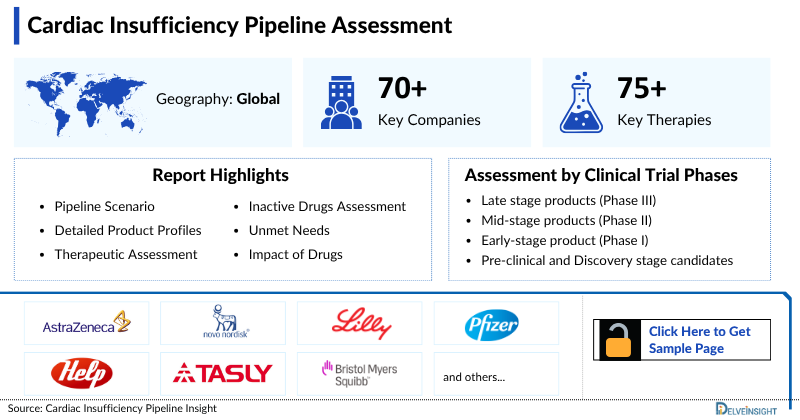
DelveInsight’s, “Cardiac Insufficiency Pipeline Insight, 2026” report provides comprehensive insights about 70+ companies and 75+ pipeline drugs in Cardiac Insufficiency pipeline landscape. It covers the pipeline drug profiles, including clinical and nonclinical stage products. It also covers the therapeutics assessment by product type, stage, route of administration, and molecule type. It further highlights the inactive pipeline products in this space.
Geography Covered
- Global coverage
Cardiac Insufficiency Understanding
Cardiac Insufficiency Overview
Cardiac Insufficiency (Heart Failure) is a chronic clinical syndrome in which the heart is unable to pump sufficient blood to meet the body's metabolic demands or can do so only at elevated filling pressures. It is not a condition where the heart stops working; rather, it reflects impaired cardiac function due to structural or functional abnormalities. Cardiac insufficiency may involve the left ventricle, right ventricle, or both, and is commonly classified as heart failure with reduced ejection fraction (HFrEF), mildly reduced ejection fraction (HFmrEF), or preserved ejection fraction (HFpEF). The condition is a leading cause of hospitalization and mortality worldwide, particularly among older adults.
Patients with cardiac insufficiency commonly present with shortness of breath (dyspnea) during exertion or at rest, fatigue, reduced exercise tolerance, and swelling (edema) of the legs, ankles, or abdomen due to fluid retention. Other symptoms include orthopnea (difficulty breathing while lying flat), paroxysmal nocturnal dyspnea, persistent cough or wheezing, rapid or irregular heartbeat, unexplained weight gain from fluid accumulation, and reduced appetite. The most frequent causes include coronary artery disease, myocardial infarction, long-standing hypertension, cardiomyopathies, valvular heart disease, congenital heart defects, diabetes, arrhythmias, obesity, and chronic kidney disease. Lifestyle factors such as smoking, excessive alcohol intake, and sedentary behavior further increase the risk.
Diagnosis involves a combination of clinical evaluation, medical history, physical examination, laboratory testing, and imaging studies. Blood tests, including measurement of B-type natriuretic peptide (BNP) or N-terminal pro-BNP (NT-proBNP), help identify cardiac stress. An electrocardiogram (ECG) assesses heart rhythm abnormalities, while echocardiography is the gold standard for evaluating cardiac structure, ventricular function, and ejection fraction. Additional investigations such as chest X-ray, cardiac MRI, stress testing, coronary angiography, and renal function tests may be performed to determine the underlying cause and severity of the disease.
Treatment aims to relieve symptoms, slow disease progression, reduce hospitalizations, and improve survival through a combination of lifestyle modifications, pharmacologic therapy, device-based interventions, and advanced procedures. Standard medical therapy includes ACE inhibitors or ARBs, angiotensin receptor-neprilysin inhibitors (ARNIs), beta-blockers, mineralocorticoid receptor antagonists (MRAs), SGLT2 inhibitors, and diuretics for symptom control. Selected patients may benefit from implantable cardioverter-defibrillators (ICDs), cardiac resynchronization therapy (CRT), or mechanical circulatory support devices. In end-stage heart failure refractory to medical therapy, heart transplantation remains the definitive treatment option. Early diagnosis, optimization of guideline-directed medical therapy, and management of underlying cardiovascular risk factors are essential for improving long-term outcomes.
"Cardiac Insufficiency Pipeline Insight, 2026" report by DelveInsight outlays comprehensive insights of present scenario and growth prospects across the indication. A detailed picture of the Cardiac Insufficiency pipeline landscape is provided which includes the disease overview and Cardiac Insufficiency treatment guidelines. The assessment part of the report embraces, in depth Cardiac Insufficiency commercial assessment and clinical assessment of the pipeline products under development. In the report, detailed description of the drug is given which includes mechanism of action of the drug, clinical studies, NDA approvals (if any), and product development activities comprising the technology, Cardiac Insufficiency collaborations, licensing, mergers and acquisition, funding, designations and other product related details.
Cardiac Insufficiency Pipeline Report Highlights
- The companies and academics are working to assess challenges and seek opportunities that could influence Cardiac Insufficiency R&D. The therapies under development are focused on novel approaches to treat/improve Cardiac Insufficiency.
Cardiac Insufficiency Emerging Drugs Analysis
This segment of the Cardiac Insufficiency report encloses its detailed analysis of various drugs in different stages of clinical development, including Phase III, II, I, Preclinical and Discovery. It also helps to understand clinical trial details, expressive pharmacological action, agreements and collaborations, and the latest news and press releases.
Cardiac Insufficiency Emerging Drugs
Baxdrostat: AstraZeneca
Baxdrostat is an investigational, orally administered, highly selective aldosterone synthase (CYP11B2) inhibitor being developed by AstraZeneca for the treatment of uncontrolled and treatment-resistant hypertension, with potential applications in cardiovascular and renal diseases. By selectively inhibiting aldosterone production while sparing cortisol synthesis, baxdrostat aims to reduce blood pressure with fewer off-target endocrine effects. The therapy has demonstrated promising blood pressure-lowering efficacy in Phase II studies and is currently being evaluated in Phase III clinical trials.
CDR132L: Novo Nordisk A/S
CDR132L is an investigational antisense oligonucleotide targeting microRNA-132 (miR-132), being developed by Novo Nordisk A/S for the treatment of heart failure. By inhibiting miR-132, CDR132L aims to reduce adverse cardiac remodeling, improve myocardial function, and slow progression of heart failure. The therapy has demonstrated encouraging safety and biomarker improvements in early clinical studies and is advancing through clinical development for patients with impaired cardiac function. The drug is in Phase II for the treatment of heart failure.
LY3971297: Eli Lilly and Company
LY3971297 is an investigational, orally administered aldosterone synthase (CYP11B2) inhibitor being developed by Eli Lilly and Company for the treatment of hypertension and cardiorenal diseases associated with excess aldosterone production. The therapy is designed to selectively suppress aldosterone synthesis while preserving cortisol production, potentially offering improved safety compared with less selective agents. LY3971297 is currently in early-to-mid stage clinical development to evaluate its efficacy, safety, and blood pressure-lowering potential in patients with hypertension. As per the clinical trials the drug is in Phase I for heart failure.
Further product details are provided in the report……..
Cardiac Insufficiency Drug Therapeutic Assessment
This segment of the report provides insights about the different Cardiac Insufficiency drugs segregated based on following parameters that define the scope of the report, such as:
- Major Cardiac Insufficiency Players in Cardiac Insufficiency
- There are approx. 70+ key companies which are developing the therapies for Cardiac Insufficiency. The companies which have their Cardiac Insufficiency drug candidates in the most advanced stage, i.e. Phase III include, AstraZeneca.
Cardiac Insufficiency Clinical Trial Phases
DelveInsight’s report covers around 75+ products under different phases of clinical development like
- Late stage products (Phase III)
- Mid-stage products (Phase II)
- Early-stage product (Phase I) along with the details of
- Pre-clinical and Discovery stage candidates
- Discontinued & Inactive candidates
Cardiac Insufficiency Drug Route of Administration
Cardiac Insufficiency pipeline report provides the therapeutic assessment of the pipeline drugs by the Route of Administration. Products have been categorized under various ROAs such as
- Oral
- Intravenous
- Subcutaneous
- Parenteral
- Topical
Cardiac Insufficiency Product Molecule Type
Products have been categorized under various Molecule types such as
- Recombinant fusion proteins
- Small molecule
- Monoclonal antibody
- Peptide
- Polymer
- Gene therapy
Cardiac Insufficiency Product Type
Drugs have been categorized under various product types like Mono, Combination and Mono/Combination.
Cardiac Insufficiency Clinical Trial Activities
The Cardiac Insufficiency Pipeline report provides insights into different Cardiac Insufficiency Clinical Trial within Phase III, II, I, preclinical and discovery stage. It also analyses Cardiac Insufficiency therapeutic drugs key players involved in developing key drugs.
Cardiac Insufficiency Pipeline Development Activities
The Cardiac Insufficiency Clinical Trial Analysis report covers the detailed information of collaborations, acquisition and merger, licensing along with a thorough therapeutic assessment of emerging Cardiac Insufficiency drugs.
Cardiac Insufficiency Report Insights
- Cardiac Insufficiency Pipeline Analysis
- Cardiac Insufficiency Therapeutic Assessment
- Cardiac Insufficiency Unmet Needs
- Impact of Cardiac Insufficiency Drugs
Cardiac Insufficiency Report Assessment
- Cardiac Insufficiency Pipeline Product Profiles
- Cardiac Insufficiency Therapeutic Assessment
- Cardiac Insufficiency Pipeline Assessment
- Cardiac Insufficiency Inactive drugs assessment
- Cardiac Insufficiency Market Unmet Needs
Key Questions Answered In the Cardiac Insufficiency Pipeline Report
- Current Treatment Scenario and Emerging Therapies:
- How many companies are developing Cardiac Insufficiency drugs?
- How many Cardiac Insufficiency drugs are developed by each company?
- How many emerging drugs are in mid-stage, and late-stage of development for the treatment of Cardiac Insufficiency?
- What are the key collaborations (Industry–Industry, Industry–Academia), Mergers and acquisitions, licensing activities related to the Cardiac Insufficiency therapeutics?
- What are the recent trends, drug types and novel technologies developed to overcome the limitation of existing therapies?
- What are the clinical studies going on for Cardiac Insufficiency and their status?
- What are the key designations that have been granted to the emerging drugs?
Cardiac Insufficiency Key Players
- AstraZeneca
- Novo Nordisk A/S
- Eli Lilly and Company
- Pfizer
- HELP Therapeutics Co., Ltd.
- Novo Nordisk A/S
- Tasly Pharmaceutical Group Co., Ltd
- Boehringer Ingelheim
- Bristol-Myers Squibb
- Sardocor Corp.
- Biopeutics Co., Ltd
Cardiac Insufficiency Key Products
- Baxdrostat
- CDR132L
- LY3971297
- PF-07328948
- HiCM-188 therapy
- NNC0537-1482
- Jia Shen Tablet
- Vicadrostat + Empagliflozin
- BMS-986435
- SRD-001
- Alprostadil