
Cell Harvesting Systems Market Summary
- • The global cell harvesting systems market was valued at USD 3.59 billion in 2025 and is projected to reach USD 9.14 billion by 2034.
- • The market is expected to expand at a CAGR of 10.95% during the forecast period 2026-2034, supported by the scale-up of biologics manufacturing, the rapid expansion of cell and gene therapy and regenerative medicine, the shift toward automated and closed single-use processing, and rising investment in cell-based research.
- • By type, the automated cell harvesters segment dominated the cell harvesting systems market with a 59% share in 2025.
- • By application, the biopharmaceutical segment dominated the cell harvesting systems market with a 52% share in 2025.
- • By end-user, the biotechnology and biopharmaceutical companies segment dominated the cell harvesting systems market with a 57% share in 2025.
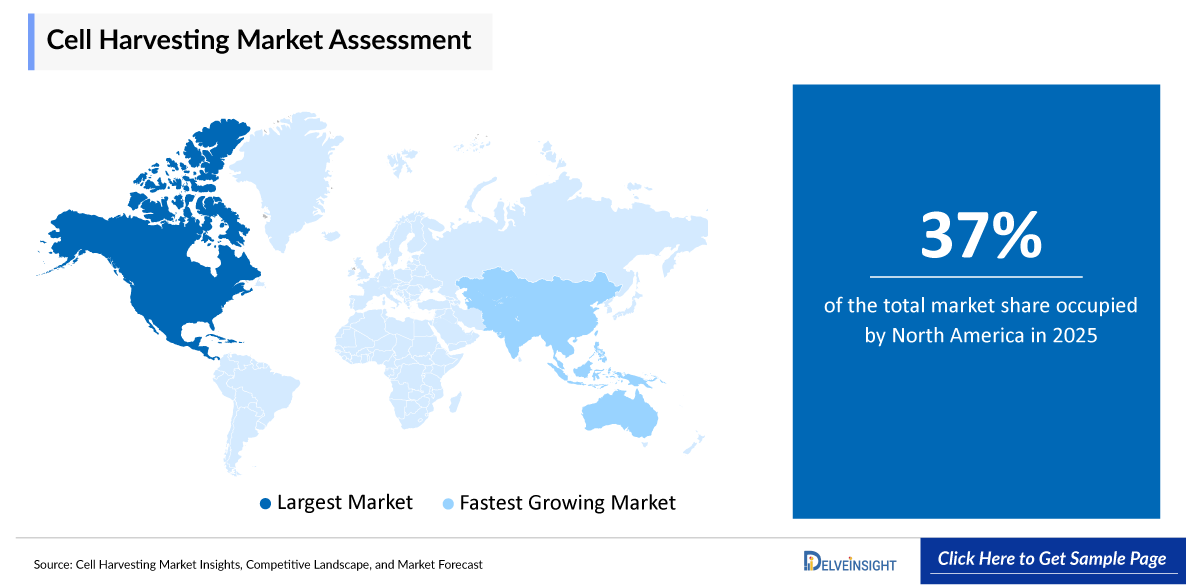
- • North America accounted for the largest share of the cell harvesting systems market at 33% in 2025, while Asia-Pacific is anticipated to register the fastest growth through 2034.
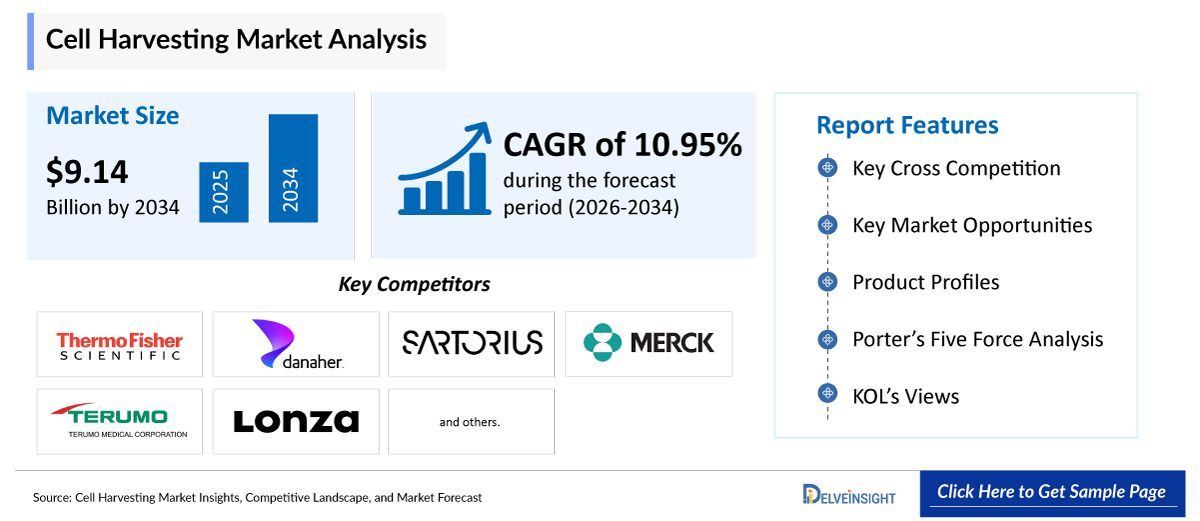
Cell harvesting is the process of separating and collecting live cells from a growth medium or culture after cell culture, and it is an essential procedure in cell culture and bioprocessing that supplies the viable cells required for biopharmaceutical production, stem cell therapy, cancer research, and vaccine development. The harvest step recovers the target cells or the secreted product from the culture while removing spent medium, cell debris, and other contaminants, and it must do so while preserving cell viability, since damaged or contaminated cells are unusable in the downstream therapy or manufacturing process that follows. The market is organized by the degree of automation of the harvesting method, the application for which the cells are harvested, and the organization that performs the harvest. By type, it divides between manual cell harvesters, which rely upon centrifugation and filtration performed by a researcher and are simple and inexpensive but labor-intensive and variable, and automated cell harvesters, which include robotic systems, automated centrifuges, and microfluidic devices that enhance yield, reproducibility, and process safety while enabling closed and scalable processing. By application, it spans biopharmaceutical production, stem cell research, and other applications, and by end-user it spans biotechnology and biopharmaceutical companies, research institutes, and others. This assessment adopts a systems scope that encompasses the harvesting instruments together with the single-use consumables, filters, and reagents consumed in the harvest step. The contemporary market is defined by the movement toward automation, single-use and closed processing, depth filtration and tangential flow filtration, and the rapid growth of cell and gene therapy.
Cell Harvesting Systems Market Key Growth Drivers
• The continued scale-up of biologics manufacturing, since the harvesting of cells is essential to the production of vaccines, recombinant proteins, and therapeutic antibodies, and rising biomanufacturing investment increases demand for automated and scalable harvesting systems.
• The rapid expansion of cell and gene therapy and regenerative medicine, including chimeric antigen receptor T-cell therapy and stem cell therapy, which require viable cells harvested under sterile, reproducible, and GMP-compliant conditions.
• The shift toward automated and closed single-use processing, which reduces contamination risk, cuts labor, and improves yield and reproducibility relative to manual centrifugation and filtration.
• Growing demand for personalized medicine and the rising incidence of chronic, life-threatening, and autoimmune diseases, which have propelled investment in novel cell therapies and clinical research.
• The widespread adoption of single-use technologies, including single-use centrifuges, depth filtration, and tangential flow filtration integrated into closed harvesting workflows.
• Regulatory support for advanced manufacturing, including the United States Food and Drug Administration Advanced Manufacturing Technologies Designation Program, which incentivizes the deployment of self-validating automation.
• The integration of real-time process monitoring, artificial intelligence, and microfluidic and lab-on-a-chip systems that optimize harvest yield, viability, and scalability.
Key Companies in Cell Harvesting Systems Market
The leading participants in the cell harvesting systems market include the following:
• Thermo Fisher Scientific Inc.
• Danaher Corporation (Cytiva)
• Sartorius AG
• Merck KGaA
• Terumo BCT (Terumo Corporation)
• Lonza Group AG
• Miltenyi Biotec B.V. & Co. KG
• STEMCELL Technologies Inc.
• Corning Incorporated
• Revvity Inc.
For illustrative purposes, only the top 10 companies are listed in the Table of Contents. The report may include analysis and references to additional companies relevant to the market assessment.
Cell Harvesting Systems Market Size
The following table summarizes the headline market metrics for the global cell harvesting systems market across the base year and the forecast horizon.
|
Report Metrics |
Details |
|
2025 Market Size |
USD 3.59 billion |
|
2034 Projected Market Size |
USD 9.14 billion |
|
Growth Rate (2026-2034) |
10.95% CAGR |
|
Largest Market |
North America (33% share in 2025) |
|
Fastest Growing Market |
Asia-Pacific |
|
Market Structure |
Moderately Concentrated |
All market values are expressed in USD and represent DelveInsight estimates synthesized from primary and secondary research.
Factors Contributing to the Growth of the Cell Harvesting Systems Market
Market Drivers
Scale-Up of Biologics Manufacturing
The foundational driver of the cell harvesting systems market is the continued scale-up of biologics manufacturing, since the harvest step is an unavoidable and recurring operation in the production of every cell-derived biologic, and the volume of harvesting capacity required rises directly with biomanufacturing output. Effective harvesting of cells is necessary for the production of biologics including vaccines, recombinant proteins, and therapeutic monoclonal antibodies, each of which is produced in cultured cells from which the product or the cells themselves must be separated and recovered, and the increasing investment in biomanufacturing and the growing global demand for biologics have propelled the biopharmaceutical application toward automated and scalable harvesting systems. The relationship between biologics output and harvesting demand is mechanical rather than discretionary, because every production batch, from clinical-scale through commercial manufacturing, passes through a harvest and clarification step that consumes both the harvesting instrument capacity and the single-use filters, depth filtration media, and consumables associated with it. As the biologics pipeline expands, as biosimilars broaden the manufactured pool, and as manufacturing capacity is added worldwide to meet demand, the harvest step scales in proportion, and the shift toward higher cell densities in modern bioreactors intensifies the clarification challenge and raises the value of the harvesting technology required per batch. Because biologics represent the fastest-growing and highest-value segment of the pharmaceutical industry, and because each unit of output requires harvesting, this driver provides the most durable foundation for market growth.
Expansion of Cell and Gene Therapy and Regenerative Medicine
The rapid expansion of cell and gene therapy and regenerative medicine is a powerful and distinctive driver of the cell harvesting systems market, because these therapies are themselves composed of living cells that must be harvested under conditions far more demanding than those of conventional biomanufacturing. Chimeric antigen receptor T-cell therapy, stem cell therapy, and other advanced cell therapies require viable cells to be harvested with minimal damage and under sterile, reproducible, and GMP-compliant conditions, since the harvested cells are not an intermediate but the therapeutic product itself, and any loss of viability or introduction of contamination directly compromises a treatment intended for a patient. The growth of this field has been extraordinary, driven by the accumulating number of approved cell and gene therapies, the expanding clinical pipeline, and the investment in induced pluripotent stem cell lines, three-dimensional organoid models, and gene-edited therapeutics, and stem cell research is consistently identified as the fastest-growing application of cell harvesting systems for precisely this reason. The autologous therapies that dominate current practice impose particularly stringent requirements, since each batch corresponds to a single patient and must meet sterility and timeline targets that reward closed and automated harvesting, while the emergence of allogeneic therapies scales the harvesting requirement toward larger volumes. Because cell and gene therapy converts the harvest step from a manufacturing operation into a component of the therapy itself, it drives demand for the highest-value and most tightly controlled harvesting technology.
Shift Toward Automation and Closed Processing
The structural shift toward automated and closed cell harvesting systems is a central driver of the market, because automation resolves the fundamental limitations of the manual methods it replaces and delivers benefits that are decisive in both manufacturing and clinical cell processing. Manual harvesting by centrifugation and filtration is simple and inexpensive but labor-intensive, susceptible to variability, and far less amenable to large-scale manufacturing, whereas automated harvesting devices improve yield, reproducibility, and process safety, mitigate contamination risk, facilitate closed processing, and can be connected to upstream and downstream bioprocessing systems. The contamination advantage is decisive in a field where a single breach can destroy a batch or endanger a patient, and the reproducibility advantage addresses the batch-to-batch consistency that regulators require and that manual technique cannot reliably deliver. The labor advantage is substantial, since the widespread adoption of advanced, closed, and automated harvesters can materially reduce the labor required per batch and improve batch consistency, a consideration of growing weight given the shortage of skilled bioprocessing personnel. Automated systems also enable the closed, connected, and continuous processing toward which modern biomanufacturing is moving, integrating harvest with the clarification, concentration, and purification steps surrounding it. Because automation simultaneously addresses contamination, reproducibility, labor, and integration, it is both a driver of market growth and the axis along which the market is shifting in value from manual toward automated systems.
Growing Demand for Personalized Medicine and Rising Disease Burden
The growing demand for personalized medicine, combined with the rising incidence of chronic, life-threatening, and autoimmune diseases, is a significant driver of the cell harvesting systems market, because it generates both the clinical need for cell-based therapies and the investment that funds their development and manufacture. The rising burden of cancer, of autoimmune and inflammatory conditions, and of the degenerative diseases associated with aging has created a large population for whom conventional therapy is inadequate and for whom cell and gene therapies offer new options, and this clinical need has propelled investment in novel cell therapies and clinical research. Personalized and autologous approaches, in which a therapy is manufactured from or tailored to an individual patient, depend absolutely upon the harvesting of that patient's cells or of the cellular product intended for them, so the shift toward personalized medicine translates directly into demand for harvesting technology suited to small-batch, patient-specific processing. The expansion of clinical research, of translational medicine, and of the academic and institutional programs that underpin them adds further demand across the research-scale end of the market. Because the underlying disease burden is large and rising, because cell-based approaches are increasingly able to address it, and because both public and private investment continue to flow into the field, this driver provides a broad and expanding foundation for demand across both the manufacturing and research applications of cell harvesting systems.
Adoption of Single-Use and Filtration Technologies
The widespread adoption of single-use technologies is an important driver of the cell harvesting systems market, because single-use systems have become the preferred approach for the harvest and clarification step across both manufacturing and clinical cell processing, and each adoption generates recurring demand for the associated consumables. The market is increasingly focused upon the combination of single-use systems with automated depth filtration and tangential flow filtration, real-time data monitoring, and the emergence of microfluidic systems for high-throughput settings, and single-use harvesting eliminates the cleaning, sterilization, and cross-contamination risk associated with fixed stainless-steel equipment while enabling the rapid changeover between products that modern multiproduct facilities require. The introduction of single-use centrifuge technology, which reduces filter use and cuts waste substantially compared with conventional systems, illustrates the direction of the field, as does the integration of depth filtration and tangential flow filtration into closed single-use harvest trains. The single-use model shifts the economics of harvesting from capital equipment toward recurring consumables, which expands the addressable market beyond the instruments themselves to the filters, media, and single-use assemblies consumed in every batch, and it aligns with the systems scope adopted in this assessment. Because single-use adoption is both broad and deepening, and because it converts harvesting into a recurring consumable demand, it is a durable contributor to market growth.
Regulatory Support for Advanced Manufacturing
Growing regulatory support for advanced and automated manufacturing is a meaningful driver of the cell harvesting systems market, because regulatory encouragement lowers the barrier to adopting the automated and closed harvesting systems that improve quality and consistency. The United States Food and Drug Administration Advanced Manufacturing Technologies Designation Program, finalized in recent guidance, incentivizes the deployment of self-validating automation that delivers consistent critical quality attributes, and it signals a regulatory environment that favors the automated, closed, and data-rich harvesting systems increasingly adopted across the field. Regulators have progressively emphasized the reproducibility, sterility, and traceability of cell processing, particularly for the cell and gene therapies whose harvested cells constitute the therapeutic product, and these expectations reward automated systems that log their own processes and deliver consistent results over manual techniques that cannot. For cell and gene therapy specifically, the requirement to manufacture under GMP conditions with full documentation makes closed and automated harvesting effectively a regulatory as well as a practical necessity. Because regulatory frameworks increasingly favor the automated and closed approaches, and because compliance with them drives the adoption of validated harvesting systems and the consumables they require, regulatory support translates directly into demand for advanced harvesting technology.
Integration of Monitoring, Artificial Intelligence, and Microfluidics
The integration of real-time process monitoring, artificial intelligence, and microfluidic technology is a growing driver of the cell harvesting systems market, transforming harvesting from a discrete mechanical operation into an intelligent and connected process. Real-time data monitoring allows the harvest step to be controlled against the critical quality attributes that determine cell viability and product quality, enabling the process to be adjusted dynamically rather than run to a fixed protocol, and artificial intelligence and machine learning increasingly optimize harvest yield, viability, and scalability by identifying the conditions that maximize recovery of viable cells. Microfluidic and lab-on-a-chip systems address the high-throughput research setting, enabling the harvesting of cells at small scale with precision and automation that manual techniques cannot match, and continuous and microfluidic approaches are being developed to support large-scale bioprocessing without compromising viability. Automated cell harvesting systems devices equipped with robotic selection and dissolvable microcarrier technologies that simplify the harvesting of adherent cells and enable scale-up further extend the technological frontier. Because these capabilities improve the yield, viability, reproducibility, and scalability that define the value of harvesting, and because they align with the broader movement of bioprocessing toward automation and data, their integration raises the value delivered per system and drives the market in value as well as volume.
Market Restraints
Despite a strong and structurally supported demand base, the cell harvesting systems market faces several material constraints. The most significant is the high capital cost of automated and closed harvesting systems, which can be substantial and which constrains adoption in smaller laboratories, in academic and research settings with limited budgets, and in cost-sensitive markets, where manual centrifugation and filtration consequently persist despite their limitations, since manual methods are simple to perform with minimal initial investment and can be directly handled by researchers for experiments involving frequent modification. A second constraint is the technical complexity of automated systems and the challenge of integrating them into existing bioprocessing and cell therapy workflows, since a harvesting system must connect to the upstream culture and downstream purification steps surrounding it, and the integration, validation, and process development required impose cost, time, and expertise burdens that weigh most heavily upon smaller organizations. A third and fundamental constraint is the difficulty of harvesting cells while preserving viability, since viable cells must be harvested with minimal damage if they are to be used in downstream applications, and the shear forces, temperature changes, and processing time inherent in harvesting can compromise the very cells the process is intended to recover, a challenge that is most acute for the fragile stem and primary cells used in advanced therapies. Additional constraints include the stringent regulatory and GMP requirements governing cell processing for clinical use, which raise the cost and complexity of qualifying and operating harvesting systems; the shortage of skilled bioprocessing and cell therapy personnel able to operate and validate advanced systems; and the persistence of labor-intensive manual methods in early-stage development and low-throughput service settings where their simplicity and low cost remain advantageous. Together these cost, technical, biological, and regulatory factors ensure that growth, while robust, proceeds against genuine constraint.
Cell Harvesting Systems Market Segment Analysis
The global cell harvesting systems market is segmented by type (manual cell harvesters and automated cell harvesters); by application (biopharmaceutical, stem cell research, and other applications); by end-user (biotechnology and biopharmaceutical companies, research institutes, and others); and by geography (North America, Europe, Asia-Pacific, and the Rest of the World).
By Type
Dominant Subsegment: Automated Cell Harvesters.
The automated cell harvesters segment accounted for a 59% share of the cell harvesting systems market in 2025. Automated cell harvesters dominate the type structure because they hold the promising potential of improving yield, reproducibility, and process safety that manual methods cannot deliver, and because the manufacturing and clinical applications that account for the majority of harvesting demand require exactly these attributes. Automated harvesting devices mitigate contamination chances, facilitate closed processing, and can be connected to upstream and downstream bioprocessing systems, which makes them the technology of choice for the biopharmaceutical production and cell therapy manufacturing that dominate the market, where sterility, batch-to-batch consistency, and integration into a connected process train are decisive. The category encompasses robotic cell harvesting systems systems, automated centrifuges, and microfluidic harvesting devices, and its leadership is reinforced by the widespread adoption of advanced, closed, and automated harvesters that reduce labor requirements and improve batch consistency, an advantage of growing weight given the shortage of skilled bioprocessing personnel. Manual cell harvesters constitute the second category, relying upon centrifugation and filtration performed by a researcher, and they retain importance for early-stage development and low-throughput service because they are simple to perform with minimal initial investment, can be directly handled by researchers, and suit experiments involving frequent modification, though they are labor-intensive, susceptible to variability, and far less amenable to large-scale manufacturing. Automated cell harvesters are expected to retain their leading share and to grow throughout the forecast period as automation deepens across the field.
By Application
Dominant Subsegment: Biopharmaceutical.
The biopharmaceutical segment accounted for a 52% share of the cell harvesting systems market in 2025. The biopharmaceutical application dominates the application structure, owing to the extensive utilization of cell-based systems in the drug manufacturing process, since effective harvesting of cells is necessary for the production of biologics including vaccines, recombinant proteins, and therapeutic antibodies. The increasing investment in biomanufacturing and the growing demand for biologics have further propelled this segment toward automated and scalable harvesting systems, and the scale of the underlying activity sustains its position, since every production batch of a cell-derived biologic, from clinical through commercial manufacturing, passes through a harvest and clarification step that consumes both harvesting instrument capacity and the single-use filters and consumables associated with it. The commercial biologics pool, supported by an increasing number of on-market therapies and by the expansion of biosimilars, anchors the segment, and the shift toward higher cell densities in modern bioreactors intensifies the clarification challenge and raises the value of the harvesting technology required per batch. Stem cell research constitutes the second application and the fastest-growing, driven by developments in regenerative medicine and cell therapy and by investment in induced pluripotent stem cell lines, organoid models, and gene-edited therapeutics, and it imposes the most stringent viability requirements since the harvested cells are the therapeutic product itself. Other applications, including cancer research and vaccine development, complete the structure. The biopharmaceutical segment is expected to retain its leading share throughout the forecast period, while stem cell research grows fastest.
By End-User
Dominant Subsegment: Biotechnology and Biopharmaceutical Companies.
The biotechnology and biopharmaceutical companies segment accounted for a 57% share of the cell harvesting systems market in 2025. Biotechnology and biopharmaceutical companies dominate the end-user structure because they perform the greatest volume of cell harvesting systems, operating commercial and clinical biomanufacturing in which the harvest step is a recurring and essential operation and adopting the automated and closed systems that the scale and regulatory requirements of manufacturing demand. These companies produce the biologics, vaccines, and cell and gene therapies that account for the majority of harvesting demand, and they possess the capital and the process development resources to invest in advanced harvesting systems, single-use consumables, and the integration of harvest into connected and continuous bioprocessing trains. Their dominance is reinforced by the concentration of cell and gene therapy manufacturing within biopharmaceutical companies and the contract organizations that serve them, and the cell therapy companies and contract development and manufacturing organizations within and adjacent to this segment are expected to register the fastest growth as advanced therapy manufacturing scales. Research institutes constitute the second end-user category, encompassing the academic and institutional laboratories that harvest cells for basic and translational research, and they are significant users of both manual and research-scale automated harvesting, though at a smaller scale and with greater price sensitivity than the manufacturers. Other end users, including hospitals and clinics performing point-of-care cell processing, complete the structure. Biotechnology and biopharmaceutical companies are expected to retain their leading share throughout the forecast period.
Cell Harvesting Systems Market Region Analysis
Dominant Region: North America
North America accounted for a 33% share of the global cell harvesting systems market in 2025. The region is expected to account for the largest share of the global market, supported by the concentration of the biopharmaceutical and cell and gene therapy industries, the scale of biomanufacturing and clinical research investment, the strong presence of the leading bioprocessing and life-science tools companies, and a supportive regulatory environment for advanced manufacturing. The United States hosts the largest concentration of biologics and advanced therapy manufacturing capacity in the world, together with the greatest number of cell and gene therapy developers and the contract organizations that serve them, and this concentration of manufacturing and clinical activity generates the greatest regional demand for harvesting systems and consumables. Regulatory leadership reinforces the position of the region, with the United States Food and Drug Administration Advanced Manufacturing Technologies Designation Program incentivizing the deployment of self-validating automation, and with the agency's emphasis upon the reproducibility, sterility, and traceability of cell processing favoring the automated and closed harvesting systems in which the region leads. The presence of the major bioprocessing companies, high research and development intensity, strong funding for cell-based research and regenerative medicine, and frequent product launches further strengthen the region. The region is expected to retain its leading position throughout the forecast period.
Fastest Growing Region: Asia-Pacific
Asia-Pacific is projected to register the fastest compound annual growth rate in the cell harvesting systems market through 2034. The region is emerging as the principal growth engine of the market, propelled by the rapid expansion of biopharmaceutical manufacturing, the growth of cell and gene therapy development, and rising investment in biotechnology and regenerative medicine across densely populated nations including China, India, Japan, and South Korea. The region combines very large patient populations with rapidly expanding domestic biopharmaceutical industries, and the governments and private sectors of several countries are investing heavily in biomanufacturing capacity, cell therapy development, and the research infrastructure that underpins them, converting a historically smaller base into rapidly growing demand for harvesting systems and consumables. China in particular has developed a substantial cell and gene therapy sector and a growing domestic bioprocessing equipment industry, exemplified by the emergence of domestically developed automated and closed cell processing systems, and Japan and South Korea combine advanced regenerative medicine programs with sophisticated manufacturing capability. The growth of contract development and manufacturing capacity across the region, rising healthcare expenditure, expanding clinical research, and the presence of both international suppliers and capable regional manufacturers offering cost-appropriate systems all contribute. Regional growth is expected to exceed the global average across every segment.
Regional Commentary
North America
North America leads on value and adoption, holding a 33% share in 2025. The region combines the largest concentration of biologics and cell and gene therapy manufacturing with strong biomanufacturing and clinical research investment, the presence of the leading bioprocessing and life-science tools companies, and regulatory leadership through the Food and Drug Administration Advanced Manufacturing Technologies Designation Program. High research and development intensity, strong funding for cell-based research and regenerative medicine, and frequent product launches reinforce the position of the region. Near-term dynamics are shaped by the growth of cell and gene therapy, the shift to automated and closed single-use processing, and the integration of monitoring and artificial intelligence into harvest workflows.
Europe
Europe is a large and sophisticated market, supported by a substantial biopharmaceutical industry, strong academic and translational research, and the presence of several of the leading bioprocessing and cell-therapy processing companies, with Germany, the United Kingdom, France, and Switzerland the principal centers. The region hosts major bioprocessing equipment and cell-therapy technology manufacturers and a strong regenerative medicine research base, and the European regulatory framework for advanced therapy medicinal products shapes the demand for GMP-compliant closed harvesting. Substantial public and private investment in cell and gene therapy manufacturing, together with the growth of contract development and manufacturing capacity, sustains demand, while pricing and reimbursement pressure and the fragmentation of national systems temper the pace of adoption.
Asia-Pacific
Asia-Pacific is the fastest-growing region, propelled by the rapid expansion of biopharmaceutical manufacturing, the growth of cell and gene therapy development, and rising investment in biotechnology and regenerative medicine across China, India, Japan, and South Korea. China has developed a substantial cell and gene therapy sector and a growing domestic bioprocessing equipment industry, while Japan and South Korea combine advanced regenerative medicine programs with sophisticated manufacturing. The growth of contract manufacturing capacity, rising healthcare expenditure, expanding clinical research, and the presence of both international and cost-competitive regional suppliers drive adoption. Growth exceeds the global average across every segment.
Rest of World
The Rest of the World comprises the Middle East, Africa, and South America. Adoption is stratified. The larger Latin American markets, particularly Brazil, support growing biopharmaceutical manufacturing and clinical research, and the automated manufacturing of cell and gene therapy products has begun to expand into the region, while the Gulf states are investing in biotechnology and advanced healthcare capability, together representing steady growth. Much of Africa has limited biomanufacturing and cell processing infrastructure, so harvesting demand is concentrated in research settings and the larger regional manufacturers. Regional growth will be driven by the expansion of biopharmaceutical manufacturing, investment in cell therapy and regenerative medicine, growing clinical research, and the availability of cost-appropriate systems from international and regional suppliers.
Cell Harvesting Systems Market Competitive Landscape
The global cell harvesting systems market is classified as Moderately Concentrated. The market is led by a group of large bioprocessing and life-science tools companies that supply integrated harvesting systems, single-use consumables, and filtration alongside their broader upstream and downstream bioprocessing portfolios, with a top tier of suppliers holding a substantial share of global revenue, complemented by cell-therapy processing specialists and by research-scale harvesting device manufacturers. Competition centers upon the breadth and integration of the bioprocessing portfolio, the performance of automated and closed systems, the depth of the single-use consumables franchise, regulatory support for GMP cell processing, and increasingly upon automation, connectivity, and data. The competitive landscape is evaluated across the following dimensions:
• Market concentration: Moderately concentrated, with a top tier of large bioprocessing suppliers holding a substantial share of global revenue alongside cell-therapy processing specialists and numerous research-scale device manufacturers, and with the scale and integration advantages of the leaders constituting a barrier to entry.
• Leading players: Thermo Fisher Scientific, Danaher through its Cytiva business, Sartorius, and Merck lead through integrated bioprocessing portfolios spanning harvesting systems, filtration, and single-use consumables, with Terumo BCT, Lonza, and Miltenyi Biotec strong in cell-therapy processing and STEMCELL Technologies, Corning, and Revvity contesting research-scale and specialized segments.
• Geographic reach: The leading participants maintain global commercial, manufacturing, and technical service organizations, which matter because harvesting systems require process development, validation, and service support, while regional manufacturers, notably in Asia-Pacific, serve domestic and cost-sensitive markets with increasingly capable automated and closed systems.
• Product portfolio strength: Competitive advantage rests upon supplying the complete bioprocessing train, spanning upstream culture, harvest and clarification, and downstream purification, together with the single-use consumables consumed throughout, since developers value an integrated and validated workflow from a single accountable supplier rather than a harvesting system in isolation.
• Pipeline strength: Development is concentrated in automated and closed cell processing platforms, single-use centrifugation and filtration, depth filtration and tangential flow filtration integration, microfluidic and continuous harvesting, real-time monitoring, and artificial-intelligence-enabled process control.
• Strategic partnerships: Collaboration spans integration of harvesting and cell processing systems into connected workflows, exemplified by partnerships combining cell processing platforms with fill-finish and manufacturing systems, alongside alliances between equipment suppliers and cell therapy developers and contract organizations.
• M&A activity: Acquisition is a defining dynamic, through which the large bioprocessing companies have assembled integrated portfolios by acquiring cell-therapy processing, single-use, and filtration technologies, and through which cell and gene therapy manufacturing capability continues to be consolidated.
• Innovation focus: Innovation is shifting toward fully automated and closed processing, single-use and waste-reducing systems, integration of harvest with upstream and downstream steps, microfluidic and continuous harvesting, dissolvable microcarriers for adherent cell harvesting systems, and artificial intelligence and real-time monitoring for yield and viability optimization.
• Regulatory standing: Demonstrated GMP compliance, support for advanced manufacturing designations, and the validation and traceability required for clinical cell processing are decisive competitive credentials, and the regulatory emphasis upon reproducibility and sterility favors the automated and closed systems and the suppliers able to support them.
Cell Harvesting Systems Market Recent Developmental Activities
In March 2026, Thermo Fisher Scientific expanded its Gibco Cell Therapy Systems portfolio with enhanced automated cell processing solutions designed to support scalable manufacturing of cell and gene therapies, improving workflow consistency and reducing manual handling. Strategic significance: deepening an integrated cell therapy processing portfolio reinforced the strategy of supplying the complete workflow, in which harvesting is one connected step, and it addressed the manual-handling and consistency limitations that automation is adopted to resolve.
In January 2026, Lonza expanded the capabilities of its Cocoon Platform with automated and closed cell therapy manufacturing solutions, supporting decentralized production and scalable processing for advanced therapies. Strategic significance: an automated and closed platform for decentralized cell therapy manufacturing addressed the sterility, reproducibility, and scale requirements of advanced therapy production, in which the harvest and processing of viable cells is integral, and it advanced the shift toward closed processing that defines the market.
In October 2025, Miltenyi Biotec expanded its CliniMACS Prodigy platform with improved automation features for closed cell processing workflows, supporting chimeric antigen receptor T-cell, stem cell, and regenerative medicine manufacturing applications. Strategic significance: enhanced automation of a widely adopted closed cell processing platform reinforced the position of a leading cell-therapy processing specialist and addressed the demanding viability and sterility requirements of advanced therapy manufacturing, where the harvested cells are the product itself.
In August 2025, Sartorius expanded its cell and gene therapy processing capabilities, extending its integrated bioprocessing portfolio spanning harvesting, filtration, and single-use consumables. Strategic significance: the expansion reinforced the strategy of the leading bioprocessing companies to supply the complete and integrated workflow, strengthening the position of a major supplier across the harvest and clarification step and the single-use consumables consumed within it.
In December 2024, Ori Biotech and Fresenius Kabi partnered to integrate the IRO platform with the Cue and Lovo cell processing systems, aiming to create a streamlined, closed cell therapy manufacturing workflow. Strategic significance: the integration of complementary cell processing systems into a single closed workflow illustrated the competitive emphasis upon connected end-to-end processing, in which harvesting, washing, and processing are combined, and it reflected the partnership model through which integrated workflows are assembled.
In November 2024, Rousselot and IamFluidics introduced a dissolvable microcarrier using patented microfluidics technology, simplifying adherent cell harvesting systems and enabling scale-up for therapies and biologics. Strategic significance: a dissolvable microcarrier that simplifies the harvesting of adherent cells addressed one of the persistent technical challenges of the field, the recovery of viable cells from microcarrier surfaces, and it supported the scale-up of adherent cell manufacturing for advanced therapies.
In October 2024, Terumo Blood and Cell Technologies announced the expansion of automated manufacturing of cell and gene therapy products to patients in Latin America, adopting automation to collect, process, and separate blood and cells. Strategic significance: extending automated cell and gene therapy manufacturing into a new region illustrated the geographic expansion of advanced therapy processing and reinforced the position of a leading cell processing specialist in the automated collection, processing, and separation of cells.
In October 2024, Sino-Biocan introduced its self-developed WUKONG Automated, Closed, Integrated Cell Processing System, building upon its existing modular cell preparation platforms. Strategic significance: the introduction of a domestically developed automated and closed cell processing system illustrated the rising capability of Asia-Pacific manufacturers and the growth of regional competition in the automated cell processing that dominates the market, particularly in the rapidly expanding Chinese cell therapy sector.
In 2024, Danaher advanced its Cytiva cell processing and single-use harvesting portfolio, including automated cell processing and single-use filtration technologies for biomanufacturing and cell therapy. Strategic significance: the continued development of an integrated cell processing and single-use portfolio by a leading bioprocessing company reinforced the competitive advantage of supplying the complete harvest and clarification workflow together with the recurring consumables it requires.
In January 2024, Thermo Fisher Scientific launched the Gibco Cell Therapy Systems Cellmation Software, which digitally connects instruments from its cell therapy portfolio to streamline and automate manufacturing. Strategic significance: software that digitally connects cell processing instruments addressed the integration and data requirements of automated manufacturing, in which harvesting is one connected and monitored step, and it advanced the movement toward connected and data-rich cell processing.
In October 2023, Molecular Devices, a Danaher company, launched the CellXpress.ai Automated Cell Culture System, a machine-learning-powered solution that automates complex feeding and passaging tasks. Strategic significance: the application of machine learning to automate cell culture workflows illustrated the integration of artificial intelligence into the upstream steps adjacent to harvesting, advancing the automated and data-driven processing toward which the field is moving.
In October 2022, Thermo Fisher Scientific launched the DynaSpin Single-Use Centrifuge, which reduces filter use substantially and cuts waste compared with conventional systems. Strategic significance: a single-use centrifuge for harvest and clarification addressed the contamination, changeover, and waste limitations of fixed equipment, exemplifying the single-use direction of the market and the shift of harvesting economics toward recurring consumables.
Cell Harvesting Systems Market Segmentation
Cell Harvesting Systems Market Assessment by Type
• Manual Cell Harvesters
• Automated Cell Harvesters
Cell Harvesting Systems Market Assessment by Application
• Biopharmaceutical
• Stem Cell Research
• Other Applications
Cell Harvesting Systems Market Assessment by End-User
• Biotechnology and Biopharmaceutical Companies
• Research Institutes
• Other End Users
Cell Harvesting Systems Market Assessment by Geography
• North America
▪ United States Cell Harvesting Systems Market Size in USD million (2023-2034)
▪ Canada Cell Harvesting Systems Market Size in USD million (2023-2034)
▪ Mexico Cell Harvesting Systems Market Size in USD million (2023-2034)
• Europe
▪ France Cell Harvesting Systems Market Size in USD million (2023-2034)
▪ Germany Cell Harvesting Systems Market Size in USD million (2023-2034)
▪ United Kingdom Cell Harvesting Systems Market Size in USD million (2023-2034)
▪ Italy Cell Harvesting Systems Market Size in USD million (2023-2034)
▪ Spain Cell Harvesting Systems Market Size in USD million (2023-2034)
▪ Rest of Europe Cell Harvesting Systems Market Size in USD million (2023-2034)
• Asia-Pacific
▪ China Cell Harvesting Systems Market Size in USD million (2023-2034)
▪ Japan Cell Harvesting Systems Market Size in USD million (2023-2034)
▪ India Cell Harvesting Systems Market Size in USD million (2023-2034)
▪ Australia Cell Harvesting Systems Market Size in USD million (2023-2034)
▪ South Korea Cell Harvesting Systems Market Size in USD million (2023-2034)
▪ Rest of Asia-Pacific Cell Harvesting Systems Market Size in USD million (2023-2034)
• Rest of the World
▪ Middle East Cell Harvesting Systems Market Size in USD million (2023-2034)
▪ Africa Cell Harvesting Systems Market Size in USD million (2023-2034)
▪ South America Cell Harvesting Systems Market Size in USD million (2023-2034)
Cell Harvesting Systems Market Recent Industry Trends and Milestones (2023-2026)
|
Category |
Key Developments |
|
Cell Harvesting Systems Market Product Launch |
Product activity concentrated upon automated and closed cell processing platforms and single-use harvesting technology. Thermo Fisher Scientific expanded its Gibco Cell Therapy Systems portfolio in March 2026 and launched Cellmation connecting software in January 2024, and it introduced the DynaSpin Single-Use Centrifuge for harvest and clarification. Lonza expanded its Cocoon Platform in January 2026, Miltenyi Biotec enhanced its CliniMACS Prodigy platform in October 2025, and Sartorius expanded its cell and gene therapy capabilities in August 2025. Sino-Biocan introduced its WUKONG automated closed cell processing system in October 2024, and Molecular Devices launched its machine-learning-powered CellXpress.ai automated cell culture system in October 2023. Across these, launches emphasized automation, closed single-use processing, and integration into connected workflows. |
|
Cell Harvesting Systems Market Technology Advancement |
Technology advancement centered upon closing and automating the harvest step and integrating it into the surrounding bioprocess. The market focused increasingly upon the combination of single-use systems with automated depth filtration and tangential flow filtration, real-time data monitoring, and microfluidic systems for high-throughput settings. Single-use centrifugation reduced filter use and waste relative to conventional systems, dissolvable microcarrier technology simplified the harvesting of adherent cells and enabled scale-up, and robotic and microfluidic devices advanced precise and automated cell selection and continuous harvesting. Artificial intelligence and machine learning were increasingly applied to optimize yield, viability, and scalability, and connected software integrated harvesting instruments into automated and monitored manufacturing workflows. |
|
Cell Harvesting Systems Market Investment |
Investment concentrated upon integrated bioprocessing portfolios and upon cell and gene therapy processing capability. The leading bioprocessing companies invested in and acquired cell-therapy processing, single-use, and filtration technologies to assemble integrated harvest-to-purification workflows, and Danaher advanced its Cytiva cell processing and single-use portfolio through 2024. Cell therapy processing specialists including Lonza, Miltenyi Biotec, and Terumo BCT invested in automated and closed platforms and expanded manufacturing and service networks, and Terumo Blood and Cell Technologies expanded automated cell and gene therapy manufacturing into Latin America in October 2024. Partnership investment integrated complementary systems, exemplified by the Ori Biotech and Fresenius Kabi collaboration in December 2024, and regional manufacturers invested in domestically developed automated and closed cell processing systems. |
|
Company Strategy |
The unifying strategic theme is competition on the completeness and integration of the bioprocessing workflow rather than on the harvesting system in isolation. Thermo Fisher Scientific, Danaher through Cytiva, Sartorius, and Merck are building and defending integrated portfolios spanning upstream culture, harvest and clarification, downstream purification, and the single-use consumables consumed throughout, using the accountability of a single validated workflow as a competitive advantage. Terumo BCT, Lonza, and Miltenyi Biotec are strengthening automated and closed cell-therapy processing positions, and STEMCELL Technologies, Corning, and Revvity are contesting research-scale and specialized segments. Across the field, participants are investing in automation, single-use, connectivity, and artificial intelligence, and regional manufacturers, particularly in Asia-Pacific, are advancing cost-competitive automated and closed systems. |
|
Emerging Technologies |
The defining emerging technologies are fully automated and closed cell processing platforms that integrate harvesting with washing, concentration, and formulation; single-use centrifugation and the integration of depth filtration and tangential flow filtration into closed single-use harvest trains; and microfluidic and continuous harvesting systems that support high-throughput research and large-scale bioprocessing without compromising viability. Complementing these are dissolvable microcarriers that simplify adherent cell harvesting systems and enable scale-up, robotic automated cell selection, real-time process monitoring against critical quality attributes, and artificial intelligence and machine learning that optimize harvest yield, viability, and scalability. Across these, the trajectory is toward harvesting that is automated, closed, single-use, connected, and increasingly intelligent, aligned with the movement of biomanufacturing and cell therapy toward closed and continuous processing. |
Cell Harvesting Systems Market Startup Funding and Investment Trends
Investment in the cell harvesting systems field concentrates upon the technologies that automate and close the harvest step for cell and gene therapy manufacturing, principally automated and closed processing platforms, connected and decentralized manufacturing systems, and the microfluidic and microcarrier technologies that address specific harvesting challenges. Because the established bioprocessing companies hold integrated portfolios and scale that a new entrant cannot readily match, innovators typically enter through differentiated automation and through platforms suited to the distinctive requirements of cell therapy, and the archetypal outcome is partnership with or acquisition by an established supplier. The table below summarizes representative companies advancing the next generation of cell harvesting systems and processing technology.
|
Company |
Total Funding |
Funding Stage |
Main Product/Offering |
Core Technology |
|
Ori Biotech |
Over USD 100 million |
Growth stage |
IRO cell therapy platform |
Closed automated manufacturing |
|
Cellares |
Over USD 350 million |
Growth stage |
Cell Shuttle |
Automated cell therapy factory |
|
Request for unlocking the report of the @Cell Harvesting Systems Market | ||||
Capital formation in this field is shaped by the moderately concentrated structure of the market and by the scale and integration of the established bioprocessing companies, which together mean that a new entrant competes most effectively through differentiated automation suited to the distinctive requirements of cell and gene therapy manufacturing rather than by contesting the integrated portfolios of the incumbents directly. Automated and closed cell therapy manufacturing is the dominant investment thesis, since the sterility, reproducibility, and labor requirements of advanced therapy production reward automation most strongly, and it has attracted substantial growth capital for platforms that automate the harvest, wash, and processing steps within a closed workflow. Connected and decentralized manufacturing, in which cell processing is distributed closer to the point of care, constitutes a second thesis, and the microfluidic, microcarrier, and continuous harvesting technologies that address specific challenges of viability and scale-up a third. The archetypal outcome for an innovator is partnership with an established bioprocessing or cell therapy company, integration into a connected workflow, or acquisition, as reflected in the continued consolidation of cell processing capability by the leading suppliers. The principal risks are the capital intensity of platform development, the length and cost of validation for clinical use, the integration challenge of connecting to existing workflows, and the ability of the incumbents to develop or acquire competing technology

