
Cendakimab Market Summary
Key Factors Driving Cendakimab Growth
1. Clinical Validation in Eosinophilic Esophagitis (EoE)
- Cendakimab (anti–IL-13 monoclonal antibody developed by Bristol Myers Squibb) has demonstrated statistically significant improvements in symptoms, histologic response and endoscopic features in patients with eosinophilic esophagitis compared with placebo in a Phase III study. Its treatment reduced dysphagia days and eosinophil counts notably at 24 weeks, with effects maintained through 48 weeks.
- Molecular data from clinical trials show that cendakimab normalizes aberrant EoE gene expression profiles associated with disease pathogenesis.
- These positive Phase III results and durable outcomes across clinical, histologic, and endoscopic measures strengthen its efficacy profile, encouraging physician and payer confidence critical drivers in biologic adoption.
2. Targeting a Well-Established Pathogenic Pathway (IL-13)
- IL-13 plays a central role in type 2 inflammation in EoE. By selectively neutralizing IL-13 signaling, cendakimab addresses a key pathological mechanism that fuels eosinophil recruitment and tissue inflammation.
- Unlike some existing biologics that block multiple cytokines (e.g., IL-4/IL-13), targeting IL-13 itself could offer distinct immunomodulatory effects on the esophageal inflammatory cascade, supporting its differentiated clinical value proposition.
- Additional exploratory studies in atopic dermatitis also indicate Cendakimab’s broader potential in type 2 inflammatory diseases, suggesting expanded future indications beyond EoE.
3. Growing EoE Prevalence and Unmet Need
- The prevalence of eosinophilic esophagitis has been rising steadily, with US standardized prevalence estimated at approximately 1 in 700 individuals based on 2022 data, pointing to a significant and expanding patient population.
- Patients often suffer chronic symptoms (e.g., dysphagia), and traditional treatments like proton pump inhibitors or topical corticosteroids may not provide sustained or complete disease control, maintaining a high unmet medical need that cendakimab is positioned to address.
4. Emerging Market Opportunity Within a Growing Therapeutic Category
- The overall EoE treatment market was valued at around USD 1.8 billion in 2023 and is projected to grow steadily through 2034, supported by rising prevalence, evolving diagnostic protocols, and the launch of novel, targeted therapies.
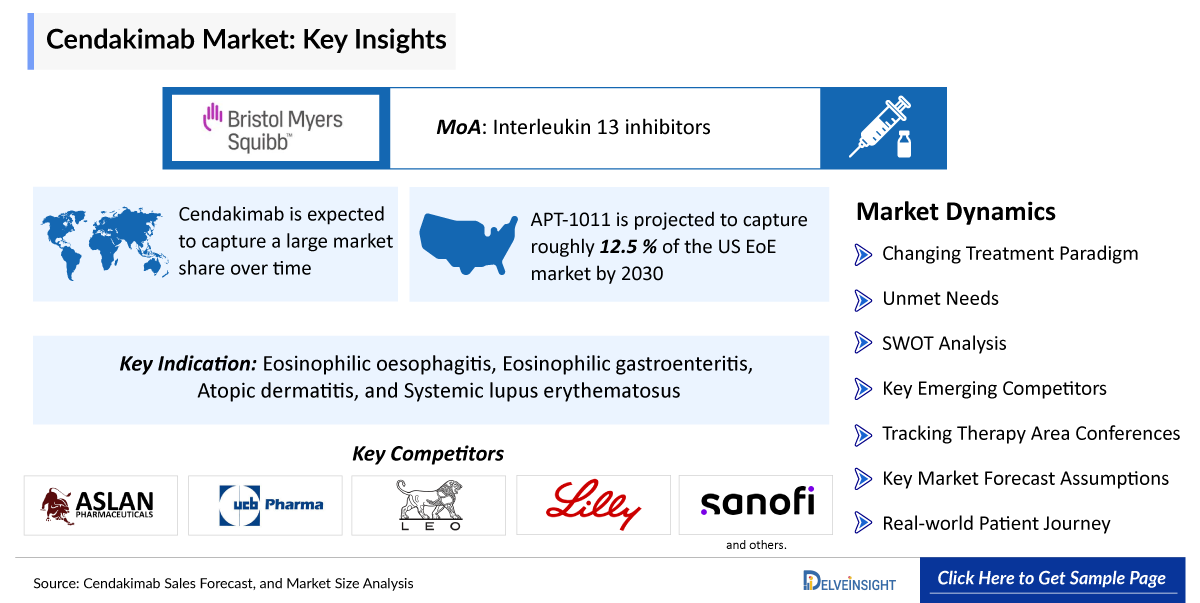
- Market research suggests that among emerging therapies for EoE, cendakimab is expected to capture a large market share over time, potentially overtaking current leaders like DUPIXENT and other biologics in the forecast period through 2034.
- These forecasts reflect both the unmet need in EoE and the increasing adoption of biologic therapies as the standard of care, which supports long-term growth potential for novel agents like cendakimab.
5. Competitive Positioning and Anticipated Uptake
- Despite DUPIXENT dominating early EoE biologic sales due to its dual IL-4/IL-13 inhibition, pipeline reports indicate that Cendakimab’s IL-13 specificity + Phase III evidence may allow it to become a market leader by the mid-to-late 2030s.
- Forecasts for the broader EoE market also highlight that emerging therapeutics—including cendakimab—will progressively displace traditional approaches and contribute a notable portion of future revenue growth as diagnosis and clinician adoption increase.
Cendakimab Recent Developments
- In November 2025, Evan Dellon leads Phase III trial on Cendakimab for Eosinophilic Esophagitis. The study’s results suggest Cendakimab offers clinically meaningful improvements in symptoms, histology, and endoscopic outcomes for patients with EoE. Importantly, the tested therapy demonstrated a manageable safety profile, reinforcing IL-13 as a viable therapeutic target in type 2 inflammatory diseases.
“Cendakimab Sales Forecast, and Market Size Analysis – 2034” report provides comprehensive insights of Cendakimab for potential indication like Eosinophilic oesophagitis, Eosinophilic gastroenteritis, Atopic dermatitis, and Systemic lupus erythematosus in the 7MM. A detailed picture of Cendakimab’s existing usage in anticipated entry and performance in potential indications in the 7MM, i.e., the United States, EU4 (Germany, France, Italy, and Spain) and the United Kingdom, and Japan for the study period 2020 –2034 is provided in this report along with a detailed description of the Cendakimab for potential indications. The Cendakimab market report provides insights about Cendakimab’s sales forecast, mechanism of action (MoA), dosage and administration, as well as research and development including regulatory milestones, along with other developmental activities. Further, it also consists of historical and current Cendakimab performance, future market assessments inclusive of the Cendakimab market forecast analysis for potential indications in the 7MM, SWOT, analysts’ views, comprehensive overview of market competitors, and brief about other emerging therapies in respective indications. It also provides analysis of Cendakimab sales forecasts, along with factors driving its market.
Cendakimab Drug Summary
Cendakimab is a humanized monoclonal antibody that specifically targets interleukin-13 (IL-13), a key type 2 cytokine driving inflammation, eosinophil recruitment, epithelial barrier disruption, and fibrosis in eosinophilic esophagitis (EoE), a chronic allergic condition causing dysphagia and esophageal narrowing. Developed by Bristol Myers Squibb (formerly Celgene), it is administered subcutaneously (typically 360 mg weekly or 720 mg every 2-4 weeks in trials) and has shown significant histologic remission (e.g., ≤6 eos/hpf), endoscopic improvements, and symptom relief (dysphagia reduction) in phase 3 trials like NCT04753697 for adults and adolescents with active EoE inadequately controlled by proton pump inhibitors or steroids. Phase II data also support its efficacy in moderate-to-severe atopic dermatitis, with dose-dependent EASI score reductions (up to 50% achieving EASI-75 at 720 mg weekly), pruritus relief, and a favorable safety profile (well-tolerated, no dose-limiting adverse events beyond mild injection-site reactions). As of late 2025, it remains investigational, with ongoing development focused on EoE as primary indication. The report provides Cendakimab’s sales, growth barriers and drivers, post usage and approvals in multiple indications.
Scope of the Cendakimab Market Report
The report provides insights into:
- A comprehensive product overview including the Cendakimab MoA, description, dosage and administration, research and development activities in potential indication like Eosinophilic oesophagitis, Eosinophilic gastroenteritis, Atopic dermatitis, and Systemic lupus erythematosus.
- Elaborated details on Cendakimab regulatory milestones and other development activities have been provided in Cendakimab market report.
- The report also highlights Cendakimab‘s cost estimates and regional variations, reported and estimated sales performance, research and development activities in potential indications across the United States, Europe, and Japan.
- The Cendakimab market report also covers the patents information, generic entry and impact on cost cut.
- The Cendakimab market report contains current and forecasted Cendakimab sales for potential indications till 2034.
- Comprehensive coverage of the late-stage emerging therapies for respective indications.
- The Cendakimab market report also features the SWOT analysis with analyst views for Cendakimab in potential indications.
Methodology
The Cendakimab market report is built using data and information sourced primarily from internal databases, primary and secondary research and in-house analysis by DelveInsight’s team of industry experts. Information and data from the secondary sources have been obtained from various printable and nonprintable sources like search engines, news websites, global regulatory authorities websites, trade journals, white papers, magazines, books, trade associations, industry associations, industry portals and access to available databases.
Cendakimab Analytical Perspective by DelveInsight
In-depth Cendakimab Market Assessment
This Cendakimab sales market forecast report provides a detailed market assessment of Cendakimab for potential indication like Eosinophilic oesophagitis, Eosinophilic gastroenteritis, Atopic dermatitis, and Systemic lupus erythematosus in the seven major markets, i.e., the United States, EU4 (Germany, France, Italy, and Spain) and the United Kingdom, and Japan. This segment of the report provides current and forecasted Cendakimab sales data uptil 2034.
Cendakimab Clinical Assessment
The Cendakimab market report provides the clinical trials information of Cendakimab for potential indications covering trial interventions, trial conditions, trial status, start and completion dates.
Cendakimab Competitive Landscape
The report provides Insights on competitors and marketed products within the domain, along with a summary of emerging products and their respective launch dates, posing significant competition in the market.
Cendakimab Market Potential & Revenue Forecast
- Projected market size for the Cendakimab and its key indications
- Estimated Cendakimab sales potential (Cendakimab peak sales forecasts)
- Cendakimab Pricing strategies and reimbursement landscape
Cendakimab Competitive Intelligence
- Number of competing drugs in development (pipeline analysis)
- Cendakimab Market positioning compared to existing treatments
- Cendakimab Strengths & weaknesses relative to competitors
Cendakimab Regulatory & Commercial Milestones
- Cendakimab Key regulatory approvals & expected launch timelines
- Commercial partnerships, licensing deals, and M&A activity
Cendakimab Clinical Differentiation
- Cendakimab Efficacy & safety advantages over existing drugs
- Cendakimab Unique selling points
Cendakimab Market Report Highlights
- In the coming years, the Cendakimab market scenario is set to change due to strong adoption, increased prescriptions and broader uptake in multiple immunological indications; which would expand the size of the market.
- The Cendakimab companies are developing therapies that focus on novel approaches to treat/improve the disease condition, assess challenges, and seek opportunities that could influence Cendakimab’s dominance.
- Other emerging products for corneal disorders are expected to give tough market competition to Cendakimab and launch of late-stage emerging therapies in the near future will significantly impact the market.
- A detailed description of regulatory milestones, and developmental activities, provide the current development scenario of Cendakimab in potential indications.
- Analyse Cendakimab cost, pricing trends and market positioning to support strategic decision-making in the immunology landscape.
- Our in-depth analysis of the forecasted Cendakimab sales data uptil 2034 will support the clients in decision-making process regarding their therapeutic portfolio by identifying the overall scenario of Cendakimab in potential indications.
Key Questions Answered In The Cendakimab Market Report
- What is the class of therapy, route of administration and mechanism of action of Cendakimab? How strong is Cendakimab’s clinical and commercial performance?
- What is Cendakimab’s clinical trial status in each individual indications such as Eosinophilic oesophagitis, Eosinophilic gastroenteritis, Atopic dermatitis, and Systemic lupus erythematosus and study completion date?
- What are the key collaborations, mergers and acquisitions, licensing and other activities related to the Cendakimab Manufacturers?
- What are the key designations that have been granted to Cendakimab for potential indications? How are they going to impact Cendakimab’s penetration in various geographies?
- What is the current and forecasted Cendakimab market scenario for potential indications? What are the key assumptions behind the forecast?
- What are the current and forecasted sales of Cendakimab in the seven major countries, including the United States, Europe (Germany, France, Italy, Spain) and the United Kingdom, and Japan?
- What are the other emerging products available and how are these giving competition to Cendakimab for potential indications?
- Which are the late-stage emerging therapies under development for the treatment of potential indications?
- How cost-effective is Cendakimab? What is the duration of therapy and what are the geographical variations in cost per patient?

