
Central Venous Catheters Market Summary
- The Central Venous Catheters market is estimated at USD 3.10 billion in 2025 and is projected to reach USD 5.51 billion by 2034. Growth is anchored in the rising burden of cancer, kidney disease, and critical illness, growing ICU and surgical volumes, and continued innovation in antimicrobial and antithrombogenic catheter technologies that reduce bloodstream infection risk.
- The global Central Venous Catheters market is growing at a CAGR of 6.6% during the forecast period from 2026 to 2034.
- By product type, the non-tunneled central venous catheters segment dominated the Central Venous Catheters market with a 57% share in 2025.
- By design, the double lumen central venous catheters segment dominated the Central Venous Catheters market with a 38% share in 2025.
- By placement site, the internal jugular vein segment dominated the Central Venous Catheters market with a 45% share in 2025.
- By end-user, the hospitals and clinics segment dominated the Central Venous Catheters market with a 68% share in 2025.
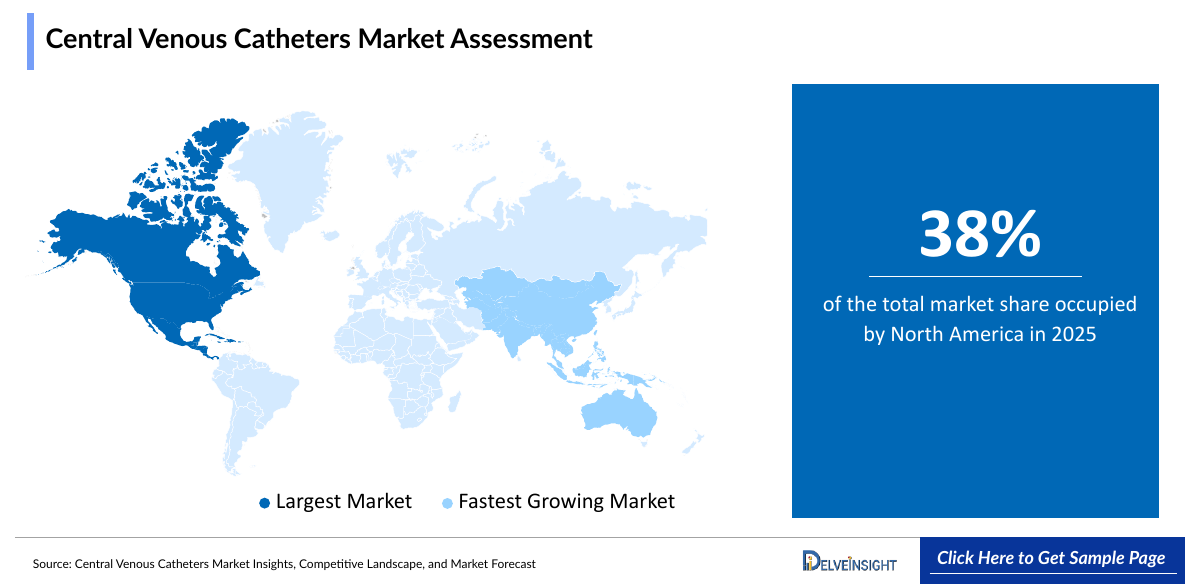
- North America dominated the global Central Venous Catheters market revenue with a 38% share in 2025, representing the highest regional market share globally.
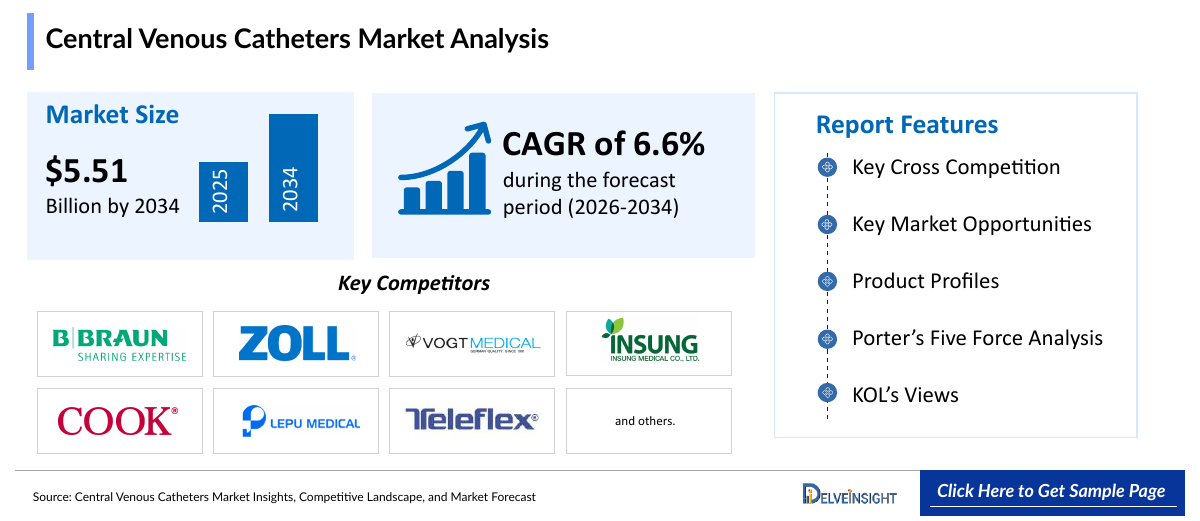
A central venous catheter (CVC) is a long, flexible catheter inserted into a large central vein, most commonly the internal jugular, subclavian, or femoral vein, with its tip positioned in or near the superior vena cava or right atrium. CVCs allow clinicians to deliver intravenous fluids, vasopressors, antibiotics, chemotherapy, parenteral nutrition, and blood products, to draw blood samples, and to monitor central venous pressure, particularly in patients whose peripheral veins are unsuitable or whose therapy is irritating, prolonged, or high-risk. The market is organized by product type across tunneled and non-tunneled central venous catheters; by design across single lumen, double lumen, and multiple lumen catheters; by placement site across the internal jugular, femoral, and subclavian veins; by end-user across hospitals and clinics, ambulatory surgical centers, and others; and by geography. Driven by a growing chronic disease and cancer burden, expanding ICU capacity and surgical volumes, rising demand for long-term and home-based infusion therapy, and strong focus on reducing catheter-related bloodstream infections through antimicrobial coatings, ultrasound guidance, and integrated insertion kits, central venous catheters remain a foundational vascular access technology in modern acute and chronic care.
Central Venous Catheters Market Key Growth Drivers
- Rising chronic disease burden and critical care admissions, including cancer, kidney failure, cardiovascular disease, and sepsis, are increasing demand for reliable central vascular access, with the World Health Organization estimating 48.9 million sepsis cases and 11 million sepsis-related deaths globally in 2017.
- The growing global cancer burden is expanding chemotherapy and long-term infusion needs, with the International Agency for Research on Cancer projecting cancer cases to rise from 20 million in 2022 to 35 million by 2050.
- Rising surgical volumes and the continued expansion of ICU, emergency, and critical care capacity are increasing the use of CVCs for fluid resuscitation, hemodynamic monitoring, and multi-drug infusion.
- Technological advances, including antimicrobial and antithrombogenic coatings, ultrasound-guided insertion, ECG-based tip navigation, and integrated maximal-barrier insertion kits, are improving safety and clinician confidence in central line use.
- The shift of infusion therapy toward ambulatory surgical centers, outpatient clinics, and home settings is increasing demand for tunneled and long-term central venous access devices.
- Infection-prevention mandates, hospital line-care bundles, and clinical guidelines on catheter-related bloodstream infections are steering purchasing toward premium coated catheters and standardized insertion packs.
- The convergence of chronic disease burden, critical care growth, outpatient care migration, and product innovation is expected to sustain steady mid-single-digit growth in the market through 2034.
Key Companies in Central Venous Catheters Market
The competitive landscape is led by the following active manufacturers:
- B. Braun Melsungen AG
- ZOLL Medical Corporation
- VOGT Medical
- Insung Medical
- Cook Group
- Lepu Medical Technology Co., Ltd
- Teleflex Incorporated
- Poly Medicure Ltd.
- ICU Medical Inc.
- Becton, Dickinson and Company
- Edwards Lifesciences Corporation
For illustrative purposes, only the top 10 companies are listed in the Table of Contents. The report may include analysis and references to additional companies relevant to the market assessment.
Central Venous Catheters Market Size
The following snapshot summarizes the principal report metrics for the Central Venous Catheters market.
|
Report Metrics |
Details |
|
2025 Market Size |
USD 3.10 billion |
|
2034 Projected Market Size |
USD 5.51 billion |
|
Growth Rate (2026-2034) |
6.6% CAGR |
|
Largest Market |
North America |
|
Fastest Growing Market |
Asia-Pacific |
|
Market Structure |
Moderately Concentrated |
All market values are expressed in USD and represent DelveInsight estimates synthesized from primary and secondary research.
Factors Contributing to the Growth of the Central Venous Catheters Market
Market Drivers
Rising Chronic Disease Burden and Critical Care Admissions
The most powerful driver of the Central Venous Catheters market is the rising burden of chronic and critical illness that requires dependable central vascular access. Cancer, chronic kidney failure, cardiovascular disease, and sepsis all generate sustained demand for intravenous therapy that peripheral lines cannot safely support. The World Health Organization estimated 48.9 million sepsis cases and 11 million sepsis-related deaths globally in 2017, and central access remains integral to fluid resuscitation, vasopressor delivery, and hemodynamic monitoring in severe cases. As populations age and multi-morbidity increases, more patients are admitted to intensive care units and require prolonged infusion of irritant or high-osmolarity drugs, parenteral nutrition, and blood products. Because central venous catheters deliver therapy directly into large central veins and allow central venous pressure monitoring, hospitals treat them as essential equipment in critical care pathways. This sustained clinical need anchors procedure volumes and device demand through 2034.
Growing Cancer Incidence and Chemotherapy Administration
The rising global cancer burden is expanding the population that needs long-term central venous access. The International Agency for Research on Cancer recorded 20 million new cancer cases in 2022 and projects 35 million by 2050. Many chemotherapy regimens use vesicant or irritant agents that are best delivered through a central vein to protect peripheral vessels, and patients often need access for weeks or months, which favors tunneled catheters and other long-dwell devices. Oncology care is also moving into outpatient infusion centers and the home, which raises demand for catheters designed for long-term use with low complication rates. As cancer prevalence and survival both increase, the number of patients who require repeated, long-term vascular access rises in step, and chemotherapy is widely expected to be among the fastest-growing application areas for central venous catheters across the forecast period.
Rising Surgical Volumes and ICU Capacity Expansion
Expanding surgical activity and critical care infrastructure are increasing the installed base of procedures that use central venous catheters. Major cardiac, thoracic, abdominal, transplant, and trauma surgeries routinely require central access for fluid management, vasoactive drug infusion, and pressure monitoring, while emergency departments rely on femoral and jugular lines in resuscitation. Hospitals in both developed and emerging economies are adding ICU beds, upgrading emergency services, and standardizing critical care protocols, which directly increases consumption of single-use central line kits. Ambulatory surgical centers are also adopting central access for same-day procedures and post-operative care as minimally invasive techniques and shorter stays spread. Because CVCs are single-use consumables that are replaced with every patient episode, growth in procedure and bed capacity converts quickly into recurring device demand across the forecast period.
Technological Advancements in Catheter Materials, Coatings, and Guidance
Continuous innovation is improving the safety profile of central venous catheters and widening clinical acceptance. Manufacturers have introduced antimicrobial coatings such as chlorhexidine-based and minocycline-rifampin-impregnated catheters, antithrombogenic surfaces, heparin-bonded designs, and more flexible multi-lumen configurations that ease insertion and reduce occlusion. Ultrasound-guided insertion and ECG-based tip confirmation improve placement accuracy and reduce the need for confirmatory imaging, and companies such as Teleflex have continued to advance Arrow catheter navigation and complete insertion systems, while BD has launched a next-generation insertion platform that unifies multiple procedural steps. Maximal-barrier insertion kits and securement solutions further support best practice. Together, these advances lower infection and misplacement risks, support longer dwell times, and give hospitals clear clinical and economic reasons to trade up to premium catheters, reinforcing value growth in the market through 2034.
Shift Toward Ambulatory, Outpatient, and Home-Based Infusion Care
The migration of infusion therapy from inpatient wards to outpatient and home settings is a structural growth driver. Cost-containment pressure, patient preference, and advances in portable infusion technology are moving chemotherapy, antibiotic therapy, parenteral nutrition, and dialysis support into ambulatory surgical centers, infusion clinics, and the home. These settings favor tunneled and long-term central venous access devices that remain secure for weeks or months and resist infection, and they require products that are simple for trained nurses and caregivers to manage. Ambulatory surgical centers are widely expected to be the fastest-growing end-user as same-day discharge protocols spread. As care delivery decentralizes, manufacturers that offer dependable long-dwell catheters, securement devices, and training support are positioned to capture incremental demand outside the traditional hospital channel across the forecast period.
Infection-Prevention Mandates and Clinical Guidelines
Regulators, accreditation bodies, and professional societies place strong emphasis on preventing catheter-related bloodstream infections, and this is shaping purchasing decisions worldwide. Hospital line-care bundles, maximal sterile barrier requirements, chlorhexidine skin antisepsis, and reimbursement penalties linked to hospital-acquired infections have made infection control a board-level priority. Guidelines encourage ultrasound-guided insertion, preferential site selection such as the internal jugular or subclavian vein over the femoral vein where feasible, and prompt removal of unnecessary lines. These practices increase demand for antimicrobial-coated catheters, standardized insertion trays, and securement and dressing products, and they raise the bar for clinical evidence supporting new devices. Manufacturers with strong clinical data, broad portfolios, and established hospital relationships benefit, as institutions consolidate suppliers to standardize safe practice across the forecast period.
Healthcare Infrastructure Investment and Manufacturing Expansion in Emerging Markets
Expanding healthcare infrastructure and regional manufacturing capacity are broadening access to central venous catheters. Asia-Pacific, the Middle East, and Latin America are investing in hospital networks, critical care units, and oncology and dialysis centers, which raises device utilization. At the same time, regional manufacturers are scaling production: Poly Medicure has been adding plant capacity and expanding its portfolio and international footprint, and companies such as Lepu Medical Technology in China and Insung Medical in South Korea are strengthening domestic and export positions. Industry consolidation, including BD's USD 4.2 billion acquisition of Edwards Lifesciences' Critical Care product group completed in September 2024, is also reshaping the competitive landscape and the hospital channel. Greater local production improves affordability and availability, supporting volume growth in price-sensitive regions through 2034.
Market Restraints
Despite steady momentum, the Central Venous Catheters market faces material constraints. Catheter-related bloodstream infections, venous thrombosis, and mechanical complications such as occlusion, dislodgement, and malposition remain persistent clinical concerns that raise morbidity, lengthen hospital stays, and increase costs, and they attract scrutiny from hospitals, regulators, and payers. Insertion complications, including pneumothorax, arterial puncture, and bleeding, depend heavily on operator skill, and the requirement for trained clinicians and ongoing line-care competence limits adoption in smaller or resource-constrained facilities. Stringent and evolving regulatory requirements across the FDA, the European Union Medical Device Regulation, and other national authorities lengthen approval timelines and raise compliance costs, and product recalls can damage brand trust. Hospital group purchasing, public tenders, and cost-containment pressure drive intense price competition, particularly for standard non-coated catheters, which compresses margins. The market also faces substitution from peripherally inserted central catheters, midlines, implanted ports, and extended-dwell peripheral catheters, which can be preferred for selected patients. Raw-material, sterilization-capacity, and supply-chain disruptions can further pressure availability and costs. Together, these clinical, regulatory, and pricing barriers temper the pace of growth, even as the underlying drivers of chronic disease burden, critical care expansion, and outpatient infusion remain firmly intact.
Central Venous Catheters Market Segment Analysis
The Central Venous Catheters Market is segmented by product type (tunneled central venous catheters, non-tunneled central venous catheters), design (single lumen central venous catheters, double lumen central venous catheters, multiple lumen central venous catheters), placement site (internal jugular vein, femoral vein, subclavian vein), end-user (hospitals and clinics, ambulatory surgical centers, others), and geography (North America, Europe, Asia-Pacific, and Rest of World).
By Product Type
Dominant Subsegment: Non-Tunneled Central Venous Catheters.
The non-tunneled central venous catheters segment accounted for 57% of the Central Venous Catheters market in 2025. Non-tunneled catheters are the leading product type because they are the standard device for short-term access in intensive care, emergency, perioperative, and general inpatient settings, where rapid bedside insertion, immediate usability, and low upfront procedural complexity matter most. They are inserted directly through the skin into the target vein without a subcutaneous tunnel, which allows clinicians to establish central access quickly in unstable patients for fluid resuscitation, vasopressors, and monitoring. High ICU admission and surgical volumes, the single-use nature of these devices, and their broad availability in kits with antimicrobial options sustain recurring demand. Tunneled catheters, which are designed for weeks to months of use in chemotherapy, long-term parenteral nutrition, and dialysis support, are the faster-growing product type as oncology and home-infusion care expand, and they are backed by strong infection-resistance advantages. Nonetheless, the sheer volume of acute-care procedures keeps non-tunneled catheters the dominant product type across the forecast period.
By Design
Dominant Subsegment: Double Lumen Central Venous Catheters.
The double lumen central venous catheters segment accounted for 38% of the Central Venous Catheters market in 2025. Double lumen catheters lead the design segment because they offer a practical balance between functionality and risk: two independent channels allow clinicians to infuse incompatible drugs, deliver fluids while sampling blood or monitoring pressure, and support common critical care and chronic therapy needs, while remaining easier to insert and associated with fewer complications than higher-lumen designs. They are widely used in emergencies, intensive care, and chronic disease management, and they suit a broad range of adult patients. Multiple lumen catheters, including triple and higher lumen configurations, are the fastest-growing design as complex ICU, oncology, and surgical patients require simultaneous infusion of vasopressors, antibiotics, parenteral nutrition, and blood products through a single access point. Single lumen catheters retain a role in simpler therapies and in pediatric and smaller-vessel use, where the smallest practical catheter diameter is preferred. The versatility and favorable risk profile of double lumen designs secure their leadership across the forecast period.
By Placement Site
Dominant Subsegment: Internal Jugular Vein.
The internal jugular vein segment accounted for 45% of the Central Venous Catheters market in 2025. The internal jugular vein is the leading placement site because it offers easy anatomical access, reliable ultrasound visualization, a direct path to the superior vena cava, and a comparatively low rate of insertion and infection complications. Clinical guidelines and established practice favor the internal jugular and subclavian veins over the femoral vein where feasible, and widespread use of real-time ultrasound guidance has made jugular cannulation safer and more reproducible, reinforcing clinician preference. It is the default choice for many cardiac surgery, oncology, and intensive care procedures. The femoral vein is the fastest-growing placement site, supported by rapid insertion in emergencies and trauma, minimal interference with airway management, and use in patients with limited upper-body access, while advances in infection control are improving its acceptability. The subclavian vein remains valued for patient comfort and lower infection risk in longer-term use, but carries a higher risk of pneumothorax. The clinical preference, safety profile, and guideline support for the internal jugular approach secure its leadership across the forecast period.
By End-User
Dominant Subsegment: Hospitals and Clinics.
The hospitals and clinics segment accounted for 68% of the Central Venous Catheters market in 2025. Hospitals and clinics are the leading end-user because they perform the large majority of procedures that require central venous access, including critical care, emergency resuscitation, major surgery, oncology infusion, and dialysis support. They concentrate the trained clinicians, ICU infrastructure, imaging and ultrasound equipment, and infection-control programs needed to insert and manage central lines safely, and they are the principal entry point for acute and complex patients. High patient inflow and the rising incidence of chronic and acute conditions sustain recurring demand for single-use catheters and kits, and institutional purchasing through group contracts and tenders reinforces the segment's scale. Ambulatory surgical centers are the fastest-growing end-user as minimally invasive procedures, same-day discharge, and cost-saving care models shift suitable cases out of the hospital. The remaining end-users, including home-care and specialty infusion providers, are expanding with long-term therapy. The breadth of procedures and infrastructure advantages of hospitals and clinics keep them dominant across the forecast period.
Central Venous Catheters Market Region Analysis
Dominant Region: North America
North America accounted for 38% of the global Central Venous Catheters market revenue in 2025, representing the highest regional market share globally. The region's leadership reflects a high prevalence of chronic disease and cancer, advanced hospital and critical care infrastructure, high procedure volumes, and strong adoption of premium antimicrobial catheters and integrated insertion systems, particularly in the United States. North America is home to leading manufacturers such as BD, Teleflex, ICU Medical, and Cook Group, and benefits from established clinical guidelines on infection prevention, a mature group-purchasing environment, and favorable reimbursement for oncology and dialysis therapy. Heavy use of ultrasound-guided insertion, rising outpatient and home infusion, and continued product innovation sustain demand for both acute and long-term central venous access devices. Together, these factors anchor the region's continued leadership across the forecast period.
Fastest Growing Region: Asia-Pacific
Asia-Pacific is the fastest-growing region in the Central Venous Catheters market. The region's elevated CAGR is driven by rapid expansion of hospital and critical care infrastructure, rising cancer and chronic disease incidence, growing surgical volumes, and increasing healthcare spending across China, Japan, India, South Korea, and Australia. Rising awareness of infection control, expansion of oncology and dialysis services, medical tourism, and government healthcare initiatives are broadening access to central venous catheters. Regional manufacturers, including Lepu Medical Technology in China, Poly Medicure in India, and Insung Medical in South Korea, are scaling production and exports, improving affordability and local availability. The combination of a large patient population, expanding care infrastructure, and strengthening local manufacturing positions Asia-Pacific as the principal source of incremental growth over the forecast period.
Regional Commentary
North America
North America accounted for 38% of the global Central Venous Catheters market revenue in 2025. The United States dominates on the strength of its critical care infrastructure, high procedure volumes, advanced infection-prevention practices, and the presence of leading manufacturers, while growth in outpatient infusion and adoption of coated and ultrasound-guided systems reinforce its leadership.
Europe
Europe is the second-largest regional market, supported by advanced healthcare systems, an aging population, high acceptance of infection-control catheters, and established reimbursement and regulatory frameworks under the European Union Medical Device Regulation. Home to manufacturers such as B. Braun and VOGT Medical, the region benefits from strong local supply and demand across Germany, France, the United Kingdom, Italy, and Spain.
Asia-Pacific
Asia-Pacific is the fastest-growing region, propelled by expanding hospital infrastructure, rising cancer and chronic disease incidence, and growing healthcare investment across China, Japan, India, South Korea, and Australia. Local manufacturing scale-up by Lepu Medical Technology, Poly Medicure, and Insung Medical, together with expanding ICU and oncology capacity, is accelerating regional adoption.
Rest of World
The Rest of World region, spanning Latin America, the Middle East, and Africa, is an emerging growth frontier. Rising healthcare spending, hospital construction, and growing use of oncology, dialysis, and emergency care are gradually broadening access to central venous catheters, although limited availability of advanced healthcare facilities and trained staff in some markets continues to temper adoption.
Central Venous Catheters Market Competitive Landscape
The Central Venous Catheters market is classified as Moderately Concentrated. A group of large, diversified vascular access and critical care players with broad hospital relationships, including Becton, Dickinson and Company, Teleflex, B. Braun, ICU Medical, and Cook Group, anchors the top tier through comprehensive catheter, kit, and securement portfolios and strong clinical evidence, while specialized and regional manufacturers such as ZOLL Medical Corporation, VOGT Medical, Insung Medical, Lepu Medical Technology, and Poly Medicure compete through targeted technologies, cost-competitive production, and regional distribution, increasing competition across both premium and value segments.
The competitive landscape can be evaluated across the following dimensions:
- Market concentration: Moderately concentrated, with large diversified vascular access players leading and a field of specialized and regional manufacturers competing on technology and price.
- Leading players: Becton, Dickinson and Company, Teleflex, B. Braun, ICU Medical, and Cook Group anchor the top tier through broad portfolios and deep hospital relationships.
- Geographic reach: Leaders operate global manufacturing and distribution networks, while regional players such as Poly Medicure, Lepu Medical Technology, and Insung Medical are expanding exports from Asia.
- Product portfolio strength: Top players offer tunneled and non-tunneled catheters across single, double, and multiple lumen designs, together with insertion kits, securement, and tip-confirmation systems.
- Clinical differentiation: Antimicrobial and antithrombogenic technologies, such as chlorhexidine-based and minocycline-rifampin coatings, and ultrasound and ECG tip-navigation compatibility are key differentiators.
- Strategic partnerships: Group purchasing agreements, hospital supply contracts, and collaborations with clinicians and research institutions extend reach and support product adoption.
- M&A activity: Active consolidation, including BD's USD 4.2 billion acquisition of Edwards Lifesciences' Critical Care product group (September 2024) and Poly Medicure's 2025 acquisitions of PendraCare International and MediStream (Citieffe).
- Manufacturing capabilities: Scaled, automated extrusion and assembly, validated sterilization capacity, and quality systems compliant with FDA and EU MDR requirements are key competitive moats.
- Innovation focus: Infection and thrombosis prevention, integrated insertion platforms, guidance and tip-positioning technologies, and longer-dwell catheter designs.
Central Venous Catheters Market Recent Developmental Activities
In 2026, Teleflex Incorporated continued to advance its Arrow vascular access systems, enhancing catheter navigation technologies to support more accurate central venous catheter placement in acute care and emergency medicine settings. Strategic significance: Strengthens Teleflex's differentiation in guided placement and reinforces its position in acute-care vascular access.
In 2026, Becton, Dickinson and Company, launched a next-generation central venous catheter insertion platform that integrates multiple procedural steps into a unified insertion workflow, designed to simplify central line placement and improve safety in high-pressure clinical environments. Strategic significance: Advances procedural standardization and expands BD's integrated vascular access offering.
In 2025, B. Braun Melsungen AG launched new catheter securement and vascular access innovations and expanded its IV and infusion-related catheter safety solutions to improve clinical workflow efficiency. Strategic significance: Broadens B. Braun's infusion and vascular access safety portfolio for hospital customers.
In 2025, ICU Medical Inc. expanded its infusion therapy and catheter-based delivery systems, with an emphasis on closed-system drug transfer and vascular access safety to reduce bloodstream infection risk in hospital central venous catheter use. Strategic significance: Reinforces ICU Medical's infection-prevention positioning across infusion and vascular access.
In 2025, Poly Medicure Ltd. completed its acquisition of Pendracare International BV and announced the acquisition of MediStream SA, which includes Citieffe SRL, while continuing to add manufacturing capacity, with new plants targeted for commissioning around mid-2026. Strategic significance: Extends Poly Medicure's European and global distribution reach and supports scale-up of its central venous access and critical care portfolio.
In 2024, Teleflex Incorporated introduced next-generation Arrow VPS Rhythm DLX technology for catheter tip navigation and the Arrow ErgoPack Complete System with antimicrobial technology for central lines. Strategic significance: Combines guidance and infection-prevention technologies into complete insertion solutions.
In September 2024, Becton, Dickinson and Company, completed its acquisition of Edwards Lifesciences' Critical Care product group for USD 4.2 billion in cash, renaming it BD Advanced Patient Monitoring. Strategic significance: Adds advanced hemodynamic monitoring and AI-enabled clinical decision tools to complement BD's infusion and vascular access franchise.
In September 2024, Edwards Lifesciences Corporation completed the sale of its Critical Care product group to BD to sharpen its focus as a structural heart innovator. Strategic significance: Reshapes the critical care and monitoring landscape and consolidates central venous monitoring-related catheters under BD.
Central Venous Catheters Market Segmentation
Central Venous Catheters Market by Product Type
- Tunneled Central Venous Catheters
- Non-Tunneled Central Venous Catheters
Central Venous Catheters Market by Design
- Single Lumen Central Venous Catheters
- Double Lumen Central Venous Catheters
- Multiple Lumen Central Venous Catheters
Central Venous Catheters Market by Placement Site
- Internal Jugular Vein
- Femoral Vein
- Subclavian Vein
Central Venous Catheters Market by End-Users
- Hospitals and Clinics
- Ambulatory Surgical Centers
- Others
Central Venous Catheters Market by Geography
- North America Central Venous Catheters Market
- United States Central Venous Catheters Market Size in USD million (2023-2034)
- Canada Central Venous Catheters Market Size in USD million (2023-2034)
- Mexico Central Venous Catheters Market Size in USD million (2023-2034)
- Europe Central Venous Catheters Market
- Germany Central Venous Catheters Market Size in USD million (2023-2034)
- United Kingdom Central Venous Catheters Market Size in USD million (2023-2034)
- France Central Venous Catheters Market Size in USD million (2023-2034)
- Italy Central Venous Catheters Market Size in USD million (2023-2034)
- Spain Central Venous Catheters Market Size in USD million (2023-2034)
- Rest of Europe Central Venous Catheters Market Size in USD million (2023-2034)
- Asia-Pacific Central Venous Catheters Market
- China Central Venous Catheters Market Size in USD million (2023-2034)
- Japan Central Venous Catheters Market Size in USD million (2023-2034)
- India Central Venous Catheters Market Size in USD million (2023-2034)
- Australia Central Venous Catheters Market Size in USD million (2023-2034)
- South Korea Central Venous Catheters Market Size in USD million (2023-2034)
- Rest of Asia-Pacific Central Venous Catheters Market Size in USD million (2023-2034)
- Rest of the World (RoW) Central Venous Catheters Market
- Middle East Central Venous Catheters Market Size in USD million (2023-2034)
- Africa Central Venous Catheters Market Size in USD million (2023-2034)
- South America Central Venous Catheters Market Size in USD million (2023-2034)
Central Venous Catheters Market Recent Industry Trends and Milestones (2023-2026)
|
Category |
Key Developments |
|
Central Venous Catheters Market Product Approval |
Product innovation is centered on infection and thrombosis prevention and on simplifying insertion. Teleflex has continued to advance Arrow catheter navigation and, in 2024, introduced Arrow VPS Rhythm DLX tip-navigation technology and the Arrow ErgoPack Complete System with antimicrobial technology, while BD launched a next-generation insertion platform in 2026 that integrates multiple procedural steps into a single workflow. B. Braun expanded its catheter securement and vascular access safety solutions in 2025, and ICU Medical focused on reducing bloodstream infection risk in hospital central venous catheter use. Chlorhexidine-based and minocycline-rifampin antimicrobial catheters, antithrombogenic surfaces, and ultrasound and ECG-guided placement continue to raise clinical standards, supporting a steady shift toward premium catheters and complete insertion kits. |
|
Central Venous Catheters Market Expansion |
Manufacturers broadened capacity and reach to meet rising global demand. Poly Medicure expanded plant capacity, with new facilities targeted for commissioning around mid-2026, and extended its international footprint through the 2025 acquisitions of Pendracare International and MediStream (Citieffe). Regional manufacturers including Lepu Medical Technology in China and Insung Medical in South Korea strengthened domestic and export positions, while global leaders continued to scale automated extrusion, assembly, and sterilization capacity. Growth in ICU beds, oncology infusion, and dialysis capacity across Asia-Pacific, the Middle East, and Latin America expanded the addressable market for both premium and value catheters. |
|
Central Venous Catheters Market Investment |
Capital and consolidation reshaped the competitive landscape. BD completed its USD 4.2 billion acquisition of Edwards Lifesciences' Critical Care product group in September 2024, creating BD Advanced Patient Monitoring, and Edwards sharpened its focus on structural heart. Poly Medicure completed the acquisition of Pendracare International in 2025 and announced the acquisition of MediStream SA. Strategic investment is concentrating on infection-prevention technologies, advanced biomaterials, guided placement, and integrated procedural platforms, as large players seek to pair vascular access devices with monitoring, infusion, and securement offerings. |
|
Company Strategy |
B. Braun Melsungen AG: Broad infusion and vascular access safety portfolio, with expanded securement and catheter safety solutions. ZOLL Medical Corporation: Acute-care and critical care focus, including catheter-based therapeutic temperature management. VOGT Medical: Specialized European supplier of central venous catheters and vascular access products. Insung Medical: Korea-based catheter manufacturer expanding regional and export reach. Cook Group: Critical care and vascular access portfolio, including antimicrobial-impregnated catheters. Lepu Medical Technology Co., Ltd: China-based device manufacturer scaling domestic and international presence. Teleflex Incorporated: Arrow-brand leadership in antimicrobial catheters, guided placement, and complete insertion systems. Poly Medicure Ltd.: Cost-competitive manufacturing, capacity expansion, and global acquisitions. ICU Medical Inc.: Infusion therapy and vascular access safety focused on reducing bloodstream infection risk. Becton, Dickinson and Company: Integrated insertion platform, vascular access leadership, and advanced patient monitoring following the Edwards Critical Care acquisition. Edwards Lifesciences Corporation: Portfolio refocused on structural heart after divesting its Critical Care business to BD. |
|
Emerging Technologies |
Safety-driven and guidance-driven technologies are the leading edge of innovation. Antimicrobial and antithrombogenic coatings, heparin-bonded surfaces, and advanced biomaterials aim to lower infection, occlusion, and thrombosis rates and extend dwell time. Ultrasound-guided insertion, ECG-based tip confirmation, and real-time navigation reduce malposition and the need for confirmatory imaging, and AI-assisted catheter placement tools are beginning to emerge. Integrated, all-in-one insertion kits and securement systems standardize best practice, while flexible multi-lumen designs and long-dwell tunneled catheters support complex ICU, oncology, and home-infusion therapy. Collaborations between manufacturers, hospitals, and research institutions are accelerating clinical validation and adoption. |
Central Venous Catheters Market Startup Funding and Investment Trends
|
Company |
Total Funding |
Funding Stage |
Main Offering |
Core Technology |
|
Access Vascular, Inc. |
Venture-backed |
Growth venture |
Biomaterial-based vascular access catheters |
Advanced biomaterial catheter design |
|
Request to unlock the report on the @ Central Venous Catheters Market | ||||
Investment in the central venous catheter ecosystem has concentrated on infection-prevention and antithrombogenic technologies, advanced biomaterials, guided placement, and portfolio consolidation among large medical device companies. The following companies illustrate recent funding and investment activity and technology focus.
Capital is flowing toward companies that reduce catheter-related infection and thrombosis, simplify insertion, and extend dwell time. BD's USD 4.2 billion acquisition of Edwards Lifesciences' Critical Care product group underscores the strategic value of critical care and vascular access portfolios, while Poly Medicure's 2025 acquisitions and plant expansion show regional manufacturers building scale and global reach. Emerging and specialized players such as Access Vascular, which develops biomaterial-based vascular access catheters, and Bactiguard, which licenses infection-prevention coating technology, are advancing differentiated materials and coatings. Collectively, these investments signal conviction that infection prevention, integrated insertion systems, advanced biomaterials, and long-dwell catheter design will define the next phase of competitive advantage in the global central venous catheters market.
Key Takeaways from the Central Venous Catheters Market Report Study
- Market size analysis for the current Central Venous Catheters market size (2025), and market forecast for 9 years (2026 to 2034).
- Top key product/technology developments, mergers, acquisitions, partnerships, and joint ventures that happened over the last 3 years.
- Key companies dominating the global Central Venous Catheters market.
- Various opportunities available for competitors in the Central Venous Catheters market space.
- What are the top-performing segments in 2025? How will these segments perform in 2034?
- Which are the top-performing regions and countries in the current Central Venous Catheters market scenario?
- Which are the regions and countries where companies should concentrate their opportunities for Central Venous Catheters market growth in the future?
Target audience who can benefit from this Central Venous Catheters market report study
- Central Venous Catheters product providers
- Research organizations and consulting companies
- Central Venous Catheters -related organizations, associations, forums, and other alliances
- Government and corporate offices
- Start-up companies, venture capitalists, and private equity firms
- Distributors and traders dealing in Central Venous Catheters
- Various end-users who want to know more about the Central Venous Catheters market and the latest technological developments in the Central Venous Catheters market.