
CFZ533 Market Summary
Key Factors Driving CFZ533 Growth
1. Novel CD40 pathway inhibition (non-depleting mechanism)
- CFZ533 is a fully human monoclonal antibody targeting CD40, blocking CD40–CD40L interaction without B-cell depletion (unlike anti-CD20 therapies).
- This pathway is central to:
o B-cell activation
o T-cell co-stimulation
o Autoantibody production (reported in peer-reviewed immunology literature/PubMed)
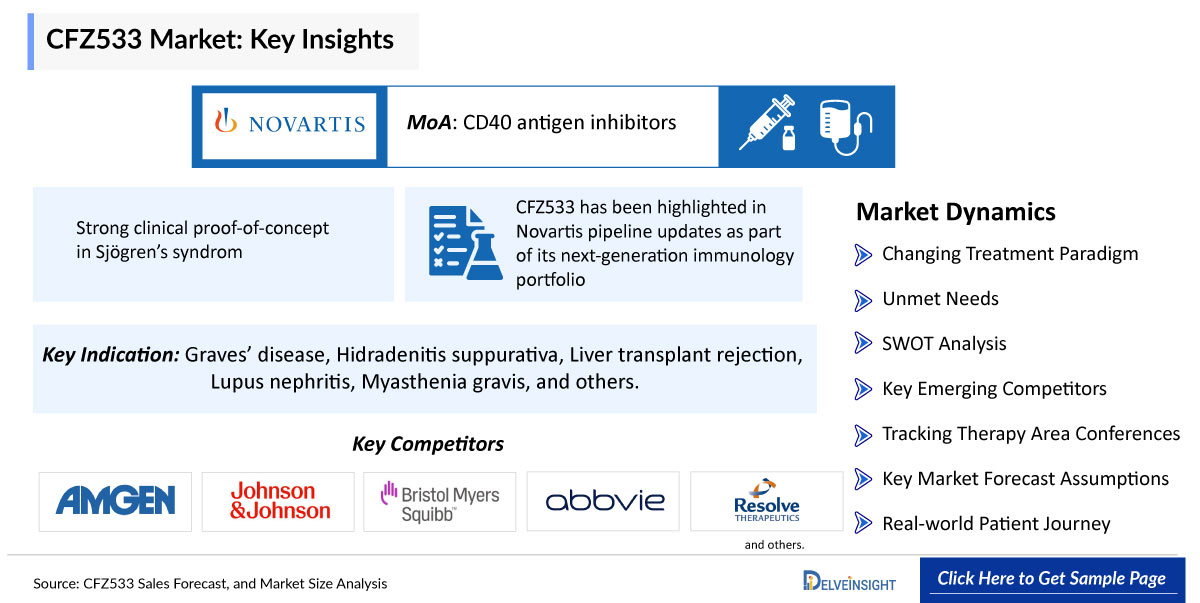
2. Strong clinical proof-of-concept in Sjögren’s syndrome
- Phase II study in primary Sjögren’s syndrome showed:
o Clinically meaningful improvements in ESSDAI scores (disease activity index)
o Favorable safety and tolerability profile (Novartis clinical publications & presentations)
3. Focus on high-value autoimmune indications
CFZ533 has been investigated in:
- Sjögren’s syndrome (lead indication)
- Kidney transplantation (prevention of rejection)
- Other autoimmune conditions (early-stage exploration)
4. Favorable safety profile vs competing mechanisms
- Unlike CD40L-targeting agents (historically associated with thromboembolic risk), CFZ533:
o Targets CD40 receptor instead of ligand
o Designed to avoid platelet activation issues seen in earlier CD40L inhibitors
5. Strategic positioning within Novartis immunology pipeline
- CFZ533 has been highlighted in Novartis pipeline updates as part of its next-generation immunology portfolio
- Complements other B-cell–targeting approaches (e.g., BAFF-R inhibitors like ianalumab)
CFZ533 Recent Developments
Phase II SS trials (e.g., TWINSS) showed safety, tolerability, and initial efficacy via ESSDAI improvements at Week 24, published in 2024. Multiple earlier trials (e.g., NCT03905525 for SS, NCT04129528 for type 1 diabetes) are completed or terminated; no active recruiting trials or new initiations noted as of March 2026. An ADA 2025 abstract (#ADA2025ADA_2531) covers iscalimab in adolescent/young adult type 1 diabetes, but no outcomes released yet.
“CFZ533 Sales Forecast, and Market Size Analysis – 2034” report provides comprehensive insights of CFZ533 for potential indication like Graves’ disease, Hidradenitis suppurativa, Liver transplant rejection, Lupus nephritis, Myasthenia gravis, Systemic lupus erythematosus, Type 1 diabetes mellitus, and Renal transplant rejection in the 7MM. A detailed picture of CFZ533’s existing usage in anticipated entry and performance in potential indications in the 7MM, i.e., the United States, EU4 (Germany, France, Italy, and Spain) and the United Kingdom, and Japan for the study period 2020 –2034 is provided in this report along with a detailed description of the CFZ533 for potential indications. The CFZ533 market report provides insights about CFZ533’s sales forecast, mechanism of action (MoA), dosage and administration, as well as research and development including regulatory milestones, along with other developmental activities. Further, it also consists of historical and current CFZ533 performance, future market assessments inclusive of the CFZ533 market forecast analysis for potential indications in the 7MM, SWOT, analysts’ views, comprehensive overview of market competitors, and brief about other emerging therapies in respective indications. It also provides analysis of CFZ533 sales forecasts, along with factors driving its market.
CFZ533 Drug Summary
CFZ533 is a fully human, non-depleting monoclonal antibody that targets CD40, a key costimulatory receptor expressed on antigen-presenting cells, and is being developed by Novartis for the treatment of autoimmune diseases and in organ transplantation. By binding to CD40, CFZ533 selectively blocks the CD40–CD40L signaling pathway, thereby inhibiting T-cell activation and downstream B-cell responses without causing broad immune cell depletion. This targeted immunomodulatory mechanism aims to reduce pathogenic immune activation while preserving baseline immune function, potentially offering a safer alternative to traditional immunosuppressive therapies. CFZ533 is administered via subcutaneous injection or intravenous infusion depending on the indication and remains in clinical development, with studies evaluating its efficacy in conditions such as Sjögren’s syndrome, systemic lupus erythematosus, and kidney transplant rejection prevention. Early clinical data suggest that CFZ533 can modulate disease activity and immune biomarkers, supporting its potential as a next-generation therapy in immune-mediated disorders. The report provides CFZ533’s sales, growth barriers and drivers, post usage and approvals in multiple indications.
Scope of the CFZ533 Market Report
The report provides insights into:
- A comprehensive product overview including the CFZ533 MoA, description, dosage and administration, research and development activities in potential indication like Graves’ disease, Hidradenitis suppurativa, Liver transplant rejection, Lupus nephritis, Myasthenia gravis, Systemic lupus erythematosus, Type 1 diabetes mellitus, and Renal transplant rejection.
- Elaborated details on CFZ533 regulatory milestones and other development activities have been provided in CFZ533 market report.
- The report also highlights CFZ533‘s cost estimates and regional variations, reported and estimated sales performance, research and development activities in potential indications across the United States, Europe, and Japan.
- The CFZ533 market report also covers the patents information, generic entry and impact on cost cut.
- The CFZ533 market report contains current and forecasted CFZ533 sales for potential indications till 2034.
- Comprehensive coverage of the late-stage emerging therapies for respective indications.
- The CFZ533 market report also features the SWOT analysis with analyst views for CFZ533 in potential indications.
Methodology
The CFZ533 market report is built using data and information sourced primarily from internal databases, primary and secondary research and in-house analysis by DelveInsight’s team of industry experts. Information and data from the secondary sources have been obtained from various printable and nonprintable sources like search engines, news websites, global regulatory authorities websites, trade journals, white papers, magazines, books, trade associations, industry associations, industry portals and access to available databases.
CFZ533 Analytical Perspective by DelveInsight
- In-depth CFZ533 Market Assessment
This CFZ533 sales market forecast report provides a detailed market assessment of CFZ533 for potential indication like Graves’ disease, Hidradenitis suppurativa, Liver transplant rejection, Lupus nephritis, Myasthenia gravis, Systemic lupus erythematosus, Type 1 diabetes mellitus, and Renal transplant rejection in the seven major markets, i.e., the United States, EU4 (Germany, France, Italy, and Spain) and the United Kingdom, and Japan. This segment of the report provides current and forecasted CFZ533 sales data uptil 2034.
- CFZ533 Clinical Assessment
The CFZ533 market report provides the clinical trials information of CFZ533 for potential indications covering trial interventions, trial conditions, trial status, start and completion dates.
CFZ533 Competitive Landscape
The report provides Insights on competitors and marketed products within the domain, along with a summary of emerging products and their respective launch dates, posing significant competition in the market.
CFZ533 Market Potential & Revenue Forecast
- Projected market size for the CFZ533 and its key indications
- Estimated CFZ533 sales potential (CFZ533 peak sales forecasts)
- CFZ533 Pricing strategies and reimbursement landscape
CFZ533 Competitive Intelligence
- Number of competing drugs in development (pipeline analysis)
- CFZ533 Market positioning compared to existing treatments
- CFZ533 Strengths & weaknesses relative to competitors
CFZ533 Regulatory & Commercial Milestones
- CFZ533 Key regulatory approvals & expected launch timelines
- Commercial partnerships, licensing deals, and M&A activity
CFZ533 Clinical Differentiation
- CFZ533 Efficacy & safety advantages over existing drugs
- CFZ533 Unique selling points
CFZ533 Market Report Highlights
- In the coming years, the CFZ533 market scenario is set to change due to strong adoption, increased prescriptions and broader uptake in multiple immunological indications; which would expand the size of the market.
- The CFZ533 companies are developing therapies that focus on novel approaches to treat/improve the disease condition, assess challenges, and seek opportunities that could influence CFZ533’s dominance.
- Other emerging products for Graves’ disease, Hidradenitis suppurativa, Liver transplant rejection, Lupus nephritis, Myasthenia gravis, Systemic lupus erythematosus, Type 1 diabetes mellitus, and Renal transplant rejection are expected to give tough market competition to CFZ533 and launch of late-stage emerging therapies in the near future will significantly impact the market.
- A detailed description of regulatory milestones, and developmental activities, provide the current development scenario of CFZ533 in potential indications.
- Analyse CFZ533 cost, pricing trends and market positioning to support strategic decision-making in the immunology landscape.
- Our in-depth analysis of the forecasted CFZ533 sales data uptil 2034 will support the clients in decision-making process regarding their therapeutic portfolio by identifying the overall scenario of CFZ533 in potential indications.
Key Questions
- What is the class of therapy, route of administration and mechanism of action of CFZ533? How strong is CFZ533’s clinical and commercial performance?
- What is CFZ533’s clinical trial status in each individual indications such as Graves’ disease, Hidradenitis suppurativa, Liver transplant rejection, Lupus nephritis, Myasthenia gravis, Systemic lupus erythematosus, Type 1 diabetes mellitus, and Renal transplant rejection and study completion date?
- What are the key collaborations, mergers and acquisitions, licensing and other activities related to the CFZ533 Manufacturers?
- What are the key designations that have been granted to CFZ533 for potential indications? How are they going to impact CFZ533’s penetration in various geographies?
- What is the current and forecasted CFZ533 market scenario for potential indications? What are the key assumptions behind the forecast?
- What are the current and forecasted sales of CFZ533 in the seven major countries, including the United States, Europe (Germany, France, Italy, Spain) and the United Kingdom, and Japan?
- What are the other emerging products available and how are these giving competition to CFZ533 for potential indications?
- Which are the late-stage emerging therapies under development for the treatment of potential indications?
- How cost-effective is CFZ533? What is the duration of therapy and what are the geographical variations in cost per patient?

