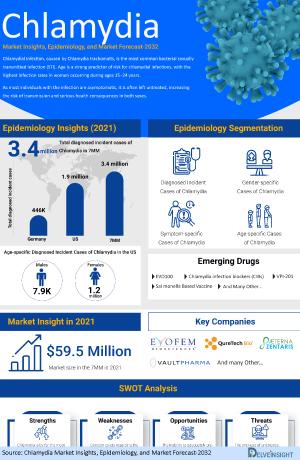
Chlamydia Market Summary
- The Chlamydia Market Size is anticipated to grow with a significant CAGR during the stuy period (2022-2036).
- The leading Chlamydia companies developing therapies in the treatment market include - Sanofi, and others
Chlamydia Market & Epidemiology Insights
- According to World Health Organization, in 2020 there were an estimated 128.5 million new chlamydia infections among adults globally.
- As per European Centre for Disease Prevention and Control, for 2023, 230,199 confirmed cases of chlamydia infection were reported in 27 EU/EEA countries.
- Chlamydia is one of the most common curable STIs globally.
- Diagnosis of chlamydia trachomatis infection is most commonly confirmed using nucleic acid amplification tests, which detect bacterial genetic material from urine or genital swab samples with high accuracy.
- Repeated and persistent infections are common among at-risk adolescent and young adult populations. Even with appropriate detection, there is increasing evidence for antibiotic resistance to the common drugs used to treat C. trachomatis.
- To reduce the risks, screening for chlamydia is implemented in several countries and regions, including the US and the UK. Screening is recommended for all women younger than 25 years, all pregnant women, and women at increased risk of infection.
- There are no chlamydia-specific therapies approved. However, the infection is effectively treated using approved broad-spectrum antibiotics such as doxycycline and azithromycin, which serve as the global standard of care. The market remains fully generic-driven with no dedicated novel drug approvals.
- The chlamydia pipeline remains limited, with only a few companies such as Sanofi actively developing early-stage vaccine candidates focused on preventive, next-generation approaches. This reflects a gradual shift from conventional antibiotic reliance toward long-term infection prevention and reduced reinfection risk.
- The chlamydia market has a significant unmet need, as there are no pathogen-specific approved therapies across the US, Europe, or Japan. Current treatment relies on generic antibiotics like doxycycline and azithromycin, which face challenges such as adherence limitations and emerging resistance concerns. This creates opportunity for novel, targeted, and long-acting therapeutic approaches.
Chlamydia Market Size and Forecast in the 7MM
- 2025 Chlamydia Market Size: ~USD XXX million
- 2036 Projected Chlamydia Market Size: ~USD XXX million
- Chlamydia Growth Rate (2026–2036): ~XXX% CAGR
Key Factors Driving the Chlamydia Market
- Growing Awareness & Screening Programs: Government and NGO-led awareness campaigns are encouraging early testing and diagnosis. Routine screening initiatives, especially in high-risk populations, are expanding the patient pool.
- Advancements in Diagnostic Technologies: Innovations such as Nucleic Acid Amplification Tests (NAATs) have improved accuracy and speed of detection. Point-of-care testing is also making diagnosis more accessible and efficient.
- Increased Access to Healthcare Services: Improved healthcare infrastructure and access in developing regions are enabling more people to get tested and treated. Telemedicine and digital health platforms further support diagnosis and follow-up care.
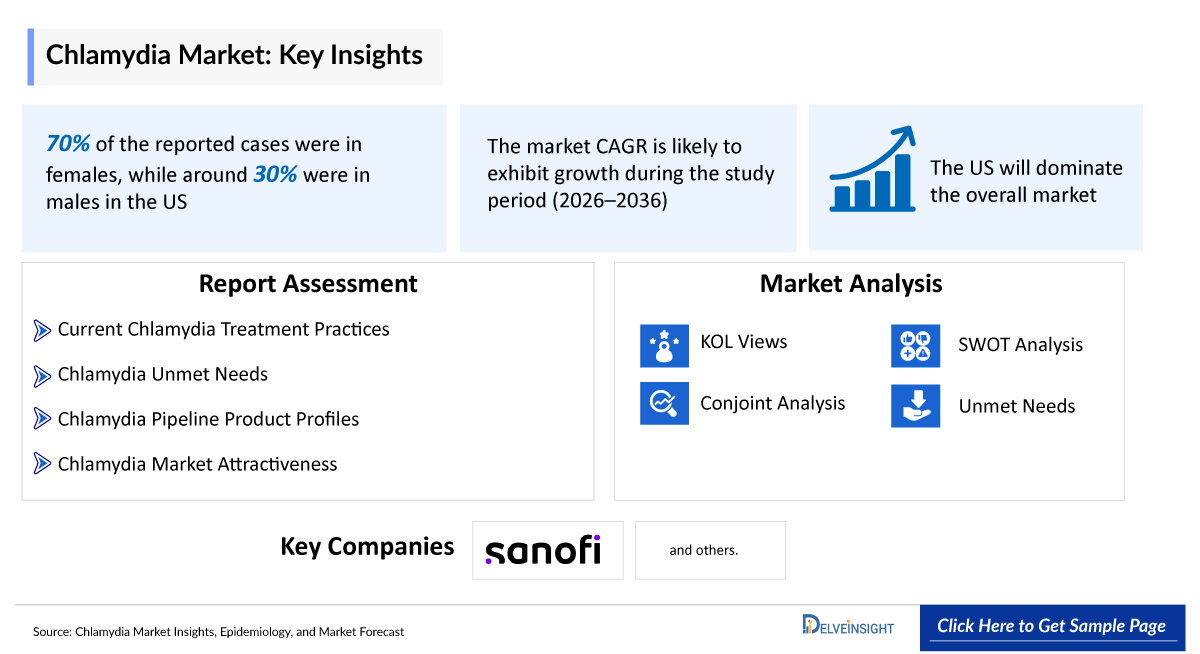
DelveInsight's ‘Chlamydia Market Insights, Epidemiology and Market Forecast – 2036’ report delivers an in-depth understanding of the chlamydia, historical and forecasted epidemiology, as well as the chlamydia market trends in the United States, EU4 (Germany, Spain, Italy, and France) and the United Kingdom, and Japan.
The chlamydia market report delivers a comprehensive analysis of the current treatment landscape, including standards of care, clinical practices, and evolving therapeutic algorithms. It evaluates chlamydia patient burden trends, revenue & market share dynamics, peak patient share & therapy uptake analysis, and provides an in-depth market size assessment, and growth rate projections (Historical & Forecast 2022–2036) across global regions. The report highlights key unmet medical needs in chlamydia and maps the competitive and clinical landscape to uncover high‑value opportunities, providing a clear outlook on future market growth potential.
Scope of the Chlamydia Market Report | |
|
Study Period |
2022–2036 |
|
Historical Year |
2022–2025 |
|
Forecast Period |
2026–2036 |
|
Base Year |
2026 |
|
Geographies Covered |
|
|
Chlamydia Market CAGR (Study period/Forecast period) |
~XXX% (2026 ̶ 2036) |
|
Chlamydia Epidemiology Segmentation Analysis |
Patient Burden Assessment
|
|
Chlamydia Companies |
|
|
Chlamydia Therapies |
|
|
Chlamydia Market |
Segmented by
|
|
Analysis |
|
Chlamydia Disease Understanding
Chlamydia Overview and Diagnosis
Chlamydia trachomatis is a common sexually transmitted bacterial infection (STI) that often remains asymptomatic, especially in women, but can affect the urogenital tract and cause complications like pelvic inflammatory disease and infertility. In men, symptoms may include urethral discharge, burning urination, testicular pain (epididymitis), or mild urethritis, while women may experience abnormal vaginal discharge, burning urination, intermenstrual or post-coital bleeding, and pelvic pain. If left untreated in either gender, it can lead to serious reproductive complications such as infertility, ectopic pregnancy in women, and epididymitis or reactive arthritis in men.
Diagnosis is mainly done using NAATs, which are the most sensitive and specific tests for detecting chlamydia DNA or RNA from urine samples or genital swabs (cervical, vaginal, or urethral). Rectal or throat swabs may also be used depending on exposure history. Screening is recommended for sexually active individuals at high risk, especially women under 25 years and those with multiple partners or a history of STIs.
Further details are provided in the report.
Current Chlamydia Treatment Landscape
The first-line treatment for uncomplicated chlamydia infection is doxycycline 100 mg twice daily for 7 days, while azithromycin 1 g as a single dose is an alternative, especially in pregnancy or when adherence is a concern. Other options include levofloxacin 500 mg once daily for 7 days, and in pregnancy, azithromycin is preferred with amoxicillin as an alternative. There is currently no approved vaccine for chlamydia. However, companies such as sanofi and other pharmaceutical developers are investigating experimental vaccine candidates, including mRNA-based approaches, which are still under clinical research.
Further details related to country-based variations are provided in the report.
Chlamydia Unmet Needs
The section “unmet needs of chlamydia” outlines the critical gaps between the current state of patient care, diagnosis, and the ideal & effective management of the disease. It highlights the obstacles experienced by patients, clinicians, and researchers and identifies potential solutions for future progress.
- Lack of routine screening leads to a significant proportion of asymptomatic infections going undetected
- There is currently no licensed vaccine available for prevention
- Reinfection and lack of long-term immunity
- Reliance on antibiotics is limited by emerging resistance concerns and treatment constraints, and others…..
Note: Comprehensive unmet needs insights in chlamydia and their strategic implications are provided in the full report.
Chlamydia Epidemiology
The Chlamydia epidemiology section provides insights about the historical and current Hemophilia patient pool and forecasted trends for individual seven major countries. It helps to recognize the causes of current and forecasted trends by exploring numerous studies and views of key opinion leaders. This part of the Hemophilia market report also provides the diagnosed patient pool and their trends along with assumptions undertaken.
Key Findings from Chlamydia Epidemiological Analysis and Forecast
- Urogenital chlamydia infections are the most frequently reported bacterial infections in the United States.
- Chlamydia is the most commonly diagnosed sexually transmitted infection in the United Kingdom, with infection rates being higher in women than in men.
- Age plays a significant role in determining risk, with women aged 15–24 experiencing the highest rates of infection.
- In 2025, Germany recorded the highest number of diagnosed incident chlamydia cases among the EU4 and UK countries. According to DelveInsight’s projections, this number is expected to increase by 2036.
- In the United States, chlamydia was more Incident among females than males. In 2025, approximately 70% of the reported cases were in females, while around 30% were in males. DelveInsight predicts that these numbers will continue to rise by 2034.
- As per secondary analysis, Despite a slowdown in the increase of chlamydia notifications in 2023, it remains the most frequently reported bacterial STI in Europe. In 2023, more than 230 000 cases were reported across EU/EEA countries, representing an increase of 13% since 2014. The infection continues to disproportionately affect young people, with the highest rates among women aged 20–24.
- As per secondary analysis, approximately 169,000 new chlamydia cases were reported across all ages in 2024, reflecting a 13% decrease from 2023, when around 194,000 cases were recorded.
Chlamydia Epidemiology Segmentation
- Total Incident Cases of Chlamydia
- Vaccine Eligible Pool of Chlamydia
- Gender-specific Incident Cases of Chlamydia
- Symptom-specific Incident Cases of Chlamydia
- Age-specific Incident Cases of Chlamydia
- Treated Cases of Chlamydia
Recent Developments in the Chlamydia Treatment Landscape
- In March 2025, chlamydia vaccine candidate has been granted fast track designation by the US FDA. The decision was driven by the vaccine candidate’s potential to tackle a serious health condition and fulfill an unmet public health need.
- In May 2025, Visby Medical submitted its Visby Medical Men’s Sexual Health Test to the US FDA for 510(k) clearance and Clinical Laboratory Improvement Amendments (CLIA) waiver. If cleared, the test will deliver Polymerase Chain Reaction (PCR) results in under 30 minutes for chlamydia and Gonorrhea detection from male urine samples in symptomatic and asymptomatic men.
Chlamydia Drug Analysis & Competitive Landscape
The chlamydia drug chapter provides a detailed, market-focused review of the emerging pipeline across Phase I/II Chlamydia clinical trials. It covers the mechanism of action, clinical trial data, regulatory approvals, patents, collaborations, and strategic partnerships, as well as upcoming key catalysts for each therapy, along with their advantages, limitations, and recent developments. This section offers critical insights into the chlamydia treatment landscape, supporting market assessment, competitive analysis, and growth forecasting for the chlamydia therapeutics market.
Note: Detailed marketed therapies assessment will be provided in the final report.
Chlamydia Pipeline Analysis
SP0269 (mRNA vaccine): Sanofi
The mRNA vaccine has been developed by Sanofi for the prevention of chlamydia infection. Sanofi has launched a Phase I/II randomized clinical trial to assess the safety and immune response of its chlamydia vaccine candidate in adults aged 18 to 29. The vaccine has shown encouraging results in pre-clinical studies and is being developed to protect against initial and repeat genital tract infections caused by chlamydia trachomatis.
Competitive Landscape of Chlamydia Pipeline Drugs | ||||||
|
Drug Name |
Company |
Highest Phase |
Indication |
RoA |
MoA |
Anticipated Launch in the US |
|
SP0269 (mRNA vaccine) |
Sanofi |
I/II |
Chlamydia |
Intramuscular (IM) |
Immune activation |
Information is available in the full report |
|
Note: Launch insights are provisional and may change with future report updates or the occurrence of major key catalysts. | ||||||
Note: Detailed emerging therapies assessment will be provided in the final report.
Chlamydia Key Players, Market Leaders and Emerging Companies
-
Sanofi
Chlamydia Market Outlook
The chlamydia market remains largely centered on antibiotic therapy, which continues to be highly effective when diagnosed early. First-line treatments recommended by organizations such as the Centers for Disease Control and Prevention include doxycycline (preferred regimen) and azithromycin (alternative, particularly in specific populations). These antibiotics achieve high cure rates by targeting bacterial replication, and treatment is typically short-course and well-tolerated.
Beyond antibiotics, the pipeline for chlamydia is gradually evolving toward preventive and immunotherapeutic strategies, particularly mRNA-based vaccines. Investigational candidates such as SP0269 are being developed to encode key chlamydia trachomatis antigens and stimulate protective immune responses, aiming to reduce infection rates and recurrence. Currently in early-stage clinical development, these vaccine approaches focus on improving immunogenicity and durability of protection, representing a shift from treatment to prevention.
-
The entry of mid-stage candidates such as SPO269 is expected to intensify competition in the chlamydia treatment landscape during the latter half of the forecast period.
Further details will be provided in the report….
Drug Class/Insights into Leading Emerging and Marketed Therapies in Chlamydia (2022–2036 Forecast)
The chlamydia market (2022–2036 forecast) is evolving toward preventive, immune-based, and disease-modifying strategies, with increasing focus on mRNA vaccine development targeting Chlamydia trachomatis. The pipeline reflects a shift from conventional antibiotic management toward long-term prevention of infection, reinfection, and transmission.
-
mRNA Vaccine: Targeted mRNA vaccine approaches are being explored for infectious diseases. SP0269 utilizes synthetic messenger RNA to encode specific bacterial antigens, stimulating host immune responses to prevent infection.
Chlamydia Drug Uptake
This section focuses on the uptake rate of potential Chlamydia drugs expected to be launched in the market during the forecast period (2026–2036). The analysis covers the chlamydia drug’s uptake, performance at peak, factors affecting performance during prime years of growth, patient uptake by therapy, and anticipated sales generated by each drug.
Antibiotics remain the cornerstone of chlamydia treatment and continue to account for the highest share of patient uptake due to their established efficacy, widespread availability, and guideline-based use as first-line therapy. During the forecast period, uptake is expected to remain steady but gradually plateau, as most diagnosed cases are already managed effectively with existing regimens. The uptake of therapies in chlamydia is expected to vary based on clinical positioning, mechanism of action, and stage of development. Pipeline candidate SP0269 (mRNA vaccine) is expected to follow a moderate uptake trajectory, reflecting its investigational status and gradual adoption as clinical evidence emerges.
Detailed insights of emerging therapies' drug uptake is included in the report
Chlamydia Market Access and Reimbursement Scenario
Reimbursement may be referred to as the negotiation of a price between a manufacturer and a payer that allows the manufacturer access to the market. It is provided to reduce the high costs and make the essential drugs affordable. Health technology assessment (HTA) plays an important role in reimbursement decision-making and recommending the use of a drug. These recommendations vary widely throughout the seven major markets, even for the same drug. In the US healthcare system, both Public and Private health insurance coverage are included. Also, Medicare and Medicaid are the largest government-funded programs in the US. The major healthcare programs, including Medicare, Medicaid, Health Insurance Program (CHIP), and the state and federal health insurance marketplaces, are overseen by the Centres for Medicare & Medicaid Services (CMS). Other than these, Pharmacy Benefit Managers (PBMs) and third-party organisations that provide services and educational programs to aid patients are also present.
The report further provides detailed insights on the country-wise accessibility and reimbursement scenarios, cost-effectiveness scenario of currently used therapies, programs making accessibility easier and out-of-pocket costs more affordable, insights on patients insured under federal or state government prescription drug programs, etc.
NOTE: Further Details are provided in the final report….
Chlamydia Therapies Price Scenario & Trends
Pricing and analogue assessment of chlamydia therapies highlights evolving price dynamics structures. This section summarizes the cost of approved treatments, the closest and most appropriate analogue selection for emerging therapies, and the understanding of how pricing influences market access, adherence, and long-term uptake.
Industry Experts and Physician Views for Chlamydia
To keep up with chlamydia market trends, we take Key Opinion Leaders (KOLs) and Subject Matter Experts (SMEs) opinions working in the domain through primary research to fill the data gaps and validate our secondary research. Industry experts were contacted for insights on the chlamydia emerging therapies, evolving treatment landscape, patient adherence to conventional therapies, therapy switching trends, drug adoption and uptake, accessibility challenges, and epidemiology and real-world prescription patterns in chlamydia, including MD, PhD, Instructor, Postdoctoral Researcher, Professor, Researcher, and others.
DelveInsight’s analysts connected with 15+ KOLs to gather insights at the country level. Centers such as the University of Nebraska Medical Center, University of Texas Health Science Center at San Antonio, and University Hospital Ulm, etc. were contacted. Their opinion helps understand and validate current and emerging chlamydia therapies, highlight unmet medical needs, provide epidemiological context, and support strategic decisions for market access, therapy adoption, and pipeline prioritization in chlamydia.
|
Region |
Key Opinion Leaders (KOLs) and Subject Matter Experts (SMEs) |
|
United States |
“The rising incidence of this bacterial infection is partly due to better laboratory testing and screening, along with inconsistent use of safe sex practices.” |
|
Germany |
“Chlamydia trachomatis is a significant public health concern. The prevalence among pregnant women is approximately 2.1%, with routine screening implemented to prevent neonatal infections.” |
Chlamydia Report Qualitative Analysis: SWOT and Conjoint Analysis
We perform qualitative and market Intelligence analysis using various approaches, such as SWOT analysis and conjoint analysis.
In the SWOT analysis of chlamydia, strengths, weaknesses, opportunities, and threats in terms of disease diagnosis, patient awareness, patient burden, competitive landscape, cost-effectiveness, and geographical accessibility of therapies are provided.
Conjoint analysis analyzes emerging therapies based on relevant attributes such as safety, efficacy, frequency of administration, route of administration, and order of entry. Scoring is given based on these parameters to analyze the effectiveness of therapy.
The team of analysts analyzes promising emerging therapies based on relevant attributes such as safety, efficacy, frequency of administration, route of administration, and order of entry. In efficacy, the trial’s primary and secondary outcome measures are evaluated, whereas the therapies’ safety is evaluated, wherein the acceptability, tolerability, and adverse events are majorly observed. In addition, the scoring is also based on the route of administration, order of entry, probability of success, and the addressable patient pool for each therapy. According to these parameters, the final weightage score and the ranking of the emerging therapies are decided.
Scope of the Chlamydia Market Report
- The report covers a segment of key events, an executive summary, a descriptive overview of chlamydia, explaining their causes, signs and symptoms, pathogenesis, and currently available treatments.
- Comprehensive insight has been provided into the epidemiology segments and forecasts, the future growth potential of the diagnosis rate, and disease progression along treatment guidelines.
- Additionally, an all-inclusive account of both the current and emerging treatments, along with the elaborative profiles of late-stage and prominent therapies, will have an impact on the current treatment landscape.
- A detailed review of the chlamydia market, historical and forecasted market size, market share by therapies, detailed assumptions, and rationale behind our approach is included in the report, covering the 7MM drug outreach.
- The report provides an edge while developing business strategies by understanding trends through SWOT analysis and expert insights/KOL views, patient journey, and treatment preferences that help in shaping and driving the 7MM chlamydia market.
Chlamydia Market Report Insights
- Chlamydia Patient Population Forecast
- Chlamydia Therapeutics Market Size
- Chlamydia Pipeline Analysis
- Chlamydia Market Size and Trends
- Chlamydia Market Opportunity (Current and forecasted)
Chlamydia Market Report Key Strengths
- Chlamydia Epidemiology‑based (Epi‑based) Bottom‑up Forecasting
- Artificial Intelligence (AI)-Enabled Market Research Report
- 11-Year Forecast
- Chlamydia Market Outlook (North America, Europe, Asia-Pacific)
- Chlamydia Patient Burden Trends (By Geography)
- Chlamydia Treatment Addressable Market (TAM)
- Chlamydia Competitve Landscape
- Chlamydia) Major Companies Insights
- Chlamydia Price Trends and Analogue Assessment
- Chlamydia Therapies Drug Adoption/Uptake
- Chlamydia Therapies Peak Patient Share Analysis
Chlamydia Market Report Assessment
- Chlamydia Current Treatment Practices
- Chlamydia Unmet Needs
- Chlamydia Clinical Development Analysis
- Chlamydia Emerging Drugs Product Profiles
- Chlamydia Market attractiveness
- Chlamydia Qualitative Analysis (SWOT and conjoint analysis)
- Chlamydia Market Drivers
- Chlamydia Market Barriers
FAQs Related to the Chlamydia Market Report:
Chlamydia Market Insights
- What was the chlamydia market size, the market size by therapies, market share (%) distribution in 2025, and what would it look like by 2036? What are the contributing factors for this growth?
- What are the anticipated pricing variations among different geographies for the emerging therapies in the future?
- What can be the future treatment paradigm of chlamydia?
- What are the disease risks, burdens, and unmet needs of chlamydia? What will be the growth opportunities across the 7MM concerning the chlamydia patient population?
- Who is the major future competitor in the market, and how will the competitors affect their market share?
- What are the current options for the treatment of chlamydia? What are the current guidelines for treating chlamydia in the US, Europe, and Japan?
Reasons to Buy Chlamydia Market Forecast Report
- The report will help in developing business strategies by understanding the latest trends and changing treatment dynamics driving the chlamydia market.
- Bottom-up forecasting builds from the affected population to product forecasts, delivering a robust, data-driven approach ideal for new therapies and novel classes.
- Insights on patient burden/disease incidence, evolution in diagnosis, and factors contributing to the change in the epidemiology of the disease during the forecast years.
- Understand the existing market opportunities in varying geographies and the growth potential over the coming years.
- Identifying strong upcoming players in the market will help devise strategies to help get ahead of competitors.
- Detailed analysis and ranking of class-wise potential emerging therapies under the conjoint analysis section to provide visibility around leading classes.
- To understand KOLs’ perspectives on the accessibility, acceptability, and compliance-related challenges of existing treatment to overcome barriers in the future.
- Detailed insights on the unmet needs of the existing market so that the upcoming players can strengthen their development and launch strategy.
- This Artificial Intelligence (AI)-enabled report summarize and simplify complex datasets with in the report into clear, actionable insights for stakeholders, investors, and healthcare providers, enabling faster, data-driven decisions.