Chronic Smell and Flavor Loss Insights and Trends
- According to DelveInsight’s analysis, the Chronic Smell and Flavor Loss market size was found to be ~USD 3,000 million in the leading markets (the United States, the EU4 (Germany, France, Italy, and Spain), the United Kingdom, and Japan) in 2025.
-
Chronic smell and flavor loss (persistent olfactory dysfunction, including post-viral and post-COVID-19 cases) affects a significant proportion of patients following upper respiratory infections.
-
The burden of chronic olfactory dysfunction is increasingly recognized across adult populations, with higher detection rates in middle-aged individuals due to greater healthcare engagement, increased ENT evaluation, and widespread post-COVID symptom screening.
-
The condition is often underdiagnosed, as patients adapt to gradual sensory loss, while objective tests (e.g., UPSIT or Sniffin’ Sticks) reveal a higher prevalence than self-reports. This gap underscores the importance of structured olfactory testing to accurately assess disease burden.
-
Currently, no FDA-approved therapies exist specifically for chronic smell and flavor loss, and management remains largely supportive. Standard of care includes olfactory training as first-line intervention, with adjunctive use of intranasal corticosteroids in cases with underlying inflammatory or sinonasal disease.
-
Emerging interventional approaches such as platelet-rich plasma (PRP) injections and vitamin A–based intranasal therapies are being explored in early clinical studies; however, these remain investigational with variable efficacy outcomes and lack regulatory approval for this indication.
-
The therapeutic landscape is shifting toward regenerative and neuro-restorative approaches. CYR-064 is the most advanced investigational candidate, designed as a first-in-class intranasal therapy for persistent post-viral olfactory dysfunction. Early clinical results show improvements in objective smell function, making it a leading contender in this underserved area.
-
Pharmaceutical and biotechnology companies engaged in the development of therapies for chronic smell loss include: Cyrano Therapeutics (CYR-064). Despite increasing research activity post-COVID-19, the pipeline remains highly concentrated with limited late-stage clinical assets.
-
A major unmet need in chronic olfactory dysfunction is the absence of validated disease-modifying therapies and reliable prognostic biomarkers. Current diagnosis relies on smell testing and clinical history, which cannot clearly differentiate reversible inflammation from permanent neurodegenerative injury. This gap highlights the need for biomarker development and targeted regenerative treatments to improve long-term outcomes.
Chronic Smell and Flavor Loss Market Size and Forecast in the 7MM
-
2025 Chronic Smell and Flavor Loss Market Size: ~USD 3,000 million
-
2036 Projected Chronic Smell and Flavor Loss Market Size: ~USD XX million
-
Chronic Smell and Flavor Loss Growth Rate (2026–2036): ~XX% CAGR
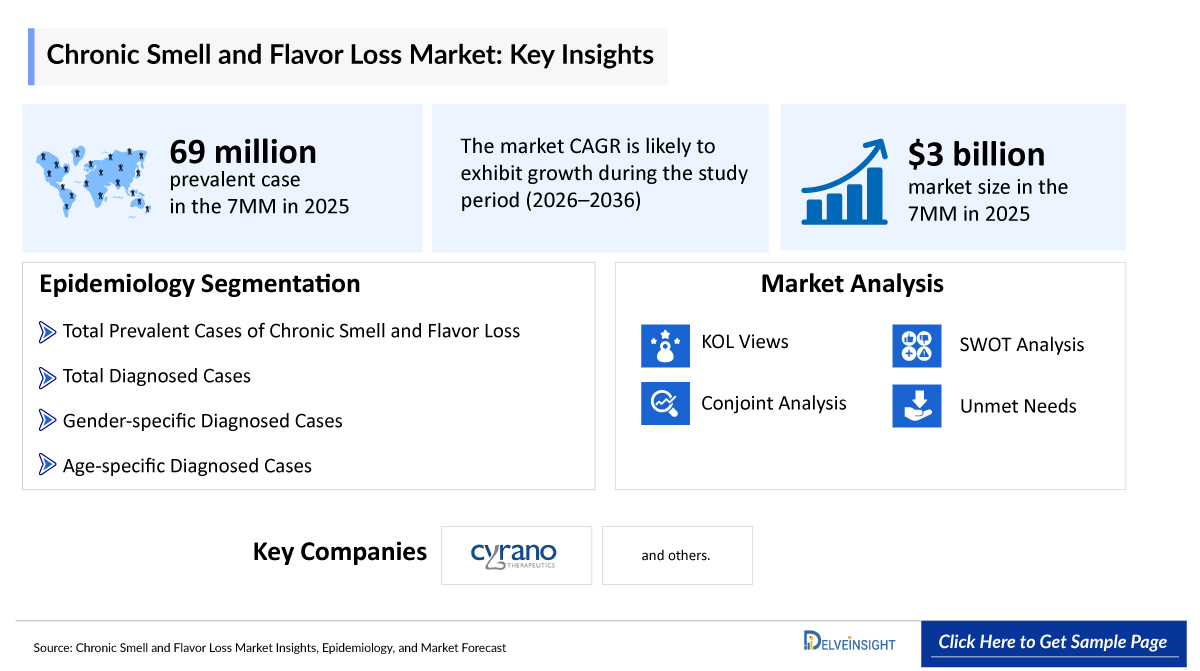
DelveInsight's ‘Chronic Smell and Flavor Loss Market Insights, Epidemiology and Market Forecast – 2036’ report delivers an in-depth understanding of the Chronic Smell and Flavor Loss, historical and forecasted epidemiology, as well as the Chronic Smell and Flavor Loss market trends in the United States, EU4 (Germany, Spain, Italy, and France) and the United Kingdom, and Japan.
The Chronic Smell and Flavor Loss market report delivers a comprehensive analysis of the current treatment landscape, including standards of care, clinical practices, and evolving therapeutic algorithms. It evaluates Chronic Smell and Flavor Loss patient burden trends, revenue & market share dynamics, peak patient share & therapy uptake analysis, and provides an in-depth market size assessment, and growth rate projections (Historical & Forecast 2022–2036) across global regions. The report highlights key unmet medical needs in chronic smell and flavor loss and maps the competitive and clinical landscape to uncover high‑value opportunities, providing a clear outlook on future market growth potential.
|
Study Period |
2022–2036 |
|
Historical Year |
2022–2025 |
|
Forecast Period |
2026–2036 |
|
Base Year |
2026 |
|
Geographies Covered |
|
|
Chronic Smell and Flavor Loss Market CAGR (Forecast period) |
~XX% (2026–2036) |
|
Chronic Smell and Flavor Loss Epidemiology Segmentation Analysis |
Patient Burden Assessment
|
|
Chronic Smell and Flavor Loss Companies |
|
|
Chronic Smell and Flavor Loss Therapies |
|
|
Chronic Smell and Flavor Loss Market |
Segmented by
|
|
Analysis |
|
|
|
Key Factors Driving the Chronic Smell and Flavor Loss Market
Rising Post-Viral Disease Burden
Chronic smell and flavor loss have increased significantly following the COVID-19 pandemic, which has made olfactory dysfunction one of the most common persistent post-viral symptoms. While most patients recover, published studies indicate a smaller but clinically relevant subset develops long-term dysfunction (>6–12 months), expanding the chronic disease pool compared with pre-pandemic levels.
Increasing Diagnosis and Clinical Awareness
Olfactory disorders are now more frequently recognized due to post-COVID screening and improved ENT evaluation practices. Objective smell testing has revealed that true prevalence is higher than self-reported cases, increasing clinical visibility and diagnosis rates globally.
Chronic Smell and Flavor Loss Understanding and Treatment Algorithm
Chronic Smell and Flavor Loss Overview and Diagnosis
Olfactory dysfunction (OD) and gustatory dysfunction are sensory disorders characterized by reduced or distorted perception of smell and taste. They gained major attention during the COVID-19 pandemic, where anosmia and hyposmia were common early symptoms, particularly in Europe. Gustatory impairments such as hypogeusia, dysgeusia, phantogeusia, and ageusia are linked to viral infections, neurological damage, autoimmune conditions, and environmental factors. Leading ENT bodies recognize chemosensory dysfunction as a key indicator of COVID-19. Due to shared neural pathways, olfactory damage often results in concurrent taste dysfunction, ranging from partial loss to complete impairment.
Diagnosis involves ENT evaluation with clinical history, physical examination, and psychophysical testing, supported by imaging (CT/MRI) when needed to identify structural or neurological causes, enabling accurate diagnosis and targeted management.
Further details are provided in the report....
Current Chronic Smell and Flavor Loss Treatment Landscape
Treatment options for smell disorders are limited and mainly effective when related to underlying nasal pathology, with corticosteroids and surgical interventions as primary approaches. For taste disorders, evidence for corticosteroids, vitamin A, and acupuncture is weak, though zinc gluconate (140 mg/day for ~3 months) has shown some benefit in idiopathic dysgeusia.
In burning mouth syndrome (BMS), tricyclic antidepressants (amitriptyline, imipramine) and benzodiazepines (clonazepam, diazepam) may provide symptomatic relief. Overall, current therapies remain limited, highlighting the need for better validated treatment options for olfactory and gustatory disorders.
Further details related to country-based variations are provided in the report....
Chronic Smell and Flavor Loss Unmet Needs
The section “unmet needs of Chronic Smell and Flavor Loss” outlines the critical gaps between the current state of patient care, diagnosis, and the ideal & effective management of the disease. It highlights the obstacles experienced by patients, clinicians, and researchers and identifies potential solutions for future progress.
-
Lack of effective disease-modifying therapies
-
Early detection and diagnosis gap
-
Limited long-term monitoring and others…..
Note: Comprehensive unmet needs insights in Chronic Smell and Flavor Loss and their strategic implications are provided in the full report.
Chronic Smell and Flavor Loss Epidemiology
Key Findings from Chronic Smell and Flavor Loss Epidemiological Analysis and Forecast
-
According to DelveInsight’s estimates, the United States accounted for the highest number of prevalent cases of Chronic Smell and Flavor Loss in 2025, with approximately 69 million cases among the 7MM.
-
US-based psychophysical testing studies using validated tools (e.g., UPSIT) show that objective smell impairment is significantly higher than self-reported rates, with up to ~50%+ of tested individuals showing measurable dysfunction even without awareness.
-
European COVID-19 cohort studies report that olfactory dysfunction prevalence during infection ranged from ~50–60% in European patients, making it one of the most commonly reported neurological symptoms.
-
In 2025, gender-specific data across the 7MM indicate that females had a higher prevalence of chronic smell and flavor loss compared to males.
Chronic Smell and Flavor Loss Drug Analysis & Competitive Landscape
The Chronic Smell and Flavor Loss drug chapter provides a detailed, market-focused review of the emerging pipeline across Phase I/II–II clinical trials. It covers the mechanism of action, clinical trial data, regulatory approvals, patents, collaborations, and strategic partnerships for each therapy, along with their advantages, limitations, and recent developments. This section offers critical insights into the chronic smell and flavor loss treatment landscape, supporting market assessment, competitive analysis, and growth forecasting for the chronic smell and flavor loss therapeutics market.
Chronic Smell and Flavor Loss Pipeline Analysis
CYR-064: Cyrano Therapeutics
CYR-064, developed by Cyrano Therapeutics, is a novel intranasal therapy aimed at restoring olfactory and gustatory function in patients with chronic sensory loss. The formulation leverages phosphodiesterase (PDE) inhibitors delivered directly to the nasal cavity to target underlying mechanisms of smell and flavor impairment. In these conditions, disruption of signaling pathways, particularly those involving adenylyl cyclase III and cyclic nucleotides (cAMP and cGMP), can reduce growth factor release and impair stem cell activity within the olfactory epithelium. By increasing local levels of cAMP and cGMP, PDE inhibition may help reactivate these pathways and support functional recovery of olfactory neurons.
CYR-064 is currently in Phase II clinical development for hyposmia, where the study successfully met its primary safety endpoint and key prespecified secondary efficacy endpoints, supporting its planned progression into Phase III development in H2 2026.
|
Competitive Landscape of Pipeline Drugs | ||||||
|
Drug Name |
Company |
Highest Phase |
Indication |
RoA |
MoA |
Anticipated Launch in the US |
|
CYR-064 |
Cyrano Therapeutics |
II |
Hyposmia |
Intranasal |
PDE inhibitors |
Information is available in the full report |
|
Note: Launch insights are provisional and may change with future report updates or the occurrence of major key catalysts. | ||||||
Note: Detailed emerging therapies assessment will be provided in the final report.
Recent Development
- In July 2026, Cyrano Therapeutics announced that results from its Phase 2 FLAVOR clinical trial evaluating CYR-064 will be featured in an oral presentation at the 72nd Annual Meeting of the American Rhinologic Society in October 2026. CYR-064 is an intranasal, broad-spectrum phosphodiesterase inhibitor designed to improve olfactory neuron excitability. The trial evaluated the efficacy of CYR-064 nasal spray in patients suffering from persistent post-viral loss of smell across 14 clinical trial sites located in the United States.
Chronic Smell and Flavor Loss Key Players, Market Leaders, and Emerging Companies
-
Cyrano Therapeutics
Chronic Smell and Flavor Loss Drug Updates
-
In February 2026, Cyrano Therapeutics announced positive topline results from its Phase II FLAVOR trial of CYR-064, an innovative, intranasal soft-mist spray for the treatment of persistent post-viral loss of smell (hyposmia), supporting advancement into Phase III development in H2 2026.
-
In June 2025, Cyrano Therapeutics announced its participation in the BIO International Convention. The company’s leadership team engaged with potential partners and investors to highlight advancements in its regenerative medicine pipeline. Discussions centered on CYR-064, an investigational intranasal therapy for post-viral hyposmia, with a focus on its targeted delivery approach to the olfactory region.
Chronic Smell and Flavor Loss Market Outlook
The chronic smell and flavor loss market remains largely dependent on non-pharmacological and supportive interventions, as no FDA-approved disease-modifying therapies are currently available. Adjunctive therapies such as intranasal corticosteroids may provide benefit in patients with underlying inflammatory or sinonasal conditions; however, their efficacy is limited in cases of true neuroepithelial damage. Beyond supportive care, the pipeline is gradually evolving toward regenerative and neuro-restorative therapies aimed at addressing underlying neuronal dysfunction. The most advanced candidate, CYR-064 (Cyrano Therapeutics), is an investigational intranasal therapy targeting cyclic nucleotide signaling pathways to promote recovery of olfactory function in post-viral hyposmia. The asset has completed Phase II clinical evaluation, demonstrating favorable safety and preliminary efficacy signals, and is expected to progress into Phase III development.
The advancement of CYR-064 into late-stage development is expected to shape the competitive landscape, with potential to establish the first targeted pharmacologic option for chronic olfactory dysfunction during the latter part of the forecast period.
-
According to estimates, the total Chronic Smell and Flavor Loss market size in 7MM was approximately USD 3,000 million in 2025, with the United States accounting for the largest share, and the market is projected to grow at a significant CAGR through 2036.
-
In 2025, among the EU4 and the UK, Germany held the largest market share, followed by France, while Spain accounted for the smallest share.
Further details will be provided in the report….
Drug Class/Insights into Leading Emerging and Marketed Therapies in Chronic Smell and Flavor Loss (2022–2036 Forecast)
The chronic smell and flavor loss market (2022–2036 forecast period) is gradually evolving toward regenerative, neuro-restorative, and disease-modifying approaches, with increasing focus on therapies that target underlying olfactory epithelial damage and neuronal dysfunction. The current pipeline reflects a shift from supportive management toward mechanism-based interventions aimed at restoring sensory function rather than providing symptomatic relief.
Neuro-regenerative intranasal therapies: Targeted approaches such as CYR-064 (Cyrano Therapeutics) utilize intranasal delivery of phosphodiesterase (PDE) inhibitors to enhance cyclic nucleotide signaling (cAMP/cGMP), supporting olfactory neuron recovery and epithelial regeneration. These therapies represent a key area of innovation, driving early pipeline development and signaling a transition toward disease-modifying treatment strategies in chronic olfactory dysfunction.
Chronic Smell and Flavor Loss Drug Uptake
This section focuses on the uptake rate of potential drugs expected to be launched in the market during the forecast period (2026–2036). The analysis covers the chronic smell and flavor loss drug’s uptake, performance at peak, factors affecting performance during prime years of growth, patient uptake by therapy, and anticipated sales generated by each drug.
The adoption of emerging therapies is expected to vary based on mechanism of action, clinical evidence, and stage of development. The leading pipeline candidate, CYR-064 (Cyrano Therapeutics), is anticipated to follow a gradual uptake trajectory, reflecting its investigational status and the need for further validation in late-stage trials. As clinical data matures and regulatory pathways advance, such therapies may drive a shift toward disease-modifying treatment approaches in chronic olfactory dysfunction.
Detailed insights into emerging therapies' drug uptake are included in the report
Market Access and Reimbursement of Approved Therapies in Chronic Smell and Flavor Loss
Reimbursement is a crucial factor that affects the drug’s access to the market. Often, the decision to reimburse comes down to the price of the drug relative to the benefit it produces in treated patients. To reduce the healthcare burden of these high-cost therapies, many payment models are being considered by payers and other industry insiders.
NOTE: Further Details are provided in the final report….
Chronic Smell and Flavor Loss Therapies Price Scenario & Trends
Pricing and analogue assessment of chronic smell and flavor loss therapies highlights evolving price dynamics structures. This section summarizes the cost of approved treatments, the closest and most appropriate analogue selection for emerging therapies, and understanding of how pricing influences market access, adherence, and long-term uptake.
Industry Experts and Physician Views for Chronic Smell and Flavor Loss
To keep up with chronic smell and flavor loss market trends, we take Key Opinion Leaders (KOLs) and Subject Matter Experts (SMEs) opinions working in the domain through primary research to fill the data gaps and validate our secondary research. Industry experts were contacted for insights on the chronic smell and flavor loss emerging therapies, evolving treatment landscape, patient adherence to conventional therapies, therapy switching trends, drug adoption and uptake, accessibility challenges, and epidemiology and real-world prescription patterns in chronic smell and flavor loss, including MD, PhD, Instructor, Postdoctoral Researcher, Professor, Researcher, and others.
DelveInsight’s analysts connected with 15+ KOLs to gather insights at the country level. Centers such as the University of Pennsylvania Smell and Taste Center, Duke University School of Medicine, and King’s College London, etc. were contacted. Their opinion helps understand and validate current and emerging chronic smell and flavor loss therapies, highlight unmet medical needs, provide epidemiological context, and support strategic decisions for market access, therapy adoption, and pipeline prioritization in chronic smell and flavor loss.
|
Region |
Key Opinion Leaders (KOLs) and Subject Matter Experts (SMEs) |
|
United States |
“A proportion of patients with post-viral olfactory loss will experience spontaneous recovery over time, but those with severe initial loss or prolonged symptoms are less likely to regain full function.” |
|
Germany |
“Effective treatments for olfactory loss remain limited, and standardized diagnostic approaches are essential, as subjective assessment alone is not reliable.” |
Qualitative Analysis: SWOT and Conjoint Analysis
We perform qualitative and market Intelligence analysis using various approaches, such as SWOT analysis and conjoint analysis.
In the SWOT analysis of Chronic Smell and Flavor Loss, strengths, weaknesses, opportunities, and threats in terms of disease diagnosis, patient awareness, patient burden, competitive landscape, cost-effectiveness, and geographical accessibility of therapies are provided.
Conjoint analysis analyzes emerging therapies based on relevant attributes such as safety, efficacy, frequency of administration, route of administration, and order of entry. Scoring is given based on these parameters to analyze the effectiveness of therapy.
The team of analysts analyzes promising emerging therapies based on relevant attributes such as safety, efficacy, frequency of administration, route of administration, and order of entry. In efficacy, the trial’s primary and secondary outcome measures are evaluated, whereas the therapies’ safety is evaluated, wherein the acceptability, tolerability, and adverse events are mainly observed. In addition, the scoring is also based on the route of administration, order of entry, probability of success, and the addressable patient pool for each therapy. According to these parameters, the final weightage score and the ranking of the emerging therapies are decided.
Scope of the Report
-
The report covers a segment of key events, an executive summary, a descriptive overview of chronic smell and flavor loss, explaining their causes, signs and symptoms, pathogenesis, and currently available treatments.
-
Comprehensive insight has been provided into the epidemiology segments and forecasts, the future growth potential of the diagnosis rate, and disease progression along treatment guidelines.
-
Additionally, an all-inclusive account of both the current and emerging treatments, along with the elaborate profiles of late-stage and prominent therapies, will have an impact on the current treatment landscape.
-
A detailed review of the chronic smell and flavor loss market, historical and forecasted market size, market share by therapies, detailed assumptions, and rationale behind our approach is included in the report, covering the 7MM drug outreach.
-
The report provides an edge while developing business strategies by understanding trends through SWOT analysis and expert insights/KOL views, patient journey, and treatment preferences that help in shaping and driving the 7MM chronic smell and flavor loss market.
Report Insights
-
Chronic Smell and Flavor Loss Patient Population Forecast
-
Chronic Smell and Flavor Loss Therapeutics Market Size
-
Chronic Smell and Flavor Loss Pipeline Analysis
-
Chronic Smell and Flavor Loss Market Size and Trends
-
Chronic Smell and Flavor Loss Market Opportunity (Current and Forecasted)
Report Key Strengths
-
Epidemiology‑based (Epi‑based) Bottom‑up Forecasting
-
Artificial Intelligence (AI)-Enabled Market Research Report
-
11-Year Forecast
-
Chronic Smell and Flavor Loss Market Outlook (North America, Europe, Asia-Pacific)
-
Patient Burden Trends (By Geography)
-
Chronic Smell and Flavor Loss Treatment Addressable Market (TAM)
-
Chronic Smell and Flavor Loss Competitive Landscape
-
Chronic Smell and Flavor Loss) Major Companies Insights
-
Chronic Smell and Flavor Loss Price Trends and Analogue Assessment
-
Chronic Smell and Flavor Loss Therapies Drug Adoption/Uptake
-
Chronic Smell and Flavor Loss Therapies Peak Patient Share Analysis
Report Assessment
-
Chronic Smell and Flavor Loss Current Treatment Practices
-
Chronic Smell and Flavor Loss Unmet Needs
-
Chronic Smell and Flavor Loss Clinical Development Analysis
-
Chronic Smell and Flavor Loss Emerging Drugs Product Profiles
-
Chronic Smell and Flavor Loss Market Attractiveness
-
Chronic Smell and Flavor Loss Qualitative Analysis (SWOT and Conjoint Analysis)
FAQs
Market Insights
-
What was the chronic smell and flavor loss market size, the market size by therapies, market share (%) distribution in 2025, and what would it look like by 2036? What are the contributing factors for this growth?
-
What are the anticipated pricing variations among different geographies for the emerging therapies in the future?
-
What can be the future treatment paradigm of chronic smell and flavor loss?
-
What are the disease risks, burdens, and unmet needs of chronic smell and flavor loss? What will be the growth opportunities across the 7MM concerning the patient population with chronic smell and flavor loss?
-
Who is the major future competitor in the market, and how will the competitors affect their market share?
-
What are the current options for the treatment of chronic smell and flavor loss? What are the current guidelines for treating chronic smell and flavor loss in the US, Europe, and Japan?
Reasons to Buy
-
The report will help in developing business strategies by understanding the latest trends and changing treatment dynamics driving the chronic smell and flavor loss market.
-
Bottom-up forecasting builds from the affected population to product forecasts, delivering a robust, data-driven approach ideal for new therapies and novel classes.
-
Insights on patient burden/disease incidence, evolution in diagnosis, and factors contributing to the change in the epidemiology of the disease during the forecast years.
-
Understand the existing market opportunities in varying geographies and the growth potential over the coming years.
-
Identifying strong upcoming players in the market will help devise strategies to help get ahead of competitors.
-
Detailed analysis and ranking of class-wise potential current and emerging therapies under the conjoint analysis section to provide visibility around leading classes.
-
To understand KOLs’ perspectives on the accessibility, acceptability, and compliance-related challenges of existing treatment to overcome barriers in the future.
-
Detailed insights into the unmet needs of the existing market so that the upcoming players can strengthen their development and launch strategy.
-
This Artificial Intelligence (AI)-enabled report summarizes and simplifies complex datasets within the report into clear, actionable insights for stakeholders, investors, and healthcare providers, enabling faster, data-driven decisions.